1
TITLE
Impact of dietary habit, iodine supplementation and smoking habit on urinary
iodine concentration during pregnancy in a Catalonia population.
Author details:
Maria-Teresa Torres1,2,3, Lluis Vila4, Josep-María Manresa2,5,6, Roser Casamitjana7,
Gemma Prieto8, Pere Toran2,6, Gemma Falguera3,9,Lidia Francés10, and the IODEGEST
study group.
1 Atenció a la Salut Sexual i Reproductiva (ASSIR), CAP Antoni Creus i Querol, Institut
Català de la Salut,Terrassa (Barcelona) Spain,
2 Unitat de Suport a la Recerca Metropolitana Nord. Institut Universitari d’Investigació en
Atenció Primària (IDIAP) Jordi Gol, Cerdanyola del Vallès (Barcelona), Spain
3 Grup de Recerca en Atenció a la Salut Sexual i Reproductiva (GRASSIR). IDIAP Jordi
Gol
4 Servei d’Endocrinologia i Nutrició, Hospital de Sant Joan Despí 'Moisès Broggi', Sant
Joan Despí (Barcelona), Spain.
5 Departament de Infermeria,Universitat Autònoma de Barcelona, Bellaterra (Cerdanyola
del Vallès), Spain
6 Grupo de Recerca Multidisciplinar en Salut i Societat (GREMSAS) IDIAP Jordi Gol 7 Servei de Bioquímica i Genètica, Hospital Clínic, Barcelona, Spain.
8 Gerencia de Asistencia Sanitaria de Ávila- Atención Primaria, Spain.
9 Atenció a la Salut Sexual i Reproductiva (ASSIR) Gerència Territorial Metropolitana
Nord, Institut Català de la Salut, Sabadell (Barcelona), Spain.
10 Escuela de Enfermería, Facultad de Medicina y Ciencias de la Salud, Universidad de
Barcelona, Hospitalet de Llobregat (Barcelona).
E-mail:
Maria Teresa Torres Costa: [email protected]; Lluis Vila Ballester: [email protected] ; Josep María Manresa Dominguez(*): [email protected] ; Roser Casamitjana: [email protected]; Gemma Prieto del Amo :[email protected] ; Pere Torá n Monserrat:
[email protected] ; Gemma Falguera Puig: [email protected];Lidia Francé s Ribera:
(*) Corresponding author:
Josep María Manresa Domínguez: [email protected]
TITLE
2 Impact of dietary habit, iodine supplementation and smoking habit on urinary
iodine concentration during pregnancy in a Catalonia population.
ABSTRACT
Background: The nutritional status of women during pregnancy can have a
considerable effect on maternal and fetal health, and on perinatal outcome. Aim:
to assess the changes occurring in dietary iodine intake, KI supplementation, and
smoking habit, and the impact of these changes on the urinary iodine
concentration (UIC) during pregnancy in a population of women in Catalonia
(Spain). Methods: Between 2009-2011 an observational study including a cohort
of women whose pregnancy was monitored in the publically-funded health
system in a central region of Catalonia. Women received individual educational
counseling imparted, a dietary questionnaire was completed, and a urine sample
collected for iodine determination at each trimester visit. Results: 633 (67.9%)
women answered the questionnaire at all 3 visits. The percentage of women with a desirable UIC (≥150μg/L) increased from the first to the second trimester and
remained stable in the third (57.3%,68.9%,68%; p<0.001). Analysis of the relationship between UIC≥150 μg/L and the women’s dietary habits showed that the percentage with UIC≥150 μg/L increased with greater consumption of milk,
fresh vegetables, and fruit in the first trimester, and the same was true for iodized
salt use in all three trimesters and iodine supplementation in all three.
Conclusion: During pregnancy increased intake of milk, iodized salt, and iodine
supplements was associated with an increase in the UIC.
Trial Registration ClinicalTrials.gov: NCT01301768
KEYWORDS
Pregnancy; Iodine; Dietary habits; Iodine supplement, Urinary iodine
3
INTRODUCTION
Iodine is an essential nutrient required for synthesizing thyroid hormones, which regulate the body’s metabolism, growth, and development. Iodine
requirements increase significantly during pregnancy and lactation, and if the
intake is insufficient during these periods, thyroid hormone production can
decrease, with consequent repercussions on the mother, the developing fetus,
and the breastfed infant[1]. Severe or moderate iodine deficiency during pregnancy and lactation can affect the mother’s and newborn’s thyroid function,
as well as the child's later neuropsychological development [1]. According to the
2014 position statement of Spanish Society of Endocrinology and Nutrition [2],
several studies have shown that most Spanish mothers are iodine-deficient
during pregnancy and lactation. Nonetheless, two recent studies performed in
pregnant women in the first trimester, one in Asturias [3] and the other by our
group in Catalonia [4], reported median urinary iodine levels of 197 g/L and 172 g/L, respectively, both values within the margins the World Health Organization
(WHO) considers indicative of adequate iodine nutrition (>150 g/L). The foods
that had the greatest impact on urinary iodine in these studies were iodized salt,
milk, and also iodine supplements.
Appropriate nutritional habits together with iodine supplementation can
help meet iodine requirements during pregnancy and postpartum, and prevent or
correct iodine deficiency and its consequences [5]. Most foods contain relatively
little iodine, and to ensure that intake of this element is sufficient in each
individual, the WHO and the United Nations International Children's Emergency
Fund (UNICEF) recommend universal salt iodization as a global strategy [6].
When iodized salt intake is of a voluntary nature, populations at higher risk, such
as pregnant women, breastfeeding mothers, and children under two years of age,
may not receive a sufficient amount of iodine unless periodic campaigns are
conducted to encourage iodized salt consumption.
Health education regarding nutrition during pregnancy aims to improve the
quality of the diet, instructing women on which foods and what amounts of food
should be consumed to achieve an optimal dietary intake. It should also include
advice on the use of various micronutrient supplements containing iron, folic acid,
4 are pregnant, or breastfeeding should be encouraged to consume iodized salt,
milk, and dairy products to obtain an adequate iodine supply. Potassium iodide
(KI) supplements (150-200 µg/day) also guarantee adequate intake of this
element [2]. Another important aspect of health education during pregnancy is
the recommendation to stop smoking. Among other harmful effects, tobacco is
considered a goitrogenic substance that interferes with iodine uptake by the
thyroid glands [8,9].
In Catalonia, the nutritional recommendations provided during pregnancy
are aimed at maintaining a healthy weight, suppressing the use of tobacco and
alcoholic beverages, and establishing a balanced, healthy diet. A healthy diet
should be sufficient, complete, varied, and balanced, but also adapted to the
characteristics of the individual, satisfying, safe, sustainable, and affordable. To
cover iodine needs during pregnancy, the diet should contain 3 servings of milk
and dairy products and 2 g of iodized salt per day. If this iodine supply cannot be
guaranteed, IK supplementation (200-250 g/day) is recommended (Generalitat
de Catalunya, Departament de Salut, 2018).
Few studies in our setting have focused on the changes in iodine nutrition that
occur during pregnancy and the possible relationship between iodine status and
dietary habits. Hence, this study aimed to investigate the effects of dietary iodine
intake, KI supplementation, and smoking habit on iodine status in a population of
pregnant women in Catalonia.
1. METHODS
Design
Observational study carried out in a cohort of pregnant women monitored
in the publically-funded health care system of the central area of Catalonia
(Spain). Initially, the study was contemplated as part of a clinical trial project to
evaluate the efficacy of an educational intervention imparted in groups to promote iodine intake and optimal urinary iodine concentrations (≥150 μg/L) in pregnant
women. The women were enrolled, but the intervention by groups was found to
be impracticable in our setting because of difficulties to ensure proper
development of the educational program. Hence, the design was converted to an
observational study with a single-arm (usual clinical practice) cohort in which
5 the routine clinical practice in our primary care centers, midwives impart
information on diet and other relevant recommendations at a prenatal visit during
the first trimester of pregnancy.
The study was conducted within the framework of the primary care center
Program for Sexual and Reproductive Health Care (PASSIR) of the Catalonian
central and northern metropolitan regional offices of the Institut Català de la Salut
(ICS, Catalan Institute of Health) in the province of Barcelona.
Participants
Consecutive recruitment was carried out during 2008 and 2009. All women
older than 17 years attending the participating centers in their first trimester of
pregnancy (<13 weeks) and accepting to participate were included in the study.
Pregnant women with thyroid disease, no telephone contact, or difficulty
communicating with the health personnel (cognitive, sensory, or language
problems), and those refusing to participate, were excluded.
Data collection
Each trimester, a visit was scheduled in the participating primary care
centers where women answered a questionnaire and a urine sample was
collected for iodine determination. The questionnaire compiled
socio-demographic data, including patient age, place of origin, place of residence
(rural/urban), and educational level. Information on dietary habits and other
factors was collected at a personal interview by primary care midwives, using a standardized questionnaire [11] that showed good reliability (Cronbach’s alpha,
0.960 and intraclass correlation coefficient, 0.927). The questionnaire contained
items related to consumption of cow milk (glasses/day; 1 glass = 200 mL), yogurt
(units/week), cheese (portions/week), cooked vegetables, fresh vegetables, fish,
canned fish, meat, cold cooked meats, eggs, fruit, and dried fruit (servings/week),
regular consumption of iodized salt and daily use of iodine supplements (KI or
iodine vitamin supplements) (Yes/No), and tobacco use.
Urinary iodine concentration (UIC) was determined as follows: A first-morning urine sample was collected from each woman, quickly frozen at −40°C,
and transported within 24 to 48 h to a central laboratory (Barcelona Hospital
Clinic), where UIC determination (μg/L) was performed using the Benotti and
Benotti method [12,13]. Urine was digested with chloric acid and then underwent
6 catalyst in the reduction of ceric ammonium sulfate in the presence of arsenious
acid. The inter-assay and intra-assay coefficients of variation of the technique
were 15.5% and 12.6%, respectively. Three times a year, the UIC assay
undergoes evaluation by an external quality assessment program from the
Spanish Association of Neonatal Screening (AECNE). UIC values obtained were dichotomized as <150 μg/L (insufficient) and ≥150 μg/L (adequate) [14].
Statistical analysis
Quantitative variables are described as the mean and standard deviation
or the median and first-third quartiles (Q1-Q3) for those with a non-normal
distribution. Categorical variables are expressed as the absolute frequency and
percentage. The Student t test for independent data and the Mann-Whitney U
test, as appropriate, were used to compare the quantitative variables, and the
Pearson chi-square test for categorical variables.
The intake information was grouped into 3 categories (milk: 0, 1-2, >2
glasses; yoghourt: 0, 1-2, >2 units; cheese: 0, 1-2, >2 portions; and the remaining:
0, 1-2, >2 servings). Multilevel mixed-effects logistic regression models adjusted
for paired measures in the 3 trimesters were performed to assess the effect of iodine-rich food intake or supplementation on UIC values ≥150 μg/L.
The initial regression model included all variables that were individually
associated with the outcome at a significance level of p<0.10. The final model
included variables that were statistically significant at p≤0.05; the Akaike
information criterion and biological plausibility were also taken into consideration.
Missing values for food intake at follow-up were imputed using all available
variables. The estimation model was based on 10 replicates and included the
same variables as in the final hierarchical model.
Statistical significance was set at p≤0.05 (two-tailed). Data were analyzed with
SPSS version 23.0. Multiple imputation and mixed-effects logistic regression
analyses were performed with the Stata/SE Statistical Package 14.0 for
Windows.
2. RESULTS
In total, 970 women who attended a first-trimester prenatal visit were included.
Among them, 945 (97.4%) answered the dietary questionnaire at this visit, 752
7 visit (Table 1). The 633 (67.9%) women who answered the questionnaire at all 3
visits showed no significant socio-demographic differences relative to those who
did not.
In the first trimester evaluation, mean age was 30.6 (4.6) years, 83% of
participants were Spanish natives, and 73.7% lived in an urban setting. As to
educational level, 3.5% were illiterate or had not completed primary school,
24.6% had a primary school diploma, 41.6% a high school diploma, and 30.4% a
university degree.
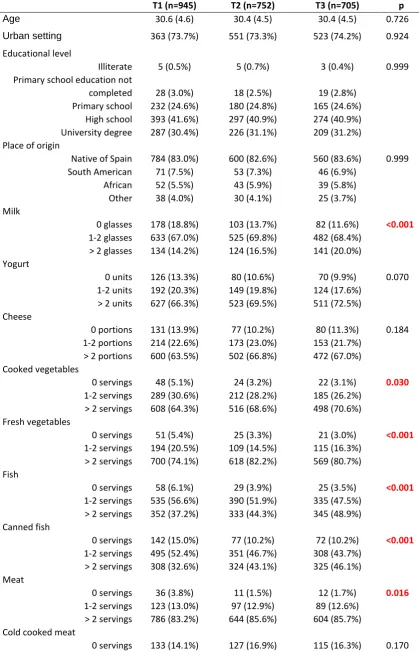
The results of the dietary questionnaire are summarized in Table 1. The
column corresponding to the first trimester shows the dietary habits women had
when they went to the first prenatal visit. At that time, they each received
counseling on nutritional health according to the usual clinical practice. The
columns for the second and third trimesters show the dietary habits acquired
following educational counseling.
In general, consumption of milk, cooked and fresh vegetables, fish, meat,
eggs, and fruit increased along the three trimesters (p<0.05) (Table 1). Yoghourt
intake increased, but only to a marginally significant degree (p=0.070).
Consumption of cheese, cold cooked meats, and dried fruit showed no changes.
Iodized salt use increased considerably in the second trimester and held steady
in the third (35.7%, 85.4%, 88.9%; p<0.001). The same trends were seen for
iodine supplementation (46.8%, 88.8%, 87.6%; p<0.001). Tobacco use
decreased somewhat in the second trimester and was maintained in the third,
with only marginal significance (24.1%, 20.0%, 19.5%; p=0.056). The median UIC
increased from the first to the second trimester and held steady in the third (172 μg/L, 210 μg/L, and 202.5 μg/L, respectively; p<0.001).
Association with UIC ≥150 μg/L
Urinary iodine values were dichotomized into <150 μg/L and ≥150 μg/L. The percentage of women with a desirable UIC level (≥150 μg/L) increased from
the first to the second trimester and held steady in the third (57.3%, 68.9%, 68%;
p<0.001) (Table 1)
Analysis of the relationship between UIC ≥150 μg/L and the women’s
dietary habits (Table 2), showed that the UIC increased as consumption of milk,
8 for iodized salt consumption in all three trimesters and iodine supplementation in
all three trimesters. Tobacco consumption did not related with the iodine status
Multivariate analysis
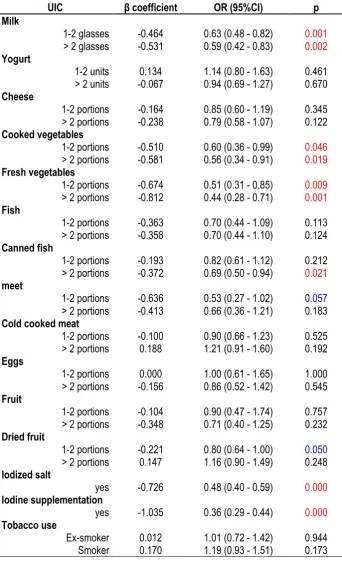
We carried out a multilevel mixed-effects logistic regression analysis of repeated
measures to determine which intake-related factors were associated with UIC <150 μg/L. Variables that were candidates for inclusion in the analysis were
examined (Table 3). The resulting multivariate model (multilevel mixed-effects) is
shown in Table 5A. A protective effect was manifested for iodine supplementation
(OR=0.42, 95% CI [0.34-0.52]; p<0.001), iodized salt intake (OR=0.67, 95%CI
[0.54-0.83]; p<0.001), and milk consumption (1-2 glasses: OR=0.68, 95%CI
[0.52-0.90]; p=0.006; >2 glasses: OR=0.64, 95%CI [0.45-0.90]; p=0.011).
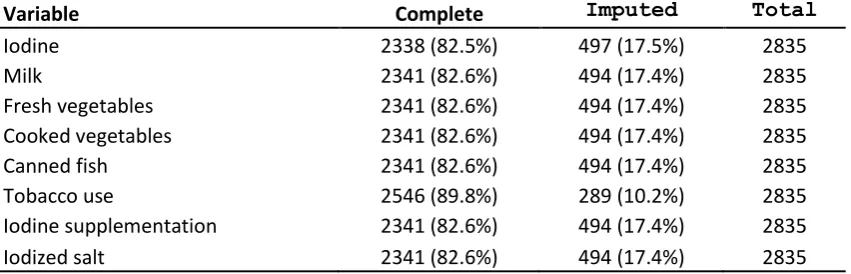
After carrying out multiple imputation of missing values in any of the three
trimesters (Table 4) and repeating the process of variable selection, we obtained
the same model as the previous one (Table 5B: multilevel with imputation), in
which the protective role of each of the factors was maintained. The model with
imputation provided OR values and confidence intervals very similar to those in
the model without imputation.
Table 1. Characteristics and habits of the participants, based on their responses to the dietary questionnaires
Table 2. Percentage of pregnant women with UIC ≥150 µg/dL related to dietary intake, iodized salt intake, iodine supplementation, and smoking
Table 3. Individual effect of each variable included in multilevel mixed-effects logistic regression models adjusted for paired measures in the 3 trimesters to assess the effect of iodine-rich food intake or supplementation on UIC values ≥150 μg/L
10
3. DISCUSSION
The results of this study showed favorable changes in iodine nutrition in a
sample of pregnant women from central Catalonia following individual
educational counseling on dietary habits imparted by the midwife in the first
trimester of pregnancy. The median UIC increased from the first to the second
trimester and held steady thereafter (172, 210, and 202.5 μg/L, respectively).
These changes were related to greater consumption of milk, iodized salt, and
iodine supplements. The data indicate that iodine nutrition is adequate in
pregnant women in our setting, in accordance with the recommendations of the
WHO, the International Council for the Control of Iodine Deficiency Disorders (ICCIDD), and the United Nations International Children’s Emergency Fund
(UNICEF), which recommend a population median of >150 g/L [6].
The daily iodine intake recommended by the WHO during pregnancy and lactation is at least 250 μg/day. However, it is difficult to estimate iodine intake
through analysis of the diet, as the amount of this micronutrient in both food and
water can vary considerably from one area to another. In normal conditions there
is a balance between iodine intake and urinary iodine elimination, which makes
determination of the UIC in casual urine specimens a reliable indicator of the
iodine nutritional status of populations [15]. Evidently, a median UIC increase
also implies a significant gain in the percentage of individuals with UIC values
≥150 g/L. However, because of the considerable variability in urinary iodine
level, this cut-off is not considered acceptable to differentiate between
populations with adequate or poor iodine nutrition. Only the median UIC is
deemed indicative of the iodine nutrition status in a specific population, such as
pregnant women [16]. Nonetheless, some studies have shown that pregnant
women with UIC <150 g/L can have a higher risk of goiter [17]. Prematurity and
low birth weight are more prevalent in their newborns [18,19], their children may
show a lower IQ (median <150 g/g creatinine) [20,21] and greater oxidative
stress [22]. Hence, it is likely that women with urinary iodine below this cut-off
have a higher risk of iodine deficiency and greater morbidity, which can also
11 but a substantial percentage of women (44.7% in the first trimester and 32% in
the third) had levels <150 g/L and, likely, a greater risk of morbidity.
The probability of developing iodine deficiency-related disorders is
undoubtedly higher when the median UIC does not reach 150 g/L. However, a
large part of the studies conducted in Europe over the last few years have
reported median UIC values considerably lower than this limit, and even below
100 g/L [24–32]. Only a few countries such as Iceland [33] and Holland [34]
have reported median values in pregnant women higher than 150 g/L. Thus,
many of the studies conducted provide evidence that most pregnant women in
Europe have insufficient iodine intake even in areas with adequate iodine nutrition
[35]. Our results coexist with findings of excellent iodine nutrition in children in our
setting [36] and adequate nutrition in the general population [37,38], despite the
borderline situation in women of childbearing age.
The UIC changes observed over pregnancy have been a subject of debate,
particularly in iodine-deficient areas. Some studies, such as one conducted in the
United Kingdom [24], have shown a significant increase in the median UIC (from
42 g/L in the first trimester to 69.4 g/L in the third, or a creatinine increase from
103 g/g to 126 g/g). These changes were associated with an increase in
consumption of dairy products as pregnancy progressed. Similar findings have
been reported in studies from Norway (from 66 g/L to 92 g/L) [25] and Ghana
[39], and in other studies carried out in Spain (Basque Country [40], Jaén [41]
and Osuna[42]). In the three Spanish studies, the increase was clearly related to
KI supplementation, received by most of the women included. Of note, in the
study performed in Jaén, women who consumed iodized salt during the year
before they became pregnant maintained a median UIC >150 g/L over the entire
pregnancy. In contrast, other studies, such as those by Stilwell [43], Brander [44],
and Koukkou [45], have reported UIC decreases with progression of pregnancy.
This would be explained mainly by depletion of iodine deposits due to increased
requirements without adequate dietary compensation. In addition, the drop in UIC
could be enhanced by pregnancy-related physiological changes in the glomerular
filtration rate. Other studies, however, have reported no significant changes in the
12 In the present study, the dietary habits that had an impact on the IUC were
consumption of milk and iodized salt, as well as KI supplementation. These
findings concur with the results obtained in the study by Bath [24] in the United
Kingdom, where daily milk intake (>280 mL) and consumption of Brazil nuts had
an impact on the UIC. Among the pregnant women studied, 97% did not receive
iodine supplements and only 6% used iodized salt. Similar findings were reported
in the study by Dhal [25] in Norway, which showed that the dietary habits with the
greatest effect on the UIC were consumption of dairy products and iodine
supplementation (15.1% of pregnant women). There was no information on
iodized salt consumption in that study. The authors found that intake of milk and
dairy products had a greater impact on the IUC than seawater fish and other
marine products. In the study by Henjum [26], the factor with the greatest impact
on the IUC during pregnancy was iodine supplementation, whereas in the study
by Shashi Kant [47] in India, it was iodized salt intake (90.9% of pregnant
women), although the median amount of iodized salt consumed was high, at 8.3
g/day.
Dairy products are an important source of iodine in numerous European
countries, as evidenced in the study by Bath in the United Kingdom [24], Dahl in
Norway [48], and some studies performed in Spain. Two Spanish studies have
reported that milk is an important source of dietary iodine [49,50]. In our country,
a glass of ordinary milk (200-250 mL) provides an average of 50 µg of iodine or
20% of the recommended amount for pregnant women and breastfeeding
mothers. The study by Menéndez [3] also showed an increase in the UIC with
intake of 2 or more daily servings of milk or milk products.
In the present study, vegetable consumption did not remain in the final model
as having a significant impact on the IUC, in accordance with the 2007-2012
study by NHANES showing no correlation between vegetable intake and the UIC
[51]. Fortification of certain vegetables with iodine has been successfully
undertaken to increase iodine intake [52], but this option is not contemplated in
our setting.
Nutritional education and counseling during pregnancy is focused on
improving the quality of the diet. Women are provided information on what foods
13 instructed on the use of micronutrient supplements such as iodine when adequate
amounts are not guaranteed by the diet [7]. We found an increase in consumption
of iodine-rich foods from the first to the second trimester that was maintained in
the third following dietary health counseling performed by the midwife on an
individual basis during the first trimester. These findings concur with those of O’Kane [53], who reported that women who received information on the
importance of iodine during pregnancy increased their intake of this micronutrient.
In contrast, Amiri [54] reported that knowledge of the importance of iodine and
iodized salt intake was enhanced after an educational intervention in pregnant
women, but there was no parallel improvement in their iodine status.
Nonetheless, the authors advocated improving health literacy in pregnant women
as an essential strategy.
4. LIIMITATIONS:
This research was the impossibility to carry out the group of nutrition education
intervention as planned in order to promote iodine consumption during
pregnancy. As it has been mentioned, an individual nutrition education intervention was carried out in the midwife’s prenatal control surgery. However,
the longitudinal design of the study allows us to attribute to it the changes
observed in the iodine intake in the 2nd and 3rd trimester and its effects on the
iodine status.
As for future research, the results of this study could be extended with a further
research which would have the objective of establishing the impact of eating
habits and iodine supplements on UIC amongst breastfeeding mothers during
postpartum
.
5. CONCLUSION
In conclusion, the individual educational counseling on proper diet and
nutrition carried out by the midwife during the routine first trimester prenatal visit
had a positive impact on consumption of iodine-rich foods in pregnant women.
Greater intake of milk and iodized salt, as well as KI supplementation was
associated with an increase in the UIC. As a result, the median UIC in the
14 of pregnancy and was sustained in the third. These data indicate adequate iodine
nutrition in the pregnant population of this area, in accordance with the WHO,
ICCIDD, and UNICEF recommendations.
Thus, a dietary educational intervention should be considered an essential
component of pregnancy management to promote optimal iodine nutrition. The
benefits obtained will contribute to decreasing fetal and maternal morbidity, as
well as morbidity in the breast-fed infant. In addition, the knowledge gained can
15 Acknowledgements
We wish to thank the pregnant women for participating as volunteers, and the
midwives who collaborated in the data collection. We appreciate the support
provided by collaborators from The IODEGEST Study Group.
The IODEGEST Study Group
Montse Abella, Nuria Sampedro, Glòria Miralpeix, Montse Villanueva,
Concepción Manzano, Judit Cos (PASSIR Sabadell); Pilar Soteras, Fermina
Casas, Coloma Graells, Mireia Llucià, Rosalia Ibars (PASSIR Cerdanyola);
Encarna López, Montserrat Manzanares, Irene Lorente, Eva Artieda, Meritxell
Casajoana, Dolors Muñoz, Llucia Burgos, Angelica Hidalgo (PASSIR Mollet);
Anna Fusté, Dolors Lladó, Rosa Subirats, Angelina Masoliver, Imma Trujillo,
Rosa Banús, Dolors Salas, Montse Pujol, Dolors Grau, Roser Sanglas, Anabel
Mayos (PASSIR Osona); Náyade Crespo, Rosa Codina, Rosa Forn, Montserrat
Galí, Antonia Hidalgo, Teresa Macià, Mercè Vendrell, Montserrat Sallent,
Montserrat Ribera, Rosa Oller, Teresa Riba, Esther Romero, Adelaida Expósito,
Encarnació Santaeulàlia, Anna Vilaseca (PASSIR Bages); Dolors Guix, Gemma
Olivera, Merche García, Rosa Sans, Marta Roman, Mª Jose Vila, Maite
Martinez, Esther Serrano, Sonia Díaz, Carolina Alcaine, Susana Sancho,
Remei Fenollosa, Encarna Gascón, Núria Risques, Araceli Santamaria, Remei
Corominas, Xavi Espada, Maria Helena Perez, Concepción de la Fuente,
Assumpta Prats, Maria Rosa Cabedo, Carme Magem, Mercedes Vigil, Carmen
Biern, Montse Bach, Joana Relat. (PASSIR Granollers); Engracia Coll, Carmen
Bayascas, Olga Ezquerro, Patricia Reategui, Anna Campos, Rosa Bach
(PASSIR Mútua de Terrassa); Inés Molina, Eva Martinez, Anna Bartolí, Rosa
Ferrer, Rocio Hernandez. (PASSIR Anoia).
Funding
This project was awarded a grant from the Spanish Ministry of Health, from the
Carlos III Health Institute (PI 07/1265) and has been registered at the Trial
16
Availability of data and materials
The data supporting the conclusions of this study are available upon reasonable request
and under the supervision of IDIAP Jordi Gol.
Authors' contributions
MTT have made substantial contributions to the conception and design, acquisition of
data, analysis and interpretation of data. GP, PT and GF have made substantial
contributions to the conception and design. RC carried out laboratory determinations of
the project. LF, LLV and JMM have made substantial contributions to the conception and
design, and interpretation of data. All authors read and approved the final manuscript.
Authors’ information Not applicable.
Ethics approval and consent to participate
All women were informed and signed their informed consent to participate in the project.
The study was approved by the Clinical Research Ethics Committee at the Primary Care Research Institute (IDIAP) Jordi Gol (Code: P07/02).
Consent for publication Not applicable.
Competing interests
17
6. References
1. Zimmermann, M.B. The Importance of Adequate Iodine during Pregnancy
and Infancy. World Rev. Nutr. Diet.2016, 115, 118–24,
doi:10.1159/000442078.
2. Donnay, S.; Arena, J.; Lucas, A.; Velasco, I.; Ares, S. Suplementación
con yodo durante el embarazo y la lactancia. Toma de posición del Grupo
de Trabajo de Trastornos relacionados con la Deficiencia de Yodo y
Disfunción Tiroidea de la Sociedad Española de Endocrinología y
Nutrición. Endocrinol. y Nutr.2014, 61, 27–34,
doi:10.1016/j.endonu.2013.05.004.
3. Menéndez Torre, E.; Delgado Alvarez, E.; Rabal Artal, A.; Suárez
Gutiérrez, L.; Rodríguez Caballero, M.G.; Ares Blanco, J.; Díaz Naya, L.;
Fernández Fernández, J.C. Iodine nutrition in pregnant women from
Oviedo area. Is iodine supplementation necessary? Endocrinol. y Nutr.
2014, 61, 404–9, doi:10.1016/j.endonu.2014.02.005.
4. Torres, M.T.; Francés, L.; Vila, L.; Manresa, J.M.; Falguera, G.; Prieto, G.;
Casamitjana, R.; Toran, P. Iodine nutritional status of women in their first
trimester of pregnancy in Catalonia. BMC Pregnancy Childbirth2017, 17,
249, doi:10.1186/s12884-017-1423-4.
5. Harding, K.B.; Peña-Rosas, J.P.; Webster, A.C.; Yap, C.M.; Payne, B.A.;
Ota, E.; De-Regil, L.M. Iodine supplementation for women during the
preconception, pregnancy and postpartum period. Cochrane database
Syst. Rev.2017, 3, CD011761, doi:10.1002/14651858.CD011761.pub2.
6. WHO; ICCIDD; UNICEF Assessment of iodine deficiency disorders and
monitoring their elimination. A Guide for programme managers.
http://whqlibdoc.who.int/publications/2007/9789241595827_eng.pdf 2007.
7. Darnton-Hill, I. OMS | Asesoramiento sobre nutrición durante el
embarazo. WHO 2013.
8. Wiersinga, W.M. Smoking and thyroid. Clin. Endocrinol. (Oxf).2013, 79, 145–51, doi:10.1111/cen.12222.
18 on thyroid gland--an update. Endokrynol. Pol.2014, 65, 54–62,
doi:10.5603/EP.2014.0008.
10. Generalitat de Catalunya. Departament de Salut Protocol de seguiment de l’embaràs a Catalunya; 2018;
11. Prieto, G.; Torres, M.T.; Francés, L.; Falguera, G.; Vila, L.; Manresa, J.M.;
Casamitjana, R.; Barrada, J.R.; Acera, A.; Guix, D.; et al. Nutritional
status of iodine in pregnant women in Catalonia (Spain): study on
hygiene-dietetic habits and iodine in urine. BMC Pregnancy Childbirth
2011, 11, 17, doi:10.1186/1471-2393-11-17.
12. BENOTTI, J.; BENOTTI, N. Protein-bound iodine, total iodine, and
butanol-extractable iodine by partial automation. Clin. Chem.1963, 12, 408–16.
13. Pino, S.; Fang, S.L.; Braverman, L.E. Ammonium persulfate: a safe
alternative oxidizing reagent for measuring urinary iodine. Clin Chem.
1996, 42, 239–243.
14. The International Council for control of Iodine Deficience Disorders (ICCIDD); Žiberna, J. Iodine requirements in pregnancy and infancy. IDD
Newsl.2007, 23, 2–3.
15. Espada Sáenz-Torre, M. La medición de yodo en la orina: revisión de las
técnicas. Endocrinol. y Nutr.2008, 55, Supple, 37–42.
16. Laurberg, P.; Andersen, S.; Bjarnadottir, R.I.; Carle, A.; Hreidarsson, A.;
Knudsen, N.; Ovesen, L.; Pedersen, I.; Rasmussen, L. Evaluating iodine
deficiency in pregnant women and young infants-complex physiology with
a risk of misinterpretation. Public Heal. Nutr2007, 10, 1547–1552.
17. Gyamfi, D.; Wiafe, Y.A.; Danquah, K.O.; Adankwah, E.; Amissah, G.A.;
Odame, A. Urinary iodine concentration and thyroid volume of pregnant
women attending antenatal care in two selected hospitals in Ashanti
Region, Ghana: a comparative cross-sectional study. BMC Pregnancy
Childbirth2018, 18, 166, doi:10.1186/s12884-018-1820-3.
18. Charoenratana, C.; Leelapat, P.; Traisrisilp, K.; Tongsong, T. Maternal
iodine insufficiency and adverse pregnancy outcomes. Matern. Child Nutr.
2016, 12, 680–7, doi:10.1111/mcn.12211.
19. León, G.; Murcia, M.; Rebagliato, M.; Álvarez-Pedrerol, M.; Castilla, A.M.;
19 Foradada, C.M.; et al. Maternal thyroid dysfunction during gestation,
preterm delivery, and birthweight. The Infancia y Medio Ambiente Cohort,
Spain. Paediatr. Perinat. Epidemiol.2015, 29, 113–22,
doi:10.1111/ppe.12172.
20. Bath, S.C.; Steer, C.D.; Golding, J.; Emmett, P.; Rayman, M.P. Effect of
inadequate iodine status in UK pregnant women on cognitive outcomes in
their children: results from the Avon Longitudinal Study of Parents and
Children (ALSPAC). Lancet (London, England)2013, 382, 331–7,
doi:10.1016/S0140-6736(13)60436-5.
21. Levie, D.; Korevaar, T.I.M.; Bath, S.C.; Murcia, M.; Dineva, M.; Llop, S.;
Espada, M.; van Herwaarden, A.E.; de Rijke, Y.B.; Ibarluzea, J.M.; et al.
Association of Maternal Iodine Status With Child IQ: A Meta-Analysis of
Individual Participant Data. J. Clin. Endocrinol. Metab.2019, 104, 5957–
5967, doi:10.1210/jc.2018-02559.
22. Vidal, Z.E.O.; Rufino, S.C.; Tlaxcalteco, E.H.; Trejo, C.H.; Campos, R.M.;
Meza, M.N.; Rodríguez, R.C.; Arroyo-Helguera, O. Oxidative stress
increased in pregnant women with iodine deficiency. Biol. Trace Elem.
Res.2014, 157, 211–7, doi:10.1007/s12011-014-9898-6.
23. Yang, J.; Liu, Y.; Liu, H.; Zheng, H.; Li, X.; Zhu, L.; Wang, Z. Associations
of maternal iodine status and thyroid function with adverse pregnancy
outcomes in Henan Province of China. J. Trace Elem. Med. Biol.2018,
47, 104–110, doi:10.1016/j.jtemb.2018.01.013.
24. Bath, S.C.; Furmidge-Owen, V.L.; Redman, C.W.; Rayman, M.P.
Gestational changes in iodine status in a cohort study of pregnant women
from the United Kingdom: season as an effect modifier. Am. J. Clin. Nutr.
2015, 101, 1180–7, doi:10.3945/ajcn.114.105536.
25. Dahl, L.; Wik Markhus, M.; Sanchez, P.; Moe, V.; Smith, L.; Meltzer, H.;
Kjellevold, M. Iodine Deficiency in a Study Population of Norwegian Pregnant Women—Results from the Little in Norway Study (LiN).
Nutrients2018, 10, 513, doi:10.3390/nu10040513.
26. Henjum, S.; Aakre, I.; Lilleengen, A.M.; Garnweidner-Holme, L.; Borthne,
S.; Pajalic, Z.; Blix, E.; Gjengedal, E.L.F.; Brantsæ ter, A.L. Suboptimal
Iodine Status among Pregnant Women in the Oslo Area, Norway.
20 27. Franzellin, F.; Hyska, J.; Bushi, E.; Fanolla, A.; Luisi, L.; Bonetti, L.;
Morosetti, G.; Radetti, G. A national study of iodine status in Albania. J.
Endocrinol. Invest.2009, 32, 533–7, doi:10.1007/BF03346502.
28. Vandevijvere, S.; Amsalkhir, S.; Mourri, A.B.; Van Oyen, H.;
Moreno-Reyes, R. Iodine deficiency among Belgian pregnant women not fully
corrected by iodine-containing multivitamins: a national cross-sectional
survey. Br. J. Nutr.2013, 109, 2276–84,
doi:10.1017/S0007114512004473.
29. Raverot, V.; Bournaud, C.; Sassolas, G.; Orgiazzi, J.; Claustrat, F.;
Gaucherand, P.; Mellier, G.; Claustrat, B.; Borson-Chazot, F.;
Zimmermann, M. Pregnant French women living in the Lyon area are
iodine deficient and have elevated serum thyroglobulin concentrations.
Thyroid2012, 22, 522–8, doi:10.1089/thy.2011.0184.
30. Tuccilli, C.; Baldini, E.; Truppa, E.; D’Auria, B.; De Quattro, D.; Cacciola,
G.; Aceti, T.; Cirillo, G.; Faiola, A.; Indigeno, P.; et al. Iodine deficiency in
pregnancy: Still a health issue for the women of Cassino city, Italy.
Nutrition2018, 50, 60–65, doi:10.1016/j.nut.2017.11.007.
31. Costeira, M.J.; Oliveira, P.; Ares, S.; de Escobar, G.M.; Palha, J.A. Iodine
status of pregnant women and their progeny in the Minho Region of
Portugal. Thyroid2009, 19, 157–63, doi:10.1089/thy.2008.0249.
32. Granfors, M.; Andersson, M.; Stinca, S.; Åkerud, H.; Skalkidou, A.;
Poromaa, I.S.; Wikström, A.-K.; Nyström, H.F. Iodine deficiency in a study
population of pregnant women in Sweden. Acta Obstet. Gynecol. Scand.
2015, 94, 1168–74, doi:10.1111/aogs.12713.
33. Nyström, H.F.; Brantsæ ter, A.L.; Erlund, I.; Gunnarsdottir, I.; Hulthén, L.;
Laurberg, P.; Mattisson, I.; Rasmussen, L.B.; Virtanen, S.; Meltzer, H.M.
Iodine status in the Nordic countries - past and present. Food Nutr. Res.
2016, 60, 31969.
34. Medici, M.; Ghassabian, A.; Visser, W.; de Muinck Keizer-Schrama,
S.M.P.F.; Jaddoe, V.W. V; Visser, W.E.; Hooijkaas, H.; Hofman, A.;
Steegers, E.A.P.; Bongers-Schokking, J.J.; et al. Women with high early
pregnancy urinary iodine levels have an increased risk of hyperthyroid
newborns: the population-based Generation R Study. Clin. Endocrinol.
21 35. ING Iodine Global Network Available online:
http://www.ign.org/western-central-europe.htm (accessed on Jun 5, 2018).
36. Vila, L.; Donnay, S.; Arena, J.; Arrizabalaga, J.J.; Pineda, J.;
Garcia-Fuentes, E.; García-Rey, C.; Marín, J.L.; Serra-Prat, M.; Velasco, I.; et al.
Iodine status and thyroid function among Spanish schoolchildren aged
6-7 years: the Tirokid study. Br. J. Nutr.2016, 115, 1623–31,
doi:10.1017/S0007114516000660.
37. Soriguer, F.; García-Fuentes, E.; Gutierrez-Repiso, C.; Rojo-Martínez, G.;
Velasco, I.; Goday, A.; Bosch-Comas, A.; Bordiú, E.; Calle, A.; Carmena,
R.; et al. Iodine intake in the adult population. [email protected] study. Clin. Nutr.
2012, 31, 882–8, doi:10.1016/j.clnu.2012.04.004.
38. Vila, L.; Castell, C.; Wengrovicz, S.; N, de L.; Casamitjana, R. Estudio de
la yoduria de la poblacion catalana adulta. Med Clin2006, 127, 730–733.
39. Simpong, D.L.; Adu, P.; Bashiru, R.; Morna, M.T.; Yeboah, F.A.; Akakpo,
K.; Ephraim, R.K.D. Assessment of iodine status among pregnant women
in a rural community in ghana - a cross sectional study. Arch. Public
Health2016, 74, 8, doi:10.1186/s13690-016-0119-y.
40. Aguayo, A.; Grau, G.; Vela, A.; Aniel-Quiroga, A.; Espada, M.; Martul, P.;
Castaño, L.; Rica, I. Urinary iodine and thyroid function in a population of
healthy pregnant women in the North of Spain. J. Trace Elem. Med. Biol.
2013, 27, 302–6, doi:10.1016/j.jtemb.2013.07.002.
41. Santiago, P.; Velasco, I.; Muela, J.A.; Sánchez, B.; Martínez, J.;
Rodriguez, A.; Berrio, M.; Gutierrez-Repiso, C.; Carreira, M.; Moreno, A.;
et al. Infant neurocognitive development is independent of the use of
iodised salt or iodine supplements given during pregnancy. Br. J. Nutr.
2013, 1–9.
42. Velasco, I.; Carreira, M.; Santiago, P.; Muela, J.A.; García-Fuentes, E.;
Sánchez-Muñoz, B.; Garriga, M.J.; González-Fernández, M.C.;
Rodríguez, A.; Caballero, F.F.; et al. Effect of iodine prophylaxis during
pregnancy on neurocognitive development of children during the first two
years of life. J. Clin. Endocrinol. Metab.2009, 94, 3234–41,
doi:10.1210/jc.2008-2652.
43. Stilwell, G.; Reynolds, P.J.; Parameswaran, V.; Blizzard, L.; Greenaway,
22 excretion in pregnancy. J. Clin. Endocrinol. Metab.2008, 93, 1737–42,
doi:10.1210/jc.2007-1715.
44. Brander, L.; Als, C.; Buess, H.; Haldimann, F.; Harder, M.; Hänggi, W.;
Herrmann, U.; Lauber, K.; Niederer, U.; Zürcher, T.; et al. Urinary iodine
concentration during pregnancy in an area of unstable dietary iodine
intake in Switzerland. J. Endocrinol. Invest.2003, 26, 389–96,
doi:10.1007/BF03345192.
45. Koukkou, E.G.; Ilias, I.; Mamalis, I.; Markou, K.B. Pregnant Greek Women
May Have a Higher Prevalence of Iodine Deficiency than the General
Greek Population. Eur. Thyroid J.2017, 6, 26–30,
doi:10.1159/000449285.
46. Mioto, V.C.B.; Monteiro, A.C. de C.N.G.; de Camargo, R.Y.A.; Borel, A.R.;
Catarino, R.M.; Kobayashi, S.; Chammas, M.C.; Marui, S. High
prevalence of iodine deficiency in pregnant women living in adequate
iodine area. Endocr. Connect.2018, 7, 762–767,
doi:10.1530/EC-18-0131.
47. Kant, S.; Haldar, P.; Lohiya, A.; Yadav, K.; Pandav, C.S. Status of Iodine
Nutrition among Pregnant Women Attending Antenatal Clinic of a
Secondary Care Hospital: A Cross-sectional Study from Northern India.
Indian J. Community Med.2017, 42, 226–229,
doi:10.4103/ijcm.IJCM_312_16.
48. Dahl, L.; Opsahl, J.A.; Meltzer, H.M.; Julshamn, K. Iodine concentration in
Norwegian milk and dairy products. Br J Nutr2003, 90, 679–685.
49. Arrizabalaga, J.J.; Jalón, M.; Espada, M.; Cañas, M.; Latorre, P.M. [Iodine concentration in ultra-high temperature pasteurized cow’s milk.
Applications in clinical practice and in community nutrition]. Med. Clin.
(Barc).2015, 145, 55–61, doi:10.1016/j.medcli.2014.04.027.
50. Soriguer, F.; Gutierrez-Repiso, C.; Gonzalez-Romero, S.; Olveira, G.;
Garriga, M.J.; Velasco, I.; Santiago, P.; de Escobar, G.M.;
Garcia-Fuentes, E. Iodine concentration in cow’s milk and its relation with urinary
iodine concentrations in the population. Clin Nutr2011, 30, 44–48.
51. Lee, K.W.; Shin, D.; Cho, M.S.; Song, W.O. Food Group Intakes as
Determinants of Iodine Status among US Adult Population. Nutrients
23 52. Tonacchera, M.; Dimida, A.; De Servi, M.; Frigeri, M.; Ferrarini, E.; De
Marco, G.; Grasso, L.; Agretti, P.; Piaggi, P.; Aghini-Lombardi, F.; et al.
Iodine fortification of vegetables improves human iodine nutrition: in vivo
evidence for a new model of iodine prophylaxis. J. Clin. Endocrinol.
Metab.2013, 98, E694-7, doi:10.1210/jc.2012-3509.
53. O’Kane, S.M.; Pourshahidi, L.K.; Farren, K.M.; Mulhern, M.S.; Strain, J.J.;
Yeates, A.J. Iodine knowledge is positively associated with dietary iodine
intake among women of childbearing age in the UK and Ireland. Br. J.
Nutr.2016, 1–8, doi:10.1017/S0007114516003925.
54. Amiri, P.; Hamzavi Zarghani, N.; Nazeri, P.; Ghofranipour, F.; Karimi, M.;
Amouzegar, A.; Mirmiran, P.; Azizi, F. Can an Educational Intervention
Improve Iodine Nutrition Status in Pregnant Women? A Randomized
24 Table 1. Characteristics and habits of the participants based on their responses to the dietary questionnaires
T1 (n=945) T2 (n=752) T3 (n=705) p
Age 30.6 (4.6) 30.4 (4.5) 30.4 (4.5) 0.726
Urban setting 363 (73.7%) 551 (73.3%) 523 (74.2%) 0.924
Educational level
Illiterate 5 (0.5%) 5 (0.7%) 3 (0.4%) 0.999
Primary school education not
completed 28 (3.0%) 18 (2.5%) 19 (2.8%)
Primary school 232 (24.6%) 180 (24.8%) 165 (24.6%) High school 393 (41.6%) 297 (40.9%) 274 (40.9%) University degree 287 (30.4%) 226 (31.1%) 209 (31.2%) Place of origin
Native of Spain 784 (83.0%) 600 (82.6%) 560 (83.6%) 0.999
South American 71 (7.5%) 53 (7.3%) 46 (6.9%)
African 52 (5.5%) 43 (5.9%) 39 (5.8%)
Other 38 (4.0%) 30 (4.1%) 25 (3.7%)
Milk
0 glasses 178 (18.8%) 103 (13.7%) 82 (11.6%) <0.001 1-2 glasses 633 (67.0%) 525 (69.8%) 482 (68.4%)
> 2 glasses 134 (14.2%) 124 (16.5%) 141 (20.0%) Yogurt
0 units 126 (13.3%) 80 (10.6%) 70 (9.9%) 0.070
1-2 units 192 (20.3%) 149 (19.8%) 124 (17.6%) > 2 units 627 (66.3%) 523 (69.5%) 511 (72.5%) Cheese
0 portions 131 (13.9%) 77 (10.2%) 80 (11.3%) 0.184
1-2 portions 214 (22.6%) 173 (23.0%) 153 (21.7%) > 2 portions 600 (63.5%) 502 (66.8%) 472 (67.0%) Cooked vegetables
0 servings 48 (5.1%) 24 (3.2%) 22 (3.1%) 0.030
1-2 servings 289 (30.6%) 212 (28.2%) 185 (26.2%) > 2 servings 608 (64.3%) 516 (68.6%) 498 (70.6%) Fresh vegetables
0 servings 51 (5.4%) 25 (3.3%) 21 (3.0%) <0.001
1-2 servings 194 (20.5%) 109 (14.5%) 115 (16.3%) > 2 servings 700 (74.1%) 618 (82.2%) 569 (80.7%) Fish
0 servings 58 (6.1%) 29 (3.9%) 25 (3.5%) <0.001
1-2 servings 535 (56.6%) 390 (51.9%) 335 (47.5%) > 2 servings 352 (37.2%) 333 (44.3%) 345 (48.9%) Canned fish
0 servings 142 (15.0%) 77 (10.2%) 72 (10.2%) <0.001 1-2 servings 495 (52.4%) 351 (46.7%) 308 (43.7%)
> 2 servings 308 (32.6%) 324 (43.1%) 325 (46.1%) Meat
0 servings 36 (3.8%) 11 (1.5%) 12 (1.7%) 0.016
1-2 servings 123 (13.0%) 97 (12.9%) 89 (12.6%) > 2 servings 786 (83.2%) 644 (85.6%) 604 (85.7%) Cold cooked meat
25 1-2 servings 261 (27.6%) 212 (28.2%) 218 (30.9%)
> 2 servings 551 (58.3%) 413 (54.9%) 372 (52.8%) Eggs
0 servings 52 (5.5%) 18 (2.4%) 22 (3.1%) <0.001
1-2 servings 526 (55.7%) 399 (53.1%) 356 (50.5%) > 2 servings 367 (38.8%) 335 (44.5%) 327 (46.4%) Fruit
0 servings 38 (4.0%) 17 (2.3%) 11 (1.6%) <0.001
1-2 servings 89 (9.4%) 46 (6.1%) 35 (5.0%)
> 2 servings 818 (86.6%) 689 (91.6%) 659 (93.5%) Dried fruit
0 servings 366 (38.7%) 286 (38.0%) 284 (40.3%) 0.918 1-2 servings 351 (37.1%) 285 (37.9%) 260 (36.9%)
> 2 servings 228 (24.1%) 181 (24.1%) 161 (22.8%)
Iodized salt 337 (35.7%) 634 (85.4%) 614 (88.9%)
Iodine supplementation 446 (46.8%) 656 (88.8%) 605 (87.6%)
Tobacco consumption
Non smoker 633 (65.7%) 555 (67.1%) 557 (67.5%) Ex-smoker 98 (10.2%) 105 (12.8%) 106 (12.8%) Smoker 232 (24.1%) 164 (20.0%) 161 (19.5%)
UIC, µg/L (*) 172 (104-289) 210 (130–319) 202.5 (131–331) <0.001 UIC ≥150 µg/L 556 (57.3%) 514 (68.5%) 479 (68.0%) <0.001 (*) Median and first-third quartiles (Q1-Q3)
26 Table 2. Percentage of pregnant women with UIC ≥150 µg/dL related to dietary intake, iodized salt intake, iodine supplementation, and smoking
T1 n=945
p T2
n=752
p T3
n=705 p
Milk 0.016 0.129 0.543
0 glasses 85 (47.8%) 63 (61.2%) 51 (63.0%)
1-2 glasses 372 (58.8%) 363 (69.4%) 332 (68.9%)
> 2 glasses 81 (60.4%) 88 (71.0%) 96 (68.1%)
Yogurt 0.372 0.468 0.416
0 units 72 (57.1%) 57 (71.3%) 46 (65.7%)
1-2 units 99 (51.6%) 104 (69.8%) 81 (65.3%)
> 2 units 367 (58.5%) 353 (67.8%) 352 (69.0%)
Cheese 0.104 0.689 0.903
0 portions 69 (52.7%) 51 (66.2%) 53 (66.3%)
1-2 portions 115 (53.7%) 118 (68.6%) 108 (70.6%) > 2 portions 354 (59.0%) 345 (68.9%) 318 (67.5%)
Cooked vegetables 0.561 0.715 0.046
0 servings 26 (54.2%) 12 (50.0%) 11 (50.0%)
1-2 servings 162 (56.1%) 151 (71.6%) 120 (65.2%) > 2 servings 350 (57.6%) 351 (68.2%) 348 (69.9%)
Fresh vegetables 0.024 0.630 0.140
0 servings 21 (41.2%) 15 (60.0%) 9 (42.9%)
1-2 servings 107 (55.2%) 76 (69.7%) 80 (69.6%) > 2 servings 410 (58.6%) 423 (68.7%) 390 (68.7%)
Fish 0.277 0.927 0.413
0 servings 31 (53.4%) 15 (53.6%) 16 (64.0%)
1-2 servings 299 (55.9%) 275 (70.5%) 235 (70.4%) > 2 servings 208 (59.1%) 224 (67.5%) 228 (66.1%)
Canned fish 0.184 0.515 0.578
0 servings 72 (50.7%) 50 (64.9%) 50 (69.4%)
1-2 servings 286 (57.8%) 240 (68.6%) 203 (65.9%) > 2 servings 180 (58.4%) 224 (69.3%) 226 (69.8%)
Meat 0.590 0.147 0.678
0 servings 18 (50.0%) 6 (54.5%) 8 (66.7%)
1-2 servings 71 (57.7%) 77 (79.4%) 63 (70.8%)
> 2 servings 449 (57.1%) 431 (67.1%) 408 (67.7%)
Cold cooked meat 0.529 0.013 0.623
0 servings 74 (55.6%) 97 (76.4%) 76 (66.7%)
1-2 servings 159 (60.9%) 148 (70.5%) 156 (71.6%) > 2 servings 305 (55.4%) 269 (65.1%) 247 (66.4%)
Eggs 0.383 0.799 0.718
0 servings 32 (61.5%) 11 (61.1%) 14 (63.6%)
1-2 servings 287 (54.6%) 273 (68.8%) 241 (67.9%) > 2 servings 219 (59.7%) 230 (68.7%) 224 (68.5%)
Fruit 0.027 0.862 0.195
0 servings 17 (44.7%) 12 (70.6%) 9 (81.8%)
1-2 servings 44 (49.4%) 30 (65.2%) 26 (74.3%)
> 2 servings 477 (58.3%) 472 (68.7%) 444 (67.5%)
Dried fruit 0.639 0.078 0.653
27 1-2 servings 213 (60.7%) 206 (72.3%) 189 (73.0%)
> 2 servings 126 (55.3%) 110 (60.8%) 101 (62.7%)
Iodized salt 0.001 0.030 0.004
No 321 (52.8%) 65 (59.6%) 42 (53.8%) Si 217 (64.4%) 449 (70.0%) 437 (69.8%)
Iodine supplementation <0.001 0.002 <0.001
No 234 (46.5%) 45 (53.6%) 44 (50.6%) Si 304 (68.8%) 469 (70.4%) 435 (70.5%)
Tobacco use 0.178 0.247 0.908
28 Table 3. Individual effect of each variable included in multilevel mixed-effects logistic
regression models adjusted for paired measures in the 3 trimesters to assess the effect of iodine-rich food intake or supplementation on UIC values ≥150 μg/L
UIC β coefficient OR (95%CI) p Milk
1-2 glasses -0.464 0.63 (0.48 - 0.82) 0.001
> 2 glasses -0.531 0.59 (0.42 - 0.83) 0.002 Yogurt
1-2 units 0.134 1.14 (0.80 - 1.63) 0.461 > 2 units -0.067 0.94 (0.69 - 1.27) 0.670
Cheese
1-2 portions -0.164 0.85 (0.60 - 1.19) 0.345 > 2 portions -0.238 0.79 (0.58 - 1.07) 0.122
Cooked vegetables
1-2 portions -0.510 0.60 (0.36 - 0.99) 0.046
> 2 portions -0.581 0.56 (0.34 - 0.91) 0.019 Fresh vegetables
1-2 portions -0.674 0.51 (0.31 - 0.85) 0.009
> 2 portions -0.812 0.44 (0.28 - 0.71) 0.001 Fish
1-2 portions -0.363 0.70 (0.44 - 1.09) 0.113 > 2 portions -0.358 0.70 (0.44 - 1.10) 0.124
Canned fish
1-2 portions -0.193 0.82 (0.61 - 1.12) 0.212 > 2 portions -0.372 0.69 (0.50 - 0.94) 0.021 meet
1-2 portions -0.636 0.53 (0.27 - 1.02) 0.057
> 2 portions -0.413 0.66 (0.36 - 1.21) 0.183
Cold cooked meat
1-2 portions -0.100 0.90 (0.66 - 1.23) 0.525 > 2 portions 0.188 1.21 (0.91 - 1.60) 0.192
Eggs
1-2 portions 0.000 1.00 (0.61 - 1.65) 1.000 > 2 portions -0.156 0.86 (0.52 - 1.42) 0.545
Fruit
1-2 portions -0.104 0.90 (0.47 - 1.74) 0.757 > 2 portions -0.348 0.71 (0.40 - 1.25) 0.232
Dried fruit
1-2 portions -0.221 0.80 (0.64 - 1.00) 0.050
> 2 portions 0.147 1.16 (0.90 - 1.49) 0.248
Iodized salt
yes -0.726 0.48 (0.40 - 0.59) 0.000 Iodine supplementation
yes -1.035 0.36 (0.29 - 0.44) 0.000 Tobacco use
29 Table 4. Summary of the missing data imputation
Variable Complete Imputed Total
Iodine 2338 (82.5%) 497 (17.5%) 2835
Milk 2341 (82.6%) 494 (17.4%) 2835
Fresh vegetables 2341 (82.6%) 494 (17.4%) 2835
Cooked vegetables 2341 (82.6%) 494 (17.4%) 2835
Canned fish 2341 (82.6%) 494 (17.4%) 2835
Tobacco use 2546 (89.8%) 289 (10.2%) 2835
Iodine supplementation 2341 (82.6%) 494 (17.4%) 2835
30 Table 5. Results of multilevel mixed-effects logistic regression models adjusted for paired measures in the 3 trimesters to assess the effect of iodine-rich food intake or supplementation
on UIC values ≥150 μg/L
A. Multilevel mixed-effects
Variables Coefficient OR(95%CI) p 1/OR (95%CI)
Iodine supplementation -0.872 0.42 (0.34-0.52) 0.000 2.39 (1.92-2.98)
Iodized salt -0.403 0.67 (0.54-0.83) 0.000 1.50 (1.21-1.85)
Milk
1-2 glasses -0.383 0.68 (0.52-0.90) 0.006 1.47 (1.12-1.93) >2 glasses -0.453 0.64 (0.45-0.90) 0.011 1.57 (1.11-2.23)
Constant 0.575
B. Multilevel with imputation
Variables Coefficient OR(95%CI) p 1/OR (95%CI)
Iodine supplementation -0.845 0.43 (0.35-0.53) 0.000 2.33 (1.89-2.87)
Iodized salt -0.383 0.68 (0.55-0.84) 0.000 1.47 (1.19-1.81)
Milk
1-2 glasses -0.382 0.68 (0.53-0.88) 0.003 1.46 (1.13-1.89) >2 glasses -0.456 0.63 (0.45-0.89) 0.008 1.58 (1.13-2.21)