Development of fuzzy logic algorithm for
water purification plant
SUDESH SINGH RANA
Department of ECE, Sir PadampatSinghania University Udaipur, Rajasthan, India
DR. ANAND A. BHASKAR
Department of ECE, Sir PadampatSinghania University Udaipur, Rajasthan, India
Abstract:
This paper propose the design of FLC algorithm for industrial application such application is water purification plant. In the water purification plant raw water or ground water is promptly purified by injecting chemical at rates related to water quality. The feed of chemical rates judged and determined by the skilled operator. Yagishita et al.[1] structured a system based on fuzzy logic so that the feed rate of the coagulant can be judged automatically without any skilled operator. We performed and simulate that structure on MATLAB.
Keywords: Fuzzy logic controller, MATLAB.
1. INTRODUCTION
Fuzzy logic
A scheme of systemic analysis that uses linguistic variables, such a s hot, cold, very, little, large, small etc. as opposed to Boolean or binary logics which is restricted to true or false states.
Fuzzy sets
Fuzzy logic starts with the concept of a fuzzy set. A fuzzy set is a set without a crisp, clearly defined boundary. It can contain elements with only a partial degree of membership.
Membership function:
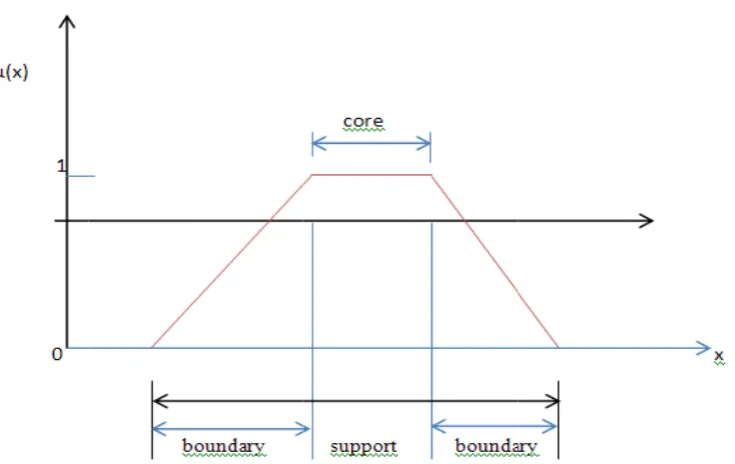
The membership function is a graphical representation of the magnitude of participation of each input. Fuzzy set described by its membership function, it is useful to develop a lexicon of term to describe various special features of this function. The function shown in the figures will all be continuous, but the terms apply equally for both discrete and continuous fuzzy set.
The core of a membership function for any fuzzy set is characterized by complete and full membership in usual set. That is, the core comprises those element x of such set that µ(x)=1.
The Support of a membership function for any fuzzy set is characterized by nonzero membership in the set. That is, the support comprises those element x such that µ(x) >0.
Shape: Triangula functions Height: Usually n Width:
Of base o
Fuzzy inf There are sugeno-k Mamdani Mam was amo attempt t obtained algorithm
Afte possible, than a di thought o simplifie dimensio
Water pu
In the wa feed rate chloride) temperatu is used fo proportio process to Yagishita automatic
The follo
ar is common s are possible
normalized to
of function.
ference metho
e two type of f kang method o
i’s fuzzy infere
mdani’s fuzzy ng the first co tocontrol a st from experie m for complex er the aggrega and in many stributed fuzz of as a prefuz s the computa onal function r
urification plan
ater purificatio e of chemical ) is used as a
ure water. An for sterilization onal to the flo
o model; no u a et al. [1] stru
cally even by
owing tables ar
F
n, but bell, but require gr
1.
d:
fuzzy inferenc of fuzzy infere
ence method:
y inference me ontrol system
team engine enced human x system a dec ation process, cases much m zy set. This is
zzified fuzzy ation required rather than int
nt
on plant raw w s is judged b
coagulant. A n alkaline agen
n. All chemic ow of raw wa universally acc uctured a syst
an unskilled o 2. BAS re used for im
Figure 1. Core, su
trapezoidal, h reater computi
ce method pre ence process.
ethod is the m built using fu and boiler c operator. Ma cision process[ there is fuzzy more efficient,
sometimes kn set .itenhance d by the more tegrating acros
water is purifi by a skilled o Aluminum sulf nt, such as lim cal agents, ex
ater. The reac cepted method em based on f operator. Ten SIC CONFIG mplication of F
upport and bounda
haversine and ing overhead t
esent, mamdan
most common uzzy set theory
ombination b amdani’s effo [1].
y set for, each , to use a sing nown as a sin es efficiency e general mam
ss the two dim
ied by injectin operator. Alum
fate is less ex me or caustic s cept the coag ction of the c d of a feed rat fuzzy logic so
control rules GURATION O
FLC for water
aries of a fuzzy s
d, exponentia to implement[
ni’s fuzzy infe
nly seen fuzzy y[1]. It was p by synthesizin ort was based
h output varia gle spike as the ngleton output of the defuzz mdanismethod mensional func
ng chemicals a minum sulfate xpensive than soda, is used f gulant agent ar coagulant with
e exists[2]. o that the feed
were used. OF IMPLICA
purification p
et
al have been [4].
erence method
y methodolog proposed by m ng a set of l
on zadeh’s (
able that need e output mem
membership zification proc d, which finds
ction to find th
at rates related e or PAC (po PAC but is n for pH adjustm re usually fed h water impu
d rate of the co
ATION plant.
used. More
d any sugeno o
gy. Mamdani’ mamdani’s (19 inguistic con (1973) paper ds defuzzifica mbership functi function, and cess because s the centroid he centroid.
d to water qua olymerized A not as effectiv ment. A chlor d at a fixed ra urities is a com
oagulant can b
complex
or
takagi-s method 975) as an trol rules
on fuzzy
ation. It is ion rather d it can be it greatly of a two
ality. The Aluminum ve in low rine agent ate that is mplicated
V N N N Z P P P The fuzzy In Ou
Input or t the table Variables NB NM NS ZE PS PM PB
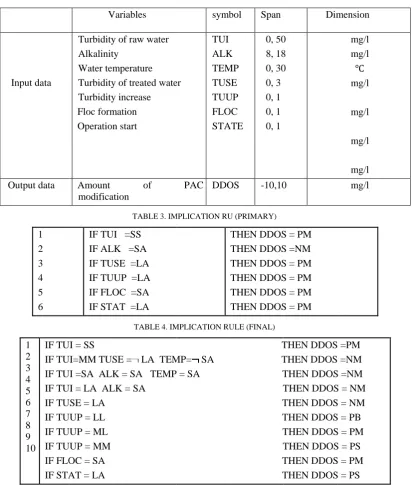
y variables us
nput data utput data 1 2 3 4 5 6 1 2 3 4 5 6 7 8 9 10 IF TU IF TU IF TU IF TU IF TU IF TU IF TU IF TU IF FLO IF STA
the output var 3. Final impli
Support -1,1 -1,1 -1,1 -1,1 -1,1 -1,1 -1,1
ed in this exp
Var Turbidity o Alkalinity Water temp Turbidity o Turbidity in Floc format Operation s Amount modificatio IF TUI IF ALK IF TUSE IF TUUP IF FLOC IF STAT
UI = SS UI=MM TUSE UI =SA ALK = UI = LA ALK USE = LA UUP = LL UUP = ML UUP = MM OC = SA AT = LA
riables with sp ication rule or
TABLE set 1 1 1 1 1 1 1
ression is one
TAB
riables
of raw water
perature of treated wate
ncrease tion start
of on
TABLE 3. IM
=SS =SA E =LA
P =LA C =SA T =LA
TABLE 4. IM
E = LA TEM
= SA TEMP = SA
pan and dime r ten rule for F
1. FUZZY VAR
µ -1.0 -0.5 -0.2 0.0 0.2 0.5 1.0
e with the inter
BLE 2. VARIAB
symb er TUI ALK TEM TUS TUU FLO STA PAC DDO MPLICATION RU MPLICATION RU MP= SA = SA ension shown FLC shown in
RIABLES Σ 0.4 0.2 0.2 0.2 0.2 0.2 0.4
rval [-1, 1] on
BLES
bol Span
K MP SE UP OC ATE 0, 50 8, 18 0, 30 0, 3 0, 1 0, 1 0, 1
OS -10,10
U (PRIMARY) THEN DDOS THEN DDOS THEN DDOS THEN DDOS THEN DDOS THEN DDOS ULE (FINAL) T T T T T T T T T T
in the table 2 the table 4.
Mea Negative big Negative med Negative sma Zero Positive smal Positive med Positive big
n table 1 [1].
Dim
0 8 0
0
S = PM S =NM S = PM S = PM S = PM S = PM
THEN DDOS THEN DDOS THEN DDOS THEN DDOS THEN DDOS THEN DDOS THEN DDOS THEN DDOS THEN DDOS THEN DDOS
2. Primary imp aning g dium all ll dium mension mg/l mg/l Ԩ mg/l mg/l mg/l mg/l mg/l S =PM =NM S =NM S = NM S = NM S = PB S = PM S = PS S = PM S = PS
(3). EXPERIMENTS AND RESULTS
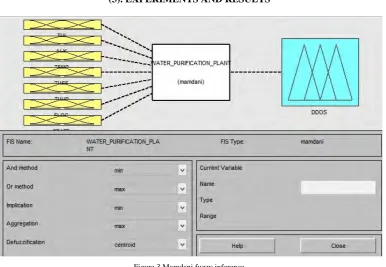
Figure 3.Mamdani fuzzy inference
Figure 3 shows the mamdani fuzzy inference, in which TUI,TEMP,TUSE,TUUP,ALK,FLOC,STAT are inputs and DDOS is output.
Figure 4.membership function of inputs and output variables
Figure 4 shows different types of input’s membership functions with different shapes. Here we design membership function for all inputs or output.
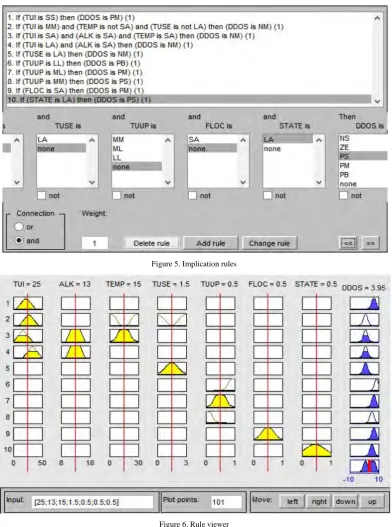
Figure 5. Implication rules
Figure 6. Rule viewer
(4). SURFACE VIEW AND SIMULATION
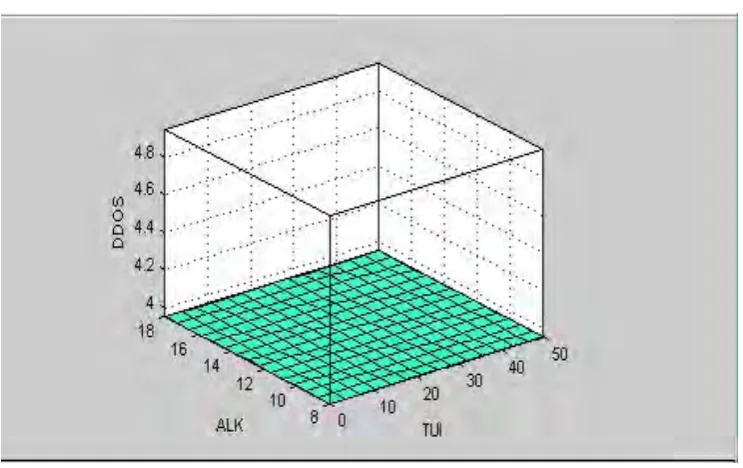
Figure 7.Surface view between ALK and TUI with output
Figure 8. Surface view between TUSE and TUI with output
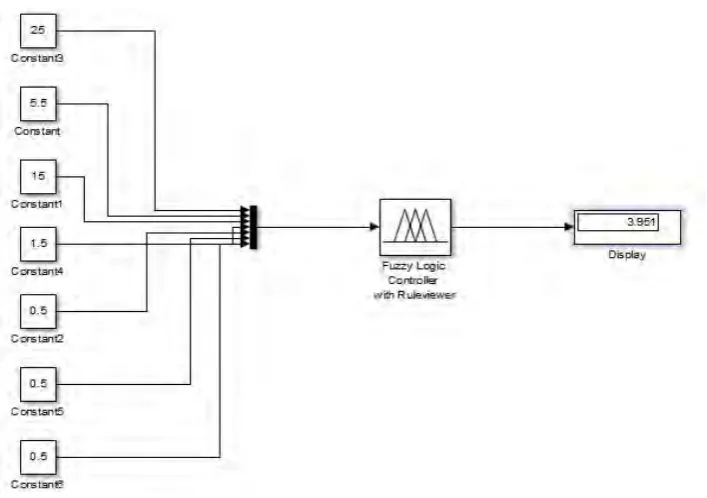
Figure 9. Simulink diagram of fuzzy logic controller of water purification plant
We can also find out the output of rule viewer by using Simulink of FLC. (5). CONCLUSION
In the above experiment and simulation we saw that by using 10 rule[O. yaghishita and M. sugeno] of implication, we can judged or control the amount of feed rate of chemical without any skilled operator.
For better efficiency the above observation can also be performed on PID like fuzzy controller. (6). ACKNOWLEDGMENT
This research paper is supported by Department of ECE at Sir PadampatSinghania University, Udaipur. References
[1] Singh G, Kumai P, Goyal D, “A Review: Fuzzy Logic and Its Application”, in proc. National ConferenceSyngc. Trnd.Eng.Tech.2014.
[2] O. Yagishita, O. Itoh and M. Sugeno, “Application of Fuzzy Reasoning to the Water Purification Process,” in Industrial Application of
Fuzzy Control, ed. M. SugenoNorth Holland,1985.
[3] Ahmad M.Ibrahim, “Introduction to Applied Fuzzy Electronics”, Pearson Education Inc.