2330
Optimization Of Load And Energy Over Cloud
Computing System Based On Nature Inspired
Algorithms
Shanky Goyal, Dr. Shashi BhushanAbstract: Workflow is the major feature of cloud computing nowadays. Cloud computing is one of the firmest raising expertise in the world. Numerous operations in the cloud are established on workflow implementation. Scheduling in common is NP-hard problem. To resolve this type of problems comprehensive approaches cannot be used. Only non-exhaustive methods can be used in order to get suitable results. Cloud computing is a paradigm that is surrounded by multiple resources, which helps in resource utilization. Infrastructure as a Service (IaaS), Platform as a Service (PaaS) and Software as a Service (Saas) are named as services of cloud computing. In the IaaS models, users can rent infrastructure of the data center as a service. Some of the examples of IAAS are Google Compute Engine (GCE) and Amazon Web Service (AWS). In the PaaS models, users can take services like operating system and database. Some of the examples of PAAS are Microsoft Azure and Google App Engine. In the SaaS models, users can access and install application software and databases via Internet. Examples of SAAS are Citrix GoToMeeting and Google Docs. In this paper author has used a metaheuristic methods called bat algorithm and Cat swarm algorithm. Bat algorithm is exactly intended for enhancing hard problems. The objective of optimization for energy consumption on cloud has also been discussed in the paper. Along with the optimization techniques, the detailed literature reviews have been presented. The performance of the proposed work will be analyzed by using the various performance parameters such as response time, energy efficiency and execution time. In this paper algorithms named as CSO and BAT are discussed. To achieve the results, CloudSim simulators and standard programming languages have been used. Different graphs of both the methods have been implemented for the simplification. Results are mentioned via using parameters such as response time, execution time, energy consumption etc.
Index Terms: cloud computing, job scheduling, SAAS, PAAS, IAAS, CSO, BAT
————————————————————
1 Introduction to the cloud computing
Cloud computing is a developing arena of computing where various assets such as hardware and software are presented as a service to a consumer but not as a manufactured article. The finest portion about these resources is that the consumers do not have to be alert of the physical locations of the services and the formations of these assets that are offering the essential resource [1] This technique is famous and efficient because it delivers multilevel concept and a set of virtualization coatings by which it becomes a more effectual network-based source computing. Approximately, it has been observed that there are 3 types of facilities of cloud computing (1) platform as a service (PaaS) (2) software as a service (SaaS), and (3) infrastructure as a service (IaaS) [2]. The most used definition of cloud is given by NIST which states that ―Cloud computing is the procedure that permits suitable resources, agreeing as per the requirements of the user on condition to access the network to various computing resources which can be networks, servers, storage, applications and services that can be apportioned and free speedily with least controlling work.‖ In cloud computing, there are four deployment models, five characteristics and three services models that are separated into 4 classes are- (1) public cloud (2) private cloud (3) community cloud (4) hybrid cloud.
Fig.1-Vision of cloud computing
In figure 1, all the facilities that a user can get from cloud are mentioned. It is basically a vision of cloud computing. It is also well- defined as a service subcontracting arrangement where a client can subcontract his facility from a third event. Cloud computing in recent time is getting over every ones nervous and it is not possible to ignore its advantages. The Advantages of cloud may include e-mail, companies to outsource data, folders and many other requests through virtual platforms through the medium of servers which are associated among them and which can be retrieved anywhere and at any time. The only thing for accessing the cloud services is to have internet connection. Cloud computing has bring a lot for IT department apart from global and internal organization of the company. Cloud computing has given a lot for back up of data, new tools and perspectives are uplifted by cloud computing for evolution in companies. The origin of cloud computing have started far before when flowcharts and presentations were used for presenting servers infrastructure of the Internet. For storage purpose cloud has done a lot work and almost every company these days is using this advantage of cloud. The main purposes of this paper are – CSO workflow scheduling that provides a best scheduling system is discussed in detail. The other optimizing technique named as ______________________________
Shanky Goyal, aResearch Scholar, computer Science Department, IKGPTU, Jalandhar bAssistant Professor, IT Department, CEC, Landran
BAT algorithm for workflow scheduling is discussed. Cloudsim simulator is used and results and outputs are shown with the help of graphs and tables.
1.1. Cloud computing models
As Fig. 2 designates, cloud facility providers offer facilities that could be classified into the following 3 groups:
Fig. 2- Services of cloud computing
Figure 2 shows the services of cloud computing and the first one is Infrastructure as a Service which lets clients to use computing assets such as loading and processing power. Another service is Platform as a Service which is a growth platform providing the Software services that gives cloud customers to implement cloud services and applications and the last one is Software as a Service that brings superior software that is tenuously obtainable by customers.
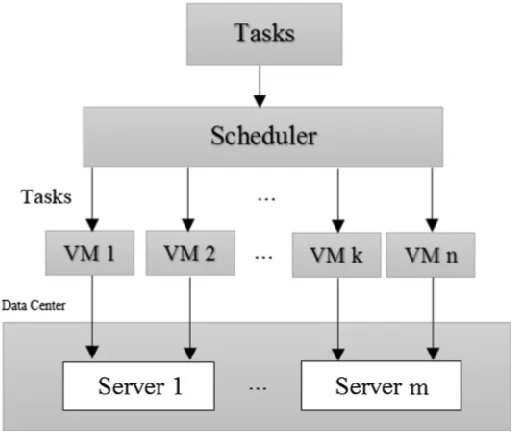
Fig.3- Mapping in Job Scheduling
1.2. Job scheduling
Job scheduling comes under the load balancing where its main work is to remove the burden from the VMs who have been assigned lot of work as compared with others and assign those overloaded work to under loaded VMs. The overall performance of system can be achieved using load balancing. The algorithms used for load balancing are classified in two
different types’ i.e static load balancing algorithms and dynamic load balancing algorithms. Job scheduling scheme is the core and stimulating issue in a cloud computing scheme. Old-style job scheduling structures only reflect how to encounter the QoS desires for the resources employers. They rarely reflect how to implement the extreme profits for the resource suppliers. Here, a job scheduling scheme shows a very significant part in how to encounter cloud computing consumer’s job QoS necessities and use the cloud facilities effectively in an financial way. Job scheduling problem which tells to the efficiency of the cloud computing services is one of the well-known combinatorial optimization problems. In figure 3, job scheduling stabs to map jobs to the suitable virtual machines for attaining purposes such as lowest makespan, job execution time, job transferring time, prices, etc.
2.
Related work
2332
3.
Simulator used
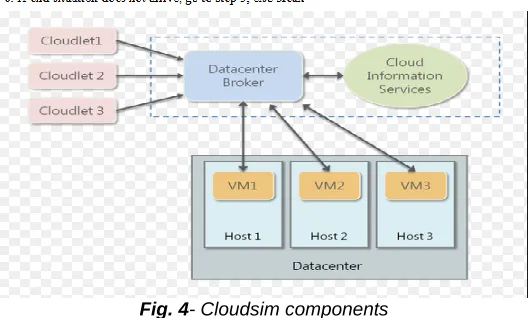
CloudSim simulator used for cloud was given by Buyya which take help of all the infrastructure and applications which are presented in a cloud. This approach makes the work easier and more feasible. Cloudsim approach help in checking the feasibility of various events. Cloudsim is simulated by various applications of cloud computing, cloud infrastructures, service brokers, cloud allocation policies and many more. To begin with the simulation process, Cloudsim under goes few important steps.
Fig. 4- Cloudsim components
Following are the steps which are followed during the execution of cloudsim:
Brokers who are proportional to the users are to be selected.
Variables are to be initialized.
Cloudsim information service is to be made.
Cloudlets are to be created. Various parameters for cloudlets are number of jobs, output size, number of PE's used for executing the job, length and size of the file.
Data center to be created. Data center may include storage size; RAM size, MIPS, Bandwidth and number of PEs etc.
Broker instances to be created, as they help in communication process.
Virtual Machines to be created, which include storage size, MIPS, Bandwidth, number of PEs.
Once VM and cloudlets are created, they are submitted to the broker.
Start Simulation. Stop Simulation
3.1. Introduction to CSO
The mutual performance of cats in actual world has motivated the growth of a new swarm-based optimization method called
as cat swarm optimization. It was introduced in 2007 by Chu and Tsai. The action of cats normally comprises spending their most of the time in resting but attentive, with relaxed and intended approach called as seeking mode. There is another mode called as tracing mode when hunting targets as they travel with great velocity. This technique is inspired by the behavior of cats to get difficult answer for optimal explanations. CSO algorithm is discussed in detail and is given below:
3.2. Introduction to BAT
In this paper author has developed another approach based on a heuristic method called Bat algorithm. Bat algorithm is intended by Xin-She Yang. This procedure is a metaheuristic algorithm which is intended for optimization dedications. This is one of the lately industrialized skills which were chiefly meant at resolving engineering glitches. Metaheuristic techniques are famous for optimization. There are numerous other metaheuristic procedures that are intended for optimization. The greatest basic problematic of optimization is expansion or minimalize of a function. Numerous metaheuristic procedures focus on this feature of optimization. Typically a decent algorithm is branded by the competence of exploiting or reducing more precisely. The algorithm for BAT is given below.
4.
Simulation outputs
Some screenshots of the output of the algorithms are shown below. Cloudsim and cloud analyst have been cast-off for the results. To estimate and match the presentation of the proposed model basic parameters have been used.
• For load balancing such as Selection of VMs, Execution Time, etc.
• For Energy Consumption such as Energy Consumption, Utilization, etc.
Fig. 5- Result 1 of CSO, BAT, PSO, CSA
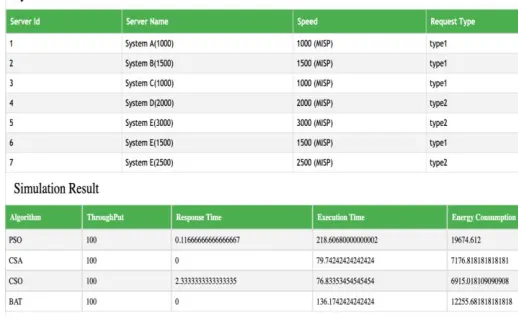
Figure 5 shows the screenshots of algorithms named as CSO and BAT. These are implemented in the simulator called Cloudsim. Output has been shown in the form Throughput, Response time, execution time and energy consumption. Outputs of these two algorithms vary according to the no of jobs. So this screenshot provides results when total no of jobs are 5
Fig. 6 -Result 2 of CSO and BAT, PSO, CSA
In Figure 6 Outputs of these two algorithms vary according to the no of jobs. So this screenshot provides results when total no of jobs are 5. It shows the screenshots of algorithms named as CSO and BAT. These are implemented in the simulator called Cloudsim. Output has been shown in the form Throughput, Response time, execution time and energy consumption.
Fig. 7- Result 3 of CSO and BAT, PSO, CSA
In Figure 7 output has been shown in the form Throughput, Response time, execution time and energy consumption. It shows the screenshots of algorithms named as CSO and BAT. These are implemented in the simulator called Cloudsim. Outputs of these two algorithms vary according to the no of jobs. So this screenshot provides results when total no of jobs are 7
Fig. 8- Result 4 of CSO and BAT, PSO, CSA
Figure 8 also shows the screenshots of algorithms named as CSO and BAT. This screenshot provides results when total no of jobs are 8. These are implemented in the simulator called Cloudsim. Output has been shown in the form Throughput, Response time, execution time and energy consumption. The outputs of these two algorithms vary according to the no of jobs.
5.
Output tables and graphs
2334 Sr.
No.
Parameters name
Comparison between Algorithms with 6 jobs
PSO CSA CSO BAT
1 Throughput 100 100 100 100
2 Response Time 0.116 1.213 2.333 0
3 Execution
Time 91.178 58.385 54.899 77.6
4 Energy
Consumption 8206.077 5254.714 4941 6984 Table 1- Simulation results for Algorithms for 5 number of jobs.
Table 1 shows the output of CSO, BAT, PSO, CSA algorithms in 5 no of jobs. Various parameters are shown in this table, These are response time, execution time, energy consumption. Total no of jobs are 5 in this table.
Sr. No.
Parameters name
Comparison between Algorithms with 6 jobs
PSO CSA CSO BAT
1 Throughput 100 100 100 100
2 Response
Time 0.116 0.857 2.190 0
3 Execution
Time 121.519 120.599 66.165 83.200
4 Energy
Consumption 10936.782 10854 5954.87 7488.034 Table 2- Simulation results for Algorithms for 6 numbers of
jobs
Table 2 shows the output of CSO, BAT, PSO, CSA algorithms in 6 no of jobs. Various parameters are shown in this table, These are response time, execution time, energy consumption. Total no of jobs are 6 in this table.
Sr. No.
Parameters name
Comparison between Algorithms with 6 jobs
PSO CSA CSO BAT
1 Throughput 100 100 100 100
2 Response
Time 0.116 0 2.333 0
3 Execution
Time 218.606 79.742 76.833 136.17
4 Energy
Consumption 19674.612 7176.818 6915.018 12255.68
Table 3- Simulation results for Algorithms for 7 numbers of jobs
Table 3 shows the output of CSO, BAT, PSO, CSA algorithms in 7 no of jobs. Various parameters are shown in this table, These are response time, execution time, energy consumption. Total no of jobs are 7 in this table.
Sr. No.
Parameters name
Comparison between Algorithms with 6 jobs
PSO CSA CSO BAT
1 Throughput 100 100 100 100
2 Response
Time 0 0 2.095 0
3 Execution
Time 248.390 94.405 103.580 101.633
4 Energy Consumption 22355.146 8496.522 9322.227 9147.0066
Table 4- Simulation results for Algorithms for 8 numbers of jobs
Table 4 shows the output of CSO, BAT, PSO, CSA algorithms in 8 no of jobs. Various parameters are shown in this table,
These are response time, execution time, energy consumption. Total no of jobs are 8 in this table.
Response time for algorithms in different jobs:
The difference among the considerations of these algorithms is given below. The enactment of these algorithms has been evaluated in different environments. The Author has already discussed the configurations of virtual machine and cloudlets. So to get better results author has tested various algorithms in different number of jobs. The results of these algorithms are presented in the form of graphs. All the results are implemented in simulation kit named as Cloudsim. Figures shown below give the comparison of two algorithms by taking multiple jobs. Table 1, 2, 3 and 4 has been shown the performance comparison of algorithms with different parameters.
Fig. 9- Response time for algorithms
The comparisons of both algorithms have been done with the help of simulator. This graph shows the response time of both algorithms. In this scenario algorithm worked on different jobs. When no of jobs= 5, Response time of CSO= 2.333, BAT=0, CSA= 1.214, PSO=0.116
No of jobs= 6, Response time of CSO= 2.190, BAT =0, CSA= 120.599, PSO=0.116
No of jobs= 7, Response time of CSO= 2.333, BAT =0, CSA= 0, PSO=0.116
No of jobs= 8, Response time of CSO= 2.095, BAT =0 , CSA= 0, PSO=0.116
Execution time for algorithms in different jobs
Fig. 10 -Execution time for algorithms in different jobs
jobs= 5, execution time of CSO= 54.899, BAT =77.6, CSA= 58.385, PSO=91.178
No of jobs= 6, execution time of CSO= 66.165, BAT =83.200, CSA= 120.599, PSO=121.519
No of jobs= 7, execution time of CSO= 76.833, BAT =136.17, CSA= 79.742, PSO=218.606
No of jobs= 8, execution time of CSO= 103.580, BAT=101.633, CSA= 94.405, PSO=248.390
Energy consumption for algorithm in different jobs
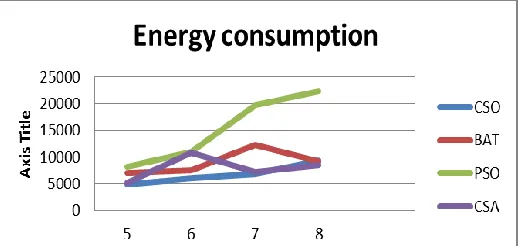
Fig. 11- Energy consumption for algorithms in different jobs
This graph shows the Execution time of both algorithms. In this scenario algorithm worked on different jobs. When no of jobs= 5, Energy consumption of CSO= 4941, BAT =6984, CSA= 5254.7142, PSO=8206.0778
No of jobs= 6, Energy consumption of CSO= 5954.87, BAT =7488.034, CSA= 10854, PSO=10936.782
No of jobs= 7, Energy consumption of CSO= 6915.018, BAT =12255.68, CSA= 7176.818, PSO=19674.612
No of jobs= 8, Energy consumption of CSA= 8496.522,
PSO=22355.146, CSO= 9322.227, BAT=9147.0066
6.
Conclusion
Cloud computing is a developing arena of computing where various assets such as hardware and software are presented as a service to a consumer but not as a manufactured article. The finest portion about these resources is that the consumers do not have to be alert of the physical locations of the services and the formations of these assets that are offering the essential resource. In the last few years existence of cloud computing has replaced the landscape of Information technology. It has been envisioned that cloud computing will be provided as 5th utility that will contribute the fundamental computing services. It offers numerous service models and deployment models. In this paper various Cloud Computing and load balancing are also discussed. Though some difficulties exist in Cloud computing and to handle load balancing is one of them. A Technique that distributes the huge dynamic local workload across all the Nodes is called as load balancing. In this paper related work of job scheduling has been discussed. Two algorithm named as CSO and BAT are explained in detail with their working area and their results and comparison with CSA and PSO have been shown using simulator CloudSim. Different parameters such as Execution Time, Energy Consumption, Utilization, Response Time, Migration Time, etc. are used. Different services of cloud are also discussed in this paper. In future work Proposed Hybrid Energy efficient model will be implemented and Cloudsim
simulator for cloud computing will be used to show all the results of the proposed technique.
R
EFERENCES[1] Gurmeet Singh, Mei-Hui Su, Karan Vahi, Ewa Deelman, Bruce Berriman, John Good, Daniel S. Katz, and Gaurang Mehta, "Workflow task clustering for best effort systems with Pegasus", ACM, MG'08, Baton Rouge, LA, USA, 2008
[2] Zhifeng Yu, Weisong Shi, "A planner-guided scheduling strategy for multiple workflow applications", IEEE International Conference on Parallel Processing – Workshops, 2008, pp.1-8 [3] Navjot Kaur, Taranjit Singh Aulakh, Rajbir Singh
Cheema, "Comparison of workflow scheduling algorithms in cloud computing", (IJACSA) International Journal of Advanced Computer Science and Applications, Vol. 2, No. 10, 2011, pp.81-86 [4] Salim Bitam, "Bees life algorithm for job scheduling in
cloud computing", ICCIT 2012, pp.186-191
[5] Qi Cao, Zhi-Bo Wei, Wen-Mao Gong, "An optimized algorithm for task scheduling based on activity based costing in cloud computing", IEEE 3rd International Conference on Bioinformatics and Biomedical Engineering, 2009, pp.1-3
[6] Liang Bai, Yan-Li Hu, Song-Yang Lao, Wei-Ming Zhang, "Task scheduling with load balancing using multiple ant colonies optimization in grid computing", IEEE Sixth International Conference on Natural Computation (ICNC 2010), 2010, pp.2715-2719 [7] Zhangjun Wu, Zhiwei Ni, Lichuan Gu, Xiao Liu, "A
revised discrete particle swarm optimization for cloud workflow scheduling", IEEE International Conference on Computational Intelligence and Security, 2010, pp.184-188
[8] Vanitha, P. Marikkannu (2017).Effective resource utilization in cloud environment through a dynamic well-organized load balancing algorithm for virtual machines. Elsevier Ltd.
[9] Shiva Razzaghzadeh, Ahmad Habibizad Navin, Amir Masoud Rahmani, Mehdi Hosseinzadeh. (2017). Probabilistic modeling to achieve load balancing in Expert Clouds. ElsevierB.V.
[10] Mohammad Goudarzi, Mehran Zamani, Abolfazl Toroghi Haghighat.(2017). A fast hybrid multi-site computation offloading for mobile cloud computing. Journal of Network and Computer Applications, Elsevier.
[11] Muhammad Baqer Mollah, Md. Abul Kalam Azad, Athanasios Vasilakos.(2017).Security and privacy challenges in mobile cloud computing: Survey and way Ahead. Journal of Network and Computer Applications, Elsevier.
[12] Sungju Huh , Seongsoo Hong. (2017). Providing fair-share scheduling on multicore computing systems via progress balancing. The Journal of Systems and Software, Elsevier.
2336 [14] Wei Zhu, Yi Zhuang, Long Zhang. (2017). A
three-dimensional virtual resource scheduling method for energy saving in cloud computing. Future Generation Computer Systems, Elsevier.
[15] SONG Ningning, GONG Chao, AN Xingshuo, ZHAN Qiang. (2016). Fog Computing Dynamic Load
Balancing Mechanism Based on Graph
Repartitioning. China Communications.
[16] Lei Zhang, Jiangchuan Liu, Edith Cheuk-Han Ngai, Wenwu Zhu.(2016). On Energy-Efficient Offloading in Mobile Cloud for RealTime Video Applications. IEEE. [17] Mohammad Mehedi Hassan, Majed Alrubaian, Atif
Alamri. (2016). Effective QoS aware Novel Resource Allocation Model for Body Sensor-Integrated Cloud platform. ICACT.
[18] Qi Liu, Weidong Cai, Jian Shen, Dandan Jin, Nigel Linge. (2016). A Load Balancing Approach B ased on Modified K-ELM and NSGA-II in a Heterogeneous Cloud Environment. IEEE International Conference on Consumer Electronics.