Licensed under Creative Common Page 475
http://ijecm.co.uk/
ISSN 2348 0386
TECHNOLOGICAL FEATURES OF ENTERPRISES: A CASE
OF TEXTILE INDUSTRY
G.E. Zahidov
Scientific Researcher, Tashkent State University of Economics, Tashkent, Uzbekistan [email protected]
Abstract
Over the past ten years in the textile industry development in Uzbekistan and abroad have been
significant changes. The first changed the role and place of this industry in the system of light
industry enterprises. On the one hand, it has undergone a change in raw material base of the
textile industry, which could not but affect the nature of the process technology, the variety and
quality of products the industry and technical - economic performance of its businesses. The
article investigates the major features of textile industry while it deals with the technical factors
for the industry itself. Moreover, it covers assortment structure of production sectors with their
manufacture specifics such as spinning, weaving, finishing production. As well as research
makes conclusions over the main directions of improving technical equipment industry.
Keywords: Textile industry, development, spinning, weaving, finishing production, assortment
structure.
INTRODUCTION
The main economic problem of the industry at present and in the longer term is a sharp increase in the productivity of social labor, which is the main criterion for the effectiveness of investment and new technology. Increasing the productivity of social labor or reduce unit costs - the main source of growth of national income and savings in our country, and ultimately enhance the base material well-being of the people(Ajwad et al., 2014).
Licensed under Creative Common Page 476 technology, the variety and quality of products the industry and technical - economic performance of its businesses. On the other hand, there have been qualitative changes in the technical base of the textile industry, which occur under the influence of raw material base restructuring, and as a result of technological progress in the textile machine industry(Calhoun, 2013).
By the mid-1990s consumption of natural and chemical fibers changed very little: on - still in it 80% from cotton, 11% wool and the rest to other types of fibers.
BACKGROUND DATA
Another important structural and technical innovation of the era of scientific and technological revolution - the rapid development of knitwear production, which in abroad has become almost the main sub-sector of the whole textile industry, the superior cost-output own tissues(Seuring, Goldbach, &Koplin, 2004).
This is largely due to the fact that labor productivity in the knitting several times higher than in weaving. But even more rapidly developing industry of non-woven materials which are increasingly being used for industrial purposes. Moreover, productivity in this industry for even higher than knitted(Salami, Shahnooshi, & Thomson, 2009).
So important is the analysis of the various equipment, spinning, weaving and finishing of textile industry than in terms of its effectiveness for the individual companies, and from the standpoint of effectiveness of the new technology for the industry as a whole. It is necessary to economically justify the optimal standard solutions that provide maximum economic efficiency and enhance the quality of products from the standpoint of the national economy.
STATISTIC REVIEW
The most important ways of development and improvement of technology, aimed at improving the productivity and competitiveness of products in the textile industry are presented in the Figure 1.
Since the main criteria of the enterprises in the conditions of market economy system are a profit and profitability, they are summarized reflected growth in the volume of production and sales of products, reduce production costs, the use of production assets, and improve product quality (Madjidov & Khakimov, 2012; McNamara, 2002).
Licensed under Creative Common Page 477 Figure 1. The significant ways of development and improvement of
technology in the textile industry
However, such an approach is not in our view correctly, when it comes to the choice of technical progress in terms of their relative efficiency.
In some cases, the use of the method of evaluation of new technology in terms of profit and profitability leads to incorrect conclusions about its effectiveness. Sometimes the evaluation of technical measures to minimize the reduced costs and profits, as well as the profitability of the same, which leads to identical conclusions about their effectiveness(Djanibekov & others, 2008)
The development of the textile industry has a number of features that highlight the increase in labor productivity.
The first feature is the need for accelerated development and further growth of the textile industry capacities for deep processing of raw materials and brings it to the finished product, which will provide the population of the country fabrics and clothing(Khalilov, 2014).
The second feature is that the textile industry there has been a certain lack of skilled labor, caused by a number of factors, not least of which the value is fairly high intensity of the process and the specific features of the nature of work. Alternately machine and manual labor,
The introduction of a fundamentally new machines several times increase the productivity of labor and equipment and improve the use of raw materials in the sectors of consumers;
The introduction of the equipment providing the comprehensive
mechanization and automation of production, significantly reducing labor costs, equipment machinery electronic regulating and control automation systems, the introduction of automated production lines;
Increase of the technological parameters of traditional equipment, increasing the speed, performance, range hoods, sizes of packages;
Intensification of technological processes, leading to a reduction in the number of transitions and labor costs and time;
Mechanization and automation of manual labor the main and auxiliary workers.
Ways of
increasing
the
productivity
and
Licensed under Creative Common Page 478 the presence of a larger number of repetitive manual operations, system machine multi-service routing, requiring large expenditures of manual labor. Eliminate this situation can be the substantial change in the nature (quality) of labor and thus productivity(Bota& others, 2005; Pulatov, 2009).
Considering the specific features of the nature of work and the use of labor resources of the textile industry it was found that productivity growth reserves due to its intensification, improvement of work organization and working with old technology pretty much exhausted. That should be a source of new technology, radically transforming the entire process, the organization of labor and production on a new technical basis(Khalilov, 2014).
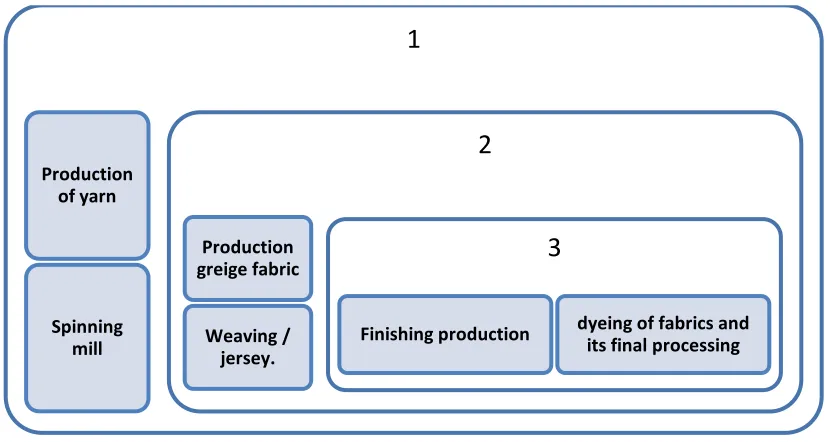
A textile consists of three main processes (Fig.2):
Figure 2. The basic technological processes of textile production
One of the ways to improve the process in the spinning mill is the comprehensive mechanization and automation of the entire process, ensuring high productivity growth. In a multi-step process of effective means of complex mechanization and automation is the organization of automated production lines, performing basic and auxiliary operation of a continuous motion the subject of labor during the process.
Spinning has long been formed as a continuously - in-line with the group location equipment. In-line arrangement of equipment typical for loosening process, beating and cleaning of cotton: parallel streams are often tape and roving equipment. Relative streaming of this production is shown in conjunction performance of individual crossings and conjugation(Kurbanova, 2013).
1
Production of yarn
Spinning mill
2
Production greige fabric
Weaving / jersey.
3
Licensed under Creative Common Page 479 Thanks to these features, favorable conditions for the introduction of automated production lines are created in the spinning. The development of automation of spinning production also promotes uniformity of equipment designed to produce a wide range of yarns, the mass character of the yarn production(Pomfret, 2000).
Automation of the entire process is very challenging, as it requires hardware synchronization performance at all crossings, tight connection between the machines and the control of a single process. Creation of automated production lines was made possible by reducing the number of transitions, increase productivity carding and tape machines, equipment machinery regulators, removers, the introduction of automatic means of cleaning equipment, the use of new methods of spinning(Pulatov, 2009).
CONCLUSION
In most of the cotton mills are working in the system, including in each spinning scotching, carding, two tape, roving and spinning transitions. The introduction of automated production lines to reduce the loss of raw materials, to reduce the complexity of the manufacture of yarns, spinning process to stabilize and increase the intensity of use of fixed assets.
Weaving is a labor-intensive system in the textile industry. The share of industrial-productive personnel engaged in the production, total employment in the major departments of the textile industry was 39.3%.The main weaving workers are employed in two technological transitions: the preparatory (winding, warping, sizing shops) and weaving. The proportion of the preparatory department of the total cost of labor weaving relatively low (20-25%). Labor costs in the preparatory department divided into preparing the warp and weft yarns.
Technological chain of equipment designed for the preparation of core yarn consists of winding, warping, sizing and tying machines, and for the preparation of the weft yarn - of the winding and refined - rewind machines. The complexity of the weaving department occupies 70-80% of total labor costs in the weaving industry, and the proportion of main workers on average in the cotton industry - 73%, and silk - 78.1. Since the bulk of the production work is concentrated in the weaving shop, it is quite obvious dependence of growth of labor productivity in the weaving industry by improving the looms.
REFERENCES
Ajwad, M. I., Abdulloev, I., Audy, R., Hut, S., de Laat, J., Kheyfets, I., … Torracchi, F. (2014). The skills road: skills for employability in Uzbekistan.
Licensed under Creative Common Page 480 Bota, F., & others. (2005). The impact of the accession to the UE on the Romanian textile industry. StudiaUniversitatis Babes Bolyai-Negotia, (1), 109–114.
Calhoun, C. (2013). Human Rights Society of Uzbekistan. Globalization.
Djanibekov, N., & others. (2008). A micro-economic analysis of farm restructuring in the Khorezm region, Uzbekistan. ZentrumfürEntwicklungsforschung.
Khalilov, S. A. (2014). The Applying of IAS/IFRS in Uzbekistan. Ovidius University Annals, Series Economic Sciences, 14(2).
Kurbanova, D. (2013). PROSPECTS OF ATTRACTION OF FOREIGN INVESTMENTS IN THE REPUBLIC OF UZBEKISTAN. In 2013 11th KALM International Conference (pp. 160–161).
Madjidov, S., &Khakimov, B. (2012). Viewpoints about potential stimulation and possibilities of investments on textile industry Uzbekistan. European Journal of Business and Economics
McNamara, D. L. (2002). Market and Society in Korea: Interest, Institution, and the Textile Industry. Psychology Press.
Nord\a as, H. K. (2004). The global textile and clothing industry post the agreement on textiles and clothing. World, 7(1,000).
Pomfret, R. (2000). The Uzbek Model of Economic Development, 1991–91. Economics of Transition, 8(3), 733–748.
Pulatov, D. (2009). Issues in development of state financial control in Uzbekistan.
Salami, H., Shahnooshi, N., & Thomson, K. J. (2009). The economic impacts of drought on the economy of Iran: An integration of linear programming and macroeconometric modelling approaches. Ecological Economics, 68(4), 1032–1039.
Seuring, S., Goldbach, M., &Koplin, J. (2004). Managing time and complexity in supply chains: two cases from the textile industry. International Journal of Integrated Supply Management, 1(2), 180–198.