Stabilization Of Soft Clay Soil Using A Gypsum
Plafond Waste Based On Cbr Testing
Herri Purwanto, Agus Setiobudi, Reffanda Kurniawan Rustam
Abstract: Soil functions as a basic foundation layer is a very important element in a road construction work, because the bearing capacity of the soil is the main element in the construction of the road construction. Soft clay soil has a high compressibility and moisture content, causing the soil carrying capacity to be low. In this study, soil improvement was carried out using soil stabilization method using a mixture of gypsum plafond waste (GPW) with a percentage of 5 %, 10 %, 15 %, 20 %, and 25 % on a laboratory scale. The soft soil samples used for the research were taken in the Pakjo area of Palembang, South Sumatra Province. The use of gypsum plafond waste as a mixture is expected to increase the bearing capacity of the red soil. The tests to be carried out are CBR (California Bearing Ratio) Soaked and Unsoaked. The results of this research: the highest of average CBR soaked value is in the gypsum plafond waste (15 GPW) mixture = 11.44 % with a soil bearing capacity) of 6.25. And the highest of average CBR unsoaked value is in the gypsum plafond waste (15 GPW) mixture = 15.75 % with a soil bearing capacity) of 6.85.
Index Terms: Stabilization, soft clay soil, gypsum plafond waste (GPW), California Bearing Ratio (CBR)
—————————— ——————————
1.
INTRODUCTION
Soil that functions as a basic foundation layer is a very important element in a road construction work. Soil as a foundation of a construction must be able to accept and withstand the loads that work on it. Therefore, before carrying out the construction work must be known in advance the bearing capacity of the subgrade at the construction site [4], [6]. One of the problems related to soil is if the soil has a low carrying capacity, so it needs extra treatment in construction planning. Example for the soil to be built on top of the road construction, if the bearing capacity of the soil is low then thicker layers of road pavement are needed. However, this behavior can increase road construction costs. Soil stabilization is one method of soil improvement to improve the mechanical properties of the soil so that the shear strength and carrying capacity of the soil increases and the soil becomes more stable and reduces the compressibility of the soil [8], [11], [12]. There are many ways to improve the soil both physically, by compaction, vibration, blasting. Addition of additional mixture materials such as cement, fly ash, bitumen, gypsum and other materials are efforts to stabilize the soil chemically. Effective soil stabilization is by adding certain chemicals, with the addition of these chemicals can affect soil characteristics. Gypsum (CaSO2.2H2O) is a white rock formed by the deposition of sea water. Generally gypsum is white, gray, brown, yellow, and transparent. Gypsum mixed with clay can reduce cracking because sodium in the soil is replaced by calcium in gypsum so that its development is smaller. Gypsum ceiling waste has a hazardous content to body health, although there are many benefits especially in the construction sector when viewed from the waste phase management. The soil classification system is generally used as a result of the development of an existing classification system. Some of these systems take into account the grain size distribution and
Atterberg limit. They are the unified soil classification system (USCS) and the AASHTO (American Association of State Highway and Transportation Official) classification system. Clay is often found in infrastructure development such as roads, bridges and others. The clay itself has a high bearing capacity and some is low. For clay which has a high bearing capacity is called rigid clay and vice versa clay with low bearing capacity is called soft clay. The properties of clay soil [3] are as follows: 1) Fine grain size, less than 0.002 mm 2) Low permeability 3) Increase in high capillary water 4) Very cohesive nature 5) High levels of shrinkage and growth 6) The consolidation process is slow.
The purpose and advantage of this research were to determine the effect of adding gypsum ceiling waste mix in increasing the bearing capacity of soaked and unsoaked CBR (California Bearing Ratio) on soft clay soil with a variation of the percentage increase in gypsum plafond waste (GPW) by 5 %, 10 %, 15 % , 20 % and 25 %. [15] The experimental using gypsum as stabilizing with different percentages variation 2 %, 4 %, 6 % and 8 % of the clay soil sample. [7] researching about the stabilization the mixture of 1 % – 10 % using material cement, limestone, and gypsum on clay soil (curing 14 days).
2 EXPERIMENTAL
PROCEDURES
2.1 Location
The scope of the fieldwork carried out is conducting a survey in the area of the location that is used as a place of sampling. The survey location is on Tanah Merah road, Pakjo area, Palembang, South Sumatera Province. Then proceed with site selection and preparation of equipment and materials. Preparatory work is to prepare accommodations for peat soil sampling and prepare equipment needed for sampling. Sampling location in the Pakjo area, Palembang, South Sumatra Province.
2.2 Testing
Red soil/soft clay soil sampling is disturbed sample and undisturbed sample. Soil samples taken have been tested for soil properties at the Laboratory of Civil Engineering, Faculty of Engineering, PGRI University, Palembang. This laboratory test is used to identify and classify soil properties taken. Soil properties test conducted in the laboratory to obtain several ————————————————
Herri Purwanto is lecturer in Civil Engineering Department, Faculty of Engineering in University of PGRI Palembang, Indonesia, PH-+6281367000060. E-mail: [email protected]
Agus Setiobudi is lecturer in Civil Engineering Department, Faculty of Engineering in University of PGRI Palembang, Indonesia, PH-+6281271383005. E-mail: [email protected]
*Reffanda Kurniawan Rustam is lecturer in Civil Engineering Department, Faculty of Engineering in University of PGRI Palembang,
Indonesia, PH-+6282377151976. E-mail:
964 soil parameters, such as water content (ASTM D-2216-90),
specific gravity (ASTM D-854), Atterberg Limit (LL, Liquid Limit) and PL, Plastic Limit) (ASTM D 42366 and ASTM D 424-74), sieve analysis (ASTM D 421 and ASTM D 422). For soil classification using ASTM, USCS, and AASHTO standards. After knowing the physical properties of the soil, then the mechanical properties were tested: standard soil compaction testing (ASTM D7380–15) and CBR testing (ASTM D1883-16). Mechanical properties testing equipment is shown in Figure 1. Standard soil compaction testing is carried out to obtain the maximum dry volume weight and optimum moisture content [2]. Puncher used 2.45 kg and height fell 30.5 cm and impacts energy 593.7 kJ/m3. The number of layers consists of 3 layers with 25 layers of layers. The type of soil bearing capacity test is the CBR (California Bearing Ratio) soaked and unsoaked tests [1]. The data of CBR unsoaked test results based on [3]. The parameters obtained from the test are used to analyze the soil bearing capacity calculation. This test was conducted at the Laboratory of the Department of Civil Engineering, Faculty of Engineering, Sriwijaya University, Inderalaya, South Sumatra Province. From the results of laboratory tests conducted, the parameter data for the bearing capacity of the soil on Jalan Tanah Merah, Pakjo, Palembang, South Sumatra is obtained.
2.3 Sample
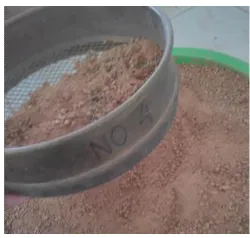
Gypsum plafond waste (GPW) used for this reserach can be seen in Fig. 2. The use of gypsum plafond waste (GPW) as a soil stabilization material is one way to overcome these wastes, because in addition to reducing environmental pollution and health hazards. The use of gypsum plafond waste is also easily obtained. The percentage increase of gypsum plafond waste (GPW) by 5 %, 10 %, 15 %, 20 %, and 25 %. The type of soft clay soil added to gypsum plafond waste is shown in Fig. 3. [10] use cement as soil stabilization to improve the behavior of clay soil in Naya Raipur, Chhattisgarh. The research from [16] study the effect of the addition of palm bunches ash and gypsum with the variations 5 %, 7.5 %, and 10% to determined he value of CBR with 3, 7, and 14 days curing. The material of gypsum and NaCl had been used in the research of [11] to improve the characteristics of the clayey soil. The material of phosphogypsum and fly ash were used for soil stabilization [17].
(a) Standard Soil Compaction (b) CBR
Fig 1. Equipments for testing the mechanical properties of soft clay soils
Fig 2. Gypsum plafond waste (GPW)
Fig 3. Soft clay soil
3 RESULTS
AND
DISCUSSION
3.1 Testing Index Properties
Index properties testing were a test that can show soill properties or characteristics of soft clay soil. In this research, soil was taken from the Pakjo Way Hitam area, Palembang City, South Sumatra Province. The results of this test can be seen in Table 1. The system used to classify the soil based on usage has two systems, namely the soil classification system based on USCS and AASHTO. The soil classification obtained based on soil classification according to the AASHTO (American Association of State Highway and Transporting Official) is A-7-6 (clavey soils). Meanwhile, according to USCS (Unified Soil Classification System) is CL (clay). The soil classification system based on USCS uses a reference in the form of the number of grains that pass filter no. 200 and the liquid limit value (LL). From the results of the index properties test, it is known that the soil passing the filter no. 200 is more than 35 % and the liquid limit value is more than 50 %. From these results it shows that the soil being tested is included as fine-grained soil.
TABLE1
SOIL PROPERTIES INDEX AND SOIL CLASSIFICATION
No. Laboratory Testing Symbol Results
a. Moisture Content 27.70
b. Specific Gravity Gs 2.67
c. Sieve Analysis No.40 (0,425 mm) % 94.48
d. Sieve Analysis No.200 (0,075 mm) % 82.56
e. Liquid Limit LL, % 66.00
f. Plastic Limit PL, % 25.13
g. Index Plastis IP, % 40.87
h. USCS Classification CH
i. AASHTO Classification A-7-6
of 82.56 %, the soil is included in the type of fine grains which means clay or silt because it is greater than 35 %. Then the yield of liquid limit (LL) is 66.00 %, which means greater than 50 %. So, the soil is classified into MH and CH types [13].
3.2 Standard Soil Compaction Test Results
Standard soil compaction testing had been done on the soft clay soil samples. The graph of standard soil compaction test results against the original soil is shown in Fig. 4. The results of the standard soil compaction test on the original soft clay soil sample obtained the optimum moisture content ( opt) = 22 % and maximum dry weight d max) = 1.74 gr/cm3). The results [15] is smaller than this research which is obtained the optimum moisture content (OMC) 11.76 %, but the value of maximum dry density (MDD) 1.92 gr/cm3 is greater than this research.
3.3 Results of CBR Laboratory Testing
CBR laboratory testing consists of Soaked and Unsoaked testing of soft clay soil and mixed soils. The results of the CBR testing of the original soil are shown in Table 2 (soaked and unsoaked). The CBR value (soaked) of 0.1 inch penetration is 6.52 % and 0.2 inch penetration is 6.45 %. And the CBR value (unsoaked) of 0.1 inch penetration is 10.83 % and 0.2 inch penetration is 10.50 %. Based on the Table 2 and the Fig. 5, it can be seen that CBR soaked value is smaller than the value of CBR unsoked.
Fig.4. Standard soil compaction test results
TABLE2 RESULT OF CBR VALUE
Penetration (inch) Soaked CBR value (%) Unsoaked
0.10 6.52 10.83
0.20 6.45 10.50
Soaked Unsoaked
Fig.5. Graph of CBR result
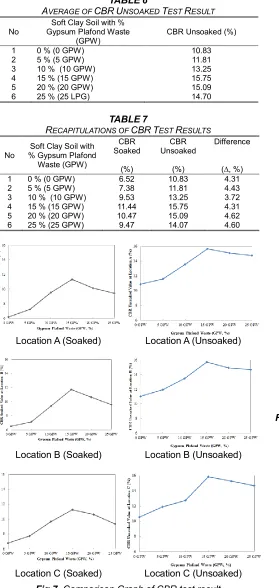
The CBR testing (soaked and unsoaked) with mixed soils consists of a mixture of soft clay soil with gypsum plafond waste (GPW). The percentage of the addition of a gypsum plafond waste (GPW): 5 %, 10 %, 15 %, 20 %, and 25 %. The graph of CBR result (soaked and unsoaked) at location A is shown in Fig. 6. This figure demonstrates the results of CBR result at location A (soaked and unsoked) in 5 %, 15 %, and 25 % percentages). The CBR soaked value result is smaller compare with the CBR unsoaked value result. The recapitulation results of the gypsum plafond waste (GPW) mix CBR values (soaked and unsoaked) at three locations (Location A, Location B, and Location C) can be seen in Table 3 and Table 4. The CBR soaked value results at location A based on Table 3: 0 % (0 GPW) = 6.23, 5 % (5 GPW) = 7.25, 10 % (10 GPW) = 9.55, 15 % (15 GPW) = 11.33, 20 % (20 GPW) = 10.14, 25 % (25 GPW) = 9.45. While, the CBR unsoaked value results at location A based on Table 4: 0 % (0 GPW) = 10.89, 5 % (5 GPW) = 11.59, 10 % (10 GPW) = 13.55, 15 % (15 GPW) = 15.66, 20 % (20 GPW) = 15.10, 25 % (25 GPW) = 14.77. The largest of CBR soaked value obtained from soft clay soil with 15 % of the gypsum plafond waste (15 GPW): 11.33 (location A), 11.75 (location B), and 11.25 (location C). And the largest of CBR unsoaked value obtained from soft clay soil with 15 % of the gypsum plafond waste (15 GPW): 15.66 (location A), 15.75 (location B), and 15.83 (location C). The Fig.7 shows the comparison graph of CBR test result in soaked and unsoaked conditions. Fig. 8 and Fig. 9 determine the graph of CBR value of the gypsum plafond waste in soaked and unsoaked conditions. This figures based the data at three locations (Location A, Location B, and Location C). Table 5 and Table 6 explain the results of the average of CBR test result (soaked and unsoaked conditions). Graph of average value show in Fig. 10. In Fig. 10 sighted comparison of CBR values between soaked and unsoaked conditions. The average of CBR soaked value test results based on Table 5: 0 % (0 GPW) = 6.52, 5 % (5 GPW) = 7.38, 10 % (10 GPW) = 9.53, 15 % (15 GPW) = 11.44, 20 % (20 GPW) = 10.47, 25 % (25 GPW) = 9.47. and the average of CBR unsoaked value test results based on Table 5: 0 % (0 GPW) = 10.83, 5 % (5 GPW) = 11.81, 10 % (10 GPW) = 13.25, 15 % (15 GPW) = 15.75, 20 % (20 GPW) = 15.09, 25 % (25 GPW) = 14.70. The recapitulations of the CBR test results show in Table 7. Perbedaan nilai CBR terkecil pad soft clay soil with 0 % gypsum plafond waste (GPW) yaitu sebesar 4.31 dimana nilai CBR soaked sebesar 6.52 dan CBR unsoaked sebesar 10.83. Sedangkan perbedaan nilai CBR terbesar pada soft clay soil with 20 % gypsum plafond waste (GPW) yaitu sebesar 4.62 dimana nilai CBR soaked sebesar 10.47 dan CBR unsoaked sebesar 15.09.
TABLE3
DATA OF CBRSOAKED TEST RESULTS
No
Soft Clay Soil with % Gypsum Plafond
Waste (GPW)
CBR Soaked (%) Location
A
Location B
Location C
1 0 % (0 GPW) 6.23 6.54 6.78
2 5 % (5 GPW) 7.25 7.15 7.75
3 10 % (10 GPW) 9.55 9.40 9.65
4 15 % (15 GPW) 11.33 11.75 11.25 5 20 % (20 GPW) 10.14 10.65 10.62
966
Soaked 5 % Unsoaked 5 %
Soaked 15 % Unsoaked 15 %
Soaked 25 % Unsoaked 25 %
Fig.6. Graph of CBR result at location A
TABLE4
DATA OF CBR UNSOAKED TEST RESULTS
No
Soft Clay Soil with % Gypsum Plafond
Waste (GPW)
CBR Unsoaked (%) Location
A Location B
Location C
1 0 % (0 GPW) 10.89 11.05 10.55
2 5 % (5 GPW) 11.59 11.95 11.90
3 10 % (10 GPW) 13.55 13.49 12.71 4 15 % (15 GPW) 15.66 15.75 15.83 5 20 % (20 GPW) 15.10 14.92 15.26 6 25 % (25 GPW) 14.77 14.69 14.65
TABLE 5
AVERAGE OF CBR SOAKED TEST RESULT
No
Soft Clay Soil with % Gypsum Plafond Waste
(GPW) CBR Soaked (%)
1 0 % (0 GPW) 6.52
2 5 % (5 GPW) 7.38
3 10 % (10 GPW) 9.53
4 15 % (15 GPW) 11.44
5 20 % (20 GPW) 10.47
TABLE6
AVERAGE OF CBR UNSOAKED TEST RESULT
No
Soft Clay Soil with % Gypsum Plafond Waste
(GPW)
CBR Unsoaked (%)
1 0 % (0 GPW) 10.83
2 5 % (5 GPW) 11.81
3 10 % (10 GPW) 13.25
4 15 % (15 GPW) 15.75
5 20 % (20 GPW) 15.09
6 25 % (25 LPG) 14.70
TABLE7
RECAPITULATIONS OF CBR TEST RESULTS
No
Soft Clay Soil with % Gypsum Plafond
Waste (GPW)
CBR Soaked
(%)
CBR Unsoaked
(%)
Difference
(∆, %)
1 0 % (0 GPW) 6.52 10.83 4.31
2 5 % (5 GPW) 7.38 11.81 4.43
3 10 % (10 GPW) 9.53 13.25 3.72 4 15 % (15 GPW) 11.44 15.75 4.31 5 20 % (20 GPW) 10.47 15.09 4.62
6 25 % (25 GPW) 9.47 14.07 4.60
Location A (Soaked) Location A (Unsoaked)
Location B (Soaked) Location B (Unsoaked)
Location C (Soaked) Location C (Unsoaked) Fig.7. Comparison Graph of CBR test result
Fig. 8. Graph of CBR soaked value of the gypsum plafond waste
Fig. 9. Graph of CBR unsoaked value of the gypsum plafond waste
968 Based on the CBR test results, it can be seen that the addition
of Gypsum plafond waste (GPW) can affect the CBR value. Mixed percentage variation of 5 %, 10 %, and 15 % Gypsum plafond waste (GPW) show that CBR value (soaked and unsoaked) of soft clay soil obtained has increased. The highest CBR value in the Gypsum plafond waste (GPW) mixture was in the 15 % (15 GPW) of 11.44 % (soaked) and 15.75 % (unsoaked). Addition of Gypsum plafond waste (GPW) soft clay soil can affect the CBR value. The highest CBR soaked value was obtained at a variation of 15 % by 11.44 %. The minimum requirement for the CBR value to be used as a road subgrade is 6 %. The soil bearing capacity value based on the calculation with the highest CBR soaked value of 11.44 % is obtained a value of 6.25. Whereas, the soil bearing capacity value based on the calculation with the highest CBR unsoaked value of 15.75 % is obtained a value of 6.85. So that the soft clay soil in this research can be used as a subgrade. The results of [1] stated that the stabilization using gypsum and NaCl can be used for pavement sub-grade for clay soil. The result of [14] which is using gypsum and paddy husk ash as material stabilization. The purpose of the research was to determine the effect of the additions of 2 % gypsum and 2 % - 15 % paddy husk ash. The results such as: the higher value of CBR 6.71 % for CBR soaked, 8 % for CBR unsoaked, and the higher UCT value of 1.67 kg/cm2.
4 CONCLUSION
1. The soft clay soil in the Palembang Pakjo area based on the results of the index properties testing is included in the soil classification system or CH (USCS) and the A-7-6 (AASHTO) classification system.
2. The results of standard soil compaction testing are obtained: Optimum water content value of opt) 22 % and maximum dry content weight of d max) 1.74 gr / cm³. 3. The CBR soaked value of soft clay soil has increased in a
mixture of 5 %, 10 %, and 15 % gypsum plafond waste (GPW). The highest CBR soaked value is in the gypsum plafond waste (15 GPW) mixture of 11.44 % with a soil bearing capacity) of 6.25.
4. The highest CBR unsoaked value is in the gypsum plafond waste (15 GPW) mixture of 15.75 % with a soil bearing capacity) of 6.85.
5 ACKNOWLEDGMENTS
The research presented in this paper was supported by a grant from Penelitian Dosen Pemula (PDP) Tahun 2019.
6
REFERENCES
[1] ASTM D1883-16 .Standard Test Method for California Bearing Ratio (CBR) of Laboratory-Compacted Soils. [2] ASTM D7380–15. Standard Test Method for Soil
Compaction.
[3] Amiwarti, et al., 2018. ―Stabilisasi Tanah Merah dengan Menggunakan Limbah Plafon Gipsum Terhadap Nilai CBR‖. Prosiding Seminar Naional, AVOER 10, Penelitian dan Pengabdian kepada Masyarakat Avoer X, Fakultas Teknik Universitas Sriwijaya, 798-804.
[4] Bowles, J.E., ―Foundation Analysis and Design‖, Publisher: McGraw-Hill, 2017
[5] Chandravanshi, M., A ―Laboratory Investigation on the Compaction Properties of Soil mixed with Fly ash and Gypsum‖, International Journal of Scientific and Research Publications, Volume 4, Issue 10, October 2014, ISSN
2250-3153.
[6] Das, B. M., 2010, Principles of Geotechnical Engineering, 7th Edition. Stamford, USA: Cengage Learning.
[7] Hastuty, I. P., and Roesyanto, ―Comparison of the use of Cement, Gypsum, and Limestone on the Improvement of Clay by Using Unconfined Compression Test‖. Journal of the Civil Engineering Forum, Vol. 5 No. 2 (May 2019), Research Article, https://doi.org/10.22146/jcef.43792. [8] Kilabanur, P., et al., Stabilization of Black Cotton Soil
Using Envirobase and Sodium Silicate With Lime, International Journal of Scientific & Technology Research (IJSTR), Volume 4, Issue 06, June 2015, ISSN 2277-8616.
[9] Ogundipe and Mose, O., An Investigation Into the Use of Lime-Stabilized Clay ss Subgrade Material, International Journal Of Scientific & Technology Research (IJSTR), Volume 2, Issue 10, October 2013, ISSN 2277-8616. Page 82-86.
[10]Pandey, A., Soil Stabilisation using Cement‖, International Journal of Civil Engineering and Technology (IJCIET), Volume 8, Issue 6, June 2, 2017, pp. 316–322, Article ID: IJCIET_08_06_035.
[11]Peddaiah, S., et al., ―Experimental Study on Effect of Gypsum and NaCl in Improvement of Engineering Properties of Clayey Soil‖. International Journal of Engineering and Technology (IJET). Vol. 9 No 4 Aug-Sep
2017.page
277-2778.DOI:10.21817/ijet/2017/v9i4/170904409. ISSN (Online): 0975-4024.
[12]Rustam, R., K., et al., 2019. ―The Effect of Gypsum Plafond Waste on Shear Strength of Soft Clay Soil‖. Sriwijaya international Conference on Science, Engineering, and Technology. IOP Conf. Series: Materials Science and Engineering 620 (2019) 012039 IOP Publishing doi:10.1088/1757-899X/620/1/012039.
[13]Rustam, R.K., and Amiwarti. 2017. ―Karakteristik Kuat Geser Tanah Merah‖. Prosiding Simposium II-UNIID 2017 e-ISBN: 978-979-587-734-9, 394-399.
[14]Roesyanto et al., ―Clay stabilization by using gypsum and paddy husk ash with reference to UCT and CBR value‖, TALENTA-CEST 2017 IOP Publishing, IOP Conf. Series: Materials Science and Engineering 309 (2018) 012026 doi:10.1088/1757-899X/309/1/012026.
[15]Sikarwar, B.P.S., and Trived, M.K., ―Stabilization of Clayey Soil by Using Gypsum‖, IJSRD-International Journal for Scientific Research & Development, Vol. 5, Issue 03, 2017, ISSN (online): 2321-0613.
[16]Sutejo, et. al., Pengaruh Penambahan Abu Tandan Sawit dan Gipsum Terhadap Tanah Lempung Lunak Berdasarkan Pengujian CBR. The 18th FSTPT International Symposium, Unila, Bandar Lampung, August 28, 2015.
[17]Sharma, A., and Walia, B. S., ―Effect of Phosphogypsum and Fly Ash on the CBR and UCS of Clayey Soil‖, International Journal of Engineering Trends and Technology (IJETT) – Volume 50 Number 5 August 2017,
ISSN: 2231-5381, Page 266-271.