© 2017 IJSRST | Volume 3 | Issue 7 | Print ISSN: 2395-6011 | Online ISSN: 2395-602X Themed Section: Science and Technology
Study on Different types of Structure based Properties in Human Membrane
Proteins
S. C. Jeyakumar
*, J. Thampi Thanka Kumaran
Department of Physics, Nesamony Memorial Christian College, Marthandam 629 165, Kanyakumari District, Tamilnadu, India
ABSTRACT
Understanding the structure and function of membrane proteins will be useful for applications in industrial protein engineering. Amino acid residues along the primary sequence interact with each other in a cooperative manner to form the stable native structure, during the process of protein folding. To understand the mechanism of protein folding and stability, the knowledge about inter-residue interactions in protein structures is very helpful. In this comparative study, we have systematically analyzed aminoacid composition and various structure based properties of molecular interactions in different classes of human membrane proteins. Parameters used in the study are aminoacid composition, long range order, surrounding hydrophobicity, long range interactions, medium range interactions, accessible surface area, ionic interactions and hydrophobic interactions. Structural based properties of different types of human membrane proteins were statistically analyzed. The results obtained in this work highlight the difference in different structure based properties like long range order, surrounding hydrophobicity, long range interaction ratio, and medium range interaction ratio, average number of residues within 8A and accessible surface area of proteins, in different types of human membrane proteins. Ionic interacting residues have higher value of surrounding hydrophobicity and higher value of neighbors within 8A, compared to ionic noninteracting residues. Accessible surface area of polar residue was found to be greater than nonpolar residues. There is marked difference in structural based properties of buried and non buried residues. Buried residues have higher value of surrounding hydrophobicity and higher value of neighbors within 8A, compared to non-buried residues. Hydrophobic interacting residues have higher value of surrounding hydrophobicity and higher value of neighbors within 8A, compared to hydrophobic noninteracting residues. Long range interactions are more prominent in hydrophobic interactions than in ionic interactions.
Keywords: Surrounding hydrophobicity, long range order, ionic interaction, hydrophobic interactions, membrane proteins.
I.
INTRODUCTION
Membrane proteins are proteins that either interact with biological membranes, or are part of, biological membranes. They include integral membrane proteins that are permanently anchored or part of the membrane and peripheral membrane proteins that are only temporarily attached to the lipid bilayer or to other integral proteins. 1,2 The integral membrane proteins are classified into transmembrane proteins and integral monotopic proteins. Transmembrane proteins span across the membrane. Proteins which are attached to only one side of the membrane are called integral monotopic proteins. Membrane proteins are a common
type of proteins along with soluble globular proteins, fibrous proteins, and disordered proteins.3
Membrane proteins are generally classified into integral proteins, peripheral proteins, and lipid-bound proteins. Integral proteins are embedded within the lipid bilayer. Integral proteins are usually transmembrane proteins, extending through the lipid bilayer so that one end contacts the interior of the cell and the other touches the exterior. Peripheral proteins are attached to the exterior of the lipid bilayer. Lipid-bound proteins are located entirely within the boundaries of the lipid bilayer.
properties, which are responsible for cell structure during key cell events such as division. Membrane proteins may also act as channels that move specific molecules into and out of the membrane.
Theoretical investigations were of great use to
understand about membrane proteins. Several
investigators have stressed the importance of hydrogen bonds, electrostatic, hydrophobic and van der Waals interactions along with weak interactions. To understand the recognition mechanism of membrane proteins, the contribution of energetic terms along with physical and chemical features were used. Amino acid residues along the polypeptide chain interact with each other in a cooperative manner to form the stable native structure, during the process of protein folding. To understand the mechanism of protein folding and stability, the knowledge about inter-residue interactions in protein structures is very helpful.4. In the formation of stable secondary structures and a unique tertiary structure for a protein, interactions between amino acid residues of the protein and with the surrounding solvent molecules play an important role. These interactions are usually non-covalent and include hydrogen bonds, ion pairs, van der Waals interactions, and hydrophobic interactions.
Long range order highlights the importance of long-range contacts, which are made by residues that are far in sequence and closer in the 3D structure. Surrounding hydrophobicity provides valuable information with regard to hydrophobic domains, nucleation sites, surface domains, loop sites and the spatial positions of residues in protein molecules. Medium range interactions and long range interactions are required to stabilize the
conformation uniquely. Ionic and hydrophobic
interactions are also needed for biological activity of proteins. Knowledge about the similarities and differences between structural based properties of the different types of membrane proteins will help to
understand about membrane proteins working
mechanism.
In this work, we have used systematically classified the human membrane proteins, which were grouped into nine, based on their function. Human membrane proteins having following functions were used for analysis. They are, Cell adhesion molecules, Cytokines, Hydrolase, Immune system proteins, Oxidoreductases, protein
binding proteins, signalling proteins, Transferase and
transport protein. An attempt was made to find the
similarities and differences between structural based properties of the human membrane proteins, which are grouped on the basis of function. Structure based properties used in this study are long range order, medium range interactions, long range interactions, surrounding hydrophobicity, average number of 8 Å neighbours, average accessible surface area of all residues, average accessible surface area of polar residues and average accessible surface area of non-polar residues, ionic interactions and hydrophobic interactions. Structure based properties of protein residues were calculated and from that structure based properties of protein chains were estimated.
Ionic non-interacting residues have lower value of surrounding hydrophobicity and lower value of neighbours within 8Å, compared to ionic interacting residues. Hydrophobic non-interacting residues have lower value of surrounding hydrophobicity and lower value of neighbours within 8Å, compared to
hydrophobic interacting residues. Hence the
environment, in which residues are present, has great influence on ionic interactions and hydrophobic interactions.
II.
MATERIALS AND METHODS
A. Data set
B. Computational Procedure
Clear description of Structure based properties like Medium range interactions, Long range interactions, Long range order, Surrounding hydrophobicity, number of 8A0 neighbours and formulae needed to calculate
them are available at the server at
http://www.iitm.ac.in/bioinfo/pdbparam/ , 5 which can
be freely accessed. Procedure to calculate Ionic interactions and Hydrophobic interactions are also explained in the same webserver.
1) Medium and long-range interactions: For a given residue, the surrounding residues within a sphere of 8 Å radii are analysed in terms of their sequence position. Residues within a window between three and four residues contribute to medium-range interactions and those more than four residues apart contribute to long-range interactions. Both medium long-range and long long-range interactions play an important role in the formation of protein structure.
2) Number of 8Å contacts : The contacts between amino acid residues in the crystal structure are computed with cutoffs of 8 Å using Cα . Number of residues within 8Å of a particular aminoacid residue gives number of 8Å contacts of that residue.
3) Long-range order: LRO is derived from long-range contacts (contacts between two residues that are close in space and far in the sequence) in the protein structure. It is defined as
LRO = ∑ (n ij / N)
n = 1 if i − j > 12;
n = 0 otherwise
where i and j are the two contacting residues within a distance of 8 Å, and N represents the total number of residues in the protein.
4) Surrounding hydrophobicity: The sum of hydrophobic indices assigned to the residues that appear within a distance of 8 Å from the central residue can be used to characterize the hydrophobic behaviour of each
amino acid residue in the protein environment. It is defined as
Hp (i) =
20
0
= j
ij
n
* hjwhere n ij is the total number of surrounding residues of
type j around the ith residue of the protein, and hj is the
hydrophobicity index (kcal/mol) obtained from
thermodynamic transfer experiments.
5) Accessible surface area : Accessible surface areas of all residues of proteins were calculated using PDB atomic coordinates and NACESS program. From that average accessible surface areas of all residues of different proteins were calculated. Average accessible surface areas of polar residues of a protein was calculated by dividing total accessible surface areas of all polar residues of a protein by total number of polar residues of that protein. Similarly average accessible surface area of nonpolar residues of a protein was calculated by dividing total accessible
surface areas of all nonpolar residues of a protein by total number of nonpolar residues of that protein.
6) Ionic interactions: Ionic interactions is contributed by ionic residue pairs Arginine(R), Lysine(K), Histidine(H) : Aspartic Acid(D) Glutamic Acid(E) falling with in a distance of 6Å.
7) Hydrophobic interactions: CB atoms of residues of Alanine(A), Valine(V), Leucine(L), Isoleucine(I),
Methionine(M), Phenylalanine(F), Tryptophan(W),
Proline(P) and Tyrosine(Y) show hydrophobic
interactions when they fall within 5Å range.
III.
PRESENT STUDY
A. Computation of amino acid composition
The amino acid composition for each protein has been computed using the number of amino acids of each type and the total number of residues. It is defined as:
Comp(i) =
20
0
/ j
i N
n
where j stands for the 20 amino acid residues. ni is the
number of residues of each type and N is the total number of residues. The summation is through all the residues in the particular protein. We have repeated the
calculation for all the proteins in all nine functional class types of human membrane proteins. By calculating the average of aminoacid composition all proteins in a particular functional type of protein, average aminoacid composition of a particular functional type of protein was calculated.
Percentage of Acidic, Basic, Polar, Aromatic and Aliphatic groups of aminoacids were calculated for the different types of human membrane proteins. The result is tabulated in Table 1.
TABLE I. PERCENTAGE OF DIFFERENT GROUPS OF AMINOACID RESIDUES IN HUMAN MEMBRANE PROTEINS
Type of aminoacid
Type of Human membrane proteins
Cell
Adhesion Cytokine Hydrolase
Immune
System Oxidoreductase
Protein Binding
Signaling
Protein Transferase
Transport Protein
Acidic 12.333 11.643 11.913 11.811 11.028 11.758 11.755 11.618 12.909
Basic 14.385 14.26 14.104 13.364 15.517 14.927 15.458 14.814 14.89
Neutral and
polar 25.985 29.659 25.384 29.453 23.092 24.912 26.547 23.455 24.641
Nonpolar and
aromatic 7.511 8.814 9.769 9.301 9.356 7.699 8.375 8.93 7.594
Nonpolar and
aliphatic 39.66 35.623 38.686 35.995 40.67 40.704 37.806 40.919 39.824
From the above table it is clear that the composition of neutral and polar groups of aminoacid residues is greater in Cytokine and immune system proteins.
Composition of nonpolar and aliphatic groups of aminoacid residues is lesser in Cytokine and immune system proteins.
B. Computation of protein properties
Using structure based properties of aminoacid residues, structure based properties of proteins were calculated using the following procedure.
1) Long range order of a protein (LRO) 6 = Sum of long range order of all aminoacid residues of that protein.
2) Ratio of total number of medium range interactions in a protein to total number of residues of a protein ( MRR ) = Total number of medium range interactions in a protein / Total number of residues of that protein.
3) Ratio of total number of long range interactions in a protein to total number of residues of a protein ( LRR ) =Total number of long range interactions in a protein / Total number of residues of that protein.
4) Surrounding hydrophobicity of a protein (Hp) = Average of surrounding hydrophobicity of all aminoacid residues of that protein.
5) Average value of accessible surface area of residues of a protein (ASA) = Sum of accessible surface area of all residues of a protein /Total number of residues of that protein.
6) Average value of accessible surface area of polar residues of a protein (ASAp) = Sum of accessible surface area of all polar residues of a protein /Total number of polar residues of that protein.
703
surface area of all nonpolar residues of a protein /Total number of nonpolar residues of that protein.
8) Ratio of nonpolar to polar residues of a protein (RNPP) = Total number of nonpolar residues in a protein / Total number of polar residues in a protein
9) Ratio of ionic interacting residues of a protein (RIR) = Total number of ionic interacting residues in a protein /Total number of (R,K,H,D,E) residues of that protein.
10) Ratio of hydrophobic interacting residues (RHR) = Total number of hydrophobic interacting residues in a
protein /Total number of (A,V,L,I,M,F,W,P,Y) residues of that protein.
11) 8 A contact number of a protein (n8År) = Average of 8 Å contact number of residues
Values of structure based properties of human membrane proteins were tabulated and compared.
Correlation analysis method was also used to find the
relation between different protein properties.
IV.
RESULT & DISCUSSION
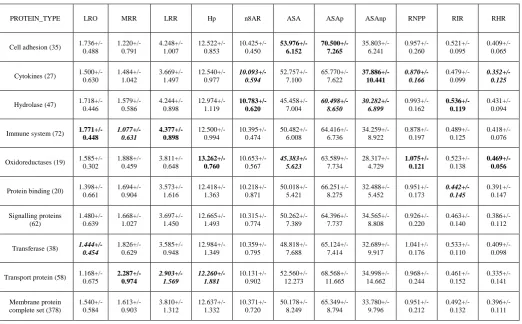
Human membrane proteins have been classified into Cell adhesion molecules, Cytokines, Hydrolase, immune system proteins, Oxidoreductases, protein binding proteins, signalling proteins, Transferase and transport protein based on functions. Average values of protein properties are tabulated below.
TABLE II. AVERAGE VALUES OF STRUCTURE BASED PROPERTIES OF PROTEIN CHAINS IN HUMAN MEMBRANE PROTEINS
PROTEIN_TYPE LRO MRR LRR Hp n8AR ASA ASAp ASAnp RNPP RIR RHR
Cell adhesion (35) 1.736+/-0.488 1.220+/-0.791 4.248+/-1.007 12.522+/-0.853 10.425+/-0.450 53.976+/-6.152 70.500+/-7.265 35.803+/-6.241 0.957+/-0.260 0.521+/-0.095 0.409+/-0.065
Cytokines (27) 1.500+/-0.630 1.484+/-1.042 3.669+/-1.497 12.540+/-0.977 10.093+/-0.594 52.757+/-7.100 65.770+/-7.622 37.886+/-10.441 0.870+/-0.166 0.479+/-0.099 0.352+/-0.125
Hydrolase (47) 1.718+/-0.446 1.579+/-0.586 4.244+/-0.898 12.974+/-1.119 10.783+/-0.620 45.458+/-7.004 60.498+/-8.650 30.282+/-6.899 0.993+/-0.162 0.536+/-0.119 0.431+/-0.094
Immune system (72)
1.771+/-0.448 1.077+/-0.631 4.377+/-0.898 12.500+/-0.994 10.395+/-0.474 50.482+/-6.008 64.416+/-6.736 34.259+/-8.922 0.878+/-0.197 0.489+/-0.125 0.418+/-0.076
Oxidoreductases (19) 1.585+/-0.302 1.888+/-0.459 3.811+/-0.648 13.262+/-0.760 10.653+/-0.567 45.383+/-5.623 63.589+/-7.734 28.317+/-4.729 1.075+/-0.121 0.523+/-0.138 0.469+/-0.056
Protein binding (20) 1.398+/-0.661 1.694+/-0.904 3.573+/-1.616 12.418+/-1.363 10.218+/-0.871 50.018+/-5.421 66.251+/-8.275 32.488+/-5.452 0.951+/-0.173 0.442+/-0.145 0.391+/-0.147 Signalling proteins (62) 1.480+/-0.639 1.668+/-1.027 3.697+/-1.450 12.665+/-1.493 10.315+/-0.774 50.262+/-7.389 64.396+/-7.737 34.565+/-8.808 0.926+/-0.220 0.463+/-0.140 0.386+/-0.112
Transferase (38)
1.444+/-0.454 1.826+/-0.629 3.585+/-0.948 12.984+/-1.349 10.359+/-0.795 48.818+/-7.688 65.124+/-7.414 32.689+/-9.917 1.041+/-0.176 0.533+/-0.110 0.409+/-0.098
Transport protein (58) 1.168+/-0.675 2.287+/-0.974 2.903+/-1.569 12.260+/-1.881 10.131+/-0.902 52.560+/-12.273 68.568+/-11.665 34.998+/-14.662 0.968+/-0.244 0.461+/-0.152 0.335+/-0.141
Membrane protein
complete set (378)
Statistical significance of the data was analysed by calculating P value using ANOVA. For all cases P < 0.001, and highly statistical significant nature of the data was established.
For all types of proteins, average value of accessible surface area of residues of a protein (ASA) was found to be greater than average value of accessible surface area of nonpolar residues of a protein (ASAnp) and less than average value of accessible surface area of polar residues of a protein (ASAp). Above result explains the hydrophobic nature of nonpolar residues and hydrophilic nature of polar residues.
A.General trend in average values of protein properties of Human membrane proteins
Type of proteins having lower average value of LRO, have lower average value of LRR.
Type of proteins having lower LRR value have higher MRR value. This result shows the complementary nature of long range interactions and medium range interactions.
Immune system membrane proteins have lowest value of MRR and highest value of LRR. Transport proteins have highest value of MRR and lowest value of LRR. Oxidoreductase membrane proteins have highest value of Hp and lowest value of ASA.
Type of proteins having higher average value of Hp, have higher average value of number of 8A0 neighbours. So the regions of proteins having highest packing of atoms have highest surrounding hydrophobicity.
B. General trend in correlation between average values of protein properties
Correlation between values of long range order (LRO), ratio of total number of medium range interactions in a protein to total number of residues of that protein
(MRR), ratio of total number of long range interactions in a protein to total number of residues of that protein (LRR), surrounding hydrophobicity (Hp), ratio of ionic interacting residues (RIR), ratio of hydrophobic interacting residues (RHR) of different types of proteins were found out.
For all types of proteins correlation between LRO and LRR was very high. LRO has high correlation with Hp and value of average number of 8A0 neighbours.
Significant negative correlation between MRR and LRO and between MRR and LRR was noticed. This shows that the long range interactions and medium range interactions are complimentary in nature.
LRR had very high correlation with value of
average number of 8Å neighbours. Significant correlation between LRR and Hp was noticed.
C. Relation between Surrounding hydrophobicity and other protein properties
For the complete set of 378 human membrane proteins, linear regression equation connecting Surrounding hydrophobicity and other protein properties of protein chains was setup. Using linear regression equation, Surrounding hydrophobicity values of 378 human membrane proteins was predicted. Correlation between actual and predicted values of 378 human membrane proteins were found out to be maximum (0.795), for the following regression equation
Hp=1.1069 * ( MRR ) + 0.9653 * ( LRR ) - 0.1543 * ASA + 0.0698 * ASAp
+ 0.0651 * ASAnp + 2.344 * RHR + 7.2296
Figure 1. Actual value of surrounding hydrophobicity and predicted value of surrounding hydrophobicity in
human membrane proteins.
Procedure used to calculate surrounding hydrophobicity Hp, medium range interactions, long range interactions and accessible surface area are different. Above regression equation shows the strong relation between them. This shows the relevance of above mentioned properties to learn about protein properties.
Percentage error in predicted value of surrounding hydrophobicity in human membrane proteins was found to be less than 10 % in 327 human membrane proteins out of 378 human membrane proteins used for the analysis. Above result shows the relation between surrounding hydrophobicity, long range interactions, medium range interactions, accessible surface area and ratio of hydrophobic residues of proteins.
D. Difference in Residue properties
Properties of residues such as percentage of nonzero LRO values, average LRO values, average number of medium range interacting residues, average number of long range interacting residues, average surrounding hydrophobicity and average number of 8A0 neighbours and accessible surface area of buried resides, which are having ASA less than 7, and non buried resides were compared.
Difference between properties of ionic interacting resides and ionic non-interacting resides were compared.
Similarly difference between properties of hydrophobic interacting resides and hydrophobic non-interacting resides were compared.
E. Comparison of properties of buried resides and nonburied resides in Human membrane proteins
An aminoacid residue is considered as buried residue if the accessible surface area of that residue is less than 7. Buried residues are positioned in the interior of protein. Hence the percentage of residues having nonzero long range order value was higher in buried residues than in non buried residues.
Average value of medium range interactions and long range interactions was higher in buried residues, which are positioned in the interior of protein than in non buried residues.
Average surrounding hydrophobicity values and number of 8A0 neighbours of buried residues which are
positioned in the interior of protein were very high compared to average surrounding hydrophobicity values and number of 8A0 neighbours of non buried residues of proteins.
Accessible surface area of buried residues was less compared to non buried residues.
Above results showed that the atomic packing of aminoacid residues was high, in the interior of protein.
F. Comparison of properties of Ionic interacting (R,K,H,D,E) residues and Ionic noninteracting (R,K,H,D,E) residues of Human membrane proteins
For all types of human membrane proteins, percentage of nonzero LRO values was higher in Ionic interacting (R,K,H,D,E) residues compared to Ionic noninteracting (R,K,H,D,E) residues.
Average LRO value was higher in Ionic interacting (R,K,H,D,E) residues compared to noninteracting (R,K,H,D,E) residues.
Average value of MRI and LRI was higher in Ionic interacting (R,K,H,D,E) residues than in noninteracting (R,K,H,D,E) residues.
Average value of accessible surface area was lower in Ionic interacting (R,K,H,D,E) residues than in noninteracting (R,K,H,D,E) residues.
Above results show that ionic interactions are favoured in regions were atomic packing of proteins is high.
G. Comparison of properties of Hydrophobic
interacting (A,V,L,I,M,F,W,P,Y) residues and
Hydrophobic noninteracting (A,V,L,I,M,F,W,P,Y) residues of Human membrane proteins
For all types of human membrane proteins, percentage of nonzero LRO values was higher in Hydrophobic interacting (A,V,L,I,M,F,W,P,Y) residues compared to noninteracting (A,V,L,I,M,F,W,P,Y) residues.
Average LRO value was higher in Hydrophobic interacting (A,V,L,I,M,F,W,P,Y) residues compared to noninteracting (A,V,L,I,M,F,W,P,Y) residues.
Average LRI, surrounding hydrophobicity and number of 8A0 neighbours was higher in Hydrophobic interacting (A,V,L,I,M,F,W,P,Y) residues compared to noninteracting (A,V,L,I,M,F,W,P,Y) residues.
Average MRI was lower in Hydrophobic interacting
(A,V,L,I,M,F,W,P,Y) residues compared to
noninteracting (A,V,L,I,M,F,W,P,Y) residues.
Above results show that the hydrophobic interactions are favoured in regions were atomic packing of proteins is high and the hydrophobic interacting residues prefer long range interactions at the expense of medium range interaction.
H. Comparison of aminoacid percentage of buried
residues and nonburied residues in Human
membrane proteins
An aminoacid residue is considered as buried residue if the accessible surface area of that residue is less than 7. Buried residues occur at the interior of proteins.
To probe the interior of proteins, composition of aminoacids of buried residues were found out. From that percentages of aminoacids of buried residues were foundout.
Similarly composition of aminoacids of all residues were found out. From that percentages of aminoacids of all residues were found out.
A bar chart is plotted for percentages of aminoacids of buried residues and nonburied residues.
Figure 2. Percentages of aminoacids of buried residues and nonburied residues
From the above chart it is found out that the percentages of nonpolar aminoacids Alanine, Phenylalanine, Isoleucine, Leucine and Valine are greater in buried regions. These aminoacids prefer interior of proteins. Negatively charged amino acids Aspatric acid, Glutamic acid and positively charged aminoacids Lysine, Arginine are lesser in buried regions. These aminoacids want to avoid interior of proteins.
V.
CONCLUSION
nature of protein interior. For both ionic and hydrophobic interactions, average value of Surrounding hydrophobicity values of interacting residues were
greater than average value of surrounding
hydrophobicity values of noninteracting residues for both mesophilic and thermophilic proteins. This shows that ionic and hydrophobic interactions are favoured in regions were atomic packing of proteins is high. Hydrophobic interacting residues prefer long range interactions compared to medium range interaction. Nonpolar aminoacids prefer interior of proteins and charged aminoacids want to avoid interior of proteins.
VI.
REFERENCES
[1]. Johnson, J. E., Cornell, R.B. Amphitropic proteins: regulation by reversible membrane interactions (review). Mol. Membr. Biol., 1999; 16 (3), 217-235.
[2]. Alenghat, Francis J., Golan, David E. Membrane Protein Dynamics and Functional Implications in Mammalian Cells. Current Topics in Membranes 2013; 89-120.
[3]. Banfalvi; Gaspar. Permeability of Biological Membranes 2016. Springer ISBN 978-3-319-28098-1
[4]. Gromiha MM, Selvaraj S. Inter-residue
interactions in protein folding and stability. Prog Biophys Mol Biol. 2004;86:235-77.
[5]. Nagarajan R, Archana A, Mary Thangakani A, Jemimah S, Velmurugan D, Michael Gromiha M. PDBparam: Online Resource for Computing Structural Parameters of Proteins. Bioinform Biol Insights. 2016; 10: 73-80.
[6]. Gromiha MM, Selvaraj S. Inter-residue