United Kingdom ISSN 2348 0386 Vol. VII, Issue 9, September 2019
Licensed under Creative Common Page 546
http://ijecm.co.uk/
SECURITY IMPLEMENTATION OF E-COMMERCE
SYSTEMS USING CRYPTOGRAPHIC METHODS
IN THE TRANSACTION PROCESS
Yusuf Panorama Putra
Faculty of Technology and Engineering, Business Information System, University of Gunadarma, Jakarta, Indonesia
Rudi Trisno Yuwono
Faculty of Technology and Engineering, University of Gunadarma, Jakarta, Indonesia [email protected]
Abstract
Security is the most important issue when we build a website specifically that supports e-commerce activities. However, many business owners are unaware of this because of limited information and often because of the lack of capabilities of the developers. In fact, if you want to
order and purchase transactions on the e-commerce website, at least it must be equipped with
data encryption facilities. One of the security methods is the use of Secure Socket Layer (SSL) technology. This can provide us with information about the security of an e-commerce system and threats that can occur during a transaction. This writing discusses the implementation of
cryptographic methods in e-commerce. The method used is a literature study and case studies on e-commerce. Data obtained through observation on the website, along with other data
obtained from the internet, journals, and other data from literature review.
Licensed under Creative Common Page 547
INTRODUCTION
The development of technology has made the marketing world also increasingly develop. As part of E-commerce business activities, online buying and selling is increasingly widespread. No need to leave the house and face traffic jams if you want to buy an item. By using the Internet and gadgets, buying and selling transactions have become very easy.
E-Commerce has a negative side, namely the existence of cybercrime (for example, lying to customers, credit card crime, phishing, hacking, sniffing, keylogging, and worms). This is directly proportional based on searches, a quarter of people who directly transact digital have felt the effects of fraud. While 1 in 2 users of digital transactions have experienced fraud on themselves or those around them. this will certainly complicate the growth of the digital economy industry in developing economies such as Indonesia because of the high number of fraud cases that occur, "said Managing Director of the Asia Pacific Experian, Dev Dhiman at Hotel Indonesia Kempinski, Jakarta (8/11). The threat will result in customers afraid of doing transaction and then return to traditional methods of doing business.
The standard data encryption facility used on the Internet today is SSL (Secure Socket Layer) issued by trusted issuers based on a recognized CA (Certificate Authority). In this case the HTTP protocol (Hypertext Transfer Protocol) is the standard protocol used on the web. In order to support the ease of communication between diverse devices, the HTTP protocol is designed to have an open platform. The simplicity of this design was apparently used by several individuals to steal information sent by users of a website.
LITERATURE REVIEW
E-Commerce Security
The system uses encryption method, or better known as cryptography, which is the method of presenting a message or data sent through a public network with certain keys. In cryptography there are four main things, namely:
1. Confidentiality is information only, for and understood by those who are entitled. 2. Integrity is information that cannot be changed in storage.
3. Non-Repudiation is information that can be ascertained who is the sender and recipient. 4. Authentication, ie the sender and recipient can confirm each other's identity and origin or destination of information.
Secure Socket Layer (SSL)
Licensed under Creative Common Page 548 between the client and SSL server), SSL Change Chiper Spec Protocol (gives approval to the Chippersuite while the session is in progress), SSL Alert Protocol (conveys an SSL error message between the SSL server and the client). SSL protocol is used to provide data integrity and reliability and has become part of the TLS (Transport Layer Security) protocol, which is an integrated security protocol (Stallings, 2003).
Public Key / Public Private key
Public key is a key that is known by the public, while private key is a key that is known by the owner. There are differences in the Private key and public key, namely the private key uses one key to do the encryption and description process, while the public key uses a different key. Private key has the advantage of being fast, while the public key has the disadvantage of requiring high computation and requiring key repositories.
Cryptographic Method
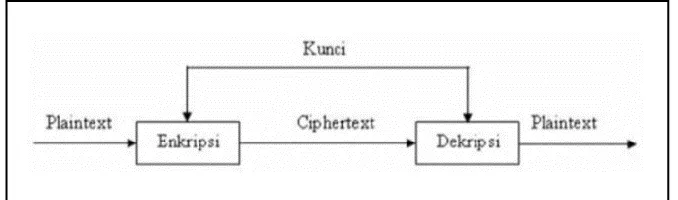
Cryptography is a technique to maintain the confidentiality of a message by encoding it so that it cannot be understood anymore. Cryptography has an algorithm in the coding process so that authenticity can be maintained. The scheme of the cryptographic system can be seen in the image below:
Figure 1 Scheme of the Cryptographic
RESULTS METHOD
Testing Method
Licensed under Creative Common Page 549 observe the results of interface execution through test data and functional checking of applications that have been made.
Encryption System
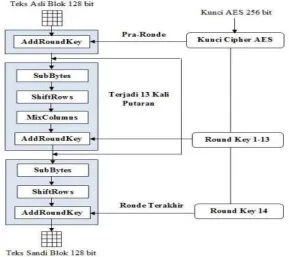
At the beginning of the encryption process, the input that has been copied into the state will undergo an AddRoundKey byte transformation. After that, the state will undergo SubBytes, ShiftRows, MixColumns, and AddRoundKey transforms as many times as this process in the AES algorithm is called the round function. The last round is somewhat different from the previous rounds, where in the last round the state did not experience the MixColumns transformation. In Figure 2 is a flow diagram of the AES encryption algorithm.
Figure 2 Encryption Flowchart
System Planning In Transactions
General system design procedures for adaptive E-Commerce development consist of several stages, including the design of program specifications, design of description and description, design of interfaces, and system testing.
Licensed under Creative Common Page 550 Figure 3 Use Case Diagram Administrator and Customers
RESULTS AND DISCUSSION
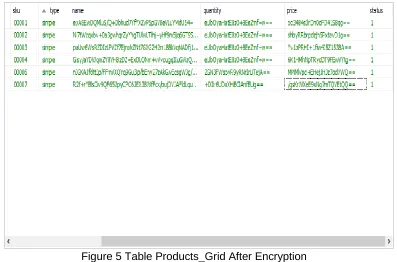
The Implementation encryption process is performed on a table contained in the database then a description is made to display the application page. This design consists of a list of fields to be encrypted, the conditions of the fields before they are encrypted, and the conditions after they are encrypted.
Before Encrypting
In the Product_Grid Table the encryption in the name, quantity and price fields is all normal and has not been encrypted as shown in Figure 4.
Licensed under Creative Common Page 551
After Encrypting
The Product_Grid Table After Encrypting the name field, the quantity and price have changed because encryption has been performed. as shown in Figure 5.
Figure 5 Table Products_Grid After Encryption
Implementation of SSL Certificate
The process of implementing SSL is done on the website throughout the application page to maintain the security of the application system and the identity of a website. The application page above the application of ssl has been done with the name url https://www.softrever.com/ and the application can run well, can be seen in Figure 6 below.
Licensed under Creative Common Page 552
Home Interface
This page is the first page that appears when E-commerce is accessed, on this page the customer can make an item transaction by looking at the details of the item that he wants to buy as shown in Figure 7 below.
Figure 7 Home Interface Page
Blackbox Testing Interface
Blackbox Testing is a testing phase where the emphasis is on the interface.
Table 1 Blackbox Testing Interface
CONCLUSION
From the results of the research and discussion it can be concluded that:
1. The process of encrypting and describing product data and transaction data in e-commerce applications is successfully carried out and can maintain data in the database with the results of encryption so as to avoid data theft from the database directly.
No Testing Expected result Test result
1. Interface halaman List Product
Halaman menu List Product
Corresponding
2. Interface halaman Login
Halaman menu Login Corresponding
3. Interface halaman Logout
Licensed under Creative Common Page 553 2. Can strengthen the security system in e-commerce applications, so it can be assumed that the cryptographic method using AES encryption can be applied to this e-commerce application.
3. With the implementation of security methods using SSL can keep the security system of e-commerce applications from attacks carried out through computer networks.
RECOMMENDATIONS
Suggestions that can be used for developing this application are as follows:
1. The application still needs to add a certification authority / digital signature which functions to verify the identity of the sender and recipient so as to minimize fraud committed by people whose identities are unknown.
2. Applications can be combined with other cryptographic algorithms by following the development of data security science.
3. Ciphertext can be combined with data compression algorithms, so the results of encryption are not too long.
REFERENCES
Andre. M, Carolina. (2010). Keamanan Dalam Electronic Commerce, Bina Nusantara University Jakarta.
Asri Prameshwari, Nyoman Putra. (2018). Implementasi Algoritma Advanced Encryption Standard (AES) 128 Untuk Enkripsi dan Dekripsi File Dokumen. Universitas Udayana.
Chey. C (2004). Cryptography For Dummies. Indianapolis, Canada.
Kartika Imam Santoso. (2015). Metode Keamanan E-commerce. STMIK Bina Patria Magelang.
Mateus, (2013). Tinjauan Keamanan Sistem Transaksi dan Pembayaran Pada E-commerce Studi Kasus Toko Online www.buahonline.com.
Pradnya B. Rane, B. B. Meshram . (2012). Application-Level and Database Security for E-Commerce Application. Veermata Jijabai Technological Institute, Matunga, Mumbai.
Revi Fajar Marta. (2013). Impementasi Kriptografi Pada E-commerce. Institut Teknologi Bandung.
Yanti Rusli Neti (2018). Implementasi Algoritma Data Encryption Standard Pada Penyandian Record Database, Teknik Informatika STMIK Budidarma Medan.
Harold Situmorang. (2016). Keamanan Basis Data Dengan Teknik Enkripsi, Universitas Sari Mutiara Indonesia. https://epolebusiness.wordpress.com/2008/06/04/keamanan-e-commerce.