2322
Improved Constraint Decision Model for Multicast
Routing in Wireless Ad Hoc Network
Trannum, Dr. Charanjit Singh, Dr. Rajbir Kaur
Abstract— MANET is the type of ad hoc network that has no fixed network infrastructure. It consists of mobile nodes distributed arbitrarily. The data transmission in MANET is dependent on the location of the network, thus, to send the data to group of destination multicast routing protocols are developed. These protocols perform well but they lack in optimum route selection. Many researchers have developed different techniques to enhance the effectiveness of multicast routing protocols. A protocol named EFMMRP is proposed, however, it is not capable of achieving the optimal route and reducing the cost value of the network. Thus, in this paper, a novel approach is developed to increase the energy efficiency of multicast routing protocols. Fuzzy based decision system is implemented to estimate the cost value and next hop selection method is also enhanced by implementing Random Waypoint Mobility Model. Results are attained through the simulation of the proposed protocol using MATLAB. It is observed that the proposed protocol is better than the existing EFMMRP.
Index Terms— Fuzzy Logic, Random waypoint model, routing protocol, multicasting
—————————— ——————————
1 I
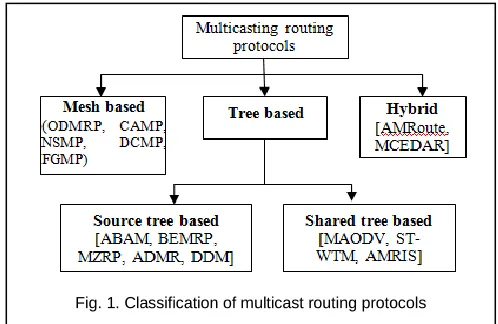
NTRODUCTION MOBILE Ad-hoc network (MANETs) is the type of ad hoc network which contains a number of wireless nodes that can communicate with each other. MANET does not require any infrastructure in order to transmit the data. The data is delivered from source node to the target node by applying multi hop routing. However, there are a significant number of constraints due to limitations and networks uncertainty of radio interface [1]. Most challenging concern in MANET is the multicast routing. In this type of routing, the frequent and unpredictable changes in the topology caused by host mobility, link breakage and host failure cannot be handled in an effective way. Multicasting is a method to determine the routes for the data transmission to a group of targets in the network. It is designed to perform group‐oriented computing that includes audio/video conferencing, collaborative works, and etc [2]. As mentioned above, presently, MANET is the challenging environment to execute multicasting. [3,4]. MANET is a self organizing network with the collection of various wireless mobile nodes. These nodes create a dynamic and temporary wireless network on a shared wireless channel without using any centralized administration. Though, MANET has changeable network topology because of the node mobility and availability of limited bandwidth. In order to operate this type of network, there is requirement to design these parameters in a novel way. Furthermore, an effectual routing protocol acclimatizing to both node mobility and possible channel error is significant to achieve a better route for transmitting data [5, 6]. Multicasting is emerging as popular technique due to its advantages such as offering efficient bandwidth decreases the cost of communication, it provides delivery of data with efficacy supporting dynamictopology with boundless mobility [7].The broadcasting capabilities of the Radio interface has the capability to broadcast the data, this feature is used for transmitting multicast traffic in each and every cell in the network. On the basis of the capacity and specific signaling protocols, multicasting technique needs technological constraint. Multicast routing protocols in MANET are classified into two broad categories: tree based and mesh based routing protocols. The classification of the multicast routing protocols is shown in figure 1.
Tree based multicast routing protocols provide only one route between a sender (source node) and a receiver (target or destination node). This protocol lacks in robustness against regular changes in the topology. Nonetheless, tree based protocol is suitable for the environments with low node mobility [8]. Ad hoc multicast routing protocol utilizing increasing id numbers (AMRISs) [9], multicast ad hoc on-demand distance vector (MAODV) [10] are some tree based protocols. In a mesh‐based protocol, redundant routes are available for transmitting the data if one path is broken or not capable of delivering the multicast packets. Along with this, the structure of the network is recreated less frequently which in turn provide low control overhead. Mesh‐based protocol, therefore, is beneficial as it is robust at a cost of redundancy in data transmissions, but it decreases the efficiency. The major ————————————————
Trannum is currently pursuing masters degree program in Electronics and Communication engineering in Punjabi University, Patiala, India. E-mail: [email protected]
Dr. Charanjit Singh is working as an Assistant Professor in department of Electronics and Communication in Punjabi University, Patiala, India Dr. Rajbir Kaur is working as an Assistant Professor in department of
Electronics and Communication in Punjabi University, Patiala, India.
difference between multicast trees and meshes is that the data packets in multicast meshes can be delivered over more than one path 4, 5. The routing protocols are developed in order to deal with the problems in the MANET. As route to deliver data from one node to another is dependent on the location, this paper is presenting a novel approach to achieve the efficient performance of the routing protocol in terms of cost efficiency and better performance. It also includes the mechanism to update the next hop selection by considering the distance factor from source node to target node. This paper is divided into different sections that present the literature review, description of the techniques used in the proposed work, and the simulation results obtained.
2
L
ITERATUREThis section, explains the work done by several authors in the field of multicast routing protocols. Ajay Kumar Yadav, Santosh Kumar Das et al. [13] made an effort to control the uncertainties issues to save the network resources by introducing fuzzy logic tool in the network. This technique converts the entire available network metrics of the routes into a single metric called as communication cost. The path that comprises the minimum fuzzy cost is considered to an optimum path. This path is used for delivering the data to the group of destinations. According to M. Jahanshahi [14], the main purpose of ad-hoc multicast routing protocols is to create and maintain a strong and efficient topology in order to deal with dynamic network and limited bandwidth. Author considered mesh-based multicasting more robust and reliable than tree-based multicasting. Biswas et al. [15], projected an efficient hybrid mesh‐based multicast routing protocol. The aim of proposing this technique is to split data forwarding path from join‐query forwarding path by integrating clustering technique with low overhead and to send data packets using DDM. In DDM approach, each header of data packet is provided with multicast tree information. The scalability problems of ODMRP are solved by using this protocol as the efficiency of multicasting is increases for different environments the overall control overhead is reduced. The simulation results demonstrated that this protocol has the capability of reducing the control overhead and increasing the packet delivery ratio (PDR) by 20% to 50% for different network environment. Lu et al., [16], in the paper, had proposed a multicast routing model to attain minimum end-to-end delay and reduced energy consumption. The genetic algorithm is the strategy to find a route, it is considered as an evolutionary model. Optimum multicast tree path is obtained by implementing genetic evolutions present in the proposed work on possible multicast trees. The ratio of energy consumption and end-to-end delay is determined by the cost function. The experimental study of this proposed model revealed the finding of optimal multicast tree with minimum consumption of energy and least end-to-end delay. The important constriction of the proposal is estimation of overhead, as the process complexity of GA is non linear; therefore, the process complexity of the process is complimented with the increased size of the network. The other limitation of the model is that overall multicast tree lifespan is not considered as a factor route selection in the
proposed method.
3 F
UZZYL
OGICFuzzy logic is an extension of Boolean logic by Lotfi Zadeh in 1965 [17] based on the mathematical theory of fuzzy sets, which is a generalization of the classical set theory. Fuzzy approach uses the fuzzy operators and fuzzy sets. IF-THEN rules are implemented in the fuzzy that makes it more useful to analyze every possible scenario. The syntax of fuzzy rules is like a conditional statement which is given as follows:
IF x is A THEN y is B
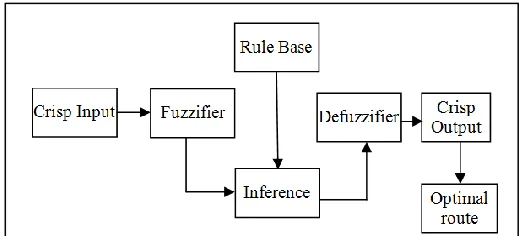
Fuzzy logic is used as it provides better decision system that also assists in estimating the cost value. With the help of fuzzy decision support system, inaccurate knowledge about linear and non-linear issues can be tackled with ease. Several problems have successfully been solved by these systems such as tool conditions monitoring, cloud computing, traffic control systems, portfolio management and environmental diseases. Regrettably these systems require an expert system which can evaluate the fuzzy knowledge database effectively and can automatically construct a knowledge base. However, the decisions made by fuzzy for the routing protocols are effective in terms of cost due to advantages of fuzzy based decision system. Fuzzification process is performed which consists of different phases shown in figure 2.
The input (crisp input) is given to the fuzzy system as different parameters such as delay, remaining energy, distance, and throughput and trust node. This crisp input is mapped into the fuzzy input by using the membership functions of above mentioned factors. these MFs are used to fuzzify the input. A rule base is developed according to all the scenarios in order to predict the output for the MANET. This is how the fuzzy system is used to increase the efficiency of the multicast routing protocol.
3.1 RANDOM WAYPOINT MOBILITY MODEL
The implementation of the fuzzy based system enhances the system performance by increasing the parameters, but the protocol is made more effective by using random waypoint (RWP) model for the mobility of the sensor nodes. RWP is mostly used in the ad hoc networks due to its various advantages such as: By applying this model to the network, the change in the location, speed and acceleration of the mobile nodes in MANETs can be easily tracked. Along with this, this model is used for the simulation purposes during the
2324 analysis of the novel protocols developed for the network.
4 PRESENT
WORK
Each sensor in a WSN has limited energy, memory and computational capacity. A significant number of nodes are deployed in wireless sensor networks, Nodes are densely basically sense highly redundant and co-related data. Thus, delivering the redundant packets to the base station increases the congestion and consumption of energy in the network. Various protocols have been proposed for data transmission and to avoid overpowering amounts of traffic in the network. But in data communication only data aggregation does not affect the performance of the network also route selection strategy play major role in network improvement. As in previous protocol name ESDAD the main focus was on data aggregation but the next hop selection was lied on maximum cost function dependent on multiple factors. But only a single factor with max value can maximize the cost value. Rest of the factors will not get maximized to achieve better selection of hop in network. Thus, to overcome the problem that was analyzed, the fuzzy controller is to design which will be dependent on the QOS parameters as Energy, communication distance, Buffer availability and link strength. One distance factor is introduced in the proposed model. This fuzzy system will provide better performance because of the reason the fuzzy will be dependent on all the factors and gives the cost values which will be calculated in terms of selection factor. Not a single parameters can give increased cost value as it was there in the previous protocol. The better selection of the next hop and best route will overcome many problem those can affect the performance of the network.
5 EXPERIMENTAL
RESULTS
This section explains the results acquired after implementing the proposed work. In this work, fuzzy system is implemented by increasing the number of parameters to enhance the performance of MANETs. The role of location in transmitting the data introduced distance factor and trust node in this model. The parameters that are taken into account are- delay, energy, trust node, distance and throughput of the network. The fuzzy architecture of the proposed work is represented in figure 3.
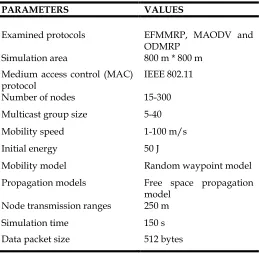
In figure 3, it is represented that fuzzy architecture consists of one system decision fuzzy (mamdani) which comprise of 81 rules and it receives four input variables i.e. distance, energy, delay and throughput and gives the output which determine the trust factor. The output i.e. the trust node consists of five membership functions and each input factor consists of three membership functions. Also, the parameters have been introduced that are used in simulation set-up. The simulation scenario of a proposed protocol in a wireless mobile ad-hoc network is to be framed in the area of 800 ×800 m^2 having 15–300 mobile nodes. Random way point network model has been used as mobility model and the free space propagation model has been used as propagation model in the simulation. The Constant Bit Rate (CBR) is used as the traffic type. The parameters that are used in the simulation are listed in Table 1.
On the basis of all these parameters, the efficient network route can be formed by considering the factors such as, delay, distance, residual energy and bandwidth. In figure 4, the formation of the route has been shown:
TABLE1
PARAMETERS USED IN SIMULATIONS
PARAMETERS VALUES
Examined protocols EFMMRP, MAODV and
ODMRP
Simulation area 800 m * 800 m
Medium access control (MAC) protocol
IEEE 802.11
Number of nodes 15-300
Multicast group size 5-40
Mobility speed 1-100 m/s
Initial energy 50 J
Mobility model Random waypoint model
Propagation models Free space propagation
model
Node transmission ranges 250 m
Simulation time 150 s
Data packet size 512 bytes
The graph of figure 4 depicts the formation of route on the basis of regarded four factors and the considered parameters. The user selects the source and destination node. In the above figure, nodes N8 and N6 represents the source and destination node respectively. After this, every node has been evaluated on the basis of considered four factors i.e. distance, delay, residual energy and bandwidth. The evaluated outcomes are then given to the fuzzy system which decides the trust value of the nodes. And then, the nodes are selected on the basis of trust value and other factors. The above graph represents that nodes which are selected on the basis of trust value and four factors are N14, N29, N16, N25, N17, N11, N3 and N12. All of these nodes then form the trustworthy and reliable route from the source node N8 to the destination node N6. The performance of the proposed protocol has been evaluated by considering the factors such as packet delivery ratio (PDR) and packet delivery delay.
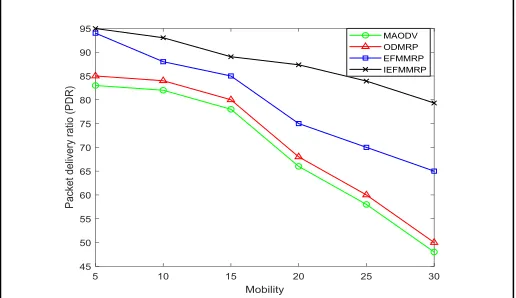
The comparison analysis of existing protocols’ and the proposed protocol’s packet delivery ratio with respect to varying mobility speed is depicted in figure 5. The graph of the above figure clearly depicts that, as the node mobility increases the packet delivery ratio (PDR) decreases relatively. The EFMMRP protocol is better than other two existing protocols i.e. MAODV and ODMRP as the PDR of the EFMMRP varies from 95 to 65. But, the proposed protocol outperforms the EFMMRP protocol also as the PDR of proposed one varies from 95 to 79. Thus, it demonstrates that the performance of the proposed IEFMMRP is better as compared to existing protocols in terms of packet delivery ratio.
Since the network metric changes very frequently due to high mobility speed the result is not to be selected a stable and optimal multicast routing path. Excess time is wasted in the selection of optimal multicast routing path in a network because of uncertainty issues that leads to packet delivery delay. It is represented in the figure 6 that with the increase in node mobility the packet delivery delay also increases relatively. The graph illustrates that the proposed protocol has the minimum packet delivery delay in contrast to other existing protocols, which implies that proposed approach is efficient in terms of packet delivery delay.
Figure 7 shows, the performance of the four multicast routing protocols. The packet delivery ratio (PDR) increases relatively with the number of nodes in a wireless mobile ad-hoc network. The EFMMEP provides better results than MAODV and ODMRP as its PDR varies from 82 to 98. But the proposed protocol (IEFMMRP) outperforms all the existing protocols in terms of PDR as it has the maximum value of packet delivery ratio which varies from 94 to 98. Thus, it is demonstrated from all the results that the performance of proposed protocol is optimal than other existing protocols in terms of packet delivery ratio and packet delivery delay.
Fig.5. Comparison analysis of PDR with respect to mobility
Fig. 6. Comparison analysis of packet delivery delay with respect to mobility
2326
6 CONCLUSION
This paper proposes an efficient fuzzy based multi-constraint multicast routing protocol for a wireless mobile Ad-hoc network. The proposed fuzzy system is dependent on the QOS parameters as Energy, communication distance, Buffer availability and link strength. One distance factor is introduced in the proposed model. This fuzzy system provides better performance because of the reason the fuzzy will be dependent on all the factors and gives the cost values which will be calculated in terms of selection factor. The better selection of the next hop and best route will overcome many problem those can affect the performance of the network. Our proposed protocol has been simulated for which various simulation parameters have been taken into account. Random way point network model has been used as mobility model and the free space propagation model has been used as propagation model in the simulation. The performance is compared with some other existing multicast routing protocols (ODMRP, MAODV and EFMMRP) considering several network performance parameters: packet delivery ratio, packet delivery delay that shows that proposed approach i.e. IEFMMRP is efficient in contrast to existing one.
R
EFERENCES[1] A Viswanath, N Papanna, Tirupati, ―Survey on Multicast Routing Protocols in MANETs‖, IJSETR, Volume 5, Issue 7, July 2016, ISSN: 2278 – 7798.
[2] Javad Akbari and Mohammad Reza Meybodi, ―Multicast Routing Protocols in MANET‖, echnological Advancements and Applications in Mobile Ad-Hoc Networks: Research Trends. 10.4018/978-1-4666-0321-9.ch002.
[3] Luo Junhai, Ye Danxia, et al., ―Research on Topology Discovery for IPv6 Networks‖, IEEE, SNPD 2007 3 (2007) 804–809. [4] S. Toumpis, ―Wireless Ad-Hoc Networks‖, in: Vienna Sarnoff
Symposium, Tele-communications Research Center, April 2004. [5] Cordeiro CM, Gossain H, Agrawal DP, ―Multicast over Wireless
Mobile Ad Hoc Networks: Present and Future Directions‖, IEEE Network 2003;17(1):52–9.
[6] Cui XX, Lin C, Wei YY, ―A Multiobjective Model for QoS Multicast Routing based on Genetic Algorithm‖, In: Proceedings of the 2003 international conference on computer networks and mobile computing (ICCNMC’03), Shanghai, China, October 20–23, 2003. p. 49–53
[7] D.Madhu Babu, M.Ussenaiah, ―An Analysis and Survey on Multicast Routing Protocols for Mobile Ad hoc Networks‖. [8] S. Rajarajeswari, P.Angaiyarkanni, A.Arockia Selvaraj, ―Survey
on Tree Based, Mesh Based and Stateless Multicast Protocols in MANET," International Journal of Innovative Research in Computer and Communication Engineering, vol. 2, 2014, [9] P. SAHU, "Disadvantage of AMRIS Protocol and its solution,"
International Journal of Engineering Research and Technology, 2012.
[10]C.-H. Huang, C.-T. Wu, K.-W. Ke, and H.-T. Wu, "MAODV-based Multisource Multicast Routing with Fast Route Recovery Scheme in MANETs," in Computer Symposium (ICS), International, pp. 79-84, 2010.
[11]Xie J, Talpade R, Mcauley A, Liu M, ―AMRoute: Ad Hoc Multicast Routing Protocol‖, Mobile Networks and
Applications 2002; 7: 429–439.
[12]Sinha P, Sivakumar R, Bharghavan V. ―MCEDAR: Multicast Core‐Extraction Distributed Ad‐Hoc Routing‖, IEEE Wireless Communications and Networking Conference, 1999; 1313–1317. [13]Ajay Kumar Yadav , Santosh Kumar Das, Sachin Tripathi , ―EFMMRP: Design of Efficient Fuzzy Based Multi-Constraint Multicast Routing Protocol for Wireless Ad-Hoc Network‖ [14]M. Jahanshahi, M. Dehghan, and M. R. Meybodi, "LAMR:
Learning Automata based Multicast Routing Protocol for Multi-Channel Multi-Radio Wireless Mesh Networks," Applied intelligence, vol. 38, pp. 58-77, 2013.
[15]J. Biswas, M. Barai, S. K. Nandy, ―Efficient Hybrid Multicast Routing Protocol for Ad hoc Wireless Networks,‖ in Proceedings of 29th Annual IEEE International Conference on local computer networks, pp. 180‐187, 2004.
[16]Lu, T. and Zhu, J. ―Genetic Algorithm for Energy-Efficient QoS Multicast Routing‖, IEEE Communications Letters, Vol. 17, No. 1, pp.31–34, (2013).