1048 IJSTR©2019
www.ijstr.org
Communication Skills And Mathematical Problem
Solving Ability Among Junior High Schools
Students Through Problem-Based Learning
Syaiful, Muslim, Nizlel Huda, Amirul Mukminin, Akhmad HabibiAbstract: The purpose of this study was to examine the communication skills and mathematical problem solving ability among junior high school students through problem-based learning. This study involved 120 seventh grade students. This study used two kinds of tests and attitude scale, namely: communication skills test, problem solving ability test, and attitude scale. The result of this study showed that problem-based learning (PBM) was better, compared to conventional learning in improving students’ mathematical communication skills. Judging from the learning and school factors, the study indicated that problem-based learning (PBM) had a more significant influence on improving students’ mathematical communication skills. Based on the learning factors and gender differences, the finding indicated that problem-based learning (PBM) had a significant influence on improving communication skills and mathematical problem solving ability, both on male and on female students. Problem-based learning (PBM) was significantly better at improving students' mathematical problem solving abilities compared to conventional learning. Problem-based learning (PBM) has an impact on the formation of students’ positive attitudes towards mathematics.
Index Terms: communication skills, mathematical problem solving ability, problem solving
—————————— ——————————
1.
INTRODUCTION
In Indonesia, the learning pattern is still struggling with the knowledge collection, including in higher education. Indonesian students may have not been prepared to adapt and learn new things quickly. Problem complexity should be solved by cross science. Additional skills needed are cognitive flexibility, adaptability, and rapid learning. Indonesian students must be trained to learn how to deal with changes. They must be trained to think independently, cooperate and dare to solve routine and non-routine questions and new problems. Especially in mathematics education, learning mathematics in schools will certainly always direct students to think independently, cooperate and dare to solve routine and non-routine questions and new problems. One of the achievement indicators is the aspects of mathematical abilities and attitudes of students towards mathematics learning. Mathematical abilities and attitudes of students towards mathematics learning from time to time always experience changes leading to improvement and increase in students' mathematical abilities and students’ attitudes towards mathematics. In relation with students' mathematical abilities, NCTM (1989) groups four aspects of mathematical abilities including mathematical problem solving abilities, mathematical communication, mathematical reasoning, and mathematical connections. These groups are in line with the demands of the capability suggested by the Indonesian government through the 2013 mathematics learning curriculum which has become the reference for the national assessment. In communication skills, NCTM (2011) suggests that we will need communication if we want to achieve full social goals such as math literacy, lifelong learning, and mathematics for everyone. Jacob (2003)
suggests that mathematics as a language so that mathematical communication is the essence of teaching, learning, and assessing mathematics. This is in line with Pugalee (2001) who states that in learning mathematics, students need to be accustomed to providing arguments for each answer and responding to answers given by others, so that what is being studied becomes more meaningful to him. Additionally, Bell (1978) states that problem solving is an important activity in teaching mathematics; because the ability to solve problems obtained in mathematics teaching can generally be transferred to be used in solving other problems. Also, Hudoyo (1979) claims that problem solving is a very essential thing in teaching mathematics as (l) students become skilled in selecting relevant information, then analyzing it and finally examining the results, (2) intellectual satisfaction will arise from within, (3) students' intellectual potential increases, and (4) students learn how to make discoveries through the process of making discoveries. The implementation of daily mathematics learning rarely asks students to communicate mathematical ideas so that students are very difficult to provide precise, clear, and logical explanations for the answers. Students are not accustomed to solving mathematical problems that require a plan, strategy, and exploring the ability to generalize in solving the problems. Inappropriate learning processes in the classroom have an impact on students' weak mathematical communication skills and mathematical problem solving. In terms of international student assessment, Indonesia is one of the countries having a lower score in PISA (Samhadi, 2012). Additionally, the TIMSS survey report in 2009, the achievements of Indonesian students were in the position of 34 of the 38 countries. Beside PISA and TIMSS, in the arena of the world mathematical competency skills, IMO (International Mathematic Olympiad) and WISO (International Mathematics and Science Olympiad), Indonesian students' mathematical achievements showed a contrast to the results in TIMSS and PISA (Supriyoko, 2008). The results of IMO and IMSO cannot necessarily be used as a benchmark for Indonesian students' mathematical abilities in general, because the events only represented by a few Indonesian students and classified as smart students, this is different from the results of TIMSS and PISA that show weak communication and problem solving Indonesian mathematical ————————————————
• Syaiful, Faculty of Teacher Training and Education, Universitas Jambi, Jambi, Indonesia.
• Muslim, Faculty of Teacher Training and Education, Universitas Jambi, Jambi, Indonesia
• Nizlel Huda, Faculty of Teacher Training and Education, Universitas Jambi, Jambi, Indonesia
• Amirul Mukminin, the Graduate School, Universitas Jambi, Jambi, Indonesia.
1049 students and both tests are more representative because they
involved thousands of Indonesian students with various levels of ability. Dealing with Indonesia’s lower positions in TIMSS, PISA, IMO, and WISO, communication skills and mathematical problem solving need to be improved because both abilities are needed in learning. The ability to communicate and solve mathematical problems can encourage students in meaningful learning. Besides, it can help students to deal with mathematical problems and everyday problems. In order to make mathematics learning in the classroom could improve students' mathematical communication skills, a good teacher must be able to provide sufficient opportunities so that each student can get used to arguing for each of his ideas and concepts. Learning should be designed through problems that enable students to make mathematical communication well. Klopfer (1992) argues that teachers must provide opportunities and assess students' ability to solve problems critically with complex situations, and teachers must work more subjective on the evaluation to understand students’ reasons. Communication skills and problem solving are capabilities that can help students better understand mathematics as a whole and make mathematics more meaningful. It will be very contrary to what happens in the field. Students' mathematical prerequisite abilities are very important in problem-based learning. Therefore, school qualifications also need to be considered in problem-based learning. The results of the study done by Juandi (2006) indicated that mathematical abilities of students who have high prerequisite abilities is better than students with moderate and low prerequisite abilities. Regarding students' ability differences, a study done by Sumarmo (1997) showed that in problem solving strategies, for upper group students, even though they had right answers, but there were still missing steps, and they had difficulties in checking the applicability of a theorem while the lower group students did not have the correct answer. Regarding gender differences, this becomes a natural factor that needs to be considered as well. Fenomena (2000) argues that in solving problems, female students tended to use more concrete strategies than male students who tended to use more abstract strategies. Furthermore, Fenomena (2000) states that the difference was only apparent during the middle school period and continued at the next school level. The purpose of this study was to examine the communication skills and mathematical problem solving ability among junior high schools through problem-based learning. The following
questions guided the study: ... 1. Are there any differences in the increase of mathematical
communication skills between groups of students through using the PBM approach and conventional learning approach?
2. Is there any interaction between learning processes and school qualifications in improving students' mathematical communication skills?
3. Is there any interaction between learning processes with gender differences in improving mathematical communication skills?
4. Are there any differences in the improvement of mathematical problem solving skills between groups of students who used PBM and who used conventional learning?
5. Is there any interaction between learning processes and school qualifications in improving students' problem solving ability?
6. Is there an interaction between learning processes with gender differences in improving students' problem solving ability?
7. Are there any differences in attitudes towards mathematics between students in quality school with students in average school?
2 METHODS
This study used a quasi-experimental design in the form of a pretest-posttest control group design. For the group distribution, two public schools were chosen which generally had different qualities, one school qualified as a good level school and one was a medium school level based on the categories from the Jambi Department of Education. Of the schools, two homogeneous classes were chosen, one class was made into the experimental class and the other class was used as the control class. In the experimental class, mathematics learning was carried out with a problem-based learning approach (PBM) and conducted by the class teacher. Both classes were given a pretest before treatment and posts after treatment. The participants of this study were 60 students from each school or 120 students from both schools. In experimental and control classes, learning was done by placing teachers and researchers inside the classroom as observers. The instruments were communication skills test and students’ mathematical problem solving, observation sheets of student learning activities, student attitude scale tests on learning activities in teacher questionnaire interviews. Test questions are used to measure communication skills and mathematical problem solving of students. Questions are arranged in two packages each consisting of 6 questions to measure mathematical communication skills and 6 questions to measure mathematical problem solving abilities. The material tested in the two package questions is three chapters of material in the second semester of class VIII, namely the Tangent Lines chapter, the Cubes and Beams chapter, and the Prism and Limas chapters. Preparation of test questions begins with making a grid of questions covering the subject matter, communication skills, problem solving, and indicators. After the grid creation is continued by arranging the questions along with the answer key and the rules for giving scores for each item. Before the mathematical communication test instrument was used, it was first tested limited to a small group of junior high school students in the city of Jambi to test the readability of the questions before being tested to large groups. In addition, the question is checked and validated.
3.
RESULTS AND DISCUSSION
1050 IJSTR©2019
testing of the data collected in this study are in detail as follows.
3.1 KKMS improvement based on school qualifications and learning
The following presents the average value of improvement of students' mathematical communication skills in terms of school qualifications and the learning approach.
Table 1. KKMS achievement average value based on school
qualifications and learning
Visually, increasing of students’ mathematical communication skills can be described as follows:
Figure 1. Increasing of Students' Mathematical Communication Capabilities
In Table 1 and Figure 1 it can be seen that, in each treatment there was an increase in mathematical communication skills. As seen from the learning approach, the PBM approach experienced a much higher increase compared to the increase in the control class. Groups of schools that used PBM experienced an increase of more than 30%, while in the school group using the conventional approach only experienced an increase of less than 10%.In terms of school qualifications, in quality school, students who study with the PBM approach experience improved communication skills that are slightly superior to medium qualification schools, but in conventional learning, average schools are experiencing a slightly higher increase than good school qualifications. The spread of gain between school qualifications and learning approaches can be seen in the path of Figure 2.
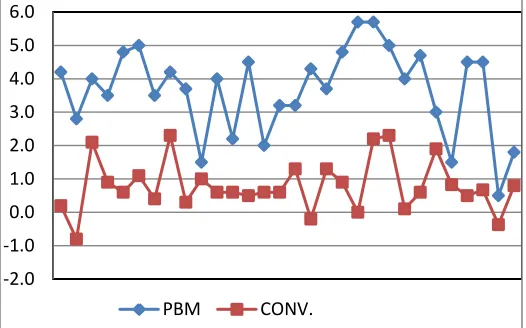
Figure 2. Data diffusion line diagram based on learning approach
From Figure 2, it can be seen that the mathematical communication skills of students using PBM have improved learning outcomes better than students who use conventional learning. Furthermore, to see further how the achievement of students' communication skills based on school qualifications and learning approaches, used statistical tests using two-way ANOVA. The results of statistical analysis are summarized in Table 2.
Table 2. Increase in KKMS based on school qualifications and
learning
H0: There is no difference in the increase in KKMS between groupsBased on Table 2, for learning factors, it turns out that H0 was significantly rejected so that it can be concluded that, the learning approach has a significant influence on improving students' mathematical communication skills. Unlike the school qualification factor, it turns out that H0 is accepted significantly so that it can be concluded that, there is no significant difference in students' mathematical communication skills between students in quality school with average schools. Similarly the interaction between learning factors with school qualifications. It turns out that H0 is accepted significantly so that it can be concluded that, the interaction between learning factors with school qualifications does not have a significant effect on improving students' mathematical communication skills.
Table 3. KKMS Gain Based on Learning 0.0
1.0 2.0 3.0 4.0 5.0 6.0
PBM CONV PBM CONV
Pretest Postest
quality school average school
-2.0 -1.0 0.0 1.0 2.0 3.0 4.0 5.0 6.0
PBM CONV.
School Qualification
Learning Approach
Pretest average
Post-test average
Gain Increase Percentage
Good
PBM 1,2 4,9 3,7 37%
CONV. 1,2 2,1 0,9 7%
Medium
PBM 1,1 4,6 3,5 35%
CONV. 1,2 2,1 0,9 9%
Factors
Normalized Gain Mean
Square df F p H0
Learning 2.634 1 185.923 .000 Reject School Qualification .000 1 .012 .915 Accept Interaction .035 1 2.496 .117 Accept
1051 t-test for Equality of Means
t df Sig.
(2-tailed
Mean Difference
Std. Error Difference
95% Confidence Interval of the
Difference Lower Upper
13.606 11
8 .000 .29633 .02176 .25320 13.606
Ho: There is no significant increase in the number of KKMS among the groups who received PBM approach with who received conventional learning.Because there were differences in students 'mathematical communication skills based on learning factors on the results of the 2-lane ANOVA, then further statistical tests were carried out by the t-test to see further differences in students' mathematical communication skills using the PBM approach and conventional learning as shown in Table 3 above. From Table 3 the value of tcount = 13,606 and value of ttable(58;0,025)=
2,001.Because tcount>ttable, then H0 is significantly rejected, so it
can be concluded that there are significant differences in the mathematical communication skills of students who get PBM with students who get conventional learning, so we can also say that PBM is significantly better for improving students' mathematical communication skills than conventional learning. Furthermore, it is seen more specifically the difference in improvement of students' mathematical communication skills between those who received PBM and conventional learning in each school qualification.
Table 4. KKMS Gain Based on Learning in Each Qualification
School
School Qualification
t-test for Equality of Means
t df Sig.
(2- tailed )
Mean Dif.
Std. Error
Dif
95% Confidence Interval of the
Difference Lowe
r Upper quality
school
9.85
7 58 .000 .3306
7
.0335 5
.2635
2 .39782 average
school
9.48
0 58 .000 .2620
0
.0276 4
.2066
8 .31804
Ho: There is no significant difference in the increase in KKMS between groups that received PBM with those who get conventional learningFrom table 4, in quality school, Value tcount = 9,857 and value ttable(58;0,025) 2,001. Because tcount>ttable
then H0 is significantly rejected, so it can be concluded that there are significant differences in mathematical communication skills of students who receive PBM in good school qualifications, or in other words PBM in good qualification schools is significantly better in improving students' mathematical communication skills than conventional
learning. As for the average school, the value of tcount= 9,480
and value of ttable(58;0,025)= 2,001. Because tcount>ttable then H0 is
rejected significantly, so it can be concluded that there are significant differences in the mathematical communication skills of students who receive PBM on average school, or in other words PBM in the average school is more significantly improve students' mathematical communication skills rather than conventional learning.
3.2. KKMS Improvement Based on Learning and Gender Differences
As an overview of the quality of student learning in terms of learning approaches and gender differences, presented in Table 5.
Table 5. Average Value of Achievement of Mathematical
Communication Capabilities Based on Learning and Gender Learning
Approaches Differences Gender Pretest average
Post-test average
Gain Increase Percentage
PBM Male 1,0 4,4 3,4 34%
Female 1,3 5,1 3,8 38%
CONV. Male 1,1 2,0 0,9 9%
Female 1,3 2,2 0,9 9%
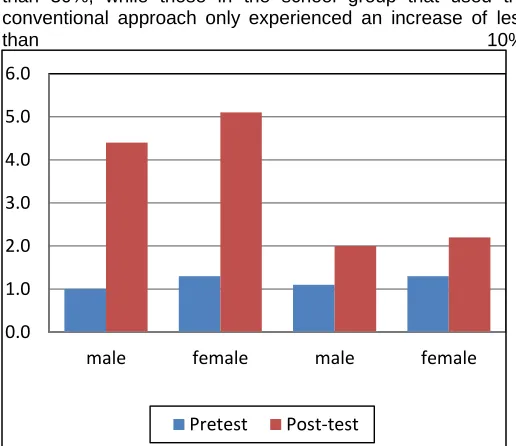
In Table 5 and Figure 4, it can be seen that, in each treatment there was an increase in mathematical communication skills. As seen from the learning approach, the PBM approach had a much higher increase compared to the increase in conventional learning classes. Both male and female groups using the PBM approach experienced an increase of more than 30%, while those in the school group that used the conventional approach only experienced an increase of less
than 10%.
Figure 3. Increase in Students' Mathematical Communication Capabilities
To see how the achievement of students' communication skills based on learning approaches and gender, statistical tests were used using two-way Anova. The results of statistical
0.0 1.0 2.0 3.0 4.0 5.0 6.0
male female male female
1052 IJSTR©2019
analysis are summarized in Table 6. Based on Table 6, for learning factors, it turns out that H0 is significantly rejected so that it can be concluded that, the learning approach has a significant influence on improving students' mathematical communication skills.
Table 6. Increased KKMS Based on Learning and Gender
Differences
Factors
Normalized Gain Mean
Square df F P H0
Learning
approach 2.634 1 187.311 .000 Rejected Gender
Differences .018 1 1.298 .257 Accepted Interaction .029 1 2.094 .151 Accepted H0: There is no difference in the increase in KKMS between groups In the factor of gender differences, it turns out that H0 was received significantly so that it can be concluded that, there is no significant difference in students' mathematical communication skills between male and female students.
Table 7. KKMS Gain Based on Learning in Male students
Groups
t-test for Equality of Means
t df
Sig. (2- tailed)
Mean Dif
Std. Error
Dif
95% Confidence Interval of the
Difference Lower Upper 8.70
7 58 .000
.2650
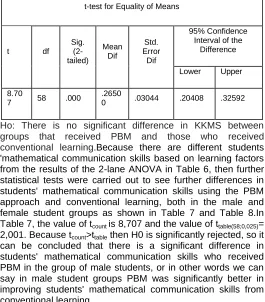
0 .03044 .20408 .32592 Ho: There is no significant difference in KKMS between groups that received PBM and those who received conventional learning.Because there are different students 'mathematical communication skills based on learning factors from the results of the 2-lane ANOVA in Table 6, then further statistical tests were carried out to see further differences in students' mathematical communication skills using the PBM approach and conventional learning, both in the male and female student groups as shown in Table 7 and Table 8.In Table 7, the value of tcount is 8,707 and the value of ttable(58;0,025)=
2,001. Because tcount>ttable then H0 is significantly rejected, so it
can be concluded that there is a significant difference in students' mathematical communication skills who received PBM in the group of male students, or in other words we can say in male student groups PBM was significantly better in improving students' mathematical communication skills from conventional learning.
Table 8. KKMS Gain Based on Female Student Groups
t-test for Equality of Means
t df Sig. (2- tailed) Mean Dif Error Std. Dif
95% Confidence Interval of the
Difference Lower Upper 10.63
7 58 .000 .32767 .03080 .26601 . 38933
Ho: There is no significant difference in KKMS between groups that received PBM and those who received conventional learningIn Table 8 the value of tcount = 10,637 and
the value of ttable(58;0,025) 2,001. Because tcount> ttable then H0 is
significantly rejected, so it can be concluded that there are significant differences in the improvement of students' mathematical communication skills in PBM in the female student group, or in other words we can say that in female students groups PBM are significantly better in improving their ability student mathematical communication rather than conventional learning.
3.3. KPMMS Improvement Based on School Qualifications and Learning
The findings of this study are mathematical problem solving abilities starting from mathematical problem solving abilities in terms of school qualifications and learning approaches.
Table 9. Average value of Mathematical Problem Solving Ability Based on School Qualifications and Learning
School Qualification
Learning Approach
Pre-test Average value
Post-test Average value
Gain The increase (%)
Good
PBM 1,2 4,5 3,3 33%
CONV. 1,0 1,9 0,9 9%
Medium
PBM 1,2 4,2 3,0 30%
CONV. 1,0 2,1 1,1 11%
1053
Figure 4. Increasing Students' Mathematical Problem Solving
Ability
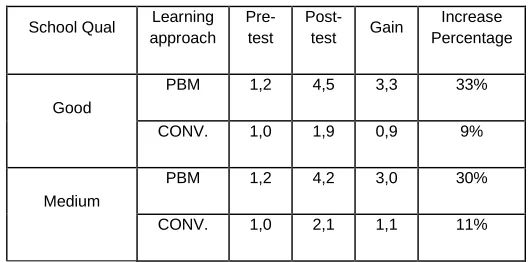
In Table 9 and Figure 4, it can be seen that, in each treatment there was an increase in mathematical problem solving abilities. As seen from the learning approach, the PBM approach experienced a much higher increase compared to the increase in the control class. In terms of school qualifications, in a quality school an increase in problem-solving abilities of students using the PBM approach is slightly superior to students in average school, but in conventional learning, students in average school are experiencing slightly higher mathematical problem solving abilities than good qualification schools. As for the spread of gains between school qualifications and learning approaches, can be seen in Figure 5.
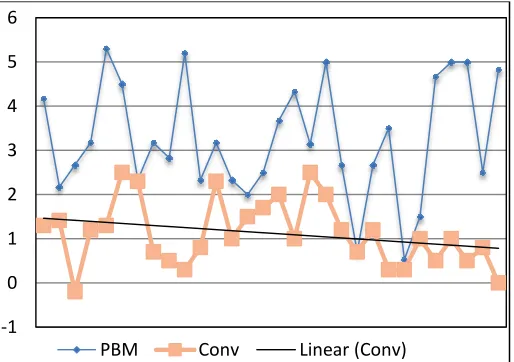
Figure 5. Data Distribution Diagram Based on Learning
From Figure 5, it can be seen that the mathematical problem solving abilities of students using PBM have improved learning outcomes better than students who use conventional learning. Furthermore, to see further how the achievement of students' problem solving abilities based on school qualifications and learning approaches, statistical tests were used using two-way ANOVA. The statistical test results are summarized in Table 10.
Table 10. Increased KPMMS Based on School Qualifications and Learning
Factors
Normalized Gain Mean
Square df F p H0
Learning
approach 1.825 1 135.323 .000 Rejected
School Qualification
3.00E-005 1 .002 .962 Accepted
Interaction .035 1 2.571 .112 Accepted
H0: There is no difference in the increase in KPMMS between groupsBased on Table 10, for learning factors, it turns out that H0 was significantly rejected, so it can be concluded that the learning approach has a significant influence on improving students' mathematical problem solving abilities. In the school qualification factor, it turned out that H0 was received significantly, so it can be concluded that there were no significant differences in the improvement of students' mathematical problem solving abilities between students in quality school and average schools. Because there are significant differences due to differences in treatment in learning on the results of the two-lane ANOVA in Table 10, further statistical tests were conducted to see further differences in students' mathematical problem solving abilities using the PBM approach and conventional learning approach.
Table 11. KPMMS Gain Based on Learning
t-test for Equality of Means
t df Sig. (2- tailed)
Mean Dif
Std. Error
Dif
95% Confidence Interval of the
Difference Lower Upper 11.605 118 .000 .24667 .02126 .20457 .28876
Ho: There is no significant difference in KPMMS between groups that receive PBM with those who get conventional learning. From Table 11 above the value of tcount is 11,605 and
the value of table(58;0,025) = 2,001. Because count>table, then H0 is
significantly rejected, so it can be concluded that there are significant differences in mathematical problem solving abilities of students who get received PBM is significantly better in improving problem solving skills students mathematics and conventional learning. Furthermore, it is seen more specifically the differences in the improvement of students' mathematical problem solving abilities between those who received PBM and conventional learning in each school qualification. The results of the statistics are summarized in Table 12.
0 1 2 3 4 5
PBM
CONV.
PBM
CONV.
Pretest Post-test
-1 0 1 2 3 4 5 6
1054 IJSTR©2019
Table 12. KPMMS Gain Based on Learning in Each Qualification School
School Qual.
t-test for Equality of Means
t df Sig.
(2- tailed)
Mean Dif
Std. Error
Dif
95% Confidence Interval of the
Difference Lower Upper Quality
school 9.011 58 .000 .2806
7
.0311 5
.2183
2 .34302 Average
school 7.389 58 .000 .2126
7
.0287 8
.1550
6 .27028 Ho: There is no significant difference in the increase in KPMMS between the groups that received PBM with those who get conventional learning. In good qualifying schools, the value of tcount= 9,011 and the value of ttable(58;0O25)= 2,001.
Because tcount>ttable then H0 is significantly rejected, so it can
be concluded that there are significant differences in the improvement of mathematical problem solving abilities of students who get a PBM approach in quality school, or in other words in quality school PBM is significantly better in improving students’ mathematical problem solving skills rather than conventional learning. As for average schools, the value of thitung= 7.389 and the value of ttabel(58:0.025)= 2,001. Because
tcount>ttable, then H0 is significantly rejected, so it can be
concluded that there are significant differences in mathematical problem solving abilities of students who received the PBM approach to average school, or in other words the PBM approach is significantly better in improving students' mathematical problem solving abilities than conventional learning approach.
3.4. KPMMS Improvement Based on Learning Factors and Gender difference
Increase of students' mathematical problem solving abilities based on learning factors and gender differences. As a general description of the quality of student learning in terms of learning approaches and gender differences, a summary of the results of the study data is presented in Table 13 below:
Table 13. Average Value of KPMMS Achievement Based on Learning and Gender
Learning Approaches
Gender Dif.
Pre-test Average value
Post-Test Average
Value
Gain Increase Percentage
PBM Male 1,2 4,2 3,0 32%
Female 1,3 4,4 3,2 32%
CONV. Male 1,0 1,9 1,0 10%
Female 1,0 2,0 1,0 10%
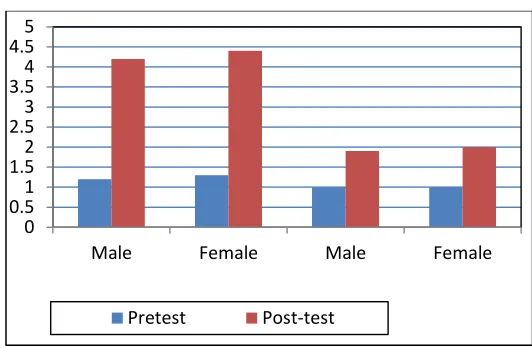
Visually, students' mathematical problem solving abilities increase can be described as follows:
Figure 6. Increasing Students' Mathematical Problem Solving
Ability
In Table 13 and Figure 6 it can be seen that, in each treatment there was an increase in mathematical problem solving abilities. As seen from the learning approach, the PBM approach had a much higher increase compared to the increase in conventional learning approach. Regarding to learning approach and gender, statistical tests were used using two-way ANOVA. The results of statistical analysis are summarized in Table 14.
Table 14. KPMMS Increase Based on Gender Learning and Differences
Factors
Normalized Gain Mean
Square df F P H0
Learning approach 1.825 1 132.880 .000 Rejected School Qualification .004 1 .281 .597 Accepted Interaction .002 1 .152 .698 Accepted Based on Table 14, for learning factors, it turns out that H0 was significantly rejected, so it can be concluded that the learning approach has a significant influence on improving students' mathematical problem solving abilities. In the factor of gender differences, it turned out that H0 was accepted significantly, so it can be concluded that there was no significant difference in students' mathematical problem solving abilities between male and female students. Because there are differences in problem-solving abilities based on learning factors based on the results of the two paths in Table 14, then a t-test is carried out to see further differences in the improvement of students' mathematical problem solving abilities using PBM learning approaches and conventional learning, both in the male student group and in female students group. The statistical test results are summarized in Table 15 and Table 16.
0 0.51 1.52 2.53 3.54 4.55
Male Female Male Female
1055 Table 15. KPMMS Gain Based on Learning in Male Groups
Gender Dif
t-test for Equality of Means
t df Sig.
(2- tailed)
Mean Dif
Std. Error
Dif
95% Confidence Interval of the
Difference
Lower Uppe r
Male 8.045 58 .000 .23833 .02963 .17903 .2976 4
Ho: There is no significant difference in the increase in KPMMS between groups who received PBM with those who received conventional learning. From Table 15 in the group of male students, the value of tcount = 8.045 and t table (58: 0.025) = 2.001. Because tcount> t table H0 is significantly rejected, so it can be concluded that there are significant differences in the improvement of mathematical problem solving abilities of students who receive PBM in the male student group, or in other words the PBM male student group is significantly better in improve students' mathematical problem solving skills rather than conventional learning.
Table 16. KPMMS Gain Based on Learning in Women's Groups
Gender Dif
t-test for Equality of Means
t df Sig.
(2- tailed )
Mean Dif
Std. Error
Dif
95% Confidence Interval of the
Difference Lower Upper
Female 8.256 58 .000 .25500 .03089 .19318 .31682
Ho: There is no significant difference in the increase in KPMMS between groups who received PBM with those who received conventional learning. From Table 16 in the group of female students, the value of tcount = 8.256 and the value of ttable (58: 0.025) = 2.001. Because tcount> t table, then H0 is significantly rejected, so it can be concluded that there is a significant difference in the improvement of mathematical problem solving abilities of students who get PBM in the female student group, or in other words in female student group PBM is significantly better in improving mathematical problem solving skills students rather than conventional learning. In general, we can say that the problem-based approach contributes more significantly than conventional learning.
3.5. Student Attitudes
The influence of students' attitudes toward mathematics is closely related to their learning achievement (Juandi, 2006).
From the results of a study of student attitudes, information is obtained which shows positive things. Most students give Strongly Agree (SS) and Agree (S) answers to statements. The opposite positive, gives the answer Disagree (TS) and Strongly Disagree (STS) for negative statements. The results of the study of student attitudes in quality school showed data such as: (1) most students (68.3%) expressed pleasure in mathematics learning, (2) most students (56.7%) stated that they were happy with problem-based learning, ( 3) most (56.7%) students showed pleasure and were challenged with mathematical communication questions, (4) most students (56.7%) stated that problem solving problems really helped them in learning mathematics, (5) most students (68.3%) stated that they preferred to study in small groups, (6) almost all students (78.3%) expressed a good attitude towards mathematics teachers. The same relative results are shown by students in average schools such as: (1) most students (74.2%) expressed pleasure in material learning, (2) most students (51.7%) expressed pleasure with problem-based learning, ( 3) most (61.7%) students showed pleasure and were challenged with mathematical communication questions, (4) most students (60.0%) stated that problem solving problems really helped them in learning mathematics, (5) most students (65.0%) stated that they preferred to study in small groups, (6) almost all students (75.0%) expressed a good attitude towards mathematics teachers. As for the average student attitude scores based on measured components are summarized in Table 17 below.
Table 17. Average Student Attitude Score
School Qual
Aspects of Student Attitudes Toward Math
Learnin g
PBM Math Com
Problem Solving
Study Group
Math Teac
hers Good 2,28 2,75 2,82 2,56 3,15 2,95 Medium 2,93 2,74 2,54 2,65 2,98 2,90
From Table 17, it can be seen that for each aspect of attitudes, the attitudes of students in quality school and average schools are showing a positive attitude towards every aspect asked. Furthermore, to find out how the attitudes of students in good and average schools, statistical tests are carried out and t-results are summarized in Table 18.
Table 18. Attitudes of Students Based on School Qualifications
Learnin g Approa
ch
t-test for Equality of Means
t df Sig.
(2- tailed )
Me an Dif
Std. Error
Dif
95% Confidence Interval of the
Difference Lowe
r
1056 IJSTR©2019
PBM
Equal varian ce
.74 4
3 8 .461
.08 500
.1141 7
-.1461
3
.316 13
Ho: There is no difference in student attitudes towards mathematics learning between students in the good and average school.From Table 18, the value of tcount = 0.744 with t table (38: 0.025) = 2,201. Because tcount <t table, then H0 is received significantly, so it can be concluded that there is no significant difference between student attitudes toward mathematics in both good and average schools. The results of this questionnaire were combined with the results of observations and interviews which showed in general the description of attitude scale, observation and interviews showed similarity; in general student attitudes are positive towards mathematics learning.
3.6. List of the Fields
The questionnaire about learning was given to the class teacher to get a response. From the results of this activity, it is illustrated that the two classroom teachers in both school qualifications have never done problem-based learning. Both interviewees interpret problem-based learning as learning that provides non-routine questions to solve for students. The two interviewees expressed the same opinion about the importance of problem-based learning applied in the classroom. The results of a questionnaire about mathematical communication and problem solving obtained information that, so far, classroom teachers interpret communication and mathematical problem solving as limited to the story questions given to students during learning.
3.7. Students’ Mathematical Communication Skill
Descriptively the acquisition of student learning outcomes is shown in Table. 19.
Table 19. KKMS Value Acquisition
School Qual
Learning Approach
Pre-test
Post-test Gain
Increase Percentage
Good
PBM 1,2 4,9 3,7 37%
CONV. 1,2 2,1 0,9 7%
Medium PBM 1,1 4,6 3,5 35%
In Table 19, the results of the pretest of mathematical communication skills of students in the experimental class and control class for each school qualification are not much different. In quality school, from a maximum score of 10, the experimental class obtained a mean value of 1.2 while the control class had an mean value of 1.2. With an average score of less than 20%, it showed that the ability of mathematical communication in quality school classes was very lacking. The same thing happened in the average school; the experimental class obtained an average value of 1.1 while the control class had an average of 1.2. With the acquisition of an average score of less than 20%, it indicates that the mathematical
communication skills in the average school are very lacking. From the post-test results, information was obtained that in quality school, the highest value was in the experimental class 7.3 and the lowest value was 1.7 with a mean of 4.9. As for the control class, the highest value was 4.7 and the lowest was 0, 8 with a mean of 2.1. The mean difference between the two learning groups is around 28%. In average school, the highest value is in the experimental class 7.7 and the lowest value is 1.7 with an average of 4.2. As for the control class, the highest value is 5.0. and the lowest value of 0.8 with an average of 2.1. The mean difference of the two learning groups was around 21%. For learning completeness above 60%, the students' mastery achievement was shown descriptively in Table 20 below.
Table 20. Acquisition of KKMS completeness
School Qual
Learning
Approach Lowest Highest
Number of students
who Passed
Completeness Percentage
Good
PBM 1,7 7,3 9 30%
CONV. 0,8 4,7 0 0%
Medium
PBM 1,7 7,7 3 10%
CONV. 0,8 5,0 0 0%
1057 learning students are not accustomed to solving non-routine
problems. Conventional learning which emphasizes more on teacher center activities with the teacher paradigm is the center of science with the stages of learning giving sample questions, exercises, of course not being able to accommodate non-routine and contextual mathematical communication problems. Although the improvement of students' mathematical communication skills in the PBM class is significantly better than conventional learning classes, this study still leaves a problem with the low value of communication skills and student completeness. 30% learning completeness in quality school and 10% in average school that use PBM are not optimal achievements. This result is also in line with the study of Ansari (2004), Setiawan (2003), and Sumarmo (1994) which states that in general students' communication skills are very low. Regarding to the low communication skills, there are at least some things that might cause low communication skills and the level of completeness of students among others:
3.7.1 Duration of Learning Factors
The factor of the duration of students in learning using the PBM approach can be used as one of the reasons for students' low mathematical communication skills. In this study students have not studied long enough in the PBM process or students familiarize with the PBM approach in the final phase of the study. The PBM approach requires a considerable amount of time so that students can do it well, because the PBM approach is a learning approach that is not easy for teachers to do in class. This is in line with Burkhardt (in Herman, 2006) which states that mathematically and pedagogically, learning to solve problems is very difficult, because it requires the expertise of teachers in providing the right stimulus when students solve problems.
3.7.2 Factors of Communication Problems
Another factor that allows low communication skills of students is the level of difficulty of the questions given. Regarding to the questions used to measure mathematical communication skills in this research, the two class teachers in both the schools are saying that the questions used are too difficult for their students. However, from the results of the test questions, it was obtained that only two of the six questions were classified as difficult while the rest were moderate questions. This might be the level of ability of students in the trial class was higher than the students in the research class. In addition, given the presence of several students who pass the subject through the PBM approach, it can be said that if PBM is accustomed to daily learning, there will be great hope of being able to bring students to complete their learning.
3.7.3 The Effect of PBM Learning in Improving KKMS The findings of this study indicate that students in the PBM approach group increased 36%, whereas in the conventional learning group only experienced an increase of 8%. From the average score of posttest and the average test performed, it is seen that students who use problem-based learning show an increase in mathematical communication skills that are significantly better than students who use conventional learning. Furthermore, from the data testing statistically show that groups of students who use PBM approach is significantly better than the group of students who use conventional learning. This is in line with Herman's (2006) study, that
student who learn by using problem-based learning, both open and structured, have higher levels of mathematical abilities that are better than students who use conventional learning.
3.7.4 Effect of School Qualifications in Improving KKMS The findings from this study indicated that the average gain score of students' communication skills in good school quality is 22% and for average schools is 21%, furthermore the statistical test concludes that there is no significant difference in the improvement of mathematical communication skills between students in quality school and students in average school. The findings of this study are not in line with the study conducted by Juandi (2006) which states that school qualification factors have a significant influence on the mathematics power of student teachers. This difference due to the possibility of sample selection conducted in this study does not really represent the quality school group, or in other words quality schools in this study are at the level of the average school.
3.7.5 Effects of Gender in Improving KKMS
The findings of the study on the influence of gender on improving students' mathematical communication skills indicated that the average increase in mathematical communication skills of male students was 22.5% and the average increase in female students was 23.5%. Although in average female mathematical communication skills were slightly superior from male students, but statistically it was concluded that there was no significant difference in the improvement of students' mathematical communication skills between male students and female students.
3.7.6. Students' Mathematical Problem Solving Ability Descriptively the acquisition of student learning outcomes is shown in table 21 below.
Table 21. KPMMS Value Acquisition
School Qual Learning approach
Pre-test
Post-test Gain
Increase Percentage
Good
PBM 1,2 4,5 3,3 33%
CONV. 1,0 1,9 0,9 9%
Medium
PBM 1,2 4,2 3,0 30%
CONV. 1,0 2,1 1,1 11%
1058 IJSTR©2019
has a mean of 1.0. With the acquisition of an average score of less than 20%, it indicates that the mathematical problem solving skills in the quality school class are very lacking. Based on post-test results indicate that in quality school, the highest value is seen in the experimental class 7.5 and the lowest value 1.7 with a mean of 4.5. As for the control class, the highest value was 3.7 and the lowest value was 0.3 with an average of 1.7. The difference between both learning groups was around 28%.In average school, the highest score is seen in the experimental class was 6.8 and the lowest value was 1.7 with the mean of 4.2. As for the control class, the highest score was 5.5 and the lowest value was 0.0 with an average of 2.1. around 21%.For learning passing is above 60%, descriptively the data of student passing is shown in Table 22 below.
Table 22. Acquisition of KPMMS Passing
School Qual
Learning
approach Lowest Highest
Number of students who pass
Passing Percentage
Good
PBM 1,7 7,5 7 23,3%
CONV. 0,7 3,7 0 0%
Medium
PBM 1,7 6,8 4 13,3%
CONV. 0,0 2,1 0 0%
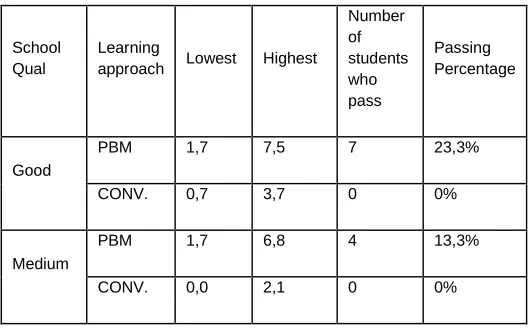
In Table 22, if using the learning pass mark of 60%, then for quality school, in the experimental class, 7 students (23.3%) were declared passed and the rest (76.7%) did not passed while in the control class all students ( 100%) did not pass. For average school, in the experimental class 4 students (13.3%) were declared passed and the rest (86.7%) were not, while in the control class all students (100%) did not pass. From the data description above, it can be seen that for each school qualification, in the PBM class the improvement of students' mathematical problem solving abilities is higher than the conventional learning class. The high increase in students' mathematical problem solving abilities in the PBM class is due to the initial activity in learning process in whicheach beginning of learning students are faced directly with problems and it is expected through these problems students learn mathematics. Students in PBM classes are accustomed to completing non-routine questions that spur students to use their abilities and all their skills to the fullest. The problems given encourage students to look for and use approaches from various perspectives to solve them, explore various strategies, examine the steps taken. From these activities it helps students in PBM classes in solving problem solving problems. The stages of student learning in PBM are in line with the expected goals in the problem solving process as stated by Dewey (in Sukasno, 2002) that the main steps in problem solving include: (1) knowing there is a problem of awareness of difficulties, despair, wonder or doubt, (2) identify problems namely classification and definition of the objectives sought, (3) use past experience, for example relevant information or ideas to form hypotheses in solving problems, (4) test consecutive hypotheses, if it needs to be reformulated, and (5)
evaluating the solution and drawing conclusions based on the available evidence. With the above suitability, it is certainly very natural if the ability in solving problems of students in PBM classes is better than students in conventional learning classes. Meanwhile, the low ability of students in conventional classes both from good and average school that achieve 0% passing, is mostly due to learning that concentrates more on memorizing exercises and certain procedural or algorithmic skills, making it difficult for students to face non-routine and contextual problems such as problem solving. Similar to the level of passing of mathematical communication skills, learning outcomes and learning completeness for mathematical problem-solving abilities of students using PBM is classified as very low. In quality school only 23.3% of students complete and in average school only 13.3%. This result is also in line with the study of Sukasno (2002) and Helmaheri (2004) which stated that in general students' problem solving abilities are very low. In the process of solving problem problems, many students arrive at the correct answer, but miss a few steps in solving problem. This is in line with the study of Sumarmo (1997) which states that in problem-solving strategies, upper and middle group students even though they arrive at the right answer, there are still missing steps, and they have difficulty checking the applicability of a theorem. Other factors regarding the low problem solving abilities and student learning completeness are learning time factors and test questions. The time factor for implementing the PBM approach has not been given too long to students, so that students feel familiar with PBM during the final phase of research and mathematical problem solving factors that may be too difficult for students in this study class. In addition, given the presence of several students who pass the learning through the PBM approach, we can say further that if PBM is accustomed to everyday learning, there will be great hopes of being able to bring students to complete or pass their learning.
3.7.7. Effect of PBM Learning in Increasing KPMMS
Based on the result, students who received PBM approach group experienced an increase of 31.5%, while in the conventional learning group only experienced a 10% increase. From the average score of posttest and the average test performed, it is seen that students who use problem-based learning show an increase in mathematical problem solving skills that are significantly better than students who use conventional learning. Furthermore, in statistical tests showed that groups of students using the PBM approach were significantly better than groups of students who used conventional learning.
1059 may be due to the selection of good school qualifications
conducted in this study is not appropriate for the standard of a quality school, but may be more suitable for average schools.
3.7.9. Effects of Gender in Increasing KPMMS
Based on the results of the influence of gender on improving mathematical problem solving abilities of students, it was obtained information that the increase in mathematical communication skills of male students was 18.5% and the average increase in female students was 20.5%. Although the average mathematical problem solving abilities of female students are slightly superior compared to male students, but the statistical test concluded that there were no significant differences in the improvement of students' mathematical problem solving abilities between male students and female students. The results of this study are in line with the results of the study of Suryadi (2005) which states that there is no significant difference in high level mathematical abilities caused by gender influences.
3.7.10. Students' Attitudes towards Mathematics
Based on the results of this study obtained an overview of students' attitudes towards mathematics learning. The results from student questionnaire showed a positive attitude towards mathematics learning with the smallest percentage value of 51% and 78% as high. This shows that most students have a positive attitude. The results of this attitude scale turned out to be related to communication skills and mathematical problem solving ability. Mathematical communication skills and mathematical Problem solving in the upper groups of each school qualification are directly proportional to the students' attitudes based on the results of questionnaires and interviews. Almost all students in the upper group express positive attitudes towards positive statements and give negative answers to each negative statement.Conversely, the lower group students were mostly negative towards mathematics learning. However, in general students show a positive attitude towards mathematics learning. The results of the study which showed that PBM had a positive impact on the formation of student attitudes towards mathematics supported the results of previous studies by Herman (2006) which stated that open PBM and structured PBM had positive effects on students' mathematical dispositions, as well as the results of Juandi's study (2006) which states that PBM had a positive impact on the formation of student teacher attitudes towards mathematics.
4.
CONCLUSIONS
Based on the results of the study the conclusions are obtained as follows. Problem-based learning (PBM) is significantly better in improving students' mathematical communication skills compared to conventional learning. The quality of learning outcomes achieved by students with PBM in both good and average school is better than those with conventional learning. The percentage of students who pass subjects by using PBM is more than students who received conventional learning.
In terms of learning factors and school factors, it was concluded that problem-based learning (PBM) had a more significant influence on improving students' mathematical communication skills, both in good and average schools. The school qualification factors do not have a significant influence on improving students' communication skills and mathematical
problem solving abilities. In terms of learning factors and gender differences, it was concluded that problem-based learning (PBM) had a significant influence on improving communication skills and problem solving ability, both on male students and on female students. The gender factor does not provide a significant direct effect on improving students' communication skills and mathematical problem solving ability. Problem-based learning (PBM) is significantly better in improving students' mathematical problem solving abilities compared to conventional learning approach. The quality of learning outcomes achieved by students with PBM in the good and average schools is better than conventional learning. The percentage of students who pass subjects with PBM is more than students with conventional learning. In terms of learning factors and school factors, it was concluded that problem-based learning (PBM) had a more significant influence on improving students' mathematical problem-solving abilities, both in good and average school. The school qualification factors do not have a significant influence on improving students' communication skills and mathematical problem solving ability. In terms of learning factors and gender differences, it was concluded that problem-based learning (PBM) had a significant influence on improving problem solving abilities. both male students and female students. The gender factor does not provide a significant direct effect on improving students' communication skills and mathematical problem solving. Problem-based learning (PBM) has an impact on the formation of positive attitudes of students towards mathematics.
REFERENCES
[1] Ansari, B. I. (2004). Developing the mathematical understanding and communication ability of high school students through the thing-talk-write strategy (Menumbuh kembangkan kemampuan pemahaman dan komunikasi matematik siswa SMU melalui strategi thing-talk-write). Bandung: Upblished.
[2] Bell, F. H. (1978). Teaching and learning mathematics in secondary school. New York: WmC Brown Company Publisher.
[3] Fogarty, R. (1997). Problem-based learning and other curriculum models for the multiple intelligences classroom. Arlington Heights, Illionis: Sky Light.
[4] Helmaheri. (2004). Developing communication capabilities and mathematical problem solving of junior high school students through thing-talk-write strategy.
(Mengembangkan kemampuan komunikasi dan
pemecahan masalah matematik siswa SLTP melalui strategi thing-talk-write). Bandung: Unpublished. [5] Herman, T. (2006). problem based learning to improve
mathematical thinking ability in middle school student level (Pembelajaran berbasis masalah untuk meningkatkan kemampuan berpikir matematis tingkat siswa sekolah menengah pertama). Bandung: Unpublished.
[6] Hudoyo, H. (1979). Development of mathematics curriculum and its implementation in front of the class
(Pengembangan kurikulum matematika dan
pelaksanaannya di depan kelas). Jakarta: Depdikbud. [7) Jacob, C. (2003). Problem solving, logical reasoning,
1060 IJSTR©2019
[8] Juandi, D. (2006). Improving mathematical power of prospective mathematics teachers through problem based learning (Meningkatkan daya matematik
mahasiswa calon guru matematika melalui
pembelajaran berbasis masalah). Bandung:
Unpublished.
[9] Klopfer, L. E. (1992). Curriculum change, student evaluation, and teacher practical knowledge. Science Education, 76(5).
[10]NCTM. (1989).Curriculum and evaluation standard for school mathematics. Reston, Virginia.
[11] NCTM. (2011). Principles and Standards for School Mathematics. Reston, Virginia.
[12] Pugalee, D. K. (2001). Using communication to develop student mathematical literacy. Journal Research of Mathematics Education, 6(5), 296-299.
[13] Samhadi, S. H. (2012). Measuring quality (Mengukur
kualitas). [online]. Tersedia.
http:www.kompascetak.com.
[14] Setiawan, A. (2003). Mathematics learning using probing techniques as an effort to improve mathematical communication skills of class i c sltpn 15 students,
Bandung (Pembelajaran matematika dengan
menggunakan teknik probing sebagai upaya untuk meningkatkan kemampuan komunikasi matematik siswa kelas I C SLTPN 15 Bandung). Bandung: Unpublished.
[15] Sukasno. (2002). Problem solving learning model in trigonometry learning (Model Pembelajaran Pemecahan Masalah dalam pembelajaran Trigonometri). Bandung: Unpublished.
[16] Sumarmo, U. (1987). Mathematical ability and reasoning of sm4 students attributed to students' logical reasoning ability and some elements of the teaching and learning process. (Kemampuan dan penalaran matematika siswa sm4 dikaitkan dengan kemampuan penalaran logik siswa dan beberapa unsur proses belajar mengajar). Bandung: Unpublished.
[17] Sumarmo, U. (1994). An alternative teaching to improve mathematical communication skills in teachers and middle school students (suatu alternatif pengajaran
untuk meningkatkan kemampuan komunikasi
matematika pada guru dan siswa SMP). Bandung: Unpublished