Page 230
EVALUATION OF THE IMPLEMENTATION AND IMPACT OF ERASMUS+ IN THE LESS COMMONLY TAUGHT EUROPEAN LANGUAGES PROGRAMS IN CHINA
Yan Lu1,2, Ilze Kangro1
1Univerisity of Latvia, Raiņa boulv. 19, Riga, LV-1586, Latvia
2Beijing Foreign Studies University, No.2 North Xisanhua Avenue, Beijing, 100089, China
Abstract
Student and staff mobility is always a heated topic in the Less Commonly Taught European Languages (LCTELs) in China, since it is an efficient instrument to compensate for the lack of locales and inadequacy of teaching materials and staff. The previous mobility was mostly organised based on the intergovernmental or inter-institutional agreements. Since European Union enlarged the influence of its exchange programme outside Europe, Erasmus+ also has become an important part in the student and staff mobility of the LCTELs programs.
Based on the out-going mobility, the aim of this paper is to examine the implementation and impact of Erasmus+ in the LCTELs programs in China, to find the positive results and the existing problems, as well as to offer the implications for the further practice in the framework of Erasmus+. The main research method is semi-structural interview. The interview involved 7 students and 19 teachers at Beijing Foreign Studies University (BFSU), which is the main institution organizing the LCTELs programs in China.
Keywords: Less Commonly Taught European Languages, Erasmus+, out-going mobility, language program management
1. INTRODUCTION
1.1. Erasmus+ programme and its evaluation
Nowadays, higher education is becoming increasingly internationalised and the degree of internationalisation is a key indicator to evaluate the quality of higher education and to rank the institutions. Countries and organizations release various exchange programmes for higher education, to improve its quality, to promote the internationalisation and to enhance competitiveness in the worldwide. These lead to the rapid growth of the international mobility of students and staff. Erasmus programme organized by EU is one of such programmes and it already proves its effectiveness not only in Europe, but also in the world.
Since the start of Erasmus programme in 1987, it was used as the main and successful measure to join national higher education systems through collaboration and to make all the European universities become attractive to the students from Europe and other parts of the world (Selickaite, Reklaitiene, 2015). The number of participants has been in substantial growth. 2017 was the year celebrating the achievements of the Erasmus programme in higher education over the past 30 years, it also witnessed the record of intra-European mobility activities in higher education: the Erasmus programme continued to attract more higher education institutions, staff and students, with a total of more than 312,300 student and 62,500 staff mobilities in the year (European Union, 2018, p. 24).
Page 231
documents, individual researchers also employ empirical methods to present personal experience and the particular cases, to evaluate the impact on the participants and to discuss the problems and possible solutions in the exchange programmes (Delmartino, Beernaert, 1998; Juknyte-Petreikiene, Pukelis, 2007; Lopourova, Korecki, 2009; Lalic, 2017; Jacobone, Moro, 2015; Burcer, 2015; Bartha, Gubik, Rethi, 2019; Capanoglu, Mutdogan, 2015; Selickaite, Reklaitiene, 2015; Nen, 2014; Tekin, Hic Gencer, 2013). Based on the experience and success of former programmes, Erasmus+ was launched to recognise the importance of the extra-EU international dimension. Erasmus+ is the EU programme which supports projects, partnerships, events and mobility in the areas of education, training, youth and sport. The programme, which runs from 2014 to 2020, provides funding opportunities for cooperation in all these areas, both among European countries and between European countries and Partner Countries throughout the world (European Union, 2015). It fosters quality improvement and internationalisation of higher education, as well as supports the participants to improve their education and training systems.
1.2. The Less Commonly Taught European Languages (LCTELs) programs and Erasmus+ programme
LCTELs teaching in China started in 1954 and the programs form a unique group in management of language teaching, which includes the European official languages except English, German, French, Russian and Spanish. Beijing Foreign Studies University (BFSU) is the main institution, which offers the LCTELs studies.
Compared to the commonly taught languages programs, the LCTELs programs are rather small-scale and immature: the numbers of in-service teachers and enrolled students are small; the team of teaching and administration staff is quite young and their research background is convergent and comparatively weak; the teaching materials and language practice opportunities are limited. All the facts hinder the LCTELs programs to follow the fast changing trends in internationalization and standardization of higher education, and to meet the increasing diversified demand in labour market. In the latest curriculum update at BFSU, based on the feedback of graduates, the new curriculum required all the language programs to add Discipline Directional Module. The aim of the new module is to provide students opportunity to use their program language study one or two disciplines in the social science and/or the humanity science, in order to prepare them for further study or enter the labour market. However, this requirement is quite challenging to the LCTELs programs team. To resolve the situation, the LCTELs programs design extra-curricula with other faculties. At present, the sub-programs LCTELs-Law and LCTELs-Economics are in implementation. Exchange programme is another effective solution. Mobility to the target language country, on one hand, provides students real environment to practice language and systematic courses to develop their knowledge in certain disciplines; on the other hand, mobility is also a strong support to teachers’ training in the LCTELs programs. The previous exchange programmes were mainly organised based on the intergovernmental or inter-institutional agreements. Since EU enlarged the influence of its exchange programme outside Europe, Erasmus+ also became an important part in the student and staff mobility of the LCTELs programs.
For the LCTELs programs, the first Erasmus+ inter-institutional agreement was signed with University of Malta in 2015. In the last four years, 15 agreements were signed and one more now is in the process. All of them are under Key Action 1 (entitled “Mobility for learners and staff”). Till now, nine agreements were implemented in seven universities of the LCTELs programs target language countries. Although all the agreements are signed and managed in the university level, the students and staff of the LCTELs programs and their sub-programs have the priority for application: when the quota is distributed from the partner universities, the first call is directly to the corresponding LCTELs programs; if the quota has surplus, the second call then is organised to other faculties. The nine complete agreements witnessed 13 students and 25 staff participate the mobility, among which, 6 students and 18 staff are studying or working in the LCTELs programs and the sub-programs.
Page 232
propose more effective mobility management with the partners in the coming phase of the Erasmus programme.
2. MATERIALS AND METHODS
Based on the out-going mobility, the aim of this paper is to examine the implementation and impact of Erasmus+ in the LCTELs programs, to find the positive results and the existing weaknesses, as well as to offer the implications for the further practice in the framework of Erasmus+. Semi-structured interview was employed as the main instrument to gather the materials. All the students and staff, who participated or were still in the Erasmus+ mobility during the period from 2015 to May, 2019, were invited to join the interview.The materials were analysed to answer the following questions: (1) How did the participants evaluate the whole process of their mobility? (2) What benefits did they get in the mobility? And did they observe any existing problem in the process? (3) What implications can be summarised for the LCTELs programs managers, in order to improve effectiveness of the mobility in the framework of Erasmus+?
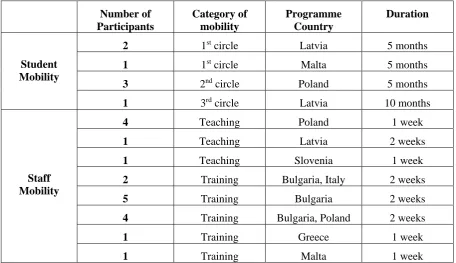
The interview was mainly carried out online by web call or email in April and May, 2019. It was completely voluntary and finally 7 students and 19 teachers responded to it. Among the participants, 4 students and 15 teachers study or work in the LCTELs programs; 2 students and 3 teachers are from the sub-programs; 1 administrator working as an exchange programme coordinator in the university department, who is mainly responsible for partners of the LCTLEs programs; and the left participant is the student from non-LCTELs programs, who was selected during the second call. The basic information of the exchange programmes and participants is showed in Table 1.
Number of Participants
Category of mobility
Programme Country
Duration
Student Mobility
2 1st circle Latvia 5 months
1 1st circle Malta 5 months
3 2nd circle Poland 5 months
1 3rd circle Latvia 10 months
Staff Mobility
4 Teaching Poland 1 week
1 Teaching Latvia 2 weeks
1 Teaching Slovenia 1 week
2 Training Bulgaria, Italy 2 weeks
5 Training Bulgaria 2 weeks
4 Training Bulgaria, Poland 2 weeks
1 Training Greece 1 week
1 Training Malta 1 week
Table 1. Basic information of the programmes and participants
Page 233 3. RESULTS
The general evaluation to the Erasmus+ experience is quite positive. According to the feedback, 14 participants reported that they were “very satisfied” with the programmes, while 10 reported “satisfied”. They are willing to participate Erasmus+ mobility again or recommend it to other students or colleagues. 2 participants were not asked to give the overall remark, since they were still in the process of the exchange study.
3.1. In the stage of “before the mobility”
As the interview participants claimed, their main sources of information about Erasmus+ and its application were the LCTELs programs managers and the exchange programme coordinators in their faculties. For students in different programs, their main motivations for application slightly varied: the primary aim of the LCTELs programs students was to improve language skills in the authentic language environment or learn more facts about the countries, while the ones in the sub-programs wanted to seek for new aspects in their specialities. The applicant in the non-LCTELs program stated that the biggest attractiveness was to experience student life and to travel in Europe, since compared with the students in the LCTELs programs, the opportunities to study in Europe with scholarship is less.
During the process of application, the 7 students stated that competition was not fierce at all, since the applicants were not many. In the LCTELs programs and sub-programs, the students have the regular exchange programmes, which is already planned in their curricula. But to them, the Erasmus+ programmes are completely new and the quota is small, so most of them would rather apply for the regular programmes to go abroad together with classmates. While in the non-LCTELs programs, exchange study in bachelor’s level is rare, so in the administration level, credit transfer is still a problem.
For the staff, 18 interviewees work in the LCTELs programs and sub-programs, and 1 coordinates with the LCTELs programs in exchange management. 6 lecturers exchanged as guest lecturers in the partner universities, and 13 staff went for training weeks. The main tasks of teaching staff were in two aspects: one was to lecture on Chinese culture and society, in order to improve inter-cultural communication for both sides; the other one was to introduce the LCTELs programs management and language teaching, in order to strengthen relationship with the partner universities. The principal motivation for the participants to apply for training mobility was to develop professional skills. 1 participant applied the job shadowing to learn international programme management methods, and the rest intended to design new curricula on European Studies with the support of relevant experts.
Recommendation is the main way to select the candidates in staff mobility. Considering the development of the LCTELs programs and their faculty, the general director and the programs managers assessed the potential applicants, who were considered in need of exchange, and confirmed with them. 4 of 6 teaching staff are programs managers, who planned to strengthen cooperation with the partner universities in language teaching and research. 10 of 13 training staff are novice lecturers or managers, who are eager to improve their competence.
All the interviewees asserted that the application procedure was not complicated and they didn’t meet any obvious problem in this stage. Only one student mentioned that, at the very beginning she misunderstood the instructions due to English language proficiency. However, with the help of the programme officers, her application successfully completed.
3.2. In the stage of “during the mobility”
Page 234
the mismatches between the training courses and their expectations. However, they also confirmed that the programme coordinators and lecturers were willing to help them, and the problems were solved or partly solved. 2 students especially pointed out that the Buddy mechanism in Erasmus+ did help a lot either in life or in study.
3.3. In the stage of “after the mobility”
For this stage, the key questions were how the mobility is recognized by their programs, and their assessment on goal achievement. Since 2 students were still in the exchange process, they didn’t participate in this part of interview.
3 students reported that, the credits they got during the mobility were totally recognized and transferred on their transcripts according to the credit management regulations in their programs. 1 master student and 1 PhD student claimed that the credits could be recognized and transferred, but they didn’t apply for it, because they had already got the full credits before their mobility. All staff mobility was recognised by university administration as part of the teachers’ development and considered in their annual performance assessment.
Most of the participants asserted that generally they achieved their goals. Only 1 teacher stated that the training didn’t meet her expectation, because none of the professors in her training program shared her research interest; but she also admitted the training still offered her new points of view and supportive network for further research.
When asked about the existing problems in administration, the participants presented some based on their experience and observation.1 student pointed out that the credit transfer procedure in his program was rather long. 2 students thought that the final assessment on students’ achievement in the exchange programs was very easy and the scores were quite high, so they doubted if the outcome of student’s mobility really met Erasmus+ standards. 3 teachers reported that all the contents of the training courses were decided by the partner universities and there was no negotiation with the participants to meet their specific needs. However, they also showed understanding that it was impossible to organize a training programme, which meets “everyone’s taste”. 1 lecturer observed that the Agreement of Implementation had very strict time limit, and all the quota in it should be completed within the limit. However, situation changed, while the administration process was not that flexible. 1 teacher recounted that she replaced her colleagues in another LCTELs program to the mobility, because the time limit of the agreement was approaching, but her colleagues could not spare time. Finally, she gave lectures on China’s Studies and international relationship. The results did not meet her expectation, and she believed that her colleagues would achieve better, because they are experts of the target language and have previous cooperation with the partner university.
4. DISCUSSION
Erasmus+ promotes the internationalization of the LECTLs programs at BFSU, especially the new initiated programs in recent years (e.g. the Maltese and the Latvian language programs). It not only deepens the previous educational cooperation with the partner universities in the Programme Countries, but also puts more MOUs into practice and enlarges cooperation with new partners supported by EU funds. In the LCTELs programs, students get one more chance to study in Europe; teaching and administration staff benefit in teachers’ development and new curriculum design. This part discusses the implementation and impact of Erasmus+ to the LCTELs programs from student and staff mobility respectively.
4.1. The implementation and impact of student mobility
Page 235
countries. BFSU also gives priority in the application process to the students of the corresponding LCTELs programs.
But at the administration level, some facts exist and prevent the student mobility from full implementation. Firstly, most of the study programs at BFSU are language programs with definite requirements of the target language proficiency, so every student in each academic year must finish certain target language courses to get the credits. That means, practically, the students need to apply for mobility to the countries, where the target language is official language or second/common language, and the partner universities offer the target language teaching as foreign language. Secondly, BFSU has its own credit system, which now is not compatible to ECTS. If a student wants to apply for the Erasmus+ mobility, he needs to confirm with the administrators in the faculty whether the ECTS transfer is available. That is also a reason, why all students in the interview reported that their credits were recognized. Thirdly, Erasmus+ mobility is quite new practice for BFSU. The guiding roles are the partner universities in Programme Countries and they decide the quota and time limit in the Agreements of Implementation based on the budget and partners’ amount. Some 1-year agreements come quite unexpectedly and the LCTELs programs cannot make advanced plan in their curricula. Besides, compared with the students’ number at BFSU, the quota for student’s mobility in each agreement is quite small; and the quota changes every year. This situation makes the administration as well as students’ attitude to the programme very conservative: they would rather apply for the regular exchange programmes with other students together instead of trying the unknown opportunity. Fourthly, administration of teaching affaires in many faculties does not encourage their students to participate the mobility, because they are unwilling to add many courses for credit transfer in the database just for 1 or 2 students.
Considering the quota and number of applicants, Erasmus+ student mobility is not a considerable part of the student exchange study, and the present way to manage the whole process is effective. However, some solutions to the above-mentioned problems can be considered to promote the student mobility in the framework of Erasmus+. Firstly, long-term agreements of implementation based on negotiation by both sides are suggested. In such agreements, the quota is distributed and informed in advance, so the corresponding programs can make precise plan for their students’ mobility, learn the programmes and introduce them to students in a more effective way. Secondly, a more compatible and flexible credit transfer system should be designed to accommodate to the internationalization trend in higher education. Additional transcript, which records the scores and credits during student mobility and the method to calculate GPA also can be considered, if it is not worthy to create so many new courses in the database for just 1 or 2 students. Thirdly, Erasmus+ student mobility can be adapted to meet the new requirement in the latest curriculum change. The most challenging part for the LCTELs programs in the new curriculum is the Discipline Directional Module. Students can be encouraged to go to the partner universities to finish the courses in a certain discipline in English. The teachers of the LCTELs programs give regular assignments about the discipline to the students, in order to guide them how to improve the target language skills.
4.2. The implementation and impact of staff mobility
Page 236
Eurasia project funded by Erasmus+, which is co-organized by universities in Bulgaria, Poland and Italy. This is a long-term project with several phases. Its main aim is to promote courses on EU Studies in partner universities in China and India, so it quite fits the requirements of the curriculum development at BFSU. In the first phase, 11 candidates from the LCTELs programs and sub-programs were recommended to the mobility. The two-week training gave the participants brief introduction in different spheres of EU Studies, and guided the participants to choose the related experts as their supervisors for curriculum design; then the participants and their supervisors formed working groups and made individual tutoring. After the first phase, the 11 participants defined 10 new courses and they will participate in the second phase to design and develop curriculum with their supervisors. The new courses are planned to be implemented in the following two academic years. Except the new courses, this project also breaks the barriers among the faculties at BFSU and promotes cooperation. It is firstly observed in the LCTELs-Law sub-program. Previously, the courses on languages and knowledge of law were separately lectured by the teachers in the LCTELs programs and Faculty of Law. After the mobility, the LCTELs teachers also participate in the course of EU Law. They offer cases in their program language countries and make the course more persuasive.
5. CONCLUSIONS
In the context of internationalization in higher education, Erasmus+ provides the LCTELs programs complementary opportunity for student and teacher mobility. Although the practice is new and the scale is not large, positive evaluation results of implementation and impact are observed in the implemented programmes. Especially the staff mobility for training gives big support for novice teachers’ professional development and new course design in Discipline Directional Module of the new curriculum.
The present Erasmus+ programme is approaching to its end in 2020. Although the management model in the next phase is not clear yet, the problems observed in this evaluation process give some implications to future cooperation, and the key ones are as follows: in-advance negotiation and long-term Agreement of Implementation are suggested to make the mobility more purposeful and effective; compatible credit transfer systems are precondition to realize active student mobility. Besides, when the Erasmus+ mobility becomes a regular exchange programme for the LCTELs programs, a specific administrator is also advised, so that the programme management will be more systematic, the connection with the partner universities in the Programme Countries will be more efficient, and the monitor and evaluation on the whole process will be more comprehensive and regular.
ACKNOWLEDGMENTS
The research was supported by China Scholarship Council.
REFERENCES
1. Bartha, Z., Gubik, AS., Rethi, G 2019, “Management of Innovations in Hungarian HEIs: Enhancing the Erasmus Mobility Programme”, Marketing and Management of Innovations, no. 1, pp. 84-95.
2. Burcer, S 2015, “Assessment of the Implementation of the Erasmus Programme in Turkey through the Experiences of Foreign Students Visiting Turkish HEI’s”, BCES Conference Books, vol. 13, no. 1, pp. 345-351.
3. Capanoglu, A., Mutdogan, S 2015, “Contribution of the Erasmus Student Exchange Program to Design Students: the Italy Example”, SGEM Conference Proceedings 2015, vol. 1, no. 1, pp. 343-350.
Page 237
5. European Commission, Erasmus+ Annual Report 2017, European Commission, viewed 21 May 2019, <https://publications.europa.eu/en/publication-detail/-/publication/4e5c3e1c-1f0b-11e9-8d04-01aa75ed71a1>.
6. European Commission, Mid-term evaluation of the Erasmus+ programme (2014-2020), European Commission, viewed 21 May 2019, <https://ec.europa.eu/programmes/erasmus-plus/resources/documents.evaluations_en>.
7. Jacobone, V., Moro, G 2015, “Evaluating the impact of the Erasmus programme: skills and European identity”, Assessment & Evaluation in Higher Education, vol. 40, no. 2, pp. 309-328.
8. Juknyte-Petreikiene, I., Pukelis, K 2007, “Quality Assessment of Internationalised Studies: Experience of SOCRATES/ERASMUS Programme Participants”, The Quality of Higher Education, no.4, pp. 74-101.
9. Lalic, H 2017, “Occupational Medicine Professor’s Participation in Erasmus+: Academic Staff Exchange Programme”, Coll. Antropol, vol. 41, no. 3, pp. 133-136.
10. Lopourova, R., Korecki, Z 2009, “The Importance of Foreign Languages Knowledge for the University of Defence Lectures”, Social-Behavioural Sciences, vol. 4, no. 56, pp. 121-125.
11. Nen, M 2014, “The Improvement in the Quality of Learning in Europe’s Higher Education Institutions”, Management & Marketing, vol. 7, no. 1, pp. 75-83.
12. Selickaite, D., Reklaitiene, D 2015, “Global Impact of Erasmus Exchange Students for Lithuania: When Its Success Can be Named”, Transformation in Business & Economics, vol. 14, no. 2B (35B), pp. 534-547.