International Journal of Health Sciences and Research
www.ijhsr.org ISSN: 2249-9571
Original Research Article
Assessment and Evaluation of Effectiveness of Valsalva Maneuver on Pain
Reduction during IV Cannulation Among Adults
Rashmi Kadyan
M.Sc. Nursing, Rajkumari Amrit Kaur College Of Nursing, Lajpat Nagar, New Delhi
ABSTRACT
Objectives: The objectives of the study were to assess the level of pain in patients undergoing IV cannulation after use of valsalva maneuver in experimental group, to compare the level of post procedure pain between groups undergoing IV cannulation with and without the use valsalva maneuver, to seek the association of level of pain and selected variables in patients in terms of: Age, Body mass index and Sex.
Methodology: A true experimental research approach with pretest posttest research design was used. Simple random sampling technique was adopted to select 60 patients (30 experimental and 30 controls) but assignment of subjects to the group was through odd and even method. Data was collected using standardized numerical rating pain scale and semi structured interview schedule for demographic data and clinical profile. The tool was validated and reliability was 0.96 which was established using interrater /interobserver.
Results: The study showed that mean post test pain score of adults in experimental group was lower (1.3) than those in experimental group (5.56). There was no significant association between age and body mass index with post test pain scores whereas there was significant association present between post test pain scores and sex.
Conclusion: Valsalva maneuver is effective technique in reducing pain associated with IV cannulation. There was significant association between posttest pain scores and sex which indicates females experience more pain than males.
Key words: Valsalva maneuver, adults
INTRODUCTION
Pain is an uncomfortable phenomenon and associated with actual or potential tissue damage. [1] Pain is whatever the person says it is, existing whenever the experiencing person says it does means pain is highly subjective in nature. [2] The fear of pain is ranked only second to the fear of death [3] and it is called fifth vital sign which emphasize increase awareness among health care professional for pain management. [4] It is one of the factors which interfere with the quality of life of the people. Pain is the most common widely under-treated health problems.
IV cannulation is a significant source of adult pain and distress when describing worse pain experiences in hospitalized adult, IV cannulation pain was found to be the second reason for the subject with underlying disease. [5] Pain can be managed by using both pharmacological and non-pharmacological method. [6] No pharmacologic interventions, used alone or in conjunction with pharmacologic interventions, have the potential to reduce the perception of pain associated with procedures. [7]
cost effective and Valsalva maneuver is one of these measures. Valsalva maneuver is non invasive, non-pharmacological and effective method to reduce pain associated with peripheral intravenous cannulation. Nurses should practice Valsalva maneuver for patients undergoing venipuncture. [8] This technique is named after Antonio Maria Valsalva, [9] the Valsalva maneuver is performed by moderately forceful attempted exhalation against a closed airway. During Valsalva maneuver contraction of thoracic cage compresses lung and causes increase in intrathoracic pressure resulting in compression of vessels within the chest and in turn stimulates vagus nerve and vagus nerve in turn activates the bar receptor . The activation of either the cardio pulmonary bar receptor reflux or sin aortic bar receptor reflux induces antinociception.
[9]
Through valsalva bar receptors activates and control activity of sympathetic system and reduce pain. [10]
Objectives of the Study:
To assess the level of pain in patients undergoing IV cannulation in experimental and control group. To compare the level of post
procedure pain between groups undergoing IV cannulation with and without the use Valsalva maneuver. To seek the association of level of
pain and selected variables in patients in terms of:
a. Age
b. Body mass index
c. Sex
Hypothesis:
H1: There will be significant difference in
the mean post test pain scores of patients during IV cannulation in experimental with valsalva maneuver and control group without the use of valsalva maneuver as measured by numeric rating pain scale at 0.05 level of significance.
H2 : There will be significant association of
mean post test pain scores of patients in experimental group with selected variables as evident from semi structured interview
and numeric rating pain scale at 0.05 level of significance.
a. Age
b. Body mass index c. sex
MATERIALS AND METHODS
Research Approach: Quantitative approach
Research Design: True experimental pretest posttest design
Research Variable: Pain and valsalva maneuver
Setting of the study: The setting for pilot and final study was St. Stephen’s Hospital, Tis Hazari, Delhi
Population: Comprises of patients admitted in hospital and posted for elective surgery and having zero pain prior to the procedure.
Sample: The sample size comprised of 60 patients (30 in experimental and 30 in control group) posted for elective surgery and having zero pain prior to the procedure.
Sampling technique: Simple random sampling technique used with assignment of subjects to the groups by odd and even method.
Procedure:
Ethical permission was taken from institutional ethical committee of R.A.K, New Delhi to conduct research study.
Permission was obtained to conduct the research study from director of St. Stephen’s hospital, Tis Hazari, Delhi
The technique of data collection was semi structured interview schedule for collecting demographic data and clinical profile of patient and numeric rating pain scale was used for assessing pain of the patient. To ensure validity of tool nine
experts were selected from various fields, three doctors (from field of medicine, general surgery and anesthesia), six from department of nursing.
coefficient of correlation which was established by inter rater / inter observer technique and it was found to be 0.96.
Formal administrative approval was obtained from the concerned authority to conduct the final study. The patients who met the inclusion
criteria were selected using simple random sampling technique.
The purpose of the study was explained to the participants. After obtaining their willingness to participate in the study the data were collected from the samples.
Statistical Analysis:
The data was analysed using descriptive and inferential statistics. Frequency and percentage for
demographic characteristics and clinical profile.
t- Test was done to compare the level of post test pain in both experimental and control group. Chi square was used to find out the
association between post test pain score of experimental group and selected demographic variables like age, sex and body mass index.
RESULTS
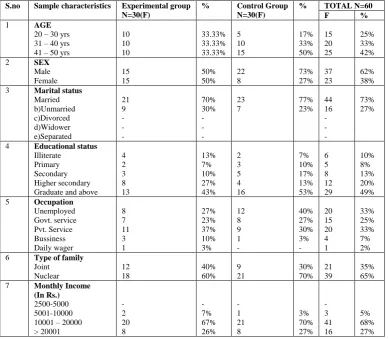
Table 1(A): Frequency and percentage distribution of demographic characteristics in experimental and control group by age , sex, marital status, educational status, occupation , type of family and monthly income. N = 60
S.no Sample characteristics Experimental group N=30(F)
% Control Group
N=30(F)
% TOTAL N=60
F %
1 AGE
20 – 30 yrs 31 – 40 yrs 41 – 50 yrs
10 10 10 33.33% 33.33% 33.33% 5 10 15 17% 33% 50% 15 20 25 25% 33% 42% 2 SEX Male Female 15 15 50% 50% 22 8 73% 27% 37 23 62% 38% 3 Marital status
Married b)Unmarried c)Divorced d)Widower e)Separated 21 9 - - - 70% 30% - - - 23 7 77% 23% 44 16 - - - 73% 27%
4 Educational status
Illiterate Primary Secondary Higher secondary Graduate and above
4 2 3 8 13 13% 7% 10% 27% 43% 2 3 5 4 16 7% 10% 17% 13% 53% 6 5 8 12 29 10% 8% 13% 20% 49% 5 Occupation Unemployed Govt. service Pvt. Service Bussiness Daily wager 8 7 11 3 1 27% 23% 37% 10% 3% 12 8 9 1 - 40% 27% 30% 3% - 20 15 20 4 1 33% 25% 33% 7% 2% 6 Type of family
Joint Nuclear 12 18 40% 60% 9 21 30% 70% 21 39 35% 65%
7 Monthly Income
(In Rs.)
2500-5000 5001-10000 10001 – 20000 > 20001 - 2 20 8 - 7% 67% 26% - 1 21 8 3% 70% 27% - 3 41 16 5% 68% 27%
Data in the table 1(A) depicts that maximum and equal percentages of samples in both groups were between 41-50 yrs age. As per sex in control group males were more and in experimental both sexes were equal in percentage. Majority of samples in both
TABLE 1(B): Frequency and percentage distribution of clinical profile in two experimental and control group by history of any
illness, history of previous surgery and history of hospitalization.N=60 S.no Sample characteristics Experimental group
N=30
% Control Group N=30
% TOTAL
N=60
F %
1. History of any illness
Yes No
5 25
17% 83%
7 23
23% 77%
12 48
20% 80% 2. History of previous surgery
Yes No
3 27
10% 90%
6 24
20% 80%
9 51
15% 85% 3. History of hospitalization
Yes No
7 23
23% 77%
5 25
17% 83%
12 48
20% 80%
Table 1(B) showed that maximum subjects in both groups were having no history of any illness. Maximum subjects in both groups were having no previous history of surgery. Majority of subjects in both were having no history of hospitalization.
Table 2: Mean, mean difference and Standard error of mean difference and t-value of post test pain scores of adults in experimental and control group. N=60
Group
Mean Mean difference
SDD SEMD T -
Value Experimental
group
1.3
4.26 0.09 0.24 17.75*
Control group 5.56
t(58) = 2.01 , , p< 0.05
The data presented in the table 2 shows that the mean post test pain scores of adults in experimental group (1.3) is lower than mean post test pain scores of adults in control group (5.56). The obtained mean difference (4.26) between post test scores of experimental and control group was found to be statistically significant as evident from t-value 17.75 at 0.05 level. Therefore obtained mean difference was true difference and not by chance so the research hypothesis (H2) is accepted. This shows that Valsalva maneuver is effective in reducing IV cannulation pain.
Table 3: CHI SQUARE SHOWING ASSOCIATION BETWEEN POST TEST PAIN SCORES AND SELECTED DEMOGRAPHIC VARIABLES. N=30
s.no Selected variables Pain scores Chi-square value df
Above median Below median 1. Age in years
20-30 yrs 31-40 yrs 41-50 yrs
4 4 3
6 6 7
0.534NS 2
2. Sex
Male female
21 8
16 15
3.99 1
3. BMI
Underweight Normal Overweight
1 7 3
1 13 5
0.64NS 3
The data presented in the table 3 shows that computed chi-square value for pain score and selected demographic variables like age and body mass index are not significant at 0.05 level of significance whereas it is significant for sex at 0.05 level of significance. Table frequency also shows that more females than males had post test scores above median indicating that females experience more pain than males.
DISCUSSION
Valsalva maneuver is effective and cost effective technique in reducing pain associated with IV cannulation among adults.
Also a study by Agnihotri M, et al.
[11]
shows the similar findings in which calculated t-value was 5.31 which also concluded that when pain was assessed immediately after IV cannulation in group underwent Valsalva maneuver, it was found to be lower than those in control group.
The present study showed in valsalva group majority i.e. 80% had mild pain whereas no one had moderate and severe pain in this group whereas in the control group majority i.e. 87% had moderate pain and 10% had severe pain .A study conducted by Anil Aggarwal et al. [12] had consistent findings with present study which also showed that in valsalva group all 100% had mild pain whereas in control group majority i.e. 56% had moderate pain.
The present study also concludes that there is significant association between sex and pain score and females experience more pain as compared to males as more females were having pain score above median compared to males. This finding is consistent with the findings OT the study conducted by Jagdamba et al. [13] on effect of gender on pain perception and reported that female patients experience more pain as compared to male patients as shown by computed chi square value of 31.84.
Limitations:
The study was confined to a small number of experimental and control group of patients in one private hospital. This limits the generalization of the findings.
Recommendations:
1. A similar study can be undertaken on a larger sample; thereby findings can be generalized for a larger population.
2. A similar study can be done in more than one setting.
3. A comparative study can be done between two or more pain control methods.
4. A similar study can be replicated for various population like pediatrics, geriatrics etc.
5. A study can be done to compare the effectiveness of Valsalva maneuver in males and females.
6. A study can be done to assess the effectiveness of valsalva maneuver in other painful procedures
7. A study can be done to assess the effectiveness of other techniques of Valsalva maneuver in IV cannula pain reduction.
CONCLUSION
Sample characteristics of both the experimental and control groups were nearly same.
The mean post test pain scores of experimental group was less than control group.
Valsalva maneuver was effective technique in reducing pain associated with IV cannulation.
The was significant association between posttest pain scores and sex .whereas there was no association found between age and pain score and body mass index with pain scores.
Implications of the study:
The study will improve the nurse’s knowledge and competence in reducing pain of patients undergoing IV cannulation and it will result in better patient’s outcome.
Even though various pain reducing techniques is present in basic nursing curriculum, nurse educators should keep the students update about the newer and cheap methods of pain reduction.
In service nursing personnel should be provided with the knowledge regarding the acute pain management regarding IV cannulation as it is also a distressing for patients who are admitted in hospital.
that they should feel the need to emphasize this practice in nursing.
To ensure quality care, administrators should utilize and rely upon evidence based nursing practice. The nurse administrators should communicate this knowledge to their clinical staff and ensure this practice in their clinical set up. Nurse administrators should organize in service education programme for their nursing staff to follow right and current practices.
REFERENCES
1. Smelter,c, Suzanne, Bare,Brenda.
Brunner & Siddhartha Textbook of Medical surgical Nursing.10th Edition. Published by Lippincott Williams and Wilkins; 217.
2. McCaffery,M.,Ferell,B.R.Nurses knowledge of pain assessment and management: How much progress have we made. Journal of pain symptom management .1997;14(3):175-188. 3. Maryet, Manas et.al (2003). Lewis,
Medical surgical nursing: Assessment and Management of clinical problems. 3 rd edition. St Louis, Mosby Year Book. 4. Campbell,J.Pain :The fifth vital sign
.American pain society .1995,Nov 11. 5. Barbara, K, Timy and Nancy, E ,Smith.
Introductory medical surgical nursing. Philadelphia.2008. 9thEdition. Published by Linton William and Wikins.
6. Bardia, A; Barton, D and Prokop,I (2006). Efficacy of complementary and alternative medicine therapies in relieving cancer pain: A systematic review, Journal of Clinical Oncology, 24(5), 5457–5464
7. Friesner, S. A; Curry, D. M and Moddeman, G. R(2006). Comparison of two pain-management strategies during chest tube removal: Relaxation exercise with Opioids and Opioids alone ,
Journal of Heart Lung, 35(2), 269–276
8. Ravneet, K; Preksha,S.M and
Rupinderjeet ,K(2015). Effectiveness of Valsalva maneuver on pain during venipuncture. International Journal of
Health Sciences and Research. 5(8),
407-416.
9. VR Vijay, Agnihotri Meenakshi, Kaur Sukhpal, Bhalla Ashish. Effect of Valsalva maneuver prior to peripheral intravenous cannulation on intensity of pain. Nursing and Midwifery Research Journal.2013October; 9(4):143-4. 10. Merrian Webster, an Encyclopedia
Britannica Company. Bar reflex.
(Internet) Available from
http://www.merriam-webster.com/medical/baroreflex
11. Agnihotri,M ; V,R Vijay; Kaur,S and Bhalla,A (2013) . Effect of Valsalva
maneuver prior to peripheral
intravenous cannulation on intensity of pain. Nursing and Midwifery Research
Journal ,9(4) ,143-144
12. Agarwal,A; Sinha,P; Tandon, M;
Dhiraaj,S and Singh(2005). Evaluating the efficacy of valsalva maneuver on venous cannulation pain: a prospective,
randomized study, Anesthesia
Analgesic, 101(4) , 1230-32.
13. Jagadamba,A; K,Kutty;Shankar,V and
Madhusudhana R(2011). Gender
variation in Pain perception after intravenous cannulation in adults. The
Internet Journal of Anaesthesiology.
28(1),1172-73
***********