Themed Section: Science and Technology
Dijikstra Algorithm In Google Map By Using Fuzzy Graph
M. Bharath Lavanya¹, T. Ramesh²
1PG Student,Department of Mathematics, Dr. SNS Rajalakshmi College of Arts and Science(Autonomous), Coimbatore, Tamilnadu, India
2Assistant professor, Department of Mathematics, Dr. SNS Rajalakshmi College of Arts And Science(Autonomous), Coimbatore, Tamilnadu, India
ABSTRACT
In graph theory, the shortest path problem is the problem of finding a path between two vertices (or nodes) in a graph such that the sum of the weights of its constituent edges is minimized. The shortest path problem (SPP) is one of the most important combinatorial optimization problems in graph theory due to its various applications. In this paper we introduce the method of finding the shortest path in complete fuzzy graph of uncertainty by using Dijikstra algorithm. To illustrate the effectiveness of the proposed approach we compare these results with Google map and discuss the algorithm by Dijikstra which is most efficient for complete fuzzy graph for uncertainty.
Keywords : Fuzzy Graph, Fuzzy Tree, Fuzzy Network, Fuzzy Sub-Trees.
I.
INTRODUCTIONGraphs are a very important model of networks. There are many real-life problems of network of transportation, communication, circuit systems, and so forth, which are modeled into graphs and hence solved. Graph theory has wide varieties of applications in several branches of engineering, science, social science, medical science, economics, and so forth, to list a few only out of many. In this paper we discuss about fuzzy shortest route (path) between two cities by using Dijikstra algorithm.
One of the main real life applications of dijikstra algorithm is in Google Maps. Google map uses many basic algorithms from Graph Theory. For example, to find the shortest path between two nodes in a graph in order to get driving directions. One unique problem is that the graphs used in Google Maps contain millions of nodes, but the algorithms have to run in milliseconds. A technique used to improve
performance is graph hierarchies. Dijkstra algorithm is used here and we compare the results with Google map also we show importance of dijikstra algorithm in Google map.
II.
BASIC CONCEPTS2.1. FUZZY GRAPH
A Fuzzy graph G= (σ, μ) is a pair of functions σ: V→ [0, 1] and μ: V×V→ [0, 1], where for all u, v∈ V, we have μ (u, v) ≤ σ (u) Λ σ (v). A path P in a fuzzy graph is a sequence of distinct nodes , , . . . , such that μ ( , ) > 0; 1 ≤ i ≤ n; here n >1 is called the
length of the path P. The consecutive pairs ( , ) are called the edge of the path.
2.2. NETWORK:
2.3. PATH:
A Path is a sequence of distinct arcs that join two nodes through other nodes regardless of the direction of flow in each arc.
2.4. FUZZY TREE
A Fuzzy path between the point s (source) to t (sink) of fuzzy graph G is called fuzzy policy or fuzzy tree.
III.
DIJIKSTRA ALGORITHMLet the node at which we are starting be called the initial node. To find the path of minimum distance between the point s(source) to t ( sink) of fuzzy graph G can be obtained using the following steps:
1. Identify the decision variables and specify objective function to be optimized for fuzzy networks.
2. Mark all nodes unvisited. Create a set of all the unvisited nodes called the unvisited set.
3. Assign to every node a tentative distance value: set it to zero for our initial node and to infinity for all other nodes. Set the initial node as current.
4. For the current node, consider all of its unvisited neighbors and calculate their tentative distances through the current node. Compare the newly calculated tentative distance to the current assigned value and assign the smaller one. For example, if the current node A is marked with a distance of 6, and the edge connecting it with a neighbor B has length 2, then the distance to B through A will be 6 + 2 = 8. If B was previously marked with a distance greater than 8 then change it to 8. Otherwise, keep the current value.
5. When we are done considering all of the neighbors of the current node, mark the current node as visited and remove it from the unvisited set. A visited node will never be checked again.
6. Move to the next unvisited node with the smallest tentative distances and repeat the above steps which check neighbors and mark visited. 7. If the destination node has been marked visited
(when planning a route between two specific nodes) or if the smallest tentative distance among the nodes in the unvisited set is infinity (when planning a complete traversal; occurs when there is no connection between the initial node and remaining unvisited nodes), then stop. The algorithm has finished.
8. Otherwise, select the unvisited node that is marked with the smallest tentative distance, set it as the new "current node", and go back to step 3. When planning a route, it is actually not necessary to wait until the destination node is "visited" as above: the algorithm can stop once the destination node has the smallest tentative distance among all "unvisited" nodes (and thus could be selected as the next "current")
IV.
DIJIKSTRA ALGORITHM IN CONTEXT TO THE PROBLEMConsider a fuzzy network [1] and in this section we discuss applicability of Dijikstra algorithm to find out the shortest path between 21 cities of Tamilnadu. Here we consider each city as vertex/node and the distance between any two cities is represented as edge or arc. In order to develop the above problem in terms of fuzzy graph, the distance between any two cities [1] is consider in the following manner.
Table 1
Distance in km Membership grades
50-75 0.02
75-100 0.04
100-125 0.06
125-150 0.08
150-175 0.1
175-200 0.12
200-225 0.14
Here the cities are represented by nodes in an alphabetical order,
A-CHENNAI , B- CHENGALPATTU, C- VELLORE, D- VILLUPURAM, E-THIRUVANAMALAI, F- DHARMAPURI, G- PERAMBALUR, H- NAMAKAL, I- ERODE, J- OOTY, K- THANJAVUR, L- TRICHY, M- COIMBATORE , N- PUDUKOTTAI , O-
DINDUKAL, P- KODAIKANAL, Q-
RAMANATHAPURAM, R- MADURAI,
S-TUTICORIN, T- THIRUNELVELI and U- KANYAKUMARI.
By using the city map of Tamilnadu we can able to find the distance between two cities (fig 4.1) as mentioned below,
Figure 1. Tamilnadu city map
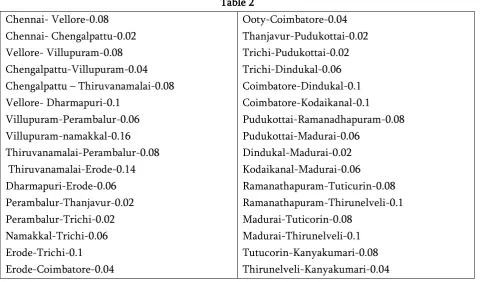
In order to find the shortest path between two cities in terms of fuzzy graph , the distance between any two cities are consider in the following manner:
Table 2 Chennai- Vellore-0.08
Chennai- Chengalpattu-0.02 Vellore- Villupuram-0.08 Chengalpattu-Villupuram-0.04 Chengalpattu – Thiruvanamalai-0.08 Vellore- Dharmapuri-0.1
Villupuram-Perambalur-0.06 Villupuram-namakkal-0.16 Thiruvanamalai-Perambalur-0.08 Thiruvanamalai-Erode-0.14 Dharmapuri-Erode-0.06 Perambalur-Thanjavur-0.02 Perambalur-Trichi-0.02 Namakkal-Trichi-0.06 Erode-Trichi-0.1 Erode-Coimbatore-0.04
Ooty-Coimbatore-0.04 Thanjavur-Pudukottai-0.02 Trichi-Pudukottai-0.02 Trichi-Dindukal-0.06 Coimbatore-Dindukal-0.1 Coimbatore-Kodaikanal-0.1
Pudukottai-Ramanadhapuram-0.08 Pudukottai-Madurai-0.06
Dindukal-Madurai-0.02 Kodaikanal-Madurai-0.06
Ramanathapuram-Tuticurin-0.08 Ramanathapuram-Thirunelveli-0.1 Madurai-Tuticorin-0.08
V.
FINDING SHORTEST PATH FROM
COIMBATORE TO KANYAKUMARI
From this fuzzy graph first let us first find the shortest path from Coimbatore - Kanyakumari (i.e.) node M-U by using dijikstra algorithm. Then the fuzzy graph from Coimbatore – Kanyakumari [1](fig 4.2)is mentioned below ,
Figure 2. Fuzzy graph from Coimbatore – Kanyakumari with different routes
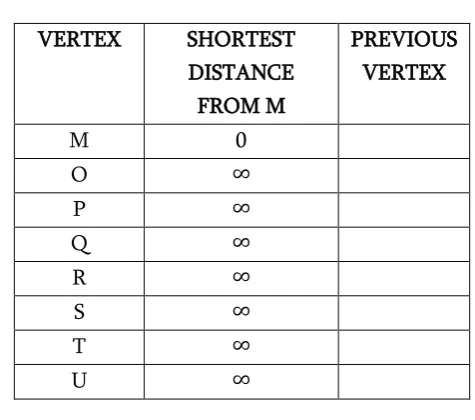
STEP1: Mark all nodes unvisited. Create a set of all the unvisited nodes called the unvisited set.
Table 3
VERTEX SHORTEST
DISTANCE FROM M
PREVIOUS VERTEX
M O P Q R S T U
Visited-[ ] Unvisited-[M, O, P, Q, R, S, T, U]
STEP 2: Assign to every node a tentative distance value: set it to zero for our initial node and to infinity for all other nodes. Set the initial node as current.
Table 4
VERTEX SHORTEST
DISTANCE FROM M
PREVIOUS VERTEX
M 0
O
P
Q
R
S
T
U
Visited-[ ] Unvisited-[M, O, P, Q, R, S, T, U] Distance to M from M is 0
Distance to all other vertices from M is unknown, therefore infinity.
STEP 3: For the current node, consider all of its unvisited neighbors and calculate their tentative
distances through the current node. Compare the newly calculated tentative distance to the current assigned value and assign the smaller one. For the current vertex, examine its unvisited neighbors. We are currently visiting M and its unvisited neighbors are O and P.
Figure 3
Here M to O = 0.1 M to P = 0.1
If the calculated distance of the vertex is less than the known distance, update the shortest distance. Update the previous vertex for each of the updated distance. In this case we visited O and P via M
Table 5
VERTEX SHORTEST
DISTANCE FROM M
PREVIOU S VERTEX
M 0
O M
P M
Q
R
S
T
U
Now add the current vertex to the list of visited vertices
Visited-[M] Unvisited-[O, P, Q, R, S, T, U]
STEP 4: Move to the next unvisited node with the smallest tentative distances and repeat the above steps which check neighbors and mark visited.
Therefore by step 4 we visit the unvisited vertex with the smallest known distance from the start vertex, this time is around either O or P because both are having same tentative distance . Let as consider O,
Figure 4
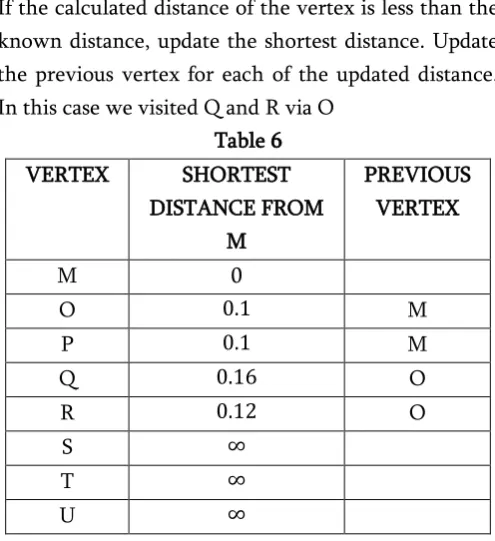
We are currently visiting O and its unvisited neighbors are Q and R.
Here O to Q = 0.1+ 0.06 = 0.16 O to R = 0.1+0.02 = 0.12
If the calculated distance of the vertex is less than the known distance, update the shortest distance. Update the previous vertex for each of the updated distance. In this case we visited Q and R via O
Table 6
VERTEX SHORTEST
DISTANCE FROM M
PREVIOUS VERTEX
M 0
O M
P M
Q O
R O
S
T
U
Now add the current vertex to the list of visited vertices
Visited-[M, O] Unvisited-[P, Q, R, S, T, U]
STEP 5: Move to the next unvisited node with the smallest tentative distances.
Figure 5
Here P to R = 0.1+0.06=0.16
If the calculated distance of the vertex is less than the known distance, update the shortest distance. But here the calculated distance(0.16) is greater than the known distance(0.12),the known distance remain as it is.
Table 7
VERTEX SHORTEST
DISTANCE FROM M
PREVIOUS VERTEX
M 0
O M
P M
Q O
R O
S
T
U
Now add the current vertex to the list of visited vertices
Visited-[M, O, P] Unvisited-[Q, R, S, T, U]
STEP 6: Move to the next unvisited node with the smallest tentative distances.
Here we visit R,
Figure 6
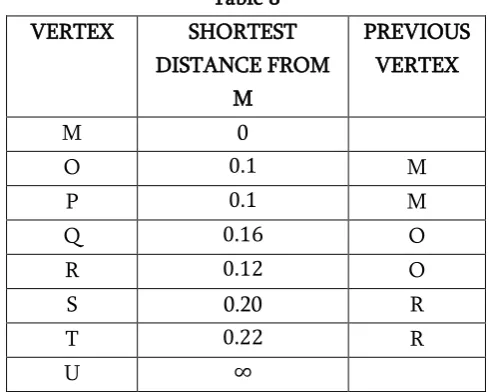
We are currently visiting R and its unvisited neighbors are S and T.
Here R to S = 0.12+ 0.08 = 0.20 R to T = 0.12+0.1 = 0.22
If the calculated distance of the vertex is less than the known distance, update the shortest distance. Update the previous vertex for each of the updated distance. In this case we visited Sand T via R
Table 8
VERTEX SHORTEST
DISTANCE FROM M
PREVIOUS VERTEX
M 0
O M
P M
Q O
R O
S 0.20 R
T R
U
Now add the current vertex to the list of visited vertices
Visited-[M, O, P, R] Unvisited-[Q, S, T, U]
STEP 7: Move to the next unvisited node with the smallest tentative distances.
Figure 7
We are currently visiting Q and its unvisited neighbors are S and T.
Here Q to S = 0.16+ 0.08 = 0.2 Q to T = 0.16+0.1 = 0.26
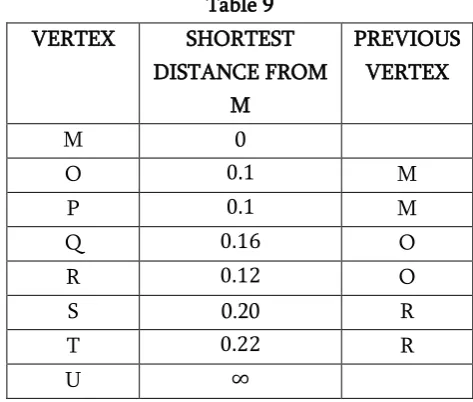
If the calculated distance of the vertex is less than the known distance, update the shortest distance. Here for the vertex S, calculated distance 0.24 is greater than the known distance 0.20. So known distance(0.20) of S remains same and also for the vertex T, calculated distance 0.26 is greater than the known distance 0.22. So known distance(0.22) of T remains same. In this case we visited S and T via Q
Table 9
VERTEX SHORTEST
DISTANCE FROM M
PREVIOUS VERTEX
M 0
O M
P M
Q O
R O
S 0.20 R
T R
U
Now add the current vertex to the list of visited vertices
Visited-[M, O, P, R, Q] Unvisited-[ S, T, U]
STEP 8: Move to the next unvisited node with the smallest tentative distances.
Here we visit S,
Figure 8
We are currently visiting S and its unvisited neighbors is U.
Here S to U = 0.20+0.08 = 0.28
If the calculated distance of the vertex is less than the known distance, update the shortest distance. In this case we visited U via S
Table 10
VERTEX SHORTEST
DISTANCE FROM M
PREVIOUS VERTEX
M 0
O M
P M
Q O
R O
S 0.20 R
T R
U S
Visited-[M, O, P, R, Q, S] Unvisited-[T, U] STEP 9: Move to the next unvisited node with the smallest tentative distances.
Here we visit T,
Figure 10
We are currently visiting T and its unvisited neighbor is U.
Here T to U = 0.22+0.04 = 0.26
If the calculated distance of the vertex is less than the known distance, update the shortest distance. Therefore the calculated distance (0.26) is replaced with the known distance (0.28). Update the previous vertex for each of the updated distance. In this case we visited U via T
Table 11
VERTEX SHORTEST
DISTANCE FROM M
PREVIOUS VERTEX
M 0
O M
P M
Q O
R O
S 0.20 R
T R
U T
Now add the current vertex to the list of visited vertices
Visited-[M, O, P, R, Q, S, T] Unvisited-[U]
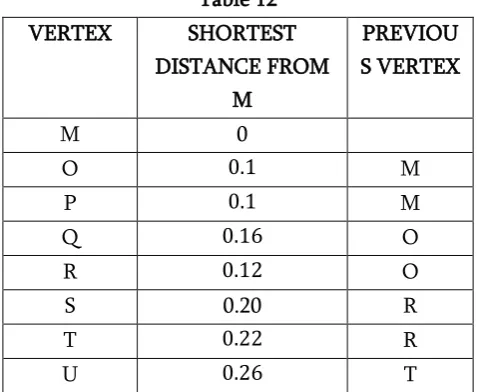
STEP 10: We are currently visiting U. We can’t able to move to the next unvisited node with the smallest tentative distances as there is no unvisited node.
Table 12
VERTEX SHORTEST
DISTANCE FROM M
PREVIOU S VERTEX
M 0
O M
P M
Q O
R O
S 0.20 R
T R
U T
Now add the current vertex to the list of visited vertices
Visited-[M, O, P, R, Q, S, T, U] Unvisited-[ ]
Hence the algorithm stops until all nodes are visited. Here the vertex U has the previous vertex T, vertex T has the previous vertex R, vertex R has the previous vertex O and vertex O has the previous vertex M. Therefore we get the shortest path from M-U is M-O-R-T-U.
VI.
DIJIKSTRA ALGORITHM TABULAR FORM
REPRESENTATION FROM COIMBATORE
TO KANYAKUMARI
Table 13
V M O P Q R S T U
M
O
P
R
Q
S
T
U
Here , , , ,
, , , are all represent visited nodes and represent unvisited nodes . Hence by this we can find the shortest distance from Coimbatore to Kanyakumari (i.e.) M to U. The vertex U has the previous vertex T, vertex T has the previous vertex R, vertex R has the previous vertex O and vertex O has the previous vertex M. Here the shortest distance is M-O-R-T-U = 0.26
Hence the shortest path is Coimbatore– Dindukkal– Madurai– Thirunelveli- Kanyakumari=0.26.
VII.
COMPARING THE RESULTS WITH
GOOGLE MAP
When we compare the results with Google map we get the same shortest path, it is represented in the figure 11
Figure 11. Google map direction from Coimbatore to Kanyakumari
It shows the same path (i.e.)., Coimbatore- Dindukkal- Madurai- Thirunelveli- Kanyakumari. Therefore we come to know that Dijikstra algorithm plays a major role in finding shortest path in Google map.
VIII.
IMPORTANCE OF DIJIKSTRA
ALGORITHM IN GOOGLE MAP
IX.
CONCLUSION
In this paper we showed the efficiency of Dijikstra algorithm in Google map and find out the value of uncertain fuzzy shortest route among the cities from Coimbatore to Kanyakumari by Bus is 0.26. The results which are obtained for the given example shows that Dijkstra Algorithm is very effective tool to find the path with lowest cost from node A to node U. Same results have been obtained also for Minimum Spanning Tree by using Kruskal algorithm[1], but this case the procedure is much simpler and easy.
X.
REFERENCES
[1].G. Nirmala & K. Uma – Shortest route algorithm for fuzzy graph, International Journal of Scientific and Research Publications, Volume 3, Issue 11, November 2013 1 ISSN 2250-3153
[2].Application of Graph Theory to find Optimal Paths for the Transportation Problem- Rame Likaja, Ahmet Shalaa and Mirlind Bruqi, International Journal of Current Engineering and Technology ISSN 2277 – 4106