EFFECTIVENESS OF STRUCTURED TEACHING PROGRAMME ON KNOWLEDGE ON IMMUNIZATION AMONG THE MOTHERS OF UNDERFIVE CHILDREN IN HARYANA.
Ms. Swapna M K
Assistant Professor, Amity College of Nursing, Amity University,Gurgaon
ABSTRACT
Immunization is one of the most successful and cost effective public health intervention in the constant effort of human beings against diseases that affect our well being. Every Year more than 10 million children in low and middle income countries die before they reach their Fifth Birthday. Vaccine Preventable diseases remain the most common cause of Childhood mortality with an estimated three million death each year. The factors includes the knowledge of mothers on acceptance of Immunization as a life saving resources. This study aims to assess the knowledge on Immunization among mothers of Haryana. Quasi Experimental One group Pretest and Posttest design was selected to determine the effectiveness of education on Immunization. A purposive Sampling technique was adopted to select 50 Samples. The knowledge questionnaire on Immunization was used to collect the data. The planned teaching Programme was developed and imparted knowledge to mothers of under five Children. The result shows that Knowledge score regarding Immunization was improved after Education. The result shown that the mean post test knowledge score was higher than the mean pre test score. The mean pretest score was and increased to 18.82 during post test .
I.Introduction
Immunization is vital, it protects nearly 3/4th of children against major childhood illness. There are several diseases, which can be easily prevented by timely vaccination as a part of routine Immunization. Every Child has the right to benefit from the appropriate traditional and new life saving vaccinations. Vaccines are protecting more children than ever before. Almost one third of deaths among Underfive children are controlled by preventable vaccine. UNICEF and its Partners are working to change these numbers and ensure that the lives of all children as successfully protected with Vaccines.
Immunization is considered as the most effective and safest public health intervention to reduce childhood morbidity and mortality although its full potential is not reached yet. Many under five children die from preventable diseases each year. The burden of infectious diseases can be reduced by primary step due to immunization. Life expectancy is also increased to vaccination. Immunization prevents diseases like diphtheria, measles, pertussis, pneumonia, Polio, Rotavirus diarrhea, rubella, tetanus and many more. The Knowledge of Parents are important factor for better immunization coverage. Studies did Previously shows misconceptions on mothers knowledge towards Immunization. Nowadays Parents are indoubt of safety and neccesity of routine childhood Immunization. Knowledge of mothers of Underfive children towards Immunization is necessary to take any decisions. Mothers Knowledge can help them to take Proper decision regarding immunization of their children.
Many in rural India lack access to education, nutrition, health care, sanitation, land and other assets and they are trapped into poverty. In rural India there is high number of Infant Mortality with low Life Expectancy at Birth Rate. While, in general, the urban-rural difference in health is a phenomenon of developing countries and countries in transition, the gender gap in health and mortality is typically endured in South Asian countries. Despite several programmatic initiatives, urban-rural and gender difference in child immunization pose an intimidating challenge to India’s public health agenda. Despite a decline in urban-rural and gender differences over time, children residing in rural areas and girls remained disadvantaged.The NFHS-3 survey reported that 57.6% of urban infants were fully vaccinated compared to 38.6% in rural areas. The percentage of infants who were not vaccinated was 5.7% in rural areas compared to 3.3% in urban areas. The urban-rural gap existed for all individual vaccines, although the gap was lowest with the 3 doses of OPV. The UNICEF 2009-10 survey recorded complete vaccination in 58.5% rural infants compared to 67.4% urban infants; the respective unvaccinated infants were 8.5% and 5.2%. Hence
II.Objectives
1. To assess the sources of Information on Immunization
2. To assess the knowledge on immunization among the mothers of Underfive Children before structured teaching Programme.
3. To assess the knowledge on immunization among the mothers of Underfive Children after structured teaching Programme.
4. To Compare the knowledge among mothers of Underfive children regarding Immunization.
III. Review of Literature
Hazaaratali Panari ,et.al., 2015, conducted a study on Immunization among the mothers of underfive children, Halage Village. The result shows that the mean value of knowledge on Immunization of mothers of underfive Children was 58.1 which falls in the level of moderately adequate knowledge and indicates that 58% of the mothers of Underfive Children have adequate Knowledge.
Soundarya Mahalingam,et.al,2014 conducted a study on Knowledge, attitude and perception of mothers with children underfive of age about vaccination and its importance .The cross Sectional descriptive study was conducted on mothers attending the Health Centre and the result revealed that 50.8% of mothers in the rural area have favourable knowledge.
Jissy Jose,et,al., 2013 conducted a study on awareness on Immunization among mothers of Underfive Children. The results revealed that 30% of mothers had poor knowledge, 23.4% of mother had good knowledge and 3.33 mother had excellent knowledge.
Chris Otubor,et.al., 2012, conducted a study on knowledge and attitude of mothers of underfive children in Jos North regarding Immunization. The results shows that out of 232 respondents, only 2.6% had excellent knowledge on Immunization and 89.6% had overall good knowledge while 5.2% had fair knowledge.
IV. Methodology
One group pretest post test design was adapted, 50 samples were selected through Purposive sampling technique. The planned structured Programme was administered on Immunization. The tool was developed by the researcher with the guidance of experts. The questionnaire contained three sections,
I. Demographic Variables
II. Sources of information on Immunization III. Knowledge regarding Immunization
V.
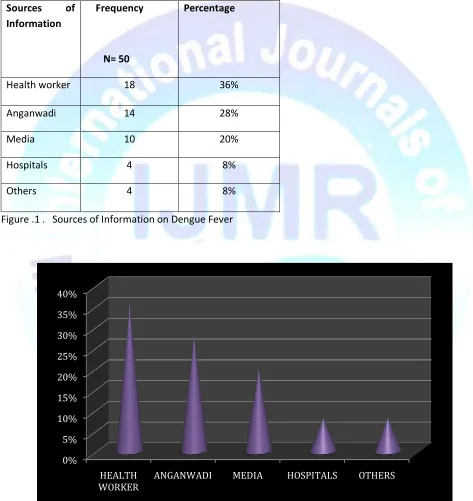
ResultsTable .1 Sources of Information on Immunization
Sources of Information
Frequency
N= 50
Percentage
Health worker 18 36%
Anganwadi 14 28%
Media 10 20%
Hospitals 4 8%
Others 4 8%
Figure .1 . Sources of Information on Dengue Fever
0% 5% 10% 15% 20% 25% 30% 35% 40%
HEALTH
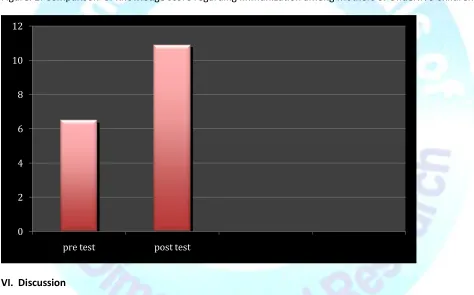
Table. 2. Comparison of Knowledge score regarding Immunization among Mothers of Underfive Children.
Mean MD Standard Deviation ‘t ‘ Value
Pretest 6.5
4.4
1.59
18.5
Post test 10.9 1.38
Figure. 2. Comparison of Knowledge score regarding Immunization among Mothers of Underfive Children
VI. Discussion
The Present study revealed that mean post test knowledge score was higher than the mean pretest score of respondents in Knowledge on Immunization. The mean pre test score of knowledge score was 6.5 and mean post test knowledge score was increased to 10.9. In this study majority of mothers source of information regarding immunization is from Health workers. A supportive study also shows same result by Ahmed Nadeem(2015), conducted a study in kerala, in this Health Personnel was the major important source of information.
0 2 4 6 8 10 12
VII Nursing Implications
Nursing Practice: Nurses can help the society by giving awareness related to the Immunization and to control the deadly diseases.
Nursing Adminstration: Inservice Education and training programmes can be conducted for student nurses, Health workers and anganwadi workers about the importance of Vaccination time to time and abet them to public.
Nursing Education: Ensuring the education to student nurses about the importance of vaccination in community.
Nursing Research: Continous Research both in urban and rural will help the public to improve the health of Children and also to know about the importance of vaccination.
VIII Conclusion
Lack of Knowledge can lead to the missed doses of Vaccination. . Education help to increase the awareness and Knowledge of importance of Vaccination. This Study was undertaken to evaluate the effectiveness of the educational programme to the mothers of Underfive Children regarding the Knowledge of Immunization. Hence this type of researches and education should be conducted in other parts of state for the improvement of health. In view of this result, government agencies and other non government organizations should strengthen its programs on massive educational campaign to awareness and knowledge regarding Immunization.
IX. Recommendations
Similar kind of study can be performed in large scale and in different settings. More educational interventions are needed to upgrade parents knowledge with special emphasis on less educated and residents of rural areas. In the view of source of information to public , role of media in providing
information need to be improved. The health personnel at the primary level, mass media and other means of Information, Education and Communication activities should be stressed to the maximum extent so as to increase the knowledge regarding immunization among people especially mothers.
References
1. Immunization Handbook for Medical officers; Dept. of Health & Family Welfare, Govt. of India; 2009. 2. Andre FE, Booy R, Bock HL, Clemens J, Datta SK, John TJ, et al. Vaccination greatly reduces disease, disability, death and inequity worldwide. Bull World Health Organ 2008; 86: 140-6.
3. World Health organization media centre. Immunization coverage Fact sheet 2013 No378 reviewed April 2015.
6. Kimmel SR, Burns IT, Wolfe RM, Zimmerman RK. Addressing immunization berriers, benefits, and risks. J Fam Pract 2007; 56: S61-9.
7. Smith MJ, Woods CR, Marshall GS. Parental vaccine concerns in Kentucky. J Ky Med Assoc 2009; 107: 342-49.
8. Hamid S, Andrabi S A H, Fazli A, Jabeen R. Immunization of Children in a Rural Area of North Kashmir, India: A KAP Study. Online Journal of Health and Allied Sciences 2012; 11: 1-4.
9. Bernsen RM, Al-Zahmi FR, Al-Ali NA, Hamoudi RO, Ali NA, Schneider J, et al. Knowledge, attitude and practice towards immunizations among mothers in a traditional city in the United Arab Emirates. Journal of Medical Sciences 2011; 4: 114-21.
10. Asim M, Malik N, Yousaf H, Gillani, Habib N. An assessment of parental knowledge, belief and attitude toward childhood immunization among minorities in rural areas of District Faisalabad, Pakistan.
Mediterranean Journal Journal of Social Sciences 2012; 3: 153-9.
11. Mollema L, Wijers N, Hahne SJ, van der Klis FR, Boshuizen HC, de Melker HE. Participation in and attitude towards the national immunization program in the Netherlands: data from population-based questionnaires. BMC Public Health 2012; 12: 57.
12. Borras E, Dominguez A, Fuentes M, Batalla J, Cardenosa N, Plasencia A. Parental knowledge of paediatric vaccination. BMC Public Health 2009; 9: 154.
13. Kimmel SR. Vaccine adverse events: separating myth from reality. Am Fam Physician 2002; 66: 2113-20.
14. Singh MC, Badole CM, Singh MP. Immunization coverage and the knowledge and practice of mothers regarding immunization in rural area. Indian J Public Health 1994; 38: 103-7.
15. Mandal S. Basu G, Kirtania R, Roy SK. Care Giver’s knowledge and Practice on Routine Immunization among 12-23 months children in a Rural Community of West Bengal. IOSR Journal of Dental and Medical Sciences (IOSR-JDMS) 2013: 6: 105-11.
16. Kapoor R, Vyas Sheetal. Awareness and knowledge of mothers of under five children regarding immunization in Ahmedabad. Healthline 2010; 1: 12-5.
17. Hilton S, Petticrew M, Hunt K. ‘Combined vaccines are like a sudden onslaught to the body’s immune system’: parental concerns about vaccine ‘overload’ and ‘immune-vulnerability’. Vaccine 2006; 24: 4321-7. 18. Gellin BG, Maibach EW, Marcuse EK. Do parents understand immunization? A national telephone survey Pediatrics 2000; 106: 1097-102.