Lazy Image Processing
An Investigation into Applications o f
Lazy Functional Languages to Image Processing
Y asu o K o z a to
Thesis submitted for the degree of Doctor of Philosophy
University College London
October 1992
Revised, July 1994
All rights reserved
INFORMATION TO ALL USERS
The quality of this reproduction is dependent upon the quality of the copy submitted.
In the unlikely event that the author did not send a complete manuscript and there are missing pages, these will be noted. Also, if material had to be removed,
a note will indicate the deletion.
uest.
ProQuest 10106566
Published by ProQuest LLC(2016). Copyright of the Dissertation is held by the Author.
All rights reserved.
This work is protected against unauthorized copying under Title 17, United States Code. Microform Edition © ProQuest LLC.
ProQuest LLC
789 East Eisenhower Parkway P.O. Box 1346
-2
Abstract
The suitability of lazy functional languages for image processing applications is
investigated by writing several image processing algorithms. The evaluation is done from an
application programm er's point of view and the criteria include ease of writing and reading,
and efficiency.
Lazy functional languages are claimed to have the advantages that they are easy to
write and read, as well as efficient. This is partly because these languages have mechanisms to
improve modularity, such as higher-order functions. Also, they have the feature that no
subexpression is evaluated until its value is required. Hence, unnecessary operations are
automatically eliminated, and therefore programs can be executed efficiently. In image
processing the amount of data handled is generally so large that much programming effort is
typically spent in tasks such as managing memory and routine sequencing operations in order
to improve efficiency. Therefore, lazy functional languages should be a good tool to write
image processing applications. However, little practical or experimental evidence on this
subject has been reported, since image processing has mostly been written in imperative
languages.
The discussion starts from the implementation of simple algorithms such as pointwise
and local operations. It is shown that a large number of algorithms can be composed from a
small number of higher-order functions. Then geometric transformations are implemented,
for which lazy functional languages are considered to be particularly suitable. As for
representations of images, lists and hierarchical data structures including binary trees and
quadtrees are implemented. Through the discussion, it is demonstrated that the laziness of the
languages improves modularity and efficiency. In particular, no pixel calculation is involved
unless the user explicitly requests pixels, and consecutive transformations are straightforward
and involve no quantisation errors.
The other items discussed include: a method to combine pixel images and images
Table of Contents
Abstract
2
Table of Contents
3
List of Figures
7
List of Tables
8
Acknowledgements
9
Acknowledgement to the Revision
10
Chapter 1: Introduction
12
1.1 Im age Processing ^
13
1.1.1 W hat is image processing
13
1.1.2 Program m ing image processing
14
1.1.3 H ow do conventional languages cope?
15
1.2 Functional Program m ing
17
1.2.1 Fundam ental concepts
17
1.2.2 A brief history
18
1.2.3 Im plem entations
21
1.2.4 M iranda
21
1.3 W hy Functional Program m ing Matters to Image Processing
22
1.4 Related W ork
24
1.5 The Rest of the Thesis
26
Chapter 2: Simple Image Processing in Miranda
29
2.1 Introduction
30
2.2 The N aive Version
30
2.2.1 Raster images
30
2.2.2 Pointwise operations
31
2.2.3 U nary operations
32
2.2.4 Binary operations
33
2.3 An Example M iranda Session
34
Chapter 3: From Pointwise to Local Neighbourhood Operations
36
3.1 Introduction
37
3.2 Im age Representation
37
3.2.1 W hy introduce an origin?
37
3.2.2 A polym orphic pixel type and interval representation
39
3.3 Pointwise operations
40
3.3.1 Definition of pointw ise operations in M iranda
40
3.3.2 Simple pointw ise examples
42
3.3.3 Look-up table functions
42
3.3.4 Spatial conditional operations
43
3.4 Image Translation
44
3.5 Local N eighbourhood Operations
45
3.5.1 Convolution in M iranda
46
- 4
-3.5.3 M inim um and m axim um filters
50
3.5.4 M edian filtering
51
3.5.5 An alternative im plem entation of convolution
52
3.5.6 Convolution an d image boundary problems
54
3.6 Discussions - W hat Are the Benefits?
55
3.6.1 Program m ing in functional style
55
3.6.2 Use of higher-order functions
57
3.6.3 Construction of 2D operations from ID
58
3.6.4 Polym orphic typing and image categories
59
3.6.5 Using flexible data structures
59
3.7 Sum m ary
60
Chapter 4: Laziness in Image Processing
61
4.1 Introduction
62
4.2 Lazy Evaluation
62
4.2.1 Elements of lazy evaluation
63
4.2.2 Space efficiency of lazy evaluation
64
4.2.3 E)rawbacks of lazy evaluation
65
4.3 H ow Laziness C ontributes to Im age Processing
65
4.3.1 Laziness contributes to efficiency
65
4.3.2 Laziness contributes to m odularity
66
4.3.3 Degrees of laziness
68
4.3.4 Image processing and infinite d ata structures
69
4.4 Inherently Lazy Operations
70
4.4.1 Geometric transform ations
70
4.4.2 Com bining pixel images and non-pixel im ages
73
4.5 Sum m ary
76
Chapter 5: Affine Transformations
77
5.1 Introduction
78
5.2 Design O verview
78
5.3 Translation an d Scaling
80
5.3.1 Image representation
81
5.3.2 Transform ations
81
5.3.3 Displaying an image
82
5.3.4 Discussions
86
5.4 Rotation, Translation and Scaling
86
5.4.1 Image representation
86
5.4.2 Transform ations
87
5.4.3 Displaying an image
87
5.5 Discussions
90
5.5.1 Limitation of the program s
90
5.5.2 Representation an d efficiency
90
5.5.3 Im perative vs lazy functional style
91
5.6 Sum m ary
93
Chapter 6: Using Hierarchical Data Structures
94
6.1 Introduction
95
6.2 An O verview of Hierarchical D ata Structures
95
6.4 A Binary Tree of Binary Trees
98
6.4.1 Relation w ith o ^ e r data structures
98
6.4.2 Image representation
"
99
6.4.3 Generating an image represented by a tree of trees
101
6.4.4 Tree condensation
102
6.4.5 Translation and scaling
103
6.4.6 Displaying an image
103
6.4.7 Discussions
106
6.5 Q uadtrees
106
6.5.1 The 2D vector abstract data type
106
6.5.2 Im age representation
107
6.5.3 Converting a 2D list to the image data structure
110
6.5.4 Q uadtree condensation
112
6.5.5 Transform ations
112
6.5.6 Displaying an image
113
6.6 Discussions
115
6.6.1 C om paring trees with quadtrees
115
6.6.2 H igher-dim ensional data and overloading
116
6.6.3 C om paring hierarchical data structures with lists
116
6.7 Sum m ary
117
Chapter 7: Combining Pixel and Non-Pixel Images
118
7.1 Introduction
119
7.2 File I / O in M iranda
119
7.2.1 Rasterfile re a d /w rite functions
119
7.2.2 Discussions on I /O
122
7.3 The A bstract Data Type: function images
124
73.1 Type signatures
124
7.3.2 Im plem entation
125
7.3.3 Examples
126
7.4 The A bstract Data Type: pixel images
128
7.4.1 Type signatures
128
7.4.2 Examples
129
7.5 Discussions
132
7.5.1 Applications of non-pixel images
132
7.5.2 Integration of fimage and pim age
133
7.5.3 H ow to integrate m ultiple representations
133
Chapter 8: Real-Life Efficiency —Some Benchmarks and Possible Improve
ment
135
8.1 Introduction
136
8.2 An U nfair Com petition
137
8.2.1 C ontender N o .l — M iranda
137
8.2.2 C ontender No.2 — Haskell (Version 1)
139
8.2.3 C ontender No.3 — C (median-by-qsort)
141
8.2.4 Result
144
8.3 Im provem ent of the C Code
145
- 6
-8.3.3 Im proved result
147
8.4 Im provem ent of the Haskell Code
147
8.4.1 Attaching le n g th ' to the interval structure (Version 2)
147
8.4.2 Eliminate identical operations (Version 3)
149
8.4.3 W hether to fold u p a list from left or right? (Version 4)
150
8.4.4 Use of cons instead of append (Version 5)
151
8.4.5 Insertion sort instead of quick sort (Version 6)
151
8.4.6 Sum m ary of the im provem ent
153
8.5 Further Benchmarks — I /O and Larger Images
154
8.5.1 H ow m uch time is consum ed by I/O ?
154
8.5.2 Space and time behaviour for larger images
154
8.6 Discussions
157
8.6.1 W hen lazy functional languages beat im perative languages
157
8.6.2 Use of other data structures
157
8.6.3 Caveats of lazy functional languages
158
Chapter 9: Conclusions
159
9.1 Overview
160
9.2 Benefits of Functional Image Processing
160
9.2.1 Image processing in functional style
160
9.2.2 H igher-order functions and image processing
160
9.2.3 Polymorphic pixel types
161
9.2.4 Com posing complex d ata and operations
162
9.3 Benefits of Lazy Image Processing
163
9.3.1 W hy lazy image processing?
163
9.3.2 Eliminating unnecessary operations
164
9.3.3 Laziness and house-keeping operations
165
9.3.4 Laziness as the "glue" of functions
165
9.4 Utility of Lazy Image Processing
166
9.5 Are Lazy Functional Languages Inefficient?
167
9.6 W hat H as Been Achieved?
168
Appendix A. Function Definitions
169
A.l Pointwise, Translation and Convolution “with an Origin”
169
A.2 Translation and Scaling Using List Representation
170
A.3 Affine Transformations Using List Representation
172
A.4 Translation and Scaling Using Tree of Trees Representation
173
A.5 Affine Transformations Using Quadtree Representation
174
A.6 Abstract Data Type: fimage
175
A.7 Abstract Data Type: pimage - The List Implementation
176
A.8 Abstract Data Type: pimage - The Quadtree Implementation
178
A.9 Abstract Data Type:vector
180
Appendix B. Paper Presented at Conference on Functional Programming Lan
guages and Computer Architecture ’93
182
References
193
Subject Index
205
List of Figures
Figure 2 -1 A scene and its raster image
30
Figure 2-2 Pointwise operations
31
Figure 2-3 The script, "naive.m"
34
Figure 2-4 M iranda sample session
35
Figure 3-1 Translation of images
38
Figure 3-2 N on-rectangular shapes
40
Figure 3-3 A spatial conditional operation
44
Figure 3-4 A local neighbourhood m ask
46
Figure 3-5 ID convolution by multiplicative and additive operations
48
Figure 3-6 Convolution - an alternative m ethod
52
Figure 4-1 A dding three images in two ways
68
Figure 4-2 An affine transform ation
71
Figure 4-3 An image conditional function using a function image
75
Figure 5-1 An example of affine transformations
79
Figure 5-2 Displaying pixels through interpolation
82
Figure 5-3 Interpolation in tw o steps
85
Figure 5-4 Displaying rotated pixels
89
Figure 5-5 Spatial relationship betw een original and display pixels
91
Figure 5-6 An affine transform ation in C
92
Figure 6-1 Example binary tree and quadtree
96
Figure 6-2 A bintree and a tree of trees
99
Figure 6-3 A pixel tree, root position and first step
100
Figure 6-4 A row w ith N il's
101
Figure 6-5 Displaying pixels w ith averaging at a required resolution
104
Figure 6-6 Representing a non-square image w ith a hole
109
Figure 6-7 Root position and tw o vectors of a quadtree
110
Figure 6-8 Displaying a quadtree at a required resolution
114
Figure 7 -1 A sinusoidal image and its rotation
127
Figure 7-2 A 2D sinusoidal image and its scaling
127
Figure 7-3 A concentric circle image and its translation
128
Figure 7-4 Transform ed pixel images
130
Figure 7-5 An example spatial conditional
132
Figure 8-1 M iranda code for m edian filtering
138
Figure 8-2 Haskell code for m edian filtering (Version 1)
140
Figure 8-3 C code for m edian filtering
142
Figure 8-4 M edian by sort in C
145
Figure 8-5 M edian by incremental histogram updating
146
8
-List of Tables
Table 1-1 Comparison between conventional languages
16
Table 1-2 Comparison of principal functional languages
20
Table 8-1 A benchmark result
144
Table 8-2 A benchmark result of the improved C versions
147
Table 8-3 Improved results of Haskell versions
153
Table 8-41/0 overheads of the Haskell versions
154
Acknowledgem ents
This work was initiated through Canon's international technical traineeship scheme,
which allowed me to spend two years from 1986 as a research student at University College
London. After the setting-up of Canon Research Europe in Guildford, our management
allowed and encouraged me to continue my research. Without their generosity my work
would never have completed. Therefore, I would like to thank all the people at Canon, in
particular Dr. H. Mitarai and Mr. H. Negishi for their continuous support.
A number of people have aided my work in many ways: First and foremost, I am
indebted to my supervisor at UCL and now colleague at CRE, Paul Otto, for his patience,
continuous encouragement and numerous relevant technical discussions and suggestions
throughout; people who have a common research interest in the interdisciplinaiy area of
functional programming and image processing: Ian Poole, for the excellent discussions and
continuous communication; Michael Parsons, Thomas Breuel, Greg Michaelson and Mark
Allsop for sending their theses, papers and relevant information; people from the Glasgow
functional programming group, who, at the workshop in Ayr, broadened my knowledge of the
state-of-the-art and future of lazy functional languages; Lennart Augustsson and Colin
Rundman for providing tools and very useful suggestions for using them.
Finally, I would like thank Fukumi, my partner in my personal and professional life,
who submitted her thesis 12 days before me. Both of us can now feel an intense sense of relief
- 10
-Acknowledgement to the R evision
More than one and a half years have passed since the first submission of the thesis.
During the revision work various things happened:
• The paper based on Chapter 8 of the first submitted version, '^Benchmarking Real-Life
Image Processing Programs in Lazy Functional Languages", was accepted and
presented at the Conference on Functional Programming and Computer Architecture in
June 1993. So I have attached the paper as an appendix and m ade major revisions in
Chapter 8.
• A new Haskell compiler (GHC) from University of Glasgow became available, which is
said to be most efficient at present. So I used GHC for the benchmarks in revised
Chapter 8.
• My viva was held on 5th January 1993. The comments by the examiners were
considered and reflected in the revision. I believe the thesis became much more polished
and I would like to thank the examiners for their useful suggestions.
• 1 returned from U.K. to Japan, and my role changed from a researcher to a manager.
These changes made the revision work much slower than 1 thought. But 1 am pleased
that 1 have done the job.
Lastly, 1 would like to thank Paul Otto again who has encouraged myself and made
1.1
Image Processing
1.1.1 W hat is im age processing
Image processing [Gonzalez87a, Schalkoff89a, Pratt91a] is a large application area which
includes literally everything which involves processing images. Although it is a diversified
area, its common property is that it involves enormous amount of data. In order to deal with
images on computers, we normally use pixels, measurements such as intensity at sampled
points of an image, and an image is typically represented as an array of pixels. The number of
pixels involved is varied but always large. For example, a television picture usually contains
approximately 500 x 500 pixels, a high-definition TV image or a bit m ap image on a current
workstation roughly 1000 x 1000, an image for printing an A4 document about 3000 x 4000,
and a panchromatic SPOT satellite image [ChevrelSla] 6000 x 6000. A pixel may contain one-
bit (ON/OFF) information, a few bits or a real number to denote a value such as a gray level,
a complex num ber for Fourier transformed images, a tuple such as RGB data for multi-spectral
images, a label, o r other types of information for various purposes. Images may be static, as
well as dynamic; such as television pictures, or processing image sequences. In addition,
images are not only 2D but also 3D or more; voxels sampled at 3D grid are used for
representing 3D structures, e.g. MRl data [Woods91a] of human bodies.
As well as the sizes, the purpose of image processing varies extensively. It may be as
simple as adjusting intensity of an image to improve the look of the image, or geometric
transforms such as rotation and scaling. It may be transformation from one domain to the
other domain, such as a Fourier transform which transforms an image from the spatial domain
to the frequency domain; Hough transform to convert an image from the spatial domain to the
Hough space; image compression such as JPEG [Wallace91a] and MPEG [Le Gall91a] for
storing images or communicating through networks. Or, it may be for extracting necessary
information out of an image such as description of edges, shapes, or labels. It may be a
conversion from some description to reconstruct an image such as data obtained from
computer tomography (CT) [HermanSOa], MRl, or synthetic-aperture radar (SAR), or
producing a picture from a picture description language such as PostScript [Adobe Systems
lnc.90a]. In any case, image processing can be described as a certain process applied to input
- 14
-1.1.2 Program m ing image processing
Because a large amount of data is involved, programming image processing is rather tedious
and cumbersome. We address the difficulties in programming image processing as follows:
• Programmers have to p u t extra effort in arranging sequences o f operations, so that the
amount o f memory used is kept w ithin reasonable bounds.
For example, even if the same operation is being applied, different code may be necessary
for processing a television image and a satellite image, since the satellite image contains a
lot more data than the television image, and so it may not be practical to have all the data
in main memory. In such a case, the satellite image may be read, processed and written in
a line by line or chunk by chunk manner, while the television image may be read and
processed at once.
As another example, in order to save memory, programmers normally overwrite an image
which will not be used. If an operation is pointwise (See Section 2.2.2) it is OK to replace
the input pixels with the output as the operation proceeds, but if it is a local neighbourhood
operation (See Section 35), overwriting the input image does not yield the correct result
because the resulting pixel value depends on the values of surrounding pixels. In such a
case, either the output image should be kept separate, or careful arrangement of memory
usage in order not to give the wrong result is necessary.
In any case, programmers have to be veiy careful in arranging proper usage (and reusage)
of memory and appropriate sequences of operations, which is not an easy task.
• Programmers have to write alm ost identical code for various operations on various
images although there are a lo t o f common structures among them.
As described in the previous subsection, there are many different image types; binary, gray,
colour, label, complex, or other kinds of images. But these images usually share a common
structure, i.e. a 2D array of pixels, and the difference lies in the type of an element in an
array. If a programming language does not have a facility to unify those image types,
programmers will have to define those images separately and write almost identical code
to process those images. For example, when a gray image and a colour image of the same
size are being defined, they may need separate definitions because the type of an element
is a single value for the gray image, whereas it is a triple of RpB values for the colour image.
Not only the structures of image data, but also the structures of computation are shared
among a num ber of image operations, such as pointwise operations, local neighbourhood
operations, and so on. These computational structures are typically expressed by control
structures in conventional languages, such as a double loop. If a programming language
does not support passing various operations to a common control structure, programmers
have to write almost identical code nriany times. For example, if they write programs to add
two images and to subtract two images in a pixel by pixel manner, they normally end up
with two separate but almost identical pieces of code in which only plus (+) and minus (-)
symbols differ.
1.1.3 H ow do conventional languages cope?
This subsection reviews conventional languages and how they cope with the problems
addressed above. No language can be a panacea, but certain facilities will work well to solve
certain problems.
In Fortran^, where only static arrays are used, arrays must be explicitly declared in
source code, i.e., the size of images must be known at compile time. Also, it is very difficult to
cope with changes of array size, and so image processing libraries written in Fortran tend to
keep the size of images fixed through operations.
In Pascal and C, where memoiy can be dynamically allocated and deallocated via
function calls, the size of images need not be known at compile time, but explicit allocation and
deallocation m ust be described in source code.
C++ [Stroustrup86a] features classes which allow encapsulation of a number of data
types and operations associated with them in one class, and the implementation details can be
hidden from users. Thus, it is possible to hide explicit memory allocation/deallocation of
complicated data structures from users, though it must be implemented somewhere by
implementors. Also, overloading of functions and operators allows registration of different
operations on different data types under the same name. So, for example, once various data
types and operations have been packaged up as the class 'pixel', users do not have to be aware
-16
-of which types -of pixels are being processed. This saves users from writing almost identical
programs. However, these techniques are quite ad-hoc [Straçhey67a] in the sense that the
underlying operations work differently on diH^erent types despite that they bear the same
name. If a new data type is to be added to a dass, implementers m ust look into the
implementation details.
A new feature of C++ called templates [Stroustrup91a] may be another solution; these
allow various types and functions to be used as parameters in different instances of a common
pattern of data, such as lists and arrays. But this is a kind of macro facility and its flexibility
and applicability are rather limited.
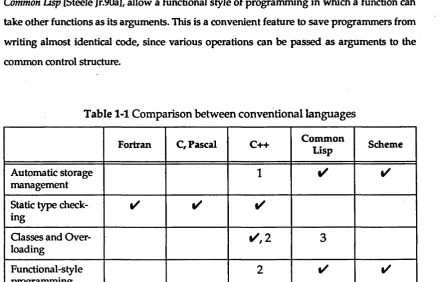
Usp automates memory management, so that normally users do not have to write code
to allocate/deallocate storage. Also, it is an untyped language, so that a function argument can
take various data types. However, it is not statically type-checked, which means that
programmers have to work hard to produce correct programs, especially w hen complicated
data structures are being used. Some dialects of Lisp, such as Scheme [AbelsonSSa] and
Common Usp [Steele Jr.90a], allow a functional style of programming in which a function can
take other functions as its arguments. This is a convenient feature to save programmers from
writing almost identical code, since various operations can be passed as arguments to the
common control structure.
Table 1-1 Comparison between conventional languages
Fortran C, Pascal C++ Common
Lisp Scheme
Automatic storage management
1 ✓ ✓
Static type check ing
✓ ✓ ✓
Classes and Over loading
3
Functional-style programming
2 ✓ ✓
1. Memory management can be hidden from users of a library.
2. Also templates [Stroustrup91al allow a limited form of polymorphism.
3. CLOS [Bobrow90a] is an object-oriented extension of Common Lisp which has classes.
note that the table is based on the "standard" programming style. So, it is possible to program
in a different style, though it could be unusual or inefficient. Also, languages are evolving, and
various extensions are available to support particular styles of writing.
1.2 Functional Programming
This section gives a brief overview of functional programming. For more details, see various
textbooks and surveys, e.g., [HendersonSOa, BirdSSa, Reade89a, Hudak89a].
1.2.1 Fundam ental concepts
Functional programming falls in the category of declarative programming. The most important
characteristic of declarative programming is that there are no implicit states, or no side-effects.
This is because assignment is prohibited in declarative programming, which contrasts with
imperative programming. Imperative programming has implicit states which may be modified
or side-effected through assignment operations. Imperative languages include nrtost
conventional languages such as Fortran, Pascal, C, C++, Lisp, and so forth.
The basic computational model of functional programming is mathematical functions
in contrast to relations in logic programming [Sterling86a] which is also categorised as
declarative programming. Programs are constructed as a collection of function definitions and
expressions are evaluated by the computer. The basic mechanism of evaluation is function
application, i.e.,
output = function (inputs)
is the fundamental style of functional programming where output names the result of applying
function to the argument inputs and is completely equivalent in its meaning. In other words,
referential transparency is secured in functional programming, provided all functions are
deterministic.
Because there are no side-effects, the output depends only on the input arguments, and
how the evaluation is carried out is the system's role. Amongst various evaluation strategies,
eager and lazy are the two which should be mentioned here. Eager evaluation, or applicative order
evaluation, takes the strategy that a function is evaluated after all the input a i lm e n t s have
been evaluated. Whereas lazy evaluation, or normal order evaluation, evaluates an expression in
-18
-evaluation is commonly used to implement languages with non-strict semantics (see Section
4.2).
One of the important features of functional languages is that a function is regarded as a
first-class object, just like a number in conventional languages. A function which takes a
function as argument, or delivers one as a result is called a higher-order function. The benefits
of a higher-order function are that it can separate control structures from operations, and that
arbitrarily complicated control structures can be relatively easily constructed from simple
ones. Scheme and Common Lisp, as described in Section 1.1.2, have this facility although they
have imperative features, as well.
Types are an important factor in programming languages to help producing reliable
code. It is often desirable that program errors are detected as early as possible, and programs
should not run if they contain type errors. Languages with this facility are said to be strongly
typed and such a type checking mechanism is called static type checking. Most functional
languages, as well as many imperative languages including Fortran, C, Pascal and C-H-, have
this feature, but Common Lisp and Scheme do not, as these are untyped, or dynamically typed
languages.
In addition, most functional languages allow polymorphic functions; that is, a function
may take arguments of arbitrary type if the function does not depend on that type. For
example, suppose there is an identity function which returns the same entity as its input
argument. If the identity function takes a number it returns the number, and if the input
argument is a string it returns the string. In this example, as long as the types of its input and
output are the same, it can be of any type. Such a type is called a polymorphic type and a type
system which allows polymorphic types is called a polymorphic type system.
1,2JZ
A b rief history
The most influential work which formed the theoretical basis of functional programming
would be the lambda calculus invented by Church [Church41a] (see also [Barendregt84a]>. As
for the programming language side, the development of Lisp by McCarthy [McCarthy60a]
was a big step forward. Lisp has been so popular in the artificial intelligence community in the
U.S. A. that it has produced a lot of dialects and extensions. The most im portant developments
amongst them were Scheme [AbelsonSSa] and Common Lisp [Steele Jr.90a] because they
Other important work was done by Landin who proposed a language called kwim
[Landin66a]. He put a lot of syntactic and semantic ideas into the language, such as infix
notations, introduction of let and where, and emphasised the importance of defining a
tactically rich language over a small but expressive core language.
The importance of Backus' Turing Award Lecture in 1977 [Backus78a] was that it drew
much attention to functional programming, although FP itself has been a less conrunon
language.
The polymorphic type system, one of the principal features of modem functional
languages, was invented by Hindley [Hindley69a] and Milner [MilnerTSa], hence called
Hindley-Milner type system, and was first implemented in a programming language called ML
[Gordon78a], later developed in SML [Milner84a]. SML has been one of the most widely-used
functional languages.
A series of language designs carried out by Turner, started as SASL [T\imer76a] then
KRC n\imer82a], has led to the development of Mirandc^ [Tumer85a] which we will use
extensively in this thesis. The most notable feature of Miranda is lazy evaluation, as well as
more common facilities such as polymorphic strong typing and higher-order functions.
Currently, Miranda is the only functional language for which there is a commercially available
implementation.
A more recent movement has been the development of Haskell [Hudak92a] by an
international group of researchers. The aim of the project is to design a common language to
avoid emergence of a number of similar functional languages and duplication of effort.
Haskell is a general purpose, purely functional language with the features of higher-order
functions, non-strict semantics, static polymorphic typing, and so forth. Besides these features
which are in common with Miranda, it also incorporates novel features such as type classes
and overloading integrated with the polymorphic type system and non-strict immutable
arrays. As of now, a few implementations have appeared [The Yale Haskell Group91a,
Augustsson92a, The AQUA Team93al. Also, a subset of Haskell has been implemented by
Jones as Gofer Qones92a]. A good introduction to Haskell is given in [Hudak92b].
Another recent development worth mentioning is a language called SISAL [Bohm92a].
This language is in the category of dataflow languages designed for dataflow architectures
-20
[Chambers84a]. On such machines operations are completely data dependent, and therefore
sequencing of operations by a human programmer is not relevant. Hence, such languages are
essentially functional. Other languages in this category include Id [Arvind89a]. The
importance of SISAL is that its implementations on parallel machines are very fast A recent
report shows that it runs as fast as Fortran using various scientific applications including
Fourier transforms and hydro-dynamics [Cann92a]. This result suggests that, although SISAL
is not lazy, and is without polymorphic typing, functional languages could be implemented
efficiently on parallel machines. Since image processing is a data intensive application area,
this possibility may be a good sign for functional languages to be used for real image
processing applications.
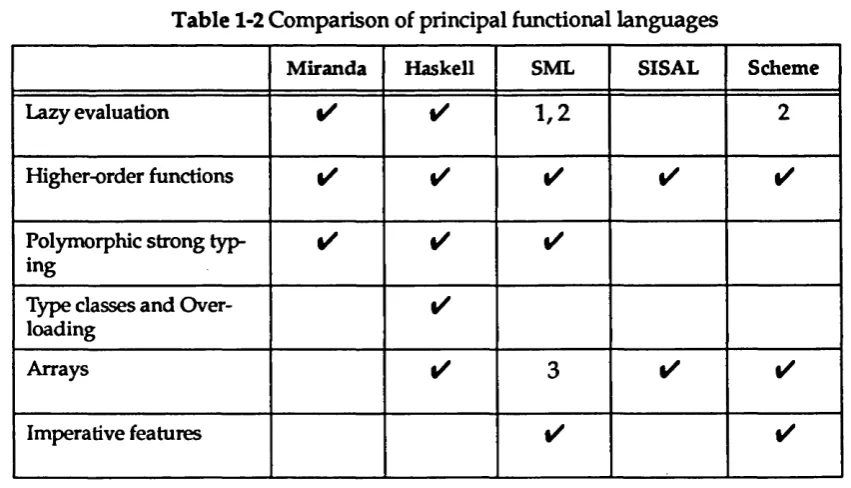
To conclude this subsection. Table 1-2 gives a comparison between principal functional
languages in terms of their facilities. Of the languages reviewed so far, w e are mainly using the
lazy functional language Miranda. Section 12.4 describes the reasons for the selection and
Section 13 describes the possible benefits of using lazy functional languages for image
processing.
Table 1-2 Comparison of principal functional languages
M iranda Haskell SML SISAL Scheme
Lazy evaluation ✓ ✓ 1 ,2 2
Higher-order functions ✓ ✓ ✓ ✓ ✓
Polymorphic strong typ ing
✓ ✓ ✓
Type classes and Over loading
✓
Arrays ✓ 3 ✓ ✓
Imperative features ✓ ✓
1. Lazy ML [Augustsson84a] supports lazy evaluation.
1.2.3 Im plem entations
Implementations of functional languages have often been described in terms of abstract
machines, since programs are analysed and compiled into a sequence of instructions which an
abstract machine can execute. Whether the machine is implemented in hardw are or software
appears to be a separate issue. However, it is generally considered that functional languages
have potential to be implemented efficiently on parallel architectures since there are no side-
effects and expressions can be evaluated in any order. In fact, the recent report on SISAL by
Cann [Cann92a] can be regarded as a strong evidence to support this statement. Thus,
although implementations of functional languages are still a research area, it should not be
long before efficient parallel iixiplementations appear.
The SECD machine invented by Landin [Landin64a] and later described by Henderson
[HendersonSOa] is one of the early-days implementations. It is a stack-based implementation
and consists of four stacks, namely S: the stack, E: the environment, C: the control list, and D: the
dump, hence the name. The SECD machine can be extended to support lazy evaluation.
Turner proposed a technique called comhinator^ reduction [Tumer79a] by which high-
level expressions can be compiled into expressions in a fixed set of low-level combinators
named SK combinators. Hughes modified this method and developed super-combinator
compilers [Hughes84b]. He showed that as the size of a program becomes larger the super-
combinator method presents better performance than Turner's method. Both methods
implement lazy evaluation and have formed the basis of m odem implementations of lazy
functional languages.
More recent implementations include TIM (The Three Instruction Machine)
[Fairbaim87a], (he G-machine [Augustsson87a, Johnsson87a], a parallel version of the G-
machine [Kingdon91a], and so forth.
1.2.4 M iran d a
M iranda has been chosen as a representative of lazy functional languages and the code that
appears in this thesis is written mostly in Miranda. The reasons are:
• Miranda is a lazy functional language which has all the principal features that modem
- 22
-functional languages have, such as higher-order functions and polymorphic strong
typing.
• Miranda is small and easy-to-leam, and is capable enough to demonstrate the claims
described below.
• A stable Miranda implementation was available when coding was being done.^
• Miranda works and integrates well on a UNIX workstation and its supporting
environment such as on-line manuals is good.
For an introduction to programming in Miranda, see, e.g., [Tumer86a] and [BirdSSa]. In
this thesis it is assumed that readers have basic knowledge of Miranda programming. Also,
Miranda's built-in operators and functions defined in the standard environment are used
without definition or explanation. If necessary, readers should refer to the M iranda's on-line
manual [Research Software LimitedS9a].
1.3
Why Functional Programming Matters to Image Processing
Image processing progranuning in functional languages has been a less common approach
until recently, partly because functional languages themselves are still under active research
[HudakS9a] and not many real-world applications have been written [Hall92a]. Nevertheless,
a few research results have shown that functional programming should be a good vehicle to
describe image processing algorithms [Allsop91a, Breuel92a].
The overall theme of this thesis is "are lazy functional languages 'good' for writing image
processing programs?". The suitability of lazy functional languages for image processing is
investigated by writing several image processing algorithms in lazy functional languages. The
focus of the discussion is on how the features of these languages, laziness in particular, make
image processing programming easier, or more difficult. Possible criteria are ease of writing
and reading, and efficiency.
A particular issue related to ease of writing and reading is modularity of programs which
describes the capability to keep code for separate operations separate and to require little work
in putting them together. If programs can be written in a modular manner it will also improve
reusabÜity, because different programs may comprise common operations or control
structures.
It is assumed that time and space efficiency of the underlying implementation of lazy
functional languages will be adequate for image processing applications. We are going to
discuss efficiency from an application programmer's point of view, such as asymptotic
behaviour, termination and the possibility of using better algorithms^.
The following is a list of possible benefits of using lazy functional languages in image
processing programming, by which the difficulties of image processing programming
discussed in Section 1.1.2 may be overcome. These items will be discussed in detail with
examples throughout the body of the thesis and revisited in the last chapter to discuss to what
extent these benefits have been confirmed. The first four items do not concern laziness, but can
be applied to any functional programming languages with higher-order functions and
polymorphic typing:
1. The basic functional style, i.e. output - functiondnputs), can naturally express image
processing which is essentially described as an "input—^process—^output" process.
2. Higher-order functions allow different functions to be mapped onto a common
structure, which enables separation of control and operations. This facility should
improve modularity and reusability of code because images typically have a common
structure, such as a 2D array of pixels.
3. Polymorphic typing allows any pixel types in a common image structure, which should
provide a mechanism to handle various types of images, such as binary, gray, colour, or
other kinds of images, in a unified manner.
4. An image may typically be represented as a 2D array of pixels, but it can also be viewed
as a collection of rows and a row b a n g a collection of pixels, i.e., an image and a row
have the common structure. Using this nature, higher-order functions together with
polymorphic typing should provide a simple mechanism to build u p higher
dimensional data and operations by combining lower dimensional ones which are
usually easier to implement and debug.
-24
And the following are three possible benefits which originate particularly from laziness:
5. Lazy evaluation ensures that an expression is not evaluated until its value is required.
In image processing where each operation is usually very expensive, this facility to
eliminate unnecessary operations may improve efficiency automatically. It may be more
beneficial when not the whole image but only a small portion is required.
6. Functional languages embed memory management and routine sequencing operations
in themselves. This, when combined with lazy evaluation, may become more beneficial
in image processing. For instance, when consecutive operations are applied to an image,
the execution sequence and the necessary intermediate memoiy can all be handled by
the functional language implementation, so that programming will be easier.
7. One particular consequence of the embedded memoiy management and sequencing
operations is that it may improve modularity, since different parts can be implemented
as different functions and not much care is necessary in putting them together. For
example, it may be possible to make a display function separate from the other image
processing parts which can be used as a common programming part for display.
Of course there are drawbacks of using lazy functional languages. As a natural
consequence of the fact that the languages do more work in order to be laz)7, i.e., it is necessaiy
to decide whether an operation is required or not, bigger overhead may be incurred and
execution of programs may be rather slow compared with eagerly evaluated languages. This,
however, should trade off with the above benefits, such as ease of programming and better
efficiency when requiring a small portion. Also, as implementation techniques of lazy
functional languages are advancing, programs will run faster when more efficient
implementations appear.
1.4
Related Work
Application of functional languages to image processing is a little-researched area and only a
few results have been reported. In this area, SML has been the most common language. SML
features higher-order functions and polymorphic strong typing, but is not lazy and has
imperative features such as references, imperative arrays, and referentially opaque I/O . So, it
is possible to program in an imperative style if a programmer chooses to do so.
Allsop [Allsop91a] implemented a basic image processing library called FUPT
(Functional Language Image Processing Toolkit) using SML and discussed basic concepts of
image processing by comparing SML programs with Apply (Hamey89a] and C. Breuel
[Breuel92a] implemented a library of functions for computer vision both in SML and C++ and
discussed how elements of functional programming benefit the programming of various
vision algorithms. They both concluded that functional programs are modular and easier to
understand because the language has strong mechanisms, such as higher-order functions and
polymorphism, to integrate from diverse sources. Breuel, in particular, stated that the
language support for closures with unlimited extent enables one to implement lazy data
structures which are particularly desirable when an algorithm does not require information at
eveiy pixel. However, SML is a strict language and so any laziness needs to be explicitly
programmed (See Table 1-2). As a consequence, he did not demonstrate this in the programs.
The overall programming style of SML, though it is functional, is quite different from lazy
languages, and so separate work using lazy languages would be necessaiy to discuss effects
of laziness.
Wallace et al. [Hopkins89a, Wallace92a] implemented the specific algorithms of scene
labelling and parallel perspective inversion using SML. Although they mentioned the general
advantages of functional programming such as modularity and ease of understanding, their
emphasis is rather on how to identify and utilise the implicit parallelism of functional
programs and how they can be efficiently executed on parallel machines. There is no mention
of laziness.
Another common functional language is Miranda which we also use intensely in this
thesis. Parsons [Parsons87a, Parsons89a] used M iranda to implement various data structures
to represent graphical data and images, including lists of line segment, rasters, quadtrees,
quadgraphs® [Parsons86a], run length code, and fractals. His focus is on the use of algebraic
data types with laws [Thompson86a]. However, laws are difficult to use and have become an
obsolete feature in the current Miranda release [Research Software Limited89a]. As for
laziness, he concluded that it contributes to improving efficiency by non-strict
transformations, displaying primitives at lower resolution, minimising relational tests, and in
- 26
-the higher-order version of RasterOp operations. His most important message is "we have been
enlightened by the use of this language; it has suggested new and interesting definitions of old
graphical ideas (Parsons87al." However, he did not discuss how laziness affects not only the
data structures, but also the way programs are written, in particular how it improves
modularity of programs. Although he implemented interesting data structures, his emphasis
was on graphics applications and he did not present commonly used image processing
operations in a way that utilises laziness in a positive nunner.
The other development using Miranda is by Poole IPoole92a]. His approach is fairly
pragmatic. The execution speed of Miranda programs with the current implementation is
rather slow for real image processing applications, so he uses M iranda as the front-end to the
existing Woolz image processing server [Piper85a] written in C. Such systems may provide a
good interim solution by combining the speed of a conventionally implemented image
processing system with the flexibility and other advantages of a lazy functional language. He
is currently working on a fully-functional version using Haskell, as efficient and reliable
implementations are appearing.
Burton and Huntbach's work [BurtonSSa] does not use a functional language, but
focuses on laziness in manipulating geometric objects. In particular, they advocated that lazy
evaluation of geometric objects is useful whenever objects are represented by quadtrees and
only a portion of the data structure is required. They implemented a lazy data structure of a
quadtree in Pascal, in which an extra boolean member indicates whether the quadtree has been
evaluated or not.
1.5
The Rest of the Thesis
In the remainder of the thesis, we will discuss whether lazy functional programming
languages are suitable for writing image processing programs using a number of examples.
Chapter 2 serves as an introduction to image processing in M iranda to familiarise
readers with this paradigm using very simple examples, such as unary and binary pointwise
operations. Also an example Miranda session is provided in order for readers to understand
how to communicate with the system. We call the version introduced in this chapter the
"ruUvef' version, because this is the image processing program which a first-time Miranda
In Chapter 3, an implementation called the "vHth an origin*' version is presented. The
categories of algorithms included are pointwise, image translation, and local neighbourhood
operations such as convolution. This version introduces the concept of an origin into the data
structure to represent an image, by which the image boundaiy problem commonly associated
with image translation and local neighbourhood operations is solved elegantly. Also, a fairly
large number of image processing algorithms based on these operations are implemented. It
is remarkable that median filtering which is not usually considered to be convolution can be
implemented using the function defined for convolution. The discussed items include: a
polymorphic pixel type allows unified treatment of various categories of images; higher-order
functions and polymorphic typing allow construction of 2D operations by combining ID
operations in a straightforward manner, and improve modularity.
Chapter 4 focuses on laziness in image processing. In the first part, laziness in the
context of functional programming languages is described, where lazy evaluation is an
implementation technique to allow non-strict semantics. Then, discussion moves on to the
relationship between laziness and image processing. We discuss how laziness is a convenient
feature to improve efficiency and how it improves modularity. The last part discusses the
algorithms which are considered to be particularly suitable if expressed in lazy languages. We
call these algorithms inherently lazy and discuss whether lazy languages can express these
algorithms in a natural fashion.
Chapter 5 gives an implementation of inherently lazy geometric transformations using
lists as the basic structure for images. Programs are written to utilise benefits of laziness of the
language which include: (a) unless the user specifically asks an image to be displayed, no pixel
operations are carried out, (b) and only the required parts are calculated, (c) program
description is forward mapping in a straightforward manner, and (d) consecutive
transformations are expressed as straightforward function composition and do not
accumulate quantisation errors. It will be shown that pursuing these benefits of laziness leads
to a novel way of image processing programming. Limitations and drawbacks of the
algorithms are also discussed.
Chapter 6 presents the same algorithms as Chapter 5, but another implementation using
hierarchical data structures. This chapter is divided into two parts: representing an image as a
binary tree of binary trees, and as a quadtree. Using a tree of trees is an extension to the method
2 8
-compose 2D operations using higher-order functions. We will dem onstrate that this principle
works for hierarchical data structures, as well, and that code is fairly easy to read and write. A
quadtree is our first attémpt to Anplement 2D data structures directly, since a simple
calculation shows that a quadtree is supposed to have space benefit compared with a binary
tree of binary trees. It will be shown that although the quadtree version seems less readable, it
gives an easy mechanism of random access, i.e. look-up a value of an image at an arbitrary
position.
Chapter 7 provides an implementation and some examples of combining pixel images
and non-pixel images together, since this is another algorithm which lazy functional languages
may be particularly good at. In the first section, issues related to image I /O are discussed
because for the pixel image side this is a non-avoidable technique to be implemented. Then, a
method to combine pixel and non-pixel images is described. Images are implemented as
abstract data types which hide implementation details from application programmers and
allow much higher level programming. Several examples are presented.
Chapter 8 gives some benchmarks comparing median filter operations written in
Miranda, Haskell and C. The comparison may not be fair, but it still gives some idea of how
fast/slow l a ^ functional languages run in real life using currently available implementations.
We show that lazy functional versions run in nearly constant space even if the size of an image
gets very large, which is not possible to achieve in C without extra progranuning effort
Chapter 9 is the last chapter. It concludes the thesis by further discussions, summary
and future developments. We will review how many of the benefits we listed earlier have been
- 30
-2.1
Introduction
Functional programming is a relatively new paradigm and is considerably different in style
from imperative programming in which image processing programs are usually written.
Therefore, it is important to get familiar with the functional programming style first. This
chapter is intended in this respect to give some simple image processing algorithms written in
Miranda, which include pointw ise operations both unary and binary.
In implementing these algorithms, w e will try to be as naive as possible. Thus, w e will
call the program described in this chapter the naive version. In addition, an example Miranda
session is presented because working procedures, i.e. from editing to running, are very
different from ordinary compiled imperative languages such as Fortran and C.
2.2
The Naive Version
2.2.1 R a s te r im a g e s
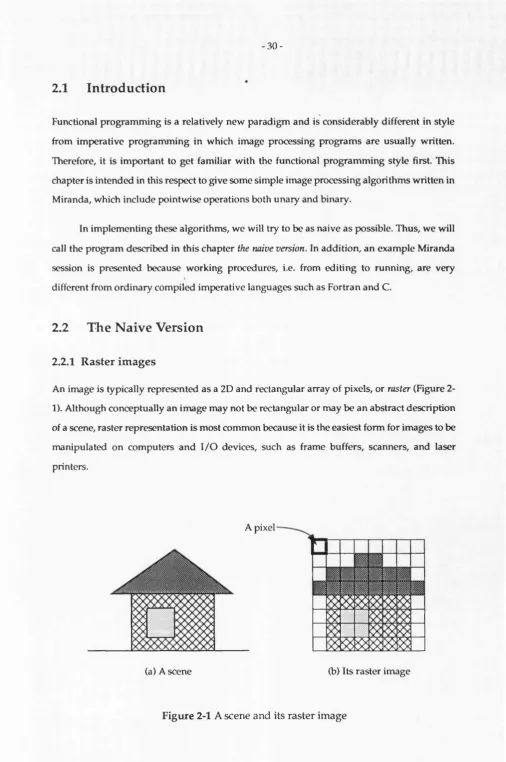
An image is typically represented as a 2D and rectangular array of pixels, or raster (Figure
2-1). Although conceptually an im age may not be rectangular or may be an abstract description
of a scene, raster representation is most common because it is the easiest form for images to be
manipulated on computers and 1 / 0 devices, such as frame buffers, scanners, and laser
printers.
A pixel
9mm
m(a) A scene (b) Its raster image
For representing an im age using imperative languages, an array structure is typically
used. In order to represent a 2D array of pixels in Miranda, use of a list of lists o f pixels would
be m ost straightforward, since arrays are not supported in Miranda. Also, the properties of a
list describe the nature of a pixel image quite well, that is, it is an ordered collection of values
and the elements of a list must have the same type. In Miranda, a 2D list is written as follows,
assum ing that pixels are numbers:
pixel == num
img == [[pixel])
'==' is a type synonym which allow s users to introduce a new name for an already existing type,
[ p i x e l ] defines a list w hose elem ents are of the type p i x e l , and [ [ p i x e l ] ] defines a list
of lists of pixels.
23 5 37 10 23 -5 -37 -10
12 64 8 15 -12 -64 -8 -15
22 20 54 0
Negate image
22 -20 -54 0
49 31 6 25 4 9 -31 -6 -25
23 5 37 10 12 64 8 15 22 20 54 0 49 31 6 25
5 3 10 15
22 31 23 9 16 51 20 38 11 4 25 42
28 8 47 25
Add two 34 95 31 24
images
38 71 74 38
60 35 31 67
F igure 2-2 Pointw ise operations
2.2.2 P o in tw is e o p e r a tio n s
The term pointwise operation describes an operation which takes one or more im ages as its input
and carries out a certain operation over the images in a pixel by pixel manner. The actual pixel
operation may be as simple as negation or addition, or it may involve more complicated
operations. The principles of the operation are: the result does not depend on any pixels of
- 3 2
-words, the operation only concerns the pixel itself in the case of an umrypointwise operation, or
the pixel itself and the pixel of the same position in the other image in the case of a binary
pointwise operation, but the same operation is carried out regardless of the position (Figure
2-2). Therefore, the pointwise operation provides a framework to define various image
processing algorithms, rather than a specific algorithm.
2.2.3 U nary operations
W e use the function map to implement unary pointwise operations, map is defined in the
standard environment, and has the type:
map:
Types can be parameterised using type variables such as * and ** in M iranda. A type variable
can accept any type which is called a polymorphic type. Code to define the type is called a type
signature. The above type signature can be read as "for all types * and * *, the functionmap takes
two arguments, a function from * into * * and a list of elements of type *, and returns a list of elements
of type **". Since the function takes a function as an argument, it is a higher-order function.
W hat map does is to apply the function given as its first argument to each element of the list
given as its second aigument. So, for example, the increment (+1) and the logical negation
(~ ) functions can be mapped on a list of numbers and booleans, respectively^:
map (+1) [ 1 , 2 , 3 ] reduces to [2 , 3 , 4]
map ( - ) [ T r u e ,F a l s e ,F a l s e ,T r u e ] reduces to [ F a ls e ,T r u e ,T r u e ,F a l s e ]
If the first argument is a function defined on a list, such as (map (+1 ) ) , then map makes a
function on a 2D list. For example:
map (map (+ 1 )) [ [ 1 , 2 , 3 ] , [4 , 5 , 6] ] reduces to [ [ 2 , 3 , 4 ] , [5 , 6 , 7 ] ]
This is what a unary pointwise operation should do. Thus, a unary pointwise operation can be
defined as follows^:
unaryPointwise::(pixel->pixel)->image->image
unaryPointwise f im = map (map f) im
1, In Miranda, both operators and functions can be used interchangeably using sections
[BirdSSa].
It is not necessaiy to attach a type signature to eveiy function definition, and even if a type
signature is not given, Miranda's type checker infers types correctly if they are well-defined.
In fact, it is often the case that the compiler infers more general types than those specified by
programmers.
Miranda uses a technique known as currying [BirdSSa] which assumes function
application to be left associative. This is useful to reduce the number of brackets which has
been a cause of unreadability of Lisp code, and to allow elimination of function arguments
from the right. For example, it is possible to omit the right most argument of the unary
pointwise function, im, and redefine it as:
unaryPointwise f = map (map f)
Since u n a r y P o in tw is e is defined as a higher-order function, it is representing rather
a category of algorithms than an individual algorithm. Each operation can be defined by
passing a certain function to the u n a r y P o in tw is e function. For example:
negatelmage = unaryPointwise neg
absImage = unaryPointwise abs
The first function negates each pixel value, and the second takes the absolute value of each
pixel.
2.2.4 Binary operations
The binary pointwise operations can be implemented by using map2 instead of map. The map2
function is defined in the standard environment whose type signature is:
map2: :(*->**->***)->[*]->[**]->[***]
How a binary pointwise function for 2D images is composed is exactly the same as the
unary pointwise's case, which is defined as follows:
binaryPointwise f = map2 (map2 f)
Using this higher-order function, various individual operations can be defined. Following are
functions to add two images by passing addition (+ ), subtract an image from an image by
- 3 4
-addlmage = binaryPointwise (+)
subimage = binaryPointwise (-)
maxImage = binaryPointwise max2
minImage = binaryPointwise min2
2.3
An Example Miranda Session
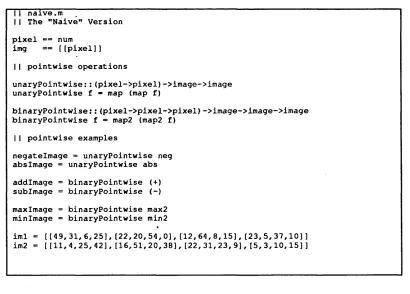
A source program is called a script in Miranda which is a collection of definitions. The script
for the naive version is given in Figure 2-3. This script contains test images such as im l and
ixn2 for simple debugging. For real usage, these test images should eventually be replaced
with real images such as ones fead from disks.
naive.m
I I The "Naive" Version
pixel == num
img == {[pixel]]
I I pointwise operations
unaryPointwise;:(pixel->pixel)->image->image unaryPointwise f * map (map f)
binaryPointwise::(pixel->pixel->pixel)->image->image->image binaryPointwise f = map2 (map2 f)
I I pointwise examples
negatelmage = unaryPointwise neg absImage = unaryPointwise abs
addlmage = binaryPointwise (+) subimage = binaryPointwise (-)
maxImage = binaryPointwise max2 minImage = binaryPointwise min2
iml = [[49,31,6,25], [22,20,54,0],[12,64,8,15], [23,5,37,10]] im2 = [[11,4,25,42],[16,51,20,38],[22,31,23,9],[5,3,10,15]]
F igure 2-3 The script, "'naive.m "
When Miranda is started it compiles the script and checks types. If the script contains
an error, Miranda reports it. Miranda is an interactive system, so that an expression which the
user types in is interpreted and evaluated by the system, and the result is returned. If an
sufficient number of arguments is not specified, Miranda still evaluates the expression and
returns that it is a function because it is a curried function. A sample session is shown in Figure
2-4, where 'M iranda' is a prom pt and a line in bold face following the prompt shows a user
input.
T h e M i r a n d a S y s t e m
version 2.014 last revised 3 May 1990
Copyright Research Software Ltd, 1989
(100000 cells) compiling naive.m
chec)cing types in naive.h\ for help type /help
Miranda n e g a t e l m a g e iml
[(-4 9,-31,-6,-251,[-22,-20,-54,0],[-12,-64,-8,-151,(-23,-5,-37,-1011
Miranda a ddlm a g e iml im2
[[60,35,31,671 ,[38,71,74,381, [34,95,31,24], [28,8,47,25]]
Miranda m a x I m a g e iml im2
[[4 9,31,25,42], [22,51,54,38], [22,64,23,15], (23,5,37, 15)]
Miranda a d d l m a g e iml (negatelmage (minlmage iml i m 2 ))
[[38,27,0,0], [6,0,34,0],[0,33,0,6], [18,2,27,0]]
Miranda ? u n a r y P o i n t w i s e
unaryPointwise;:(num->num)->[[num]]->[[num]] |(defined in "naive.m" line 11
Miranda ?addlmage
addlmage::[[num]]->[[num]]->([num]] | I defined in "naive.m" line 21
Miranda addl m a g e
<function>
Miranda a d d l m a g e iml
<function>
Miranda a d d l m a g e iml iml
[[98,62,12,50],[44,40, 108,0], [24,128,16,30], [4 6,10,74,20]]
Miranda n e g a t e l m a g e [1,2,3]
type error in expression cannot unify [num] with [[num]]
Miranda n e g a t e l m a g e [[ 'a','b ' ], ['c',^ d ' ]]
type error in expression
cannot unify [[char]] with [[num]] Miranda