208 |
P a g e
SIMULATE AND IMPLEMENTATION OF PAGE
REPLACEMENT TECHNIQUES THROUGH
MEMORY ADDRESSES
Brijesh Kumar Mishra
(Deptt. Of CSE, Monad University, Pilkhuwa, Hapur, INDIA)
ABSTRACT
There are many page replacement Algorithms such as LRU, FIFO, Optimal, WS, NRU, NFU, Random, Second chance, Clock, CAR, and ARC etc. are available in memory management. In this paper we try to attempts the analysis and comparative knowledge between FIFO, LRU, Optimal, Random and Second chance page replacement algorithms. And also analysis the efficiency of processor when the page miss situation enters in memory through the memory addresses and standard traces. Our experimental results demonstrate the Performance of the many page replacement techniques in providing the less page miss and small cost of overhead.
Keywords -
Cache Performance, FIFO, Hit ratio, LRU, Memory Management, Random, SC,
Virtual Memory.
I. INTRODUCTION
The Main memory provides an important and limited resource in a computer system. So by this importance
main memory has essential amount of demand in the past decades. It is also known by everyone that processor
and main memory has much faster speed compared to secondary memories. If main memory has enough space
for other program then it will shared this space for use by other users. When occupied fraction memory from
one programs not sufficient for program execution then to remove this problem we use the concept of virtual
memory. A virtual memory system uses efficient and less overhead page replacement algorithms to decide
which pages swap out from memory when a page miss occurred. The Pages are carried out into main memory
only when the processor demands them for execution of process, this is called demand paging. The virtual
memory allows the execution of process that does not exist completely inside main memory. This memory plays
a vital role in page replacement techniques to swap in swap out of required pages in memory.
II. PAGE REPLACEMENT
The page replacement policy is used to select the page in memory that will be replaced when a new page
brought in. When a user executes a program then page miss situation occurs. The page replacement takes the
following approaches for use-
(I) If there is no free space in frame.
(II) If it finds some free page in memory that is not really in use then swap out.
(III)The same type of page brought into memory in several time.
Page replacement techniquesclarify that which memory pages will be page out (swap out, write to disk) when
memory need to be allocated it. Paging concept arises when a page miss occurs and a there is no free page on
209 |
P a g e
(1) Local page replacement:-When a process found that a page miss occurred on same
Process for Page replacement is called local page replacement.
(2) Global page replacement: - This is free to select any page in memory.
First-In, First-Out page replacement (FIFO):
It is a simple page-replacement algorithm. The first-in, first-out (FIFO) is a low-overhead algorithm. The operating system maintains all the pages in memory in aqueue pattern, with the most recent arrival at the back, and the earliest arrival in front. When a page needs to be
replaced, the page at the front of the queue (the oldest page) is selected.
Least Recently Used (LRU) page replacement:
The least recently used page replacement algorithm, though similar in name to NRU, differs in the fact that LRU keeps track of page usage over a short period oftime, while NRU just looks at the usage in the last clock interval. LRU works on the idea that pages that have
been most heavily used in the past few instructions are most likely to be used heavily in the next few
instructions too. It is rather expensive to implement in practice. It discards page that has not been accessed in
longest time. Use (recent) past as a predictor of the future. LRU replacement associates with each page the time
of that page’s last use. When a page must be replaced, it chooses the page that has not been used for the longest
period of time.
Second Chance (SC) page replacement algorithm
: A modified form of the FIFO page replacement algorithm, known as the second chance page replacement algorithm relatively better than FIFO at little cost forthe improvement. It works by looking at the front of the queue as FIFO does, but instead of immediately paging
out that page, it checks to see if its referenced bit is set. If it is not set, the page is swapped out. Otherwise, the
referenced bit is cleared, the page is inserted at the back of the queue and this process is repeated. This can also
be thought of as a circular queue. If all the pages have their referenced bit set, on the second encounter of the
first page in the list, that page will be swapped out, as it now has its referenced bit cleared.
Random page replacement algorithm
: Random replacement algorithm replaces a random page in memory. This eliminates the overhead cost of tracking page references. Usually it fares better than FIFO, andfor looping memory references it is better than LRU, although generally LRU performs better in practice. Throw
out a random page.
(1) Obviously not the best scheme
(2) Although very easy to implement
Probably the simplest page replacement algorithm is the replacement of a random page. If a frequently used
page is evicted, the performance may suffer. For example, some page, that contains program initialization code
which may never be needed again during the program execution, could be evicted instead. So there are
Performance benefits available with choosing the right page.
210 |
P a g e
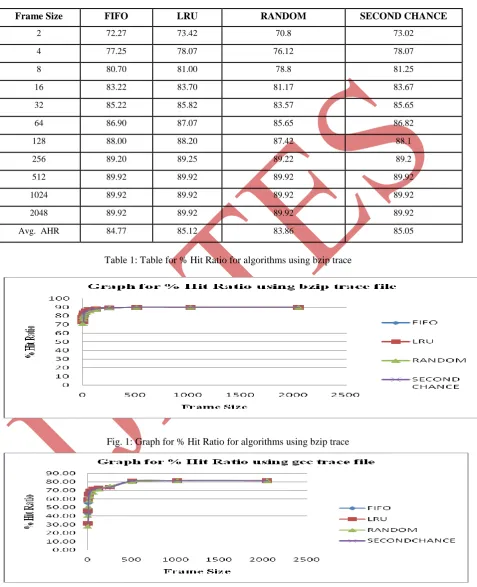
We draw a page miss table and graph for each replacement techniques, Draw a page hit table and graph for
replacement techniques and Draw AHR table and graph for replacement techniques. After that we measure the
performance analysis.
Table 1: Table for % Hit Ratio for algorithms using bzip trace
Fig. 1: Graph for % Hit Ratio for algorithms using bzip trace
Fig. 2: Graph for % Hit Ratio for algorithms using gcc trace
Frame Size FIFO LRU RANDOM SECOND CHANCE
2 72.27 73.42 70.8 73.02
4 77.25 78.07 76.12 78.07
8 80.70 81.00 78.8 81.25
16 83.22 83.70 81.17 83.67
32 85.22 85.82 83.57 85.65
64 86.90 87.07 85.65 86.82
128 88.00 88.20 87.42 88.1
256 89.20 89.25 89.22 89.2
512 89.92 89.92 89.92 89.92
1024 89.92 89.92 89.92 89.92
2048 89.92 89.92 89.92 89.92
211 |
P a g e
Frame Size FIFO LRU RANDOM SECOND
CHANCE
2 29.23 30.93 27.68 31.03
4 42.45 45.90 40.35 46.83
8 54.88 59.13 50.90 58.40
16 63.80 65.43 58.35 65.45
32 68.15 69.28 62.65 69.13
64 70.80 71.53 67.68 71.25
128 72.28 72.85 71.43 72.78
256 73.58 73.78 74.98 73.63
512 80.20 80.90 80.23 81.18
1024 81.50 81.50 81.50 81.50
2048 81.50 81.50 81.50 81.50
Avg. AHR 65.31 66.61 63.39 66.61
Table 2: Table for % Hit Ratio for algorithms using gcc trace
Frame Size FIFO LRU RANDOM SECONDCHANCE
2 40.05 44.75 38.35 43.52
4 51.85 58.70 50.25 58.67
8 61.32 64.45 61.69 65.50
16 72.97 78.75 77.10 80.45
32 93.37 96.65 93.27 96.75
64 98.45 98.45 98.45 98.45
128 98.45 98.45 98.45 98.45
256 98.45 98.45 98.45 98.45
512 98.45 98.45 98.45 98.45
1024 98.45 98.45 98.45 98.45
2048 98.45 98.45 98.45 98.45
Avg. AHR 82.75 84.91 82.85 85.05
Table 3: Table for % Hit Ratio for algorithms using swim trace
Fig. 3: Graph for % Hit Ratio for algorithms using swim
Now we observed the performance of page replacement algorithms using traces bzip, gcc, and swim. Their
conclusions are as follow-
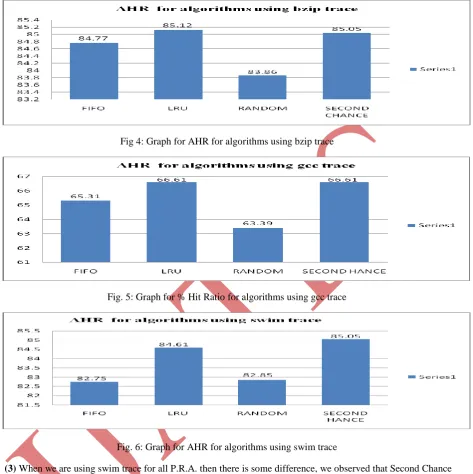
(1) When we are using bzip trace for all P.R.A. then we observed that LRU (85.12) performs better than other algorithms. After that Second Chance (85.05), FIFO (84.77) and Random (83.86) respectively are better. Thus
LRU P.R.A. is best for page replacement when bzip trace will use.
(2) When we are using gcc trace for all P.R.A. then we observed that LRU (66.61) performs better than other algorithms. After that Second Chance (66.61), FIFO (65.31) and Random (63.39) respectively are better. Thus
212 |
P a g e
Fig 4: Graph for AHR for algorithms using bzip trace
Fig. 5: Graph for % Hit Ratio for algorithms using gcc trace
Fig. 6: Graph for AHR for algorithms using swim trace
(3) When we are using swim trace for all P.R.A. then there is some difference, we observed that Second Chance (65.05) performs better than other algorithms. After that LRU (84.61), Random (82.85) and FIFO (82.75)
respectively are better. Thus Second Chance P.R.A. is best for page replacement when swim trace will use.
IV. CONCLUSION
Therefore from all conclusions we observed that the first most popular algorithm is used for bzip trace LRU
(85.12) and Second Chance (85.05). The second most popular algorithms is used for gcc trace LRU (66.61) and
Second Chance (66.61)). These two algorithms provide low overhead on memory and processor. If we are
taking swim trace then Second Chance (65.05) and LRU (84.61). But taking overall performance these two
algorithms LRU and Second Chance play a vital and effective role in page replacement algorithm. We also
observed that if page hit increase then the overhead on memory as well as processor will reduces and
213 |
P a g e
V. FUTURE WORK:-
From above results and performance analysis we observed that which algorithm is based for page replacement
and will reduce the low overhead on memory as well as processor. In future vision we make an algorithm using
traces which make faster page replacement and will compare the performance and overhead with exiting
algorithms FIFO, LRU, Second Chance and Random mention in this thesis.
REFERENCES:
[1] Amit S. Chavan, Kartik R. Nayak, Keval D. Vora, Manish D. Purohit and Pramila M. Chawan,” A Comparison of Page Replacement Algorithms” IACSIT International Journal of Engineering and
Technology, Vol.3, No.2, April 2011.
[2]Mr.C.C.Kavar, Mr. S.S.Parmar” Performance Analysis of LRU Page Replacement Algorithm with Reference
to different Data Structure”, International Journal of Engineering Research and Applications (IJERA) ISSN:
2248-9622 www.ijera.com Vol. 3, Issue 1, January -February 2013, pp.2070-2076
[3] Debabrata Swain, Bancha Nidhi Dash, Debendra O Shamkuwar, Debabala Swain,” Analysis and Predictability of Page Replacement Techniques towards Optimized Performance”, IRCTITCS, 2011, pp.
12-16.
[4] S.M. Shamsheer Daula, Dr. K.E Sreenivasa Murthy, G Amjad Khan,” A Throughput Analysis on Page Replacement Algorithms in Cache Memory Management”, International Journal of Engineering Research
and applications (IJERA) ISSN: 2248- 9622 www.ijera.com Vol. 2, Issue 2, Mar-Apr 2012, Pp.126-130.
[5]Muthukumar, S. and P.K. Jawahar,” HIT RATE MAXIMIZATION BY LOGICAL CACHE PARTITIONING IN A MULTI-CORE ENVIRONMENT”, Journal of Computer Science 10(3): 492-498,
2014 ISSN: 1549-3636© 2014 Science Publicationsdoi:10.3844/jcssp.2014.492.498 Published Online 10 (3)
2014
[6] Yogesh Niranjan,” Design and Implementation of Page Replacement Algorithm for Web Proxy Caching”, Int.J.Computer Technology & Applications, Vol 4 (2), 221-225 IJCTA | Mar-Apr 2013 Available
[email protected] 221 ISSN: 2229-6093
[7]Ms. Richa Gupta and Dr. Sanjiv Tokekar,” A Novel Pair of Replacement Algorithms on L1 and L2 Cache
For FFT”, International Journal on Computer Science And Engineering Vol.2 (1), 2010, 92-97
[8] ALFRED V. AHO and PETER J. DENNING AND JEFFREY D. ULLMAN,” Principles of Optimal Page Replacement”, Journal of the .Association for Computing Machinery, Vol. 18, No. 1, January 1971, pp.
80-93
[9] ww.cs.princeton.edu/courses/archive/fall10/cos318/
[10]www.en.wikipedia.org/wiki/Page_replacement_algorithm.
[11]Song Jiang, Feng Chen and Xiaodong Zhang, CLOCK-Pro: An Effective Improvement of the CLOCK Replacement, USENIX Annual Technical Conference, 2005.