Closed-Loop Automatic Oxygen Control (CLAC) in
Preterm Infants: A Randomized Controlled Trial
WHAT’S KNOWN ON THIS SUBJECT: In preterm infants receiving supplemental oxygen, manual control of the inspired oxygen fraction is often difficult and time consuming, which may increase the risk of complications. We developed a system for automatic oxygen control and proved its efficacy in the past.
WHAT THIS STUDY ADDS: A multicenter study adds evidence for the proposed automatic oxygen control system to significantly improve oxygen administration to preterm infants receiving mechanical ventilation or nasal continuous positive airway pressure while reducing workload compared with routine manual oxygen control.
abstract
BACKGROUND AND OBJECTIVE:In preterm infants receiving supple-mental oxygen, routine manual control (RMC) of the fraction of inspired oxygen (FIO2) is often difficult and time consuming. We developed a system for closed-loop automatic control (CLAC) of the FIO2 and demonstrated its short-term safety and efficacy in a single-center study. The objective of this study was to test the hypothesis that this system is more effective than RMC alone in maintaining arterial oxygen saturation within target levels when evaluated over 24 hours under routine conditions and with different target levels.
METHODS:We performed a multicenter, randomized controlled, cross-over clinical trial in 34 preterm infants receiving mechanical ventila-tion or nasal continuous positive airway pressure and supplemental oxygen. Twenty-four–hour periods with RMC were compared with 24-hour periods of RMC supported by CLAC.
RESULTS:The median (range) percentage of time with arterial oxygen saturation levels within target range was 61.4 (31.5–99.5) for RMC and 71.2 (44.0–95.4) for CLAC (P,.001). The median (range) number of manual FIO2 adjustments was reduced from 77.0 (0.0–224.0) for RMC to 52.0 (10.0–317.0) for CLAC (P= .007).
CONCLUSIONS:CLAC may improve oxygen administration to preterm infants receiving mechanical ventilation or nasal continuous positive airway pressure while reducing workload related to RMC.Pediatrics
2014;133:e379–e385
AUTHORS:Antonietta Hallenberger, MD,aChristian
Friedrich Poets, MD,aWerner Horn, PhD,bAndreas
Seyfang, PhD,cand Michael Siegfried Urschitz, MD, MSc,a,d
on behalf of the CLAC Study Group
aDepartment of Neonatology, University Children’s Hospital,
Tuebingen, Germany;bSection for Artificial Intelligence, Center
for Medical Statistics, Informatics, and Intelligent Systems, Medical University of Vienna, Vienna, Austria;cInstitute of
Software Technology and Interactive Systems, Vienna University of Technology, Vienna, Austria; anddInstitute of Medical
Biostatistics, Epidemiology, and Informatics, University Medical Center of the Johannes Gutenberg University, Mainz, Germany
KEY WORDS
controller, hypoxia, hyperoxia, ventilation
ABBREVIATIONS
CI—confidence interval
CLAC—closed-loop automatic control CPAP—continuous positive airway pressure FIO2—fraction of inspired oxygen
FIO2C—fraction of inspired oxygen controller
RMC—routine manual control SpO2—pulse oximeter saturation
Target%—proportion of time spent within target range
Dr Hallenberger coordinated and supervised patient
recruitment and data collection at the study centers, evaluated the analyses, and drafted the initial manuscript; Dr Poets supervised the study design and critically reviewed the manuscript; Drs Horn and Seyfang designed the fraction of inspired oxygen controller, carried out the initial analyses, and critically reviewed the manuscript; Dr Urschitz conceptualized and designed the study, evaluated the analyses, and critically reviewed the manuscript; and all authors approved thefinal manuscript as submitted.
This trial has been registered with the German Clinical Trials Register (DRKS00000157).
www.pediatrics.org/cgi/doi/10.1542/peds.2013-1834
doi:10.1542/peds.2013-1834
Accepted for publication Nov 22, 2013
Address correspondence to Michael S. Urschitz, MD, MSc, Unit of Pediatric Epidemiology, Institute of Medical Biostatistics, Epidemiology, and Informatics, University Medical Center of the Johannes Gutenberg University Mainz, Obere Zahlbacher Str. 69; 55131 Mainz, Germany. E-mail: [email protected]
PEDIATRICS (ISSN Numbers: Print, 0031-4005; Online, 1098-4275).
Copyright © 2014 by the American Academy of Pediatrics
(Continued on last page)
fi 2
tissues while minimizing O2toxicity and
oxidative stress, which may result from too high or too widely fluctuating O2
levels. Although the optimal level of ar-terial pulse oximeter saturation (SpO2) is still debated, there is evidence that wide
fluctuations in SpO2should in any case be avoided.1–3 This may be difficult to
achieve, however, under routine clinical conditions.4
Thus, automatic titration of the fraction of inspired oxygen (FIO2) by using a closed-loop FIO2 controller (FIO2C) seems
at-tractive. Thefirst attempts at automating O2delivery to patients date back to the
1970s, but only recently, with the advance of motion-resistant pulse oximetry, so-phisticated systems have been de-veloped that seem to be suitable for clinical use in preterm infants requiring respiratory support.5,6 In a group of
preterm infants receiving nasal contin-uous positive airway pressure (CPAP), we previously tested an FIO2C that was
able to maintain SpO2within target for
91% of the time.7Another system, tested
in mechanically ventilated infants, main-tained SpO2within target for 40% of the
time.6With both systems, automatic was
better than manual control in maintain-ing SpO2within the desired range.
The objective of this study was to test the hypothesis that closed-loop automatic control (CLAC) of the FIO2, performed by our FIO2C, as compared with routine manual control (RMC) performed by nursing staff, is superior in maintaining SpO2 within a predefined target range under routine conditions in various NICUs and for prolonged periods of time (24 hours).
METHODS
Technical Solutions
The underlying algorithm, the software solution, and the hardware setup have been described elsewhere.7–9In short,
qualitative descriptions from oscillating high-frequency data, such as SpO2values. The algorithm tends to level out SpO2
fluctuations, thereby keeping SpO2 in a predefined target range. Its conceptual design is not aimed at treating acute severe hypoxic episodes, as these may require individual intervention by care-givers.
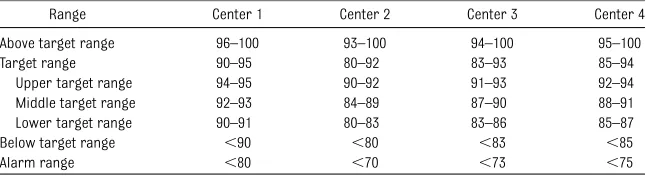
SpO2data are analyzed in time windows and qualified as outlined in Table 1. The target range is further subdivided into “upper target range,” “middle target range,”and“lower target range.” Accord-ing to this qualification, 5 different FIO2 adjustments are suggested (–0.02,–0.01,
60, +0.02, +0.05). Each adjustment is followed by a wait-and-see period of 180 seconds during which the FIO2C software does not effect further changes. In the case of low SpO2 values, the algorithm changes into an“alarm” mode, signals this condition, and suspends further adjustments until the SpO2values are again above this critical limit.
In the current study, a laptop computer (Eee PC 900; Asus, Taipei, Taiwan) exe-cuting the FIO2C software was connected via serial links to a motion-resistant pulse oximeter (Radical 7; Masimo Inc, Irvine, CA;“Fast-sat”mode with 2-second averaging, ASCII-1 data output mode) and a commercially available neonatal venti-lator (Leoni plus; Heinen & Loewenstein
The FIO2C software was programmed to acquire SpO2values, pulse rate, and other parameters (eg, signal IQ, perfusion in-dex) from the pulse oximeter, analyze these data, and derive FIO2adjustments. SpO2values associated with a low signal IQ (a signal quality parameter indicating potentially artifactual readings) were au-tomatically excluded. The ventilator was equipped with a digital feedback-controlled O2 blender. The FIO2C
soft-ware automatically executed its FIO2 adjustments by directly changing the ventilator’s FIO2setting.
Study Design and Progress
This study was designed as a multicen-ter, randomized controlled, crossover clinical trial at 3 German level-III NICUs (University Children’s Hospital Tuebingen, University Children’s Hospital Ulm, and University Children’s Hospital Freiburg). However, recruitment of patients took longer than expected, and a fourth study center (Children’s Hospital, Klinikum am Steinenberg; Reutlingen, Germany) was involved 2 years after study initiation. In addition, study funding ran out after 3 years and the study had to be terminated prematurely.
After a run-in phase of 3 hours, each patient underwent 2 different modes of FIO2control (treatment modalities: RMC alone versus RMC supported by CLAC).
TABLE 1 Center-Specific SpO2Ranges
Range Center 1 Center 2 Center 3 Center 4
Above target range 96–100 93–100 94–100 95–100
Target range 90–95 80–92 83–93 85–94
Upper target range 94–95 90–92 91–93 92–94
Middle target range 92–93 84–89 87–90 88–91
Lower target range 90–91 80–83 83–86 85–87
Below target range ,90 ,80 ,83 ,85
Alarm range ,80 ,70 ,73 ,75
Each treatment phase lasted 24 hours, leading to a total study duration per patient of 51 hours. For group alloca-tion, a computer-generated list of ran-dom numbers was used with a 1:1 allocation by using random block sizes of 9. This list was prepared by an in-vestigator without clinical involvement in the trial (M.S.U.). After recruitment, infants were randomly assigned by a senior doctor to 1 of 2 study groups by opening corresponding sequentially numbered and sealed opaque enve-lopes. Each group represented afixed order of treatment modalities.
The trial was approved by the institutional review board (project 7/2006) and regis-tered in the German Clinical Trials Register (DRKS00000157). The device setup was approved by the local department of biomedical engineering and written in-formed parental consent was obtained for each infant.
Patients
Preterm infants admitted to partici-pating study centers were eligible if they had a gestational age at birth of
,37 weeks, required mechanical ven-tilation or nasal CPAP, and needed an FIO2 of at least 0.25. Patients were excluded if they had congenital di-aphragmatic hernia, cyanotic heart disease, or another medical condition necessitating a deviation from the usual SpO2 target range. Individual exclusion criteria were reached in case of resuscitation, termination of both mechanical ventilation and CPAP, and withdrawal of parental consent. Extubation (and switch to nasal CPAP), changes in ventilator settings, and no further need of additional O2
(ie, switch to room air) were no ex-clusion criteria.
Protocol
Twenty-four–hour periods with RMC were compared with 24-hour periods of RMC supported by CLAC. During the
whole study period, the nurse on duty remained responsible for any FIO2 adjust-ments necessary and the patient remained on the standard monitoring system throughout (SpO2averaging time was 8 seconds in 1 center and 10 seconds in the remaining centers). Nurses were encouraged to ignore the readings of the study oximeters and to adjust the FIO2 according to the readings of the standard monitor. The patient-to-nurse ratio was 2:1 or 3:1 at that time.
O2administration policy was determined
according to clinical experience of the bedside nurse and was not further specified for the current study. To comply with routine conditions in participating study centers, we left the center-specific SpO2target levels (ranging from 80% to
95%; Table 1) unchanged. Changes in ventilator settings and body position, as well as routine nursing procedures, were allowed throughout.
Data Acquisition and Analysis
The patient’s SpO2and pulse rate, other SpO2-related variables (eg, signal IQ, perfusion index), and the number of FIO2 adjustments executed by nurses and/or the FIO2C were digitally recorded by the FIO2C software. Data were ana-lyzed and visualized by using standard data handling and plotting software by 1 of the investigators (W.H.) who was blinded to group assignment. SpO2 values associated with low signal IQ (ie, artifactual readings) were excluded from analysis. Recordings were ex-cluded if more than 10% of SpO2values of a study phase were missing or the amount of artifactual readings was more than 10% of a study phase. According to the center-specific SpO2 target levels (Table 1), SpO2values were qualified as above target range, within target range, and below target range. During time periods in which patients did not need additional O2 (ie, FIO2 =
0.21), SpO2 values qualified as above target range were requalified as within
target range, because in this situation, further FIO2reduction is not an option.
Sample Size and Statistical Analysis
The primary study variable was the proportion of time (expressed as per-centage) spent within target range (Target%). The sample size calculation was based on pilot data from our pre-vious trial and the assumption that no carryover effects would occur.7An
in-crease of 2 percentage points in Target % was judged as clinically relevant. We calculated that 18 study participants would be sufficient to detect improve-ment with 0.05 type-I error and 0.1 type-II error (ie, 90% power) and this was the lower limit of sample size for the current study. We assumed that the presence of different conditions among study cen-ters potentially influences the assump-tions made for sample size calculation. Consequently, and as a secondary goal, we initially powered the study to detect significant differences for each individual study center. Hence, we decided to en-roll 18 patients in each participating center (ie, 54 in total) and to perform a center-stratified secondary analysis. However, at study termination, only 1 center had reached its center-specific sample size (n= 18) and we decided against center-stratified secondary hy-pothesis testing and calculated center-specific treatment effects only.
Secondary study variables were the percentage of time spent above target range and below target range, as well as the number of manual FIO2adjustments performed by bedside personnel. De-scriptive statistics (nand percentage, as well as median, minimum, and max-imum) were used to summarize de-mographic and clinical characteristics, as well as primary and secondary study variables. As Target% was normally distributed in our sample, treatment effects across modalities were calcu-lated as the mean of the individual
fi
means of Target% across treatment mo-dalities were performed using a linear mixed model with the patient as random factor. The model was adjusted for study center, study phase, and carryover effects (expressed as interaction term between treatment and study phase). For confi r-matory analysis,P,.05 was considered statistically significant. For exploratory analysis, secondary study variables were compared across treatment modalities by using the nonparametric 2-tailed Wilcoxon signed-rank test. For exploratory analysis, corrections for multiple testing were not performed andPvalues were given for descriptive reasons only. Ana-lyses were done with statistical software (IBM SPSS Statistics 20; IBM Corporation, Chicago, IL).
RESULTS
Patients
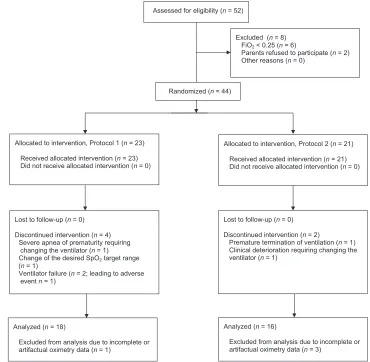
Between April 2009 and March 2012, 52 infants were approached and 44 were enrolled and randomized (Fig 1). Of these, 6 had to be later excluded be-cause of protocol nonadherence (severe apnea of prematurity requiring chang-ing the ventilator,n= 1; change of the desired SpO2target range,n= 1; venti-lator failure,n= 2 [leading to adverse event,n= 1]; premature termination of ventilation,n= 1; clinical deterioration requiring changing the ventilator,n= 1) and 4 were later excluded because of incomplete oximetry data (ie, more than 10% of data were missing for either study phase). The final sample size stratified by center was 4, 5, 7, and 18. Demographic and clinical character-istics of the 34 included study partic-ipants are shown in Table 2. Patients received predominantly nasal CPAP. During the run-in phase, 2 infants were extubated and remained on nasal CPAP, and 1 received surfactant. All 3 infants remained in the study.
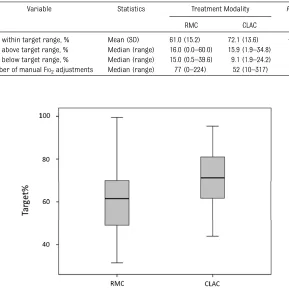
throughout the trial and all infants tol-erated the study procedures well. There was no study interruption or termina-tion related to failures of the FIO2C soft-ware. In every single patient, Target% was higher during CLAC compared with RMC. Regarding the total sample, results for primary and secondary study vari-ables are given in Table 3. A box-and-whisker plot of Target% is presented in Fig 2. Target% increased substantially during CLAC compared with RMC; the mean treatment effect (95% CI) of CLAC compared with RMC was +11.1 per-centage points (+6.6 to +15.6). This was higher than what we had defined as clinically relevant (ie, +2 percentage points). In the linear mixed model, the main effect of the treatment modality was highly significant (P , .001), whereas there were no significant study phase or carryover effects (P= .979 and .164, respectively). There was also a re-duction in percentage of time spent below target range in CLAC compared with RMC. In contrast, the percentage of time spent above target range did not differ between treatment modalities. In addition, the number of manual FIO2 adjustments executed by nurses was reduced in CLAC compared with RMC.
Center-Specific Treatment Effects
Results of the center-stratified secondary analysis for Target% are shown in Table 4. Mean Target% for CLAC was higher throughout, compared with RMC. Because of the small sample size, CIs for the mean treatment effect were large in some cen-ters, including 0 in 1 center. However, in 3 of 4 centers, the lower limit of the 95% CI for the mean treatment effect was .2 percentage points, which was our cutoff value for a clinically relevant improvement.
DISCUSSION
In this multicenter, randomized controlled trial, the evaluated FIO2C significantly
fect was∼11 percentage points (ie, an improvement in Target% from 61% to 72%). This is in line with previous stud-ies from our7as well as other groups,5,6
and indicates the potential of an FIO2C to optimize O2therapy. Such a system may
help to avoid unnecessarily high or low O2exposure, sustained hypoxemic and/ or hyperoxemic episodes, and large
fluctuations in SpO2levels, all related to adverse clinical outcomes.1–3Moreover,
the proposed FIO2C decreased the fre-quency of manual FIO2adjustments ex-ecuted by bedside personnel, which could reduce workload resulting from SpO2monitoring and FIO2control.
Strengths of the study included that the FIO2C was tested under routine con-ditions in different NICUs and for 24 hours. Hence, the FIO2C was handled solely by routine clinical staff. Different ventilation modes were allowed and each study center’s given SpO2target range was not influenced by the study protocol. Even under these conditions, a significant improvement in main-taining a predefined target level could be achieved by using the FIO2C. This indicates a high external validity of the trialfindings.
Low target ranges may predispose infants to hypoxemic episodes and cerebral desa-turations due to respiratory instability as-sociated with low SpO2values.10However, a preliminary post hoc analysis did not suggest that the target range affected the efficacy of the FIO2C in a relevant manner (data not shown).
It has been suggested by recent large multicenter trials11–13 that extremely
low gestational age infants may best be
maintained within a relatively narrow range of SpO2 values (eg, 91%–95% SpO2). Given the workload associated with keeping infants within such a narrow SpO2 target range, reducing this workload by means of an FIO2C seems even more relevant.
In a recent study evaluating a different FIO2C in 32 infants, Target% also in-creased significantly during CLAC peri-ods compared with RMC periperi-ods.6In this
study, however, time with SpO2,87% in-creased significantly during CLAC peri-ods, with more frequent episodes of SpO2 ranging from 80% to 86%.6In contrast,
the improvement in Target% in the cur-rent study was predominantly accom-plished via a reduction in hypoxemic episodes, whereas at the same time, un-desired hyperoxemic periods or over-shooting O2delivery could be avoided.
We explicitly aimed at avoiding hypoxemic episodes with the proposed FIO2C. There-fore, we subdivided the target range into 3 areas (upper target, middle target, lower target) and added FIO2adjustments of–0.01 for upper target and +0.02 for lower target.7In other words, our FIO
2C is
proactive in avoiding hypoxemic episodes by adjusting FIO2 while the SpO2 is still TABLE 2 Demographic and Clinical Characteristics (n= 34)
Characteristic Definition Statistics Results
Gender Male/female n 23/11
Birth weight Grams Median (range) 840 (410–2460)
Gestational age at birth Weeks Median (range) 26.4 (23.0–35.3)
Age at study entry Weeks Median (range) 29.9 (26.0–35.6)
FIO2at study entry Fraction Median (range) 0.32 (0.25–0.63)
Ventilation mode at study entry Mechanical ventilation/CPAP n 11/23 FIGURE 1
Study progress.
within (lower) target range. The result-ing reduction in hypoxemic episodes may be important in terms of potential sequelae of hypoxemic episodes in pre-term infants.1,3,14–16
We assumed different conditions among study centers and aimed at detecting significant improvements concerning Target% for each single study by en-rolling 18 infants per center. Unfor-tunately and despite considerable effort, we failed to reach this projected sample size in 3 of 4 centers. This did not allow us
to perform center-stratified formal sta-tistical hypothesis testing. However, on a descriptive basis we found mean treatment effects with 95% CIs not in-cluding the null in 3 of 4 centers. In our opinion, this is sufficient evidence to assume that the FIO2C will be effective in its present form in diverse settings. This should be further assessed by post-marketing surveillance studies.
Nurses did not get any study-specific additional instructions on how to make their routine manual FIO2 adjustments.
instructed nurses, the additional benefit of an FIO2C may be smaller than seen here.
Despite the advice to ignore the read-ings of the study oximeter, nurses may have been influenced in their routine care by these readings. However, the consideration of the readings had, if any, rather improved RMC periods (due to a double feedback about SpO2status). This likely translated into a conserva-tive (toward the null) bias. We specu-late that shielding the oximeter displays would have led to an even larger
bene-ficial effect of the FIO2C during CLAC periods.
The efficacy of FIO2C in maintaining SpO2 within target has yet been tested for only 2 devices.5–7Thus, results cannot be
gen-eralized to other devices, which should therefore undergo similar evaluation be-fore recommending them for clinical use in this vulnerable patient population.
CONCLUSIONS
The FIO2C tested here increased the pro-portion of time with SpO2 levels within a desired range, while at the same time decreased the number of hypoxemic episodes. This was associated with a re-duction in manual FIO2adjustments exe-cuted by bedside personnel. The device might help to reduce morbidity resulting from intermittent hypoxemia or large
fluctuations in SpO2levels, such as reti-nopathy of prematurity, brain injury, or other organ damage and may help to improve neurodevelopmental outcome. Furthermore, the system may reduce workload related to FIO2control and may help to decrease the level of noise and stress for nursing staff members and patients alike.
ACKNOWLEDGMENTS
Members of the CLAC Study Group were Silvia Miksch (ViennaUniversityofTechnol-ogy, Vienna, Austria); Ingo Mueller-Hansen
RMC CLAC
Time within target range, % Mean (SD) 61.0 (15.2) 72.1 (13.6) ,.001 Time above target range, % Median (range) 16.0 (0.0–60.0) 15.9 (1.9–34.8) .108 Time below target range, % Median (range) 15.0 (0.5–39.6) 9.1 (1.9–24.2) .001 Number of manual FIO2adjustments Median (range) 77 (0–224) 52 (10–317) .007
FIGURE 2
Box-and-whisker plot of the primary outcome variable: percentage of time spent within the SpO2target
range (Target%). Comparison between RMC of the inspired oxygen fraction and CLAC of the inspired oxygen fraction.
TABLE 4 Results of the Center-Stratified Secondary Analysis for Target% (n= 34)
Center n Treatment Modality Mean Treatment Effect (95%CI)
RMC CLAC
Mean % (SD) Mean % (SD)
1 18 62.7 (16.6) 71.4 (15.3) +8.7 percentage points (+2.3 to +15.1) 2 7 64.3 (9.1) 69.1 (11.3) +4.8 percentage points (–0.5 to +10.2)
3 4 42.9 (9.1) 65.8 (6.0) +22.9 percentage points (+2.5 to +43.2)
(University Children’s Hospital, Tuebingen, Germany); Helmut Hummler, Manuel Schmid, Jochen Essers, and Marc Mendler (University Children’s Hospi-tal, Ulm, Germany); Roland Hentschel
(University Children’s Hospital, Frei-burg, Germany); and Peter Freisinger and Hans-Christoph Schneider (Children’s Hospital at the Klinikum am Steinen-berg, Reutlingen, Germany). The authors
thank Veronika Weyer (Institute of Medi-cal Biostatistics, Epidemiology and Infor-matics, Mainz, Germany) for critically reviewing the statistical section of the manuscript.
REFERENCES
1. Cunningham S, Fleck BW, Elton RA, McIntosh N. Transcutaneous oxygen levels in retinop-athy of prematurity.Lancet. 1995;346(8988): 1464–1465
2. Chow LC, Wright KW, Sola A; CSMC Oxygen Administration Study Group. Can changes in clinical practice decrease the incidence of severe retinopathy of prematurity in very low birth weight infants? Pediatrics. 2003;111(2):339–345
3. Di Fiore JM, Bloom JN, Orge F, Schutt A, Schluchter M, Cheruvu VK, et al. A higher incidence of intermittent hypoxemic epi-sodes is associated with severe retinopathy of prematurity.J Pediatr. 2010;157(1):69–73
4. Hagadorn JI, Furey AM, Nghiem TH, Schmid CH, Phelps DL, Pillers DA, et al. Achieved versus intended pulse oximeter saturation in infants born less than 28 weeks’ gesta-tion: the AVIOx study. Pediatrics. 2006;118 (4):1574–1582
5. Claure N, Gerhardt T, Everett R, Musante G, Herrera C, Bancalari E. Closed-loop controlled inspired oxygen concentration for mechan-ically ventilated very low birth weight infants with frequent episodes of hypoxemia. Pedi-atrics. 2001;107(5):1120–1124
6. Claure N, Bancalari E, D’Ugard C, et al. Multicenter crossover study of automated control of inspired oxygen in ventilated preterm infants. Pediatrics. 2011;127(1). Available at: www.pediatrics.org/cgi/content/ full/127/1/e76
7. Urschitz MS, Horn W, Seyfang A, et al. Au-tomatic control of the inspired oxygen fraction in preterm infants: a randomized crossover trial.Am J Respir Crit Care Med. 2004;170(10):1095–1100
8. Seyfang A, Miksch S, Horn W, Urschitz MS, Popow C, Poets CF. Using Time-Oriented Data Abstraction Methods to Optimize Oxy-gen Supply for Neonates. In: Quaglini S, Barahona P, Andreassen S, eds. Artificial Intelligence in Medicine: 8th Conference on Artificial Intelligence in Medicine in Europe, AIME 2001, Cascais, Portugal, July 1–4, 2001, Proceedings. Lecture Notes in Computer Science; Vol. 2101: Lecture Notes in Artificial Intelligence Berlin, Heidelberg, New York: Springer-Verlag; 2001:217–226
9. Miksch S, Seyfang A, Horn W, Popow C. Abstracting Steady Qualitative Descriptions over Time from Noisy, High-Frequency Data. In: Horn W, Shahar Y, Lindberg G, Andreassen S, Wyatt J, editors.Artificial Intelligence in Medicine: Joint European Conference on Artificial Intelligence in Medicine and Medi-cal Decision Making, AIMDM’99, Aalborg, Denmark, June 20–24, 1999, Proceedings. Lecture Notes in Computer Science; Vol. 1620: Lecture Notes in Artificial Intelligence. Berlin, Heidelberg, New York: Springer-Ver-lag; 1999:281–290
10. Schmid MB, Hopfner RJ, Lenhof S, Hummler HD, Fuchs H. Cerebral desaturations in preterm infants: a crossover trial on
in-fluence of oxygen saturation target range. Arch Dis Child Fetal Neonatal Ed. 2013;98 (5):F392–F398
11. Schmidt B, Whyte RK, Asztalos EV, et al; Canadian Oxygen Trial (COT) Group. Effects of targeting higher vs lower arterial oxygen saturations on death or disability in ex-tremely preterm infants: a randomized clinical trial.JAMA. 2013;309(20):2111–2120
12. Carlo WA, Finer NN, Walsh MC, et al; SUP-PORT Study Group of the Eunice Kennedy Shriver NICHD Neonatal Research Network. Target ranges of oxygen saturation in ex-tremely preterm infants. N Engl J Med. 2010;362(21):1959–1969
13. Stenson BJ, Tarnow-Mordi WO, Darlow BA, et al; BOOST II United Kingdom Collaborative Group; BOOST II Australia Collaborative Group; BOOST II New Zealand Collaborative Group. Oxygen saturation and outcomes in preterm infants.N Engl J Med. 2013;368(22):2094–2104
14. Martinelli S, Gatelli I, Proto A. SpO2 and retinopathy of prematurity: state of the art. J Matern Fetal Neonatal Med. 2012;25(suppl 4):108–110
15. Jobe AH, Bancalari E. Bronchopulmonary dysplasia.Am J Respir Crit Care Med. 2001; 163(7):1723–1729
16. Haynes RL, Folkerth RD, Keefe RJ, et al. Nitrosative and oxidative injury to pre-myelinating oligodendrocytes in periven-tricular leukomalacia. J Neuropathol Exp Neurol. 2003;62(5):441–450
(Continued fromfirst page)
FINANCIAL DISCLOSURE:The authors have indicated they have nofinancial relationships relevant to this article to disclose.
FUNDING:Supported by a research grant from Heinen & Loewenstein GmbH (Bad Ems, Germany). Four ventilators were provided by Heinen & Loewenstein GmbH. Three Oximeters were provided by Masimo Inc (Irvine, CA).
POTENTIAL CONFLICT OF INTEREST:Dr Poets has served on an advisory board for Philips and received a grant from Masimo Inc. The other authors have indicated they have no potential conflicts of interest to disclose.
DOI: 10.1542/peds.2013-1834 originally published online January 27, 2014;
2014;133;e379
Pediatrics
and Michael Siegfried Urschitz
Services
Updated Information &
http://pediatrics.aappublications.org/content/133/2/e379 including high resolution figures, can be found at:
References
http://pediatrics.aappublications.org/content/133/2/e379#BIBL This article cites 13 articles, 4 of which you can access for free at:
Subspecialty Collections
http://www.aappublications.org/cgi/collection/neonatology_sub
Neonatology
sub
http://www.aappublications.org/cgi/collection/fetus:newborn_infant_
Fetus/Newborn Infant
nt_sub
http://www.aappublications.org/cgi/collection/med_tech_advanceme
Medical Technology and Advancement
e_management_sub
http://www.aappublications.org/cgi/collection/administration:practic
Administration/Practice Management
following collection(s):
This article, along with others on similar topics, appears in the
Permissions & Licensing
http://www.aappublications.org/site/misc/Permissions.xhtml in its entirety can be found online at:
Information about reproducing this article in parts (figures, tables) or
Reprints
DOI: 10.1542/peds.2013-1834 originally published online January 27, 2014;
2014;133;e379
Pediatrics
and Michael Siegfried Urschitz
Antonietta Hallenberger, Christian Friedrich Poets, Werner Horn, Andreas Seyfang
Randomized Controlled Trial
Closed-Loop Automatic Oxygen Control (CLAC) in Preterm Infants: A
http://pediatrics.aappublications.org/content/133/2/e379
located on the World Wide Web at:
The online version of this article, along with updated information and services, is
by the American Academy of Pediatrics. All rights reserved. Print ISSN: 1073-0397.