Visualization of cortical, subcortical, and deep brain neural
circuit dynamics during naturalistic mammalian behavior with
head-mounted microscopes and chronically implanted lenses
Shanna L. Resendez1, Josh H. Jennings2, Randall L. Ung1, Vijay Mohan K. Namboodiri1, Zhe Charles Zhou1, James M. Otis1, Hiroshi Nomura1, Jenna A. McHenry1, Oksana Kosyk1,
and Garret D. Stuber1,3,#
1Departments of Psychiatry and Cell Biology and Physiology, University of North Carolina, Chapel
Hill, NC
2Department of Bioengineering, Stanford University, Stanford, CA
3Curriculum in Neurobiology, University of North Carolina, Chapel Hill, NC
Abstract
Genetically encoded calcium indicators for visualizing dynamic cellular activity have greatly expanded our understanding of the brain. However, due to light scattering properties of the brain as well as the size and rigidity of traditional imaging technology, in vivo calcium imaging has been limited to superficial brain structures during head fixed behavioral tasks. This limitation can now be circumvented by utilizing miniature, integrated microscopes in conjunction with an implantable microendoscopic lens to guide light into and out of the brain, thus permitting optical access to deep brain (or superficial) neural ensembles during naturalistic behaviors. Here, we describe procedural steps to conduct such imaging studies using mice. However, we anticipate the protocol can be easily adapted for use in other small vertebrates. Successful completion of this protocol will permit cellular imaging of neuronal activity and the generation of data sets with sufficient
statistical power to correlate neural activity with stimulus presentation, physiological state, and other aspects of complex behavioral tasks. This protocol takes 6–11 weeks to complete.
Introduction
Methodologies for monitoring neural activity in vivo, such as electrophysiology1,2, neurochemical measurements3,4, and optical imaging of fluorescently reported neural dynamics5–8 have substantially increased our understanding of the neural computations underlying complex behavioral states. Among these techniques, the development and
#Address correspondence to: Garret D. Stuber, Ph.D., Assistant Professor, Departments of Psychiatry & Cell Biology and Physiology,
Neuroscience Center, University of North Carolina at Chapel Hill, Tel: +1 (919) 843-7140, Fax: +1 (919) 966-1050, [email protected].
Author contribution statement
SLR and GDS wrote the manuscript. SLR, JHJ, RLU, and VN contributed to the development of the procedure. CZ, JO, HN, and JAM assisted with manuscript preparation.
HHS Public Access
Author manuscript
Nat Protoc
. Author manuscript; available in PMC 2017 January 16. Published in final edited form as:Nat Protoc. 2016 March ; 11(3): 566–597. doi:10.1038/nprot.2016.021.
A
uthor Man
uscr
ipt
A
uthor Man
uscr
ipt
A
uthor Man
uscr
ipt
A
uthor Man
uscr
implementation of genetically-encoded Ca2+ indicators (GECI)6,9–13 have been particularly advantageous to the study of brain function. During periods of heightened neural
activity14,15, Ca2+ flows into the dendritic branches16 and cell bodies of neurons, increasing intracellular concentrations of Ca2+. These activity dependent fluctuations in intracellular Ca2+ can be monitored by introducing a Ca2+ indicator, such as GCaMP13, into the neuronal population of interest. Upon the binding of Ca2+, indicators of Ca2+ emit a fluorescent signal, which is intensified during periods of elevated neural activity14,15. As a result, fluctuations in fluorescent emission over time can be used to infer dynamic changes in cellular activity. Moreover, when these signals are visualized with cellular-level resolution, fluorescent indicators of neural activity provide not only temporal information related to dynamic changes in brain cell activity17, but they also enable the visualization of each cells spatial location within the brain18.
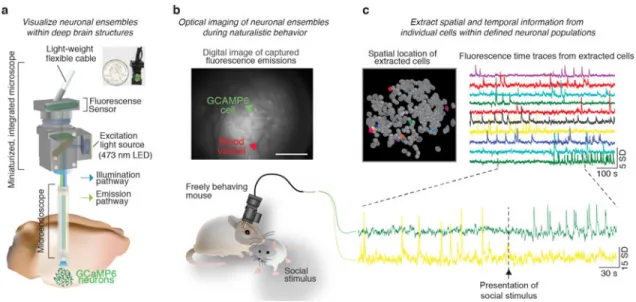
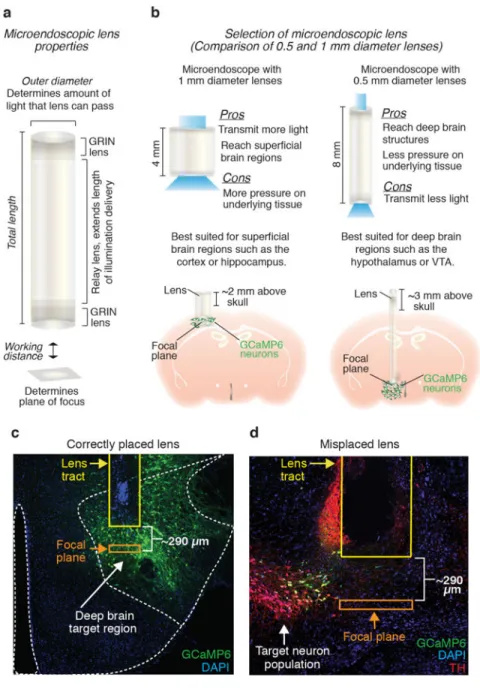
The visualization of fluorescently reported neural signals within the brain requires both a light source to excite the Ca2+ indicator as well as a light-sensing device to detect the emission signal19. As a result, optical monitoring of fluorescently reported neural activity is constrained by physical limitations to transmit light to and from the neuron population of interest. Specifically, neural tissue exhibits high levels of light scattering and this physical property has precluded optical imaging of in vivo Ca2+ transients within deep brain regions19. However, limitations in the propensity to transmit light through the brain can be circumvented by the implantation of a microendoscopic lens (gradient refractive index (GRIN) lenses attached on either end of a relay lens) in subcortical or deep brain regions20–22 (Fig. 1a). Microendoscopic lenses facilitate the visualization of deep brain neural activity by relaying light to and from deep brain structures, bringing previously inaccessible fluorescence signals into a field of view outside the brain11,23–25. For example, these lenses have been utilized to visualize the activity of genetically defined neurons located within deep brain regions, such as the hypothalamus, thus greatly expanding the population of neurons that can be visualized and monitored within the brain26,27.
Due to the size and rigidity of traditional imaging technology, previous imaging studies have also been limited in the types of behaviors that could be examined, and therefore the scientific questions that could be asked. However, the miniaturization of optical imaging technology, such as the development of miniature, integrated microscopes, which are small and light enough to be carried on the head of the animal without interfering with behavior has greatly expanded the scope of scientific questions that can be asked28. Importantly, these miniature microscopes can be utilized in conjunction with microendoscopic lenses,
permitting access to deep brain neural computations associated with naturalistic animal behavior (Fig 1a)22,26,27. An additional advantage of this technique is that it can be used to repeatedly visualize large-scale neuronal populations (up to a thousand neurons in one mouse29), providing a significant increase in statistical power over previously developed in vivo recording methods. Here, we provide a detailed protocol for the surgical implantation of a microendoscopic lens above a deep brain (or superficial) neuron population and the subsequent collection of in vivo imaging data in a freely behaving mouse (Fig 1b,c). These procedures have been developed and used by our laboratory to maximize imaging success rate during active, naturalistic, animal behaviors26.
A
uthor Man
uscr
ipt
A
uthor Man
uscr
ipt
A
uthor Man
uscr
ipt
A
uthor Man
uscr
Comparison with other in vivo recording methods
One commonly used approach to image fluorescently reported neuronal dynamics is 2-photon microscopy30. This technique utilizes low energy near infrared (IR) photons to penetrate highly light-scattering brain tissue up to 600–700 μm below the surface of the brain31. A significant advantage of 2-photon microscopy is the ability to selectively excite fluorophores within a well-defined focal plane, resulting in a spatial resolution capable of resolving cellular activity within precisely defined anatomical sub-regions of neurons, such as dendrites and axonal boutons30. Notably, although this imaging modality provides superior spatial resolution, it requires the head fixation of animals and, in the absence of a microendoscope or optical cannula, 2-photon imaging is limited to superficial layers of the brain32,33. Together, these behavioral and optical limitations greatly reduce the scope of scientific questions that can be examined with 2-photon microscopy.
Implantation of small, lightweight fiber optics above a region of interest, such as with fiber photometry, circumvents optical and behavioral limitations posed by 2-photon
microscopy34. However, unlike 2-photon microscopy, fiber photometry lacks cellular level resolution and provides only aggregate activity within the field of view (i.e., bulk changes in fluorescent signal)22. Thus, this method is better suited for monitoring dynamic activity within neural projection fields35. In addition to limitations in optical resolution, fiber photometry requires the test subject to be secured to a rigid fiber optic bundle, which can be difficult for small mammals, such as mice, to maneuver34. Thus, while fiber photometry increases the depth in which neural activity can be monitored, it presents significant limitations in optical resolution, restricts the natural behavioral repertoire of an animal, and limits the animal models that can be optimally utilized.
Large-scale recordings of neural activity within freely behaving mammals36 can also be conducted with techniques that do not rely on the use of fluorescence indicators of neural activity, such as in vivo electrophysiological recordings2. Importantly, compared to in vivo Ca2+ imaging, electrophysiology provides superior temporal resolution, allowing for more accurate spike timing estimations17,37,38 as well as the correlation of neural activity with precisely defined temporal events. In addition, in vivo electrophysiology can be combined with optogenetic perturbations of genetically defined neuronal populations to permit the identification (although not unequivocally) and manipulation of defined neuronal
populations39–41. The ability to monitor and subsequently manipulate a circuit is particularly important to the study of brain function as it allows the causal role of identified
computations to be elucidated. Thus, compared to freely behaving in vivo optical imaging methods, in vivo electrophysiology methods offer advantages in the domain of temporal resolution as well as technological integration. One notable limitation of this method is that the spatial location of monitored cells cannot be visualized, making it difficult to assert that an identified cell is similar or unique across recording sessions1. Moreover, because in vivo electrophysiology relies on waveform shapes to differentiate individual cells from each other, it can be challenging to detect cells with sparse firing patterns or that are located within densely populated networks. Finally, the number of cells that can be detected with in vivo electrophysiology methods is often far less than the number of cells that can be monitored with the optical imaging methods described in this protocol29,42. Taken together,
A
uthor Man
uscr
ipt
A
uthor Man
uscr
ipt
A
uthor Man
uscr
ipt
A
uthor Man
uscr
these limitations in cell identification and statistical power pose a significant disadvantage for studies that require chronic monitoring of neural activity.
Advantages and application of microendoscopic Ca
2+imaging
In an effort to understand both adaptive and maladaptive states, in vivo methods for
monitoring neural activity in animal models have been developed to characterize patterns of brain activity associated with adaptive behavioral states as well as those resembling core features of human psychiatric illness43. Many of the behavioral paradigms used in these studies require animals to be able to move about the testing apparatus in a naturalistic, unrestricted manner. The lightweight, head-mountable microscopes used in this protocol are well suited for such studies as they allow neuronal activity to monitored during relatively unrestricted behavior22,28. Another advantage to the microscopes described in this protocol is that they can easily be attached and detached to the skull of an individual animal, allowing the same neuronal populations to be repeatedly imaged across multiple experimental sessions29,44. This particular advantage makes this imaging methodology appealing to studies of neural development as well as research examining maladaptive neural plasticity associated with the transition to pathological disease states.
While previous imaging studies have been limited to superficial areas of the brain, the implantation of a microendoscopic lens as described in this protocol expands the transmission of neural information by light far beyond superficial cortical regions. Given that the cortex contains only about 5.3% of neurons in the mouse brain45, this protocol substantially increases the neuronal populations in which in vivo Ca2+ imaging methods can be applied to the study of brain function. Finally, when a microendoscopic lens is utilized in combination with a genetically encoded Ca2+ indicator9,26,46,47, neural activity within brain structures composed of heterogenous populations of neurons can be decoded at the
microcircuit level. Together, these advantages will facilitate the dynamic mapping of large-scale neural circuits and possibly the reconstruction of typical activity patterns in the diseased brain19,43.
Limitations
While this methodology presents many significant advantages over other in vivo recording procedures, limitations do exist. Specifically, although the microscope utilized in this protocol allows for a wide variety of naturalistic behaviors to be examined22,26,29, it is not suitable for behavioral experiments that require the test subject to be submerged in water, such as the forced swim task22 or Morris water maze48. Additionally, currently available miniaturized microscopes are not compatible for use with far-red shifted indicators28 that are better suited for combining in vivo imaging methods with optogenetic methods for circuit perturbation39,49,50. The ability to monitor and manipulate a defined neuronal population within the same subject will require technological advances in the light transmission and detection properties of currently available miniature microscopes. This specific advancement will be critical for determining the causal role of specific neuronal computations involved in the generation of complex behaviors36. Finally, due to insufficient camera frame rates, currently available microscopes may not be suitable for imaging neural membrane dynamics
A
uthor Man
uscr
ipt
A
uthor Man
uscr
ipt
A
uthor Man
uscr
ipt
A
uthor Man
uscr
via voltage sensors19, which provide superior temporal resolution over Ca2+ indicators. Thus, concurrent advancements in both protein engineering as well as optical imaging devices are needed if this in vivo imaging method is to be utilized in conjunction with optogenetic manipulations of neural circuits or with indicators that more accurately monitor the temporal dynamics of cellular activity.
Current in vivo imaging methods in freely behaving mammals only allow for transient cellular activity to be captured and analyzed within a subset of an entire neural circuit. Specifically, the size of both the implantable microendoscopic GRIN lens as well as the microscope baseplate docking system, limits the detection of in vivo Ca2+ transients with this imaging method to one brain region per animal. Given that molecularly and
anatomically defined neuronal ensembles are merely components of larger neural networks spread across multiple brain nuclei, concurrent imaging of multiple brain nuclei is necessary to understand how dynamic activity across an entire neural circuit contributes to both adaptive and pathological behavioral responses51. Finally, it is also important to consider that the implantation of a microendoscopic lens above a target neuron population may damage or disrupt associated neural circuits that are critical for the appropriate expression of the behavior or physiological condition under investigation.
Similar to the rapid growth in data acquisition methods that were previously experienced by the field of physics and genetics, data storage and analysis methods in neuroscience have not kept up with exponential increases in the rate of data acquisition. To take full advantage of the information encoded in the relatively large and complex data sets that are generated by in vivo Ca2+ imaging, continued advancements are needed in methods for data storage and retrieval, the rate and efficiency in which temporal and spatial information of individual cellular units can be extracted, as well as the ability to accurately correlate these data with observed environmental, behavioral, or physiological events37,52–54. For example, a powerful future application of this imaging method would be the potential to monitor, decode, and manipulate neural circuit activity within a freely behaving animal in real time. In addition to the advances in microscope technology described above that would enable the concurrent optical monitoring and manipulation of neural activity, the rate in which the dynamic activity of microcircuits can be extracted and decoded would also need to be substantially increased55. Ultimately, the ability to monitor, manipulate, and model the collective interaction of neural circuits will be essential to decoding the neural syntax that regulates complex physiological and behavioral states.
Experimental design
Animal model and microendoscope selection
The experimental preparation presented in this protocol is ideal for imaging in small
mammals, such as mice, but can also be adapted to larger animal models, such as rats as well as other non-traditional laboratory species, such as songbirds56. However, when working with larger animal models, it is important to consider possible limitations in imaging. For example, a microendoscope that is 8 mm in length can easily reach deep brain areas such as the ventral tegmental area (VTA) in a mouse (depth of brain region: ~4.15 mm ventral to bregma), but would not be long enough to reach this same structure in a rat (depth of brain
A
uthor Man
uscr
ipt
A
uthor Man
uscr
ipt
A
uthor Man
uscr
ipt
A
uthor Man
uscr
region: ~ 7.3 mm ventral to bregma). In this case, it is possible to have a custom
microendoscope of appropriate length fabricated (See Materials section for recommended companies), but the optics of the combined microendoscope and microscope system would need to be tested before proceeding with in vivo experiments. Specifically, the
microendoscope would need to be designed in a manner that would permit the adequate transmission of light in the range of the excitation and emission spectra of the Ca2+ indicator (Fig 1), while limiting optical distortions that can occur with the use of a GRIN lens57.
Introduction of GCaMP
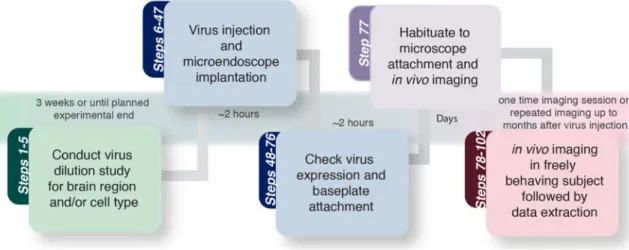
If a viral indicator of GCaMP is being used, a critical step in this procedure is the optimization of viral expression within the target cell population29. This portion of the procedure can take 3–8 weeks depending on the goals of the experiment and should be conducted before the start of in vivo imaging experiments (Fig 2). To optimize viral
expression of GCaMP, we recommend conducting a dilution protocol and that the protocol is carried out to the longest planned time point of the experiment. For example, experimental designs in which only one acute imaging session is needed, a dilution study at one experimental time point should be sufficient. This time point should be selected based on optimal viral expression of GCaMP (3–8 weeks), the duration of time required to recovery from surgical procedures (2–3 weeks), as well as learning and/or habituation procedures directly related to the experimental manipulation.
Given the potential to repeatedly monitor neural activity within the same test subject, it is more likely that this protocol will be utilized for prolonged optical monitoring of defined neuronal ensembles. For chronic imaging experiments, it is recommended that the dilution protocol be carried out to the longest planned time point of the (e.g., 8 weeks following stereotaxic injection of virus) (Fig 2) and that this step is completed prior to beginning an experimental cohort of animals. A failure to optimize viral expression of GCaMP for the total duration of the study may result in over-expression of the indicator at later time points. Over-expression of GCaMP is deleterious to the experimental procedures as it can
substantially interfere with a cells ability to buffer Ca2+, resulting in a lack of dynamic Ca2+ signals, nuclear filling of GCaMP, and cell death14,19,29. Conversely, inadequate expression of the viral indicator would hinder the ability to visualize fluorescently encoded GCaMP signals or the likelihood of extracting statistically significant Ca2+ signals from the data.
While the methods presented in this protocol emphasize the use of virally encoded GCaMP indicators, transgenic mouse lines engineered to express fluorescent reporters of neural activity58–61 can also be used. An advantage to these lines is that they stably expresses GCaMP throughout development, which may be better suited for chronic imaging experiments that are subject to risk for over-expression of the viral indicator to occur. An additional advantage to the use of a transgenic line engineered to express GCaMP is that there is greater homogeneity in GCaMP expression across subjects. An additional alternative method for the introduction of GCaMP is in utero electroporation62. This method of viral transduction may be better suited for animal models in which few transgenic lines are available63. Before the start of an in vivo imaging experiment, these alternative methods for the visualization of fluorescently reported neural activity should be tested within the target
A
uthor Man
uscr
ipt
A
uthor Man
uscr
ipt
A
uthor Man
uscr
ipt
A
uthor Man
uscr
neuron population of interest as well as in conjunction with the appropriate optic materials (microendoscope and microscope).
Surgical procedures for lens implantation and baseplate attachment
Once the appropriate microendoscope has been selected and expression levels of the fluorescent indicator have been optimized, in vivo imaging experiments can be conducted for weeks to months following the initial surgery, permitting long-term tracking of defined neuronal ensembles29. Subsequent procedures to conduct chronic imaging studies within deep brain regions require the surgical implantation of a microendoscopic lens above the target neuron population44 and the attachment of a baseplate to the mouse’s (or other species) head to interface with the miniature, integrated microscope23,28. Each of these surgical procedures takes about 2–3 hours to complete (Fig 2).
Behavioral procedures and data analysis
When designing freely behaving in vivo Ca2+ imaging experiments, it is important to consider a list of experimental precautions as well as controls that will be required to permit accurate data interpretation. For instance, while some movement of neural tissue is normal and can be corrected for by the application of a motion correction algorithm64, optical monitoring of neural activity within deep brain regions of freely behaving animals has a heightened potential for behaviorally mediated motion artifacts to be encoded in the data. Although we have not yet found this to be an issue with the preparation described in this protocol, it is possible that during periods of rapid or rigorous animal movement, extra strain may be placed on the animal’s skull, causing the position of the lens in relation to the target neuron population to shift between frames. These types of mechanically induced shifts in the imaging plane are of particular concern to the experimental design as they have the potential to alter both the intensity and spatial location of optically detected signals. Thus, during active behavior, it is possible for motion-induced changes in fluorescence signals to be inappropriately assigned as physiologically relevant neural signals.
To ensure that optically detected fluorescent signals are representative of neural activity, care should be taken to ensure that the test subject can freely move throughout its environment as well as perform the behavioral task with minimal restraint. In addition, once the data collection process is complete, optically detected fluorescence signals should be inspected to confirm that they have the appropriate morphology and that changes in fluorescence signals over time have identified characteristics of Ca2+ transients (Fig 3a–d). Finally, it is also possible to include an experimental group that contains a lens above the target neuron population, but rather than introducing a fluorescent reporter of neural activity, a fluorescent marker for cell identification, such as yellow fluorescent protein (YFP) is introduced into the target neuron population. In this case, dynamic changes in neural activity should only be observed in animals expressing the fluorescent reporter of neural activity and not YFP expressing animals35. Any observed changes in fluorescence in the YFP group would be the result of movement noise and possibly indicate that the design of the experimental paradigm is not optimal for this methodology or that more care needs to be taken during the
experimental preparation to ensure that the head cap is securely affixed to the skull.
A
uthor Man
uscr
ipt
A
uthor Man
uscr
ipt
A
uthor Man
uscr
ipt
A
uthor Man
uscr
Given that the intensity of Ca2+ encoded signals can change as a function of time, it is important to consider both the duration of an individual recording session42 as well as how long a chronic imaging paradigm will be carried out for29. More specifically, during an acute imaging session of particularly long duration (i.e., greater than 40-mins), it is possible for photobleaching of the signal to occur, resulting in a reduction in fluorescence intensity and or a reduction in the total number of detected cells to decrease throughout the recording sessions. If signs of photobleaching are apparent, the experimental design should be modified to either reduce the total duration of an imaging session or modified so that imaging data is only collected at experimentally relevant time points. For example, for pharmacological manipulations a 45-min imaging regimen can be used with 10-minutes intervals of the LED on followed by a 5-min off period for a total of 30-minutes of imaging data42. The inclusion off LED-off periods into a relatively long imaging session will reduce the risk of photobleaching.
As described above, chronic imaging paradigms have an additional level of complexity as steady increases in the expression of the Ca2+ indicator over time can result in both an increase in the fluorescence intensity of individual cells as well as the number of detected cells cross sessions. During the experimental procedure, basal fluorescence intensity should be monitored to confirm that fluorescence emissions are stable throughout the duration of the experiment29. In addition to steady increases in fluorescence intensity, long-term expression of GCaMP may alter a cells natural ability to buffer Ca2+ and therefore alter neural activity and/or behavior. To confirm that an observed change in neural activity is the result of a particular experimental manipulation and not merely due to the expression of GCaMP within a defined neural population, a control group that is imaged at similar time points as the test group, but does not undergo any other experimental manipulations can be included (e.g., Surgery positive/GCaMP positive/Manipulation negative). Within the control group, neural activity should be stable throughout the duration of the test procedure. To confirm that the expression of GCaMP does not interfere with the performance of a behavioral task, the behavior of test subjects should be stable across time or change in a manner that is predicted by the behavior of animals that have undergone similar experimental procedures, but do not express GCaMP (e.g., Surgery positive/GCaMP negative/Manipulation positive)42. Alternatively, this experimental group could express YFP within the target neuron population so that motion induced changes in fluorescent intensity as well as GCaMP-induced changes in behavior can be controlled for in one group (e.g., Surgery positive/YFP-positive/Manipulation positive)35. Finally, experimental subjects can also be monitored for gross changes in behavior or general indicators of health42.
The experimental controls and precautions listed in this section are recommendations primarily based on the experience of our laboratory with this methodology. Given the broad applicability of this technique to the field of neuroscience, these recommendations are unlikely to be a complete list. Thus, the appropriate experimental controls necessary for accurate data interpretation should be carefully considered before the start of an experiment. It is also important to consider if a freely behaving design is the ideal method to answer the experimental question. For instance, while a freely behaving design may be appropriate for complex behavioral tasks that require an animal to be able to move naturally through its environment and appropriately adapt its behavior to a dynamically changing stimulus, such
A
uthor Man
uscr
ipt
A
uthor Man
uscr
ipt
A
uthor Man
uscr
ipt
A
uthor Man
uscr
as during species-typical social behavior, it may not be ideal for experimental questions that require precise time-locked exposure to an environmental stimulus, such as studies related to sensory processing. For the latter experiment, if the goal is conduct Ca2+ imaging within a deep brain neuronal structure, similar procedures for the introduction of GCaMP as well as the chronic implantation of a micorendoscope may be used as described in this protocol (Procedural steps 1–47) and subsequently combined with head fixed imaging
procedures20,44.
MATERIALS
Reagents
• Mouse line of choice (wild type, Cre line for targeting specific cell types, or transgenic mouse lines expressing GCaMP in a stable and uniform manner across cells for up to 6 months61 (available from the The Jackson Laboratory,
www.jax.org).
CAUTION Use of animal species should be conducted in accordance with institutional guidelines and regulations. UNC IACUC approved the procedures used in this protocol.
• AAV constructs (see Table 1 for a list of available viral constructs) Our laboratory has successfully utilized GCaMP6 viruses available from the University of Pennsylvania, Stanford University, and the University of North Carolina (UNC) Vector Core. The data shown in the present paper is from viral constructs created at Stanford and UNC. Other groups have successfully utilized variants of GCaMP available from the University of Pennsylvania Vector Core with similar imaging procedures described in this protocol42,65. CAUTION Use and disposal of AAV constructs should be conducted in accordance with institutional guidelines CRITICAL For long-term imaging studies, an alternative to viral delivery of GCaMP is to use transgenic mouse lines that stably express GCaMP.
• Kwik-Sil adhesive (World Precision Instruments, cat. no. KWIK-SIL)
• Kwik-Cast sealant (World Precision Instruments, cat. no. KWIK-CAST)
• Mixer tips (World Precision Instruments, cat. no. 600009)
• Super glue liquid professional (Loctite)
• C&B-Metabond (Parkell, cat. no. S380)
A
uthor Man
uscr
ipt
A
uthor Man
uscr
ipt
A
uthor Man
uscr
ipt
A
uthor Man
uscr
• Absolute Ethanol – 200 proof (Fisher Bioreagents, cat. no. BP2818-4)
• Isopropanol, 70% v/v (Fisher Chemical, cat. no. A459-1)
• Jet denture repair powder (Lang Dental, cat. no. 1250)
• Ortho-jet crystal liquid fast curing acrylic resin (Lang Dental, cat. no. 0206; for pink dental cement)
• Contemporary ortho-jet liquid (Lang Dental, cat. no. 1506 Black; for black dental cement)
• Acrylic primer (Lang Dental, cat. no. 1602)
• Isoflurane CAUTION Gas anesthesia should be used in a
well ventilated room66
• Medical grade oxygen (Airgas, cat. no. OX USP125)
• Topical anesthetic (Lidociane, USP (Akorn, NDC:
17478-711-30)
• Tissue adhesive (Vetbond, 3M, cat. no. 1469SB)
• Eye ointment (Henry Schein, cat. no. 18582)
• 0.9% sodium chloride injection (Hospira, cat. no. 4888-20)
• Betadine solution, poviderm medical scrub (Butler Schein, cat. no. 003659)
• Ibuprofen, 160 mg/5 ml (Tylenol, Childrens Tylenol)
Equipment
Surgery consumables
• Ideal micro drill bur, 0.8 mm (Cell Point Scientific, cat. no. 60-1000)
• Trephine for Microdrill (Fine Science Tools, cat. no. 18004-18)
• Stainless steel disposable scalpels (Miltex, cat. no. 4-410)
• 5-0 Sofsilk sutures (Covidien, cat. no. D4G1516X)
• 1 mL syringe (BD, cat. no. 309659)
• 27G 0.5-inch blunt needle (SAI Infusion Technologies,
B27-50)
• 27G 0.5-inch needle (BD, cat. no. 305109)
• 25G 5/8-inch needle (BD, cat. no. 305122)
• 18G 1-inch needle (BD, cat. no. 305195)
A
uthor Man
uscr
ipt
A
uthor Man
uscr
ipt
A
uthor Man
uscr
ipt
A
uthor Man
uscr
• 18G 1.5-inch blunt needle (BD, cat. no. 305180)
• Dust-off compressed gas (Falcon Safety Products, DPSXL)
• Gelfoam absorbable sponge (Pfizer Injectables, cat. no. 00009-0342-01)
• 12-well culture plates (Falcon, cat. no. 353043)
• Skull screws (Glass and Watch Screws, 900 piece set,
JT69900)
• 1/16-inch diameter heat shrink tubing (Qualtek, cat. no. Q2-F3X-1/16-01-MS100FT)
• Carbon filter (ReFresh, cat. no. EZ-258)
• Parafilm (Parafilm, PM-999)
Optical materials
• Microendoscopic lens (see Table 2 for options available from Inscopix,)
• Microscope baseplate (Inscopix, cat. no. BPL-2)
• Microscope baseplate cover (i.e., dust cap) (Inscopix, cat. no. BPC-2)
• Microscope Gripper tool (Inscopix, cat. no. GRP-1)
• Hex key (Inscopix, cat. no. ATW-1)
• Dummy microscope (Inscopix, cat. no. DMS-2)
• Microscope objective lens cover (Inscopix, cat. no. MSC-2)
• Optical Cleaning Kit (Fine Science Tools, cat. no. 29000-10)
• Premium grade lens cleaner (Thorlabs, cat. no. MC-50E)
• *Methods in this protocol have been developed and tested using optical materials purchased from Inscopix. For other imaging system and microendocopic lens options please see the following websites (doriclenses.com,
welcome.gofoton.com).
Surgery tools and equipment
• Vannas spring scissors (Fine Science Tools, cat. no. 15000-08)
• Curved graefe forceps (Fine Science Tools, cat. no. 11052-10)
A
uthor Man
uscr
ipt
A
uthor Man
uscr
ipt
A
uthor Man
uscr
ipt
A
uthor Man
uscr
• Dumont 7 ceramic coated forceps (Fine Science Tools, cat. no. 11272-50)
• Dumont 5 forceps (Fine Science Tools, cat. no. 11251-10)
• Dissecting chisel (Fine Science Tools, cat. no. 10095-12)
• Curved 50 mm bulldog clamp (Fine Science Tools, cat. no.
18051-51)
• Bonn micro probe (Fine Science Tools, cat. no. 10033-13)
• Micro curette (Fine Science Tools, 10082-15)
• Bulldog serrefine (Fine Science Tools, cat. no. 18050-28)
• Glass bead sterilizer (Simon Keller, cat. no. Steri 250)
• Pump 11 Elite (Harvard Apparatus, cat. no. 70-4505)
• 7002KH 2.0 uL syringe (Hamilton, cat. no. 88400)
• Modular Routine Stereo Microscope with 8:1 Zoom (Leica,
cat. no. M80)
• Model 942 Small Animal Stereotaxic Instrument with
Digital Display Console (Kopf, cat. no. 942)
• Non-rupture Mouse Earbar (Kopf, cat. ID. Set 2, Model
922)
• Electrode holder with removable open side clamp (Kopf,
Model 1773)
• Cannula holder (Kopf, Model 1776-P1)
• Microdrill (Cell Point Scientific, cat. no. RS-67-1000)
• Stereotaxic handpiece holder (Kopf, Model 1466-B)
• Precision screwdriver (Westward, cat. no. 1UG41)
• Homeothermic monitor (Harvard Apparatus, cat. no.
50-7220-F; for surgery)
• Animal anesthesia kit (E-Z Anesthesia, cat. no. EZ-7000)
• Oxygen regulator (E-Z Anesthesia, cat. no. EZ-320)
• Heating pad (Sunbeam, cat. no. 126982; for recovery)
• Heat gun (Weller, cat. no. 6966C)
• Fixed Sliding Probe Carriage (Scientifica, cat. no. PS-7750)
• Patchstar Micromanipulator (Scientifica, cat. no. PS07000C)
• ½″ Articulated ball and socket mount (Thor labs, TRB1)
A
uthor Man
uscr
ipt
A
uthor Man
uscr
ipt
A
uthor Man
uscr
ipt
A
uthor Man
uscr
In vivo imaging equipment and data analysis
• SPRO ball bearing swivels with interlock snap (Cabelas, IK-117351)
• Model 923-B Mouse Gas Anesthesia Head Holder (Kopf)
• Arduino circuit board (Arduino, cat. no. A000066)
• Bayonet Neil-Concelman Connector (BNC) (f) with
American wire gauge (AWG) leads (Ponoma Electronics, cat. no. 4969)
• Desktop with Intel core i7 processor, Windows 8.1, ideally with 32GB of memory (eg. Lenovo, K450 Ideacenter; for data analysis) <m>CRITICAL</m> In vivo Ca2+ imaging sessions create large datasets and it is recommended that a computer for the analysis of these data sets with
specifications of at least an Intel core i7 processor, 8 GB of RAM, 2 terabyte free hard disk space, and USB 3.0 ports.
• Desktop with Intel core i5 processor, Windows 8.1, and at least 8GB of memory (eg. Dell, XPS8700; for data acquisition)
Reagent Setup
• Virus preparation: Prior to stereotactic injection of the
virus, if necessary, dilute the virus with sterile saline. Recommended virus dilutions are as follows: 1:2, 1:4, 1:8, 1:16, and 1:32. If the virus is being used that day, store on ice until it is time to conduct the virus infusion procedure. Store all remaining aliquots at −80° Celsius. Under conditions of minimal freeze/thaw cycles, virus aliquots can typically be stored for ~5 years.
• Pink dental cement (for the foundation of the head cap):
Prior to the start of the surgery, fill each well of a 12-well plate with 2 g of acrylic powder. When ready to secure the microendoscope to the skull, mix 1 mL of clear Ortho-Jet liquid with the powder located in one well and load the mixture into a 1 ml syringe. Attach an 18G 1.5-inch blunt needle to the filled syringe. Wait at least 30 seconds before applying the dental acrylic solution to skull. CRITICAL Prepare well plates with dental cement before beginning surgical procedures for the implantation of a
microendoscope.
• Black dental cement (blocking background light and the
attachment of the baseplate): prepare a well plate with
A
uthor Man
uscr
ipt
A
uthor Man
uscr
ipt
A
uthor Man
uscr
ipt
A
uthor Man
uscr
acrylic powder as described above. When ready to apply the black dental cement to the head cap or baseplate, add 1 ml of black Ortho-Jet liquid to the powder and load the mixture into a syringe as described above. Wait ~30 seconds before applying to the skull. CRITICAL Prepare well plates with dental cement before beginning surgical procedures for the attachment of the baseplate.
• Ibuprofen for post-operative care: Fill the water bottle
that is to be placed in the test subject’s home cage with 200 mL of water and add 2.5 ml of Childrens Tylenol (80 mg ibuprofen/200 mL water). Allow water bottle to remain in home cage for 2–3 days.
• Post-operative recovery cage: Prior to the start of surgical
procedures, it is recommended that a clean cage (fresh bedding, softened chow, nestlet material, and a paper towel for the animal to be placed on immediately
post-operatively) be prepared for the test subject to recover in. If a wire lid is used to hold chow, it is recommended that this is removed to reduce the number of physical objects in the cage that can potentially cause damage to the exposed surface of the lens. This analgesia and recovery procedure has been approved by UNC IACUC and should be conducted in accordance with the guidelines of your institution.
Equipment Setup
• Heat shrink covered surgery tools: When handling
delicate optical materials, such as the microendoscope, apply heat shrink tubing to hard metal tools. For general lens handling, apply heat shrink to the Dumont 5 forceps, with ~10 mm of tubing added to each arm. Cut heat shrink to appropriate size and fix the heat shrink to the forceps with the application of the heat gun (Supplemental Fig 1a).
• Lens holder: Cut two 5-mm long heat shrink sleeves. Slide heat shrink over each arm of the bulldog serrefine and apply heat with heat gun (Supplemental Fig 1b). When it is time to implant the microendoscope, clamp the back end of the serrefine in the cannula holder (Supplemental Fig 1c) and mount the entire apparatus on the stereotax
(Supplemental Fig 1d). Next, secure the microendoscope into the heat shrink covered arms of the bulldog the serrefine. When the lens holder has been secured to the stereotax, visually inspect the microendoscopic lens to
A
uthor Man
uscr
ipt
A
uthor Man
uscr
ipt
A
uthor Man
uscr
ipt
A
uthor Man
uscr
ensure that it is leveled within the clamp. Once the
microendoscope is leveled, it is ready to be lowered into the brain. CRITICAL It is recommended that all lens handling procedures are conducted over lens cloth to prevent damage to the lens in the case that it is accidently dropped during the preparation stage.
• Bent needle for bone extraction: Using curved graefe forceps, bend the tip of a 27G 0.5-inch needle ~45 degrees (Supplemental Fig 1e).
• Sterile saline for irrigation during surgery: Attach an
18G 1-inch needle to a 1 ml syringe and fill with sterile saline. Use this syringe to apply sterile saline throughout the craniotomy and lens implantation procedure.
PROCEDURE
Virus Dilution Study
CRITICAL If using transgenic mice expressing GCaMP in a stable and uniform manner across cells, this section is not necessary and you can proceed direct to step 5.
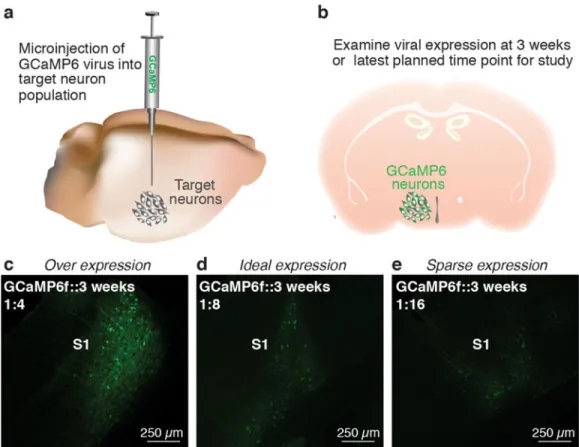
1 Before beginning in vivo imaging experiments, select the appropriate variant of GCaMP (fast (f), medium (m), slow (s)) and optimize the concentration of virus for the neuron population by first conducting a virus dilution study. Inject various dilutions of the desired viral construct into the brain region and mouse line of interest. Perform previously described stereotaxic procedures to introduce the viral construct into the brain (Fig 4a)
CRITICAL STEP Variants of the ultrasensitive GCaMP6 Ca2+ sensors outperform other sensors in vivo, but still warrant consideration of temporal precision during live imaging and post processing. These indicators vary in kinetic properties and sensitivity, with sensors with slower kinetics having greater sensitivity. For example, GCaMP6f and GCaMP6m have faster kinetics (determined by the rise time + half the decay time) compared to GCaMP6s and thus a greater potential to separate individual spikes within a burst or detect single action potentials in neuronal populations that exhibit fast firing rates. However, due to the fast binding kinetics of these variants, GCaMP6f and m have lower signal intensities during excitatory events that are associated with a low number of action potentials14. Thus, selection of variant will depend on the firing rate and signal to noise ratio of the cell population being imaged.
TROUBLE SHOOTING
A
uthor Man
uscr
ipt
A
uthor Man
uscr
ipt
A
uthor Man
uscr
ipt
A
uthor Man
uscr
2 Methods for virus introduction used in this procedural step, such as microinjections with a Hamilton syringe or Nanoject, should be similar to those planned to be used in experimental subjects. Recommended virus dilution concentrations to test are 1:2, 1:4, 1:8, 1:16, and 1:32 of virus diluted from a high titer viral stock. Allow at least 3 weeks for sufficient viral expression to occur (Fig 4b).
TROUBLE SHOOTING
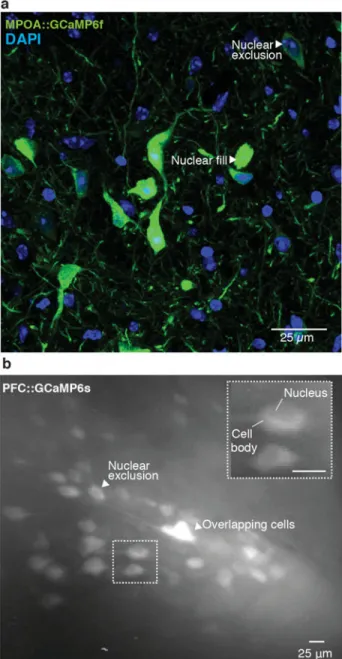
3 When sufficient time has elapsed for viral expression of the Ca2+ indicator, perfuse the subject as described in references 67 and 68 and examine the proportion of cells expressing GCaMP as well as the health of GCaMP expressing cells (Fig 4c–e)67,68. Healthy cells should show nuclear exclusion of GCaMP6, exhibiting a honeycomb shaped appearance (Fig 5 a,b, Supplemental video 1). If GCaMP6 expression is observed throughout the entire cell body, resulting in a complete filling of the cell body with the fluorescence indicator, it is likely that over expression of the Ca2+ indicator has occurred leading to unhealthy cells and, eventually, cell death (Fig 5a). CRITICAL STEP Completion of this step prior to conducting imaging experiments is critical as different AAV serotypes or promoters may not be optimal for all cell types69–71 (see Table 1 for a list of available viral constructs). CRITICAL STEP Optimal viral transduction is dependent on viral titers as well as the efficiency of a particular virus for transducing a given cell type. Caution should be taken when directly comparing viral titers between vector cores as quality control assays and methods for
determining physical and infectious titer can vary. Physical titer is expressed as the number of virus particles, viral genome, or genome copies per unit of measurement. Functional or infectious titer is the measure of virus that infects a target cell. This is expressed as transduction units per mL or plaque forming units per mL. These values are not absolute, but rather a relative measure of infectivity and direct quantitative
measurements are therefore not comparable across vector cores.
TROUBLE SHOOTING
4 If your experimental paradigm requires chronic imaging sessions (i.e., weeks to months) repeat steps 1 and 2 with suitable viral dilutions and examine viral expression at the longest time point planned for the experiment (e.g. 8 – 12 weeks after virus injection). It is particularly critical that cell health is examined at these later time points to ensure that long-term expression of GCaMP does not result in cell death. Cell health
A
uthor Man
uscr
ipt
A
uthor Man
uscr
ipt
A
uthor Man
uscr
ipt
A
uthor Man
uscr
can be examined after the completion of an experiment by examining mounted tissue sections under a microscope (i.e., post tissue histology)24,25 (Fig 5a) or with 1- or 2-photon microscopy in living mice (awake or anesthetized) throughout the experiment29 (Fig 5b). Post tissue histology is
recommended for the initial optimization of virus dilution, while 1- or 2-photon microscopy is best suited to confirm stable GCaMP expression and neural activity during the experiment. CRITICAL STEP It is normal for virus expression levels of GCaMP to increase stably, and, moderately over time, resulting in greater changes in fluorescence intensities compared to those measured at earlier time points as well as an increase in the proportion of cells that express GCaMP17,27. Thus, it is critical that stable virus expression throughout the duration of the study is optimized prior to the start of in vivo imaging experiments to ensure accurate data interpretation.
5 If targeting a genetically defined population of neurons, confirm cell type specific expression using immunohistological methods (for example, Supplemental Fig 2a–d).
Selection of microendoscopic lens
6 Select the appropriate lens for your brain region of interest (see Table 2 and Fig 6a). The lens should be long enough to reach just above your neuronal population of interest, while still allowing for ~2 mm of the lens to protrude above the skull (Fig 6b). When selecting the appropriate microendoscope for your neuron population, it is also important to weigh the optical properties of the microendocope with the invasive nature of the lens implantation procedure. For example, both the transmission of light to and from the brain as well as field of view size increase with lens diameter, optical properties which both impact signal detection capabilities (Supplemental Fig 3a,b). However, as lens diameter increases, so does the extent of tissue damage. Thus, the length and diameter of lens selected should be optimized to visualize the neuron population of interest, while minimizing damage to the underlying neural tissue.
CRITICAL STEP Before beginning surgeries on experimental subjects, it is beneficial to optimize the
placement of the microendoscope in relation to the target neuron
population. For the lenses utilized in this protocol, the focal plane is ~290 μm below the surface of the lower
A
uthor Man
uscr
ipt
A
uthor Man
uscr
ipt
A
uthor Man
uscr
ipt
A
uthor Man
uscr
lens. Thus, to bring neuronal signals into focus, the bottom of the microendoscope should sit between 200 and 300 μm above GCaMP expressing neurons (Fig 6c). Given this relatively narrow range in the dorsal-ventral imaging plane, it is highly recommended that the viral indicator is also injected during the lens optimization procedure. During post-histology, the distance between the bottom of the lens and GCaMP expressing neurons can be calculated to validate the appropriate placement of the lens (Fig 6c). Optimizing these steps prior to beginning a large cohort of animals will decrease the number of subjects in which the focal plane of the lens is out of range of the target cell population (Fig 6d).
TROUBLE SHOOTING
Surgical preparation for craniotomy and lens implantation
CRITICAL Once the virus dilution has been optimized and the appropriate microendoscope has been selected, lens implantation surgery can be begun on experimental subjects.
7 Prior to beginning surgical procedures, anesthetize the animal with isoflurane. Gas anesthesia is preferred over an injectable anesthesia, such as the combined use of Ketamine and xylazine, due to the long duration of the surgery66.
8 Next, stabilize the mouse’s head in the stereotaxic apparatus72 (Fig 7a).
9 Perform aseptic procedures in accordance with the guidelines of your institution. We perform surgical procedures in a
designated, sanitized area (Fig 7a), autoclave all instruments, pluck hair from the surgical site (Fig 7b), and clean the surgical site with 3 alternating scrubs of isopropyl alcohol and betadine (Fig 7c).
10 To reduce the perception of pain at the surgical site and therefore lower the level of general anesthetic needed to maintain anesthesia during surgery, we recommend application of topical lidocaine to the procedure site.
A
uthor Man
uscr
ipt
A
uthor Man
uscr
ipt
A
uthor Man
uscr
ipt
A
uthor Man
uscr
11 Make a small incision (~12 to 15 mm) along the sagittal line of the skull by using graefe forceps to hold the skin taught while running a scalpel blade in a straight line from the anterior to posterior region of the exposed skin. Use 4 curved 50 mm bulldog clamps to further expose the skull (Fig 7d). If necessary, use Vanna spring scissors to cut a larger opening in the skin and remove any hair that may be too close to the area of the skull where the head cap will be made.
12 To increase the accuracy of stereotaxic procedures, ensure that the skull is level by comparing the height of bregma in relation to lambda (Fig 7e). The difference in height between lambda and bregma should be less than 0.05 mm (Fig 7f,g). If the difference in height between the two is greater than 0.05 mm adjust the position of the skull in the dorsal-ventral direction until it is leveled. Next ensure that the skull is level in the medial-lateral direction by measuring the height of the skull at a set distance posterior from bregma, such as −2.0 mm, and an equal distance lateral from the midline on either side of the skull, such as ± 1.5 mm (Fig 7h). The difference in height at each location from the midline should also be less than 0.05 mm in the dorsal ventral direction. If the difference is greater than 0.05 mm, rotate the mouse’s skull using the bite bar or reposition the mouse’s head in the ear bar72.
TROUBLE SHOOTING
13 To reduce the occurrence of movement noise during in vivo imaging sessions, remove connective tissue from the top of the skull and muscle near the top edge of the skulls surface. Use a cotton tip applicator to remove periosteum and connective tissue from the skulls surface (Fig 8a). Use the dissecting chisel to clear away all tendons and muscles located near the area of the skull where the head cap will be made73 (Fig 8b). Apply sterile saline to the skull once all connective tissue has been removed. CRITICAL STEP It is crucial that connective tissue, tendons, muscle, skin, or fur are not allowed to come in contact with the dental cement that will be used to form the head cap (Fig 8c). This can cause the head cap to become loose, increasing movement noise during recording sessions or possibly resulting in the loss of an experimental subject.
TROUBLE SHOOTING
14 Use the 0.8 mm burr to drill holes for the placement of three skull screws (Fig 9a). When drilling is complete, use an air can and a cotton-tip applicator to clear away any debris from the skull (Fig 9a). To reduce the likelihood of excess bone
A
uthor Man
uscr
ipt
A
uthor Man
uscr
ipt
A
uthor Man
uscr
ipt
A
uthor Man
uscr
fragments getting into the craniotomy site, we recommend that the drilling of skull screw holes and the removal of bone debris from this procedure occur before the craniotomy is performed. CRITICAL STEP For maximum stability of the
microendoscopic lens, each screw should be equally placed in a triangle shape about 1.5 cm from the craniotomy site (Fig 9a).
15 Irrigate the skull with sterile saline to reduce tissue over heating during the craniotomy procedure (Fig 9b).
Craniotomy, durotomy, and tissue aspiration
16 Prior to performing the craniotomy, attach the trephine drill bit to the microdrill and zero the center of the trephine drill bit above bregma (Fig 9c). Move the trephine drill bit to the x,y coordinates where the microendoscope will be implanted (determined by mouse atlas)74.
17 To etch away the skull, slowly lower the trephine drill bit up and down on the exposed skull (Fig 9d). Stop drilling when only a thin layer of skull remains (Fig 9e). A craniotomy may also be performed using a 0.8 mm drill bit to etch a cranial window that is just large enough to perform the virus injections (if
necessary) as well as lower the microendoscope. A cranial window that is just large enough to implant the lens will stabilize the lens and minimize movement noise. CRITICAL STEP To prevent overheating, do not allow the drill bit to remain in one location for too long. Overheating the skull may result in bleeding under the skull.
18 Use a bent 27G 1.5-inch needle (or Bonn microprobe) to break through the remaining skull and loosen the large skull fragment in the center of the craniotomy (Fig 9f).
19 With Dumont 7 ceramic-coated forceps, grab onto the large skull fragment and move it away from the brain (Fig 9g).
20 Immediately irrigate the exposed tissue with sterile saline (Fig 9h).
21 Use a bent 27G 1.5-inch needle (or Micro curette) to remove any remaining small bone fragments.
TROUBLE SHOOTING
22 To facilitate virus injection and lens implantation, perform a durotomy (Fig 10a). Use the bent 27G needle (or Bonn Micro Probe) to pierce through the dura and slowly peel it away from the brain (Fig 10b). Compared to brain tissue, dura has a yellow tint to it (Fig 10b) and exposed neural tissue should appear
A
uthor Man
uscr
ipt
A
uthor Man
uscr
ipt
A
uthor Man
uscr
ipt
A
uthor Man
uscr
white once the dura has been removed (Fig 10c). CRITICAL STEP When removing dura, be careful to avoid rupturing vasculature. If bleeding occurs during the procedure, pause the procedural step and apply a few drops of sterile saline to the exposed tissue. Use a pair of forceps to gently place a small piece of gel foam on top of the exposed tissue. Allow the saline-soaked gel foam to remain on the tissue until all bleeding has subsided. Once bleeding has stopped, use a pair of forceps to remove the gel foam and irrigate the area with sterile saline. CRITICAL STEP It is important that sterile saline is used in conjunction with the gel foam to prevent the gel foam from sticking to the tissue resulting in damage to the underlying tissue when the gel foam is removed.
TROUBLE SHOOTING
23 Irrigate the exposed brain tissue with sterile saline immediately following completion of the durotomy.
24 Implantation of a microendoscopic lens deep within the brain will result in a large amount of pressure on the underlying neural tissue. To minimize tissue pressure, gently aspirate tissue above your region of interest (at least 1–2 mm of superficial layers for deep brain regions) (Fig 10d). Before beginning the aspiration, bend a blunt 27G needle 90° and connect the bent needle to a vacuum pump. Test the vacuum pressure by slowly approaching the saline bubble on top of the skull with the needle and adjust the pressure of the vacuum pump so that only a small volume of saline is aspirated at a time. To allow constant, fine control of suction pressure by hand, a 1 mm hole can be drilled into the plastic fitting of the needle providing an exhaust for redirection of airflow20. Large changes in saline volume should not be immediately visible by eye. If large changes in volume are readily visible, the pressure of the pump should be lowered.
TROUBLE SHOOTING
25 To begin tissue aspiration, slowly lower the needle toward the exposed neural tissue while continuously applying sterile saline, aCSF, or Ringer’s solution for irrigation (Fig 10e). Some bleeding is normal during aspiration and adjustments in irrigation rates should be made to maintain tissue visibility as well as prevent the formation of large blood clots. This can be completed by stopping irrigation and aspiration for 5s intervals, allowing only small clot formation. Gel foam can be used to control bleeding at the edges of the aspiration site. Aspiration should stop when at least 1 mm of tissue has been aspirated or
A
uthor Man
uscr
ipt
A
uthor Man
uscr
ipt
A
uthor Man
uscr
ipt
A
uthor Man
uscr
at least a thin layer of tissue (500–800 um) remains above your region of interest23. We have found more conservative estimates of tissue aspiration (i.e., aspiration of 1–2 mm of tissue when implanting a probe 4 mm into brain) to sufficiently reduce tissue pressure, while minimizing the risk of damage to the target structure (Fig 10f).
For some brain regions, structural landmarks can be used to determine when the aspiration procedure should stop. For example, when aspirating tissue for the implantation of a microendoscopic lens in the
hippocampus, aspiration should stop when the white matter tracts of the corpus callosum become visible (indicated by a shiny appearance to the tissue).
We do not recommend that tissue is aspirated for superficial structures, such as the cortex.
CRITICAL STEP To further minimize pressure-induced tissue damage, a needle can be lowered about 2.0–2.5 mm above the region of interest and subsequently retracted. This needle serves as a way to further clear a path for lens implantation and does not function to suction tissue from the brain.
TROUBLE SHOOTING
Introduction of Ca2+ indicator into neural population of interest
CRITICAL If the viral construct was injected at an earlier time point42,75, or if a transgenic mouse line that expresses a Ca2+ indicator is being used (ww.jax.org), skip procedural steps 26 and 27 and proceed straight to step 28.
26 Utilize established stereotaxic procedures to introduce the selected GCaMP encoding viral construct into the brain region of interest27,46 (Fig 10g). To infuse virus in the mouse brain, our laboratory utilizes an injector needle connected to a 2 μl Hamilton syringe by PE20 tubing, but other methodologies for microinjections, such as with the use of a Nanoject, may also be used. Load the desired amount of viral construct (250–500 nL) into an injector needle and secure the injector needle onto the
A
uthor Man
uscr
ipt
A
uthor Man
uscr
ipt
A
uthor Man
uscr
ipt
A
uthor Man
uscr
stereotaxic apparatus (Fig 10g). Center the injector needle above bregma and move the needle to the appropriate
stereotaxic coordinates (Fig 10h,i). We recommend that the site of viral infusion be placed 250 μm medial/lateral and ventral to the site of lens implantation to minimize tissue damage under the lens (Supplemental Fig 4).
TROUBLE SHOOTING
27 Infuse virus at a constant, slow rate of 100 nL/min.
If imaging a vertical plane, such as with a prism lens that bends light at a 90° angle77–79, multiple injections along the imaging plane may be required. For example, if imaging within cortical regions of the brain, it may be necessary to make at least three 250 nL injections spaced about 250–300 μm apart along the dorsal-ventral axis to successfully capture neural activity across multiple cortical layers. For 1.0 mm diameter lenses, multiple injections along the medial-lateral axis (e.g., ± 300–500 μm lateral from the center of the lens) may increase the amount of GCaMP expressing cells in the focal plane, but is not required for signal detection.
TROUBLE SHOOTING
Lens implantation
28 Before beginning lens implantation, implant the skull screws in the holes drilled in step 14 (Fig 10j). These screws will act to anchor the dental cement to the skull. The final placement of the skull screws should not protrude out of the skull at a point higher than the final height of the implanted lens. This height will depend on the length of the lens that is being used as well as the depth in which this lens is implanted in the brain.
TROUBLE SHOOTING
29 Attach the prepared lens holder to the stereotaxic apparatus (Supplemental Fig 1).
30 Prepare the microendoscope for placement into the lens holder by gently placing the microendoscope on the lens cloth from the Optical Cleaning Kit. Using heat shrink covered Dumont 5
A
uthor Man
uscr
ipt
A
uthor Man
uscr
ipt
A
uthor Man
uscr
ipt
A
uthor Man
uscr
forceps, pick up the microendoscope and use an air can to gently remove any dust particles (Fig 11a). CRITICAL STEP The microendoscope is composed of two GRIN lenses attached onto either side of a relay lens. To avoid damaging either imaging surface, the microendoscope must be handled with care.
31 Hold the microendoscope with heat shrink covered forceps in one hand and use the other hand to open the heat shrink covered bulldog serrefine clamp. Place the microendoscope in the bulldog serrefine clamp and carefully adjust the placement of the microendoscope in the holder until it is level within the apparatus (Fig 11b).
32 Without touching the microendoscope to the skull, zero the microendoscope just above bregma and move the
microendoscope to the target location.
33 Before the lens is lowered, visually inspect the craniotomy site for bleeding. CRITCAL STEP It is crucial that all bleeding has stopped before the microendoscope is lowered as excessive bleeding may occlude the field of view.
If bleeding does occur at any stage of the procedure, apply gel foam to the craniotomy site until bleeding has subsided. If bleeding from the craniotomy site cannot be stopped, a lens should not be implanted as the bleeding will likely occlude the field of view under the lens.
34 Carefully lower the lens to ~300 μm above the target neuron population. The microendoscope should be lowered at a constant, slow-rate, ~100–200 μm/min in steps of 10–20 μm (Fig 11c). The slower rate of 100 μm/min is recommended to achieve optimal recording conditions. Bleeding should not occur during this process and brain tissue as well as small vasculature should be visible under the lens throughout the duration of the lens implant procedure (Supplemental Fig 5). CRITICAL STEP Lowering the microendoscope at a slow rate may provide the neurons, glia, and vasculature time to separate, thus reducing the amount of tissue damage under the lens.
CRITICAL STEP When lowering the microendoscope, retracting it up and down may also facilitate clearing a path for its implantation.
A
uthor Man
uscr
ipt
A
uthor Man
uscr
ipt
A
uthor Man
uscr
ipt
A
uthor Man
uscr
TROUBLE SHOOTING
35 Once the microendoscope has been lowered to its final position, apply a small amount of Kwik-Sill around the lens within the craniotomy to cover any exposed tissue (Fig 11d). It is not necessary that the amount of Kwik-Sil applied to the
craniotomy exceeds the height of the skull. Application of too much Kwik-Sil may decrease the stability of the lens and therefore increase the likelihood of movement noise to occur during an in vivo imaging session.
36 To facilitate adherence of the dental cement to the skull, apply Metabond according to the application instructions provided in the kit suggested in the materials list. Alternatively, dental acrylic may be used, but Metabond is recommended.
TROUBLE SHOOTING
37 Secure the microendoscope to the skull with dental cement. Use a 1ml syringe connected to an 18G needle to apply a thin layer of the pink cement to the skull. Allow this layer of dental cement to run all the way to the microendoscope and skull screws (Fig 11e). CRITICAL STEP This layer should be thin so that it can run to the lens on its own without any interference from the experimenter (i.e., manually pushing the cement towards the lens). This method will reduce the risk of bumping the lens during the dental application process.
38 Once the first layer of dental cement has dried (~10 min), build up the head cap to cover the top of the skull screws (Fig 11e). While the dental cement is still pliable, use a spatula to smooth the edges of the head cap and move the dement cement away from any tissue. Allow this second application to dry for ~15 mins.
39 To further secure the microendoscopic lens to the dental cement, apply a small amount of super glue where the base of the dental cement meets the lens (Fig 11e). CRITICAL STEP Avoid getting dental cement or super glue near the bulldog serrefine that is holding the microendoscope or on the exposed lens of the microendoscope.
40 Once the cement has completely dried, carefully dislodge the microendoscope from the bulldog serrefine. The
microendoscope should not move when the bulldog serrefine is removed.
41 To prevent light other than that from the microscope-LED from entering the microendoscope, apply a layer of dental cement mixed with black acrylic around the head cap (Fig 11f).