409
Abstract—The municipal solid wastes in Nigeria contain all sources of unsorted wastes, such as commercial refuse, construction and demolition debris, garbage, electronic wastes etc, which are dumped indiscriminately on roadsides and any available open pits irrespective of the health implication on people. The aim is to emphasize various waste management options, which integrated waste management disclosed the hierarchy of waste management options, environmental impacts of those options where studied under health and social effects, and the legislation of Extended Producer Responsibility were suggested where by product take back by manufacturers, especially when remanufacturing and reuse is available to ensure sound management practice in developing country Nigeria.
Index Terms—Disposal habit, Environmental Impacts, Legislation, Management options, Nigeria, Waste Generation.
I. INTRODUCTION
A broad range of materials are classified as municipal solid waste (MSW), including garbage, refuse, sludge from a waste treatment plant, water supply treatment plant, or air pollution control facility and other discarded material including solid, liquid, semisolid, and or contained gaseous material resulting from industrial, commercial, mining and agricultural operations and from community activities, but does not include solid or dissolved material in domestic sewage [1]. Waste, garbage, trash, junk, debris and refuse are all names given to the “stuff” that is no longer useful in its current form. According to Cointream [2], that MSW is defined as non-air and sewage emissions created within and disposed off by a municipality, including household garbage, commercial refuse, construction and demolition debris, dead animals, and abandoned vehicles. Recently Onwughara et al [3] reported that MSW contains a great deal of energy that
1Onwughara Innocent Nkwachukwu is with Department of Pure and
Industrial Chemistry, Nnamdi Azikiwe University Awka, P.M.B. 5052 Awka, Anambra State, Nigeria (Corresponding Author: Phone: +2348063781088, e-mail: [email protected]).
2Dr. Nnorom Innocent Chidi is with Department of Industrial Chemistry,
Abia State University Uturu, P.M.B 2000 Uturu, Abia State, Nigeria (e-mail: [email protected]).
3Kanno Okechukwu Charles is with Quality Assurance Department,
GlaxoSmithKline Consumer Nigeria Plc Igbesa Road Agbara Ogun State, Nigeria (e-mail: [email protected]).
potentially could be recovered, it also contains a great deal of valuable raw materials. Adedibu [4] reported that the source of waste generation increase as income rises but at a smaller unit (rate) than income. He posed that the amount of waste discharge into the environment is related to the population composition, size and per capital income. A remarkable growth in population and income give rise to the production and consumption of goods and services and thus, the discharge rate is increased. Department of Environmental Quality Promotion, 2002 [5], stated that the majority of substances composing MSW include paper, vegetable matter, plastics, metals, textiles, rubber and glass. MSW disposal is an enormous task in the developing countries across the world, as poverty, population growth and high urbanization rates combine an effectual and under-funded government to prevent efficient management of wastes [2], [6]-[8].
Collection and disposal of wastes differs from country to country. In USA, the methods of disposal are landfills and incineration, disposal method in Australia is landfill, while in Japan its incineration and Recycling which started in April 2001 [9]. In Nigeria, the common method of disposal is open dump [3]. The amount of trash that accumulates in a matter of hours would be more than waste collectors could haul in a day, these garbage “dumps” are located on the side of the highway at the fringe of cities and slums (personal experience). Using Umuahia, a town in the Southeast of Nigeria, the capital of Abia State as case study, with a population of about 1.2 million people produced 250 metric tons of waste in 2005 and 350 metric tons of waste in 2007 daily with 76 refuse bins (receptacles) which consist of 63 NDDC type bins and 13 Eco-power bins were being kept at cities slums; the capacities of trucks (waste disposal vehicles) used in carrying those receptacles in Table I [10].
TABLEI:CAPACITY OF TRUCKS (WASTE DISPOSAL VEHICLES) IN METRIC TONS.
No of Trucks Types of Trucks Metric Tons/each
9 NDDC Trucks 0.7
10 Eco-power Trucks 3.5
2 Tippers lorries 2.1
(Source: Abia State Environmental Protection Agency, ASEPA 2007) [10].
Issues of Roadside Disposal Habit of Municipal
Solid Waste, Environmental Impacts and
Implementation of Sound Management Practices
in Developing Country “Nigeria”
410 This paper reports the disposal habit, environmental impact of municipal solid waste (MSW) of developing country “Nigeria” also overview various management practicing and necessary rules to achieve sound management.
A. Disposal Habit
In most developing nation such as Nigeria with about 140 million population, waste are dumped indiscriminately on roadsides and any available open pits irrespective of the health implication on people [3]. All classes of solid waste are collected and dumped together without much effect at segregating and differentiating the different component of solid wastes. There are cases where these waste are dumped in streams or river channels [4]. Due to deposit in the rivers Abulude [11] reported that developing countries are witnessing changes in ground water, which constitute another source of portable water. Comparing waste produced in developing countries and developed countries such as America, where an average American produces about 4.4 pounds of municipal solid waste each day, resulting in roughly 210 million tons per year for the nation [12] and that of developing countries, waste are disposed off on the open space or roadside; scavenging at dump sites is still common [13].
Metals in raw surface water reflect erosion from natural sources, fallout from the atmosphere and additions from industrial activities. These metals in soil and water may enter food chain, further potential sources of human exposure include consumer products and industrial waste as well as the working environment in Fig. 1 [14].
Fig. 1: Routes for transport of trace elements in the environment (Source: Curtis et al., 1980) [14].
In this developing nations, sites previously utilized as dump sites are often converted to farm lands without any treatments. Plants grown in such soils take up toxicants such as metals, which accumulated in plants tissues pose environmental and health risks. It is important to realize that an entire economy is geared to oppose realistic management of solid waste, obsolesce is expected and in case of disposal or recycling is not considered in the design and marketing of consumer products. The municipalities do not take upon themselves to recycle materials or at least have any such
plans for the future. In which current disposal methods spend about 80% of the time on waste collection [4].
B. Municipal Solid Waste (Msw) Compositions
According to ASEPA (2007) [10], the percent components of different categories of solid waste generated in Umuahia 2007 is presented in Table II.
TABLEII:%COMPONENTS OF CATEGORIES OF SOLID WASTE GENERATED IN
UMUAHIA 2007. COMPOSITION PERCENTAGE
Food particle/garbage 52.2
Plastics 1.5
Bottles 0.6
Metallic Objects 3.0
Polythene Materials (nylon) 10.2
Furniture/Wood Materials 12.0
Paper 18.5
Unclassified Waste 2.0
(Source, Abia State Environmental Protection Agency, ASEPA 2007) [10].
In the MSW generated in Umuahia, Abia State, 2% of wastes are from Individuals, 6% from House holds, 12% from corporate bodies and 80% from Market trader, Fig 2.
0 10 20 30 40 50 60 70 80 90
Individual House holds
Corporate bodies
411 Fig. 2: Percentage of waste generation in Umuahia 2007.
Table III reflecting the MSW materials categorization by type, composition and source.
Some of the specific components that contain hazardous waste were from burnt Wastes Electrical and Electronics Equipment (WEEE) [15] which include:
@
Printed wiring boards@
Cathode ray tubes@
Wires and cables@
Mercury switches@
Light generator (lamps)@
Capacitors and resistors@
Sensor and connectors.Also from facial (make-up) Cosmetics such as Lead [16], [17].
They are considered as hazardous if the solid waste or combination of solid waste, which because of its quantity, concentration, or physical chemical or infectious characteristic may pose a hazardous to human health or the environment such as Television and computer CRTs which present a disposal problem because of their growing magnitude in the waste stream and their role as a major source of lead in municipal solid waste (MSW). Lead toxic effects are known, specifically its effects upon the development of children [18], [19]. Such wastes are considered hazardous and are currently ruled by numerous Federal and State Public health and Environmental Safety Laws. Waste may be brought into hazardous waste regulatory system:
1) By listing
2) By identification through their characteristics.
C. Listing wsates:
According to Resource Conservation and Recovery Act (RCRA) a waste is considered hazardous if it appears on any one of the four lists of hazardous wastes contained in RCRA regulations. Over 400 hazardous wastes were listed in the regulations including discarded commercial products and wastes derived from manufacturing processes. Some waste are considered to be “acutely hazardous” having been determined by EPA to be dangerous in small amount that they are regulated in the same way a large amount of other hazardous wastes.
D. Characteristic waste:
Some wastes are considered hazardous even though they do not appear on the EPA list because they have one or more of the following characteristics:
1) They are easily combustible or flammable, examples of such “ignitable” waste are paint wastes, certain degreasers and other solvents.
2) They dissolved metals or other materials or burn the skin. Examples of such “corrosive” waste include rust removers, waste acid or alkaline cleaning fluids and waste battery acid.
3) They are unstable or undergo rapid or violent chemical reaction with water or other materials. Examples of these “reactive” wastes are waste bleaches, other waste
oxidizers, and cyanide plating wastes.
4) They exhibit EP (Extraction Procedure) toxicity. Wastes are EP toxic if an extract from the waste is tested and found to contain high concentrations of heavy metals (mercury, lead, cadmium) or specific pesticides that could be released into the ground water [1].
When a consumer no longer wants to keep a product any of the following option may be possible. The product might be:
Reused (as with old furniture)
Re-manufactured (as with copier machines or automobile alternators).
Re-cycled into the same use in a “closed loop” (as with asphalt pavement).
Re-cycles into a lower valued use (as with re-cycled plastic molded into park benches).
Incinerated (as with burning paper to recover energy), Landfilled (as with most MSW), or
Discarded directly to the environment (as with littering). A program is beneficial to the environment and sustainability only if it actually reduces energy, resource use and pollution, taking account of the full life cycles of the program compared to its alternatives [1], [12], [20]-[22].
II. WASTE MANGEMENT OPTIONS
Waste management is the collection, transport, processing (waste) treatment, recycling or disposal of waste materials in an effort to reduce their effect on human health or local amenity, (Wikipedia).
In developing countries, there is much higher proportion of organic and considerably less plastics waste [2], [3]. The large amount of organic materials makes the waste more dense, with greater moisture and smaller particles size [2]. The reduction of hazardous waste generated or subsequently treated, stored or disposed off, these include source reduction, undertaken by a generator to reduce the total volume or quantity of hazardous waste and/or on-site and off-site recycling as waste minimization. OTA 1986 [23] states “Action taken away from the waste generating activity including waste recycling or treatment of waste after they are generated are not considered as waste reduction” that waste reduction is In-plant practices, that is to avoid, or eliminate the generation of hazardous waste.
A. Options Of Msw Management
There are many options of municipal solid waste management base on their sources and compositions or components. They are: Landfilling, Incineration, Composting, Source reduction and Recycling (reuse, remanufacture and reclamination). An option is beneficial to the environment and sustainability only if it actually reduce energy, resource use and pollution, taking account of the full life cycles of the program compared to its alternative [1], [12].
B. Landfilling Option
412 terrible were infested with rats and other pests and posed risks to health. The major problems of landfills are production of landfill gases and leachate, which can harm human and natural systems. Landfill gases (LFGs) produced when methanogens decompose complex molecules, are primarily methane and carbondioxide (up to 90%) but also includes CO, N2, alcohols, hydrocarbons, Organo-sulfur compounds, and heavy metals [24], which contribute to urban ozone problems and global warming. Leachates are formed from the landfill as water percolates intermittently through the refuse pile. This could contain high levels of nutrients (nitrogen, phosphorous, potassium) heavy metals, toxins such as cyanide and dissolved organics [24]. Another major problem facing the society is the management of old closed and abandoned dumps, [25].
However, the landfill of today is far different from a simple hole in the ground into which garbage a clay-lined depression in which each day’s deposit of fresh garbage is covered with a layer of soil. New landfills have complex bottom layers, the trap contaminant laden, water leaching through the buried trash. This landfill has a minimum odor, nuisance, do not have pests and pose few problems after they are close. The LFGs like methane produced by rotting garbage is collected and used to generate electricity, the water that leaches through the site are collected and treated. Before selection of modern landfill site, there will be understanding of a ground water geology, soil type and sensitivity of local citizen’s concerns once the site is selected.
C. Incineration Option
This is the high-temperature combustion of wastes [26]. Non- combustibles like metals, plastics, glass etc must be sorted out before incineration. Incinerator drastically reduces the amount of MSW to 90% by volume and 75% by weight resulting in less need for landfill space. Although many combustibles are recyclable, there is often a higher total value (due to processing cost) in burning the waste for energy than in recycling. Often many combustible/recyclable materials are contaminated and rendered difficult and/or expensive to recycle. Many incinerators were eliminated because of aesthetic concerns, such as foul odors, noxious gases and gritty smoke, rather than for reasons of public health.
About 13% of the MSW in the US incinerated, most incinerators are not used just to burn trash. The heat derived from the burning is converted into stem and electricity [27]. The newest means of incineration, an European concept called “Mass burn”, in the mass burn technique, MSW is fed into a furnace, where it falls on the moving grates and is burned at temperature up to 1,300oC the burning drives a turbine to generate electricity which is solid to a utility. The major primary risks of incineration, however involve air-quality problems, the toxicity and disposal of ash. Heavy metals, leached from fly ash over a long period of time into an ash pond or lagoon, percolate through soil and many enter the ground water [17]. The physicochemical characteristics of ash, soil and depth of the ground water affect percolation rate of ash effluents.
Various forms of heavy metals, when added to soils, slowly redistributed among their solid-phase components,
which is also the chemical characteristic of MSW incineration residue and its toxicity. As a result of this toxicity, the ash must be stabilized before their disposal in a landfill [28]. The chemicals produce known as dioxins and furan, which have been implicated in birth defects and several kinds of cancer especially, incinerating plastics. The slag and fly-ash were found to be environmental benefits in cement production and for use of off gases for power production [29].
D. Composting Option
In developing countries, there is a much higher proportion of organics, and considerably less plastics waste [2]. Composting and anaerobic digestion use natural microbial organisms to decompose the organic fraction of MSW [27]. Composing is a viable option of waste management in many developed countries, due to diminishing landfill capacity and increasing cost for landfilling, increasing legislation by the government to protect ground water, increasing demands for resource recovery from solid wastes, improved compost quality and favourable marketing conditions for compost products, this option is advantageous over landfilling because of its potential lower operational cost [30], the beneficial use of the end products such as agricultural fertilizers, or processed into fuel for motor vehicles [31], [32].
Composting is one of the simplest ways to prevent emissions of methane because the organic fraction of the waste stream is diverted from landfill, it lessens the pollution impact on the environment. While composting does release carbondioxide, it is currently considered to be a natural process since the removal of carbondioxide from the atmosphere by photosynthesis to produce organic matter is also not considered [33]. But composting itself may produce leachate, which is potentially high in Biochemical Oxygen Demand (BOD) and phenols, which should not be discharged into water bodies. Through the collection and recirculation of the leachate into active compost piles helps mitigating any environmental impact while at the same time enhance the compost process. According to Wu [34], the quality of compost depends on the level of organic matter stability. Application of non-stabilized organic materials could affect both crops and the environment because of the presence of phytotoxic compound [35].
The most biodegradable organic compounds are broken during the composting in which parts of the remaining organic materials are converted into humic-like substance [36], [37]. The humification parameters based on the fractionalization of the extractable humic-like and non-humic organic carbon have been successfully used for evaluating the stability of level of compost [38].
E. Source Reduction Option
413
Fig. 3: Source Reduction Techniques (Sources: James, 1997) [1].
But waste reduction In-Plant practices that reduce, avoid, or eliminate the generation of hazardous waste, according to OTA 1986 [23], “is an actions taken away from the waste generating activity, including waste recycling or treatment of wastes after they are generated are not considered waste reduction” also “action that merely concentrates the hazardous content of a waste to reduce waste volume… is not waste reduction”.
A. Recycling Option
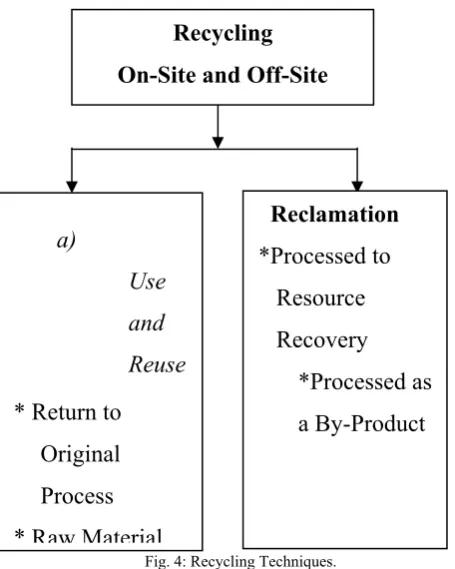
1) This is the use or reuse of a waste as a substitution for a commercial product or as a feedstock to an industrial process. These include on-site or off-site reclamation of useful fractions of a waste or removal of contamination from a waste to allow its reuse. There are different techniques of recycling.
2) a. Reuse: This is using item again after their initial consumer use in past either return to original process as re-manufacturing, examples as with coiper machines or automobile alternators and as material substitute for another process. Example, reuse of old wood furniture [12], [39].
3) b. Reclamation: This is recovery material from waste
products so that it can be used again either processed for resource or processed as a by-product. Example, reclaiming glass from old bottles [1], [40].
This recycling option has been set nationally, unfortunately, the definitions of recycling, rates of recycling and appropriate components of MSW vary. It has been found to be costly for most municipalities compared to landfill disposal. Recycling is a good option only if environmental impacts and the resources, used to collect, sort and recycle a material to provide equivalent virgin material plus the resources needed to dispose of the post consumer material safely. There are different Techniques of Recycling, Fig. 4.
Before recycling can occur, the materials must be collected from consumers, a reversal of the logistics system that distributed products to consumers. One of this method of reverse logistics system that is universal, cheap and reliable is curbside pickup system with it peculiar advantages, other method of reverse logistic system include consumer taking recyclable to a central collection point and returning them to the retailer as part of a deposit-refund system
.
Input
Material
Changes
*
Material
Purificati on
*Material Substitutio
Terrestrial
Run-off
Lakes
Source Reduction
Product Changes
*Product
Substitution
*Product
Conservation
*Changes in
Product
Composition
A.
Sour
ce
control
a)
T
e
c
h
n
o
l
o
g
y
C
h
a
Good
Operating
Practices
*Procedural Measures
2) *Lost Prevention
*Management Practices *Waste Stream
Segregation *Material
Handling Improvements *Production
414 Fig. 4: Recycling Techniques.
Practicing recycling option comes with these four primary goals.
1) Helps to save landfill space.
2) Save money from handling MSW. Government faces fiscal difficulties and constant criticism for being inefficient in providing public services especially in developing countries.
3) To increase environmental quality, by lowering discharges of pollutants. In particular, the goal is to eliminate discharge missions of hazardous and toxic materials to the environment, including greenhouse gases and toxic materials sent to MSW landfills.
4) Also to increase the sustainability of the economy. This implies minimizing the use of depletable resources such as ores or petroleum and reducing the use of renewable resources, such as lumber, to sustainable levels.
These reverse logistics can be ensured by or also deserve consideration as MSW recycling options. Deposit/refund schemes offer an important option, where by products earmarked for recycling would require a consumer (or producer) deposit, with a refund to the consumer when they are returned, example, each return of a nickel-cadmium battery would receive a refund sufficient to make it attractive to undertake the return. The aim of these deposit/refund schemes is that products and materials can be individually targeted for removal from the MSW stream.
Another way is product take-back by manufacturers, especially when remanufacturing and re-use is available [12], [41].
B. Integrated Waste Management
The integrated waste management, IWM is defined as “the selection and application of suitable techniques technologies and management programs to achieve specific wastes management objectives and goals” [42]. The IWM waste hierarchy is shown in Fig. 5. The strategy used to develop an
IWM system is to identify the level at which the highest values of individual and collective materials can be recovered. The list start with reduction-using less and reusing more, thereby saving material production, resource cost and energy, at the bottom of the list is the ultimate disposal, (the final resting place of waste) [25].
Recycling through collection, scavenging and processing with a high proportion of reuse is very efficient. In IWM, there is a need to create markets and market incentives to encourage scavenging, recycling and composting.
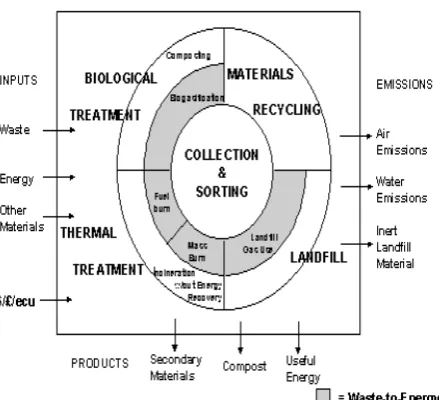
There is already high demand for scavenged materials [43], and since MSW in developing countries has such a large proportion of organic material, composting could be an effective option to reduce waste volume. Fig. 6 shows the all the options of MSW management mention above and it’s Input and Output materials.
Fig. 5: Hierarchy of integrated solid waste management.
Recycling
On-Site and Off-Site
a)
Use
and
Reuse
* Return to
Original
Process
* Raw Material
Reclamation
*Processed to
Resource
Recovery
415
vayf
Fig. 6: MSW management Options and it’s Input and output materials.
III. ENVIRONMENTAL IMPACTS OF POOR MANAGEMENT OF WASTE
The poor start of solid waste management in urban areas of Nigeria continues to pose an environmental problem and also a major social handicap [6]. Assessing the impacts of MSW involves consideration of a large number of components. The environmental impacts can be grouped into six categories. 1) Global warming
2) Photochemical Oxidant Creation 3) Acidification
4) Ecotoxicity of water 5) Eutrophication
6) Abiotic resource depletion [27], [44].
The emission of landfill gases (LGs) produced by the anaerobic and aerobic decomposition of organic matter is a major source of green house gases (GHG), which are responsible for global warming and ozone depletion. Ozone formation can cause decrease in crop yield and plant growth rate.
Methane and carbondioxide are green house gases that contribute to global warming. Methane is twenty times more effective at trapping heat than carbondioxide and more persistent in the environment [45].
A. Health And Social Impacts Of Msw
Dolks [46] reported that the health impacts of MSW include exposure to toxic chemical through air, water and soil media, exposure to infection and biological contaminants, stress related to odor, noise, “vermin and visual amenity” risk of tires explosions and subsidence, spills, accidents and transport emission. Leachate from the landfill can enter ground water systems, leading to increase in nutrient levels that cause eutrophication, [24], [47]. Also biaccumulation of toxins and heavy metal can occur. Landfills are associated with a plethora of health and social effect. Health and social impacts include odor nuisance, ozone formation (from reaction of NOx and non-methane organic compounds with sunlight) that can cause pulmonary and central nervous system from build-up of methane, an increase in the number
of Vermin (birds, rodents and insects) which act as disease vectors, and ground and air pollution from the Leachate and landfill gases [6], [24], [45], [48].
Water contamination by Leachate can transmit bacteria and disease, typhoid fever is a common problem for the people of developing nations, many of them cannot afford to dig wells deep enough to reach fresh aquifers. An accurate risk assessment on contaminated landfills should consider the risk of vertical heavy metals transfer both to the ground water and to the above ground vegetation [49].
Incineration impacts society by production of odors and in the unsightliness of the facility [50]. There is also the potential for surface water pollution from wastewater (used for quenching hot ashes before transport) [26]. Burning of polystyrene foam in incinerators might release harmful air pollution also ash from incineration is also major obstacle to the construction of waste-to-energy facilities, because small concentrations of heavy metals are present both in the air emission (fly ash) and residue (bottom ash) from the facilities [16], [17].
Many of the microorganisms found in compost are known respirator sensitizes that can cause a range of respiratory symptoms including allergic rhinitis, asthma, and chronic bronchitis, that come from composting [51].
Gladding [52] started that sorting facilities contain high concentrations of dust, bio-aerosols and metals, where workers commonly experience itching eyes, sore throats and respiratory diseases.
IV. RULES AND LEGISLATION
Industry should realize that the impact their product has on the environment does not start and end with the manufacture of the product. The impact a product has on the world starts with the design and ends at the ultimate disposal of the product after its useful life. The Society for Environmental Toxicity and Chemistry (SETAC) defined the period of the analysis that is Life Cycle Assessment (LCA) as an objective process to evaluate the environmental burden associated with a product, process or activity by identifying and quantifying energy and materials usage and environmental releases, to assess the impact of those energy and material uses and releases on the environment and to evaluate and implement opportunities to effect environmental improvements. The assessment includes the entire Life-Cycle of the product from “cradle to grave” encompassing:
1) raw material extraction and processing 2) manufacturing
3) transportation, distribution and trade 4) use, re-use, maintenance
5) recycling 6) final disposal
LCA address environmental impacts of system under study in the areas of ecological health, human health, and resource depletion [21], [41], [44], [53], [54].
416 Most of the Electrical and Electronics Equipment (EEE) imported in developing countries have under goes their End Of Life (EOL), before imported [3]. Due to backlogged demand for EEE in developing countries as well as the lack of national regulation and/ or lax enforcement of existing laws can also promote the growth of semiformal or informal WEEE recycling economies that are poorly controlled and involved extremely risky techniques. Often the participants in these sectors are not aware of the risks, do not know of better practices, or simply have no access to investment capital to finance profitable improvements [15].
According to United Nation Basel Convention 1989 [55], the convention puts the onus on exporting countries to ensure that hazardous waste are managed in an environmentally sound manner in the country of import [55]. If the waste items are proclaimed to be recycled by the EPA, the corresponding responsible enterprises are enforced to pay recycling-clearance-disposal fees to the Recycling Management Fund (RMF) of the EPA for recycling the waste items [22].
From this fact, the following rules are needed to implement in developing country Nigeria to ensure better management practices or sound recycling system:
1) Pollution Pay Principle (PPP),
2) Extended Producer Responsibility (EPR) and 3) Integrated Product Policy (IPP).
In PPP, producers and importers have only obligation for paying the recycling-clearance-disposal fees to the EPA, but do not assume any responsibility for recycling work.
Also in EPR, system requires producers to have full obligation for recycling the products they produce both within and outside the manufactured country.
While in the IPP, seek to improve the environment performance by looking at all phase of the products life cycle and taking action where it is most effective. All these strategies depend on the nature of product and waste.
The introduction of EPR with well-defined roles for all participants, producers, users, authorities and waste mangers is essential for designing an effective waste management system [3], [56], especially in developing country like Nigeria, where there is no recycling facilities by Environmental Protection Agencies of all States. This EPA ensure product take back by manufacturers, especially when remanufacturing and re-use is available [12] [41], it is then the responsibility of the manufacturers to pay in deposit/refund systems and in curbside collection of reverse logistic.
V. CONCLUSION
The informal MSW disposal habit must be prohibited by legislation. An introduction of EPR through curbside collection or deposit/refund schemes, that is consumers taking recyclable to a central point or returning them to the retailer as part of a deposit-refund system (reverse Logistics systems) with its peculiar advantages and draw backs, or implementing PPP rule, of which producers and importers have only obligation for paying the recycling-clearance-disposal fees to the EPA, it can recover the vast majority of the product, the energy and resources
requires could be large.
Finally, it is also necessary to arouse and enhance public awareness regarding environmental protection by publicity and education to guide consumer preferences to support products that are produced with and ultimately generate little hazardous or solid waste. While it is left for EPA to use integrated waste management patterns, which is selecting and applying of suitable techniques technologies and management programs to achieve specific wastes management objectives and goals.
ACKNOWLEDGEMENT
The authors acknowledge the help of the referees of this paper who identified key literature adopted for sound environmental recycling system. The editorial assistance of fellow course mates Mr. Chukwuma Royal and Mr. Chukwu Henry is very much appreciated
REFERENCES
[1] A. James, “Riegel’s Handbook of Industrial Chemistry.” S. K. Jain for CBS Publishers and Distributors, India, 1997, pp. 15-60.
[2] S. J. Cointreau, (1982). Environmental management of urban solid wastes in developing countries: a project guide. Urban Development Dept, World Bank [Online]. Available: http://www.worldbank.org/html/fpd/urban//solid-wm/techpaper5.pdf. [3] I. N. Onwughara, I. C. Nnorom, O. C. Kanno, and R. C. Chukwuma,
2010. “Disposal methods and heavy metals released from certain electrical and electronic equipment wastes in Nigeria: Adoption of environmental sound recycling system (Accepted for publication),” International Journal of Environmental Science and Development, 1 (4), to be published.
[4] A. A. Adedibu, “Comparative analysis of solid waste composition and generating in two cities of developing nation.” The Environmentalist, 1985, 5 (2). pp. 123-127.
[5] Department of Environmental Quality Promotion. “Building Awareness in Community.” Paper presented on the People Participation in Environmental Management, Environmental Center Research and Training, Ministry of Science Technology and Environment, 2002.
[6] [6] E. Daskalopoulos, O. Badr, and S. D. I. Probert, “An integrated approach to municipal solid waste management.” Resources, Conservation and Recycling, 1998, 24 (1), 33-50.
[7] P. L. Doan, “Institutionalizing household waste collection: the urban environmental management project in Cote d’Ivoire.” Habitat International, 1998, 22 (1), 27-39.
[8] United Nations Environment Program, UNEP 2002. “International Source Book on Environmentally and Technologies for Municipal Solid Waste Management.” International Environmental Technology Centre (IETC), Technical Publication Series, Issue 6.
[9] T. Matsuto, C. H. Jung, and N. Tanaka, “Material and heavy metal balance in a recycling facility for home electrical appliances.” Journal of Waste management, vol. 24, 2004, pp. 425-426.
[10] Abia State Environmental Protection Agency ASEPA 2007. Annual reports of Waste Generation in Umuahia 2007.
[11] F. O. Abulude, G. O. Obidiran, and S. Orungbemi, “Determination of Physico-chemical parameter and Trace metal contents of drink water sample in Akure Nigeria.” Electronic Journal of Environmental, Agricultural and Food Chemistry, 2007, 6 (8). pp. 2298-2299. [12] L. B. Lave, T. H. Chris, M. C. Noellette, and C. M. Fracis, “Municipal
solid waste recycling issues.” Technical report, green design Initiative, Carnegie Mellon, 1999.
[13] M. Huysman, “Waste picking as a survival strategy for Women in India Cities.” Environment and Urbanization, 1994, 6(2), 155-174. [14] D. K. Curtis, O. A. Mary, and D. John, “Casarett Doull’s Toxicology:
The Basic sciences of poisons.” Macmillan Publishing Company, New York, 1980, pp. 582-583.
417 [16] I. C. Nnorom, J. C. Igwe, and C. G. Oji-nnorom, “Trace metal contents
of facial (make-up) cosmetics commonly used in Nigeria.” African Journal of Biotechnology, 2005, 4 (10), 1131-1133.
[17] I. C. Nnorom, O. Osibanjo, K. Okechukwu, O. Nkwachukwu, and R. C. Chukwuma, “Evaluation of heavy metal release from the Disposal of waste computer monitors at an Open Dump.” International Journal of Environmental Science and Development, 2010, 1 (3), 227-233. [18] E. M. Stephen, J. Young-Chul, G. T. Timothy, and C. Il-Hyun,
“Characterization of lead leachability from cathode ray tubes using the toxic characteristic leaching procedure.” Environmental Science Technology, vol. 34, 2000, pp. 4376-4378.
[19] J. O. Chi, and O. L. Sung, “Selective leaching of valuable metals from waste printed circuit boards.” Journal of the Air and water management Association, vol. 53, 2003, pp. 897-898.
[20] A. B. Culaba, and M. R. I. Purvis, “A methodology for the life cycle and sustainability analysis of manufacturing process.” Journal of Cleaner Production, vol. 7, 1999, pp. 436-441.
[21] H. L. Anne, and K. Vijia, “Life cycle assessment of rock crusher.” Resources, Conservation and Recycling, vol. 28, 2000, pp. 209-211. [22] E. Hsu, and C. –M. Kuo, “Recycling rates of waste home appliances in
Taiwan.” Journal of waste management, vol. 25, 2005, pp. 53-57. [23] United States Congress, Office of Technology Assessment, OTA 1986
“Serious Reduction of Hazardous Waste”, OTA-ITE-317, GPO Washington DC September 1986.
[24] E. Mutasem, N. F. Angelos, and O. L. James, “Environmental impacts of solid waste landfilling.” Journal of Environmental Management, 1997, 50 (1), 1-25.
[25] Fact sheet CDFS-106-05. “Integrated Solid Waste Management.”
[26] United States Environmental Protection Agency, EPA1995a. Municipal and Industrial Waste Division. “Decision-Makers Guide to Solid Waste Management.” Vol. II: ch8. Available: http://www.epa.gov/epaoswer/non-hw/muncpl/dmg2/chapter8.pdf. [27] S. Seongwon et al 2004. “Environmental impact of solid waste
treatment methods in Korea.” Journal of Environmental Engineering, 2004, 130 (1), 81-88.
[28] S. Dugenet, M. Olle, A. Ribes, and M. F. Grenier-Loustalot, 1998. “Chemical characterization of municipal solid waste incineration residue: Dissolution of elements with a microwave-dilute acids digestion technique compared to conventional methods.” Journal of analysis EDP sciences, wiley-VCH vol. 26, 1998, pp. 256-257. [29] L. Wibberley, J. Nunn, A. Cottrell, M. Searles, A. Urfer, and P. Seaife,
“LCA of steel and Electricity production.” Australian Coal Association Research Program, Brisbane, Australia.
[30] D. S. Airan, and J. H. Bell, “Resource recovery through composting- a slleping giant.” In Proc. Waste Process. Conference., Washington, Dc. 11-14th May 1980. Am. Soc. Mech. Eng., New York, NY. 1980, pp. 121-129.
[31] R. P. Poincelot, “A scientific examination of the principles and practice of composting.” Journal of Composting Science, vol. 15, 1974, pp. 24-31.
[32] U. Sonesson, A. Bjorklund, M. Carlsson, M. Dalemo, “Environmental
and economic analysis of management systems for biodegradable waste.” Resources, Conservation and Recycling, 2000, 28(1/2), 29-46. [33] T. C. Daniel, A. N. Sharpley, D. R. Edwards, R. Wedepohl, and J. L. Leminyon, “Minimizing surface water eutrophication from agriculture by phosphorus management.” Soil Water Conservation, vol. 49, 1994, pp. 30-38.
[34] L. Wu, L. Q. Ma, and G. A. Martinez, “Comparison of methods for evaluating stability and maturity of biosolids compost.” Journal Environmental Quality, vol. 29, 2000, pp. 424-429.
[35] T. A. Butler, L. J. Sikora, P. M. Steinhilber, and L. W. Douglass, “Compost age and sample storage effects in maturity indicators of biosolids compost.” Journal Environmental Quality, vol. 30, 2001, pp. 2141-2148.
[36] M. A. Sanchez-Monedero, A. Roig, J. Cegarra, and M. P. Bernal, “Relationship between water soluble carbohydrate and phenol fractions and the humification indices of different organic wastes during composting.” Bioresources Technology, vol. 72, 1999, pp. 33-41.
[37] L. Wu, and L. Q. Ma, “Relationship between compost stability and extractable organic carbon.” Journal Environmental Quality, vol. 31, 2002, pp. 1323-1328.
[38] M. T. Dell’Abate, S. Canali, A. Trincera, A. Benedetti, and P. Sequi, “Thermal analysis in the evaluation of compost stability. A comparison with humification parameters.” Nutr. Cycling Agro-ecosyst, vol. 51, 1998, pp. 217-224.
[39] A. Fernanda, B. Luisa, C. Anna, and L. Isabella, “Cathode ray tube glass recycling: an example of clean technology.” Journal of Waste Management and Research, vol. 23, 2005, pp.1-6.
[40] L. J. P. John, (1999, November 15) “Reclaiming End-of-Life cathode ray tubes (CRTs), and Electronics: A Florida Update.” Hazardous Materials Management Conference Tucson, Arizona.
[41] B. Rene Van, (2000, 29 October to 1 November) Life cycle assessment for environmental improvement of minerals’ production. Environment Workshop-Mineral Council of Australia, pp.1-6.
[42] T. Arowolo, and M. K. C. Sridhar, “Options in urban waste conversion: Organo-mineral fertilizers to integrated waste management: The Experience so far.” A paper presented at one day technical session organized by Ogun State Ministry of Environment, Nigeria, February 3, 2005.
[43] M. E. Kasseva, and S. E. Mbuligue, “Ramifications of solid waste disposal site relocation in urban areas of developing countries: a case study in Tanzania.” Resources, Conservation and Recycling, 2000, 28(1/2), 147-161.
[44] A. Zabaniotou, and E. Kassidi, “Life cycle assessment applied to egg packaging made from polystyrene and recycled paper.” Journal of Cleaner production, vol. 11, 2003, pp. 594-597.
[45] United States Environmental Protection Agency, EPA1995b. Emission Standards Division. “Air emissions from municipal solid waste landfills-Background information for final standards and guidelines.” p15, Available: http://www.epa.gov/ttn/atw/landfill/ bidfl.pdf. [46] H. Dolk, “Methodological Issues Related to Epidemiological
Assessment of Health Risks of Waste Management.” Environmental and Health Impact of Solid Waste Management Activities, 2002, pp.195-209.
[47] M. Vidal, J. P. Lopez-Sanchez, J. Sastre, G. Jimenez, G., Dagnac, T. “Prediction of the impact of the Aznalcollar toxic spill on the trace element contamination of agricultural soils.” Journal of the Science of the Total Environment, Vol. 242, 1999, pp. 132-135.
[48] H. A. Neal, and J. R. Schubel, “Solid Waste Management and the Environment.” New Jersey: Prentice-Hall, Inc. 1987.
[49] E. Remon, J. –B. Bouchardon, B. Cornier, B. Guy, J. –C. Leclerc, and O. Faure, “Soil characteristics, heavy metal availability and vegetation recovery at a former metallurgical landfill: implications in risk assessment and site restoration.” Journal of Environmental pollution, vol. 137, 2005, pp. 316-320.
[50] G. Garrod, and W. Ken, “Estimating lost amenity due to landfill waste disposal.” Resources, Conservation and Recycling, vol. 22, 1998, pp. 83-95.
[51] J. R. Swan, et al “Microbial Emissions from Composting Sites.” Environmental and Health Impact of Solid Waste Management, 2002, pp. 75-86.
[52] T. Gladding, “Health Risks of Materials Recycling Facilities.” Environmental and Health Impact of Solid Waste Management Activities, 2002, pp. 53-72.
[53] K. Junichi, “Life cycle assessment, evaluation method for sustainable development." Elsevier Science, vol. 20, 1999, pp. 387-388.
[54] S. Erwan, and V. Gert, “A data base for the life cycle assessment of Procter and Gamble laundry detergents.” International Journal of Life Cycle Analysis, vol. 6 2001, pp. 1-5.
[55] Secretariat of the Basel convention, 1999. Code of practice for the Environmentally sound management of Asbestos containing materials in the cribbean. Secretariat of the Basel convention, Geneva, SBC No.99: Asbestos: 001.
[56] L. Xianbing, T. Masaru, and M. Yasuhiro, “Electrical and electronic waste management in China: Progress and the barriers to over come.” Journal of waste Management and Research, vol. 24, 2006, pp. 92-100.
TABLEIII:MSW MATERIALS CATEGORIZATION BY TYPE, COMPOSITION AND SOURCE
S/n Type Composition Source
1. Garbage (food Wastes)
Waste from preparation, cooking and serving of food, market waste, waste from handling storage and sale of products
Households, restaurants, grocery stores, market.
418
wood furniture, bedding plastic. industry.
3. Yard wastes Leaves, garden debris, trimming, pruning. Residences, public gathering.
4. Street Sweeping Sweeping, dirt, leaves, catch basin dirt, content of litters receptacles. Municipalities.
5. Ashes Residues from fires used for cooking and heating and from onsite incinerator. Households, incinerator, industry.
6. Industrial wastes
Food processing wastes, boiler house cinders, lumber scraps, metal scraps shavings.
Factories power plant.
7. Abandoned Vehicles Unwanted cars and trucks left as public property Roadside, express ways
8. Dead animal and Man Cats, dogs, horse, cows humans Street, sidewalks alleys, vacant lots.
9. Demolition wastes
Lumber pipes, brick, and tier construction materials from razed buildings and other structures.
Demolition site to be used for new buildings, renewal projects, expressways.
10. Hazardous Toxic, pathogenic, highly flammable, explosive, radioactive materials. Households, hotels, hospitals, institution stores, industry.
![Fig. 1: Routes for transport of trace elements in the environment (Source: Curtis et al., 1980) [14]](https://thumb-us.123doks.com/thumbv2/123dok_us/1394516.1650985/2.595.60.276.421.627/fig-routes-transport-trace-elements-environment-source-curtis.webp)
![Fig. 3: Source Reduction Techniques (Sources: James, 1997) [1].](https://thumb-us.123doks.com/thumbv2/123dok_us/1394516.1650985/5.595.178.431.48.487/fig-source-reduction-techniques-sources-james.webp)