QoS-Aware Bandwidth Estimation Scheme for Delay Based
Analysis in Mobile Ad-Hoc Networks
1
Mukesh Kalla,
2Avinash Panwar,
3Prasun Chakrabarti,
4Jinesh K.Singh
1,2,3,4Dept. of CSE, Sir Padampat Singhania University, Udaipur, Rajasthan, India
Abstract
Most of the routing protocols focus on obtaining a workable route without considering network traffic condition for a mobile ad-hoc network (MANETs). Therefore, the quality of service (QoS) is not easily achieved by the real time or multimedia applications. Providing quality-of-service (QoS) in wireless ad-hoc networks is an intrinsically complex task due to node mobility, distributed channel access, and fading radio signal effects. To find a QoS constrained route from source to destination, it should be able to effectively determine the available resources throughout the route. The routing protocol is the most integral part of any type of QoS provisioning. In this paper, modification has been proposed in the existing MANET protocols to get the information about total path bandwidth for delay analysis. It uses modified technique for bandwidth estimation and for route maintenance. Resultof simulationshows that there is much improvement in Packet delivery ratio, overheads, delaysignificantly reduced and without any impact on overall end-to-end throughput.
Keywords
Mobile Ad-hoc Networks, Bandwidth Estimation, AODV, Quality of Service (QoS)
I. Introduction
Mobile Ad-Hoc Networks (MANETs) is a group of two or more devices or nodes or terminals with wireless communications and networking competence that communicate with each other without the help of any centralized administrator. It is an independent system in which mobile hosts are connected without wire and are free to move dynamically.
In MANETs, the wireless mobile nodes may dynamically enter in the network as well as leave the network. Because of the limited transmission range of wireless network nodes, multiple hops are generally required for a node to exchange information with any other node in the network. Multipath routing permits the formation of multiple paths between one source node and one destination node. Many routing protocols [1-5] have been proposed to provide quality of service provisioning. Broadly these protocols can be classified as: proactive routing protocols and reactive routing protocols. In proactive routing protocols, routing information is periodically exchanged between network nodes. While in reactive protocols, the routing information is obtained only on demand. The basic reactive protocols such as Ad-hoc On Demand Distance Vector (AODV) [6] and Dynamic Source Routing (DSR) [7], flooding is used as the basic mechanism to propagate control packets. These control packets generates a large number of redundant packets that consumes network resources inefficiently. Due to this, more contention and overheads are there in the network.
Quality of Service (QoS) is a set of service requirements that needs to be met by the network while transporting a packet stream from a source to its destination. The network needs are governed by the service requirements of end user applications in terms of end-to-end performance, such as delay, bandwidth, probability
of packet loss, etc.
If QoS parameters are not taken into consideration for route selection, so a minimum hop path cannot be QoS constrained path. Determination of link capacity and available bandwidth and path delay is must for the success of real time delay analysis. If route selection criterion is least path delay with minimum required bandwidth instead of simple minimum hop count, then it will be able to maintain the required QoS constraints throughout the session. In IEEE 802.11, each node contends with its neighbor nodes and also the neighbors of its neighbors in the medium contention procedure [8]. Since the range of possible medium contention of a mobile node is wide, medium contention times can affect the end-to-end delay considerably.
This paper proposes a QoS Ad-hoc on demand Distance Vector protocol for provision of minimum end-to-end delay guarantee with required throughput in mobile ad- hoc networks. The proposed protocol is developed by modifying AODV [6], in which routing table is used to forward packets, “Hello” messages are used to detect broken route. The protocol modifies and extends AODV [6] to discover a route with least traffic and maintain the minimum required bandwidth. This algorithm selects routes with least traffic and follows alternate route method for route maintenance.
II. Related Work
idle time for channel and calculated the available bandwidth as a ratio of idle time to total time multiplied by the channel capacity. A. Abdrabouet al. [10] proposed a MAC layer based estimation method. It is based on the bandwidth of a link in discrete time intervals by averaging the throughputs of the recent packets in the past time window and use it to estimate the bandwidth in the current time window. Obviously, this estimation may not be accurate because the channel condition may have changed.Greedy [11] Perimeter State-less Routing (GPSR) is used to discover a route to the destination of a new flow. This is a location based protocol which is characterized by their scalability and efficient bandwidth utilization as they do not flood the network to find the destination. S.S. et al. [12] proposed a new approach based on Multipath Routing Backbone (MRB) for supporting enhanced QoS in MANETS. It improves throughput and minimizes overall end-to-end delay. This protocol is designed for highly dynamic ad- hoc networks where link failures and route breaks occur frequently. This protocol finds multiple disjoint paths from source to destination where each path satisfies the conditions for QoS. Greedy [13] based Backup Routing Protocol considers both route length and link lifetime to achieve high route stability. Primary route for forwarding data packets is formed primarily based on greedy forwarding mechanism, whereas local backup path is established according to link lifetime. Jiazi Li.et al.[14] proposed a Multipath Optimized Link State Routing (MP-OLSR) which is a multipath routing protocol. This protocol gives great flexibility by employing different route metrics and cost functions. A modified route recovery and loop detection mechanisms are also implemented in MP-OLSR in order to improve QoS. Sharma et al. [15] proposed average end-to-end delay and maximum achievable pernode throughput for in-vehicle Ad hoc multimedia network with stationary and mobile nodes. The relative traffic load, number of slots assigned to each link, and the schedule frame length are used to compute expected end-to-end delay.LinFang et al. [16] used Markov chain model to analyze the channel access delay of IEEE 802.11 DCF multi-hop Ad- hoc networks.The model has also been extended from analyzing the single-hop average packet delay to evaluating the end-to-end packet delay in multi-hop Ad-hoc networks under different traffic loads.
III. Methodology
QoS is an agreement to provide guaranteed services, such as bandwidth, delay, delay jitter, and packet delivery rate to users. Supporting more than one QoS constraint makes the QoS routing problem NP-complete. In this paper bandwidth constrained routing has considered for delay analysis which supporting real time applications and live video or audio transmission. A QoS constrained routing proposed that has been provides feedback about the available bandwidth throughout the route considering overall end-to-end delay for transmission.
A. Available Bandwidth Estimation
For bandwidth constrained QoS routing, the available end-to-end bandwidth throughout the route must be known from source to destination. The available end-to- end available bandwidth can be calculated by minimum residual bandwidth among the intermediate hosts throughout the route. Since the available bandwidth among the links is shared between neighboring hosts, it is difficult for individual host to calculate residual bandwidth as it has no knowledge about other neighboring hosts. Among the several proposed methods to estimate the available bandwidth, the most common is to estimate the network utilization and subtract it
from the maximum link capacity. Different methods for estimating network utilization like802.11 MAC also utilizes some bandwidth in DIFS(Distributed Co-ordination Function Inter Frame Space), SIFS (Short Inter Frame Space ) and back off scheme as overheads, these must be taken into consideration in calculation of available bandwidth. These overheads restrict the MAC scheme to fully utilize the available bandwidth for data transmission.
To estimate the available bandwidth, host can listen to the channel to track the network utilization and nearly estimate the available bandwidth per second. For this, 802.11 MAC can be used to determine free and busy times using a physical carrier sense and a virtual carrier sense through network allocation vector (NAV). MAC layer detects that the channel is free when network allocation vector is less than the current time or receive state is idle or send state is idle. It also detects that the channel is busy when network allocation vector sets a new value or receive state changes from idle to any other stage or send stage changes from idle to some other state.
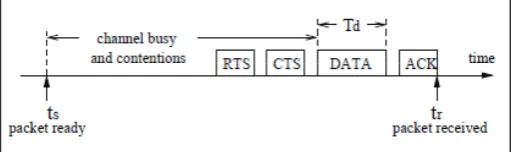
Fig. 1 shows the stages in the transmission of a single packet using the IEEE 802.11 DCF(Distributed coordination function) MAC protocol.
Fig. 1: IEEE 802.11 Packet Transmission
Throughput can be measure by transmitting a packet
as-Where,
TP is Throughput, S is size of the packet, tr is the time the ACK received and ts is the time the packer is ready for transmission. The time interval tr-ts includes the channel busy and contention time. Separate throughput estimates should be kept to different neighbors because the channel conditions may be very different to eachone [17]. This link layer measurement mechanism captures the effect of contention time on available bandwidth. If contention is high, tr-ts will increase and the throughput TP will decrease. This mechanism also captures the effect of fading and interference errors because if these errors affect the RTS or DATA packets, they have to be retransmitted. This increases tr-ts and correspondingly decreases available bandwidth.
B. Node Delay Analysis
For selection of route, the QoS constrained algorithm considers only those paths which satisfies bandwidth requirement with total overall end-to-end delay equal to or less than the specified in the Route Request (RREQ). For calculating overall path delay, proposed algorithm estimates the path delay at each node. To provide QoS guarantee in bandwidth and delay, RREQ and Route Reply (RREP) packet format and routing table is modified to meet the service requirements. Since node traversal time at any node is very small, major part of the delay is contributed by packet queuing and contention delay at the 802.11 MAC.
The overall end-to-end delay of a path, consist of node delay at each node and link delay between nodes. Di
delay denote the overall
is the delay encountered in Attempt State and DB(i)is the delay encountered in Back-off State. Neglecting the propagation delay as it is negligible, the forwarding delay [17] which is used to calculate the accumulated delay throughout the route formation can be calculated as.
Where
Avg_bt is a random backoff time interval before transmission. DA(i)is expected delay encountered in the Attempt state and given by
And
DB(i)is expected delay encountered in the Backoff state and is given by
Here
Denote the probability of source successes in sensing channel idle for time interval “t”. is the probability of the state transition from Packet arrival to Attempt state and “
” is the probability of the state transition from Packet arrival to Back-off state. In fig. 2 which shows that simplified state transition diagram of source that tries to transmit packet.
Fig. 2: State Transition of Mobile Node
Initially, the source is in idle state. When any packet arrives at Station (STA)from any neighbor or generated by itself, this node will enter into Packet arrival sate. In this state, source senses medium busy in SIFS period. It recognizes that the channel is busy and will enter into the Back-off state. Otherwise if the channel remains idle for DIFS period, it will enter into attempt state and delay a random back-off time interval before transmitting the packet.
C. Route Discovery
Proposed QoS aware routing protocol utilizes cross layer design. This supports two kinds of QoS constraints. One, when the
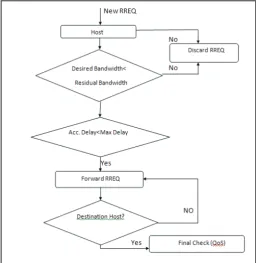
application indicates in RREQ header about the minimum required bandwidth that must be guaranteed. Other, when the application indicates in RREQ header for maximum permissible end-to-end delay. To provide quality of service constrained routing in terms of available bandwidth and overall end-to-end delay, extensions are added to RREQ, RREP and Route Error (RERR) messages. Some modifications also have been made in routing table structure of AODV protocol. Any node which receives the RREQ with QoS guarantee must agree to fulfill the service requirement as desired by the application. To initiate the route discovery process, the source host sends a RREQ packet whose header is changed to (bandwidth request, maxdelay, Accumulated delay, AODV RREQ header). The bandwidth request indicates that RREQ packet will be forwarded only if residual bandwidth on that link is greater than the minbandwidth request. Max delay in the RREQ message is the maximum permissible overall end-to-end delay. Accumulated delay is the time which provides information about the time that has been experienced by nodes along the path from the source node to the node currently processing the RREQ. Before forwarding the RREQ packet, intermediate node must ensure that accumulated delay is less than maximum permissible overall end-to-end delay, otherwise discard the route RREQ will be discarded. The whole procedure is shown in the Figure 3for the proposed route discovery method.
When any host gets a new RREQ, it will compare the available bandwidth with the desired bandwidth specified in RREQ header. If available bandwidth is less than desired one, host will discard the RREQ, otherwise it will compare accumulated delay with maximum permissible delay.
Fig. 3: Host Working Procedure
the route discovery procedure. Therefore final check is essential before sending the RREP to the source host.
Finally the destination host sends a RREP with modified header (min bandwidth, accumulated delay, AODV RREP header) to the source host. Once intermediate host receives the RREP, they enable the route and record the minimum bandwidth and accumulated delay in the routing table which is useful for route maintenance.
D. Route Maintenance
AODV detects a broken route by monitoring the “Hello” messages. If a node does not receive a “Hello” message from a specific neighbor within a predefined interval, it marks the routes using that neighbor host invalid and sends a corresponding error message RERR to the upstream hosts. Only the source host reinitiates the route discovery once receiving the error message. Thus cache memory of the host is not utilized to respond to route break. AODV cannot be implemented in QoS awarerouting scheme as bandwidth is not released at the same time whenever there is a route break. It is not possible to calculate the new route without exactly knowing how much bandwidth is consumed by each host in the route. Asimple scenario has been used in Figure4to illustrate what will happen if AODV’s route maintenance scheme used without any modification.
The topology is a single chain and is composed of five hosts N1, N2, N3, N4, and N5. Every host is in its neighbor’s transmission range and its second neighbor’s interference range. The source host sends packets with a 1.0 Mb/s feeding rate. The first table shows the host’s first neighbors and the linked tables show the host’s second neighbors. If the link between N3 and N4 is broken, an “Error” message is initiated in N3 and N1 receives it through N2’s propagation. Once N1 gets the error message, it sends a new RREQ. The time interval between claiming a broken route and initiating a route discovery is only several milliseconds. Therefore, the host neighbors’ caches have not yet updated their bandwidth consumption when the new RREQ arrives. In fact, all bandwidth is offered to this single chain transmission and the available end-to-end bandwidth is actually 1.0 Mb/s. This problem is caused by the fact that the neighbor cache was not updated in a timely fashion. Therefore, it should incorporate a forced cache update in the route maintenance scheme. The QoS-aware routing with “Forced Bandwidth Information” uses the first neighbors relay to get the second neighbors information. Therefore, once the neighbors get the forced updates, they should disseminate the update information immediately to their neighbors. “Forced release BW” message have been used to address this concern. This special message’s content is exactly the same as the “Hello” message, except the packet type is marked as “Forced release BW” in order to differentiate with the regular “Hello” message. When a host receives “Forced release BW” message, it sends its regular “Hello” message immediately. The “Error” message is also adopted to trigger an update of bandwidth consumption registers and the dissemination of “Forced release BW” messages. Once a host receives an “Error” message, it will deduct the amount of bandwidth that the broken route consumes from its bandwidth consumption register to reflect the bandwidth allocation changes. The proposed protocol uses “Forced release BW” because the bandwidth should be released instantly among all the neighboring hosts whenever a route break is there.
Fig. 4: Route maintenance Failure
IV. Simulation and Results
To test the performance of our QoS-aware routing protocol, simulations are implemented using NS-2. The IEEE 802.11 MAC protocol has been used in RTS/CTS/Data/ ACK mode with a channel data rate of 2 Mb/s. Each host is equipped with a radio transceiver whose transmission range is up to 250 meters over a wireless channel. It is used two ray ground model to predict the signal power received by the user. The packet size used in our simulations is 1200 bytes. The topologies vary according to the different simulation purposes. In the simulations, CBR data traffic flows are injected into the network from the servers and size of the data payload is 512 bytes. To test the performance of our proposed protocol, 50 mobile nodes are placed randomly in 1000 m × 1000 m area. Simulation run time is 50 sec. The average simulation results with node velocity 15m/sec are shown.
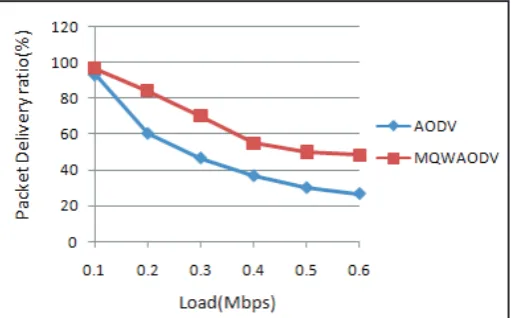
Fig. 5: Average Delivery Ratio
Fig. 5 shows that there is much improvement in delivery ratio of packets in MQWAODV as compared to conventional AODV.
Fig. 6: Average Overheads
Fig. 7: Average Throughput
Fig. 7shows that end to end throughput using MQWAODV has almost no negative impact despite of the fact that number of overheads is largely reduced.
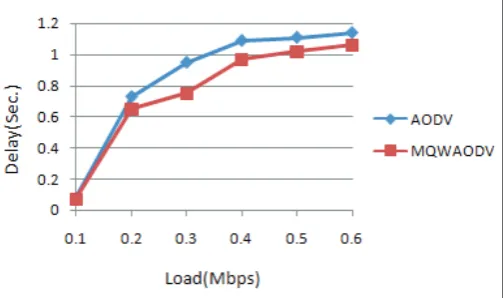
Fig. 8: Average End to End Delay
Fig. 8 shows that significantly reduced end to end delay in MQWAODV as compared to conventional AODV.
Simulations results show that normalized overheads are much less in MQWAODV as compared to conventional AODV with the new proposed protocol without much impact on overall end-to-end throughput.In our new proposed protocol, the routes less loaded and therefore less packets are dropped due to less congestion. As the results shows clearly that overheads are largely reduced in MQWAODV which improves scalability. Delivery ratio is much significantly improved and end to end delay reduced in MQWAODV as compared to AODV.
V. Conclusions and Future Work
In this paper, On demand QoS routing protocol (MQWAODV) for bandwidth constrained delay analysis in MANETs has been proposed to overcome some shortcomings of AODV protocol. It is an efficient method where networks are not very stable since it can better estimate the residual bandwidth in case of frequent route breaks. Proposed protocol discovers routes based on bandwidth constrained path delay in addition to hop count instead of hop count only. Route maintenance is more efficient than the existing standards as consumed bandwidth is updated immediately. Proposedprotocol has not been considered any predictive way to foresee a route break, which degrades the performance in mobile topologies. Therefore, some methods such as preemptive maintenance routing and route maintenance based on signal strength might help to reduce the transient time when the required QoS is not guaranteed due to a route break or network partition.
References
[1] Y. Yang, R. Kravets,“Contention-Aware Admission Control for Ad Hoc Networks,” IEEE Transactions on Mobile Computing, Vol. 4, No. 4, 2005, pp. 363-377.
[2] I. D. Chakeres, E. M. Belding-Royer,“PAC: Percep-tive Admission Control for Mobile Wireless Networks,” 1st International Conference on Quality of Service in Heterogeneous Wired/Wireless Networks, Dallas, 18-20 August 2004, pp. 18-26.
[3] L. Chen, W. Heinzelman,“QoS-Aware Routing Based on bandwidth Estimation for Mobile Ad-Hoc Networks,” IEEE Journal on Selected Areas in Communications, Vol. 23, No. 3, 2005, pp. 561-572.
[4] F. Filali,“Wimeter: A Novel Technique for Available Bandwidth Estimation in WLANs and Its Assistance in QoS Provisioning,” Eurecom Research Report, June 2006. [5] M. Liu, Z. Li, J. Shi, E. Dutkiewicz, R. Raad,“An On-Demand
QoS Routing Protocol for Mobile Ad Hoc Networks,” Springer-Verlag, Berlin, 2004, pp. 207-218.
[6] C. E. Perkins, E. M. Belding-Royer,“Ad-Hoc on De-mand Distance Vector (AODV) Routing,” Internet Draft, 19 October 2003. draft-perkins-manet-aodvbis-00.txt
[7] D. B. Johnson, D. A. Maltz,“Dynamic Source Rout-ing in Ad Hoc Wireless Networks,” Mobile Computing, 1996, pp. 1806-1830.
[8] I. Chlamtac, M. Conti, J. J. N. Liu,“Mobile Ad Hoc Networking: Imperatives and Challenges,” Ad-Hoc Net-works, Vol. 1, No. 1, 2003, pp. 13-64.
[9] V. D. Hang, Z. Shao, M. Fujise,“Efficient Load bal-ancing in MANETs to Improve Network Performance,” International Conference on ITS Telecommunications Proceedings, Chengdu, June 2006, pp. 753-756.
[10] A. Abdrabou, W. Zhuang,“A Position-Based QoS Routing Scheme for UWB Mobile Ad Hoc Networks,” IEEE Journal on Selected Areas in Communications, Vol. 24, No. 4, 2006, pp. 850-856.
[11] F. Qi, J. Zheng, W. J. Jia, G. J. Wang,“Available Bandwidth Measurement Schemes over Networks”, Net-working and Mobile Computing, Vol. 3619, 2005, pp. 931-940.
[12] S.Soundararajan, R. S. Bhuvaneswaran,“Multipath Routing Backbone for Improving QoS in Mobile Ad-hoc Networks,” European Journal of Scientific Research, Vol. 53, No. 2, 2011, pp. 222-230.
[13] W. J. Yang, X. Y. Yang, S. S. Yang, D. X. Yang,“A greedy-based stable multi-path routing protocol in mobile Ad-hoc networks,” Ad-Hoc Networks, Vol. 9, No. 4, 2011, 662-674.
[14] J.Z.Yi, A.Adnane, S. David, B. Parrein,“Multipath Optimized Link State Routing for Mobile Ad hoc Net-works,” Ad Hoc Networks, Vol. 9, No. 1, 2011, pp. 28-47.
[15] Sharma et al.,“Modeling and Analysis of End-To-End Delay for Ad hoc Pervasive Multimedia Network,” Proceedings of the International MultiConference of Engineers and Computer Scientists 2010, Vol. 1, IMECS 2010, March 17-19, 2010, Hong Kong.
[16] Dong Lin Fang et al.,“Packet delay analysis on IEEE 802.11 DCF under finite load traffic in multi-hop Ad-hoc Networks,”Science in China Series F:Information Sciences, April 2008, Vol. 51, No. 4, pp. 408-416.