K. Turewicz (ed.). Cognitive linguistics – a user friendly approach.
University of Szczecin Publishing House, 2005 (forthcoming)
COMPLEX SENTENCE AS A STRUCTURE FOR REPRESENTING KNOWLEDGE
© Alexander V. Kravchenko and Julia B. Zelberg Baikal National University of Economics and Law
Abstract
Structural variations involving both morphological and syntactic features of the
com-plex sentence of the type “When S, S” and their relevance for the interpretation of sentence
meaning are analyzed. It is hypothesized that the constraints on certain sequences
intui-tively felt by native speakers are due to semantic contradictions that arise between the
in-dexical content of the verbal tense and aspect and the syntactic structure of the sentence
which iconically reflects the cognitive processing of perceptual data. The cognitive value of
different syntactically acceptable sequences is assessed from the point of view of the
1. INTRODUCTION
The problem of discourse interpretation, despite a long history of studies and a variety of related theories, is still looming large and defiant on the linguistic horizon. Although the basic constituent of discourse, the sentence/utterance, seems to have been exhaustively analyzed and described within different theoretical frameworks such as generative gram-mar (Chomsky 1965), functional gramgram-mar (Halliday, 1985; Dik, 1989; Givón, 1993), typology (Greenberg, 1978; Hawkins, 1983; Givón, 1990), semantics (Ullmann, 1962;
Lyons, 1977), pragmatics (Verschueren, 1999), etc., there does not seem to be a univer-sal understanding of how sentential grammar works in discourse.
As a sign system, natural language operates on two levels of knowledge represen-tation: the level of text (discourse), and the level of linguistic units that add up to pro-duce a text. The resulting informative value of a text largely depends on the informative value of its constituents. The traditional approach to language grammar attempts to pro-vide an explicit set of features of meaning allegedly associated with a given form. In contemporary linguistic science these features are viewed as an assembly of concepts we have about the world, which are acquired via natural language and with the help of lan-guage. The outcome of this acquisition process is the sum total of our linguistic ences; thus, grammar is viewed as a system of categorized patterned cognitive experi-ence (Bod, 1998).
With this in view, the principal objective of a grammatical theory (that is, morphol-ogy and syntax) should be the explication of the relationship between linguistic structures and cognitive concepts behind them (cf. Taylor & MacLaury, 1995; Shibatani & Thomp-son, 1996; Heine, 1997; Kravchenko, 2001). In other words, grammar is called upon to provide a means for encoding cognitive experience via conceptualization and categoriza-tion (cf. Svorou, 1994; Kravchenko, 2002a).
On the level of syntactic structure such encoding is associated with iconicity (cf. Haiman, 1985; Givón, 1995), when the syntactic properties of the sentence are analyzed
perceptually, with perceptually salient elements becoming figures as opposed to ground (Tomlin, 1987). A trivial example would be the particular order of adjectives used in strings of attributes preceding a noun in a noun phrase, as in (1):
(1) (a) Suddenly I was approached by a tall young man (b) ?? Suddenly I was approached by a young tall man
This perceptual salience may be called salience of the first order.
On the other hand, the linear structure of the sentence may depend on salience of the second order, when the speaker assigns to a thing or property a degree of
signifi-cance determined by the speaker’s relative system of values rather than by perceptual salience, as in (2):
(2) “What’s your new neighbor like?”
“Well, John Bradley is a rather young, tall man...”
Examples like (1) and (2) illustrate an important distinction between two cognitive types of discourse: we speak either about what we perceive, or about what we know as a result of the processing of the phenomenological input and integrating it into our system of beliefs and values.
2. THE DATA
This paper addresses the problem of the relationship between the form and meaning of the complex sentence of the type “When S, S” in the context of admissible structural variations (involving both morphological and syntactic features) and their relevance for the interpretation of sentence meaning (cf. Haiman and Thompson, 1989; Kovalyova et al., 2001). The following theoretically possible sequences are brought under scrutiny:
Set I.
(a1) ? When John came home, Ann cooked (a2) When John came home, Ann cooked dinner (b1) ? Ann cooked when John came home (b2) Ann cooked dinner when John came home (c1) * John came home when Ann cooked (c2) ? John came home when Ann cooked dinner (d1) ?? When Ann cooked, John came home (d2) ?? When Ann cooked dinner, John came home
Set II.
(a1) When John came home, Ann was cooking (a2) When John came home, Ann was cooking dinner (b1) Ann was cooking when John came home (b2) Ann was cooking dinner when John came home (c1) ? John came home when Ann was cooking (c2) John came home when Ann was cooking dinner (d1) ? When Ann was cooking, John came home (d2) When Ann was cooking dinner, John came home
Set III.
(a2) When John came home, Ann had cooked dinner (b1) ?? Ann had cooked when John came home (b2) Ann had cooked dinner when John came home (c1) ?? John came home when Ann had cooked (c2) ? John came home when Ann had cooked dinner (d1) ?? When Ann had cooked, John came home (d2) ? When Ann had cooked dinner, John came home
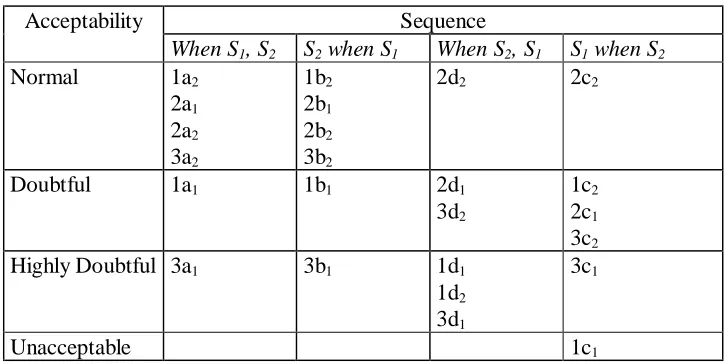
These sample data were obtained with the help of a questionnaire offered to a number of educated adult native speakers of English who were asked to assess the sen-tences as either “normal”, “doubtful (?)”, “highly doubtful (??)”, or “unacceptable (*)”. Although there was a slight dispersion of answers for the latter three categories, the ten-dency to mark down certain types of sequences as deviant appeared to be quite obvious. The data are summed up in Table 1.
Acceptability Sequence
When S1, S2 S2 when S1 When S2, S1 S1 when S2
Normal 1a2
2a1 2a2 3a2
1b2 2b1 2b2 3b2
2d2 2c2
Doubtful 1a1 1b1 2d1
3d2
1c2 2c1 3c2
Highly Doubtful 3a1 3b1 1d1
1d2 3d1
3c1
Unacceptable 1c1
Table 1. Degree of Acceptability of Possible Clause Sequences
four — S2 when S1. The main difference between the syntactically similar S1 and S2 in our sample is that while in S1 the verb is in the simple form in all the examples, in S2 it varies from simple to progressive to perfect. Note that most of the doubtful sequences in Table 1 (more than 71%) are the sequences where S2 is pre-posed by when. Obviously, there are some constraints on the combinability of when with a clause imposed by the aspect form of the verb used in the clause. And of course, the question is, “What is going on here?”
As the data show, the constraints seem to depend on the interplay of the following factors:
(i) the order in which the clauses are combined (S1 S2 or S2 S1), (ii) the relative position of when (when S1 or when S2),
(iii) the aspect form of the verb used in each clause,
(iv) the presence/absence of the verb complement in a clause.
2.1 Clause Combining and the Position of When
Traditionally, the term sentence refers to an utterance or written sequence of words which is regarded as capable of standing alone to express a coherent thought (Trask, 1993). In our case, it means that the syntactic structure of the type When S, S should express a coherent thought to qualify as a sentence. However, as our sample shows, not all possible sequences with this structure possess the necessary degree of coherence. For some reason, certain sequences are felt by native speakers to be less acceptable than oth-ers.
If we look at the propositional content of the two clauses S1 and S2 (John came home and Ann cooked dinner), there doesn’t seem to be anything there to tie one to the
others. Whether Ann cooked dinner because John came home, or it was just a coinci-dence, remains an open question as long as there is no indication to contextual parame-ters (background knowledge) necessary for the adequate interpretation of the relation-ship between the two events. In the same manner, a sequence such as Ann cooked din-ner. John came home could be interpreted either causally as ‘John came home because
Ann cooked dinner’, or simply iconically as two unrelated events occurring successively. To show that a certain relationship really exists, conjunctions are used to specify this relation either as subordinate or coordinate (or hypotactic and paratactic — we are not concerned with the terminological issue here).
Thus, with an addition of when, the clause John came home becomes subordinate to Ann cooked dinner in (Ia2), and vice versa in (Ib2). This subordinate relation means that in the first case John’s coming home is perceived as less relevant than Ann’s cooking dinner, while in the second case it is the other way around. But what, then, is the differ-ence between (Ia2) and (Ib2) in terms of their informative value? If both possess the same degree of iconicity reflecting the perceptual processing of information flow, how can the different clausal order be explained? This is the first question we will attempt to answer by discussing the relevant data in Table 1. (It is necessary to note here that the explana-tion of the difference in clause sequencing in terms of manifestaexplana-tion of their thematic status (Halliday, 1967; Fries, 1983; Matthiessen & Thompson, 1988 inter alia) does not
answer the question how a certain thematic status is assigned in the first place, so we are not going to probe into that area.)
2.2 Verbal Aspect and Complementation
Now, what kind of relationship exists between verbal aspect and complementation in, say, S2 on the one hand, and the resulting acceptability of the complex sentence in rela-tion to clause combining, on the other hand? Upon a closer look a certain pattern emerges.
progressive). As soon as the progressive is replaced by the simple or the perfect, the re-sulting complex sentence begins to lack coherence necessary to view it as an acceptable structure for expressing thought (representing knowledge). However, if the verb is fol-lowed by a complement (dinner in our examples), the constraint on sentence acceptabil-ity for the structures When S1, S2 and S2 when S1 disappears.
Moreover, the progressive is the only form which, when used in S2 with a comple-ment, yields acceptable complex sentences with the structure S1 when S2 and When S2, S1. Both the sequences When S1, S2 and S2 when S1 are acceptable regardless of the kind
of aspect used in S2 as long as the verb is followed by a complement. However, the se-quences When S2, S1 and S1 when S2 yield only one acceptable sentence each, again with the progressive verb in S2. So, the second question we will attempt to answer is, “What cognitive mechanisms are at work here?"
3. THE HYPOTHESIS AND DISCUSSION
The data presented above allow to suggest the following hypothesis:
Constraints on certain sequences in the complex sentence with an adverbial
when- clause are the result of cognitive discordance between the indexical
meaning of specific aspect forms of the verb and the conjunction when, on
the one hand, and clause sequencing which iconically reflects the cognitive
processing of perceptual data, on the other hand.
point-of-reference for indexical phenomena is the observer as an identifiable source of informa-tion.
Every time an indexical is used in discourse it is a signal that a certain quantum of information is tied to an identifiable source whose perceptual experiences are an inalien-able part of the propositional content of the linguistic expression.
The examples from our sample contain three types of indexicals, the tense, the as-pect, and the conjunction when. Since there is no tense variation affecting the interpreta-tion of the sentence, this indexical is not considered here. As for the morphosyntactic category of aspect, within the framework of the Cognitive Theory of Tense and Aspect (CTTA) (Kravchenko, 1990; 1992; 1997) its cognitive content is related to the contrast between two basic concepts of events: verbal referents are categorized either as those identified empirically (through direct observation), or those identified on the basis of existing (background) knowledge. These concepts reflect the two modes of knowledge representation mentioned above, phenomenological and structural, which are based on cognitively different channels for data input. These different types of input may be prag-matically interpreted as “observer’s competence/knowledge” and “speaker’s competence/ knowledge”.
In the course of using language, we speak either about what we perceive or about what we just know. In the first case, the source of information about the verbal referent is definite because the observer may be identified. In the second case, no immediate iden-tification is possible, so the source of information about the event is indefinite. The grammatical meaning of aspect is thus defined as “indication to the source of information about the event” which can be definite (based on observation), or indefinite (based on the speaker's knowledge whose source is not specified). So, the category of aspect falls within a wide range of linguistic means of expressing evidentiality found across different languages of the world (cf. Willett, 1988).
participle with a copula) is used to describe an observed situation in which the referent
of the verb is past the senses. In other words, in the case of the progressive it is the process itself unfolding before the observer’s eyes (we speak about what we see actually happening), whereas in the case of the perfect it is only some sign(s) telling the observer that a certain process must have taken place (we speak about something we see and compare with what we saw some time before to make an inference). When the two cate-gorial situations underlying the grammatical meaning of the progressive and the perfect overlap, the perfect progressive is used which is, basically, a combination of the two, both in form and meaning.
The lexical item when in traditional functionally oriented grammars (Quirk et al. 1973; Leech & Svartvik 1975; Givón 1993) is assigned different roles and defined either
as an adverb (When will he leave?), subordinating conjunction (see our sample), or rela-tive pronoun (Since when has this been going on?). However, functional-syntactic dif-ferences aside, one cannot rid oneself of the feeling that in all the three cases there is some basic sameness in meaning in the sense that there is one core concept (cognitive structure) underlying the meaning of when regardless of its syntactic function .
Following the tenet of the bio-cognitive philosophy of language about the experi-ential nature of meaning (Kravchenko, 2002b; 2003), and in view of the fact that when is traced etymologically to the Gothic accusative of who (Skeat,1956) and thus belongs to the pronominal class (interrogative pronoun), we claim that its meaning can be under-stood only in the context of its indexical properties, that is, its role in identifying the source of information that constitutes the propositional content of the complex sentence
it is a part of.
1929; Hudleston 1984; Bache 1985), why would the very same respondents mark certain sentences as doubtful? Obviously, the speaker is not always at liberty to choose any of the possible linguistic structures for expressing a particular thought in a coherent way. This coherence depends on the interplay of the four factors mentioned in Section 2. Spe-cifically, there seems to be a certain dependency of the sentence acceptability on the rela-tive position of when with respect to the aspect forms of the verb used in the clauses. Let us compare structurally similar sentences from the three sample groups.
In Set II, (a1), (a2), (b1), (b2), (c2) and (d2) have been all checked as normal as if it really did not matter which clause with what verbal aspect in it in what sequence was pre-posed with when. But the picture changes as soon as the progressive form of the verb in S2 is changed either to the simple as in Set I, or the perfect as in Set III. Sen-tences (a1) and (b1) from Set II become doubtful in Set I and highly doubtful in Set III; sentence (IIc2) becomes doubtful as (Ic2) and (IIIc2), and sentence (IId2) becomes doubt-ful as (IIId2) and highly doubtdoubt-ful as (Id2). Moreover, sentences marked as doubtdoubt-ful change their degree of acceptability: (IId1) from doubtful becomes highly doubtful both as (IIId1) and (Id1), and (IIc1) from doubtful becomes highly doubtful as (IIIc1) and un-acceptable as (Ic1). How can this phenomenon be explained?
event ‘Ann’s cooking’ is Ann herself (the situation described in the first clause is viewed as if from Ann’s perspective), while in the second clause the observer is still John. This results in a double cognitive perspective on the complex situation as a whole and falls within the scope of stylistic phenomena of personification.
Now, why in Set II both (a1) and (a2) have been marked as normal, and in Sets I and III the absence of the complement in S2 results in anomalousness? The difference between (IIa1) and (IIa2) is only in the degree of informativeness of S2: in the former, John sees enough to identify Ann’s activity as cooking, but he cannot tell what it is that Ann is cooking; in the latter, he evidently sees enough to infer that it is dinner being cooked. The perfect in (IIIa1) and (IIIa2) indicates that John sees something and com-pares it with a previous state of affairs: seeing dinner ready and waiting, he naturally in-fers that it has been cooked by Ann (example (IIIa2)), while in (IIIa1) it is indicated that John sees something as a result of Ann’s cooking but what it is that he sees is left un-specified, creating a semantic lacuna.
A similar semantic gap is found in (Ia1). If we compare (Ia2) and (IIa2), we will see that because of the different aspects used in S2 in these examples its informative value differs: Ann was cooking dinner represents phenomenological knowledge, it describes the situation as ‘here-and-now’, that is, at the time of John’s observation, so there is no causal relationship between the two propositions. By contrast, Ann cooked dinner repre-sents structural knowledge, it describes the situation as a structural part of the world known to the speaker as a result of accumulated experience of similar situations, and a functional structure is characterized by causal relationships of its components, so in (Ia2) the proposition in S1 stands in a causal relationship to the proposition in S2 yielding the following meaning: ‘Ann cooked dinner every time John came home so he could eat’. The omission of the complement in (Ia1) creates a slight semantic anomaly because of the causal relationship between the two parts, as in the absence of the complement it is not quite clear why Ann should start cooking at all every time John came home.
which is also obvious in (IIIc1) and (IIId1) when compared with (IIIc2) and (IIId2) as to the degree of acceptability. At the same time, all the (c) and (d) sequences in Sets I and III have been marked as anomalous. According to our hypothesis, in sequence (d) when identifies Ann as the observer of the event ‘John’s coming home’, while the indefinite aspect of the verb used in S1 indicates that the information about this event is part of the speaker’s background knowledge obtained in an unspecified manner (the speaker knows for a fact that John came home, but the source of this knowledge is unspecified). Thus, the specific relative positioning of the two indexicals in the complex sentence of the type When S2, S1 results in cognitive discord with sentence iconicity inasmuch as the
identifi-cation of the perceptual processor of the information flow is involved. Consequently, there is no sufficient cognitive link between the two clauses that would allow to view the whole sentence as a linguistic structure representing a quantum of knowledge (a com-plete thought) in a coherent way.
5. CONCLUSION
As we have tried to show, the cognitive value of different acceptable sequences of clauses in a complex sentence of the type When S, S may be assessed from the point of view of the relationship between their indexical and iconic properties. The suggested hypothesis may provide a useful tool for the analysis of sentential and, by extension, dis-course grammar by making redis-course to the concept of cognitive processor of the infor-mation flow iconically represented by the syntactic structure of the sentence. We have argued that the order of clause combining is influenced, on the one hand, by the interplay of such cognitive factors as the speaker and the observer identified as possible sources of information (knowledge) about the described events and, on the other hand, by the in-dexical meaning of the pronominal when and the markedness of definite aspect verbs for event observability.
be-lieve that such generalizations may, in fact, be quite possible — but of course, only con-tinued research into the matter may show if our assumptions are valid.
REFERENCES
Bache c. (1985), Verbal aspect: a general theory and its application to present-day English. Odense: Odense University Press.
Chomsky N. (1965), Aspects of the theory of syntax. Cambridge, Mass.: The MIT Press. Dik S. (1989), The theory of functional grammar. Part I: The structure of the clause.
Dordrecht: Foris Publications.
Fries P. (1983), “On the status of theme in English: arguments from discourse”, [in:] Petöfi J. & E. Sozer (eds.), Micro and macro connexity of texts. Hamburg: Helmut Buske Verlag. pp. 116-152.
Givón T. (1990), Syntax. A functional-typological introduction. Vol.2. Amsterdam, Philadelphia: John Benjamins.
Givón T. (1993), English grammar. A function-based introduction. Vol. 1-2. Amster-dam, Philadelphia: John Benjamins.
Givón T. (1995), Functionalism and grammar. Amsterdam, Philadelphia: John Benja-mins.
Greenberg J. H. (ed.) (1978), Universals of human language. Vol. 4: Syntax. Stanford, CA: Stanford UP.
Haiman J. (ed.) (1985), Iconicity in syntax. Amsterdam, Philadelphia: John Benjamins. Haiman J. & S. Thompson (eds.) (1989), Clause combining in grammar and discourse.
Amsterdam, Philadelphia: John Benjamins.
Hawkins J. (1983), Word order universals. New York: Academic Press.
Heine B. (1997), Cognitive foundations of grammar. New York; Oxford: Oxford Uni-versity Press.
Halliday M. (1967), Journal of Linguistics, "Notes on transitivity and theme, Part II", nr. 3, pp. 199-245.
Halliday M. (1985), An introduction to functional grammar. London: Edward Arnold. Hill D. (1994), Spatial configurations and evidential propositions. Nijmegen: Max Plank
Institute for Psycholinguistics.
Huddleston R. (1984), Introduction to the grammar of English. Cambridge University Press.
Jespersen O. (1929), The philosophy of grammar. London: Allen and Unwin.
Kovalyova, L., L. Dundik & J. Zelberg (2001), Ocherki po semantike polipredikativ-nogo predlozhenija. Irkutsk: BNUEL Press.
Kravchenko A. (2003), Sign, meaning, knowledge. An essay in the cognitive philosophy of language. Frankfurt/Main: Peter Lang GmbH.
Lewandowska-Tomaszczyk B. & K. Turewicz (eds.), Cognitive linguistics today. Frankfurt/Main: Peter Lang. pp. 41-55.
Kravchenko A. (2002b), Perspectives: Journal for Interdisciplinary Work in the Hu-manities, "Toward a bio-cognitive philosophy of language", vol. 1, nr. 5 (http://www.brookes.ac.uk/~/perspectives).
Kravchenko A. (2002c), Anglophonia. French Journal of English Studies, "A cognitive account of tense and aspect: resurrecting "dead" metaphors”, nr. 12, pp. 199-212. Kravchenko A. (2001), "Russian verbs of spatial orientation STAND, SIT, LIE" [in:]
Nemeth E. (ed.), Cognition in language use. Selected papers from the 7th Interna-tional Pragmatics Conference, vol. 1. Antwerp: InternaInterna-tional Pragmatics Association. pp. 216-225.
Kravchenko A. (ed.) (1997), The English verb. A new grammar for everyone. Irkutsk: ISLU Press.
Kravchenko A. (1993), Izvestiya Rossiiskoi Akademii Nauk. Seriya Literatury i Yazyka, "K probleme nabludatelya kak sistemoobrazuyushchego faktora v yazyke", vol. 52, nr. 3, pp. 45-56. Moscow.
Kravchenko A. (1992), Voprosy teorii ukazatelnosti. Egotsentrichnost. Deiktichnost. Indexalnost. Irkutsk: Irkutsk University Press [Issues in the theory of indication: Egocentricity. Deixis. Indexicality].
Kravchenko A. (1990), Philologicheskiye Nauki, "K kognitivnoi teorii vremeni i vida", nr. 6, pp. 81-90. Moscow.
Leech G. & J. Svartvik (1975), A communicative grammar of English. Longman. Lyons J. (1977), Semantics. Vol. 1-2. Cambridge: Cambridge University Press.
Matthiessen C. & S. Thompson. "The structure of discourse and ‘subordination’" [in:] Haiman and Thompson (1989), pp. 275-329.
Maturana U. (1970), The biology of cognition. BCL Report 9.0. Urbana, University of Illinois.
Quirk R., S. Greenbaum, G. Leech and J. Svartvik (1973), A university grammar of English. Longman.
Russell B. (1963), An inquiry into meaning and truth. London: Penguin Books.
Shibatani M. & S. Thompson (eds.) (1996), Grammatical constructions: their form and meaning. Oxford: Oxford UP.
Skeat W. (1956), An etymological dictionary of the English language. Oxford: Claren-don Press.
Svorou S. (1994), The grammar of space. Amsterdam, Philadelphia: John Benjamins. Taylor J. & R. MacLaury (eds.) (1995), Language and the cognitive construal of the
world. Berlin: Mouton de Gruyter.
Trask A. (1993), A dictionary of grammatical terms in linguistics. London & New York: Routledge.
Ullmann S. (1962), Semantics. An introduction to the science of meaning. Oxford: Basil Blackwell.
Verschueren J. (1999), Understanding pragmatics. London, etc.: Arnold.