OncoTargets and Therapy 2016:9 2153–2168
OncoTargets and Therapy
Dove
press
submit your manuscript | www.dovepress.com 2153
O r i g i n a l r e s e a r c h open access to scientific and medical research
Open access Full Text article
effects of exercise intervention in breast cancer
survivors: a meta-analysis of 33 randomized
controlled trails
guoqing Zhu1
Xiao Zhang1
Yulan Wang1
huizi Xiong2
Yinghui Zhao1
Fenyong sun1
1Department of clinical laboratory Medicine, 2Department of
Dermatology, shanghai Tenth People’s hospital of Tongji University, shanghai, People’s republic of china
Background: Exercise is associated with favorable outcomes in cancer survivors. The purpose of this meta-analysis is to comprehensively summarize the effects of exercise intervention in breast cancer survivors.
Methods: A systematic search of PubMed, Elsevier, and Google scholar was conducted up to March 2015. References from relevant meta-analyses and reviews were also checked.
Results: Thirty-three randomized controlled trials were included in this meta-analysis, including 2,659 breast cancer survivors. Compared with the control group, quality of life was significantly improved in exercise intervention group, especially in mental health and general health subscales of short form 36 questionnaire, as well as emotion well-being and social well-being subscales of the Functional Assessment of Cancer Therapy. Besides, exercise alleviated the symptoms of depression and anxiety in the exercise group. Furthermore, exercise was also associated with positive outcomes in body mass index, lean mass, and muscle strength. In addition, the serum concentration of insulin, insulin-like growth factor-II, and insulin-like growth factor binding protein-1 was significantly reduced in exercise intervention group. However, based on the current data of this meta-analysis, there were no significant differences in sleep dysfunction or fatigue between groups.
Conclusion: Our study suggested that exercise intervention was beneficial to breast cancer survivors. Therefore, exercise should be recommended to this patient group.
Keywords: exercise, quality of life, depression, BMI, insulin
Introduction
Breast cancer is one of the main causes of cancer deaths in women,1 which was
respon-sible for 23% of total cancer cases and 14% of cancer deaths.2 With the improvements
in early detection and treatment, the number of cancer survivors continued to increase, in which women with breast cancer accounted for 22% of total cancer survivors in
2012.3 However, the problems related to breast cancer and cancer treatment, such as
cardiac toxicity of adjuvant systemic therapy,4,5 arm or shoulder problems, body image,6
change in social life, fear,7 and poorer quality of life8 were negatively associated with
the overall well-being of breast cancer survivors.
A growing body of evidence indicated that exercise intervention results in beneficial outcomes in cancer patients. Some studies had suggested that exercise increased car-diorespiratory fitness,9 physical performance,10 and reduced overall mortality.11 There
were also studies demonstrating that exercise was associated with improvements in the symptom of depression,12 body image, self-esteem,13 and quality of life,14–16 though
some conclusions were not inconsistent in terms of fatigue.17
correspondence: Fenyong sun Department of clinical laboratory Medicine, shanghai Tenth People’s hospital of Tongji University, no 301 Middle Yanchang rd, shanghai, 200072, People’s republic of china
Tel +86 21 6630 0588 Fax +86 21 6630 0588
email [email protected]
Journal name: OncoTargets and Therapy Article Designation: Original Research Year: 2016
Volume: 9
Running head verso: Zhu et al
Running head recto: Effects of exercise in breast cancer survivors DOI: http://dx.doi.org/10.2147/OTT.S97864
OncoTargets and Therapy downloaded from https://www.dovepress.com/ by 118.70.13.36 on 26-Aug-2020
For personal use only.
Number of times this article has been viewed
This article was published in the following Dove Press journal: OncoTargets and Therapy
Dovepress
Zhu et al
Previously, these effects of exercise intervention in breast cancer patients had been assessed in several meta-analyses and systematic reviews.18–22 However, some of them only
summarized some of effects related to intervention,18,19 or
compared the effects of group exercise with individual exer-cise.20 Others either only focused on one special symptom,21
or evaluated the efficacy of Tai Chi Chuan alone.22 Moreover,
new evidences in recent years have not been included. Thus, we aim to comprehensively summarize the effects of exercise intervention on breast cancer patients based on the available data from randomized controlled trials.
Methods
literature search
We searched PubMed, Elsevier, and Google Scholar up to March 2015. The reference lists of relevant system-atic reviews and meta-analyses were also examined to identify additional studies. The search terms used in this meta-analysis were related to breast cancer (breast neoplasm, cancer, tumour, tumor, carcinoma) and exercise (exercise, physical activity, sport, weight training).
inclusion criteria
Studies were considered eligible if they met the following criteria: 1) were written in English; 2) adopted a randomized controlled trial design, comparing exercise intervention group with control group (usual care, maintain current activity level, or waitlist); 3) included adults diagnosed with breast cancer; and 4) evaluated the effects of exercise in breast cancer patients.
Studies were excluded if: 1) included mixed cancer populations, including other types of cancer patients; 2) included other types of intervention (exercise intervention combined with diet); and 3) exercise merely focused on upper limb or arm.
Data extraction
Relevant data were independently extracted by GQ Zhu and X Zhang with a standard excel template, including 1) characteristics of the study and participants (first author, year of publication, mean age, sample size); 2) content of exercise intervention: exercise type, timing (before, during, or after treatment), and the frequency, intensity, and dura-tion of intervendura-tion; 3) outcomes of intervendura-tion (quality of life, depression, anxiety, fatigue, muscle strength, body composition, physiological markers); and 4) assessment methods. Any disagreements were checked and discussed until a consensus was reached.
Methodological quality assessment
The methodological quality of the studies were independently assessed by two reviewers (GQ Zhu and YL Wang) using the Delphi criteria list,23 which is a set of nine criteria for
qual-ity assessment of randomized controlled trials. It was hard to blind the participants and providers in the interventional study. Therefore, participants blinding and provider blinding were not rated, and we only assessed the blinding of the out-come assessors. Each item was scored as yes (+) or no (-).
statistical analysis
The outcomes were assessed if the data were available in at least two studies. For continuous outcomes, standardized mean differences with 95% confidence intervals (CIs) were calculated, with P0.05 considered statistically significant. Statistical heterogeneity among studies was measured by
I2 test, in which values above 25% and 50% were considered
as the indicative of moderate and high heterogeneity, respec-tively.24 A fixed-effect model was adopted when I250%;
otherwise, a random-effect model was used.
In the presence of heterogeneity, subgroup analysis was performed based on the measurement methods or the type of exercise. Besides, sensitivity analysis was carried out to evalu-ate the influence of a single study to the overall estimevalu-ate. Pub-lication bias was estimated through Begg’s test and Egger’s linear regression, with P0.10 consumed as an indication of publication bias.25 All analyses were conducted using Review
Manager Version 5.3 (Cochrane Collaboration, Copenhagen, Denmark) and Stata 12.0 (College Station, TX, USA).
Results
study selection
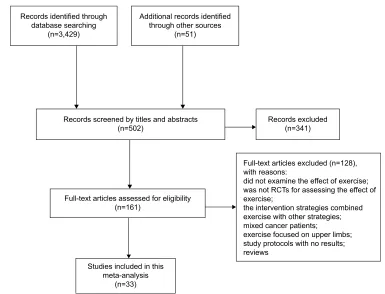
A total of 3,429 records were identified from the database (Figure 1). After screening the titles and abstracts, the full texts of 161 articles were further reviewed for eligibility. Finally, 33 articles26–58 were included and assessed for
meth-odological quality, with 128 articles excluded in which the aim, intervention type, or design of the study failed to meet the inclusion criteria.
characteristics of the exercise
interventions
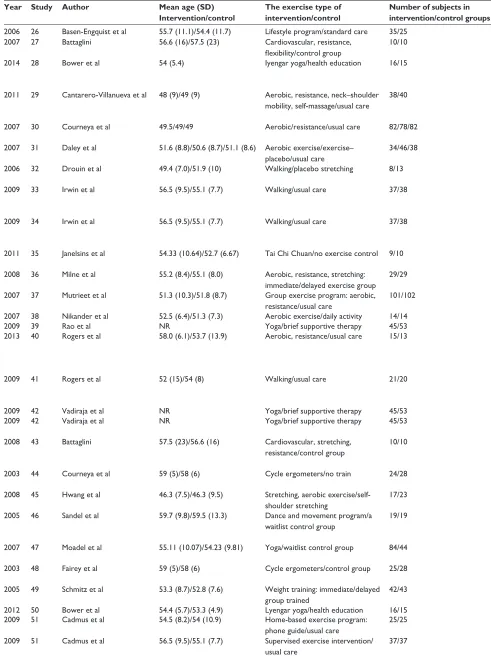
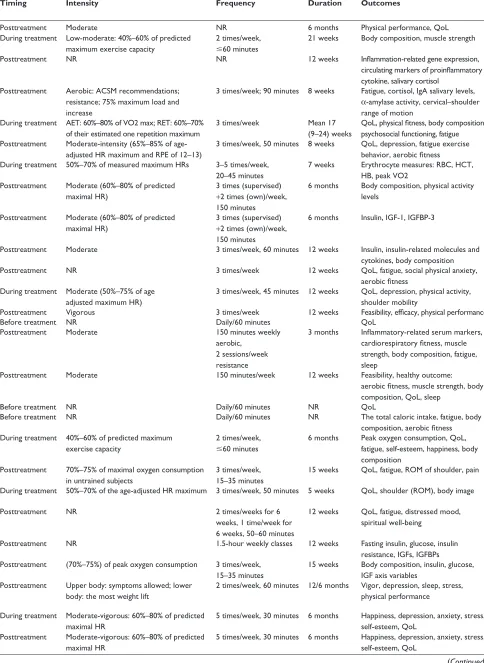
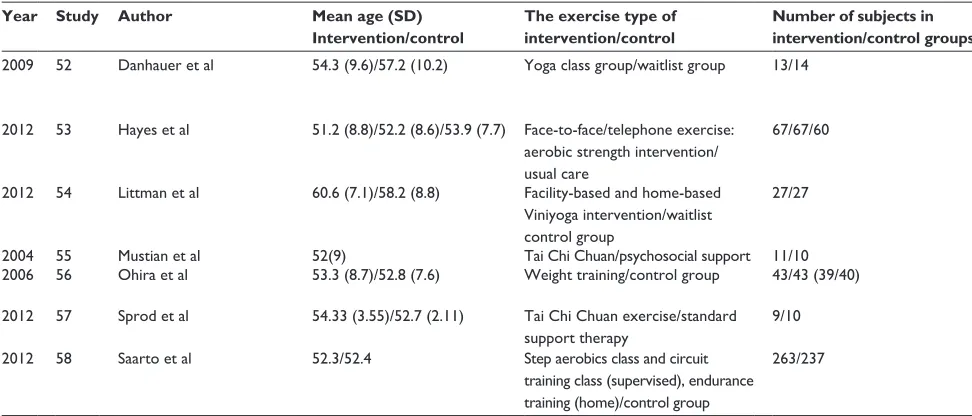
There were 2,659 breast cancer patients, with the mean age of 54 (46.3–60.6) years (Table 1). The main types of exercise interventions reported in this meta-analysis were aerobic, resistance, and stretching exercises. Besides, there were also six studies on yoga intervention,28,39,42,4,50,52 two studies on
tai chi chuan,35,55 and one on dancing.46 Twenty Five studies
OncoTargets and Therapy downloaded from https://www.dovepress.com/ by 118.70.13.36 on 26-Aug-2020
Dovepress effects of exercise in breast cancer survivors
performed intervention after treatment,26,28,29,31,33–36,38,40,41,44,46–58
seven studies during treatment,20,27,32,37,43,45,51 and the remaining
two studies before treatment.39,42 The duration of
interven-tion lasted from 6 weeks to 12 months, with the frequency of intervention varying from two times a week to every day. The intensity of exercise also varied from low to vigorous in different situations, among which the moderate intensity was most frequently reported.
Methodological quality of included studies
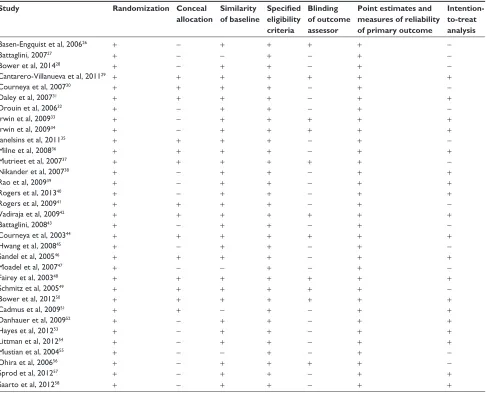
We assessed 33 articles according to the Delphi criteria list, and seven criteria were examined in each of the study. In all, 14 studies met five criteria,26,30,35,38–41,51–54,56–58 12 studies
more than five criteria,29,31,33,34,36,37,42,44,46,48–50 and the
remain-ing 7 studies less than five criteria.27,28,32,43,45,47,55 Of these, 19
studies failed to conceal the allocation,26–28,32–34,38-40,43,45,47,52–58
and 22 studies did not blind the outcome assessor.27–28,30–32,35–36, 38–41,43,45–47,51–55,57,58 Besides, 14 studies were not
intention-to-treat analysis (Table 2).26–28,30,32,35,37,41,43,45,47,49,55,56
Pooled effect estimates for outcome
measures
In this meta-analysis, we examined the effects of exercise intervention on quality of life, psychological outcomes,
body composition, physical function and symptom, and physiological markers of breast cancer survivors. A total of 53 outcomes were evaluated, which were reported in at least two studies (Table 3).
results of quality of life
The quality of life was reported as an outcome in 18 stud ies,26,30,31,36,37,41,42,45,46,51–58 among which 10 studies used the
Functional Assessment of Cancer Therapy-Breast (FACT-B) and the Functional Assessment of Cancer Therapy–General (FACT-G) questionnaire,31,36,37,41,45,46,51,53–55 4 studies the
Medical Outcomes Study Short Form health survey (SF-36) questionnaire,26,46,51,57 and two studies Treatment of
Cancer-Quality of Life questionnaire (EORTCQoLC30).42,58 The
other 4 studies used SF-12 health survey (SF-12),52 the
Functional Assessment of Cancer Therapy–Anemia,30
the World Health Organization Quality of Life
(WHOQOL-BREF),45 and the Cancer Rehabilitation Evaluation
System-Short Form,56 respectively. We only pooled the outcomes that
data could be extracted in at least two studies. Therefore, the data of 12 studies, involving 15 quality life domains, were included in this meta-analysis.26,31,36,37,41,45,46,51,53–55,57
Measured by SF-36 or MOS SF-36, the exercise inter-vention significantly improved the mental health (I2=0%,
Figure 1 Flow diagram of study selection. Abbreviation: rcT, randomized controlled trial.
5HFRUGVLGHQWLILHGWKURXJK GDWDEDVHVHDUFKLQJ
Q
5HFRUGVVFUHHQHGE\WLWOHVDQGDEVWUDFWV Q
)XOOWH[WDUWLFOHVDVVHVVHGIRUHOLJLELOLW\ Q
)XOOWH[WDUWLFOHVH[FOXGHGQ ZLWKUHDVRQV
GLGQRWH[DPLQHWKHHIIHFWRIH[HUFLVH ZDVQRW5&7VIRUDVVHVVLQJWKHHIIHFWRI H[HUFLVH
WKHLQWHUYHQWLRQVWUDWHJLHVFRPELQHG H[HUFLVHZLWKRWKHUVWUDWHJLHV PL[HGFDQFHUSDWLHQWV
H[HUFLVHIRFXVHGRQXSSHUOLPEV VWXG\SURWRFROVZLWKQRUHVXOWV UHYLHZV
6WXGLHVLQFOXGHGLQWKLV PHWDDQDO\VLV
Q
5HFRUGVH[FOXGHG Q $GGLWLRQDOUHFRUGVLGHQWLILHG
WKURXJKRWKHUVRXUFHV Q
OncoTargets and Therapy downloaded from https://www.dovepress.com/ by 118.70.13.36 on 26-Aug-2020
Dovepress
Zhu et al
Table 1 characteristics of 33 studies included in this meta-analysis
Year Study Author Mean age (SD)
Intervention/control
The exercise type of intervention/control
Number of subjects in intervention/control groups
Timing Intensity Frequency Duration Outcomes
2006 26 Basen-engquist et al 55.7 (11.1)/54.4 (11.7) lifestyle program/standard care 35/25 Posttreatment Moderate nr 6 months Physical performance, Qol
2007 27 Battaglini 56.6 (16)/57.5 (23) cardiovascular, resistance, flexibility/control group
10/10 During treatment low-moderate: 40%–60% of predicted
maximum exercise capacity
2 times/week,
60 minutes
21 weeks Body composition, muscle strength
2014 28 Bower et al 54 (5.4) iyengar yoga/health education 16/15 Posttreatment nr nr 12 weeks Inflammation-related gene expression,
circulating markers of proinflammatory cytokine, salivary cortisol
2011 29 cantarero-Villanueva et al 48 (9)/49 (9) aerobic, resistance, neck–shoulder mobility, self-massage/usual care
38/40 Posttreatment aerobic: acsM recommendations;
resistance; 75% maximum load and increase
3 times/week; 90 minutes 8 weeks Fatigue, cortisol, iga salivary levels,
α-amylase activity, cervical–shoulder range of motion
2007 30 courneya et al 49.5/49/49 aerobic/resistance/usual care 82/78/82 During treatment aeT: 60%–80% of VO2 max; reT: 60%–70%
of their estimated one repetition maximum
3 times/week Mean 17
(9–24) weeks
QoL, physical fitness, body composition, psychosocial functioning, fatigue 2007 31 Daley et al 51.6 (8.8)/50.6 (8.7)/51.1 (8.6) aerobic exercise/exercise–
placebo/usual care
34/46/38 Posttreatment Moderate-intensity (65%–85% of
age-adjusted hr maximum and rPe of 12–13)
3 times/week, 50 minutes 8 weeks Qol, depression, fatigue exercise behavior, aerobic fitness
2006 32 Drouin et al 49.4 (7.0)/51.9 (10) Walking/placebo stretching 8/13 During treatment 50%–70% of measured maximum hrs 3–5 times/week,
20–45 minutes
7 weeks erythrocyte measures: rBc, hcT, hB, peak VO2
2009 33 irwin et al 56.5 (9.5)/55.1 (7.7) Walking/usual care 37/38 Posttreatment Moderate (60%–80% of predicted
maximal hr)
3 times (supervised)
+2 times (own)/week, 150 minutes
6 months Body composition, physical activity levels
2009 34 irwin et al 56.5 (9.5)/55.1 (7.7) Walking/usual care 37/38 Posttreatment Moderate (60%–80% of predicted
maximal hr)
3 times (supervised)
+2 times (own)/week, 150 minutes
6 months insulin, igF-1, igFBP-3
2011 35 Janelsins et al 54.33 (10.64)/52.7 (6.67) Tai chi chuan/no exercise control 9/10 Posttreatment Moderate 3 times/week, 60 minutes 12 weeks insulin, insulin-related molecules and
cytokines, body composition 2008 36 Milne et al 55.2 (8.4)/55.1 (8.0) aerobic, resistance, stretching:
immediate/delayed exercise group
29/29 Posttreatment nr 3 times/week 12 weeks Qol, fatigue, social physical anxiety,
aerobic fitness 2007 37 Mutrieet et al 51.3 (10.3)/51.8 (8.7) group exercise program: aerobic,
resistance/usual care
101/102 During treatment Moderate (50%–75% of age
adjusted maximum hr)
3 times/week, 45 minutes 12 weeks Qol, depression, physical activity, shoulder mobility
2007 38 nikander et al 52.5 (6.4)/51.3 (7.3) aerobic exercise/daily activity 14/14 Posttreatment Vigorous 3 times/week 12 weeks Feasibility, efficacy, physical performance
2009 39 rao et al nr Yoga/brief supportive therapy 45/53 Before treatment nr Daily/60 minutes Qol
2013 40 rogers et al 58.0 (6.1)/53.7 (13.9) aerobic, resistance/usual care 15/13 Posttreatment Moderate 150 minutes weekly
aerobic, 2 sessions/week resistance
3 months Inflammatory-related serum markers, cardiorespiratory fitness, muscle strength, body composition, fatigue, sleep
2009 41 rogers et al 52 (15)/54 (8) Walking/usual care 21/20 Posttreatment Moderate 150 minutes/week 12 weeks Feasibility, healthy outcome:
aerobic fitness, muscle strength, body composition, Qol, sleep
2009 42 Vadiraja et al nr Yoga/brief supportive therapy 45/53 Before treatment nr Daily/60 minutes nr Qol
2009 42 Vadiraja et al nr Yoga/brief supportive therapy 45/53 Before treatment nr Daily/60 minutes nr The total caloric intake, fatigue, body
composition, aerobic fitness 2008 43 Battaglini 57.5 (23)/56.6 (16) cardiovascular, stretching,
resistance/control group
10/10 During treatment 40%–60% of predicted maximum
exercise capacity
2 times/week,
60 minutes
6 months Peak oxygen consumption, Qol, fatigue, self-esteem, happiness, body composition
2003 44 courneya et al 59 (5)/58 (6) cycle ergometers/no train 24/28 Posttreatment 70%–75% of maximal oxygen consumption
in untrained subjects
3 times/week, 15–35 minutes
15 weeks Qol, fatigue, rOM of shoulder, pain 2008 45 hwang et al 46.3 (7.5)/46.3 (9.5) stretching, aerobic
exercise/self-shoulder stretching
17/23 During treatment 50%–70% of the age-adjusted hr maximum 3 times/week, 50 minutes 5 weeks Qol, shoulder (rOM), body image
2005 46 sandel et al 59.7 (9.8)/59.5 (13.3) Dance and movement program/a waitlist control group
19/19 Posttreatment nr 2 times/weeks for 6
weeks, 1 time/week for 6 weeks, 50–60 minutes
12 weeks Qol, fatigue, distressed mood, spiritual well-being
2007 47 Moadel et al 55.11 (10.07)/54.23 (9.81) Yoga/waitlist control group 84/44 Posttreatment nr 1.5-hour weekly classes 12 weeks Fasting insulin, glucose, insulin
resistance, igFs, igFBPs
2003 48 Fairey et al 59 (5)/58 (6) cycle ergometers/control group 25/28 Posttreatment (70%–75%) of peak oxygen consumption 3 times/week,
15–35 minutes
15 weeks Body composition, insulin, glucose, igF axis variables
2005 49 schmitz et al 53.3 (8.7)/52.8 (7.6) Weight training: immediate/delayed group trained
42/43 Posttreatment Upper body: symptoms allowed; lower
body: the most weight lift
2 times/week, 60 minutes 12/6 months Vigor, depression, sleep, stress, physical performance 2012 50 Bower et al 54.4 (5.7)/53.3 (4.9) lyengar yoga/health education 16/15
2009 51 cadmus et al 54.5 (8.2)/54 (10.9) home-based exercise program: phone guide/usual care
25/25 During treatment Moderate-vigorous: 60%–80% of predicted
maximal hr
5 times/week, 30 minutes 6 months happiness, depression, anxiety, stress, self-esteem, Qol
2009 51 cadmus et al 56.5 (9.5)/55.1 (7.7) supervised exercise intervention/ usual care
37/37 Posttreatment Moderate-vigorous: 60%–80% of predicted
maximal hr
5 times/week, 30 minutes 6 months happiness, depression, anxiety, stress, self-esteem, Qol
(Continued)
OncoTargets and Therapy downloaded from https://www.dovepress.com/ by 118.70.13.36 on 26-Aug-2020
Dovepress effects of exercise in breast cancer survivors
Table 1 characteristics of 33 studies included in this meta-analysis
Year Study Author Mean age (SD)
Intervention/control
The exercise type of intervention/control
Number of subjects in intervention/control groups
Timing Intensity Frequency Duration Outcomes
2006 26 Basen-engquist et al 55.7 (11.1)/54.4 (11.7) lifestyle program/standard care 35/25 Posttreatment Moderate nr 6 months Physical performance, Qol
2007 27 Battaglini 56.6 (16)/57.5 (23) cardiovascular, resistance, flexibility/control group
10/10 During treatment low-moderate: 40%–60% of predicted
maximum exercise capacity
2 times/week,
60 minutes
21 weeks Body composition, muscle strength
2014 28 Bower et al 54 (5.4) iyengar yoga/health education 16/15 Posttreatment nr nr 12 weeks Inflammation-related gene expression,
circulating markers of proinflammatory cytokine, salivary cortisol
2011 29 cantarero-Villanueva et al 48 (9)/49 (9) aerobic, resistance, neck–shoulder mobility, self-massage/usual care
38/40 Posttreatment aerobic: acsM recommendations;
resistance; 75% maximum load and increase
3 times/week; 90 minutes 8 weeks Fatigue, cortisol, iga salivary levels,
α-amylase activity, cervical–shoulder range of motion
2007 30 courneya et al 49.5/49/49 aerobic/resistance/usual care 82/78/82 During treatment aeT: 60%–80% of VO2 max; reT: 60%–70%
of their estimated one repetition maximum
3 times/week Mean 17
(9–24) weeks
QoL, physical fitness, body composition, psychosocial functioning, fatigue 2007 31 Daley et al 51.6 (8.8)/50.6 (8.7)/51.1 (8.6) aerobic exercise/exercise–
placebo/usual care
34/46/38 Posttreatment Moderate-intensity (65%–85% of
age-adjusted hr maximum and rPe of 12–13)
3 times/week, 50 minutes 8 weeks Qol, depression, fatigue exercise behavior, aerobic fitness
2006 32 Drouin et al 49.4 (7.0)/51.9 (10) Walking/placebo stretching 8/13 During treatment 50%–70% of measured maximum hrs 3–5 times/week,
20–45 minutes
7 weeks erythrocyte measures: rBc, hcT, hB, peak VO2
2009 33 irwin et al 56.5 (9.5)/55.1 (7.7) Walking/usual care 37/38 Posttreatment Moderate (60%–80% of predicted
maximal hr)
3 times (supervised)
+2 times (own)/week, 150 minutes
6 months Body composition, physical activity levels
2009 34 irwin et al 56.5 (9.5)/55.1 (7.7) Walking/usual care 37/38 Posttreatment Moderate (60%–80% of predicted
maximal hr)
3 times (supervised)
+2 times (own)/week, 150 minutes
6 months insulin, igF-1, igFBP-3
2011 35 Janelsins et al 54.33 (10.64)/52.7 (6.67) Tai chi chuan/no exercise control 9/10 Posttreatment Moderate 3 times/week, 60 minutes 12 weeks insulin, insulin-related molecules and
cytokines, body composition 2008 36 Milne et al 55.2 (8.4)/55.1 (8.0) aerobic, resistance, stretching:
immediate/delayed exercise group
29/29 Posttreatment nr 3 times/week 12 weeks Qol, fatigue, social physical anxiety,
aerobic fitness 2007 37 Mutrieet et al 51.3 (10.3)/51.8 (8.7) group exercise program: aerobic,
resistance/usual care
101/102 During treatment Moderate (50%–75% of age
adjusted maximum hr)
3 times/week, 45 minutes 12 weeks Qol, depression, physical activity, shoulder mobility
2007 38 nikander et al 52.5 (6.4)/51.3 (7.3) aerobic exercise/daily activity 14/14 Posttreatment Vigorous 3 times/week 12 weeks Feasibility, efficacy, physical performance
2009 39 rao et al nr Yoga/brief supportive therapy 45/53 Before treatment nr Daily/60 minutes Qol
2013 40 rogers et al 58.0 (6.1)/53.7 (13.9) aerobic, resistance/usual care 15/13 Posttreatment Moderate 150 minutes weekly
aerobic, 2 sessions/week resistance
3 months Inflammatory-related serum markers, cardiorespiratory fitness, muscle strength, body composition, fatigue, sleep
2009 41 rogers et al 52 (15)/54 (8) Walking/usual care 21/20 Posttreatment Moderate 150 minutes/week 12 weeks Feasibility, healthy outcome:
aerobic fitness, muscle strength, body composition, Qol, sleep
2009 42 Vadiraja et al nr Yoga/brief supportive therapy 45/53 Before treatment nr Daily/60 minutes nr Qol
2009 42 Vadiraja et al nr Yoga/brief supportive therapy 45/53 Before treatment nr Daily/60 minutes nr The total caloric intake, fatigue, body
composition, aerobic fitness 2008 43 Battaglini 57.5 (23)/56.6 (16) cardiovascular, stretching,
resistance/control group
10/10 During treatment 40%–60% of predicted maximum
exercise capacity
2 times/week,
60 minutes
6 months Peak oxygen consumption, Qol, fatigue, self-esteem, happiness, body composition
2003 44 courneya et al 59 (5)/58 (6) cycle ergometers/no train 24/28 Posttreatment 70%–75% of maximal oxygen consumption
in untrained subjects
3 times/week, 15–35 minutes
15 weeks Qol, fatigue, rOM of shoulder, pain 2008 45 hwang et al 46.3 (7.5)/46.3 (9.5) stretching, aerobic
exercise/self-shoulder stretching
17/23 During treatment 50%–70% of the age-adjusted hr maximum 3 times/week, 50 minutes 5 weeks Qol, shoulder (rOM), body image
2005 46 sandel et al 59.7 (9.8)/59.5 (13.3) Dance and movement program/a waitlist control group
19/19 Posttreatment nr 2 times/weeks for 6
weeks, 1 time/week for 6 weeks, 50–60 minutes
12 weeks Qol, fatigue, distressed mood, spiritual well-being
2007 47 Moadel et al 55.11 (10.07)/54.23 (9.81) Yoga/waitlist control group 84/44 Posttreatment nr 1.5-hour weekly classes 12 weeks Fasting insulin, glucose, insulin
resistance, igFs, igFBPs
2003 48 Fairey et al 59 (5)/58 (6) cycle ergometers/control group 25/28 Posttreatment (70%–75%) of peak oxygen consumption 3 times/week,
15–35 minutes
15 weeks Body composition, insulin, glucose, igF axis variables
2005 49 schmitz et al 53.3 (8.7)/52.8 (7.6) Weight training: immediate/delayed group trained
42/43 Posttreatment Upper body: symptoms allowed; lower
body: the most weight lift
2 times/week, 60 minutes 12/6 months Vigor, depression, sleep, stress, physical performance 2012 50 Bower et al 54.4 (5.7)/53.3 (4.9) lyengar yoga/health education 16/15
2009 51 cadmus et al 54.5 (8.2)/54 (10.9) home-based exercise program: phone guide/usual care
25/25 During treatment Moderate-vigorous: 60%–80% of predicted
maximal hr
5 times/week, 30 minutes 6 months happiness, depression, anxiety, stress, self-esteem, Qol
2009 51 cadmus et al 56.5 (9.5)/55.1 (7.7) supervised exercise intervention/ usual care
37/37 Posttreatment Moderate-vigorous: 60%–80% of predicted
maximal hr
5 times/week, 30 minutes 6 months happiness, depression, anxiety, stress, self-esteem, Qol
(Continued)
OncoTargets and Therapy downloaded from https://www.dovepress.com/ by 118.70.13.36 on 26-Aug-2020
Dovepress
Zhu et al
P=0.006, 95% CI: 0.11, 0.62, Figure 2) and general health
(I2=95%, P=0.02, 95% CI: 0.70, 8.48, Figure 2) compared
with the control groups. Besides, exercise was associated with a significant increase in emotion well-being (I2=2%,
P=0.0006, 95% CI: 0.12, 0.43, Figure 2) and social well-being subscales (I2=0%, P=0.01, 95% CI: 0.19, 1.69, Figure 2) of
the Functional Assessment of Cancer Therapy. The pooled results of five studies showed a significant increase in breast cancer subscale of the Functional Assessment of Cancer Therapy from exercise (I2=15%, P=0.000001, 95% CI: 1.85,
4.04) (Table 3).36,37,44,54,57
However, substantial heterogeneity was observed for some outcomes. There was no evidence of publication bias
except for SF-36 role-emotion (P=0.062, Table 3).
results of psychological outcomes
Pooled data from three studies indicated that the self-esteem score was higher in the intervention group (I2=0%, P=0.02,
95% CI: 0.18, 2.22), measured by the Rosenberg Self-Esteem Scale (Table 3).29,44,51 Meanwhile, exercise intervention
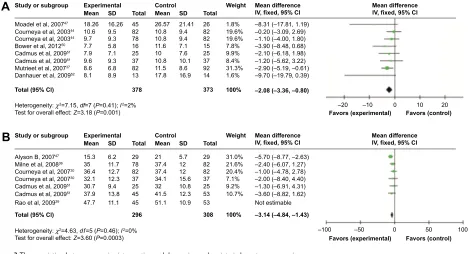
reduced depression (I2=2%, P=0.001, 95% CI: -3.36, -0.80,
Figure 3) and anxiety score (I2=0%, P0.0001, 95%
CI: -4.76, -1.58, Figure 3), which were of clinical impor-tance. However, the pooled results showed no difference in happiness and stress between intervention and control groups, assessed by the 2-item Fordyce Happiness Measure and the Perceived Stress Scale (Table 3).
Furthermore, exercise led to improvement in the positive and negative attitudes in breast cancer survivors, measured by the Positive and Negative Affect Schedule (PANAS), of
which the PANAS negative score decreased by 3.51 points (I2=76%, P=0.02, 95% CI: -9.92, -0.71) and the PANAS
positive score increased by 4.46 points (I2=0, P0.00001,
95% CI: 2.48, 6.44) (Table 3). In addition, measured by the Functional Assessment of Chronic Illness Therapy– Spiritual, exercise was associated with positive effect in spirit compared with control groups (I2=0%, P=0.02, 95%
CI: 0.76, 7.13) (Table 3).
No publication bias were detected in any of the results,
except the Pittsburgh Sleep Quality Index (P=0.082).
High heterogeneity was only found for PANAS negative (Table 3).
results of body compositions
Seven parameters were included in this meta–analysis (Table 3). Body mass index (BMI) was examined in nine stud-ies, and the pooled results indicated it reduced significantly with exercise (I2=0%, P0.00001, 95% CI: -1.09, -0.47,
Figure 4).34,35,37,38,40,41,44,49,54 Besides, the pooled results of four
studies showed that exercise was associated with significant increase in lean mass compared with control groups (I2=57%,
P=0.04, 95% CI: 0.08, 2.25) (Table 3).
Similarly, body fat percentage (I2=57%, P=0.02, 95%
CI: -3.33, -0.35) and fat mass (I2=0%, P=0.05, 95%
CI: -4.83, -0.04) were significantly reduced in the exercise intervention groups (Table 3). However, there were no signifi-cant differences on waist circumference, hip circumference, and waist-to-hip ratio between intervention and control groups.
No publication bias was observed, with only moderate heterogeneity for lean mass and body fat (Table 3).
Table 1 (Continued)
Year Study Author Mean age (SD)
Intervention/control
The exercise type of intervention/control
Number of subjects in intervention/control groups
Timing Intensity Frequency Duration Outcomes
2009 52 Danhauer et al 54.3 (9.6)/57.2 (10.2) Yoga class group/waitlist group 13/14 Posttreatment nr 1 times/week, 75 minutes 10 weeks Feasibility, aerobic fitness, muscle
strength, body composition, Qol, fatigue, sleep
2012 53 hayes et al 51.2 (8.8)/52.2 (8.6)/53.9 (7.7) Face-to-face/telephone exercise: aerobic strength intervention/ usual care
67/67/60 Posttreatment individually tailored 4 times/week, 45 minutes 8 months Qol, body function, fatigue,
lymphedema, BMi, menopausal symptoms, anxiety, depression, pain 2012 54 littman et al 60.6 (7.1)/58.2 (8.8) Facility-based and home-based
Viniyoga intervention/waitlist control group
27/27 Posttreatment nr 5 times/week,
75 minutes
6 months Qol, fatigue, body composition
2004 55 Mustian et al 52(9) Tai chi chuan/psychosocial support 11/10 Posttreatment Moderate 3 times/week, 60 minutes 12 weeks Qol, self-esteem
2006 56 Ohira et al 53.3 (8.7)/52.8 (7.6) Weight training/control group 43/43 (39/40) Posttreatment nr 2 times/week 6 months Qol, depression, body composition,
upper and lower body strength 2012 57 sprod et al 54.33 (3.55)/52.7 (2.11) Tai chi chuan exercise/standard
support therapy
9/10 Posttreatment nr 3 times/week, 60 minutes 12 weeks il-6, il-8, igF-i, glucose, insulin,
cortisol, igFBP-1, igFBP-3, Qol
2012 58 saarto et al 52.3/52.4 step aerobics class and circuit
training class (supervised), endurance training (home)/control group
263/237 Posttreatment 86%–92% of maximal hr, 76%–85% of
maximal VO2
3–4 times/week: 1 supervised +2/3 home, 60 minutes
12 months QoL, fatigue, physical fitness, physical activity
Abbreviations: acsM, american college of sports medicine; aeT, aerobic exercise training; BMi, body mass index; hB, hemoglobin; hcT, hematocrit; hr, heart rate;
iFgBP, insulin-like growth factor binding protein; igF, insulin-like growth factor; il, interleukin; nr, not reported; Qol, quality of life; rBc, red blood cell; reT, resistance exercise training; VO2 peak, peak oxygen consumption; iga, immunoglobulin a; sD, standard deviation; rOM, range of motion; rPe, rating of perceived exertion.
OncoTargets and Therapy downloaded from https://www.dovepress.com/ by 118.70.13.36 on 26-Aug-2020
Dovepress effects of exercise in breast cancer survivors
Table 2 Methodological quality assessment of 33 randomized controlled trials
Study Randomization Conceal
allocation
Similarity of baseline
Specified eligibility criteria
Blinding of outcome assessor
Point estimates and measures of reliability of primary outcome
Intention- to-treat analysis
Basen-engquist et al, 200626 + - + + + +
-Battaglini, 200727 + - - + - +
-Bower et al, 201428 + - + + - +
-cantarero-Villanueva et al, 201129 + + + + + + +
courneya et al, 200730 + + + + - +
-Daley et al, 200731 + + + + - + +
Drouin et al, 200632 + - + + - +
-irwin et al, 200933 + - + + + + +
irwin et al, 200934 + - + + + + +
Janelsins et al, 201135 + + + + - +
-Milne et al, 200836 + + + + - + +
Mutrieet et al, 200737 + + + + + +
-nikander et al, 200738 + - + + - + +
rao et al, 200939 + - + + - + +
rogers et al, 201340 + - + + - + +
rogers et al, 200941 + + + + - +
-Vadiraja et al, 200942 + + + + + + +
Battaglini, 200843 + - + + - +
-courneya et al, 200344 + + + + + + +
hwang et al, 200845 + - + + - +
-sandel et al, 200546 + + + + - + +
Moadel et al, 200747 + - - + - +
-Fairey et al, 200348 + + + + + + +
schmitz et al, 200549 + + + + + +
-Bower et al, 201250 + + + + + + +
cadmus et al, 200951 + + - + - + +
Danhauer et al, 200952 + - + + - + +
hayes et al, 201253 + - + + - + +
littman et al, 201254 + - + + - + +
Mustian et al, 200455 + - - + - +
-Ohira et al, 200656 + - + + + +
-sprod et al, 201257 + - + + - + +
saarto et al, 201258 + - + + - + +
Table 1 (Continued)
Year Study Author Mean age (SD)
Intervention/control
The exercise type of intervention/control
Number of subjects in intervention/control groups
Timing Intensity Frequency Duration Outcomes
2009 52 Danhauer et al 54.3 (9.6)/57.2 (10.2) Yoga class group/waitlist group 13/14 Posttreatment nr 1 times/week, 75 minutes 10 weeks Feasibility, aerobic fitness, muscle
strength, body composition, Qol, fatigue, sleep
2012 53 hayes et al 51.2 (8.8)/52.2 (8.6)/53.9 (7.7) Face-to-face/telephone exercise: aerobic strength intervention/ usual care
67/67/60 Posttreatment individually tailored 4 times/week, 45 minutes 8 months Qol, body function, fatigue,
lymphedema, BMi, menopausal symptoms, anxiety, depression, pain 2012 54 littman et al 60.6 (7.1)/58.2 (8.8) Facility-based and home-based
Viniyoga intervention/waitlist control group
27/27 Posttreatment nr 5 times/week,
75 minutes
6 months Qol, fatigue, body composition
2004 55 Mustian et al 52(9) Tai chi chuan/psychosocial support 11/10 Posttreatment Moderate 3 times/week, 60 minutes 12 weeks Qol, self-esteem
2006 56 Ohira et al 53.3 (8.7)/52.8 (7.6) Weight training/control group 43/43 (39/40) Posttreatment nr 2 times/week 6 months Qol, depression, body composition,
upper and lower body strength 2012 57 sprod et al 54.33 (3.55)/52.7 (2.11) Tai chi chuan exercise/standard
support therapy
9/10 Posttreatment nr 3 times/week, 60 minutes 12 weeks il-6, il-8, igF-i, glucose, insulin,
cortisol, igFBP-1, igFBP-3, Qol
2012 58 saarto et al 52.3/52.4 step aerobics class and circuit
training class (supervised), endurance training (home)/control group
263/237 Posttreatment 86%–92% of maximal hr, 76%–85% of
maximal VO2
3–4 times/week: 1 supervised +2/3 home, 60 minutes
12 months QoL, fatigue, physical fitness, physical activity
Abbreviations: acsM, american college of sports medicine; aeT, aerobic exercise training; BMi, body mass index; hB, hemoglobin; hcT, hematocrit; hr, heart rate;
iFgBP, insulin-like growth factor binding protein; igF, insulin-like growth factor; il, interleukin; nr, not reported; Qol, quality of life; rBc, red blood cell; reT, resistance exercise training; VO2 peak, peak oxygen consumption; iga, immunoglobulin a; sD, standard deviation; rOM, range of motion; rPe, rating of perceived exertion.
OncoTargets and Therapy downloaded from https://www.dovepress.com/ by 118.70.13.36 on 26-Aug-2020
Dovepress
Zhu et al
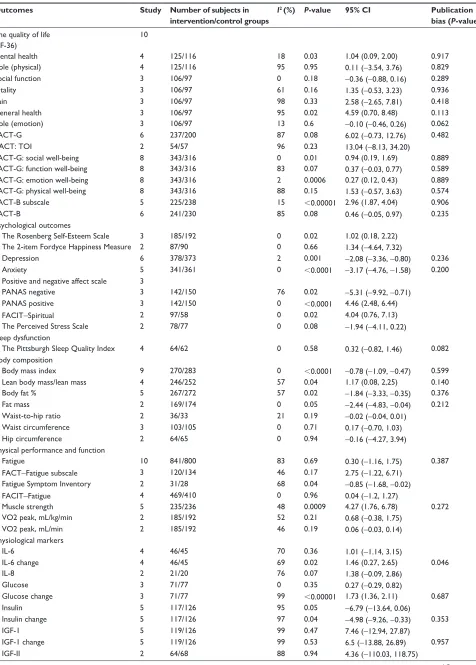
Table 3 Meta-analysis of the effect of exercise intervention in breast cancer survivors
Outcomes Study Number of subjects in
intervention/control groups
I2 (%) P-value 95% CI Publication
bias (P-value)
The quality of life 10
(sF-36)
Mental health 4 125/116 18 0.03 1.04 (0.09, 2.00) 0.917
role (physical) 4 125/116 95 0.95 0.11 (-3.54, 3.76) 0.829
social function 3 106/97 0 0.18 -0.36 (-0.88, 0.16) 0.289
Vitality 3 106/97 61 0.16 1.35 (-0.53, 3.23) 0.936
Pain 3 106/97 98 0.33 2.58 (-2.65, 7.81) 0.418
general health 3 106/97 95 0.02 4.59 (0.70, 8.48) 0.113
role (emotion) 3 106/97 13 0.6 -0.10 (-0.46, 0.26) 0.062
FacT-g 6 237/200 87 0.08 6.02 (-0.73, 12.76) 0.482
TacT: TOi 2 54/57 96 0.23 13.04 (-8.13, 34.20)
FacT-g: social well-being 8 343/316 0 0.01 0.94 (0.19, 1.69) 0.889
FacT-g: function well-being 8 343/316 83 0.07 0.37 (-0.03, 0.77) 0.589
FacT-g: emotion well-being 8 343/316 2 0.0006 0.27 (0.12, 0.43) 0.889
FacT-g: physical well-being 8 343/316 88 0.15 1.53 (-0.57, 3.63) 0.574
FacT-B subscale 5 225/238 15 0.00001 2.96 (1.87, 4.04) 0.906
FacT-B 6 241/230 85 0.08 0.46 (-0.05, 0.97) 0.235
Psychological outcomes
The rosenberg self-esteem scale 3 185/192 0 0.02 1.02 (0.18, 2.22)
The 2-item Fordyce happiness Measure 2 87/90 0 0.66 1.34 (-4.64, 7.32)
Depression 6 378/373 2 0.001 -2.08 (-3.36, -0.80) 0.236
anxiety 5 341/361 0 0.0001 -3.17 (-4.76, -1.58) 0.200
Positive and negative affect scale 3
Panas negative 3 142/150 76 0.02 -5.31 (-9.92, -0.71)
Panas positive 3 142/150 0 0.0001 4.46 (2.48, 6.44)
FaciT-spiritual 2 97/58 0 0.02 4.04 (0.76, 7.13)
The Perceived stress scale 2 78/77 0 0.08 -1.94 (-4.11, 0.22)
sleep dysfunction
The Pittsburgh sleep Quality index 4 64/62 0 0.58 0.32 (-0.82, 1.46) 0.082
Body composition
Body mass index 9 270/283 0 0.0001 -0.78 (-1.09, -0.47) 0.599
lean body mass/lean mass 4 246/252 57 0.04 1.17 (0.08, 2,25) 0.140
Body fat % 5 267/272 57 0.02 -1.84 (-3.33, -0.35) 0.376
Fat mass 2 169/174 0 0.05 -2.44 (-4.83, -0.04) 0.212
Waist-to-hip ratio 2 36/33 21 0.19 -0.02 (-0.04, 0.01)
Waist circumference 3 103/105 0 0.71 0.17 (-0.70, 1.03)
hip circumference 2 64/65 0 0.94 -0.16 (-4.27, 3.94)
Physical performance and function
Fatigue 10 841/800 83 0.69 0.30 (-1.16, 1.75) 0.387
FacT-Fatigue subscale 3 120/134 46 0.17 2.75 (-1.22, 6.71)
Fatigue symptom inventory 2 31/28 68 0.04 -0.85 (-1.68, -0.02)
FaciT-Fatigue 4 469/410 0 0.96 0.04 (-1.2, 1.27)
Muscle strength 5 235/236 48 0.0009 4.27 (1.76, 6.78) 0.272
VO2 peak, ml/kg/min 2 185/192 52 0.21 0.68 (-0.38, 1.75)
VO2 peak, ml/min 2 185/192 46 0.19 0.06 (-0.03, 0.14)
Physiological markers
il-6 4 46/45 70 0.36 1.01 (-1.14, 3.15)
il-6 change 4 46/45 69 0.02 1.46 (0.27, 2.65) 0.046
il-8 2 21/20 76 0.07 1.38 (-0.09, 2.86)
glucose 3 71/77 0 0.35 0.27 (-0.29, 0.82)
glucose change 3 71/77 99 0.00001 1.73 (1.36, 2.11) 0.687
insulin 5 117/126 95 0.05 -6.79 (-13.64, 0.06)
insulin change 5 117/126 97 0.04 -4.98 (-9.26, -0.33) 0.353
igF-1 5 119/126 99 0.47 7.46 (-12.94, 27.87)
igF-1 change 5 119/126 99 0.53 6.5 (-13.88, 26.89) 0.957
igF-ii 2 64/68 88 0.94 4.36 (-110.03, 118.75)
(Continued)
OncoTargets and Therapy downloaded from https://www.dovepress.com/ by 118.70.13.36 on 26-Aug-2020
Dovepress effects of exercise in breast cancer survivors
Table 3 (Continued)
Outcomes Study Number of subjects in
intervention/control groups
I2 (%) P-value 95% CI Publication
bias (P-value)
igF-ii change 2 64/68 0 0.0001 -54.21 (-61.41, -47.00)
igFBP-1 4 82/88 46 0.0001 -3.16 (-4.40, -1.91)
igFBP-1 change 4 82/88 0 0.0001 -2.93 (-3.93, -1.93) 0.639
igFBP-3 5 119/126 93 0.9 -0.2 (-3.24, 2.48) 0.830
igFBP-3 change 5 119/126 86 0.55 0.49 (-1.11, 2.08)
Abbreviations: FacT-B, Functional assessment of cancer Therapy–Breast Questionnaire; FacT-g, Functional assessment of cancer Therapy-general; FaciT–spiritual,
Functional assessment of chronic illness Therapy–spiritual well-being scale; igF-i, insulin-like growth factor-i; igF-ii, insulin-like growth factor-ii; igFBP-1, insulin-like growth factor binding protein-1; igFBP-3, insulin-like growth factor binding protein-3; il, interleukin; Panas, Positive and negative affect schedule; sF-36, short form 36 questionnaire; VO2 peak, peak oxygen consumption; CI, confidence interval; TOI, Trial Outcome Index; FACIT-Fatigue, Functional Assessment of Chronic Illness Therapy–Fatigue scale.
Figure 2 The association between exercise intervention and quality of life in breast cancer survivors.
Notes: (A) sF-36 mental health, (B) sF-36 general health, (C) FacT emotion well-being, and (D) FacT social well-being.
Abbreviations: CI, confidence interval; FACT, Functional Assessment of Cancer Therapy; SD, standard deviation; SF-36, short form 36 questionnaire; df, degree of freedom. 0HDQGLIIHUHQFH ,9UDQGRP&O 6WGPHDQGLIIHUHQFH ,9IL[HG&O ± ± ± ± )DYRUVH[SHULPHQWDO )DYRUVH[SHULPHQWDO )DYRUVFRQWURO )DYRUVFRQWURO ± ± )DYRUVH[SHULPHQWDO )DYRUVFRQWURO ± ± )DYRUVH[SHULPHQWDO )DYRUVFRQWURO 6WGPHDQGLIIHUHQFH ,9IL[HG&, 0HDQGLIIHUHQFH ,9IL[HG&,
+HWHURJHQHLW\τ2 χ GI 3,
7HVWIRURYHUDOOHIIHFW= 3
+HWHURJHQHLW\χ GI 3 , 7HVWIRURYHUDOOHIIHFW= 3
7HVWIRUVXEJURXSGLIIHUHQFHVQRWDSSOLFDEOH
$
%
+HWHURJHQHLW\χ GI 3 ,
7HVWIRURYHUDOOHIIHFW= 3
+HWHURJHQHLW\χ GI 3 ,
7HVWIRURYHUDOOHIIHFW= 3
&
6)PHQWDOKHDOWK %DVHQ(QJTXLVWHWDO &DGPXVHWDO &DGPXVHWDO 6SURGHWDO 6DQGDOHWDO 6XEWRWDO&O 6WXG\RUVXEJURXS 6)JHQHUDOKHDOWK %DVHQ(QJTXLVWHWDO &DGPXVHWDO &DGPXVHWDO 6SURGHWDO 6XEWRWDO&O 6WXG\RUVXEJURXS /LWWPDQHWDO &RXUQH\DHWDO 0LOQHHWDO 5RJHUVHWDO 0RDGHOHWDO &DGPXVHWDO &DGPXVHWDO 0XWULHHWHWDO 'DQKDXHUHWDO 7RWDO&, 6WXG\RUVXEJURXS 0RDGHOHWDO /LWWPDQHWDO &RXUQH\DHWDO 0LOQHHWDO 5RJHUVHWDO &DGPXVHWDO &DGPXVHWDO 0XWULHHWHWDO +D\HVHWDO 7RWDO&, 6WXG\RUVXEJURXS'
7RWDO 7RWDO 7RWDO 7RWDO 6' 6' 6' 6' 7RWDO 7RWDO 7RWDO 7RWDO :HLJKW :HLJKW :HLJKW :HLJKW ±± ± ± ± ± ± ± 6WGPHDQGLIIHUHQFH ,9IL[HG&O 0HDQGLIIHUHQFH ,9UDQGRP&O ± ± ± ± ± ±± ± ± ± ± ±± ± ±± ± ± ± ± 6WGPHDQGLIIHUHQFH ,9IL[HG&, 0HDQGLIIHUHQFH ,9IL[HG&, 6' 6' 6' 6' ([SHULPHQWDO ([SHULPHQWDO ([SHULPHQWDO 0HDQ 0HDQ 0HDQ 0HDQ ([SHULPHQWDO &RQWURO &RQWURO &RQWURO 0HDQ 0HDQ 0HDQ 0HDQ &RQWUROOncoTargets and Therapy downloaded from https://www.dovepress.com/ by 118.70.13.36 on 26-Aug-2020
Dovepress
Zhu et al
Figure 3 The association between exercise intervention and depression and anxiety in breast cancer survivors. Notes: (A) Depression and (B) anxiety.
Abbreviations: CI, confidence interval; SD, standard deviation; df, degree of freedom.
0HDQGLIIHUHQFH ,9IL[HG&O ± ± ± ± )DYRUVH[SHULPHQWDO )DYRUVH[SHULPHQWDO )DYRUVFRQWURO )DYRUVFRQWURO 0HDQGLIIHUHQFH ,9IL[HG&O ([SHULPHQWDO &RQWURO
+HWHURJHQHLW\χ GI 3 ,
7HVWIRURYHUDOOHIIHFW= 3
+HWHURJHQHLW\χ GI 3 ,
7HVWIRURYHUDOOHIIHFW= 3 6WXG\RUVXEJURXS 0RDGHOHWDO $O\VRQ% &RXUQH\DHWDO &RXUQH\DHWDO 0LOQHHWDO &RXUQH\DHWDO &RXUQH\DHWDO %RZHUHWDO &DGPXVHWDO &DGPXVHWDO 5DRHWDO &DGPXVHWDO &DGPXVHWDO 0XWULHHWHWDO 'DQKDXHUHWDO 7RWDO&O 7RWDO&O 6WXG\RUVXEJURXS ([SHULPHQWDO 6' 6' 7RWDO 7RWDO &RQWURO 6' 6' 7RWDO 7RWDO :HLJKW :HLJKW 0HDQ 0HDQ 0HDQ 0HDQ
$
%
0HDQGLIIHUHQFH ,9IL[HG&O ±± ±± ±± ±± ±± ±± ±±± ±± ±±± ±±± ±± ±± ±± ±± ±±± ±± 0HDQGLIIHUHQFH ,9IL[HG&O 1RWHVWLPDEOHFigure 4 The association between exercise intervention and body mass index in breast cancer survivors. Abbreviations: CI, confidence interval; SD, standard deviation; df, degree of freedom.
6WXG\RUVXEJURXS 0HDQGLIIHUHQFH
,9IL[HG&, 0HDQ
([SHULPHQWDO &RQWURO
7RWDO 0HDQ 6' 7RWDO :HLJKW 0HDQGLIIHUHQFH,9IL[HG&, 6' /LWWPDQHWDO &RXUQH\DHWDO 6FKPLW]HWDO 5RJHUVHWDO ,UZLQHWDO -DQHOVLQVHWDO 0XWULHHWHWDO 1LNDQGHUHWDO 7RWDO&,
+HWHURJHQHLW\χ GI 3 ,
7HVWIRURYHUDOOHIIHFW= 3
5RJHUVHWDO ± ± ±±± ± ± ±±± ±± ±± ±± ± ± ± )DYRUVH[SHULPHQWDO )DYRUVFRQWURO
results of physical function and symptom
Muscle strength was reported in five studies, which indicated significant improvement (I2=48%, P=0.0009, 95% CI: 1.76,
6.78, Figure 5) in exercise intervention group. Besides, no sig-nificant improvement was showed on peak oxygen consump-tion, based on the data from two studies (Table 3).27,30,34,40,41
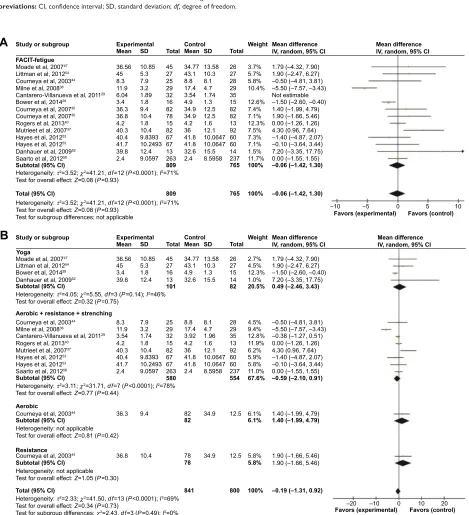
Fatigue was assessed in 12 studies, the pooled results of which indicated that there was no difference on fatigue between the intervention and control groups (Figure 6).29,30,36,37,40,47,50,52–54,58
In the present of high heterogeneity, we performed the sub-group analysis stratified by the measurement method and the type of exercise intervention (Figure 6). However, the effect of exercise on the symptom of fatigue still remained insignificant in both of the subgroups, except small reduction in Fatigue
Symptom Inventory (I2=68%, P=0.04, 95% CI: -1.68, -0.02).
No evidence of publication bias was detected in any of the results (Table 3).
results of physiological markers
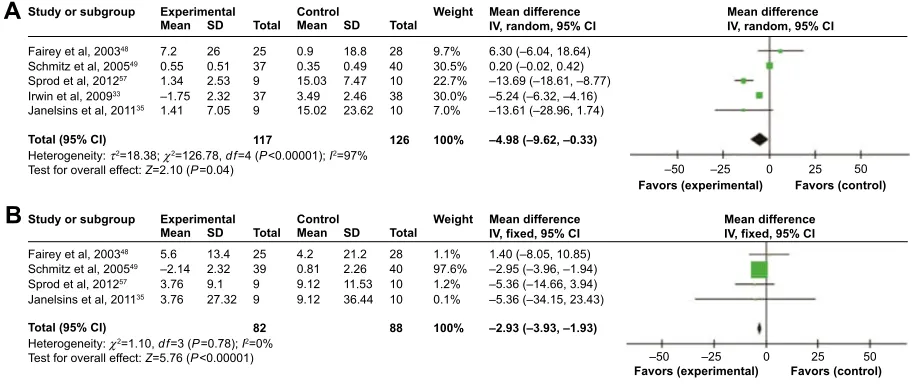
Eight physiological markers were examined in this meta-analysis (Table 3). When the data of postintervention were used, only insulin (I2=95%, P=0.05, 95% CI: -13.64, 0.06)
and insulin-like growth factor binding protein (IGFBP)-1 (I2=46%, P0.00001, 95% CI: -4.40, -1.91) were
signifi-cantly reduced after exercise intervention. However, based on the changed serum concentration of physiological markers after intervention (postintervention minus baseline), exercise sig-nificantly reduced the serum concentration of insulin (I2=97%,
OncoTargets and Therapy downloaded from https://www.dovepress.com/ by 118.70.13.36 on 26-Aug-2020
Dovepress effects of exercise in breast cancer survivors
Figure 5 The association between exercise intervention and muscle strength in breast cancer survivors. Abbreviations: CI, confidence interval; SD, standard deviation; df, degree of freedom.
0HDQGLIIHUHQFH ,9IL[HG&,
± ±
)DYRUVH[SHULPHQWDO )DYRUVFRQWURO +HWHURJHQHLW\χ GI 3 ,
7HVWIRURYHUDOOHIIHFW= 3
&RXUQH\DHWDO &RXUQH\DHWDO 0LOQHHWDO %DWWDJOLQL 5RJHUVHWDO 5RJHUVHWDO 7RWDO&, 6WXG\RUVXEJURXS 0HDQ 7RWDO 0HDQ 6' 7RWDO :HLJKW ± ± ± 0HDQGLIIHUHQFH ,9IL[HG&, 6' ([SHULPHQWDO &RQWURO 0HDQGLIIHUHQFH ,9UDQGRP&, 0HDQGLIIHUHQFH ,9UDQGRP&, ± ± )DYRUVH[SHULPHQWDO )DYRUVFRQWURO ± ± )DYRUVH[SHULPHQWDO )DYRUVFRQWURO
$
([SHULPHQWDO &RQWURO<RJD 0RDGHHWDO 0RDGHHWDO )$&,7IHWLJXH $HURELFUHVLVWDQFHVWUHQFKLQJ $HURELF 5HVLVWDQFH /LWWPDQHWDO /LWWPDQHWDO &RXUQH\DHWDO 0LOQHHWDO &RXUQH\DHWDO 0LOQHHWDO &DQWDUHUR9LOODQXHYDHWDO &DQWDUHUR9LOODQXHYDHWDO %RZHUHWDO %RZHUHWDO &RXUQH\DHWDO &RXUQH\DHWDO 5RJHUVHWDO 0XWULHHWHWDO +D\HVHWDO +D\HVHWDO 'DQKDXHUHWDO 'DQKDXHUHWDO 6DDUWRHWDO 6XEWRWDO&, 5RJHUVHWDO 0XWULHHWHWDO +D\HVHWDO +D\HVHWDO 6DDUWRHWDO 6XEWRWDO&, 6XEWRWDO&, 7RWDO&, 6XEWRWDO&, 6WXG\RUVXEJURXS 7RWDO&, &RXUQH\DHWDO 6XEWRWDO&, &RXUQH\DHWDO 6WXG\RUVXEJURXS
%
0HDQ 0HDQ 7RWDO 7RWDO 6' 6' 7RWDO 7RWDO :HLJKW :HLJKW ±± ±±± ±± ± ±± ±± ± ±± ± ± ±±± ± ± ± ± ±± ±±± 1RWHVWLPDEOH ±±± ± ± ± ±± ±± ± ± ±± ±± ±± 0HDQGLIIHUHQFH ,9UDQGRP&, ± ± ± ± 0HDQGLIIHUHQFH ,9UDQGRP&, 6' 6' ([SHULPHQWDO 0HDQ 0HDQ &RQWURO+HWHURJHQHLW\τ χ GI 3,
7HVWIRURYHUDOOHIIHFW= 3
+HWHURJHQHLW\τ χ GI 3 , 7HVWIRURYHUDOOHIIHFW= 3
+HWHURJHQHLW\τ χ GI 3, 7HVWIRURYHUDOOHIIHFW= 3
+HWHURJHQHLW\QRWDSSOLFDEOH 7HVWIRURYHUDOOHIIHFW= 3
+HWHURJHQHLW\QRWDSSOLFDEOH 7HVWIRURYHUDOOHIIHFW= 3
+HWHURJHQHLW\τ χ GI 3,
7HVWIRURYHUDOOHIIHFW= 3
7HVWIRUVXEJURXSGLIIHUHQFHVQRWDSSOLFDEOH
+HWHURJHQHLW\τ χ GI 3,
7HVWIRURYHUDOOHIIHFW= 3
7HVWIRUVXEJURXSGLIIHUHQFHVχ GI 3 ,
Figure 6 The association between exercise intervention and fatigue in breast cancer survivors. Notes: (A) Overall effect and (B) subgroup analysis based on the type of exercise intervention.
Abbreviations: CI, confidence interval; FACIT, Functional Assessment of Chronic Illness Therapy; SD, standard deviation; df, degree of freedom.
OncoTargets and Therapy downloaded from https://www.dovepress.com/ by 118.70.13.36 on 26-Aug-2020
Dovepress
Zhu et al
P0.00001, 95% CI: -9.26, -0.33, Figure 7), IGFBP-1 (I2=0%, P0.00001, 95% CI: -3.93, -1.93, Figure 7), and
insulin-like growth factor (IGF)-II (I2=0%, P0.00001,
95% CI: -61.41, -47.00). Significant increases were shown
in interleukin (IL)-6 (I2=69%, P=0.02, 95% CI: 0.27, 2.65)
and glucose (I2=99%, P0.00001, 95% CI: 0.27, 2.65). There
were substantial heterogeneity in some of the physiological markers, and evident publication bias was only observed in IL-6 (P=0.046) (Table 3).
Discussion
In this meta-analysis, we summarized the effects of exercise intervention on breast cancer survivors, including 53 outcomes reported from 33 articles. Results showed that exercise was associated with significant improvements in quality of life, self-esteem, and the response attitude toward life. Besides, it allevi-ated the symptoms of depression and anxiety in breast cancer survivors. In addition to the beneficial outcome in body com-position, exercise also increased muscle strength in the inter-vention groups. Furthermore, the serum concentration of some physiological markers, such as insulin, IGF-II, and IGFBP-1, was significantly reduced after exercise intervention.
In line with previous meta-analyses,19,59,60 the pooled
results supported the evidences that exercise improved the quality of life in cancer patients. However, a significant improvement was shown in general health subscale of SF-36 in our meta-analysis, but not in general health scale of the Functional Assessment of Cancer Therapy.
Similarly, a statistically significant increase was only detected in the social function and emotion function scales of
the Functional Assessment of Cancer Therapy, but not in the role emotion and social function subscales of SF-36. It was the same as the evidence of Fong who discovered that exercise improved SF-36 scores in physical function, social function, and mental health with mixed type of cancer survivors.61
Thus, despite the fact that exercise was proved to improve quality of life, there were slight differences in the domains of quality life, owing to the differences in the features of patients and exercise, as well as measurement methods.
According to the sensitivity analysis of the Functional Assessment of Cancer Therapy, the study by Mustian was identified as an outlier: the timing of intervention was during treatment in the study by Milne, whereas, the other studies were posttreatment.36 When excluding this outliers from
analysis, the heterogeneity in the Functional Assessment of Cancer Therapy subscales (social being, function well-being, emotion well-well-being, physical well-being) decreased
evidently (I2=0%, 27%, 20%, 0%, 8%, respectively).
The study by Basen-Engquist was also identified as an outlier, based on the sensitivity analysis of SF-36 subscales: in this study, the exercise intervention was lifestyle interven-tion, which encouraged participants to integrate activity into daily routine and perform activities they choose.26 When
this study was excluded, the heterogeneity was evidently decreased in vitality (I2=0%), body pain of SF-36 (I2=0%),
and general health (I2=86%).
In our current meta-analysis, we only calculated the effect size of outcomes reported in at least two studies. Therefore, the data of life quality measured by the Functional Assessment
of Cancer Therapy–Anemia,30 the European Organization
Figure 7 The association between exercise intervention and insulin and igFBP-1 in breast cancer survivors. Notes: (A) insulin and (B) igFBP-1.
Abbreviations: CI, confidence interval; IFGBP-1, insulin-like growth factor binding protein-1; SD, standard deviation; df, degree of freedom.
0HDQGLIIHUHQFH ,9UDQGRP&,
0HDQGLIIHUHQFH ,9IL[HG&,
± ±
)DYRUVH[SHULPHQWDO )DYRUVFRQWURO
± ±
)DYRUVH[SHULPHQWDO )DYRUVFRQWURO +HWHURJHQHLW\τ χ GI 3,
7HVWIRURYHUDOOHIIHFW= 3
+HWHURJHQHLW\χ GI 3 ,
7HVWIRURYHUDOOHIIHFW= 3
$
%
([SHULPHQWDO &RQWURO
6FKPLW]HWDO
,UZLQHWDO
-DQHOVLQVHWDO
)DLUH\HWDO
6SURGHWDO
6FKPLW]HWDO
)DLUH\HWDO
6SURGHWDO
7RWDO&, 7RWDO&, 6WXG\RUVXEJURXS
-DQHOVLQVHWDO
6WXG\RUVXEJURXS
±
±
0HDQ
0HDQ
7RWDO
7RWDO
6'
6'
7RWDO
7RWDO
:HLJKW
:HLJKW
±±
±±±
±±± ±
±± ±±±
±±±
± ± ±±±
0HDQGLIIHUHQFH ,9UDQGRP&,
±±
0HDQGLIIHUHQFH ,9IL[HG&,
6'
6' ([SHULPHQWDO
0HDQ
0HDQ &RQWURO
OncoTargets and Therapy downloaded from https://www.dovepress.com/ by 118.70.13.36 on 26-Aug-2020
Dovepress effects of exercise in breast cancer survivors
for the Research and Treatment of Cancer-Quality of Life
(EORTCQoLC30 questionnaire),42,58 the Cancer
Rehabilita-tion EvaluaRehabilita-tion System-Short Form,56 and the
WHOQOL-BREF were not pooled.45 Even though all the five studies
favored exercise intervention, only three of them reported a clinical significant improvement in quality of life on breast cancer survivors,42,45,56 and the results in other two studies
failed to reach statistical significance.30,58
We observed a significant improvement in depression, anxiety, and self-esteem in breast cancer patients, which were frequently reported in pervious meta-analyses and systematic reviews with mixed cancer patients.59,61–64 We also discovered
that the attitude toward life in intervention group was more posi-tive than control group. The posiposi-tive attitude played a critical role in the emotion well-being, which might have some correla-tion with improved quality of life in breast cancer survivors.
There was no clinical significant change on the symptom of fatigue between groups, based on the pooled results in our meta-analysis, which was consistent with a previous
meta-analysis.61 However, physical activity was reported to
be associated with improvement on the symptom of fatigue in several meta-analyses, both breast and other cancer survivors.19,59,62,65,66
In the subgroup analysis based on the measurement meth-ods, a significant decrease of fatigue was only observed in the Fatigue Symptom Inventory. We then stratified the results by the types of intervention, the results of which still remained insignificant. Even yoga, a “mind–body” exercise, had no significant effect on fatigue, which had been suggested to be associated with a moderate reduction of fatigue in a
previ-ous study.67 We further performed sensitivity analysis, the
results of which indicated the studies by Bower and Milne exerted substantial influence to the overall estimate.28,36
How-ever, when excluding the two studies, the fatigue level was increased in exercise intervention groups (I2=50%, P=0.05,
95% CI: 0.02, 2.19), which had not been reported in previous meta-analysis. Given the current inconsistent conclusions, more researches are needed to further examine this effect.
Several system reviews and meta-analyses had suggested positive effects of exercise on peak oxygen consumption.18,19,61,66
However, the pooled results of two studies observed no sta-tistical significance change of peak oxygen consumption between groups, which might be attributed to the small size in our meta-analysis. Furthermore, owing to the lack of
suf-ficient data, the outcomes, such as the 3-minute step test52
and the figure-8 running test,38 were not included in our
meta-analysis, which also showed improvements compared with control groups.
Results indicated that exercise led to a statistically sig-nificant reduction in BMI and insulin. Each 5 kg weight gain might increase the breast cancer-specific mortality by 13%
and all-caused mortality by 12%.68 Besides, research showed
that insulin was associated with BMI, and the increase of insulin was related to a twofold increased risk of breast
cancer recurrence.69 Thus, the decreased BMI and insulin
from exercise might potentially contribute to a reduced risk of mortality and recurrence on breast cancer survivors.
Additionally, one study suggested that IGFBP-1 and IGFBP-5 as IGF-I antagonists might block mammary
gland development.70 However, pooled results showed that
IGFBP-1 was significantly decreased in exercise intervention group, while the change of IGF-1 was insignificant. Contrary to previous results, two meta-analyses reported only IGF-I was reduced significantly, and no evidences of significant change were found in insulin, IGFBP-1, and glucose in both breast cancer patients or mixed cancer patients.61,62 Therefore,
given this inconsistency, we should treat the association between exercise and the change of physiological markers with caution, and more researches are needed before making a confirmed conclusion.
The sensitivity analysis of physiological markers identi-fied two outliers: the study by Schmitz and Melinda, in which the duration of intervention lasted for 6 to 12 months, while the durations were 12 to 15 weeks in other studies.34,39
There-fore, it is likely that the duration of exercise intervention is the source of heterogeneity among these results.
limitations
In our meta-analysis, we only included published randomized control trails in two databases, though we further searched the relevant reference lists for potential articles, which may increase the risk of publication bias. Besides, there was a lack of consistency in terms of the outcomes reported and measurement methods among the studies. The outcomes, such as erythrocyte Levels,32 salivary cortisol,29 were reported
in only one study respectively, and we, therefore, failed to calculate their effect sizes in present meta-analysis.
Similarly, the quality of life was measured by different methods, which made it difficult to combine the diverse out-comes. Therefore, we only pooled the outcomes of quality life components measured by the Functional Assessment of Cancer Therapy and SF-36, respectively, which were used in most of the studies.
Furthermore, some data could not be extracted in sev-eral studies, and we did not try to contact the authors for detailed information. In addition, we used the mean and
OncoTargets and Therapy downloaded from https://www.dovepress.com/ by 118.70.13.36 on 26-Aug-2020