*Corresponding author, [email protected]
SHORT COMMUNICATION
EFFECT OF NaCl, CaCl
2AND THEIR INTERACTION ON PROLINE, GLYCINE
BETAINE CONTENTS AND LIPOXYGENASE ACTIVITY DURING SEEDLING
DEVELOPMENT OF GROUNDNUT (ARACHIS HYPOGEA L.)
S.K.M. BASHA1, G. FAREEDA2 AND N. SAVITHRAMMA*
1NBKR Research Center, Division of Plant Physiology, Vidyanagar- 524 413
2Department of Biochemistry, *Department of Botany, S.V. University, Tirupati -517 502, A.P.
Received on 18th Jan., 2011; Revised and Accepted on 15th Sept, 2011
The present study was carried out to study the proline, glycine betaine (GB) contents and lipoxygenase (LOX) activity under NaCl salinity and its amelioration by CaCl2 during early seedling growth of groundnut (Arachis hypogaea L.). Proline and glycine betaine contents were found to be increased more by addition of CaCl2 to the NaCl stressed seedlings than NaCl alone. NaCl treatment caused decrease in the level of LOX activity when compared to the seedlings treated with either CaCl2 or its combination with NaCl. LOX showed a single peak with an UV absorption maximum at 235 nm on HPLC.
Key words: Glycine betaine, lipoxygenase, proline, salinity stress
induced damage (Matysik et al. 2002). Groundnut is one of the important oil seed crops grown in various parts of India and is known to be sensitive to salinity. Hence, the present study was aimed to investigate the adverse effects of NaCl salinity and its amelioration by CaCl2 on LOX activity, proline and GB content of groundnut cultivar TPT-2.
Seeds of groundnut cultivar TPT-2 were obtained from the Regional Agricultural Research Centre (Tirupati, Andhra Pradesh, India). The seeds were surface sterilised with 0.02% HgCl2 solution and divided into four batches and germinated in bread boxes containing fluted filter paper towels. Seedlings were subjected to the following treatments: irrigation with (1) Distilled water (control) (2) 100 mM NaCl, (3) 30 mM
CaCl2, (4) 100 mM NaCl + 30 mM CaCl2. Seedlings
were illuminated continuously with fluorescent lamps in a growth room. The temperature was maintained at Salinity affects the yield of agricultural crops by
25±2°C. The seedlings were harvested randomly from the bread boxes on 3, 6, 9 and 12th day from the bread boxes. Measurements were carried out separately in the cotyledons and the embryonic axis.
Proline content was determined by the method of Bates et al. (1973) and GB was extracted following the method of Grieve and Grattan (1983). Data was analysed by ANOVA. The values are mean ± SE of five replications and means compared by the least significant difference test at the 0.05 level.
LOX activity was assayed by determining O2
consumption using Clark’s Oxygen Electrode (Model 5300). 5 gm each of the cotyledons and embryonic axis of the seedlings were homogenised with 10 ml of 200 mM of phosphate buffer (pH 7.4). The homogenate was filtered through muslin cloth and centrifuged at 25,000 Xg for 60 min. The supernatant was used as a source of enzyme. The assay mixture contained 2 ml of 200 mM phosphate buffer (pH 7.4), 100 μl of enzyme solution and 0.2 μl of 40 mM linoleic acid (in ethanol). The enzyme activity was measured at 25°C. HPLC was carried out on reverse phase column equipped with a pump model 6000A and an injector model U 6K. A reaction was carried out in an oxygenated buffer, 15 mM potassium phosphate (pH 7.0) with an excess of enzyme. The
reaction was initiated by the addition of Arachidonic acid (133 μM) and incubated for 2 min at 30°C linoleic acid and the products were extracted immediately twice with hexane: ether (1:1v/v). The organic extracts were pooled, dried over anhydrous sodium sulphate and evaporated to dryness. The residue was reconstituted in the HPLC solvent system of hexane: 2-propanol: acetic acid (1000:4:1). The HPETE was determined on RP-8 column at a flow rate of 2 μl min-1.
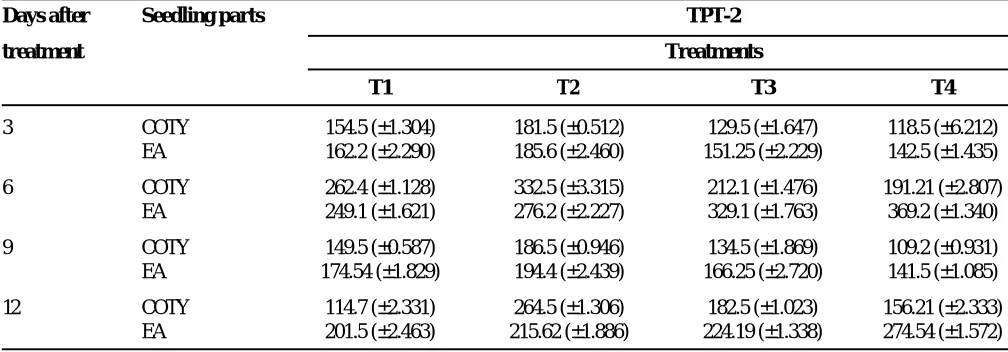
The proline content increased in the presence of NaCl in both cotyledons and the embryonic axis of groundnut seedlings. Accumulation was high in embryonic axis whereas cotyledons showed lower accumulation of proline under salt stress. On the other hand proline content decreased by the addition of CaCl2, while CaCl2 alone was similar in the effect of the control (Table 1) (p<0.05). As seedlings grew, the specific proline content of the cotyledons decreased in all the treatments possibly due to a dilution effect while in the embryonic tissue, it increased with advanced seedling age in the presence of NaCl. Our results are supported by Misra and Gupta (2005). Increase in proline content under NaCl + CaCl2 treatment was much less than NaCl treatment. Increased proline may be an adaptation to overcome the salinity (Girija et al. 2002).
Table 1. Effect of NaCl, CaCl2 and their interaction on changes in proline content (mg g-1 fw) of cotyledons (COTY) and embryonic axis (EA) of groundnut cultivar during seedling growth (Values are mean ± SE of 3 replications) (p< 0.01). (T1 - control; T2 -100 mM NaCl; T3-30 mM CaCl2; T4 -100 mM NaCl +30 mM NaCl)
Days after Seedling parts TPT-2
treatment Treatments
T1 T2 T3 T4
3 COTY 154.5 (±1.304) 181.5 (±0.512) 129.5 (±1.647) 118.5 (±6.212) EA 162.2 (±2.290) 185.6 (±2.460) 151.25 (±2.229) 142.5 (±1.435)
6 COTY 262.4 (±1.128) 332.5 (±3.315) 212.1 (±1.476) 191.21 (±2.807) EA 249.1 (±1.621) 276.2 (±2.227) 329.1 (±1.763) 369.2 (±1.340)
9 COTY 149.5 (±0.587) 186.5 (±0.946) 134.5 (±1.869) 109.2 (±0.931) EA 174.54 (±1.829) 194.4 (±2.439) 166.25 (±2.720) 141.5 (±1.085)
GB content was higher in the embryonic axis in comparison with cotyledons. GB content increased in addition of CaCl2 to NaCl stressed seedlings than NaCl alone (Table 2) (p <0.05). For all treatments there was consistently more GB in embryonic axis than the cotyledons. CaCl2 alone also promoted GB synthesis significantly above control levels especially in the cotyledons. An increase in the GB levels under stress conditions was found to increase the sodium flux from the cytoplasm to the vacuole and was also known to modify the membrane behaviour in water stressed barley leaves (Hitz et al. 1981). Sodium chloride stress increased the level of GB in groundnut cotyledonds and embryonic axis, addition of CaCl2 to the NaCl stressed seedlings increased the GB to a greater extent than in unstressed seedlings. The findings suggested that the cultivar TPT-2 is sensitive to NaCl stress and CaCl2 treatment alleviated NaCl stress.
The level of LOX activity of the cotyledons increased upto 6th day of sowing followed by continuous decline in all treatments (Table 1), and similar trend was observed by Tappel et al. (1963). NaCl treatment caused decrease in the level of LOX activity when compared to the seedlings treated with CaCl2 and its combination with NaCl. In CaCl2 treated seedlings LOX activity was found to be higher compared to the NaCl treatment and NaCl + CaCl2 treatments. The level of LOX activity of
embryonic axis of the control seedlings showed a gradual decrease from 3rd day to 12th day after sowing. NaCl treatment caused a gradual decline in the LOX activity of the embryonic axis of the seedlings upto 9th day followed by a sudden decrease by 12th day after sowing.
On the other hand in CaCl2 treated seedlings LOX
activity increased steadily upto 9th day followed by a decline. The LOX enzyme is widely distributed in plant tissue being particularly abundant in leguminous plants and its activities needed to initiate lipid peroxidation (Funk
et al. 1986). During the progressive germination of
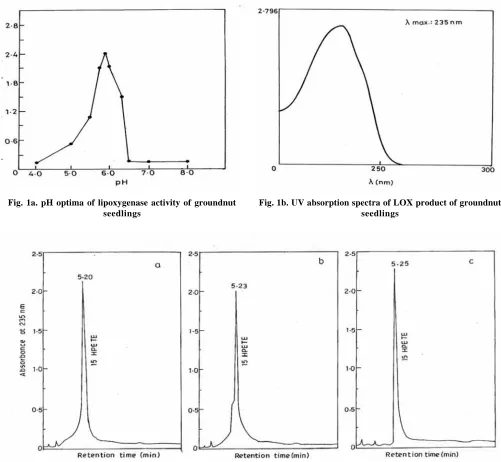
groundnut cotyledons CaCl2 prevents the formation of linoleic and linolenic acid from Sn2 acyl-side chain may be by maintaining cytosolic Ca2+ at homeostatic level and because of the decrease in substrate level LOX activity declines. This may be the reason for the decreased LOX activity under CaCl2 treatment and its combination with NaCl. The biological implication of the CaCl2 in lowering endogenous activity of the LOX enzyme include decleration of production of the free radicals and possibly preventing oxidation of phospholipids (Grossman and Leshem 1978) in Pisum. The pH optima of the groundnut LOX was found to be 6.0 (Fig. 1a). When arachidonic acid was incubated with the groundnut LOX, a single major peak with an UV absorption maximum at 235 nm (Fig. 1b), characteristic of a conjugated diene system was resolved on HPLC with standard 15-HPETE (Fig. 1c). This data suggests that groundnut LOX is rather
Table 2. Effect of NaCl, CaCl2 and their interaction on changes in glycine betaine content (mg g-1 fw) of cotyledons (COTY) and embryonic axis (EA) of ground nut cultivars during seedling growth. (Values are mean ± SE of 3 replications) (p<0.01). (T1 - control; T2 -100 mM NaCl; T3-30 mM CaCl2; T4
-100 mM NaCl +30 mM NaCl)
Days after Seedling parts TPT-2
treatment Treatments
T1 T2 T3 T4
3 COTY 0.038 (±0.002) 0.049 (±0.004) 0.074 (±0.002) 0.096 (±0.003) EA 0.132 (±0.003) 0.151(±0.003) 0.179 (±0.004) 0.192 (±0.006)
6 COTY 0.132 (±0.003) 0.146 (±0.007) 0.172 (±0.001) 0.181 (±0.003) EA 0.284 (±0.003) 0.300 (±0.005) 0.332 (±0.010) 0.356 (±0.005)
9 COTY 0.112 (±0.003) 0.132 (±0.003) 0.146 (±0.003) 0.159 (±0.006) EA 0.261 (±0.002) 0.274 (±0.002) 0.304 (±0.002) 0.311 (±0.005)
Fig. 1a. pH optima of lipoxygenase activity of groundnut seedlings
Fig. 1b. UV absorption spectra of LOX product of groundnut seedlings
Fig. 1c. HPLC profiles at 235 nm of a) standard 15-HPETE b) products generated after incubation of lipoxygenase with arachidonic acid and c) mixture of ‘a’ and ‘b’
specific for the insertion of O2 and 15th carbon on acid molecule.
Both the glycine betaine and proline production were induced by NaCl in cotyledons and embryonic axis of groundnut seedlings. Concentrations of osmolytes were much greater in embryonic axis than in cotyledon tissue.
REFERENCES
Bates, L.S., Waldren, R.P. and Tears, I.D. (1973). Rapid determination of free proline in water stress studies.
Plant and Soil 39: 205-207.
Feussner, I., Kuhn, H. and Wasternack, C. (2001). Lipoxygenase–dependent degradation of storage lipids.
Trends Plant Sci. 6: 268-273.
Flowers, T.J. and Yeo, A.R. (1995). Breeding for salinity resistance in crop plants. Aust. J. Plant Physiol. 22: 875.
Funk, M.O., Carroll, R.T., Thompson, J.F. and William, R.D. (1986). The lipoxygenase in developing soybean seeds, their characterization and synthesis in vitro. Plant
Physiol. 82: 1139-1144.
Girija, C., Smith, B.N. and Swamy, P.M. (2002). Interactive effects of sodium chloride and calcium chloride on the accumulation of proline and glycine betaine in peanut;
Environ. Exp. Bot. 47: 1-10.
Grieve, C.M. and Grattan, S.R. (1983). Rapid assay for the determination of water, soluble quaternary ammonium compounds. Plant and Soil 70: 303-307.
Grossman, S. and Leshem, Y. (1978). Lowering of endogenous lipoxygenase activity in Pisum sativum foliage by cytokinin as related to senescence. Physiol. Plant. 43: 359-362.
Hanson, J.B., Tinker, P.B. and Lauchli, A. (1984). The function of calcium in plant nutrition. In: Advances in plant nutrition. Praeger, New York, pp.149-208.
Hitz, W.D., Rhodes, D. and Hanson, A.D. (1981). Radiotracer evidence implicating phosphoryl and phosphotidyl bases as intermediates in betaine synthesis by water stressed barely leaves. Plant Physiol. 68: 814-822.
Madhumita, P., Joshi, H.C. and Sairam, R.K. (2007). Germination behavior and physiological response of rice to paper mill effluent application. Indian J. Plant
Physiol. 12: 388-392.
Matysik, J., Alia, Bhalu, B. and Mohanty, P. (2002). Molecular mechanisms of quenching reactive species by proline under stress in plants Curr. Sci. 82: 525-532.
Misra, N. and Gupta, A.J. ( 2005) . Effect of salt stress on proline metabolism in two high yielding genotypes of green gram. J. Plant Sci. 169: 331-339.
Murugan, K. and Kishore Mohan, T.C. (2007). Ameliorative mechanisms of sodium chloride stress in Sesbania
sesban. Indian J. Plant Physiol. 12: 373-377.
Tappel, A.L. (1963). In the enzymes (eds) P.D. Boyer, H. Lardy, and K. E. Myrbeck, Academic Press. New York. pp. 275-283.
Vaidyanathan, H., Sivakumar, P., Chakrabarty, R. and Thomas, G. (2003). Scavenging of ROS in NaCl stressed rice. Differential response in salt tolerant and sensitive varieties. Plant Sci. 165: 1411-1418.