San Francisco Bay Fish Project
Grant Program
Request for Proposals 2011
Announcement Date: February 23, 2011PROGRAM OVERVIEW
The California Department of Public Health (CDPH) seeks proposals to increase awareness and understanding of fish contamination issues and reduce exposure to chemicals from eating fish caught in San Francisco Bay.
Funding Available: $100,000 is available for this grant program.
Size of Grants: Applicants may apply for any funding amount up to $25,000. Eligibility of Applicants: Applicants must be a non-profit organization, federally-recognized or non-federally-federally-recognized tribe, or local government agency, including public K-12 schools.
Application Deadline: Proposals must be received by CDPH by 5:00 p.m. on Friday, April 1, 2011 or, if sent by US mail, postmarked by April 1, 2011.
BACKGROUND
While fish is an important part of a healthy diet, most fish caught in San Francisco Bay contain elevated levels of harmful chemicals, including mercury and polychlorinated biphenyls (PCBs). The presence of these chemicals in Bay fish is the basis for the current health advisory (see http://www.oehha.ca.gov/fish/general/sfbaydelta.html), which recommends that fish consumers limit the types and amounts of fish they eat as a way to limit their exposure to these chemicals. The advisory will be revised and
updated in 2011. The new advisory will also identify low-contaminant fish that may be consumed frequently as part of a healthy diet.
The clean-up and management of mercury and PCBs in San Francisco Bay is the long-term goal of state and local regulatory agencies. However, activities are needed in the interim to address the possible health risks to consumers of Bay fish. The California Department of Public Health (CDPH) has undertaken the San Francisco Bay Fish Project (SFBFP) to raise awareness and understanding of fish contamination issues and reduce exposure to chemicals in fish from San Francisco Bay. CDPH recognizes that different groups offer varying experiences and perspectives that are important to successfully addressing this issue. In particular, the community-based, or grassroots, perspective is a critical component to the efforts that will address this issue. CDPH is working with a Stakeholder Advisory Group (SAG) consisting of community-based organizations, local agencies, and other interested stakeholders to obtain feedback, build collaboration, and integrate diverse viewpoints towards making the project successful.
The SFBFP was created by CDPH in partnership with the Aquatic Science Center, the California Environmental Protection Agency’s Office of Environmental Health Hazard Assessment and the San Francisco Bay Regional Water Quality Control Board.
Primary funding for this grant program has been provided by the Bay Area Clean Water Agencies, the Western States Petroleum Association, the Bay Area Stormwater
Management Agencies Association, and the U.S. Environmental Protection Agency. TYPES OF PROJECT THAT CAN BE FUNDED
An important element of the SFBFP is to provide funding for projects that address fish contamination issues in San Francisco Bay. The main purpose of the grant program is to assist local organizations/agencies and tribes in conducting projects that:
1. promote awareness and understanding of fish consumption advisories, contamination issues, or health risks and benefits associated with eating San Francisco Bay fish, and/or
2. reduce human exposure to mercury and PCBs from eating San Francisco Bay fish.
Projects funded by the grant program must be directed to consumers of fish from San Francisco Bay. Consumers include populations who catch and consume fish from San
Francisco Bay, as well as their families and friends who consume their catch. This program does not address commercial fishing activities.
This grant program seeks projects that focus on consumers of San Francisco Bay fish who are most at risk. We define these “at-risk” populations below. Projects must include San Francisco Bay fish consumers from one or more of these at-risk populations.
1. Moderate-to-high consumers
Populations are most at risk if they consume moderate-to-high amounts of San
Francisco Bay fish on a regular basis (i.e., greater than one time per month for at least 6 months of the year).
2. Consumers of highly contaminated species
The level of contaminants in San Francisco Bay fish varies widely by species. Some species, such as white croaker and shark, contain very high levels of chemicals and consumption should be avoided or restricted. Some populations are at risk if they eat these highly contaminated species from San Francisco Bay. The list of highly
contaminated species may be expanded when the new advisory is issued. 3. Sensitive populations
Because mercury exposure is most harmful to an unborn child or children, at-risk populations also include women of childbearing age, especially pregnant women, and children. Sensitive populations must also be consumers of fish from San Francisco Bay.
WHO CAN APPLY?
Applicants must be a non-profit organization, federally-recognized or non-federally-recognized tribe, or a local government agency, including public K-12 schools. Due to the limited amount of funding available and the competitive nature of these grants, we encourage applicants to form collaborative partnerships.
GEOGRAPHIC AREA OF PROJECTS
Project activities may be conducted anywhere as long as they are directed to consumers of fish from San Francisco Bay. For purposes of this program, San
Francisco Bay includes: the central Bay east of the Golden Gate Bridge, including San Leandro Bay; the South Bay; and the North Bay including Richardson Bay, San Rafael Bay, San Pablo Bay, the Carquinez Strait, Suisun Bay, Grizzly Bay, and Honker Bay.
APPLICATION PROCEDURE
All the information listed below must be included in your application for it to be
considered complete. For sections 2-5, please follow the page length guidelines using typed, double-spaced text with at least 12-point font. The application materials,
including Microsoft Word versions of Attachments 1 and 3, and an Excel spreadsheet version of Attachment 2 (Timeline Template), are available at: http://www.sfei.org/sfbfp. 1. Application Cover Page (Attachment 1)
2. Description of Organization and Qualifications (one page maximum) • Describe the mission and history of your organization.
• Describe your organization’s qualifications for conducting the project.
Highlight any fish-related activities or health outreach and education activities that you have conducted.
• Describe the qualifications and experience of the staff who will implement and evaluate the project.
3. Intended Audience and Geographic Area (one page maximum)
The projects must be directed to consumers of fish from San Francisco Bay, as defined above.
• Describe the intended audience served by the project.
• If your project is not directed to fishing populations at San Francisco Bay fishing locations, describe your strategy for demonstrating that the intended audience consumes fish from San Francisco Bay.
• Describe your organization’s experience in working with the intended audience.
• Describe the geographic area or areas where the project will take place. 4. Project Activities (two page maximum)
Proposed activities must
(1) promote awareness and understanding of fish consumption advisories, contamination issues, or health risks and benefits associated with eating San Francisco Bay fish; and/or
(2) promote reductions in human exposure to mercury and PCBs from consumption of fish from San Francisco Bay.
Projects may address both (1) and (2).
• Describe in detail your plan for developing and implementing the project, including specific activities and tasks.
• Explain why you are choosing your specific approach and the changes you anticipate will result from your activities.
• Describe how the project includes at-risk consumers of SF Bay fish as defined above.
• Describe how the project will address the cultural, literacy, or language needs of the intended audience.
5. Project Evaluation (one page maximum)
The project evaluation will describe how you will monitor progress, measure what you accomplish, and determine the success of your project.
• Describe your overall plan for evaluating your project.
• Describe the specific changes that you anticipate will result from project activities. These specific changes may include increases in awareness or knowledge, intent to change behavior, or actual changes in behavior. • Describe how the specific changes that will result from your project will be
measured.
• Describe the evaluation data that will be collected, including any evaluation tools (such as questionnaires) you will use to measure the specific changes that will result from project activities.
• Include an estimate of the number of consumers of fish from San Francisco Bay your project will reach.
6. Timeline Template (Attachment 2)
Please provide information about the project tasks and timeline following the general format of the Timeline Template in Attachment 2 (you are not required to use this form). The applicant may also use the Excel spreadsheet version of the Timeline Template that is available at www.sfei.org/sfbfp. Project timelines should begin June 1, 2011 and end by May 31, 2012. Please be sure your timeline corresponds with your project description.
7. Project Budget Form (Attachment 3)
Please include the information listed in the attached Project Budget Form to describe the project budget. You do not need to use the Project Budget Form if you follow the general format of the form and include all of the items listed on the form. Note that indirect costs (rent, utilities, and indirect administrative support) cannot exceed 15% of the sum of total personnel and total operating expenses. Please separate the
requested funding from any additional resources contributed to the project, if applicable. 8. Additional Attachments
• Non-profit organizations must include documentation of non-profit status such as an exemption letter from the U.S. Internal Revenue Service.
• Supporting materials, such as examples of educational materials or letters of support, may be included. Limit supporting materials to 5 pages.
SELECTION PROCESS
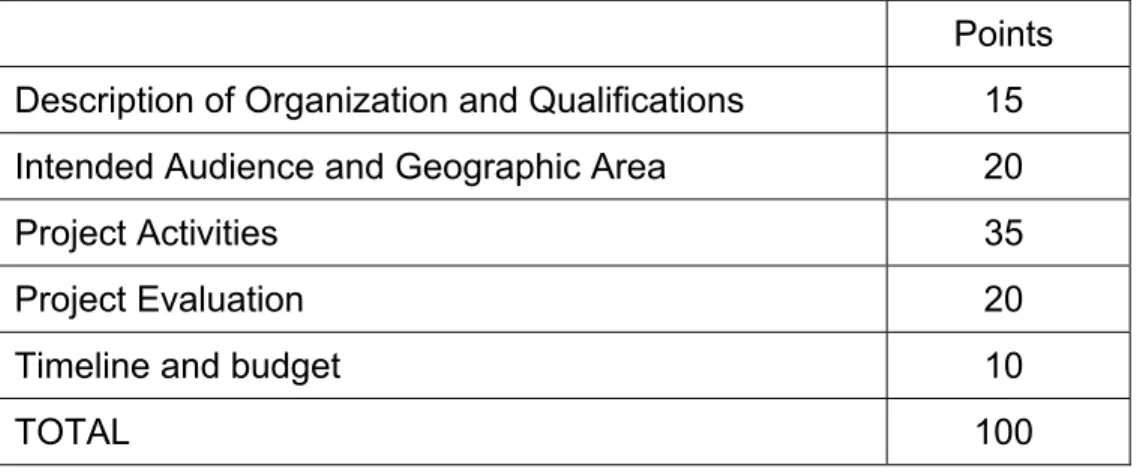
Applications will be reviewed by a panel that will include staff from CDPH and outside organizations, including Stakeholder Advisory Group members. The selection process will consist of two tiers. In the first tier, the panel will score applications based on the points for each section listed in Table 1, below. In the second tier, reviewers will
consider both the strength of the individual projects as well as the ability of the projects to collectively address several factors, including geographic spread; ethnic diversity of
intended audience; and diversity among the types of organizations that receive funding. Reviewers in the second tier will also consider the innovation and originality of project activities and the potential for collaborative partnerships.
CDPH anticipates notifying successful applicants by May 1, 2011. Table 1. Application Scoring
Points Description of Organization and Qualifications 15
Intended Audience and Geographic Area 20
Project Activities 35
Project Evaluation 20
Timeline and budget 10
TOTAL 100
IF YOU RECEIVE AN AWARD
If you receive an award, you will be required to sign a Memorandum of Agreement (MOA) with CDPH. The MOA will list the requirements for receiving funding. In addition to describing the specific activities of your project, we anticipate that the MOA will
include the following:
• Grantees will be required to attend the quarterly SAG meetings during the term of the project. Grantees may be asked to give periodic updates on their projects at these meetings.
• Grantees will be required to attend 1 to 2 days of training on fish contamination issues in San Francisco Bay and evaluation tools and methods.
• Grantees will be required to develop a complete evaluation plan, and submit this plan for CDPH approval, before beginning the implementation of their projects. • Grantees will be required to attend 2 to 3 meetings or conference calls with other
grantees.
• Grantees will allow CDPH to meet with the grantee at the grantee’s offices to review progress of the project.
• Grantees will allow CDPH to observe the implementation of a project activity. • Grant funding will be provided in three installments:
o 50% will be provided at the beginning of the project, after a Memorandum of Agreement is completed and signed;
o 40% will be provided midway, after completion of a mid-term report; and o 10% will be provided upon completion of the project and submission of a
• Grantees will comply with any Federal requirements regarding this funding (we will provide this information).
• Any materials produced as a result of the grant award must mention the funding sources (we will provide this information).
CDPH will be available to provide technical assistance to grantees throughout the implementation of their project, based on their individual needs.
QUESTIONS?
An optional conference call will be held on Tuesday, March 8, 2011, from 3:00 pm to 5:00 pm to answer any questions from applicants.
Conference call number: (866) 791-8031 Pass code: 2943447#
Before the conference call, please submit your specific questions to Aida Negrón by phone or email at (510) 620-6262 or [email protected]. Attendance on this call is not required to apply for funds. You may also contact Aida before or after the call about any questions you have on the grant program.
HOW TO SUBMIT AN APPLICATION
Proposals may be submitted by email, US mail, or FAX. Proposals must be received by CDPH by 5:00 p.m. on Friday, April 1, 2011 or, if sent by US mail, postmarked by April 1, 2011. We will send an acknowledgement by email upon receiving your application. Email: [email protected]
Mail or Fax: Rona Hampton
California Department of Public Health Environmental Health Investigations Branch 850 Marina Bay Parkway, Building P, 3rd Floor Richmond, CA 94804
(510) 620-3652
Fax: (510) 620-3720 STAY IN TOUCH
If did you not receive this announcement directly from us and wish to be kept informed about the SFBFP, please contact Rona Hampton and we will add you to the project email list.
RESOURCES FOR MORE INFORMATION
Information about the San Francisco Bay Fish Project can be found at:
http://www.sfei.org/sfbfp.
For more information about fish contamination issues in California, see:
http://www.oehha.ca.gov/fish.html. Also, the current fish consumption advisory for San Francisco Bay can be found here:
http://www.oehha.ca.gov/fish/general/sfbaydelta.html. Note that this advisory will be updated in 2011.
General information about fish contamination advisories from the US Environmental Protection Agency can be found here:
http://water.epa.gov/scitech/swguidance/fishshellfish/fishadvisories/advisories_index.cf m.
For more information about planning, implementing, and evaluating health
communication programs, we recommend the National Cancer Institute’s “Making Health Communication Programs Work” (also known as the “pink book”). See:
Attachment 1: APPLICATION COVER PAGE
Name of Organization: ___________________________________________________ Name and Title of Contact Person: __________________________________________ Address: ______________________________________________________________ _____________________________ Telephone/Office: _________________________ Cell: ______________________________ Fax: _______________________________ Email:___________________________ Website: _____________________________ Project Title: ___________________________________________________________ ______________________________________________________________________ Project Description: Briefly describe the objectives and activities of your project. What
is the overall goal and specific objectives of the project? (Please limit to 100 words). ______________________________________________________________________ ______________________________________________________________________ ______________________________________________________________________ ______________________________________________________________________ ______________________________________________________________________ ______________________________________________________________________ ______________________________________________________________________ Requested Amount: $_______________ Total Project Budget: $__________________ Type of Organization:
□ Non-profit organization
□
Tribe□
Local government agency□
K-12 School For non-profit organizations, give your organization’s current annual budget and sources of funding:Current Annual Budget: $______________ Sources of funding:__________________ ______________________________________________________________________ Proposal Prepared by: _________________________ Title: _____________________ Signature: ___________________________________ Date: _____________________
Attachment 2: TIMELINE TEMPLATE
(The applicant does not need to use this form, but should provide information about the project tasks and timeline following the general format below. The applicant may also use the Excel spreadsheet version of this form that is available at www.sfei.org/sfbfp.) Mark the weeks for each month that correspond to each task.
Task
Jun Jul Aug Sept Oct Nov1 2 3 4 1 2 3 4 1 2 3 4 1 2 3 4 1 2 3 4 1 2 3 4 1. 2. 3. 4. 5. 6. 7. 8. 9. 10.
Task
Dec Jan Feb Mar Apl May1 2 3 4 1 2 3 4 1 2 3 4 1 2 3 4 1 2 3 4 1 2 3 4 1. 2. 3. 4. 5. 6. 7. 8. 9. 10.
Attachment 3: PROJECT BUDGET FORM
(The applicant does not need to use this form, but should follow the general format and include the information listed below.)
Name of Organization: ___________________________________________________ Project Title: ___________________________________________________________ Requested Amount ($25,000 maximum): $______________
Requested Amount Contributed Amount Total Project Budget Personnel:
Salaries & wages1
Example: health educator @
$3000/mo. x 25% for 6 mo. Benefits and taxes
Consultant & contract services2
Example: graphic artist @
$100/hour for 20 hours
Total Personnel Operating Expenses Supplies/Materials/Printing3 Equipment4 Travel Other (describe):
Total Operating Expenses
Indirect Costs5
Total Budget
1. For all project staff include position title, salary, percentage time, and number of months the staff will be supported by the grant.
2. For all consultant and contract services, describe the type of services provided, and include hourly rate and number of hours.
3. Include office supplies, training materials, postage, etc.
4. Please describe equipment costs above $500 such as the purchase of a computer. 5. Indirect costs include rent, utilities, and indirect administrative support. Indirect costs should not exceed 15% of the sum of total personnel and total operating expenses.