Journal of Research in Pharmaceutical Science
Volume 6 ~ Issue 5 (2020) pp: 03-09
ISSN(Online) : 2347-2995
www.questjournals.org
Research Paper
Induction protocol for minimal risk patients in relation to the
general population protocol.
Adebowale O Adekoya(PhD), Basirat O Johnson, Seye Oladimeji,
Mumini Amisu
Lagos State University Teaching Hospital, Ikeja, Lagos State, Nigeria
R
eceived 30 November, 2020;
A
ccepted 15 December, 2020 © The author(s) 2020.
P
ublished with open access at
www.questjournals.org
I.
INTRODUCTION
Kidney transplantation is the best form of renal replacement therapy(1, 2) and there is measurable improvement in patient and graft outcomes over time in this form of treatment modality that started about half a century ago. This improvement is largely as a result of advances in immunosuppression of kidney recipients among other things.
Advances in immunosuppression has evolved (table 1) from the early days of using total body irradiation in combination with large doses of prednisolone and 6 mecaptopurine, an era that was characterised by first year graft survival rate of 40% and acute rejection rate of 80%, to the present day of newer drugs that has seen graft survival climbed to an all-time high of about 96% and a considerable drop in rejection rate to between 10 and 20 %. One other major gains arising from the use of these more specific agents, in addition to patient and graft survival is the attainment of better side effect profile.
Transplantation is standing on a tripod of basic research, clinical transplantation and ethno-cultural factors. The major concern in this review is induction immunosuppression.
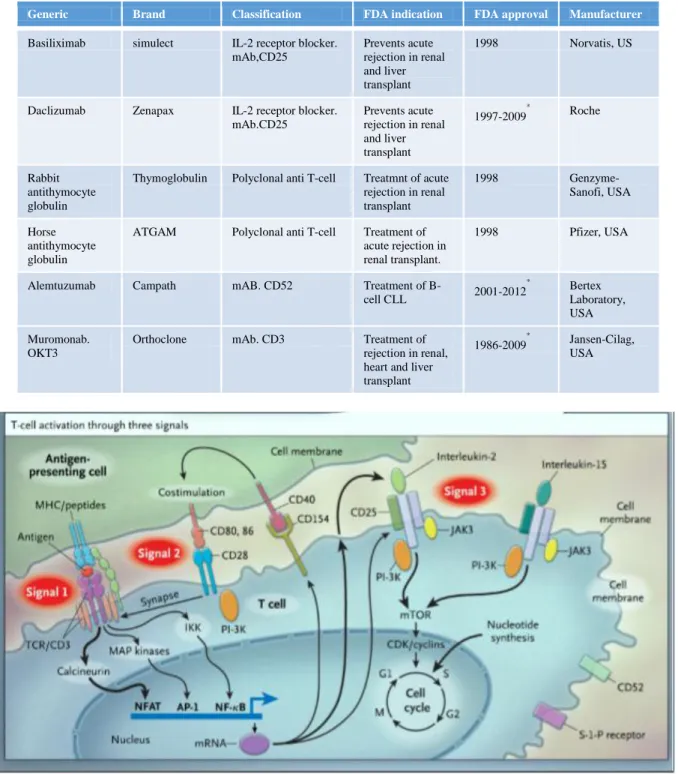
The basic understanding of induction immunosuppression is better appreciated when one understands the ‘three signal model of alloimmune responses. (3),( figure 1). The first signal is an antigen-antibody interaction that is triggered by presentation made to T cell by antigen presenting cell (APC). The second signal is a non-antigen-antibody dependent co-stimulatory signal between B7 on APC and CD28 on T-cell. These two signals result in the release of IL-2and as well as other growth related cytokines. The third and final signal is triggered by signal 2 and it heralds cell proliferation through mTOR (mammalian target of rapamycin) formation.
Immunosuppression requires the use of ‘initial’ medication for induction and some as maintenance therapy. Closely related to these is the use of medication for treatment of rejection. Medication being used for induction immunosuppression are biological agents which are either polyclonal or monoclonal antibodies. They can also be classified as lymphocyte depleting and non-depleting. Advantages and disadvantages of lymphocyte depleting and non-depleting agents are well known (table 3). Although most of these agents are being used for induction immunosuppression, their primary indication is for treatment of acute rejection. Induction immunosuppression is simply defined as the prophylactic use of medicationin the immediate post-transplant period in an attempt to prevent the risk of graft loss and ensure better patient survival especially in immunologically high risk patients. However, induction immunosuppression is also used in the low risk group.
Risk profiling in clinical transplantation is a measure of the patient’s tendency to survive for a considerable length of time following the treatment option. This profile is often dictated by the sensitization state of the recipient as well as comorbidities with special emphasis on compatibility of the donor kidney. The major way through which recipients are sensitized are following blood transfusion, pregnancy or previous transplantation. The best graft and patient outcome is derived from transplantation between identical twins but this is rarely the case. There are pressing demands for transplantation across various risk lines and in individual with all forms of seemingly unfavourable comorbidities.
In summary high risk patient are the younger patients, those with panel reactive antibody (PRA) greater than 20%, those with human leukocyte antigen (HLA) mismatch, especially at the DR locus, ABO incompatibility, presence of donor specific antibody (DSA), cold ischemia time greater than 24 hours, delay graft function(DGF) and Afro-American ethnicity.
Putting all these together, a minimal risk patient will be defined as a non-Afro-American with near absence of unfavourable co morbidities and with low immunological response to the antigen from intending donor.
The present practice in the general population withrespect to kidney transplantation in the high risk patients is to create a best practice that will ensure good outcome following transplantation and also get the best out of low risk patients. The former is made possible by aggressive induction immunosuppression protocol and use of the best combination of medication for maintenance immunosuppression alongside adjunctive agents. This is coupled with aggressive management of acute rejection episodes.The induction immunosuppression in this case will be mostlythrough the use of lymphocyte depleting agents. There are also novel ways of managing the sensitized patients in order to ensure better graft outcome and improve patient survival. Similarly, there are various ways of optimally managing comorbidities in the high risk patients. The ultimate goal in all of these is to make kidney available to this group of patient despite being high risk and ensuring less rejection episodes.
Conversely, the minimal risk patient requires lessaggressive induction immunosuppression. The reasonable option of medication in them is the non-lymphocytedepleting group of induction immunosuppression. The decision to give induction immunosuppressive agent to the minimal risk patients is to ensure that nothing is left to chance in the bid to optimize treatment in them. Induction immunosuppression improves the chances of graft survival by reducing the possibilities of acute rejection episode. There are no fixed protocols and each centre stays with the best option that is suitable for the generality of its patients. Even within centres, treatment is majorly based on the individual patient in question. The only common denominator is the broad definition that brings the patients together in one group based on the strength of their risk profiling.
Apart from these two protocols, others are steroid withdrawal, Calcineurin inhibitor (CNI) minimizing protocol as well as the use of mammalian target of rapamycin (mTOR) inhibitor.
There are various centre specific protocols as well as other guidelines which includes that of the kidney disease improving global outcome (KDIGO) guideline suggestions for the use of immunosuppression.
Kidney transplantation is an available option of renal replacement therapy for end stage kidney disease patients in Nigeria.(4) .This is a country that is strategically located in western part of Africa. With a population of about 180.2 million people, (World Bank data, 2015) Nigeria is the most populous black nation in the world. The prevalence of chronic kidney disease in Nigeria varies between 16 to 26%. (4, 5)and allthe transplant done so far are living donor transplantation in carefully selected group of patients. Majority of these patients can be classified as minimal risk patients despite the fact that they are black. This is because available statistic shows that none of the recipients have so far received lymphocyte depleting induction immunosuppression. The commonly use agent for induction immunosuppression in Nigeria is basiliximab. In addition, these patients are carefully chosen after a thorough immunological work up and only those who immunological profile that warrant low risk protocol are often chosen for the limited number of cases that have been done in the country so far.(4) This arbitrary classification of these patients as minimal risk is without prejudice to their race which is black African. Undoubtedly, data from Afro- American can be used for them as there are no robust data describing transplant outcome measures.Understandably, this racial background might put themin the high risk group but if one considers all other factors like the immunological status of the recipients coupled with the fact that the transplantation done so far are living donor transplantation during which basiliximab was used for induction immunosuppression, it is appropriate to arbitrarily classify the Nigeria transplant patients as minimal risk patient..
Common antibodies use in kidney transplantation.
These antibodies are either polyclonal or monoclonal Polyclonal antibodies
They are immunoglobulins that are prepared by injecting animals with human thymocytes. These thymocytes contain multiple epitomes for antigen binding. These immunoglobulins are then purified
Monoclonal antibodies (mAb)
Monoclonal antibodies are normally produced from a single clone that is active against a target antigen. Production of mAb requires the fusion of myeloma cell from murine with splenic B cell from mice. This is preceded by immunisation of the mice against a specific antigen. The result of this fusion is a formation of a hybridoma which is able to produce an infinite amount of antibody that is specific to the antigen in question.
OKT3 is the first mAb to be approved for human use. It is of murine origin and it react with the T cell receptor CD3 complex which are found on the surface of circulating T cell. This result in the blockage of T cell proliferation and differentiation
Blockage of IL-2 receptor is a major focus of mAb action and because IL-2 is a major factor in T cell growth, its blockage by mAb makes it a more specific agent than polyclonal antibodies.
Similarly, the knowledge that activation of IL-2 is triggered by its binding to its receptor on T cell has led to the production of anti CD25 antibodies. This will selectively block IL-2 action on activated T cell.
Advances in immunobiology has led to the production on chimeric and humanized form of mAb that can selectively block IL-2 receptor. Basiliximab is a chimeric anti CD25 antibody mAb (produced by genetic engineering). It is made up of 75% human and 25% murine protein. Daclizumab on the other hand is a humanised anti CD25 which is 90% human and 10% murine. The resultant effect of the modification is the production of mAb with better safety profile
The aim of this review is to robustly articulate the induction immunosuppression protocol for minimal risk patients in general population and attempt to relate that with the practice in Nigeria.
Table 1: Some datelines in introduction of immunosuppression agents
¶: No longer in use, ¥: The patent has expired.(6)
Agent Year discovered
6 Mercaptopurine 1960s
Prednisolone 1960s
Azathioprine 1960s
ATG Mid 1970s
ALG Mid 1970S
Cyclosporine Early 1980s
OKT3¶ 1983
Tacrolimus 1990s
Mycophenolate mofetil¥
1995
Basiliximab 1990s
Sirolimus 1999
Table 2: Component of conventional immunosuppressive protocol.
Class Examples
Calcineurin inhibitor Cyclosporine, tacrolimus
Corticosteroids Dose and regimen
Adjunctive agent Azathioprine,MMF,Sirolimus
Antibody induction Lyphocyte depleting or non depleting
Supplementary agent CCB
Infection prophylaxis Bactrim, antiviral
Table 3: Advantages and disadvantages of lymphocyte depleting and non-lymphocyte depleting agents. Lymphocyte depleting agent
(e.g. OKT3, ATG, rATG )
Non lymphocyte depleting agent. (e.g. Basiliximab and Daclizumab)
Rejection rarely occurs following use. Associated with rejection
Use of CNI can be delayed. Use of CNI should not be delayed.
Associated with acute side effect. Requires premedication
Not associated with acute side effect. Administration requires no premedication
Associated with increased incidence of infection and malignancy.
Table 4: Overview of some induction immunosuppression agents.
*: withdrawn from the market.
Generic Brand Classification FDA indication FDA approval Manufacturer
Basiliximab simulect IL-2 receptor blocker.
mAb,CD25
Prevents acute rejection in renal and liver transplant
1998 Norvatis, US
Daclizumab Zenapax IL-2 receptor blocker.
mAb.CD25
Prevents acute rejection in renal and liver transplant
1997-2009
* Roche
Rabbit antithymocyte globulin
Thymoglobulin Polyclonal anti T-cell Treatmnt of acute
rejection in renal transplant
1998
Genzyme-Sanofi, USA
Horse antithymocyte globulin
ATGAM Polyclonal anti T-cell Treatment of
acute rejection in renal transplant.
1998 Pfizer, USA
Alemtuzumab Campath mAB. CD52 Treatment of
B-cell CLL 2001-2012
* Bertex
Laboratory, USA Muromonab.
OKT3
Orthoclone mAb. CD3 Treatment of
rejection in renal, heart and liver transplant
1986-2009
*
Jansen-Cilag, USA
Figure 1: The three (3) signal model of alloimmune responses courtesy of Halloran PF, (2004) N Eng. J Med.
II.
DISCUSSION
Minimal risk patients are those with less of the characteristics of high-risk patients outlined earlier. The guiding principle is to use less aggressive agent for induction immunosuppression. This is mainly the use of non-lymphocyte depleting agent the commonest example of which is Basiliximab.
The KDIGO guideline suggest that for low risk patients in whom induction immunosuppression is used corticosteroid could be discontinued during the first week after transplantation.
There are presently seven government owned and two privately owned kidney transplant centres in Nigeria. The private centres are the active centres. They are St Nicholas Hospital, Lagos and Zenith Hospital and Kidney Centre Abuja. The former has performed over a hundred living donor kidney transplant over ten
years while the latter is a fast growing, new centre that has performed about forty cases in about two years. The government owned centres are not active. Majority of them have done just one or two kidney transplantation with the exception of one where over twenty cases have been done so far. This is a far cry from the global average in countries where kidney transplant is active. For instance, over one thousand (1000) patients are referred yearly for kidney transplant at the University of California at San Francisco Transplant programme where an average of three hundred (300) adult and paediatric transplant is performed annually.
The implication of this is that kidney transplant programme is new in Nigeria and it is mainly private practice driven with some effort by the government to provide the service in public institution.
Again, it is not out of place to categorise the patients who have been transplanted so far in Nigeria as minimal risk patients. They are those who could pay out of pocket for intensive recipient and donor screenings that included HLA typing and cross matching, mostly in laboratoryoverseas. The major induction immunosuppression in this group of patients is non lymphocyte depleting agent, Basiliximab. It is a routine to give most of these patients Basiliximab in two doses these days. The maintenance immunosuppression protocol is main using CNI with mycophenolate mofetil alongside prednisolone. The choice of CNI in maintenance immunosuppression is centre and patient dependent but Tacrolimus is more commonly used than cyclosporine in Nigeria.
Rational for induction in general population.: To give or not to give.
The main determinant of the need for induction is the risk profile of the patient. Another important factor is the cost.
There are trials of basiliximab and Daclizumab that shows that the use of these medication for induction immunosuppression is associated with decrease in incidence of acute rejection episodes(7, 8). Bumgardner and colleagues described the 1 and 3-year outcome in renal transplant patients who had earlier participated in a two phase 111 clinical trial of Daclizumab. The earlier trials had reported reduction in the incidence of acute rejection following use of Daclizumab for induction immunosuppression. This study by Bumgardner and colleagues showed a significant reduction in 1year biopsy proven acute rejection following the use of Daclizumab for induction immunosuppression but the 3rd year graft survival was not significantly different compared with the control group where placebo was used in place of Daclizumab. Another key finding in that study is that Daclizumab was well tolerated. It wasnot significantly associated with adverse clinical sequel like post-transplant lymphoproliferative disease(7). In the same vein, Webster el al conducted a meta-analysis of the comparison of the effectiveness of basiliximab and Daclizumab for induction immunosuppression in kidney transplant recipients. That analysis reviewed the results of 38 trials that recruited 4,893 patients. They concluded that there was no difference between the two IL-2 receptor antagonist in terms of episodes of acute rejection, cytomegalovirus infection and malignancy(9). They reported that both agents produced fewer side effects.
Similarly, Kahan et al reported their finding in a double blind placebo control phase 111 study where they assessed the effectiveness of basiliximab in reducing acute rejection episodes. In that study, they randomised 348 patients into two groups. One group received basiliximab while the other had placebo. All the patients had cyclosporine and steroid for maintenance immunosuppression. They concluded that basiliximab was well tolerated and significantly reduce the incidence of biopsy proven acute rejection episode(10).This conclusion was also reached by Nashan el al(11)
Conversely, Gavela and colleagues retrospectively compared 21 low risk recipients who received basiliximab for induction immunosuppression with 33 low risk patients who had no induction immunosuppression. There was no significant difference in the incidence of delayed graft function and acute rejection between the two groups. They concluded that there was no justification for the use of basiliximab for induction immunosuppression in low risk patients. Both groups had tacrolimus based maintenance immunosuppression.(12). This conclusion by Gavela and his colleagues is supported by the fact that when Basiliximab is given as single dose instead of the standard two doses for induction immunosuppression and the outcome compared with that of recipients who received the standard two doses, there was no significant difference observed in the patients survival, graft survival, acute cellular rejection, antibody mediated rejection and opportunistic infection between the two groups (13). If not giving enough produced the same effect as giving enough, the reason for giving in the first place should then be questioned.
Gralla and Wiseman (14) carried out what is perhaps one of the largest outcome study of the effectiveness of basiliximab use for induction immunosuppression. They analysed the results of about 30,000 recipients from the Scientific Renal Transplant Registry of adult and found out that there was no significant difference in the short and long term graft and patients survival in recipients who had basiliximab for induction immunosuppression and the placebo group. More importantly, they found out that although using this agent for induction immunosuppression reduced the incidence of acute rejection episodes over one year, that significance became negligible when that data was subjected to multivariate analysis.All the recipients received tacrolimus, mycophenolate mofetil and steroid for maintenance immunosuppression.
Another determinant factor for the use of basiliximab for induction immunosuppression is its safety profile. It is safe when compared with polyclonal antibodies like ATG which is known to be associated with an undesirable side effect known as cytokine release syndrome(15). This safety profile of basiliximab makes it an ideal agent for induction immunosuppression in an emerging transplant community like Nigeria.
The issue of cost is another factor. Basiliximab is cheaper than the non-lymphocyte depleting agents(16). Although one might argue that it is still relative expensive for patienst in the developing world like Nigeria, it is still one of the cheapest. ATG is now being replaced by rabbit ATG (rATG). This produces more tolerable adverse effect when compared with ATG which is derived from horse. Nonetheless, rATG comes at a greater cost and safety profile is not better than that of basiliximab
Rational for protocol production in Nigeria.
Kidney transplant is a not uncommon as a renal replacement option in Nigeria. There was a mini report where an attempt at narrating the general overview of kidney transplant in Nigeria up till 2010 was made and the common immunosuppression protocols were described.(4). That report was about half a decade ago and the most common maintenance immunosuppression agent was a triple regimen of Calcineurin inhibitor (Tacrolimus or cyclosporine), Mycophenolate mofetil or azathioprine and steroid. The report showed that only a very small percentage (4.2%) of the recipient had antibody induction. The acute rejection rate was put at over 30%. Cost was definitely an issue. Interestingly, a large number of kidney transplant that have been done in the country after that report have seen majority of the recipients receiving basiliximab as induction immunosuppression (unpublished data).
Lesson for other centre on this Nigeria model
The importance of data gathering and service review is evident in the case of kidney transplant programme in Nigeria. There is paucity of data and this have undermined the availability of information on the transplant programme in Nigeria. Centres need to document and report the induction immunosuppression protocol, as well as other relevant issues to allow for objective assessment. For instance, the published data of 4.2% rate of use of induction immunosuppression is not reflective of the state of current practice as regards kidney transplantation in Nigeria today.
III.
CONCLUSION
The commonly used induction immunosuppression agent in recipient with minimal risk is the IL-2 receptor antagonist. It is generally reported to be well tolerated and its use is associated with significant reduction in incidence of acute rejection. However, there is no significant difference between this medication and placebo in terms of impact on onshort- and long-term patient and graft survival. Nigerian kidney transplant patients are black African yet they can be arbitrarily classified as having minimal risk when other characteristic features of risk profiling are considered. Moreso that basiliximab is the main drug for induction immunosuppression in Nigerian kidney transplant recipients. These patients receive triple drug therapy of Calcineurin inhibitors, MMF/Azathioprine and steroid for maintenance immunosuppression. There is paucity of data on induction immunosuppression protocol from Nigeria and this has led to serious under reporting of protocols and outcome measures
REFERENCES
[1]. Groth CG, Fehrman I, Ringden O, Lundgren G. Related donor kidney transplantation is the best form of treatment for uremia. Transplantation proceedings. 1987;19(1 Pt 3):2278-9.
[2]. Protzel C, Fuhrer A, Hakenberg OW. [Terminal renal insufficiency and indication for kidney transplantation]. Der Urologe Ausg A.
2015;54(10):1356-61.
[3]. Halloran PF. Immunosuppressive drugs for kidney transplantation. The New England journal of medicine. 2004;351(26):2715-29.
[4]. Arogundade FA. Kidney transplantation in a low-resource setting: Nigeria experience. Kidney international supplements.
2013;3(2):241-5.
[5]. Oluyombo R, Ayodele OE, Akinwusi PO, Okunola OO, Akinsola A, Arogundade FA, et al. A community study of the prevalence,
risk factors and pattern of chronic kidney disease in Osun State, South West Nigeria. West African journal of medicine. 2013;32(2):85-92.
[6]. van Gelder T, Hesselink DA. Mycophenolate revisited. Transplant international : official journal of the European Society for Organ
Transplantation. 2015;28(5):508-15.
[7]. Bumgardner GL, Hardie I, Johnson RW, Lin A, Nashan B, Pescovitz MD, et al. Results of 3-year phase III clinical trials with daclizumab prophylaxis for prevention of acute rejection after renal transplantation. Transplantation. 2001;72(5):839-45.
[8]. Kovarik JM, Kahan BD, Rajagopalan PR, Bennett W, Mulloy LL, Gerbeau C, et al. Population pharmacokinetics and
exposure-response relationships for basiliximab in kidney transplantation. The U.S. Simulect Renal Transplant Study Group. Transplantation. 1999;68(9):1288-94.
[9]. Webster AC, Playford EG, Higgins G, Chapman JR, Craig JC. Interleukin 2 receptor antagonists for renal transplant recipients: a
meta-analysis of randomized trials. Transplantation. 2004;77(2):166-76.
[10]. Kahan BD, Rajagopalan PR, Hall M. Reduction of the occurrence of acute cellular rejection among renal allograft recipients treated
with basiliximab, a chimeric anti-interleukin-2-receptor monoclonal antibody. United States Simulect Renal Study Group. Transplantation. 1999;67(2):276-84.
[11]. Nashan B, Moore R, Amlot P, Schmidt AG, Abeywickrama K, Soulillou JP. Randomised trial of basiliximab versus placebo for control of acute cellular rejection in renal allograft recipients. CHIB 201 International Study Group. Lancet (London, England). 1997;350(9086):1193-8.
[12]. Gavela Martinez E, Avila Bernabeu AI, Sancho Calabuig A, Beltran Catalan S, Escudero Quesada V, Pallardo Mateu LM. Use of
basiliximab induction in low-immunological risk renal transplant recipients receiving tacrolimus-based immunosuppression. Transplantation proceedings. 2009;41(6):2337-8.
[13]. Cunningham KC, Hager DR, Fischer J, D'Alessandro AM, Leverson GE, Kaufman DB, et al. Single-Dose Basiliximab Induction in
Low-Risk Renal Transplant Recipients. Pharmacotherapy. 2016.
[14]. Gralla J, Wiseman AC. The impact of IL2ra induction therapy in kidney transplantation using tacrolimus- and mycophenolate-based
immunosuppression. Transplantation. 2010;90(6):639-44.
[15]. Soulillou JP, Cantarovich D, Le Mauff B, Giral M, Robillard N, Hourmant M, et al. Randomized controlled trial of a monoclonal
antibody against the interleukin-2 receptor (33B3.1) as compared with rabbit antithymocyte globulin for prophylaxis against rejection of renal allografts. The New England journal of medicine. 1990;322(17):1175-82.
[16]. Woodroffe R, Yao GL, Meads C, Bayliss S, Ready A, Raftery J, et al. Clinical and cost-effectiveness of newer immunosuppressive
regimens in renal transplantation: a systematic review and modelling study. Health technology assessment (Winchester, England). 2005;9(21):1-179, iii-iv.