Contents
1.0 Introduction ... 5
2.0 Background ... 5
3.0 ADR best practice project: Report 2 ... 6
4.0 Part One: Government ADR Centre of Excellence ... 6
Background ... 6
Best practice in government ADR ... 8
Government ADR Centre of Excellence ... 9
Ready for the future ... 9
Structure and functional arrangements ...10
Functional leadership ...11
Policy development ...11
Business operations development ...11
Research and evaluation ...11
Working collaboratively with ADR partners outside government ...12
Location within MBIE ...12
Better Public Services ...12
Next steps...13
5.0 The State’s involvement in government ADR - four quadrants ... 13
Goal One – Fit for purpose supply of ADR for government ...13
Adequacy of ADR Supply ...14
Goal Two – Effective mechanisms to define demand for government ADR services ...18
Goal Three - Set standards for service delivery and hold suppliers of government ADR services to account ...19
Goal Four - Establish an ADR framework for government integrating resolution policy ...19
Legislative audit ...20
Fees framework ...21
Principles for fee setting ...21
Early resolution approaches ...22
Cost of disputes ...22
Thinkplace customer/stakeholder research ...23
Research findings ...24
7.0 Realising opportunities for continuous improvement ... 27
Current initiatives ...28
Pre mediation Workbook ...28
Project Resolve - case management system replacement ...28
Tenancy Tribunal Business Process Improvement ...29
Ministry of Justice targeted review of Tribunals...29
Service Transformation Initiatives and Quick Wins ...30
Fasttrack implementation ...31
Focus on continuous improvement in Tenancy Tribunal processes ...32
Culture of continuous improvement ...32
Annex One: Government ADR Best practice principles ... 33
Table of Figures
Figure 1 Intention alignment ... 24
Table of Tables
Table 1 Funding models: benefits, limitations and suitability for ADR ... 15Table 2 General themes from customer and stakeholder feedback ... 23
Table 3 Key insights and innovation opportunities ... 26
1.0 Introduction
The Alternative Dispute Resolution (ADR) Best Practice project (the project) was initiated in 2013 with a focus on investigating the consolidation and standardisation of dispute resolution systems across the newly formed Ministry of Business, Innovation and Employment (MBIE) and the justice sector. Despite a strong trend towards government use of ADR over the last 20 to 30 years the development of ADR has been relatively ad hoc with the result that there is a lack of consistency and coherence in ADR systems across government.
Important work has been undertaken under the best practice project to improve the quality and effectiveness of ADR regimes delivered for or by government. This work has included identifying the four roles that the state is, or could be, involved concerning government ADR – as ADR supplier, demander, standard setter and framework developer and establishing best practice principles for government ADR. However, if MBIE is to continue to provide leadership and guidance to agencies across government concerning government ADR, there is a need for more long term arrangements to now be put in place.
On the basis of recommendations in Report 1, Ministers agreed that in addition to providing further updates on progress under the project, Report 2 should include a proposal for the establishment of a government ADR Centre of Excellence within MBIE.
2.0 Background
In August 2012, the State Services Commission (SSC) submitted a suite of papers to Ministers concerning issues and opportunities arising from the newly formed Ministry of Business, Innovation and Employment (MBIE). The advice included a proposal to further investigate the consolidation and standardisation of dispute resolution services across MBIE and the justice sector.
The Ministers of Economic Development, Justice and State Services subsequently agreed that MBIE, together with the Ministry of Justice (MoJ), should proceed to identify and implement best practice in government dispute resolution through the ADR best practice project (the project) and that two reports would be provided.
Report 1, submitted in November 2013:
• provides an overview of the use and development of Alternative Dispute Resolution (ADR) in
government in New Zealand
• examines the role(s) where the state is, or could be, active in government ADR – as supplier,
demander, standard setter and framework developer
• introduces a set of best practice principles to guide the future development of government
ADR
• identifies opportunities for improvement and policy recommendations.
Report 1 concludes that there is an opportunity for government to build on the work started under the project by exploring options for:
• stimulating the development of scale in the private sector supply market to ensure that
supply can meet increased government ADR demand
• establishing a government ADR Centre of Excellence to ensure a more active and deliberate
role for government in terms of its own ADR systems across the four domains of ADR-related activity (as supplier, demander, standards setter and framework developer).
On the basis of recommendations in Report 1, Ministers agreed that in addition to getting its “own house in order” in terms of its own demand for and supply of ADR services, MBIE should take a key leadership role in relation to the future development of government ADR in New Zealand. It was also agreed that report two should include a proposal for a government ADR Centre of Excellence to be established within MBIE.
3.0 ADR best practice project: Report 2
This report is the second of the two reports to Ministers under the ADR best practice project (the project) and is a joint report between MBIE and MoJ. The report is presented in two parts.
Part One presents a proposal concerning the establishment of a government ADR Centre of Excellence within MBIE: This includes:
• discussion about the rationale for establishing a government ADR Centre of Excellence within
MBIE
• early thinking concerning the structure, functions and areas of focus for the government
ADR Centre of Excellence
• further consideration of the state’s role in government ADR across the four domains
identified in report 1.
Part Two provides progress updates on specific business improvement initiatives in the Tenancy Tribunal (a shared process across MBIE and MoJ).
4.0 Part One: Government ADR Centre of Excellence
This part of the report concerns the proposal to establish a government ADR Centre of Excellence within MBIE.
Background
Report 1 confirms that to date the development of ADR systems, processes and mechanisms for government in New Zealand has been relatively ad hoc, with demand primarily driven by agencies desire to provide fast and cost effective approaches to resolving disputes within their sectors or areas of responsibility. Report 1 identifies that there are now two primary directions from which the need for government ADR is generated:
• the need for mechanisms within the justice system for earlier and more cost effective
resolution of disputes before issues escalate to the Courts. Examples include the new family dispute resolution (FDR) system, due to commence on 31 March this year; and
• the establishment of processes to resolve disputes between civil parties in sectors, aimed at
the effective functioning of markets. For example, employment relations problems or disputes between landlords and tenants in the residential property market.
Demand for ADR services from government has been growing steadily over the last 20 to 30 years and does not show signs of abating. Report 1 identifies the many benefits of ADR. These benefits include:
• earlier and less adversarial resolution of disputes enabling long term relationships to be
retained or restored;
• higher levels of specialisation enabling more innovative approaches and solutions;
• more active involvement by participants in the resolution of their disputes, resulting to
greater ownership of resolution outcomes;
• increased confidentiality and privacy in relation to dispute resolution processes; and
• faster, more cost effective and flexible processes for resolving dispute than traditional court
based approaches.
There are also significant financial and economic benefits to be gained through the early and effective resolution of disputes. This report (page 22) includes preliminary calculations concerning the significant cost of disputes in relation to just one area - employment disputes. In light of the extensive range of potential issues in dispute across government, this exercise provides an indication of the potential savings (to government, to the economy and to parties) in ensuring effective and consistent ADR systems are in place across government.
Given the significant potential benefits of ADR, the state has a strong interest in continuing to foster and support the development of government ADR systems. However, it is timely to review current regimes to identify the approaches and mechanisms most likely to deliver the outcomes sought from government ADR. While important work has commenced under the best practice project, if this work is to continue beyond the life of the project it needs to be formalised in some way.
The state’s role in government ADR
Report 1 identified four roles in which the state is, or could be involved concerning government ADR.
Framework developer Standards setter
Government plays a key role in establishing the framework conditions for government demanded ADR regimes. This includes ADR policy questions and settings, legislative frameworks, fee setting and the procurement of services.
Government could play a role in setting the standards for ADR entities who deliver to or for government and holding them to account for quality outcomes and efficiencies for government.
Demander Supplier
Government establishes significant demand for ADR services through legislative regimes and holds the collective source of information and market knowledge about government ADR systems and approaches.
Government is a significant supplier of ADR services. It is involved in the direct provision of services or through arm’s length provision via panels of private providers and Crown company (Fairway Resolution Ltd).
At present the state is a significant demander of ADR services; it is also a major supplier of those services. However, at present individual ADR regimes are developed in the absence of an overarching framework for ADR within government and without any agreed standards for the delivery of ADR services to government. This indicates that in the short term there may be a need for focused attention on the standard setter and framework developer roles.
In terms of the state’s role in ADR overall, it is likely that the state will continue to have a role in each of the four quadrants of ADR related activity identified in Report 1. However, the extent of the state’s involvement within each quadrant is likely to change over time. For example, until there are sufficient private sector providers in place with national reach and infrastructure to support high volume ADR delivery, the state is likely to continue to be involved with supplying ADR services to government. However, by providing mechanisms to encourage and support more ADR entities to enter the government ADR supply market, the state is likely to be in a position to reduce its involvement in the supply of ADR services to government over time.
The four roles of ADR related activity are relevant not only to the state’s involvement in government ADR overall, but also to each individual ADR regime. As both a significant demander and the dominant supplier of ADR services to government, MBIE is a significant player in government ADR in New Zealand. However, the ADR landscape in New Zealand government extends well beyond MBIE with numerous other agencies requiring some form of dispute resolution processes.
The process of establishing an ADR regime is complex and resource intensive with expertise needed in standard setting, contracting, procurement, professional services, systems design and fee structures. MoJ’s recent establishment of FDR services provides important insights into the challenges involved with setting up a new government ADR system.
The decision tree (attached as Annex 2) provides a guide as to the various stages and the range of issues relating to the four roles that need to be traversed in relation to any new government ADR regime.
Best practice in government ADR
Another important aspect of achieving the best possible outcomes from government ADR is ensuring that any new regimes, while responsive to the context in which they will operate, will accord as much as possible with best practice. Report 1 introduced a set of best practice principles for government ADR in New Zealand, developed by assessing the intervention logic for ADR and analysis or current policy and legislative settings. The principles (attached as Annex One) also draw on the Government’s Better Public Services priorities and international expertise and experience.
The best practice principles provide a cornerstone for the future development of government ADR systems, processes and services in New Zealand. They can be applied to individual components of a government ADR system, including policy, legislation and practice and can be used both to assess existing ADR regimes and to guide the development of new government ADR systems. For example, Report 1 includes an assessment of MBIE’s current service delivery against the best practice principles and opportunities for improvement. This report identifies how those opportunities and further opportunities identified through customer and stakeholder research and staff feedback are being realised under the best practice project.
Government ADR Centre of Excellence
It is important that the state takes responsibility for continuing to foster the future use of ADR within government. Only the state has the capacity and capability to undertake the activities required for system wide ADR development for government. For example, only the state can sculpt government demand for ADR through the development of Acts and regulations. Moreover, at present the state undertakes important functions that will support government ADR development including data collection and analysis, research and evaluation and policy development.
The government ADR Centre of Excellence will provide a “one stop shop” to support existing and new government ADR regimes. The establishment of the Centre of Excellence within MBIE will enable the important work commenced under the ADR best practice project to continue. For example, ongoing guidance and leadership in terms of government involvement in the four quadrants of ADR related activity and the best practice principles identified in Report 1 will be provided. The establishment of the Centre of Excellence will also reduce inconsistency in approach and duplication of effort across government ADR systems, consolidate government knowledge and enable government to plan for the future in terms of the use of ADR within government.
It is unrealistic to expect that individual government agencies will be able to navigate the complex process and many considerations involved (such as the application of the four quadrant model and the best practice principles) in setting up a government ADR regime in isolation and without significant support. The proposal for the establishment of a government ADR Centre of Excellence is based on the need to provide ADR leadership, support and guidance concerning government ADR across government.
Ready for the future
A government ADR Centre of Excellence will also need to be future focused - ahead of demand and continually assessing and seeking to maximise the value of ADR. A key focus will be on ensuring that government ADR services contribute to achieving both high level policy objectives (such as well functioning sectors and markets) and system outcomes (such as integrated service based online systems). For example, the Centre of Excellence provides a new opportunity to think about ADR from a sector and systems perspective.
The Centre of Excellence concept is not new to New Zealand and reflects developments in other complex areas of government activity. For example, in 2010 a need for Procurement Functional Leadership (PFL) in government was identified and it was decided that this responsibility should sit with MBIE. The stated purpose of PFL was to detail specific measures and actions to address deficiencies in commercial capability and practices in the state services. These proposals were underpinned by two key principles:
• individual Chief Executives remain accountable for their agency’s performance; and
• functional leadership does not mean centralisation of procurement activities, rather it means
“centre led activities” through greater collaboration.
The same considerations potentially apply in relation to ADR as well as to other areas of cross government related activity, including the GCIO (the Government Chief Information Officer) in the Department of Internal Affairs and the PIMCO (Property Management Centre of Expertise) in the Ministry of Social Development.
Structure and functional arrangements
The use of alternative dispute resolution to facilitate early resolution of mainstream disputes has seen a dramatic rise globally in the last 20 to 30 years. Accordingly, other jurisdictions have also been grappling with the issue of how to support the further development of ADR. For various reasons, including statutory mandates and the weight of the sheer number of disputes, the development of ADR in some overseas jurisdictions has progressed to a greater extent than in New Zealand - particularly in the establishment of Centres of Excellence for ADR and the development of best practice guidance and performance measures. Internationally, Centre of Excellence type bodies tend to have several key functions which ultimately work together to provide a best practice example across ADR practice. These functions include:
Accreditation
The Australian Mediation Standards Board’s universal accreditation system is the mechanism for implementing approval standards and practice standards. In comparison, there is no universal ADR practitioner accreditation system in New Zealand - accreditation is provided by private organisations. A less formal approach to accreditation could see MBIE in its capacity as the government ADR Centre of Excellence focus on forming strong relationships with accreditation providers and advising on standards for the delivery of ADR services to government. MoJ took this approach in relation to the new Family Mediation Service by holding discussions with ADROs (Approved Dispute Resolution Organisations) regarding expectations of the standards that family mediation practitioners must meet before being accredited.
Facilitating interagency ADR collaboration and knowledge sharing
Australia and the United States both have government bodies aimed at fostering a collaborative ADR culture within government and ensuring ADR provision reflects their governments’ conception of best practice principles. There is also international precedent for organisations based around collaboration between the private sector and government as well as within government1. In New Zealand, without a Centre of Excellence or consistent ADR guidance, the provision of government ADR will continue to lack cohesion and would struggle to present a uniform best practice example to the private sector.
Research, development and policy guidance
The National Alternative Dispute Resolution Advisory Council (NADRAC) provided guidance and support to the ADR industry both in Australia and New Zealand and further afield, but was disestablished in 2013. The current proposal differs from the NADRAC approach in that the research, policy development and guidance role that the Centre of Excellence would carry out would be located within an existing agency (MBIE), building on existing practices and expertise as a significant demander and supplier of government ADR services.
The focus for the government ADR Centre of Excellence would be on deliberate thinking about the best approaches and mechanisms for government ADR rather than reliance on what has been done
1
For example, in Australia’s Northern Territory the Community Justice Consultative Council is effectively a forum for industry- wide ADR discussion. The Civil Mediation Council in the United Kingdom plays a similar role and is used by the British government to fulfil its European requirement for a quality control mechanism in the ADR industry.
in the past. The functions that a New Zealand ADR Centre of Excellence for government could perform include:
Functional leadership
• Dispute resolution functional leadership - working directly with agencies to tailor ADR
systems, developing advice and information concerning the development of structures and systems to create robust dispute resolution environments and deliver quality outcomes.
• Ensuring that government is getting the advantage of intelligence gained from ADR
information management systems.
Policy development
• Identifying key policy questions and considerations to guide the development of new
government ADR regimes.
• Supporting agencies to assess the extent of the state’s involvement across the four roles that
government could perform in relation to any new ADR regime as supplier, demander, standards setter and framework developer.
• Identifying appropriate legislative settings, service delivery standards, procurement and
contracting arrangements and fee structures for achieving high quality and efficient ADR outcomes.
Business operations development
• Analysis of the future delivery environment relevant to the agencies customers, data
collection and sector analysis.
• Framing systems to support and implement dispute resolution operations and to support
private provision of dispute resolution services.
• Tailoring dispute resolution standards to ensure best practice operations and to enable
agencies to hold delivery partners to account through regular verification and audit.
• Oversight of delivery to enable agencies to assess extent to which delivery partners are
meeting and maintaining professional standards and expectations for staff training and development.
• Case Management as a Service: providing agencies with options for suitable IT platforms to
manage dispute resolution delivery, services that delivery partners can utilise without having to invest heavily in IT infrastructure in a low volume dispute resolution environment.
• Agencies would also be able to access these systems for real time data and for reporting and
trend analysis purposes.
Research and evaluation
• Developing “new frontier approaches” and trialling and implementing these approaches as
appropriate for keeping dispute resolution systems relevant and up to date.
• Understanding the economics of disputes - what they cost to parties, the economy and the
state and what they cost to resolve at different stages (information and education, dispute resolution, tribunal and court litigation).
Working collaboratively with ADR partners outside government
Important expertise in relation to ADR sits in ADR professional standards bodies such as LEADR, AMINZ, and the Law Society and in the private sector. There will need to be mechanisms for effective inclusion of this expertise in the government ADR Centre of Excellence. Officials have attended meetings with key ADR key stakeholders, including professional standards bodies, Business New Zealand (BNZ), the Council of Trade Unions (CTU), and Fairway Resolution Limited to discuss the government ADR Centre of Excellence concept. The proposal to establish the Centre of Excellence has been generally well received with stakeholders wanting to be kept informed and keen to know what happens next. The development of a full stakeholder engagement plan will be an early priority in the establishment phase for the government ADR Centre of Excellence.
Location within MBIE
The proposal for a government ADR Centre of Excellence within MBIE sits within a broader context of government activity and priorities. The proposal is well aligned with the Government’s goals and the associated expectation of significant efficiency gains over time through the integration of government ADR functions and capabilities.
The driving goal for this Government is to build a more competitive and internationally focused economy. MBIE was established to deliver a single dedicated, business facing government department to:
• strengthen government’s microeconomic policy capability in the business development
sector
• improve the regulatory environment for business and consumers by focusing on economic
impact
• bring together business facing service delivery functions
• improve government’s internal coordination and reduce duplication of effort. Better Public Services
MBIE is the lead agency for the Better Public Services Result 9: Better Public Services for Business. The project will contribute towards meeting the government’s Better Public Services priorities, including the aim of “making public services faster, integrated, online and better fitted to customer needs”. The project is strongly focused on improving the quality, responsiveness and value for money for all users of ADR services.
Drawing on expertise gained through being the major supplier of ADR services within government, MBIE is currently assisting to meet the growing demand for ADR services by providing advice and guidance to relevant government agencies concerning all aspects of ADR. Being an exemplar in terms of ADR practice in government and establishing a culture of continuous improvement are important prerequisites for MBIE being seen as a credible Centre of Excellence for ADR within government.
In general, an individual government agency may be required to establish a new ADR system only once in a decade or so. In comparison, as the most significant supplier of ADR services to government, MBIE has already developed considerable expertise in setting up and running dispute resolution services. The experience of amalgamating mediation services from the four foundation agencies has also added considerably to MBIE’s understanding of ADR systems and approaches. The knowledge that MBIE has gained both as a major supplier and demander of government ADR services, and from undertaking the best practice project, means that MBIE is well qualified to take on a longer term leadership role concerning government ADR. MBIE has started work to identify and develop the resources needed to provide appropriate ADR leadership, guidance and support across government. For example, ongoing attention is being given to how MBIE can use the approaches and outcomes achieved through assessing and improving its own ADR service delivery to inform the work of the Centre of Excellence.
Further work will be undertaken to determine the size and structure and governance arrangements for the Centre of Excellence. However, at this stage it is envisaged that the Centre of Excellence will take the form of a small unit within the Resolution Services group within MBIE. MoJ supports the proposal to locate the government ADR Centre of Excellence within MBIE.
Next steps
MBIE is well placed to continue to lead and support the future development of ADR in New Zealand through a government ADR Centre of Excellence. Important work to establish and frame the role and functions of the Centre of Excellence has been initiated and is progressing well under the best practice project. However, decisions are now needed as to more longstanding arrangements and appropriate resourcing for the ADR Centre of Excellence for government in New Zealand.
If the recommendations accompanying this report are agreed by Ministers, the next step will be for MBIE to make an application to the 2014/15 Better Public Services seed fund to pay for the development of a full business case for the government ADR Centre of Excellence.
5.0 The State’s involvement in government ADR - four quadrants
MBIE, in its capacity as a government ADR Centre of Excellence, could lead work to achieve goals in the area where that state is, or could play a role (supply, demand, standard setting and framework development). We have identified goals for each quadrant.Goal One Fit for purpose supply of ADR for government
Goal Two Effective mechanisms to define demand for government ADR services
Goal Three Set standards for service delivery and hold suppliers of government ADR services to account
Goal Four Establish an ADR framework for government integrating resolution policy
Goal One – Fit for purpose supply of ADR for government
There are two main facets to achieving fit for purpose supply of ADR services. The first is ensuring that there is adequate supply of appropriate ADR services to meet steadily increasing demand for
these services within Government. The second facet concerns ensuring that the quality of the services provided is sufficient to meet desired outcomes.
Adequacy of ADR Supply
Government has a strong interest in encouraging consistent supply of high quality ADR services. However, MBIE has identified that the market that provides mediation services to Government is not yet a well-developed market from an entity perspective. In the context of steadily increasing demand for ADR it is neither desirable nor sustainable to have just two major providers of ADR services (MBIE and FairWay Resolution Limited), with the balance of supply provided by independent small scale operators.
Government has achieved some success in structuring its demand to encourage new and larger business entities to emerge that can compete more effectively with the two dominant players. Agencies are supporting ADR practitioners to form ADR entities for the purpose of ease of contracting and continuity of supply of ADR services in a variety of ways. For example, MoJ through its recent selection of FDR providers required all applicants to have at least five mediators available to provide mediation services. Contrary to expectations of a weak supply market six potential ADR delivery entities met MoJ’s criteria and were subsequently shortlisted. There are other lessons from MoJ’s recent experience, including that providing a reasonably lengthy lead in time enables potential suppliers to consolidate their resources and that suppliers are able to get themselves “market ready” reasonably quickly if appropriate opportunities arise.
Alongside efforts by agencies purchasing ADR services, initiatives are also needed to continue to strengthen the supply market for ADR services to government generally. A combination of funding and procurement tools should be used to ensure desired behaviours are achieved.
ADR Funding Models
The methods used for funding ADR services can help build a robust supply market. Funding models can potentially provide a significant incentive to enter the market; they can also be a major behavioural driver for service suppliers in terms of efficiency, effectiveness and innovation. The funding model must deliver sufficient money to suppliers to make the provision of ADR worthwhile. Further, a poorly designed funding model can create some disincentives for strong performance, and this should be avoided.
Current approaches for funding ADR are seen to deter both efficiency and effectiveness and, by themselves, only provide relatively weak incentives for individuals to combine into larger entities. Therefore, as part of its focus on developing innovative solutions for service delivery, MBIE has assessed the suitability and viability of a range of funding models for ADR.
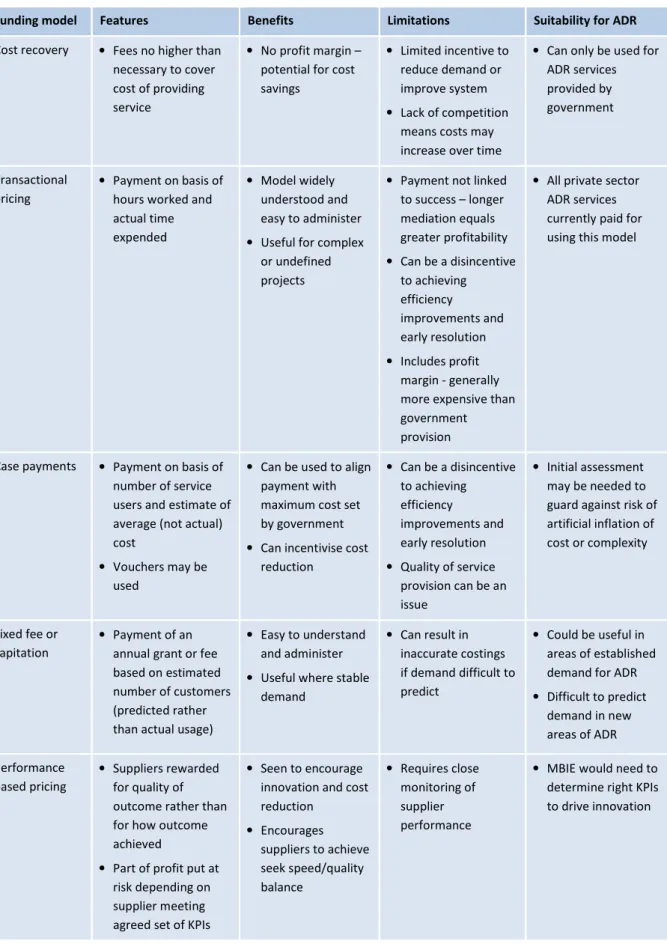
Table 1 Funding models: benefits, limitations and suitability for ADR
Funding model Features Benefits Limitations Suitability for ADR
Cost recovery • Fees no higher than necessary to cover cost of providing service
• No profit margin – potential for cost savings
• Limited incentive to reduce demand or improve system • Lack of competition
means costs may increase over time
• Can only be used for ADR services provided by government Transactional pricing • Payment on basis of hours worked and actual time expended
• Model widely understood and easy to administer • Useful for complex
or undefined projects
• Payment not linked to success – longer mediation equals greater profitability • Can be a disincentive to achieving efficiency improvements and early resolution • Includes profit margin - generally more expensive than government provision
• All private sector ADR services currently paid for using this model
Case payments • Payment on basis of number of service users and estimate of average (not actual) cost
• Vouchers may be used
• Can be used to align payment with maximum cost set by government • Can incentivise cost
reduction • Can be a disincentive to achieving efficiency improvements and early resolution • Quality of service provision can be an issue • Initial assessment may be needed to guard against risk of artificial inflation of cost or complexity
Fixed fee or capitation
• Payment of an annual grant or fee based on estimated number of customers (predicted rather than actual usage)
• Easy to understand and administer • Useful where stable
demand • Can result in inaccurate costings if demand difficult to predict • Could be useful in areas of established demand for ADR • Difficult to predict demand in new areas of ADR Performance based pricing • Suppliers rewarded for quality of outcome rather than for how outcome achieved
• Part of profit put at risk depending on supplier meeting agreed set of KPIs
• Seen to encourage innovation and cost reduction • Encourages suppliers to achieve seek speed/quality balance • Requires close monitoring of supplier performance
• MBIE would need to determine right KPIs to drive innovation
Funding model Features Benefits Limitations Suitability for ADR Target cost incentive fee (TCIF) • Performance based pricing model • KPIs established and
then supplier decides how KPIs to be achieved • Can be used to control costs in monopoly or sole supplier environment • Can be used to incentivise suppliers to prevent disputes arising or to use fewer mediators • Time consuming to negotiate and complex to administer. • Requires new contract management philosophy -providing scope to enable supplier to influence demand • Sufficient data
needed for accurate predictions of demand
• Right KPIs needed to drive innovation • Leaving achievement of outcomes to suppliers could be seen as inconsistent with MBIE accountabilities
In 2013, MBIE considered the issue of an appropriate funding framework to incentivise quality and cost effectiveness in an area with a similar long term lack of competition as ADR. Several models were assessed including fixed fee models, performance based models and annual capped fee models (based on cost per case and projected workload). All of the models assessed were seen to have drawbacks if used exclusively. For example, fixed fee models were found to be unworkable where there was a lack of data to set the fees or where there were wide variations in cost per case and there was a risk that administration fees would outweigh the benefits of using a performance based model.
Current funding arrangements for MBIE’s existing ADR services reflect wide variations in approach, carrying over arrangements prior to amalgamation of the four federation agencies. Given significant differences in how the services are being delivered and in the nature of the outcomes being sought, it is unlikely that a single payment model will suit all ADR services contracted by or for government. Moreover, it may be appropriate to use more than one funding model within the same service. For example, approaches to containing the cost of legal aid services include using fixed fees for standard, high volume cases and hourly rates combined with case management for high-cost, more complex cases. MoJ’s new FDR service is also funded on a mixed funding basis - preparatory counselling is paid for an hourly rate while assessment and mediation are paid for through a fixed fee.
In determining the appropriate payment model for each service the following factors should be taken into account:
• type of service • scope of service
• availability and integration of case management and reporting tools
• maturity of mediator performance standards and ability to assess suppliers’ activities,
behaviours and results
• charges to users (free, levies, part charge or full cost) • variability of demand
• regional cost differences.
The best results from government funded ADR services are likely to be achieved by government defining the outcomes it would like to achieve and asking the market to deliver those outcomes, rather than a specified number of mediation hours. Nevertheless, whichever models are used for funding ADR services to government all models should aim to:
• incentivise efficiency and effectiveness without having an adverse impact on quality • encourage investment from the commercial sector
• minimise total cost to the Crown (including by avoiding the cost of any court based dispute
resolution processes)
• ensure the focus is on outputs and outcomes rather than inputs
• change the funding relationship from a hierarchical grantor/grantee relationship to a
collaborative partnership
• be simple, enduring and stable enough to reduce any administrative burden. Procurement approaches
Achieving a goal of creating larger, stronger organisations for individual ADR providers to operate within is most likely best attained through being specific at the procurement stage. The recent Requests for Proposals for FDR Services issued by MoJ in October 2013 did just that, by seeking responses from suppliers of FDR services of a certain size, rather than seeking responses from individual providers.
The Service Levels agreed within contracts, and also the contract length, are powerful drivers of performance - and are most likely more effective than the specific funding model. While the funding model is important, the knowledge that an organisation will be judged through a well-informed procurement process is far more likely to drive performance than the funding model.
Support for ADR practitioners
The need for continuity of supply dictates that individual mediation practitioners need to continue to be supported to enter and remain a part of the ADR supply market. MBIE initiatives currently underway that will support more practitioners to enter the ADR supply market include the development of a case management system that can be accessed by private providers and the development of its own competency framework.
The quality of supply
Ensuring the quality of supply is closely related to work to achieve goal 3 (setting standards for delivery and holding suppliers to account). MBIE’s initial focus concerning the quality of ADR services has been on ensuring that its own supply of ADR services is the very best it can be. MBIE is strongly focused on improving the quality, responsiveness and value for money for all users of ADR services. It will do this, in relation to its own service delivery, by:
• helping to prevent disputes arising through providing legislative clarity and clear information
• supporting early resolution of any disputes that arise by ensuring that the right information
and services are in place
• developing customer focused services, such as a case management system to support all
existing and any new ADR systems
• focusing on continuous improvement, including the use of pilots to trial new and more
tailored approaches to ADR delivery to ensure ADR is fit for purpose.
A number of initiatives are in train to optimise the quality and responsiveness of MBIE’s ADR services. Current priorities include implementing approaches that have been successfully piloted (such as Fasttrack for tenancy mediations), designing an appropriate operating model for ADR delivery within MBIE and introducing a new case management system. Other areas of focus include reviewing Resolution Services’ contact centre, addressing workplace productivity issues (workload and throughput) and reviewing and aligning terms and conditions for MBIE’s mediation staff. As well as improving our own service delivery, these initiatives will assist MBIE to provide leadership across government in relation to future supply of ADR services.
An important aspect of MBIE’s role as the Centre of Excellence will involve ensuring that all ADR services are appropriate and effective to meet the specific needs of service users. All service providers should measure the benefits and outcomes of the services they provide. Notwithstanding this, ongoing monitoring and oversight of all ADR services provided by or to government is still likely to be required. Consideration may need to be given to finding ways to strike an appropriate balance between upholding key principles concerning ADR delivery, such as the need for confidentiality, against other considerations such as the public’s interest in accountability and value for money. Other questions, such as how the oversight role should be performed, and whether, for example, MBIE is best placed to perform it, are likely to require early consideration by the Centre of Excellence.
Over time, it will be important to develop an understanding of where long term government involvement in the supply of ADR services may, or may not, be appropriate. This involves ensuring, for example, that there is a good fit between the supply and demand for ADR services and that regardless of the delivery mechanism used, the quality of the services provided is consistently high and the services are delivered in accordance with established dispute resolution benchmarks. This is likely to require some form of ongoing ADR oversight and review function within MBIE. The details of this new function, including estimates of the extent of the role and the resources required are yet to be worked through but will be a focus for MBIE over the coming year.
Goal Two – Effective mechanisms to define demand for government ADR services
Government demand for ADR has increased steadily over the last 20 to 30 years and does not show signs of abating. There are currently 191 statutes that make reference to some form of ADR process. Not all statutes are linked to government ADR regimes; however, this figure gives a good indication of the prevalence of disputes arising across government. As government reliance on ADR continues to grow it is more important than ever to ensure that agencies are supported to develop ADR regimes that are efficient and effective and meet expected outcomes.
There are a number of areas or sectors where the need for ADR has been identified and work is continuing to identify the best ways to meet that demand.
The “go live” date for FDR is 31 March 2014. Challenges involved in implementing getting the FMS service up and running, included finding sufficient suppliers to provide national coverage, establishing appropriate standards and funding for the service. Notwithstanding these difficulties, the process of establishing the FDR was relatively fast in comparison to progress in other areas. Discussions are underway within MBIE and between MBIE and relevant government concerning proposed additional ADR models.
Until such time as an ADR Centre of Excellence is established, there are limited resources available within MBIE’s Market Services group to assist other government agencies in the ADR establishment stage. Developing a full ADR toolkit to support every stage of the ADR development process will need to be an ongoing focus for the Centre of Excellence. The work that has been progressed by the Resolution Services group concerning potential new areas of ADR demand has provided considerable learnings to assist MBIE and other agencies to be well informed demanders of ADR services.
Goal Three - Set standards for service delivery and hold suppliers of government ADR services to account
Standards can be described as the rules, principles, criteria or models by which quality, effectiveness and compliance can be measured. Standards assist in:
• improving performance and efficiency • identifying and minimising risk
• designing and delivering quality service • procurement of services
• providing a framework to enable supply or service and innovation.
Standards can be expressed in a wide variety of forms. Standards may be:
• legislative provisions (to enforce compliance) • minimum specifications (to minimise safety risks) • aspirational targets (for performance improvement) • good practice (for service design).
MBIE has undertaken preliminary work to develop a standards framework for dispute resolution. This exercise has involved examining all the various mechanisms by which each of the best practice principles for ADR may be met. Examples of the metrics that could be used to measure whether the standard has been met have also been identified. A preliminary Dispute Resolution Standards Framework has been developed and is available to guide government in the standard setter role. We are currently assessing the best ways to articulate and reinforce ADR standards.
Goal Four - Establish an ADR framework for government integrating resolution policy
The role of ADR framework development involves drawing together all the elements needed for a robust and effective ADR system. This incorporates the right policy and legislative settings, the right structures and governance arrangements and the right functions and service delivery approaches.
Much of the work of the best practice project to date has involved consideration of various elements of the framework development role.
Legislative audit
Provision for ADR is generally made through subject or sector specific legislation. Accordingly, the rapid development of government ADR in New Zealand is matched by a proliferation of ADR related legislative provisions. In all, 191 statutes have been identified that provide for, or make reference to, some form of ADR. A preliminary assessment of these provisions shows wide variations in approach. The ADR regimes currently administered by MBIE’s Resolution Services group are provided for in the:
• Employment Relations Act 2000 (employment disputes) • Residential Tenancies Act 1986 (tenancy disputes)
• Weathertight Homes Resolution Services Act 2006 (weathertight disputes) • Unit Titles Act 2010 (unit titles disputes).
In addition to identifying systems design principles based on the best practice principle, a preliminary assessment of the ADR provisions in statutes administered by MBIE against the best practice principles has also been made. Findings from this exercise include:
• the ADR provisions currently included in the legislation that MBIE administers reflect the
time when they were developed and reflect differences in approach and emphasis
• not all principles are reflected in every piece of legislation; but notwithstanding this there are
no glaring omissions needing to be rectified immediately
• full consideration of the appropriateness of current ADR legislative provisions requires good
understanding of how these provisions are currently applied and work in practice. Working with MBIE’s mediators to assess the relevance of the various good practice principles and the appropriateness of current ADR provisions could be a useful next step in ongoing work to demonstrate best practice ADR delivery.
This exercise has provided a number of important insights including:
• all new ADR regimes to be included in legislation should be drafted in accordance with the
best practice principles
• while all the best practice principles are important to each legislative ADR regime, their
importance will vary depending on the particular nature of the parties involved and the disputes arising. For example, principles such as independence while relevant to all regimes are critical in areas of dispute where impartiality is most likely to be subject to scrutiny (employment relations)
• adherence to the principles is not absolute and may need to be qualified. For example, while
upholding the principle of confidentiality may be a cornerstone of ADR this should not be at the expense of achieving important outcomes from the mediation process, such as effectively addressing workplace harassment or bullying
• legislation is only one of a suite of tools for realising an ADR best practice principle. Other
mechanisms include standards, performance agreements and contracts for ADR service provision.
Fees framework
As part of the best practice programme of work MBIE has also reviewed the alignment of the principles for setting fees for dispute resolution services. This work, along with work to identify appropriate funding frameworks for ADR services, is closely aligned with other objectives for the project, including ensuring adequate supply and high quality ADR services and being strongly customer focused in the services that we provide.
MBIE’s work has involved assessing the guidance currently available for setting fees for goods and services provided by government and synthesising a set of principles for setting fees that draws on this guidance.
Principles for fee setting Freedom to operate
• A public entity must have the legal authority to charge a fee for the goods and services it
provides. Policy considerations
• The fee should be consistent with and assist in delivering the policy objectives of the activity. • Charges should broadly reflect the balance of public and private benefit arising from the
service.
• Fees should be set at levels that do not create barriers to accessing justice.
• Fees should not unduly stifle competition within a marketplace or hinder industry
innovation.
Establishing costs and cost structure design
• To ensure accountability the process for setting fees and identifying costs should be fully
transparent.
• Charges should reflect the full cost of providing the service to users unless other policy
considerations result in charges being set at less than cost recovery.
• Fees should provide value for money and should generally be set at no more than the
amount necessary to recover costs. Implementation considerations
• Resources should be allocated to maximise efficiency and transaction costs to users
minimised.
The next step in the fees framework development work is to undertake a policy assessment of MBIE’s dispute resolution fees regimes based on the principles developed. An assessment will also be made as to how MBIE’s approach for charging fees for dispute resolution services aligns with similar regimes across government and fits with the overall approach to resourcing the ADR Centre
of Excellence. The findings from this analysis will inform the fee setting component of the ADR framework.
Early resolution approaches
There are clear advantages to resolving issues early - both for the parties and for government. For disputes where the maintenance or restoration of the relationship is a key consideration (such as family and employment disputes), it is well established that once parties are entrenched in dispute the chances of returning to normal relations are seriously compromised. MBIE and MoJ are strongly focused on early resolution of disputes in the areas for which it is responsible. For example, FDR aims to resolve family disputes before they escalate to the Family Court. Similarly, achieving compliance with minimum labour standards without recourse to court action is a key focus for MBIE.
Cost of disputes
Disputes are costly for all those involved and unresolved disputes can have a significant financial impact on individuals, families, communities and businesses. The longer and more protracted the dispute the more difficult and expensive to resolve.
In 2007, the former Department of Labour commissioned research on the cost of employment relationship problems (ERPs)2. The research found that the cost of ERPs was $214 million (0.6% of private sector wages and salaries for the year2). Using the Labour Cost Index (LCI) to adjust to present day values, this becomes $242 million (in 2013 dollars). This equates to 0.4% of private sector wages and salaries for the year3. This calculation is the present day value of the 2007 estimate. An estimate of the cost of more recent ERPs, also incorporating indirect costs such loss of productivity, morale and personal relationship issues resulting from the dispute, would provide a truer picture of the current cost of ERPs to the New Zealand economy.
In addition to considerable savings to the economy, there are also significant systems savings to be made through resolving employment disputes before they become intractable and more formal and expensive dispute resolution processes may be needed. The MoJ has calculated that the total cost of running the Employment Court in 2010 was $3.3 million. This equates to an average of $13,070 per case. The average application fee paid was $155 (GST exclusive). The total revenue collected by the Employment Court in 2010/11 was $49,052, representing just 1.5% of the Court’s total running cost4. Therefore, the lion’s share of the cost of not resolving employment disputes early and so proceeding to formal court litigation is currently borne by the taxpayer.
Based on the estimated cost to the economy of just one type of disputes (employment disputes), it is likely that current cumulative cost of all disputes would run into the many hundreds of millions or billions of dollars each year. In this context, there is a strong case for sustained attention on both preventing disputes from arising (for example through the clear articulation of rights and responsibilities in legislation and early communication and information to potential disputants) and on achieving early resolution where disputes do arise.
2
http://www.dol.govt.nz/PDFs/er-problems.pdf
3 Calculated using Quarterly Employment Survey data, Statistics New Zealand. 4
The cost of unresolved disputes in specific sectors is also likely to have significant flow on effects. For example, in the housing sector costs incurred in resolving disputes may be a contributing factor in rental increases.
The cost of disputes may provide strong impetus for government to look to lower level and more cost effective dispute resolution mechanisms, such as those offered by ADR. However, in order to gain public acceptance and credibility, as well as fully realise the potential benefits of adopting ADR a more consistent and principles based approach to the future development of ADR is now needed. Developing an understanding of the economics of disputes - what they cost to the state, the economy and to parties will be a key focus for the government ADR Centre of Excellence.
Thinkplace customer/stakeholder research
In September 2013, MBIE worked with ThinkPlace Ltd to conduct qualitative research with the goal of gaining a deeper understanding of people’s experiences of using MBIE’s dispute resolution services. The main focus for the research was the experience customers (including tenants, landlords, employers and employees) have of disputes and the role of MBIE’s Resolution Services group within this experience. Stakeholders, including mediators and dispute resolution experts from across New Zealand, were interviewed. In all, 44 key participant interviews were undertaken in the course of the research.
Preliminary findings from the research were presented in the first report. ThinkPlace’s final report was provided in December 2013. The report explores the drivers for accessing dispute resolution and the impacts of the overall resolution process. Common experiences between users, as well as areas of difference are identified. The report highlights general themes in relation to MBIE’s delivery of mediation services.
Table 2 General themes from customer and stakeholder feedback
Mediation is highly valued The actual mediation session, or event, is valued by most as an effective process to resolve conflicts or move the conflict forward.
Preparation and expectations influence the experience
Preparation and expectation setting significantly influences whether mediation might work and why it might fail.
The degree of service awareness varies and can drive cost
How and when customers become aware of mediation service varies dramatically and seems to have an impact on the initial experience, including cost.
Roles and experience matter The quality of a customer’s experience can be strongly influenced by the level of structure and support provided.
People prefer mediation to Court
The mediation process is generally seen to be a collaborative solution focused process in comparison to court which is seen as external escalation.
The report uses a series of customer journeys (amalgamations of participant stories) that represent typical “end to end” experiences of users of the tenancy and employment mediation services. The journeys explore the relationships and interactions between the parties in dispute and provide insights into the goals and outcomes sought by service users.
Research findings
A key finding from the research is that participants are seeking a wide variety of outcomes from the dispute resolution process. While for some people the mediation process is about achieving full resolution, such as the mending of relationship or the righting of a wrong; for others the focus is on reaching a settlement to the dispute rather than addressing any deep seated issues. This may mean that there is a mismatch of intentions and expectations between parties entering a dispute resolution process, with the likely result that at least one party may not achieve the outcome that they are seeking from the resolution process. The challenge is to understand the extent to which intention and expectation mismatches matter.
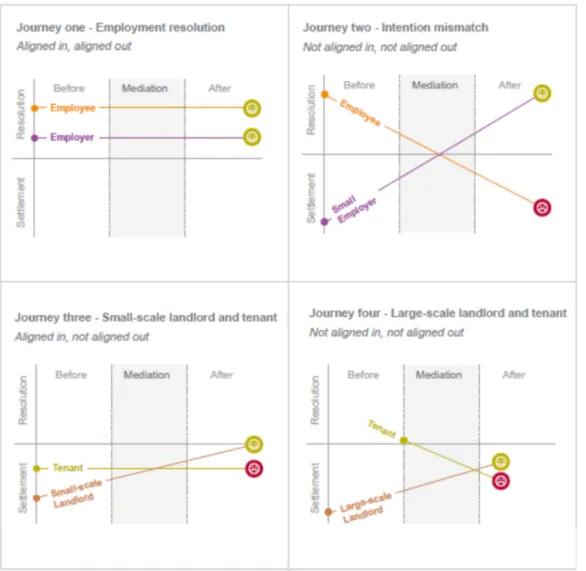
The report presents four user journeys to demonstrate how a lack of alignment between parties’ intentions can play out through a dispute resolution process.
Figure 1 Intention alignment
In essence, the less aligned the parties are in terms of what they are seeking at the commencement of the dispute resolution process the less aligned they are likely to still be at the conclusion of that process. Therefore, we need to assess what this means from a service delivery perspective. For example, do we need to differentiate between settlement and resolution in the ADR services that we provide? Fasttrack is an acknowledgement of an alignment in settlement that has led to service design changes.
Another key finding was that the mediation process was only one step, albeit a significant step, in the dispute resolution process. This highlights the need for service providers to also consider the support provided to parties both before and following the mediation event.
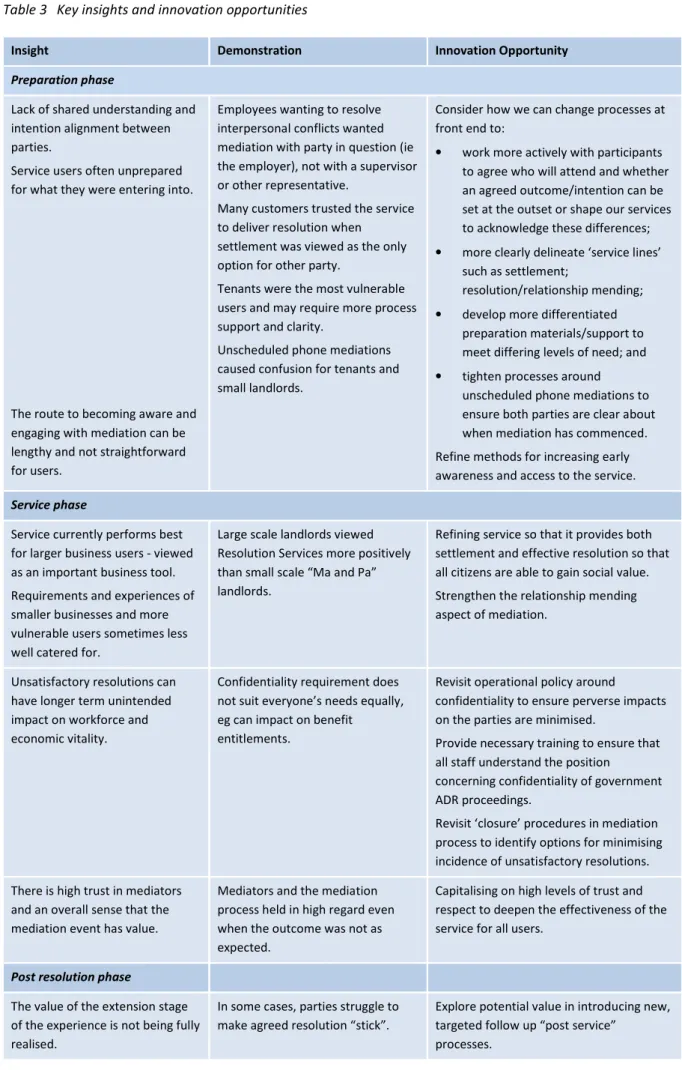
The Thinkplace report highlighted key insights and a number of opportunities for innovation in service delivery through the different phases of dispute resolution for each MBIE service.
Table 3 Key insights and innovation opportunities
Insight Demonstration Innovation Opportunity
Preparation phase
Lack of shared understanding and intention alignment between parties.
Service users often unprepared for what they were entering into.
The route to becoming aware and engaging with mediation can be lengthy and not straightforward for users.
Employees wanting to resolve interpersonal conflicts wanted mediation with party in question (ie the employer), not with a supervisor or other representative.
Many customers trusted the service to deliver resolution when
settlement was viewed as the only option for other party.
Tenants were the most vulnerable users and may require more process support and clarity.
Unscheduled phone mediations caused confusion for tenants and small landlords.
Consider how we can change processes at front end to:
• work more actively with participants to agree who will attend and whether an agreed outcome/intention can be set at the outset or shape our services to acknowledge these differences; • more clearly delineate ‘service lines’
such as settlement;
resolution/relationship mending; • develop more differentiated
preparation materials/support to meet differing levels of need; and • tighten processes around
unscheduled phone mediations to ensure both parties are clear about when mediation has commenced. Refine methods for increasing early awareness and access to the service.
Service phase
Service currently performs best for larger business users - viewed as an important business tool. Requirements and experiences of smaller businesses and more vulnerable users sometimes less well catered for.
Large scale landlords viewed Resolution Services more positively than small scale “Ma and Pa” landlords.
Refining service so that it provides both settlement and effective resolution so that all citizens are able to gain social value. Strengthen the relationship mending aspect of mediation.
Unsatisfactory resolutions can have longer term unintended impact on workforce and economic vitality.
Confidentiality requirement does not suit everyone’s needs equally, eg can impact on benefit
entitlements.
Revisit operational policy around
confidentiality to ensure perverse impacts on the parties are minimised.
Provide necessary training to ensure that all staff understand the position
concerning confidentiality of government ADR proceedings.
Revisit ‘closure’ procedures in mediation process to identify options for minimising incidence of unsatisfactory resolutions. There is high trust in mediators
and an overall sense that the mediation event has value.
Mediators and the mediation process held in high regard even when the outcome was not as expected.
Capitalising on high levels of trust and respect to deepen the effectiveness of the service for all users.
Post resolution phase
The value of the extension stage of the experience is not being fully realised.
In some cases, parties struggle to make agreed resolution “stick”.
Explore potential value in introducing new, targeted follow up “post service”
The Thinkplace research will assist MBIE to find tangible ways to improve and innovate in terms of its own dispute resolution services. The report is also an important resource for informing the future development of government ADR services at policy and service development stages. A number of issues are currently under consideration including:
• should parties be required to be explicit about the outcomes they are seeking at the outset
of the dispute resolution process – would this assist to achieve better outcomes from government ADR processes or create more problems
• should MBIE be working more actively with customers at the start of the dispute resolution
process
• is MBIE getting an accurate picture of the true success of its dispute resolution processes or
the extent to which higher level objectives, such as productive employment relations, are being met (the outcome of a dispute process is recorded but not the parties’ level of satisfaction with the outcome)
• should MBIE develop different service lines for different outcomes, such as “full resolution”
and “settlement and non-resolution” outcomes.
MBIE is keen to work in partnership with other government agencies that deliver ADR services and with service user groups to address the issues raised through the Thinkplace research and our own analysis as new government ADR regimes are built. A series of stakeholder meetings are currently underway to provide information about the Best Practice review and MBIE’s future direction concerning dispute resolution services. This includes providing assurance that the services that customers have used in the past are still available to them and that there is an ongoing programme of work to deliver further improvements and efficiencies in the provision of government ADR services.
7.0 Realising opportunities for continuous improvement
A full programme of work is underway within MBIE’s Resolution Services group to ensure that MBIE’s delivery of dispute resolution services is as effective and efficient as it can be. A number of initiatives have been designed to address the issues identified through the analysis of current service delivery arrangements, issues raised by staff through the Bottleneck Challenge, and insights provided through the Thinkplace research. As well as supporting the best outcomes from current dispute resolution services, a continuous improvement approach to ADR service delivery provides learnings and insights that could become a significant resource for an ADR Centre of Excellence. MBIE would gain trust and credibility as an ADR Centre of Excellence through “demonstrating by doing” and then sharing our expertise with others involved with dispute resolution across government.
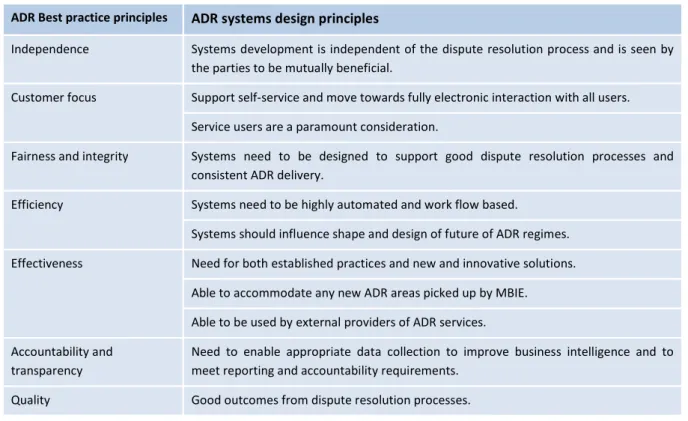
Drawing on the ADR best practice principles, a generic set of design principles have been identified to guide our service delivery continuous improvement programme.
Table 4 ADR systems design principles
ADR Best practice principles ADR systems design principles
Independence Systems development is independent of the dispute resolution process and is seen by the parties to be mutually beneficial.
Customer focus Support self-service and move towards fully electronic interaction with all users. Service users are a paramount consideration.
Fairness and integrity Systems need to be designed to support good dispute resolution processes and consistent ADR delivery.
Efficiency Systems need to be highly automated and work flow based.
Systems should influence shape and design of future of ADR regimes. Effectiveness Need for both established practices and new and innovative solutions.
Able to accommodate any new ADR areas picked up by MBIE. Able to be used by external providers of ADR services. Accountability and
transparency
Need to enable appropriate data collection to improve business intelligence and to meet reporting and accountability requirements.
Quality Good outcomes from dispute resolution processes.
Current initiatives
MBIE needs to be a responsive and agile supplier of ADR services. This includes ensuring that adequate support and information is available to potential users and that processes and systems are efficient and able to be tailored to different areas and different categories of dispute as required.
Pre mediation Workbook
In response to staff feedback received through the Bottleneck Challenge, a pre mediation workbook is being developed for the purpose of assisting parties to prepare for their mediation. The workbook provides information about the mediation process and helps parties to identify how they would like to approach the mediation session and the main points they would like to get across. Parties are encouraged to anticipate the likely different viewpoints about matters in dispute and to consider the range of possible outcomes given the nature of the dispute. The potential impact of the mediation on the future relationship between the parties is also something that parties are encouraged to think about before the mediation takes place. The pre mediation workbook is going to be implemented across each of MBIE’s ADR service lines in April 2014.
The ThinkPlace research highlighted the need to address expectation and intention asymmetry between the parties and provide additional assistance to unrepresented parties. The pre mediation workbook will be provided to all unrepresented parties and will assist parties to understand the various possible outcomes from the ADR process.
Project Resolve - case management system replacement
Each of the mediation services brought together with the MBIE merger (Tenancy, Employment, Unit Titles and Weathertight Homes) came with their own approach to case management. A key aspect of business process improvements is designing and implementing a new case management system.