A Riverhead Networks Whitepaper
Distributed Denial of Service (DDoS) attacks are weapons of mass disruption. Unlike access attacks that penetrate security perimeters to steal information, DDoS attacks paralyze Internet systems by swamping servers, network links and network devices (routers, firewalls, etc.) with bogus traffic.
DDoS is emerging as the weapon of choice for hackers, political “hacktivists” and international cyber-terrorists. Easily launched against limited defenses, DDoS attacks target not only individual Web sites or other servers at the edge of the network they subdue the network itself. Attacks have begun to explicitly target the network infrastructure, like aggregation or core routers, or DNS servers in a provider’s network. In October 2002, a harbinger of future large-scale attacks was a crude DDoS attack that affected eight of the 13 root Domain Name Service (DNS) servers, critical systems serving as the roadmap for virtually all Internet communications.
The growing dependence on the Internet makes the impact of successful DDoS attacks — financial and otherwise — increasingly painful for service providers, enterprises and government agencies. And newer, more powerful DDoS tools promise to unleash even more destructive attacks in the months and years to come.
Because DDoS attacks are among the most difficult to defend against, responding to them in an appropriate and effective manner poses a tremendous challenge for all Internet-dependent organizations. Network devices and traditional perimeter security technologies such as firewalls and IDSs (Intrusion Detection Systems) are simply not capable of providing sufficient DDoS protection. Instead, facing the current DDoS onslaught to secure Internet availability requires a next-generation architecture that detects and defeats increasingly sophisticated, complex and deceptive attacks. This white paper describes:
• The growing DDoS threat and the severe impact successful attacks have on organizations.
• Why current router and perimeter security technologies cannot provide adequate DDoS protection.
• What baseline requirements must be met to defeat DDoS attacks.
• How Riverhead Networks’ innovative technology and architecture delivers complete DDoS protection.
The DDoS Threat
A DDoS attack directs hundreds or even thousands of compromised “zombie” hosts against a single target. These zombie hosts are unwittingly recruited from the millions of unprotected computers
accessing the Internet through high-bandwidth, “always on” connections. By planting “sleeper” codes on these machines, hackers can quickly build a legion of zombies, all waiting for the command to launch a DDoS attack. With enough zombie hosts participating, the volume of an attack can be astounding.
The Impact of DDoS Attacks
The impact of a successful DDoS attack is widespread. Site performance is severely compromised, resulting in frustrated customers and other users. Service level agreements (SLAs) are violated, triggering costly service credits. Company reputations are tarnished, sometimes permanently. Lost revenue, lost productivity, increased IT expenses, litigation costs the losses just keep mounting. The numbers are staggering. Estimates from Forrester, IDC and the Yankee Group predict the cost of a 24-hour outage for a company like Cisco would approach $30 million. A spate of DDoS attacks against Amazon, Yahoo, eBay and other major sites in February 2000 caused an estimated cumulative loss of $1.2 billion, according to the Yankee Group. And in January 2001, Microsoft lost approximately $500 million over the course of a few days from a DDoS attack on their site. Clearly, businesses must take steps to protect themselves from theses malicious attacks.
Inside DDoS Attacks
How do DDoS attacks work? By taking advantage of Internet protocols and the Internet’s fundamental benefit delivering data packets from nearly any source to any destination, without prejudice. Essentially, it is the behavior of these packets that define the DDoS attack: either there are too many, overwhelming network devices as well as servers, or they are deliberately incomplete to rapidly consume server resources. What makes DDoS attacks so hard to prevent is that illegitimate packets are
indistinguishable from legitimate packets, making detection difficult; typical “signature” pattern
matching, performed by intrusion detection systems, don’t work. Many of these attacks also use spoofed source IP addresses, therefore eluding source identification by anomaly based monitoring tools looking for unusually high volumes of traffic coming from specific origins.
The two most basic types of DDoS attacks are:
• Bandwidth Attacks: These DDoS attacks consume resources such as network bandwidth or equipment by overwhelming one or the other (or both) with a high volume of packets. Routers, servers and firewalls all of which have limited processing resources are rendered
unavailable for valid transactions and can fail under the load.
The most common form of bandwidth attack is a packet-flooding attack, in which a large number of seemingly legitimate TCP, UDP or ICMP packets are directed to a specific destination. To make detection even more difficult, such attacks might also spoof the source address — that is, misrepresent the IP address that supposedly generated the request to prevent identification.
• Application Attacks: These DDoS attacks use the expected behavior of protocols such as TCP and HTTP to the attacker’s advantage by tying up computational resources and preventing them from processing transactions or requests. HTTP half-open and HTTP error attacks are just a couple examples of application attacks.
Hackers activate zombies on
innocent computers
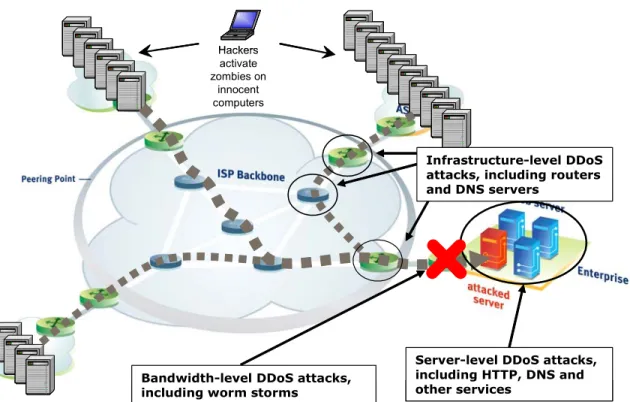
Server-level DDoS attacks, including HTTP, DNS and other services
Bandwidth-level DDoS attacks, including worm storms
Infrastructure-level DDoS attacks, including routers and DNS servers Hackers activate zombies on innocent computers
Server-level DDoS attacks, including HTTP, DNS and other services
Bandwidth-level DDoS attacks, including worm storms
Infrastructure-level DDoS attacks, including routers and DNS servers
Figure 1: Multiple points of vulnerability and failures.
The DDoS Threat Grows Ever More Deadly
A growing trend among DDoS attackers is to use sophisticated spoofing techniques and essential protocols (instead of non-essential protocols that can be blocked) to make DDoS attacks even more stealthy and deadly. These attacks, which utilize legitimate application protocols and services, are very difficult to identify and defeat; employing packet filtering or rate-limiting measures simply complete the attacker’s task by shutting everything down, causing legitimate users to be denied.
Today’s Inadequate DDoS Defenses
Regardless of the type of DDoS attack, current techniques used to deal with them fall short in terms of mitigation and ensuring business continuity. Today’s more popular DDoS responses such as
“blackholing” and router filtering — are woefully inadequate for dealing with increasingly sophisticated attacks. These responses are not only labor intensive and slow, but they also block valid traffic. Intrusion detection systems (IDSs) offer some detection capabilities but no mitigation, while firewalls offer minimal protection that is further limited by other weaknesses. Still other strategies, such as over-provisioning, don’t provide adequate protection against ever larger attacks and are far too costly as a DDoS prevention strategy.
Blackholing
Blackholing describes the process of a service provider blocking all traffic destined for a targeted
enterprise as far upstream as possible, sending the diverted traffic to a “black hole” where it is discarded in an effort to save the provider’s network and its other customers. Since legitimate packets are discarded along with malicious attack traffic, blackholing is not a solution. The victim loses all their traffic and the attacker wins.
Routers
Many people assume that routers, with their filtering capabilities, can provide a defense against DDoS attacks. The truth is, because the router’s main defense is based on access control lists (ACLs), they are ill equipped to defend against today’s sophisticated DDoS attacks, described in detail below.
A router can stop only a few simple DDoS attacks, such as ping attacks, by filtering non-essential unneeded protocols. This still requires a manual, reactive effort that is often after services have failed under attack. Additionally, today’s DDoS attacks use valid protocols that are essential for an Internet presence, rendering filtering by protocol useless. A router can also stop invalid IP address spaces but, again, DDoS attacks easily spoof valid IP addresses.
Another suggested router-based DDoS prevention strategy — using uRPF to stop spoofed attacks on the outbound side — is also ineffective against today’s DDoS attacks because the underlying principle of uRPF is to block outbound traffic if the IP address doesn’t belong to the subnet. However, attacks can spoof source IP addresses from the same subnet they are sitting behind, rendering such a solution useless. More importantly, for uRPF to be effective, it would have to be implemented in front of every potential attack source — not a current or likely occurrence.
Essentially, router ACLs are ineffective against a wide variety of spoofed attacks using valid protocols, including:
• SYN, SYN-ACK, FIN, etc. floods. For a random spoofed SYN attack or an ACK and RST attack on Port 80 of a Web server, where the spoofed source IP addresses are constantly changing, no set of ACLs can possibly track and stop such an attack. Manual tracing or anomaly detection cannot identify all the individual spoofed sources. The only option would be to block the entire server, completing the attacker’s goal.
• Proxy. Because an ACL cannot distinguish between legitimate and malicious SYNs coming from the same source IP or proxy, it ends up blocking all the victimʹs clients coming from a certain source IP or proxy when attempting to stop this focused spoofed attack.
• DNS or BGP. When these types of randomly spoofed DNS server or BGP router attacks are launched, the ACLs — similar to the SYN flood — not only can’t track the rapidly changing volume of random spoofed traffic, but they have no way of identifying which addresses are spoofed versus valid in the first place.
ACLs are ineffective against application-level (client) attacks as well, whether spoofed or not. While ACLs could theoretically block client attacks — such as HTTP error and HTTP half-open connection attacks, provided the attack and individual non-spoofed sources could be accurately detected — it would require users to configure hundreds and sometimes thousands of ACLs per victim.
Firewalls
Many firewall vendors claim their products offer DDoS prevention capabilities. But the fact is, firewalls are not purpose-built DDoS prevention devices and suffer inherent limitations that impede their ability to protect against today’s sophisticated attacks.
First among those limitations is location. Firewalls reside too far downstream on the data path to provide adequate protection for the access link extending from the provider to the edge router at the fringe of the enterprise, leaving those components vulnerable to DDoS attacks. Furthermore, because firewalls reside in-line, they become potential points of failure that are themselves susceptible to DDoS assaults that saturate their session handling capacity.
The second limitation is the lack of anomaly detection. Firewalls are intended primarily for controlling access to private networks. One way this is accomplished is by tracking sessions initiated from inside (the “clean” side) to an outside service and then accepting only specific replies from expected sources on the “dirty” outside. However, this doesn’t work for services such as Web, DNS and other services, which must be open to the general public to receive requests. In these cases, the firewalls do something called opening a conduit i.e., letting HTTP traffic pass to the IP address of the Web server. While such an approach offers some protection by only accepting specific protocols for specific addresses, it is
ineffective against DDoS attacks because hackers can use the “approved” protocol (HTTP in this case). The lack of any anomaly detection capabilities means firewalls can’t recognize when valid protocols are being used as an attack vehicle.
Even if firewalls could detect anomalous behavior, the third limitation — little to no anti-spoofing capabilities — would allow the attack to occur. When a DDoS attack is detected, firewalls can shut down a specific flow associated with the attack, but they cannot perform anti-spoofing on a packet-by-packet basis to separate good or legitimate traffic from bad, rendering them virtually useless against attacks using spoofed IP addresses.
IDS
Signature-based IDS solutions will miss DDoS attacks leveraging valid packets. An IDS solution would have to provide state-of-the-art behavioral or anomaly-based algorithms to detect today’s DDoS attacks. Some anomaly-based capabilities are available but require extensive manual tuning by experts,
frequently generate false positives, and don’t identify the specific attack flows. The IDS can also become a victim of a DDoS attack itself.
Perhaps the IDS’ greatest shortcoming as a DDoS defense platform is that it detects only and does nothing to mitigate the effects of an attack. IDS solutions may recommend filters for routers and firewalls, but, as described earlier, these are not effective mitigation solutions for DDoS attacks, nor are in-line deployments of IDS’ using similar static filtering. What IDS’ require is a complementary mitigation solution that provides the next level of specific attack flow identification integrated with immediate enforcement capabilities.
Manual Responses to DDoS Attacks
Manual processes used as part of a DDoS defense are a case of too little, too late. A victim’s first response to a DDoS attack is typically to ask the closest upstream connectivity provider an ISP, a hosting
long and tedious process that requires cooperation among many providers. And though a source might be identified, blocking it would mean blocking all traffic good and bad.
Other Strategies
In order to withstand DDoS attacks, enterprise operators may have considered various strategies such as over-provisioning that is, buying excess bandwidth or redundant network devices to handle any spikes in demand. Such an approach is not particularly cost-effective, especially since it requires the addition of redundant network interfaces and devices. And regardless of the initial effect, attackers merely need to increase the volume of the attack to defeat the extra hardware.
The Case for Securing Availability
Any business with an online presence has any number of reasons — economic and otherwise — to invest in DDoS protection. Large enterprises, government organizations, service providers — all need to protect the components of their infrastructures (Web servers, DNS servers, e-mail and chat servers, firewalls, switches, routers) to preserve the integrity of business operations and make more efficient use of technical staff.
ROI Models of DDoS Defense
Of course, implementing complete DDoS protection carries its own costs. However, the return on investment (ROI) for implementing such a program is compelling.
• E-Commerce. DDoS protection for e-commerce sites can pay for themselves within a matter of hours when compared to the cost of potential losses associated with a DDoS attack. An
e-commerce site’s transactional volumes, average revenue per transaction, advertisement revenues, intangibles such as brand equity and legal liabilities, as well as technical staff time required to restore an attacked site, should all be taken into account when determining the fiscal impact of any DDoS-related downtime. Add the possibility that DDoS protection might allow
downgrading to less-expensive bandwidth links, and the ROI figures grow even more impressive.
• Service Providers. For service providers, keeping their own network operational has huge ROI ramifications. If a provider’s infrastructure is attacked (routers, DNS, etc.), all services to customers fail, resulting in SLA violations. The cost of DDoS protection is insurance against catastrophic failures that would cost the business orders of magnitude more in terms of both revenue and negative customer relations.
Cost-avoidance, however, is not the only motivation for hosting, transit and service providers to implement a complete DDoS solution. For these users, DDoS protection can also be offered as a value-added service that creates new revenue streams and provides competitive differentiation.
Mitigating the DDoS Threat
Taking on DDoS attacks requires a new approach that not only detects increasingly complex and deceptive assaults but also mitigates the effects of the attack to ensure business continuity and resource availability.
Complete DDoS protection is built around four key themes: 1. Mitigate, not just detect
2. Accurately distinguish good traffic from bad traffic to preserve business continuity, not just detect the overall presence of an attack
3. Include performance and architecture to deploy upstream to protect all points of vulnerability 4. Maintain reliable and cost-efficient scalability
A DDoS defense built on these concepts delivers the following protection attributes:
• Enables immediate response to DDoS attacks via integrated detection and blocking mechanisms, even during spoofed attacks when attacker identities and profiles are changing constantly
• Provides more complete verification capabilities than either static router filters or IDS signatures can provide today
• Delivers behavior-based anomaly recognition to detect valid packets sent with malicious intents to flood a service
• Identifies and blocks individual spoofed packets to protect legitimate business transactions
• Offers mechanisms designed to handle the huge volume of DDoS attacks without suffering the same fate as protected resources
• Enables on-demand deployment to protect during attacks without introducing a point of failure or imposing the scaling costs of an in-line solution
• Built-in intelligence processes only contaminated traffic streams, ensuring maximum reliability and minimum scaling costs
• Avoids reliance on network device resources or configuration changes
• Utilizes standard protocols for all communications, ensuring maximum interoperability and reliability
Riverhead Networks’ Complete DDoS Protection Solution
Riverhead Networks delivers a complete DDoS protection solution based on the principles of detection, diversion, verification and forwarding to ensure total protection. When a DDoS attack is launched against a victim protected by the Riverhead solution, business continuity is maintained by:
1. Detecting the DDoS attack
2. Diverting the data traffic destined for the target device to a Riverhead appliance for treatment 3. Analyzing and filtering the bad data packets from the good data packets, preventing malicious
traffic from impacting performance while allowing legitimate transactions to complete 4. Forwarding the good traffic to maintain business continuity
The Riverhead Solution Set
The Riverhead solution provides complete protection against all types of DDoS attacks, even those that have never been seen before. Featuring active mitigation capabilities that rapidly detect attacks and separate malicious packets from legitimate traffic, the Riverhead solution delivers a rapid DDoS response that is measured in seconds, not hours. And easily deployed adjacent to critical routers and switches, the Riverhead solution offers a scalable option that eliminates any single points of failure and doesn’t impact the performance or reliability of the existing network components.
The Riverhead solution set includes two distinct components — the Riverhead Detector and the Riverhead Guard — that, working together, deliver complete DDoS protection for virtually any environment.
• Riverhead Detector: Acting as an early warning system, the Riverhead Detector provides in-depth analysis of the most complex DDoS attacks. The Detector passively monitors network traffic, looking for any deviation from “normal” or baseline behavior that indicates a DDoS attack. When an attack is identified, the Detector alerts the Riverhead Guard, providing detailed reports as well as specific alerts to quickly react to the threat. For example, the Detector can observe that the rate of UDP packets from a single source IP is out of range, even if overall thresholds are not exceeded.
• Riverhead Guard: The Riverhead Guard is the cornerstone of the Riverhead DDoS solution set a high-performance DDoS attack mitigation device that is deployed upstream at either the
ISP/data center or within a large enterprise to protect both the network and data center resources. When the Guard is notified that a target is under attack (whether from a Riverhead Detector or some other security monitoring device such as an intrusion detector or firewall), traffic destined for the target is diverted to the Guard (or Guards) associated with the targeted device. The traffic is then subjected to a rigorous five-stage analysis and filtering designed to remove all malicious traffic while allowing good packets to continue flowing uninterrupted.
The Guard resides adjacent to a router or switch on a separate network interface, enabling on-demand protection without impacting data traffic flow of other systems. Depending on its location, the Guard can concurrently protect multiple potential targets, including routers, Web servers, DNS servers, and LAN and WAN bandwidth.
The Riverhead Networks MVP Architecture
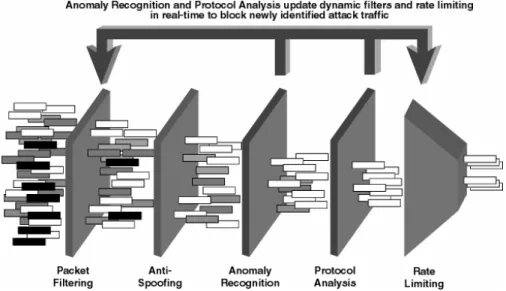
The Riverhead Guard’s next generation DDoS defense solution is based on a unique, patent-pending Multi-Verification Process (MVP) architecture that integrates a variety of verification, analysis and enforcement techniques to identify and separate malicious traffic from legitimate traffic. This purification process consists of five modules or steps:
• Filtering: This module includes both static and dynamic DDoS filters. Static filters, which block non-essential traffic from reaching the victim under attack, are user-configurable and come from
Riverhead with preset default values. Dynamic filters are inserted by the other modules based on observed behavior and detailed analysis of traffic flows, delivering real-time updates that either increase the level of verification applied to suspicious flows or block sources and flows that have been verified as malicious.
Figure 2: Riverhead Networks’ Multi-Verification Process (MVP) architecture
• Anti-Spoofing: This module verifies that packets entering the system have not been spoofed. The Guard uses a number of unique, patent-pending source authentication mechanisms to stop spoofed packets from reaching the victim. The anti-spoofing module also has several mechanisms to ensure proper identification of legitimate traffic, virtually eliminating the risk of valid packets being discarded.
• Anomaly Recognition: This module monitors all traffic that was not stopped by the filter or the anti-spoofing modules and compares it to baseline behavior recorded over time, looking for deviations that would identify the source of malicious packets. The basic principle behind this module’s operation is that the pattern of traffic originating from a “black-hat” daemon residing at a source differs dramatically from the pattern generated by legitimate sources during normal operation. This principle is used to identify the attack source and type, as well as to provide guidelines for blocking traffic or performing more detailed analysis of the suspected data.
• Protocol Analysis: This module processes flows that anomaly recognition finds suspicious in order to identify application-specific attacks, such as http-error attacks. Protocol analysis then detects any misbehaving protocol transactions, including incomplete transactions or errors.
• Rate Limiting: This module provides another enforcement option and prevents misbehaving flows from overwhelming the target while more detailed monitoring is taking place. The module performs per-flow traffic shaping, penalizing sources that consume too many resources (e.g. bandwidth or connections) for too long a period.
It is important to note that, between attacks, the Riverhead Guard is in “learning” mode, passively monitoring traffic patterns and flow for each of the different resources is protects to understand normal behavior and establish a baseline profile. This information is later used to fine-tune policies for
recognizing and filtering both known and unknown, never-before-seen attacks in real-time network activity.
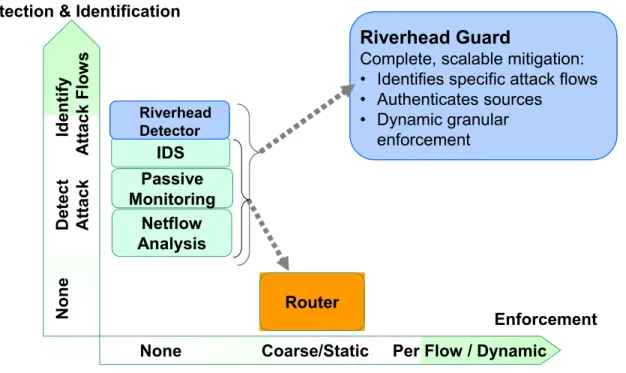
Figure 3: Riverhead advantages versus current alternatives.
Riverhead DDoS Defense Deployment
Riverhead’s DDoS protection offers flexible, scalable deployment scenarios to protect data centers (servers and network devices), ISP links, or backbones (routers and DNS servers).
Providers
The Riverhead Guard can be deployed at strategic points in the provider’s infrastructure, such as at each peering point, to protect core routers, downstream edge devices, links and customers. Deployment can also be at the edge router for dedicated customer protection. The detection mechanisms can be near the provider edge or on the customer premise. Riverhead’s scalable solution for protecting the network itself and multiple customer data centers from upstream deployment supports provider requirements.
Enterprises and Data Centers
In enterprise data centers, the Riverhead Guard is deployed at the distribution layer in the data center, protecting lower-speed links downstream and the servers. The Guard can be connected to the
distribution switch and support a redundant configuration (see Figure 5, page 12). None Coarse/Static Per Flow / Dynamic
None D ete ct Identify A ttack A ttac k F lo w s Enforcement Detection & Identification
Router Passive Monitoring Netflow Analysis IDS
Riverhead Guard
Complete, scalable mitigation: • Identifies specific attack flows • Authenticates sources • Dynamic granular enforcement Riverhead Detector
Riverhead Guard
Complete, scalable mitigation: • Identifies specific attack flows • Authenticates sources
• Dynamic granular enforcement
Riverhead Guard
Complete, scalable mitigation: • Identifies specific attack flows • Authenticates sources • Dynamic granular enforcement Riverhead Detector Riverhead Detector
Figure 4: Riverhead protection in an ISP environment. Traffic destined for targeted device is diverted to Riverhead Guards; clean traffic is returned to the system.
Mitigate DDoS Attacks Today
DDoS attacks will continue to grow in scale and severity thanks to increasingly powerful (and readily available) attack tools, the Internet’s multiple points of vulnerability, and business’ increasing
dependence on the Internet. As the cost of these attacks rise, providers, enterprises and governments must respond to protect their investments, revenues and services.
Existing technologies are simply not up to the task of protecting against today’s DDoS attacks. Passive detection technologies working with static filtering solutions won’t work against today’s complex, sophisticated attacks; they simply don’t offer the dynamic detection and mitigation capabilities required to identify and instantly stop attack traffic to protect mission-critical operations.
What’s required today is a new type of solution that not only detects the most sophisticated DDoS attacks, but also delivers the ability to block increasingly complex and hard-to-detect attack traffic without impacting legitimate business transactions. Such an approach demands more granular inspection and analysis of attack traffic than today’s solutions can provide.
Riverhead Network’s innovative technology and architecture delivers an innovative new approach that subjects traffic to the most detailed scrutiny available today, ensuring the DDoS attacks fail to achieve their objective of halting business operations. Going beyond simple filtering, the Riverhead solution scrubs data to remove malicious traffic while allowing good packets to pass, ensuring business continuity and preserving business integrity.
DNS Servers Riverhead Guard Riverhead Guard Riverhead Guard Traffic for targeted
device diverted through Guard “Clean” traffic returned to system Riverhead Guard
Figure 5: Riverhead protection in an enterprise environment. Only traffic destined for the targeted device is diverted to the Guard, which returns “clean” transactions back to the system.
For More Information
For more information on Riverhead Network’s DDoS mitigation solution, visit us at www.riverhead.com.
Corporate HQ International HQ
Riverhead Networks, Inc. Riverhead Networks, Ltd.
20195 Stevens Creek Blvd. 22 Raoul Wallenberg
Cupertino, CA 95014 Tel Aviv, Israel 69710
Tel: (408) 253-5700 Tel: +972-3-649-7006 Fax: (408) 253-5735 Fax: +972-3-649-0069 [email protected] I S C ta ys5 0 P r p y S S P w p tr c s r RI C ST S CS S SD Catalyst8500 PowerSupply0
CISCO YSTEMSS PowerSupply1
Switch Processor SERES Router D a l t 80 owe Supl 0 CISCOYTEMS o erSuply1 Swi ch P o eso SEES I COSYS EM Switch I CO SYSTEM Firewall Internal network ISP 1 ISP 2 G-Ethernet Riverhead Guard
Switch I CO SYSEM I CO SYSTEM
Alert
DNS Servers Web, Chat, etc.
Servers Riverhead Guard Riverhead Detector or other detection system I S C ta ys5 0 P r p y S S P w p tr c s r RI C ST S CS S SD Catalyst8500 PowerSupply0
CISCO YSTEMSS PowerSupply1
Switch Processor SERES SD Catalyst8500 PowerSupply0
CISCO YSTEMSS PowerSupply1
Switch Processor SER SD Catalyst8500 PowerSupply0
CISCO YSTEMSS PowerSupply1
Switch Processor SERES Router D a l t 80 owe Supl 0 CISCOYTEMS o erSuply1 Swi ch P o eso SEES D a l t 80 owe Supl 0 CISCOYTEMS o erSuply1 Swi ch P o eso SEES I COSYS EM I COSYS EM
Switch I CO SYSTEMI CO SYSTEM
Firewall Internal network ISP 1 ISP 2 G-Ethernet Riverhead Guard
Switch I CO SYSEMI CO SYSEM I CO SYSTEMI CO SYSTEM
Alert
DNS Servers Web, Chat, etc.
Servers Riverhead Guard Riverhead Detector or other detection system