INNOVATION REPORT
Services for gaming-on-demand
Combined application-layer adaptation and cross-domain network
management
• • • • • • • • • • • • • • • • • • • • • • • • • • • • • • • • • • • • • • • • • • • • •
The ITEA project MAGELLAN involves the efficient combination of application-layer adaptation and end-to-end network management, taking into account the required quality of service (QoS) level needed for video content delivery. While MAGELLAN focused on gaming-on-demand services, similar solutions can be imagined for video-streaming applications such as high-definition TV-on-demand services over IP TV networks.
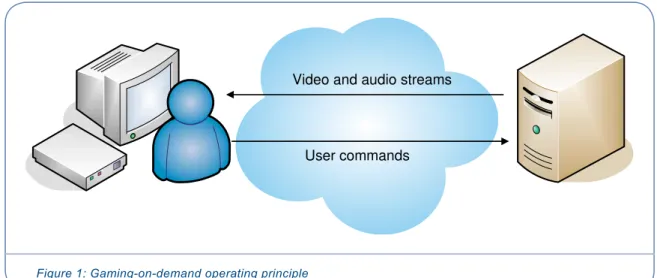
Networked games are very demanding concerning network quality. Only very little latency can be tolerated as games are by their nature extremely interactive. Gaming-on-demand services (see figure1) make a wide variety of computer games available to users equipped with resource-limited devices, such as IPTV set-top boxes. The games are stored and executed on a server and the audiovisual content of the game is delivered to the player by video streaming. Because streaming video with adequate high quality requires fairly high bitrates, gaming-on-demand services demand high downlink bandwidths in addition to the requirement of low latency, common to all types of networked games.
In ideal conditions, both these requirements can be fulfilled with current broadband network technologies. However, there are two problems that can lead to disturbance to the player’s user experience: First, if the last-mile connection to the Internet is shared by uses other than gaming – such as downloading files or browsing the web – the available bandwidth for the game service can vary substantially; and, secondly, problems may arise in the core network between the game server and the client due to congestion during peak periods or malfunctions in network components. The first problem is usually addressed by over-provisioning, that is by using a network connection, which can accommodate all needed services at the same time. This straightforward solution may work in some circumstances, but fails as a general solution because the bandwidth of a last-mile connection cannot be increased arbitrarily high. For example, the maximum bandwidth of an xDSL connection is limited due to the physical length and the quality of the subscriber loop.
Figure 1: Gaming-on-demand operating principle
Video and audio streams
INNOVATION REPORT
Other solutions include admission control and resource reservation or service differentiation and prioritisation. Nevertheless, these techniques are not used widely in last-mile connections because of their complexity.
There are many solutions available for the problem concerning QoS in the core network. For example, multiprotocol label switching (MPLS) [1] and differentiated services (DiffServ) [2] are widely
used in current networks. Traditional asynchronous transfer mode (ATM) and synchronous digital hierarchy/ synchronous optical network (SDH/SONET) networks also have specific mechanisms to support QoS, but all-in-all managing the end-to-end connection between service provider and client is problematic because of the multitude of different techniques used on the way. Today, the different networks are managed separately and there is a need for cross-domain capable network management solutions.
MAGELLAN offers a complete two-tier solution for gaming-on-demand services over multi-domain networks. The solution is based on service adaptation on the application layer to make the system resilient to fluctuations in network performance and network-level architecture for managing the network resources end-to-end. The consortium claims this kind of overall solution could be used in real gaming-on-demand deployments to enhance end-user experience and simplify system management.
Application Layer Adaptation
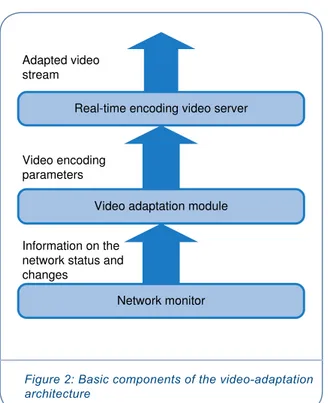
The designed video-adaptation solution (Figure 2) [3][4] consists of three components: a network monitoring tool, a video-adaptation module and a real-time encoding video server. The network-monitoring tool observes traffic flows in the network and gives this information to the adaptation module. The adaptation module chooses video-encoding parameters according the transient network status; the video server encodes and transmits the resulting video stream.
Network monitoring can be done either entirely at the server or split between the server and the client, depending on the underlying transport protocol. In the case of the IP transmission control protocol (TCP), network monitoring is performed entirely on the server but, for the user datagram protocol (UDP), an additional feedback channel is required between client and server, and thus the client has to host a monitoring tool as well. Even where UDP is used for video streaming, the feedback channel needs a reliable TCP connection. Generally speaking, the solution gives some freedom in the positioning of the network monitoring tool: communication between the adaptation module and the monitoring tool uses TCP/IP and the tool can be located anywhere in the network. Thus network status information could also derive from an external source such as a network management system.
Network monitor Video adaptation module Real-time encoding video server
Information on the network status and changes
Video encoding parameters Adapted video stream
Figure 2: Basic components of the video-adaptation architecture
INNOVATION REPORT
The monitoring tool captures data packets on the data-link layer and collects the required information from packet header fields. Monitoring is performed without affecting the actual video transmission. The parameters measured from the transport stream are bit rate, round-trip time (RTT), RTT jitter and packet loss. This information is used to detect changes in the available network bandwidth so that the bit rate of the video stream can be adjusted accordingly.
Rate-adaptive video encoding is used to match the sending bit rate of the video application to the available bandwidth. This is accomplished by manipulating the encoding parameters – for example frame rate and quantization – in such a way that the encoder produces a specific bit rate video stream, where the bit rate changes dynamically according to the estimated available bandwidth. A realisation of the solution was presented in [4]. The results of the evaluation indicated that this kind of application-layer adaptation solution is really beneficial for gaming-on-demand service. Using the solution decreased problems in the game by more than 90% compared with a conventional non-adaptive gaming-on-demand service.
End-to-End Network Management
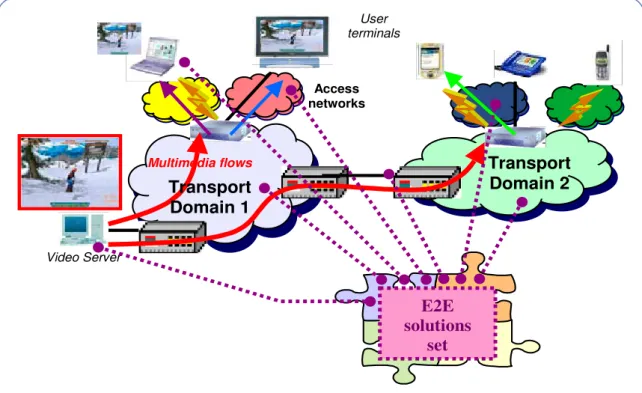
Additional challenges occur in a complex network setting, where the game server is very distant from the user terminals, and the video stream crosses several administrative network domains. The goal of an end-to-end system is to grant service providers means to orchestrate efficiently the different components of an uninterrupted service: networking, system and application components. This is particularly important when adapting the audio-visual services to new technologies, or new administrative and market situations. Co-ordination of various elements spanning customer premises equipment, access, aggregation and transport networks, and content distribution/video processing tools should be achieved for smooth service operation. Its importance is particularly amplified in closed – complex private network – settings for video-service distribution (Figure 3). Integrity of the service should be preserved.
Figure 3: End-to-end components over multi-domain topology
Transport
Domain 2
Video Server Access networks User terminals Multimedia flowsE2E
solutions
set
Transport
Domain 1
INNOVATION REPORT
Two types of solutions may be employed to control communications services end-to-end: control plane – signalling – and management mechanisms. It is felt that purely control-plane-oriented solutions – MPLS [1], GMPLS [5], SIP [6], and RSVP-TE [7] – have serious limitations. Unification of the control plane would give each node within the domain a complete view of the packet/circuit topologies and would provide that view to the domain manager. Nevertheless, this view is often limited to the domain boundaries. In particular, reliability and trust considerations are key here: indeed, operators have limited trust for inter-domain signalling because of the complex translation rules, network address translation (NAT) traversals and especially security vulnerability issues – distributed/denial of service attacks (DoS/DDoS), etc. Other operations and management functions such as network planning and resource inventory, service-level agreement (SLA) assurance, accounting and, most importantly, cross-domain management are still required.
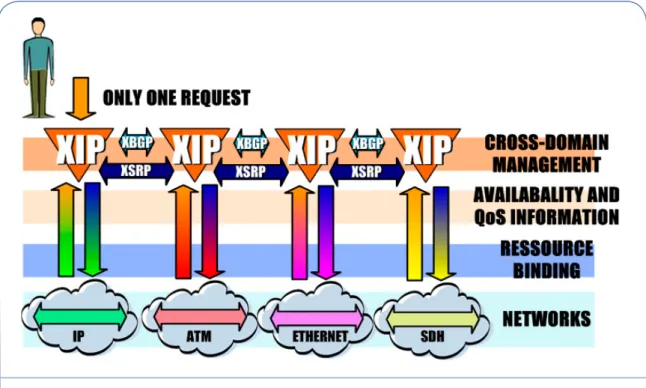
Based on these considerations, the cross-domain network and service management (X-NSM) solution was developed. This makes possible the implementation of end-to-end services on a multi-domain network in a consistent and semi-automated – ‘Flow-through’ – way. Specifically, it allows hiding the different steps from the user: multi-domain network discovery, global topology construction and maintenance, dynamic cross-domain path reservation and connectivity restoration. Moreover, it supports networks of different technologies – such as IP, Ethernet, ATM or fibre optic.
X-NSM is implemented in a set of software components sitting over the controllers of different net-work domains (see figure 4). Behind the cross-domain integration platform (XIP) components de-picted, there is a ‘network-service management’ part and a ‘resource management’ part. XIP com-ponents then communicate together using special protocols – the cross-domain border gateway protocol (XBGP) and cross-domain service resource protocol (XSRP) – for finding and provisioning of another end-to-end path with required QoS levels, possibly going through alternative domains. A key characteristic of the X-NSM architecture with respect to the multi-domain layer is automa-tion and extensibility: new technologies could be introduced with minimal effects on the existing network-service applications through the dynamic registration of new network domains that may introduce new resource types and capabilities to implement service roles.
INNOVATION REPORT
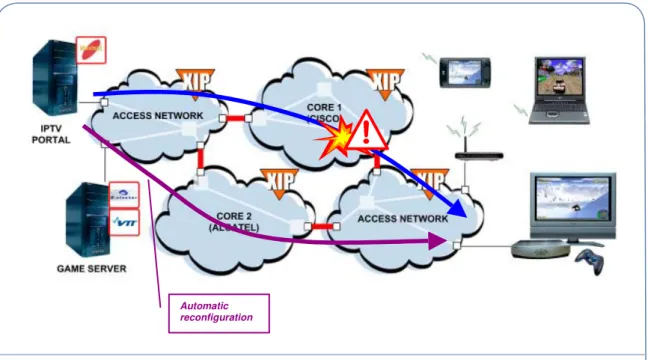
In some cases, a hook to the application-level plane might be needed to perform and fine-tune application parameters. This was realised in MAGELLAN for adaptable video compression – the project targeted experimentation of advanced networked video services. Building one comprehensive demonstrator over a real network and user equipment with an appealing scenario was achieved using the technology developed by different MAGELLAN partners (Figure 5):
Inter-domain management layer components (Alcatel); and Dynamic application-layer QoS control solution (VTT).
When QoS degrades, an application-level QoS adaptation is enabled by adapting video-encoding parameters as explained earlier. When a severe QoS degradation occurs in the first core – transport – network, the SLA is violated as an acceptable perceived quality can no longer be achieved; an automatic end-to-end reconfiguration is then performed through X-NSM mechanisms – i.e. switching to an alternative transport network is carried out without breaking the service session. Therefore, a user can enjoy optimal game experience in all situations.
Conclusion
An implementation of the described solution combining application-layer service adaptation and advanced end-to-end network management mechanisms was realised in the end-to-end gaming demonstrator of the MAGELLAN project. In the demonstrator, the application-layer adaptation was used to handle small variations in the network capacity to optimise the gaming experience. When a sustained SLA violation is detected by the end-to-end network management system, the game traffic is rerouted through the alternative domain to re-attain the agreed service level. The solution presented here was demonstrated with a gaming-on-demand service. However, the same solution can be used also for any other video- or audio-streaming-based application, such as IPTV or voice-over-IP (VoIP) applications. The mechanisms could be easily deployed in real-world service deployments.
Figure 5: End-to-end gaming-on-demand demonstration scenario
Automatic reconfiguration
INNOVATION REPORT
Authors
Yann Gasté, Alcatel Research & Innovation France ([email protected]) Jukka-Pekka Laulajainen, VTT, Finland ([email protected])
Linas Maknavicius, Alcatel Research & Innovation France ([email protected]) Patrick Schwartz, Thomson GrassValley, France ([email protected])
References
[1] E. Rosen, A. Viswanathan, and R. Callon. Multiprotocol Label Switching Architecture, RFC 3031. IETF, Jan. 2001.
[2] S. Blake, D. Black, M. Carlson, E. Davies, Z. Wang, and W. Weiss. An Architecture for Differentiated Services. RFC 2475. IETF, Dec. 1998.
[3] S. Järvinen, J.-P. Laulajainen, T. Sutinen, S. Sallinen. QoS-Aware Real-Time Video Encoding - How to Improve the User Experience of a Gaming-on-Demand Service. In 3rd IEEE Consumer Communications and Networking Conf. (CCNC ’06), Jan 8–10, Las Vegas, NV, USA, 2006.
[4] J.-P. Laulajainen, T. Sutinen, S. Järvinen. Experiments with QoS-Aware Gaming-on-Demand Service. In 20th International Conf. on Advanced Information Networking and Applications (AINA ’06), Apr 18-20, Vienna, Austria, 2006.
[5] L. Berger. Generalized Multi-Protocol Label Switching (GMPLS) Signaling Functional Description, RFC 3471, IETF, Jan. 2003.
[6] J. Rosenberg, H. Schulzrinne, G. Camarillo, A. Johnston et al. SIP: Session Initiation Protocol, RFC 3261. IETF, Jun 2002.CORBA Components version 3.0, Object Management Group, 2002.
[7] D. Awduche, L. Berger, D. Gan, T. Li et al. RSVP-TE: Extensions to RSVP for LSP Tunnels, RFC 3209. IETF, Dec. 2001.