ISSN: 0975 -8542
Journal of Global Pharma Technology
Available Online at: www.jgpt.co.in
RESEARCH ARTICLE
Think Pair Share (TPS) Method Improves Knowledge and Attitude
of School-Age Children in Vegetable Consumption
Sri Puastiningsih, Ferry Efendi, Praba Diyan Rachmawati*, Kristiawati
Faculty of Nursing, Universitas Airlangga, Surabaya, Indonesia.
*Corresponding Author: Praba Diyan Rachmawati
Abstract
School-age children need vegetable consumption to meet optimal growth and development needs. However, it remains a challenge to ensure the need of adequate quantities of vegetable consumption. The Think Pair Share (TPS) method may offer the solution of this problem. The aim of this study was to analyze the effect of applying health education with a think pair share on the knowledge and attitudes of school-age children in vegetable consumption. This study used a pre-experimental research design. The population in this study was 40 students at a fourth-grade elementary school and employed total sampling technique. The independent variable was health education with a think pair share learning method, while the dependent variables in this study were knowledge and attitudes. Instruments in this study were questionnaires of knowledge and attitudes. The data were analyzed using Wilcoxon Sign Rank Test statistical test with significance α≤0.05. The results of the statistical tests showed significant effect on knowledge (p=0.000) and attitude (p=0.000) of children in consuming vegetables. Think Pair Share method can increase the knowledge and attitude of children in vegetable consumption. Future studies may consider using this method as a medium of health education to increase vegetable consumption in school-age children.
Keywords: Attitude, Knowledge, Think pair share, Vegetable consumption.
Introduction
A vegetable is a part of the essential foods to be consumed daily as the requirements in fulfilling a balanced nutritional diet [1]. Consuming vegetables is very important not only for adults, but also for children. A deficiency in consuming vegetables causes several nutrition problems for the body, such as protein, vitamins, minerals and fiber. Moreover, among children, it is highly likely to experience diseases, namely, the risk of obesity, and malnutrition [2]. The daily consumption rate of vegetables in children is roughly 70.4 grams; the lowest vegetable consumption is 15 grams and the highest is about 148 grams [3].
This prevalence can result in bad conditions for children's growth and development. Children are greatly at risk to experience malnutrition if food is consumed in small amounts [4]. The Gateshead Millenium Baby Study in 2006 in the UK proved that about 20% of parents reported their children had eating disorders, with the highest prevalence
of children’s eating habits tending to choose certain foods to consume [5]. The National Socioeconomic Survey (SUSENAS) in 2014 found 83.64% of school-age children in Indonesia consumed fewer vegetables, as children often experience a difficult phase of eating, especially difficulty in eating vegetables [6]. The results of the Basic Health Research (Riskesdas) by the Ministry of Health in 2013 found about 93.5% of Indonesia's population consumed few fruits and vegetables [7]. Based on preliminary observations of 4th-grade students in Surabaya, about 16 children from a total of 40 students did not like to eat vegetables.
consuming vegetables and fruit by <3 servings per day [8]. A fairly large proportion of children in the world do not meet the recommendations of the World Health Organization (WHO) in the consumption of vegetables and fruit, which is consuming at least 400 grams per day or as many as 3-5 servings a day. The WHO recommends vegetable needs of 150-200 grams, equivalent to 1-2 bowls a day [9]. According to Nurmahmudah's study in 2015, the role of health education is very influential in increasing children's knowledge about vegetables, particularly using learning media to provide a good understanding for children by adapting to the stages of the child development [10].
Think pair share cooperative learning model (TPS) is a learning method which aims for students to enable thinking (think), expressing opinions in pairs (pair), and sharing opinions (share) to solve a problem and learn the material in the form of cooperation between group members [11]. Health education with the TPS method is suitable for school-age children as children will try to think, respond to each other and help in discussions [12]. However, in this TPS learning model, students are trained to be reasonable and thinkable in order to increase their knowledge and change the child's tendency (attitude) on vegetable consuming behavior. The aim of this study was to analyze the effect of applying health education with a think pair share on the knowledge and attitudes of school-age children in vegetable consumption.
Methods
A pre-experimental design with a one-group pre-post-test approach has been used in this study. The location of the study was conducted at an elementary school in Surabaya City, East Java. The targeted population was school-age children (6-12 years), in a total of 235 students, while the affordable population was Grade 4 students, about 40 students. The sampling technique was done in the total sampling technique.
The independent variable consisted of health education through the think pair share learning model and the dependent variables included the knowledge and attitudes of school-age children in vegetable consumption. Data collection used pre-test and post-test questionnaires. Knowledge and
attitude questionnaire were based on Sibagariang's study in 2016, and the questionnaire has been through discussion by experts and through validity and reliability tests with valid and reliable results; Cronbach's alpha coefficient of knowledge was r=0.762 and Cronbach's alpha coefficient of attitude equalled to r=0.759 [13]. Knowledge and attitude questionnaire consisted of 20 questions including six aspects, namely the types of vegetables, the benefits of eating vegetables, vegetable content, how to properly process vegetables, the frequency and amount of intake of eating vegetables, and the impact of eating fewer vegetables.
Attitude questionnaire consisted of 20 questions, including the child's attitude in accepting and responding to vegetable consumption, the benefits of eating vegetables, vegetable content, and the proper way of processing vegetables. Health education with the TPS learning model was carried out in three meetings with duration of 3x45 minutes a week. A previous study by Santi in 2013 explained that the TPS learning model carried out three meetings that can improve student learning outcomes [14]. Each respondent paired to other respondents who were predetermined by researchers, each group consisted of two people; there were 20 pairs of groups. Determination of group pairs was based on ranking coordinated by the homeroom teacher, in order that it expected children with less ranking can be motivated upon discussing with children who have good ratings in the class.
Giving interventions was done directly by researchers and research assistants according to the procedure of the TPS learning model in the Learning Program Unit (SAP) and the topic of learning was the importance of vegetable consumption. Each meeting had a duration of 45 minutes and students were asked to think independently (think) for five minutes about the questions given by writing down their ideas on a piece of paper.
Finally, groups presented the results of the discussion; the facilitator gave an evaluation and equated perceptions related to the problem of the topic. The second and third meeting was the same as the first meeting. At the end of the learning activity, the facilitator provided leaflets as a medium to increase students' knowledge and attitudes about vegetable consumption.
After three meetings, researchers conducted a post-test assessment using a questionnaire instrument whose contents were the same as the questions in the pre-test. The results of the pre-test and post-test were compared to determine the extent of the differences produced. The data were tabulated and analysis was performed using the Wilcoxon Signed Rank Test (α=0.05) to determine the
comparability of the two samples collected in ordinal data in each dependent variable.
Results
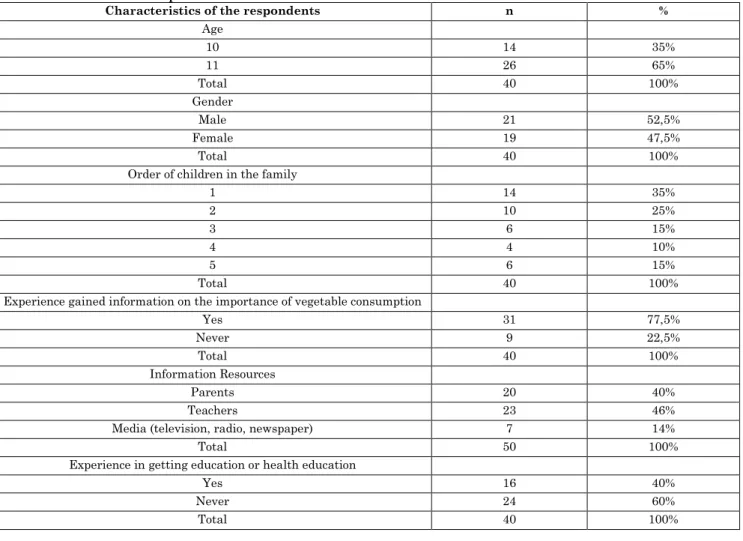
Most respondents were 11 years old (65%) divided into 21 male (52.5%) and 19 female respondents (47.5%). The majority of respondents were the first child (35%) and a small proportion were fourth children (10%). Most respondents had received information about the importance of vegetable consumption. There were also some respondents who had never received information about the importance of vegetable consumption (77, 5%) and some who received information from school teachers (46%). Those who had never received health education or counseling counted as many as 60% (Table 1).
Table 1: Distribution of respondents
Characteristics of the respondents n %
Age
10 14 35%
11 26 65%
Total 40 100%
Gender
Male 21 52,5%
Female 19 47,5%
Total 40 100%
Order of children in the family
1 14 35%
2 10 25%
3 6 15%
4 4 10%
5 6 15%
Total 40 100%
Experience gained information on the importance of vegetable consumption
Yes 31 77,5%
Never 9 22,5%
Total 40 100%
Information Resources
Parents 20 40%
Teachers 23 46%
Media (television, radio, newspaper) 7 14%
Total 50 100%
Experience in getting education or health education
Yes 16 40%
Never 24 60%
Total 40 100%
Table 2: Knowledge about vegetable consumption before and after the think pair share method
Category Before After
n % n %
Good 1 2.5 % 33 82.5%
Sufficient 17 42.5% 7 17.5%
Less 22 55% 0 0%
Total 40 100% 40 100%
Wilcoxon sign rank test p=0,000
Table 3: Attitudes about vegetable consumption before and after the think pair share learning method is given
Category Before After
n % N %
Positive 20 50% 24 60%
Negative 20 50% 16 40%
Total 40 100% 40 100%
Wilcoxon sign rank test p=0,000
Before being given health education, respondents had the same attitude in the positive and negative category, respectively as many as 20 respondents. The majority of respondents showed an increase in attitude. Respondents after being given an intervention were positive as many as 24 respondents, while those who were negative were 16 respondents. Wilcoxon statistical test results sign rank test value of sig (2-tailed) showed there were differences in the results of the attitude before and after the significance value of p = 0.000 i.e. p ≤ 0.05 (Table 3)
Discussion
A person's knowledge is influenced by several factors, including age, education, occupation, interests, experience, culture and information [15]. The increase of knowledge in 35 respondents was the result of a health education intervention using think pair share learning models. Previous research states that the TPS learning model invited students to work independently or in groups through a structural approach that emphasizes structures designed to influence students' thinking patterns and interactions [16].
This TPS learning model encouraged students to be better able to process information and communication and develop thinking skills [17]. Research showed that the TPS learning model helped students in developing conceptual understanding, information, drawing conclusions and helping to form opinions and assume the views of others [18].
Increased knowledge will raise children's understanding of good and healthy vegetable consumption behavior. This is supported by previous research that good knowledge can change the behavior of children in consuming vegetables and fruit.
TPS learning model increased student knowledge as it empowered students to play an active role, respect the opinions of others and try to think about solving a problem [19]. TPS learning model made students be active and cooperative in participation and cooperation in group learning. Students have high motivation since they were encouraged by peers, students were required to be of an attitude to help in social behavior [14].
Even though the respondent group was given an intervention in the form of health education with the TPS learning model, there were still five respondents who did not experience a change in value or remained. This is due to several factors, including (1) a
person's internal factors, namely factors that exist in individuals such as intelligence, interests and also physical conditions; (2) external factors, namely factors originating from outside the individual, such as family, community and also facilities; and (3) learning approach factors, namely the factor of one's learning effort toward an innovation, such as learning strategies and methods [20]. Some respondents were found to have never received health education or counseling about vegetable consumption behavior.
The cause of insufficient and insufficient knowledge about the importance of vegetable consumption in children is due to information media. This fact is supported by Green's (1991) theory that the lack of facilities and infrastructure, in this case, can affect the level of knowledge of children who have not been included in either category [21]. Before being given health education with the TPS learning model, respondents had positive and negative attitudes. The pre-test results showed the same value as many as 20 respondents had a positive attitude and in the same number in a negative attitude.
Some respondents who have negative attitudes never get information about vegetable consumption behavior. This is supported by the theory which stated information obtained from the mass media and educational institutions can direct one's opinion in order that it can provide a cognitive foundation for the formation of a positive attitude. Information ever obtained by someone can influence one's attitude to be positive [22]. The stages of attitude formation will change a person's attitude from negative to positive [23].
The item questions were included in the category of responsible questions. Responsible was the highest level to form a positive attitude that requires frequent health education intensity [24].
Increased attitudes were obtained during the post-test, namely about 12 respondents have increased 30% from the negative attitude category to positive. This increase was in accordance with the theory explained by Green which stated that, by providing health education, it can change the predisposing factor; one of the predisposing factors is someone’s attitude [21]. The existence of health education using the TPS learning model causes information absorbed by children to change negative thought patterns into positive ones [25].
Conclusion
Health education with a think pair share learning model can improve the knowledge and attitudes of school-age children toward vegetable consumption. The majority of respondents have increased knowledge with good categories and increased the attitude of students in consuming vegetables to be positive.
Schools, with the assistance of local primary healthcare staff, should monitor the nutritional status of students and provide health-related health education regularly. Future studies are expected to carry out research on measures of vegetable consumption in children with a multivariate statistical test approach so that the test results can control the results more deeply.
References
1. Asy’ariyah NZ, Arief YS, Krisnana I (2019) Storytelling sebagai upaya meningkatkan konsumsi sayur. Pediomaternal Nurs. J., 3: 73-82.
2. Mak T (2013) Patterns of Sociodemographic and Food Practice Characteristics in Relation to Fruit and Vegetable Consumption in Children: Results From the U.K. National Diet and Nutrition Survey Rolling Programme (2008-2010). Public Health Nutr., 16(11): 1912-1923.
3. Nutrition Information Centre (2013) Fruit and Vegetales : South African children found “wanting” Tygerberg. NICUS Nutr. Univ Stellenbosch, 19: 61.
4. Fitriani F Gambaran Penyebab Kesulitan Makan pada Anak Prasekolah Usia 3-5 Tahun di Perumahan Top Amin Mulya Jakabaring Palembang. Eprints Univ Sriwij Palembang.
5. Wright CM et al (2007) How do toddler eating problems relate to their eating behavior, food preferences, and growth? Am Acad Pediatr., 120: 1069.
6. Badan Pusat Statistik (2014) Indonesia - Survei Sosial Ekonomi Nasional 2014 Triwulan 1: 1-129.
7. RI K (2013) Riset Kesehatan Dasar. Indonesia.
8. Putriana MI, Putriana MI Konsumsi Sayur dan Buah pada Anak Prasekolah
Terkait dengan Pengetahuan Gizi dan Sikap Ibu.
9. Krolner (2011) Determinants of Fruit and Vegetable Consumption Among Children and Adolescents: a Review of the Literature. Part II: Qualitative Studies. Int. J. Behav. Nutr. Phys. Act, 8: 112. 10. Nurmahmudah DK, Aruben R, Suyatno S
(2015) Faktor-Faktor yang Mempengaruhi Konsumsi Makan Buah dan Sayur pada Anak Pra Sekolah Paud TK Sapta Prasetya Kota Semarang. J. Kesehat. Masy., 3: 244-255.
11. Carss WD (2007) The Effect of Using Think-Pair-Share During Guided Reading Lessions. Thesis of University Waikato. 12. Arini F (2015) Pengaruh Pendidikan
Kesehatan Metode Pembelajaran Kooperatif Think Pair Share (TPS) Terhadap Pengetahuan, Sikap, dan Tindakan Anak dalam Pencegahan Dengue Hemorrhagic Fever (DHF). Skripsi Fakultas Keperawatan Universitas Airlangga Surabaya,.
14. Santi N (2013) Model Pembelajaran Kooperatif Tipe Think Pair Share untuk Meningkatkan Hasil Belajar Siswa pada Pembelajaran Matematika Materi Operasi Hitung Campuran Bilangan Bulat. Skripsi Universitas Pendidikan Indonesia,.
15. Mubarak (2009) Ilmu Kesehatan Masyarakat Teori dan Aplikasi. Jakarta: Salemba Medika,.
16. Nurjanah D Penerapan Pembelajaran Kooperatif Think Pair Share Untuk Meningkatkan Minat Belajar Biologi Siswa Kelas X-3 SMAN 1 Mojolaban Tahun Pelajaran 2010/2011. Skripsi Univ Sebel Maret Surakarta.
17. Bamiro AO (2015) Effects of Guided Discovery and ThinkPair-Share Strategies on Secondary School Students’ Achievement in Chemistry. Scopus, 5: 1-7. 18. Theobald H (2011) The Effects of Think-Pair-Share On Participation and Engagement of Second Grade Students During Whole Group Discussion. California: The Faculty of the Kalmanovitz School of Education,.
19. Gloiani AD (2009) Kreativitas Siswa kelas VIIIC SMP Negeri 4 Magelang dalam Pembelajaran Matematika Melalui Model Pembelajaran Kooperatif Tipe Think Pair Share (TPS). Skripsi Universitas Negeri Yogyakarta,.
20. Nursalam. Metodologi Penelitian Ilmu Keperawatan: Pendekatan Praktis.
Metodol Penelit Ilmu Keperawatan Pendekatan Prakt.
21. Green L, Kreuter M Application of PRECEDE/PROCEED in community settings: health promotion planning: an educational and environmental approach. Mt View, Calif, Mayf.
22. Hariani D (2011) Pengaruh Penyuluhan terhadap Pengetahuan dan Sikap Konsumsi Buah dan Sayuran Siswa Sekolah Dasar di SD Negri 064975 Kecamatan Medan Denai Kota Medan. Skripsi Fakultas Kesehatan Masyarakat Universitas Sumatera Utara.
23. Wepiyanti NK (2015) Pengaruh Pendidikan Kesehatan Melalui Model Pembelajaran Think Pair Share (TPS) Terhadap Perilaku Pemilihan Jajanan Sehat Pada Anak Sekolah Kelas 5 SDN Pacarkeling VII Surabaya. Skripsi Fakultas Keperawatan Universitas Airlangga Surabaya,.
24. Lie A (2007) Cooperative Learning Mempraktikkan Cooperative Learning di Ruang-Ruang Kelas. Jakarta: Grasindo,. 25. Rahayu (2012) Efektivitas Model