154
ANTIMICOTIC ACTIVITY OF
OCIMUM BASILICUM
ESSENTIAL
OIL AGAINST STORED FUNGI
Roxana DUDOIU1, Viorel FATU1, Carmen LUPU1, Daria POPA1, Elena RADU2, Mariana POPESCU2 1Research Development Institute for Plant Protection, Bucharest 2
The National Institute for Research & Development in Chemistry and Petrochemistry
Key words: basil volatile oil, storage fungi, antimicrobial activity.
ABSTRACT
The use of indigenous products as an alternative for the biocontrol of mycotoxigenic fungi has become a key factor due to the negative impact of synthetic fungicides towards environment and human health. They are widely used in medicine for these purposes. Essential oils (EOs) have been long recognized for their antibacterial, antifungal and antiviral properties. Worldwide, at the scientific community level there have been discovered a series of plant bioactive eco-friendly principles, and were performed a multitude of researches regarding the potential of essentials oils and mixture of organic volatile compounds, as alternative insecticides and antimicrobial fumigants for a sustainable agricultural production. EOs and their components show promising activities against many pathogens and spoilage microorganisms when tested in vitro. Among promising alternative methods to control food spoilage much attention is being paid to the use of essential oils (EOs), and lately also to their activity in vapor phase. Ocimum basilicum, commonly known as basil, is an aromatic annual herb and an important economic crop. The paper presents a study regarding the activity of basil volatile essential oil towards the growth and development of stored pathogenic fungi.
INTRODUCTION
Global warming may strongly influence the occurrence and distribution of mycotoxin producing fungi. Climate change can lead to the increasing abundance of thermo-tolerant species (especially in extremely hot years) in regions with temperate climate, including Central Europe. This is accompanied with the appearance of their mycotoxins in agricultural products (Toth et al. 2013). From all these reasons, mycotoxins are in the focus of food safety concerns today.
EOs are volatile substances with an oily consistency typically produced by plants. Various techniques can be used to extract EOs from different parts of the aromatic plants, including water or steam distillation, solvent extraction, expression under pressure, supercritical fluid and subcritical water extractions. Several authors demonstrated that, most of the essential oils extracted from aromatic plants, have antimicrobial, antifungal effect and/or antioxidant properties. That means they have also a potential to act against mycotoxin-producing fungi. There are some results which suggest that in an experimental system the extent of inhibition of fungal growth and aflatoxin production depends on the concentration of essential oils used (Atanda et al. 2006; Sindhu et al. 2011). A great advantage of EOs is their bioactivity in the vapour-phase, a characteristic that makes them attractive as feasible fumigants for stored product protection (Tripati and Dubey 2004). It is also worth to mention that EOs proved their potential as antimicrobial compounds in food preservation (Nguefack et al. 2004).
155
of diffusion or dilution methods, as reviewed by some literatures (Holley & Patel, 2005; Janisiewicz & Korsten, 2002; Tripathi & Dubey, 2004; Burt, 2004).
The aim of this study is to evaluate the efficacy of the basil essential oil in vapor phase against two storage pathogens belonging to Fusarium and Penicillium genera.
MATERIALS AND METHODS
Essential oil. The essential oil of Ocimum basilicum was purchased from Cozak Plant and stored at +4°C in a refrigerator until analysis. There was performed a Gas Chromatography-Mass Spectroscopy (GC-MS) analysis of the basil essential oil in order to determine the percentage of the main volatile compounds. The analysis was carried out using with 7000 Triple Quad GC/MS Agilent. A DB-WAX capillary column of 30 m x 0.25 mm and 0.25 in film thickness was used. Helium was used as a carrier gas (1.4 ml/min). The column was temperature programmed as follows: 2 min at 70°C; then raises with 10°C/min to 220°C and held for 10 min. The injector and detector temperatures were to 220 and 250°C, respectively. Injection was carried out automatic mode. Peak areas and retention times were measured by Electronic Integration.
Microorganisms. The screening of the antifungal activity was performed against two strains of fungi isolated from cereals samples, taken from a warehouse in Prahova County. The fungi taken into analysis consisted in one strain of Fusarium tricinctum and one strain of Penicillium sp. (figure 1). Stock cultures of fungal strains were grown on potato-dextrose-agar medium at 26°C for 7 days before the experiment.
Figure 1. Test fungi strains on PDA medium
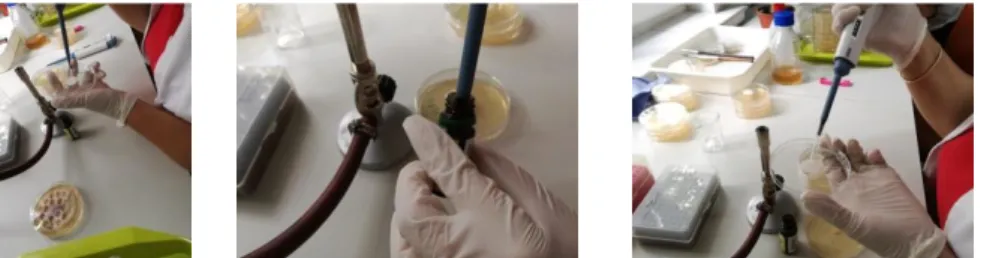
An amount of 15 ml of sterile PDA medium was poured into 10 cm diameter Petri dishes. After solidifying, plates were kept in an inverted position; a sterilized filter paper disk of 30 mm diameter was placed in the center of each plate’s lid and 1, 10, 20, 40, 60 and 100 µl of pure basil essential oil were added to the filter paper. At the same time, fungal mycelia-disks (diameter of 5 mm) prepared from growing margin of each isolate were placed in the center of PDA plates (figure 2). Control plates contained equivalent amounts of distilled water. Plates were tightly sealed with parafilm and incubated at 26°C for 14 days. Diameters of the growing colonies were measured at 7 and 14 days.
156
RESULTS AND DISCUSSIONS
Identification of the compounds was achieved by comparing retention times and mass spectra with those of the NIST database. As presented in figure 3, the basil oil analyzed had a high percentage of Estragole – 65,18%, followed by 26,98% Linalool, 2,38% Euclyptol and 2,06% Bergamotene.
Figure 3. Basil volatile oil chromatogram
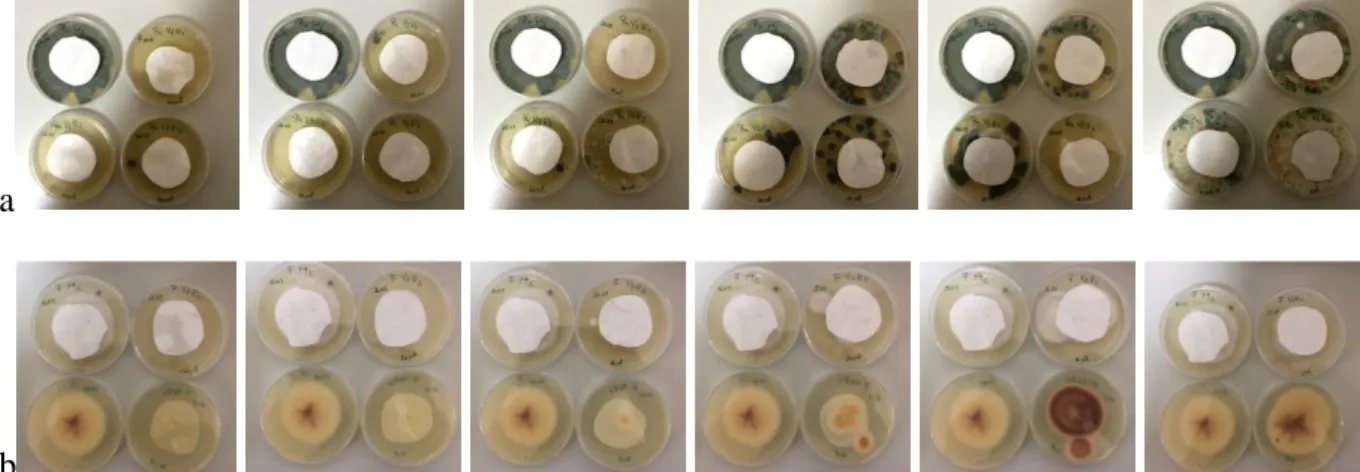
Both fungal strains were susceptible to the basil essential oil vapors (figure 4).
a
b
Figure 4. Tested fungi inhibited by different basil EO concentrations compared with negative control
a. Penicillium sp.; b. Fusarium tricinctum.
157
Figure 5. Inhibition activity of fungal strains
Due to the disk filter paper method used, it was demonstrated by the growth inhibition of the microorganisms, which was uniform, and no "inhibition zones" indicating uneven concentration of active constituents were observed.
The experiments will be continued in order to establish a method by which will be able to determine if the essential oils have also activity to suppress the mycotoxins’ secretion.
CONCLUSIONS
The basil essential oil tested in all 6 concentrations manifested a strong fungi static and fungi toxic activity by totally inhibiting the growth of interest pathogenic strains.
ACKNOWLEDGEMENTS
The study is founded by UEFISCDI, PCCA2013, Contract no. 156/2014, Ecological products based on diatomaceous earth and essential oils for the residues and contaminants reduction from the food chain – PEDIOL.
BIBLIOGRAPHY
ATANDA OO, AKPAN I, OLUWAFEMI F (2006). The potential of some spice essential oils in the control of A. parasiticus CFR 223 and aflatoxin production. Food Control 18:601-607. 0 10 20 30 40 50
50 500 1000 2000 3000 5000
D IAM ET ER ( m m ) doses (ppm)
Fusarium tricinctum
3 days 7 days 0 20 40 60 80 10050 500 1000 2000 3000 5000
% g ro th doses (ppm)
Penicillium
sp.
158
BURT, S. (2004). Essential oils: their antibacterial properties and potential applications in foods – a review.Int J. Food Microbiol., 94, 223-253.
HOLLEY, R. A., and PATEL, D. (2005). Improvement in shelf-life and safety of perishable foods by plant essential oils and smoke antimicrobials. Food Microbiology, 22 (4): 273-292.
JANISIEWICZ WJ, KORSTEN L (2002) Biological control of postharvest diseases of fruits. AnnualReview of Phytopathology 40:411-444.
NGUEFACK J, LETH V, AMVAN ZOLLO PH, MATHUR SB (2004). Evaluation of five essential oils from aromatic plants of Cameroon for controlling food spoilage and mycotoxin producing fungi. Int J Food Microbiol 94:329-334.
SINDHU S, CHEMPAKAM B, LEELA NK, SUSEELA BHAI R (2011). Chemopre- vention by essential oil of turmeric leaves (Curcuma longa L.) on the growth of Aspergillus flavus and aflatoxin production. Food Chem Tox, 49:1188-1192.
TOTH B, KOTAI E, VARGA M, PALFI X, BARANYI N, SZIGETI GY, KOCSUBE S, VARGA J (2013). Climate change and mycotoxin contamination in Cen¬tral Europe: an overview of recent findings. Rev Agric Rural Develop 2(l):461-466.