R E S E A R C H
Open Access
Exploring provider perspectives on
respectful maternity care in Kenya:
“
Work
with what you have
”
Charity Ndwiga
1*, Charlotte E Warren
2, Julie Ritter
3, Pooja Sripad
2and Timothy Abuya
1Abstract
Background:Promoting respect and dignity is a key component of providing quality care during facility-based childbirth and is becoming a critical indicator of maternal health care. Providing quality care requires essential skills and attitudes from healthcare providers, as their role is central to optimizing interventions in maternity settings. Methods:In 13 facilities in Kenya we conducted a mixed methods, pre-post study design to assess health providers’ perspectives of a multi-component intervention (the Heshima project), which aimed to mitigate aspects of disrespect and abuse during facility-based childbirth. Providers working in maternity units at study facilities were interviewed using a two-part quantitative questionnaire: an interviewer-guided section on knowledge and practice, and a self-administered section focusing on intrinsic value systems and perceptions. Eleven distinct composite scores were created on client rights and care, provider emotional wellbeing, and work environments. Bivariate analyses compared pre- and post-scores. Qualitative in-depth interviews focused on underlying factors that affected provider attitudes and behaviors including the complexities of service delivery, and perceptions of the Heshima interventions.
Results:Composite scales were developed on provider knowledge of client rights (Chronbachα= 0.70), client-centered
care (α= 0.80), and HIV care (α= 0.81); providers’emotional health (α= 0.76) and working relationships (α= 0.88); and
provider perceptions of management (α= 0.93), job fairness (α= 0.68), supervision (α= 0.84), promotion (α= 0.83), health
systems (α= 0.85), and work environment (α= 0.85). Comparison of baseline and endline individual item scores and
composite scores showed that provider knowledge of client rights and practice of a rights-based approach, treatment of
clients living with HIV, and client-centered care during labor, delivery, and postnatal periods improved (p< 0.001). Changes
in emotional health, perceptions of management, job fairness, supervision, and promotion seen in composite scores did not directly align with changes in item-specific responses. Qualitative data reveal health system challenges limit the
translation of providers’positive attitudes and behaviors into implementation of a rights-based approach to maternity care.
Conclusion:Behavior change interventions, central to promoting respectful care, are feasible to implement, as seen in the Heshima experience, but require sustained interaction with health systems where providers practice. Provider emotional
health has the potential to drive (mis)treatment and affect women’s care.
Keywords:Mistreatment, Disrespect and abuse, In-humane treatment, Caring behavior, Respectful maternity care, Behavior change, Interventions
* Correspondence:[email protected]
1Population Council, PO Box 17643-00500, Nairobi, Kenya Full list of author information is available at the end of the article
Plain english summary
Many women encounter uncaring and abusive treatment from health care providers during facility-based labor and delivery. In this study, the Heshima project sought health care providers’ opinions and experiences in implementing a package of activities designed to promote caring and humane treatment during facility-based childbirth.
Health providers working in maternity units were interviewed on their knowledge and practice of women’s childbirth rights as well as how their working conditions, supported or limited their ability to provide caring behaviors. Providers were also given a self-administered questionnaire focusing on their own attitudes, behavior, supervisors, and health care systems.
Eighty-nine and thirty-three providers were inter-viewed at baseline and endline, respectively. There was a significant increase in the proportion of providers identi-fying elements that constitute clients’ rights: ‘explaining to clients when and how procedures will be performed and the outcomes’, from 38.8% to 63.2% at endline. High case loads, work-related stress, and un-supportive work environments limited providers’efforts in offering digni-fied and respectful care.
In conclusion, our results show that interventions promoting providers’positive behaviors and attitudes are feasible to implement but require a sustained, supportive health system environment. Provider working relation-ships and environments not only affect their own emotional health, but also how they treat mothers during childbirth.
Background
Disrespect and abuse of pregnant women seeking mater-nity services persists in high, middle, and low income settings [1–9]. For decades,‘unfriendly’ and ‘poor’ atti-tudes from health care providers have been described, by women, as barriers to maternal care [10, 11]. Weak health systems contribute to this poor access and use of maternal health services by amplifying the negative ef-fects of disrespect and abuse during childbirth. Existing quality of care frameworks focus on reducing adverse maternal and newborn outcomes, and emphasize caring for women with respect and dignity as an integral part of reducing mistreatment during childbirth [11–13].
The current discourse in promoting respectful mater-nity care (RMC) is driven by several initiatives attempt-ing to address women’s mistreatment during labor and delivery, including the Humanizing Childbirth Move-ment [14], the Better Births Initiative [15], and more recently, studies implemented between 2011 and 2015 in Ethiopia, Kenya (the Heshima Project), Ghana, Nigeria, and Tanzania [4, 5, 7, 16, 17]. These recent studies built upon findings from a 2010 landscape review that
reiterated knowledge and practice gaps in women’s treat-ment during this vulnerable period [1]. Attempts to better define disrespect and abuse during childbirth [18], as well as describe and measure its occurrence, have contributed to the development of a range of evidence-based interventions [7, 19, 20]. Strategies for resolving this problem increasingly use a rights-based approach to ensure health providers’ and their managers’ account-ability [11].
Health providers’ role in ensuring safe delivery and promoting respectful maternity care in unsupportive and weak health systems environments often conflicts with accepted professional norms, increasing susceptibility to propagate mistreatment. Evidence shows that drivers of mistreatment in facilities are multidimensional, ranging from individual providers to organizational and systemic factors [1, 21]. Facility influences on efforts to reduce women’s mistreatment include staff attitudes, motiv-ation, and maternity care service governance [19]. With increasing recognition of these social and organizational factors, provider perceptions and responses for promot-ing RMC initiatives remain part of the core to their suc-cess. It is therefore critical to study and assess providers’ understanding and experience in promoting RMC [22]. This paper describes providers’ perceptions, attitudes, knowledge, and practices for both their work environ-ment and clients’ rights after a behavior change inter-vention package aimed at promoting RMC in Kenya.
Overview of intervention tested at facility level
maternity staff allocation and essential maternity com-modities and drugs. Counseling or psychosocial support (in group or individual sessions) enabled providers to discuss work challenges and related pressures. Maternity Open Days, where maternity staff invited pregnant women and their families to tour labor wards, provided opportunities for women to learn about labor and delivery procedures, demystifying the birth process, along with discussing birth planning with male partners and other family members.
These interventions were implemented during a series of political and policy changes starting with Kenya’s new constitution in 2010, which devolved resources and power from the national government to its 47 counties in effect after the March 2013 general election [26]. Counties assumed greater health system roles and responsibilities including financing, governance, human resources, procurement, and logistics [27]. A second policy influence on this study’s implementation was the introduction of free maternity care in public health facilities in 2013. Increased workloads following these changes and uncertainty in salary sources (e.g. national or county) resulted in two nursing strikes of 2 to 3 months affecting service delivery and slowing implemen-tation in study facilities. Table 1 shows the participants reached, duration, periodicity, and indicators associated with each intervention.
Methods Study design
In order to assess the effects of the Heshima project at provider level we conducted a pre-post study, without a comparison group, to describe provider attitudes before and after interventions to reduce disrespect and abuse during childbirth in 13 Kenyan health facilities in five counties (including Nairobi) in Central and Western Kenya [19, 23]. Researchers collected baseline data between September 2011 and February 2012, and end-line data between January and February 2014. The 13 purposefully selected facilities comprised different facil-ity types (public, private, faith-based) and levels of care, with three referral hospitals, three district hospitals with maternity units, two faith-based hospitals, two maternity homes, and one health center. Four facilities were rural, and the rest were in urban or peri-urban areas.
Data sources and collection
This paper is based on two sets of data collected.Quanti-tative interviews with health care providers (nurse-mid-wives) and qualitative in-depth interviews (IDIs) with health care providers (nurse-midwives, doctors), facility-in-charges (nurse-midwives) and facility managers, senior reproductive health program managers (at national, county, and sub-county levels), and civil society
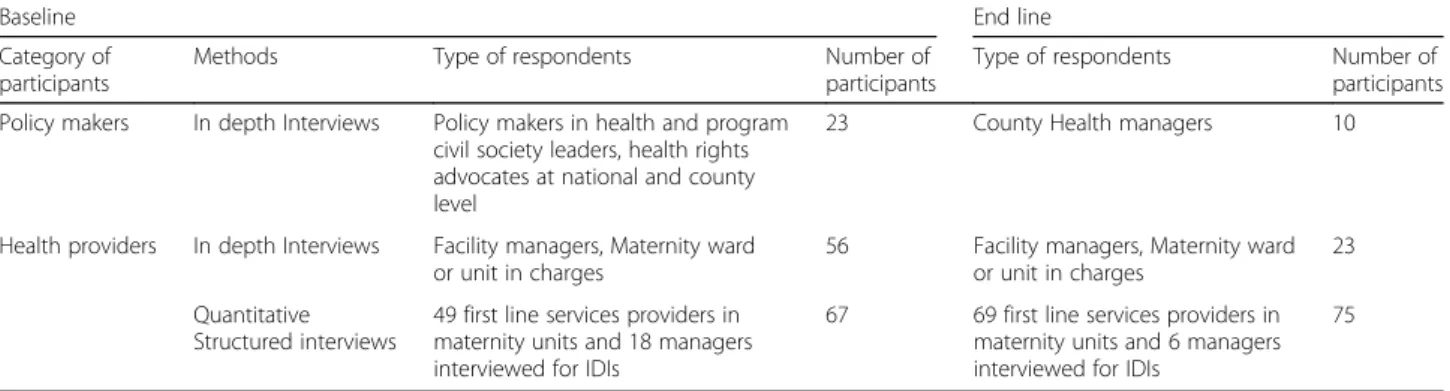
representatives. Eighty-nine IDIs (Nbaseline= 56; Nendline= 33)
were conducted with purposively selected providers with at least 6 months’ work experience. Interviews were conducted at times of providers’convenience at their place of work. At each site two or three providers were inter-viewed on their knowledge and perceptions of women’s childbearing rights, their own attitudes and behaviors toward clients, their work environments and related stress, and experiences with RMC interventions. IDIs sought add-itional information on systemic and governance factors that could have contributed to abuse and disrespect. Whenever possible, the same providers were interviewed at baseline and endline; however, due to the frequency of transfers within the health system and challenges due to the devolu-tion process, only 20% of providers interviewed at baseline, and attended the primary VCAT workshops, were available to be interviewed again at endline.
A total of 142 quantitative interviews with providers (Nbaseline = 67; Nendline = 75) were conducted in the 13
facilities. All providers responsible for maternal health services in a facility available on the day(s) of data collection were interviewed (Table 2). Research assis-tants conducted the first part of the quantitative questionnaire, while the second half was self-administered. Both components featured questions on provider knowledge, attitudes, practice, and experiences working in maternity units. Demographic characteristics, membership in professional organizations, and salary information was also collected.
The second part of the study tool, originally developed and validated in South Africa [28], used a Likert type scale focusing on providers’perceptions of working con-ditions, respect, client empathy and prejudice, awareness of policy and service delivery guidelines on respect, dignity and client rights, along with questions on staff turnover, absenteeism, vacancy rates, workload, motiv-ation, with challenges in managing and retaining mater-nity staff also included.
Data management and analysis Qualitative data analysis
meaning and relationships of themes generated. The re-search team discussed findings throughout the analytic process, for both reflexivity and rigor. Results were subsequently organized around the centrality of provider attitude and behavior in promoting RMC, understanding and operationalizing client rights, and work environment (Fig. 1).
Quantitative data analysis
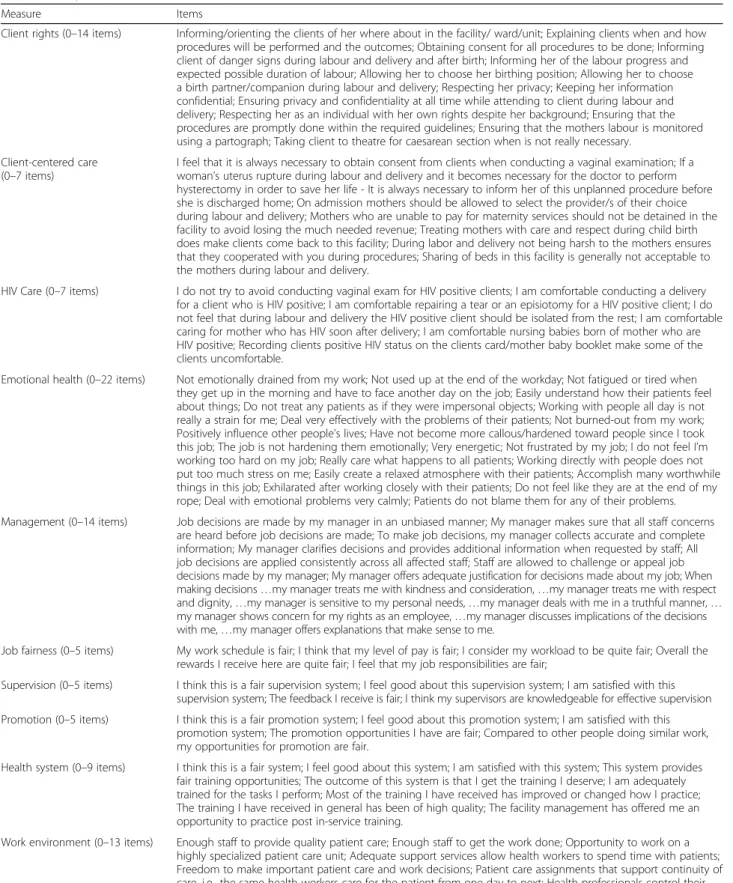
The quantitative survey directly assessed demographic characteristics, knowledge, professional organization membership, and salary information. Other outcomes related to facility factors, such as provider knowledge and attitudes–many of which are latent constructs that encompass multiple indicators – were developed as composite scores consisting of individual items within the survey. Eleven distinct composite scores were created to assess overall provider attitudes about client treatment (‘client rights’,‘client-centered care’,‘HIV care’), providers’ emotional wellbeing, and work environment
(management, job fairness, supervision, promotion, system issues). Table 3 describes the scales, individual items comprising the composite scores, and associated reliability using Chronbach’s alpha. The full list of indi-vidual items and frequencies are presented in Additional file 1 Table A. These items emerged from prior literature as well as Heshima’s formative phase and thus exhibit face and content validity [31].
For all scales created to assess provider knowledge and attitudes, individual items were dichotomized with 1 representing endorsement of the item or agreement and 0 representing non-endorsement or disagreement with the item. A composite score was then created by summing all the individual items within each scale. Individual items for ‘Client-Centered Care’, ‘HIV Care’, and the five scales addressing work systems (manage-ment, job fairness, supervision, promotion, and health system) were originally assessed on a five-point Likert scale and then dichotomized as strongly agree/agree
versus all other responses. Two additional scales assessing
Fig. 1Relation between D & A drivers and provider’s perspective on RMC interventions Table 2Data collection methods and type of study participants
Baseline End line
Category of participants
Methods Type of respondents Number of
participants
Type of respondents Number of participants
Policy makers In depth Interviews Policy makers in health and program civil society leaders, health rights advocates at national and county level
23 County Health managers 10
Health providers In depth Interviews Facility managers, Maternity ward or unit in charges
56 Facility managers, Maternity ward or unit in charges
23
Quantitative Structured interviews
49 first line services providers in maternity units and 18 managers interviewed for IDIs
67 69 first line services providers in maternity units and 6 managers interviewed for IDIs
Table 3Composite measure item list
Measure Items
Client rights (0–14 items) Informing/orienting the clients of her where about in the facility/ ward/unit; Explaining clients when and how procedures will be performed and the outcomes; Obtaining consent for all procedures to be done; Informing client of danger signs during labour and delivery and after birth; Informing her of the labour progress and expected possible duration of labour; Allowing her to choose her birthing position; Allowing her to choose a birth partner/companion during labour and delivery; Respecting her privacy; Keeping her information confidential; Ensuring privacy and confidentiality at all time while attending to client during labour and delivery; Respecting her as an individual with her own rights despite her background; Ensuring that the procedures are promptly done within the required guidelines; Ensuring that the mothers labour is monitored using a partograph; Taking client to theatre for caesarean section when is not really necessary.
Client-centered care (0–7 items)
I feel that it is always necessary to obtain consent from clients when conducting a vaginal examination; If a woman’s uterus rupture during labour and delivery and it becomes necessary for the doctor to perform hysterectomy in order to save her life - It is always necessary to inform her of this unplanned procedure before she is discharged home; On admission mothers should be allowed to select the provider/s of their choice during labour and delivery; Mothers who are unable to pay for maternity services should not be detained in the facility to avoid losing the much needed revenue; Treating mothers with care and respect during child birth does make clients come back to this facility; During labor and delivery not being harsh to the mothers ensures that they cooperated with you during procedures; Sharing of beds in this facility is generally not acceptable to the mothers during labour and delivery.
HIV Care (0–7 items) I do not try to avoid conducting vaginal exam for HIV positive clients; I am comfortable conducting a delivery for a client who is HIV positive; I am comfortable repairing a tear or an episiotomy for a HIV positive client; I do not feel that during labour and delivery the HIV positive client should be isolated from the rest; I am comfortable caring for mother who has HIV soon after delivery; I am comfortable nursing babies born of mother who are HIV positive; Recording clients positive HIV status on the clients card/mother baby booklet make some of the clients uncomfortable.
Emotional health (0–22 items) Not emotionally drained from my work; Not used up at the end of the workday; Not fatigued or tired when they get up in the morning and have to face another day on the job; Easily understand how their patients feel about things; Do not treat any patients as if they were impersonal objects; Working with people all day is not really a strain for me; Deal very effectively with the problems of their patients; Not burned-out from my work; Positively influence other people’s lives; Have not become more callous/hardened toward people since I took this job; The job is not hardening them emotionally; Very energetic; Not frustrated by my job; I do not feel I’m working too hard on my job; Really care what happens to all patients; Working directly with people does not put too much stress on me; Easily create a relaxed atmosphere with their patients; Accomplish many worthwhile things in this job; Exhilarated after working closely with their patients; Do not feel like they are at the end of my rope; Deal with emotional problems very calmly; Patients do not blame them for any of their problems.
Management (0–14 items) Job decisions are made by my manager in an unbiased manner; My manager makes sure that all staff concerns are heard before job decisions are made; To make job decisions, my manager collects accurate and complete information; My manager clarifies decisions and provides additional information when requested by staff; All job decisions are applied consistently across all affected staff; Staff are allowed to challenge or appeal job decisions made by my manager; My manager offers adequate justification for decisions made about my job; When making decisions…my manager treats me with kindness and consideration,…my manager treats me with respect and dignity,…my manager is sensitive to my personal needs,…my manager deals with me in a truthful manner,… my manager shows concern for my rights as an employee,…my manager discusses implications of the decisions with me,…my manager offers explanations that make sense to me.
Job fairness (0–5 items) My work schedule is fair; I think that my level of pay is fair; I consider my workload to be quite fair; Overall the rewards I receive here are quite fair; I feel that my job responsibilities are fair;
Supervision (0–5 items) I think this is a fair supervision system; I feel good about this supervision system; I am satisfied with this supervision system; The feedback I receive is fair; I think my supervisors are knowledgeable for effective supervision
Promotion (0–5 items) I think this is a fair promotion system; I feel good about this promotion system; I am satisfied with this promotion system; The promotion opportunities I have are fair; Compared to other people doing similar work, my opportunities for promotion are fair.
Health system (0–9 items) I think this is a fair system; I feel good about this system; I am satisfied with this system; This system provides fair training opportunities; The outcome of this system is that I get the training I deserve; I am adequately trained for the tasks I perform; Most of the training I have received has improved or changed how I practice; The training I have received in general has been of high quality; The facility management has offered me an opportunity to practice post in-service training.
work environment and relationships consisted of items originally assessed on a four-point Likert scale (strongly agree, somewhat agree, somewhat disagree, strongly dis-agree) were dichotomized as‘Agree’versus‘Disagree’.
Descriptive statistics were provided to characterize the sample at baseline and endline, both for provider teristics (e.g. age, gender, etc.) and facility or job charac-teristics (e.g. facility type, current working station of provider). Bivariate analyses using chi-square or t-tests, to determine if baseline and endline participants were significantly different in socio-demographic characteris-tics or in provider knowledge or attitudes, were assessed at thep= 0.05 significance level. Subsequent exploratory bivariate analyses (Chi-square or Fisher’s Exact test in event of small cell sizes) examined differences between baseline and endline for the individual components of each scale to consider what specific components, if any, were driving significant change between the two groups. All quantitative analyses employed SAS software, Ver-sion 9.4 (Cary, North Carolina, USA).
Results
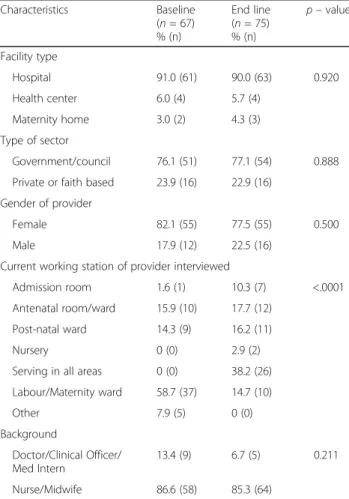
Characteristics of providers
Providers interviewed during baseline and endline were similar in terms of socio-demographic characteristics, work experience, professional support, and compensa-tion (Table 4). Providers were, on average, 35 years old and had worked in the health sector for 11 years. There was an increase (0% to 38%) in the number of providers serving all areas (admission, antenatal, postnatal, labor, delivery, nursery) at endline, suggesting improved pro-vider functioning through diversified ability to respond as needed across units, although it may also reflect staff-ing challenges followstaff-ing the influx of patients due to free maternity services.
Understanding and operationalization of client’s rights
The quantitative and qualitative data supported, by vary-ing degrees, the understandvary-ing and operationalization of client rights, an integral component of provider promo-tion of RMC. Quantitatively, providers’ perceptions of how they treated clients reveal, on average, an increase
in their awareness of ‘client rights’and improvements in
‘HIV care’and‘client-centered care’. Providers’awareness of ‘client rights’(max score = 14) increased from a mean score of 4.5 (SD = 2.4) at baseline to 6.2 (SD = 3.1) at endline (p= 0.001). The mean score for how providers treat women living with HIV (max score = 7) improved from 1.5 (SD = 1.5) at baseline to 4.8 (SD = 1.9) at end-line (p< .0001). The mean score on selected aspects of
‘client-centered care’during labor, delivery, and the post-natal period (max score = 7) showed significant
Table 3Composite measure item list(Continued)
Working relationships (0–14 items) Enough time and opportunity to discuss patient care problems with other staff; A manager who is provides support supervision and leadership; A manager who backs up the staff in decision-making and conflict resolution even if the conflict is within cadre, below or with a more qualified member of staff; Hospital/clinic managers support and value health workers; Doctors, nurses and other health workers have good working relationships; Medical Officers have good working relationships with Clinical Officers; Nurses have good working relationships with Clinical Officers; Medical officers have good working relationships with Nurse midwives; Obstetricians have good working relationship with midwives; Enrolled nurses have good relationships with registered nurses; Nurses have good relationships with Medical Officers/interns; Nurses have good relationships with doctors; Collaboration (joint practice) between different cadres of health workers; A lot of team work between different cadres of health workers.
Table 4Characteristics of health care providers participating in baseline (2012) or endline (2014) surveys of the Heshima project in 13 facilities in Kenya,N= 142
Characteristics Baseline (n= 67) % (n)
End line (n= 75) % (n)
p–value
Facility type
Hospital 91.0 (61) 90.0 (63) 0.920
Health center 6.0 (4) 5.7 (4)
Maternity home 3.0 (2) 4.3 (3)
Type of sector
Government/council 76.1 (51) 77.1 (54) 0.888
Private or faith based 23.9 (16) 22.9 (16)
Gender of provider
Female 82.1 (55) 77.5 (55) 0.500
Male 17.9 (12) 22.5 (16)
Current working station of provider interviewed
Admission room 1.6 (1) 10.3 (7) <.0001
Antenatal room/ward 15.9 (10) 17.7 (12)
Post-natal ward 14.3 (9) 16.2 (11)
Nursery 0 (0) 2.9 (2)
Serving in all areas 0 (0) 38.2 (26)
Labour/Maternity ward 58.7 (37) 14.7 (10)
Other 7.9 (5) 0 (0)
Background
Doctor/Clinical Officer/ Med Intern
13.4 (9) 6.7 (5) 0.211
improvement, from 1.8 (SD = 1.4) at baseline to 5.6 (SD = 1.3) at endline, (p< .0001) (Table 5).
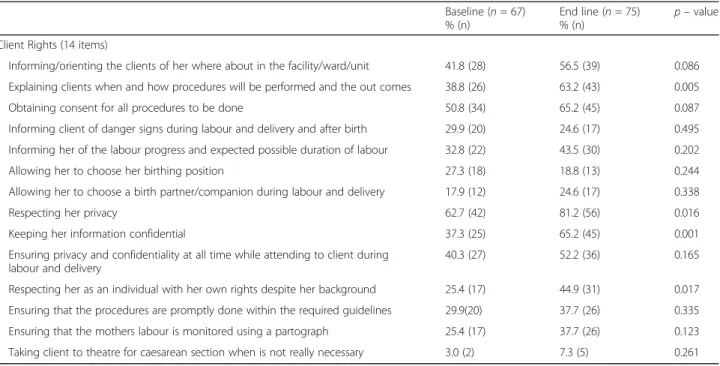
Exploratory analyses of individual items within each scale show how specific components drive these im-provements (detail in Additional file 1 Table A). There was a significant increase in the proportion of providers identifying certain aspects of client rights:‘explaining to clients when and how procedures will be performed and the outcomes’ (38.8% to 63.2%; p = 0.005),‘respecting her privacy’(62.7% to 81.2%; p= 0.016), and‘respecting her as an individual with her own rights despite her background’ (25.4% to 44.9%; p = 0.017). All individual elements showed significantly increased proportions of providers who felt comfortable providing ‘HIV care’for women living with HIV and their babies. Within the‘ cli-ent-centered care’ scale, there was an increase in the proportion of providers endorsing the need for client consent for vaginal examination (18.8% to 86.4%;
p< 0.0001), along with ensuring cooperation with proce-dures by not being harsh with women during labor and delivery (25.4% to 89.8%;p< .0001).
Qualitative data suggest providers’ made efforts to improve clients’ rights by informing and including clients in the decision-making process during care. It appears there was need for providers’ training on clients’ rights, while some improvements were ob-served at endline.
“As we think how to reduce D&A, at the very least
train providers on the clients’rights and obligations”
(Manager, Baseline)
“You know in our set up the client is always right so if they say I don’t want to be in this position or I do not want to stand here for long then you explain to the client the risks and benefits then the client makes the decision.”(Maternity in-charge, endline)
Challenges remain, however, to improving clients’ rights. Despite facility improvements such as provision of curtains for privacy, respondents felt that staff short-ages still hindered implementation of client rights protocols.
“Because we are short in staffing, we want a quick eye contact both sides of the ward….when you are running to attend to the other cases there, I can be able to spot this mother in bed five very fast…the staffing does not allow us to have good ample one-on-one personalized care…I would not want them to be under the curtain because if she is changing conditions there while am busy doing other things, by the time I realize, things are worse.”(Midwife, endline)
Providers’work related environment
Work environments played a significant role in shap-ing providers’ abilities to promote RMC in their work (Fig. 1), specifically affecting provider’s emotional health and perceptions on supervision, job fairness and management, as well as communication and teamwork.
Emotional health
Overall, the majority (>75%) of providers at baseline and endline indicated good working relationships between different provider cadres. (Table 5). However, providers still experience burnout and emotional strain. A signifi-cant decrease (p = 0.036) was seen in the composite mean emotional health score (max score = 22) between baseline (16.3, SD = 3.4) and endline (14.8, SD = 3.6). Exploratory analyses of individual emotional health items showed no difference, except a few significant elements of work-related emotional stress (Table 6). More providers felt at the‘end of their tether’at endline than at baseline (26% v. 12%, p = 0.043), indicating increased levels of frustration and fatigue, may, in part, result from the free maternity mandate that coincided with the laterHeshimaimplementation stages.
Qualitative findings support providers’ work-related stress, at both baseline and endline.
“…In the same place... they are very active (referring to midwives)...you can find somebody who has worked overnight and yet is still in the mood of working. That one we can give a locum (extra work for pay) and maybe there is one who cannot handle the work after
Table 5Composite scores assessing provider knowledge and attitudes on client’s rights among health care providers participating in baseline (2012) or endline (2014) surveys of the Heshima project in 13 facilities in Kenya,N= 142
Baseline (n= 67) Mean score (SD)
End line (n= 75) Mean score (SD)
p- value Cronbach’s alpha
Clients Rights (0–14) 4.5 (2.4) 6.2 (3.1) 0.001 0.70
Emotional Health (0–22) 16.3 (3.4) 14.8 (3.6) 0.036 0.76
Client Centred Care (0–7) 1.8 (1.4) 5.6 (1.3) <.0001 0.80
such a shift.... she is so stressed... but I can you tell both are tired anyway but we do not have enough staffs……we need someone to cover a shift”(Maternity Manager. baseline).
At endline one respondent said;
“…Sometimes nurses experience burnout related to work and workload and sometimes related to outcomes like a maternal death. And it would put them in a situation where they are not able to cope”
(Midwife, Endline)
Perceptions on supervision, job fairness and management
Providers’ perceptions of their supervision, job fairness, management, health facilities, and systems effects are shown in Table 6. Providers felt improvements in super-vision as shown by a significant mean score (max score = 5) increase of supervision positive attributes from 1.1 (1.5) at baseline to 3.0 (1.9) at endline (p < .0001). They also reported a higher management score (max score = 14) at endline of 7.5 (5.2) than base-line, of 4.2 (4.4) (p< 0.0004). By contrast, providers indi-cated significant decreases on their job fairness scale scores (max score = 5), from 2.9 (1.7) at baseline to only 1.7 (1.4) at endline (p = <.0001).
The decrease in job fairness assessments are likely re-lated to burnout and declines in work-rere-lated emotional health (Table 6). Between baseline and endline, signifi-cantly fewer providers agreed that their pay was fair
(69.4% to 11.3%;p< .0001), their workload was fair (68.3% to 21.0%;p< .0001), and their rewards are fair (77.4% to 16.1%; p < .0001). Regardless of the composite score on provider dissatisfaction with workload and compensation, significant increases, from 20% at baseline to over 50% at endline, were seen for all individual indicators of supervi-sion and fairness. Exploratory results demonstrate super-visory improvement: at baseline, only 18% of providers reported manager clarification of decisions and additional information when requested by staff; by endline, this pro-portion increased to 53.2% (p< .0001).
These results triangulate with qualitative results. Re-spondents’perceive that high caseloads and limited staff in maternity care resulting in poor care, overworked providers, work-related stress, combined with limited in-frastructure for service delivery, negatively influence their attitudes towards their work. Similar facility factors persisted, at both baseline and endline, as challenges to providers’abilities to promote RMC.
“Women expect too much from the providers, if the provider does not have curtains or blankets, they can do nothing to ensure comfort and privacy”(Midwife, baseline).
“So even if she would appreciate the value and
clarification exercise, she is not able to deliver fully to the client as she would also wish to do…the human resource factor is a problem. The other handicap was the space, the infrastructure in itself.”(Medical doctor, endline).
Table 6Individual composite score items assessing knowledge and attitudes on clients rights of providers participating in baseline (2012) and endline (2014) surveys of the Heshima project in 13 facilities in Kenya,N= 142
Baseline (n= 67) % (n)
End line (n= 75) % (n)
p–value
Client Rights (14 items)
Informing/orienting the clients of her where about in the facility/ward/unit 41.8 (28) 56.5 (39) 0.086
Explaining clients when and how procedures will be performed and the out comes 38.8 (26) 63.2 (43) 0.005
Obtaining consent for all procedures to be done 50.8 (34) 65.2 (45) 0.087
Informing client of danger signs during labour and delivery and after birth 29.9 (20) 24.6 (17) 0.495
Informing her of the labour progress and expected possible duration of labour 32.8 (22) 43.5 (30) 0.202
Allowing her to choose her birthing position 27.3 (18) 18.8 (13) 0.244
Allowing her to choose a birth partner/companion during labour and delivery 17.9 (12) 24.6 (17) 0.338
Respecting her privacy 62.7 (42) 81.2 (56) 0.016
Keeping her information confidential 37.3 (25) 65.2 (45) 0.001
Ensuring privacy and confidentiality at all time while attending to client during labour and delivery
40.3 (27) 52.2 (36) 0.165
Respecting her as an individual with her own rights despite her background 25.4 (17) 44.9 (31) 0.017
Ensuring that the procedures are promptly done within the required guidelines 29.9(20) 37.7 (26) 0.335
Ensuring that the mothers labour is monitored using a partograph 25.4 (17) 37.7 (26) 0.123
Qualitative data further show improvements in provider perceptions of manager-provider interactions. Stake-holders as well as baseline results suggest need for an
intervention focusing on managers’ leadership roles and
responsibility for improving maternity units’ working
conditions.
“Some maternity managers can be trained in leadership and the management should select competent managers in those positions, focus should also be on facility in charges themselves…provide equipment also”(Facility Manager, baseline).
Managers at endline were described as supportive of both clients and providers engaging in RMC-promoting behaviors. A nurse manager described her role in
sus-tainingHeshimapractices.
“We are adhering to what we learnt about respecting our clients…. we are encouraging men to come for ANC where we encourage mothers to come with their spouses…we want them to feel comfortable; we give them a visit round the facility so that in the event they come [for delivery] they know where they will be attended and by who. We are also encouraging the staff to be courteous to the clients…to introduce themselves…make sure they have their name tags properly displayed…”(Facility manager, endline).
Results also show improved provider management, com-munication, and teamwork, resulting in better relations between providers and clients.
“The element of communication really improved; midwives could communicate very well with clients and it reduced some of clients’perceptions of disrespect and abuse…another thing which worked very well was teamwork, which started at the site of
implementation; the maternity itself, the nursing office... right to the Health Management Team.”
(Nurse-midwife & mentorship coordinator, endline)
However, managers – and providers who experience
heavy workloads – express frustration with the effort
required to ensure clients receive quality and respectful care. One manager lamented about her inability to ad-dress understaffing, which may contribute to client
rights’violations.
“I make the best noise I can to my in-charge to im-prove staffing in maternity…. And she also raises her hands up (implying giving up) that I have also made noise up there (implying to staffing office) and there have not posted for me staff…. So you will work with
what you have. But I will not keep quiet but it is the reality. You want to give the quality care…but it needs the manpower to give it”. (Reproductive health coordinator, endline)
Providers also reported that the promotion system is un-fair, pay inadequate, and demotivating. Provider demo-tivation across Kenya may have stemmed from three
nationwide providers’ strikes that lasted five out of the
20 months of the study’s implementation period, for
rea-sons that included delayed salaries, poor pay, lack of promotion, and poor working conditions. Some pro-viders suggest rewarding good behavior and attitudes to motivate providers offering maternity care services.
“They [providers] should be motivated in a way, even if
it’s not allowances or cash but the management or profes-sional should appreciate the unique work that is being
carried out at the maternity… we can rate the health
provider in the maternity who is doing well…maybe the
best appreciated midwife can be recognized and given
trophy, something like that.”(Facility in-charge, endline).
Discussion
Our study used mixed methods and developed compos-ite measures for individuals and teams to measure be-havior, beliefs and attitudes, professional ethics, and self-awareness. The data describes the complexity of factors affecting provider behavior and the challenges they face in the provision of maternal health care. Quantitative data show that more than half the providers reported that they were emotionally drained from their work or exhausted at the end of the workday both at baseline and endline, yet there were improvements in their performance in respecting client rights.
Our findings demonstrate that positively influencing providers’ understanding of client rights is feasible, but optimizing their attitudes and behaviors for successful implementation of a rights-based approach upholding clients’ rights is complex. Despite the increase in com-posite scores for clients’rights and supported qualitative findings, closer investigation of individual measures shows little change over the intervention period. In few cases, even when providers internalized their VCAT training, were they unable to apply due to peer influ-ences, supporting the theory that individual behaviors in health service delivery systems may be affected by
‘groupthink’or a team’s cultural normative practice [32]. A provider’s ability to critically self-regulate, along with group composition and work dynamics, influence provision of client-centered care and highlights the need to respond to both midwife and client needs [12, 33–35].
Providers’abilities to deliver women-centered care are moderated by work environment [36, 37]. Our study illustrates improvements in nurses’ experiences with enhanced team efforts and better supervision including a fair review system. Other studies show that conducive work environments foster uptake of the effective midwif-ery practices, while inter-professional rivalries deter qual-ity of care [38, 39]. Our findings show difficulties in providing client-centered care for various reasons includ-ing inadequate space, low staffinclud-ing, and high client loads, leading to provider burn-out particularly in in big facilities with higher volume maternity units. The need for ad-equate staff with a positive attitude for maternity care, along with adequate space, equipment, supplies, and com-modities is integral to women-centered care [19, 36, 40].
This study elevates the necessity of providers’emotional well-being to deliver respectful and dignified care in over-whelmed work environments. Nurses’ and junior pro-viders’psychological health are heavily influenced by how supportive management styles and communication struc-tures are [41]. Despite the high acceptability of counseling among providers and managers, its effect on emotional health was not statistically significant, likely because of limited session frequencies and variability in type and quality of identified counselors. Counselors described as
‘too familiar’with nurses in maternity units often were less effective in providing psychosocial support.
Minimal improvements in work environment and working relationships between baseline and endline af-fected staff emotional well-being. Poor staff behavior often stems from work-related stress and unfavorable conditions, emphasizing the need to improve health ser-vice delivery settings before blaming providers for disres-pectful and abusive behaviors. Specifically, our findings point to the importance of interventional focus on work environment, group dynamics, and the wider health sys-tem [42], as well as the need for increasing the intensity
of emotional support with greater counseling session fre-quency [43].
Leadership and management affects facility environ-ments and behavior change interventions targeting clini-cians and midwives, as seen from provider and manager concurrence on teamwork and improved supervision. In contrast, resentment, anger, discontent and mistrust - if unaddressed - may result in work-related frustration transferred to patients, resulting in disrespectful and abusive behaviors to clients. This may be further aggravated by poor remuneration and unsupportive supervision structures [44, 45]. Our findings show that dissatisfaction with unresponsive management related to perceptions of fair job promotion can lead to de-moti-vated health workers. At the same time, unclear guid-ance on managing human resources in a devolved health system affected provider training and delayed salaries [26, 46]. Resulting provider dissatisfaction with manage-ment structures may have contributed to the provider strikes during the intervention period. The need for a more supportive work environment and prevailing policy context is central to provider performance generally and specifically for promoting RMC.
Limitations
Varied results for composite scores and individual mea-sures of changes in provider knowledge, attitudes, and behaviors illustrate the challenge of measuring the multi-dimensional RMC-promotion processes and outcomes. Factor analyses of measures indicate high reli-ability of composite scales capturing changes in almost every element, although breakdown analysis of individual items reveals fewer statistically significant improvements over the intervention period. For example, the composite score in management shows improvements following
Heshima implementation; however, we saw no change (plausibly due to insufficient sample size) in the majority of its individual components. The intervention effect stems primarily from changes in managers’ decision-making behaviors for providers’ needs, addressing pro-vider and client concerns and rights, and treating both with respect, dignity and kindness. This may be due to
Heshima’s differential influence on specific elements or a function of the loss of variance in composite scores. As such, using composite scores to evaluate changes from baseline to endline ought to be interpreted carefully due to delivery size, facility size, ratio of staff to deliveries, type of facility. Given that this study is one of the first globally to develop these composite measures for RMC, further testing and validation is needed in other settings.
intervention implementation and efficacy. Devolution of administrative power from the national to county level involved reassignment of districts and prior geographic areas into distinct counties, followed by a progressively phased formation of county health teams–all of which were contemporaneous with Heshima implementation and affected provider work environments. The study was unable to follow a specific cohort of providers over time, to capture their individual trajectories (qualitatively or quantitatively), preventing causal claims about effective-ness. Future studies should focus on longitudinal and panel designs to better assess the efficacy and effective-ness of multi-component interventions likeHeshima.
Despite these limitations, the mixed method imple-mentation research approach presents a set of broad findings that can further be assessed in Kenya and other contexts, and considers provider perspectives over time. It is the first of its kind to try to gather provider perspectives of a multi-component intervention for un-derstanding and addressing women’s mistreatment dur-ing childbirth. Though sustaindur-ing behavior changes after interventions likeHeshimais difficult given the complex affective factors, it is possible when accompanied by ad-vocacy, leadership, and partnership with ministries of health, committed partners, and regulatory and profes-sional bodies invested in scaling up of RMC as an inte-gral part of MNH services.
Conclusions
Behavior change interventions focusing on providers are central to promoting RMC. This study unveils how an intervention package such as Heshima affects provider attitudes and practices, is possible to imple-ment, influences RMC promotion, and provides les-sons for scale up. Provider working relationships and environment not only impact their own emotional health (burnout), but also can drive poor provider-client interactions and affect women’s care. Factors influencing performance, management, and decision-making remain a challenge for mitigating mistreat-ment. We must recognize the health providers’ chal-lenging work environments and learn how to support them, daily, for achieving RMC.
Additional file
Additional file 1: Table A.Individual composite score items assessing knowledge and attitudes of providers participating in baseline (2012) and end line (2014) surveys of theHeshimaproject in 13 facilities in Kenya, N= 142. (DOCX 21 kb)
Abbreviations
D&A:Di srespect and abuse; FIDA: Federation of Women Lawyers in Kenya; HIV: Human immunodeficiency virus; IDIs: In-depth interviews;
NNAK: National nurses association Kenya; QITs: Quality improvement teams;
RMC: Respectful maternity care; SAS: Statistical analysis system; SD: Standard deviation; URC: University research company.; USAID: United States Agency for International Development; VCAT: Values clarification and attitude transformation
Acknowledgements
The Heshima Project (Promoting Dignified Care During Childbirth in Kenya) was a sub agreement (F11 G01 6990) between URCs Translating Research into Action (TRAction) and Population Council, supported by the US Agency for International Development under USAID Cooperative Agreement GHS-A000-09-00015-00. We thank the consortium of three organizations; Population Council, Federation of Women Lawyers in Kenya (FIDA-Kenya) and National Nurses Association Kenya (NNAK), who came together to address this issue in Kenya with the Ministry of Health. We thank the URC-TRAction and USAID colleagues and the advisory group who reviewed this article. Finally we thank all participants who provided us with information that generated this evidence. The paper reflects the views of the authors and not USAID or the Government of Kenya. The funders had no role in the study design, data collection and analysis, decisions to publish or preparation of the manuscript.
Funding
Funding for this study was through Population Council as part of the TRAction project by USAID under Cooperative Agreement No. GHS-A-00-09-00015-00.
Availability of data and materials
Supporting data for this manuscript is available on request.
Authors’contributions
CN was involved in the conceptual design, intervention implementation, data collection, qualitative analysis, writing and revision of manuscript, CEW was involved in the overall conceptual design of the study, data analysis, writing and review. JR was involved in the quantitative data analysis and interpretation. PS was involved in writing and critical review of the manuscript. TA was involved in the conceptual design of the study, data analysis and manuscript revision. All authors have read and approved the final manuscript.
Ethics approval and consent to participate
The study was approved by the Population Council’s IRB (# 517) and KEMRI ethical review board (Non-SCC #288). Researchers obtained informed consent for all interviews and audio-recorded qualitative interviews.
Consent for publication
All authors have given consent for publication.
Competing interests
The authors declare that they have no competing interests.
Publisher’s Note
Springer Nature remains neutral with regard to jurisdictional claims in published maps and institutional affiliations.
Author details
1Population Council, PO Box 17643-00500, Nairobi, Kenya.2Population Council, 4301 Connecticut Ave NW, Suite 280, Washington, DC 20008, USA. 3St. Jude Children’s Research Hospital, Memphis, TN, USA.
Received: 31 January 2017 Accepted: 10 August 2017
References
1. Exploring evidence for disrespect and abuse in facilitybased childbirth: report of a landscape analysis. USAID-TRAction Project, Harvard School of Public Health and University Research Co., September 20, 2010. Available at www.traction.org.
2. Abuya T, Warren CE, Miller N, Njuki R, Ndwiga C, et al. Exploring the prevalence of disrespect and abuse during childbirth in Kenya. PLoS One. 2015;10(4):e0123606.
Facilities Globally: A Mixed-Methods Systematic Review. PLoS Med. 2015; 12(6):e1001847.
4. Kujawski S, Mbaruku G, Freedman L, Ramsey P, Moyo K, Kruk W, M E. Association Between Disrespect and Abuse During Childbirth and Women's Confidence in Health Facilities in Tanzania. Matern Child Health J. 2015; 19(10):2243–50.
5. Asefa A, Bekele D. Status of respectful and non-abusive care during facility-based childbirth in a hospital and health centers in Addis Ababa, Ethiopia. Reprod Health. 2015;12:33.
6. Behruzi R, Hatem M, Fraser W, Goulet L, Ii M, Misago C. Facilitators and barriers in the humanization of childbirth practice in Japan. BMC Pregnancy Childbirth. 2010;10:25.
7. Okafor II, Ugwu EO, Obi SN. Disrespect and abuse during facility-based childbirth in a low-income country. Int J Gynaecol Obstet. 2015;128(2):110–3. 8. Rosen HE, Lynam PF, Carr C, Reis V, Ricca J, Bazant ES, Bartlett LA. Quality of,
Maternal Newborn Care Study Group of the, Maternal Child Health Integrated, Program, Direct observation of respectful maternity care in five countries: a cross-sectional study of health facilities in East and Southern Africa. BMC Pregnancy Childbirth. 2015;15:306.
9. Sando D, Ratcliffe H, McDonald K, Spiegelman D, Lyatuu G, Mwanyika-Sando M, Emil F, Wegner M, Chalamilla N, Langer G, A. The prevalence of disrespect and abuse during facility-based childbirth in urban Tanzania. BMC Pregnancy Childbirth. 2016;16:236.
10. Jewkes R, Penn-Kekana L. Mistreatment of Women in Childbirth: Time for Action on This Important Dimension of Violence against Women. PLoS Med. 2015;12(6):e1001849.
11. Honikman S, Fawcus S, Meintjes I. Abuse in South African maternity settings is a disgrace: Potential solutions to the problem. S Afr Med J. 2015;105(4):284–6. 12. Freedman LP, Kruk ME. Disrespect and abuse of women in childbirth:
challenging the global quality and accountability agendas. Lancet. 2014; 384(9948):e42–4.
13. WHO. Standards for improving quality of maternal and newborn care in health facilities. GENEVA: WHO; 2016.
14. Goer H. Humanizing birth: a global grassroots movement. Birth. 2004; 31(4):308–14.
15. Smith H, Brown H, Hofmeyr GJ, Garner P. Evidence-based obstetric care in South Africa–influencing practice through the‘Better Births Initiative’. S Afr Med J. 2004;94(2):117–20.
16. McMahon S, George AS, Chebet JJ, Mosha IH, Mpembeni RN, et al. Experiences of and responses to disrespectful maternity care and abuse during childbirth; a qualitative study with women and men in Morogoro Region, Tanzania. BMC Pregnancy Childbirth. 2014;14:268.
17. Moyer CA, Adongo PB, Aborigo RA, Hodgson A, Engmann CM.‘They treat you like you are not a human being’: maltreatment during labour and delivery in rural northern Ghana. Midwifery. 2014;30(2):262–8.
18. Freedman L, R K, Abuya T, Bellows B, Ndwiga C, Warren CE, et al. Defining disrespect and abuse of women in childbirth: a research, policy and rights agenda. Bull World Health Organ. 2014;92(12):915–7.
19. Abuya T, Ndwiga C, Ritter J, Kanya L, Bellows B, Binkin N, Warren CE. The effect of a multi-component intervention on disrespect and abuse during childbirth in Kenya. BMC Pregnancy Childbirth. 2015;15:224.
20. Sheferaw ED, Mengesha TZ, Wase SB. Development of a tool to measure women’s perception of respectful maternity care in public health facilities. BMC Pregnancy Childbirth. 2016;16:67.
21. Warren CE, Rebecca N, Charity N, Timothy A. Manifestations and drivers of mistreatment of women during childbirth in Kenya: Implications for measurement and developing interventions. BMC Pregnancy and Childbirth. 2017 Mar 28;17(1):102.
22. Freedman LP. Implementation and aspiration gaps: whose view counts? Lancet. 2016;388(10056):2068–9. Available at http://www.thelancet.com/journals/lancet/ article/PIIS0140-6736(16)31530-6/abstract. Accessed 29 Oct 2016.
23. Warren C, Njuki R, Abuya T, Ndwiga C, Maingi G, Serwanga J, Mbehero F, Muteti L, Njeru A, Karanja J, Olenja J, Gitonga L, Rakuom C, Bellows B. Study protocol for promoting respectful maternity care initiative to assess, measure and design interventions to reduce disrespect and abuse during childbirth in Kenya. BMC Preg Childbirth. 2013;13:21. doi:10.1186/1471-2393-13-21. Available at https://bmcpregnancychildbirth.biomedcentral.com/articles/10.1186/ 1471-2393-13-21.
24. Warren CE, et al. Manifestations and drivers of mistreatment of women during childbirth in Kenya: implications for measurement and developing interventions. BMC Pregnancy Childbirth. 2017;17(1):102.
25. Turner K, Kimberly K. Abortion attitude transformation: A values clarification toolkit for global audiences. Chapel Hill, NC: Ipas. Activities adapted for young women by Deborah McSmith, Evelina Börjesson, Laura Villa and Katherine L. Turner; 2008. Chapman
26. Williamson T, Mulaki A. Devolution of Kenya’s Health Sytem. The Role of HPP. 2015. Policy brief. Available at https://www.healthpolicyproject.com/ index.cfm?id=publications&get=pubID&pubId=719.
27. Omolo A, Nizam R, Anyango M, Oyalo A, Finch C, Musira L. World Bank Centre for Devolution Studies Kenya School of Government (KSG), Devolution Working Paper 6: Practical Approaches for County Governments. 2015. Available at https://openknowledge.worldbank.org/bitstream/handle/ 10986/21669/94502.pdf;sequence=2.
28. Penn-Kekana L, McPake B, Parkhurst J. Improving maternal health: getting what works to happen. Reprod Health Matters. 2007;15(30):28–37. 29. Warren C, N R, Abuya T, Ndwiga C, Maingi G, Serwanga J, Mbehero F, et al.
Study protocol for promoting respectful maternity care initiative to assess, measure and design interventions to reduce disrespect and abuse during childbirth in Kenya. BMC Pregnancy Childbirth. 2013;13:21.
30. Bowser D, Hill K. Exploring evidence for disrespect and abuse in facilitybased childbirth: report of a landscape analysis. USAID-TRAction Project, Harvard School of Public Health and University Research Co., September 20, 2010. 2010. Available at http://www.tractionproject.org/ resources/access-skilled-care-respectful-maternal-care/exploring-evidence-disrespect-and-abuse.
31. DeVeLLis, R F. Scale Development, Theory and Applications. Third ed; 2012. 32. Fernandez CP. Creating thought diversity: the antidote to group think. J
Public Health Manag Pract. 2007;13(6):670–1.
33. Ladley, D., I. Wilkinson, and L. Young, The impact of individual versus group rewards on work group performance and cooperation: A computational social science approach. Journal of Business Research, 2015. https://doi.org/ 10.1016/j.jbusres.2015.02.020.
34. Klug M, Bagrow JP. Understanding the group dynamics and success of teams. R Soc Open Sci. 2016;3(4):160007.
35. Sakala C, Newburn M. Meeting needs of childbearing women and newborn infants through strengthened midwifery. Lancet. 2014;384(9948):e39–40. 36. Renfrew MJ, McFadden A, Bastos MH, Campbell J, Channon AA, Cheung NF,
Silva DR, Downe S, Kennedy HP, Malata A, McCormick F, Wick L, Declercq E. Midwifery and quality care: findings from a new evidence-informed framework for maternal and newborn care. Lancet. 2014;384(9948):1129–45. 37. Filby A, McConville F, Portela A. What Prevents Quality Midwifery Care? A
Systematic Mapping of Barriers in Low and Middle Income Countries from the Provider Perspective. PLoS One. 2016;11(5):e0153391.
38. Shamian J. Interprofessional collaboration, the only way to Save Every Woman and Every Child. Lancet. 2014;384(9948):e41–2.
39. Homer CS, Friberg IK, Dias MA, ten Hoope-Bender P, Sandall J, Speciale AM, Bartlett LA. The projected effect of scaling up midwifery. Lancet. 2014; 384(9948):1146–57.
40. Ganle JK, Parker M, Fitzpatrick R, Otupiri E. A qualitative study of health system barriers to accessibility and utilization of maternal and newborn healthcare services in Ghana after user-fee abolition. BMC Pregnancy Childbirth. 2014;14:425.
41. Michie S, Williams S. Reducing work related psychological ill health and sickness absence: a systematic literature review. Occup Environ Med. 2003;60(1):3–9.
42. de Freitas-Swerts F, Robazzi ML. The effects of compensatory workplace exercises to reduce work-related stress and musculoskeletal pain. Rev Lat Am Enfermagem. 2014;22(4):629–36.
43. Mannava P, Durrant K, Fisher J, Chersich M, Luchters S. Attitudes and behaviours of maternal health care providers in interactions with clients: a systematic review. Glob Health. 2015;11:36.
44. Mrisho M, Schellenberg JA, Mushi AK, Obrist B, Mshinda H, Tanner M, Schellenberg D. Factors affecting home delivery in rural Tanzania. Tropical Med Int Health. 2007;12(7):862–72.
45. Robertson, R. and J. Jochelson, Interventions that change clinician behaviour: mapping the literature 2006, National Institute for Health and Clinical Excellence. 46. Owili PO, Hsu YH, Chern JY, Chiu CH, Wang B, Huang KC, Muga MA.