SOFTWARE
A retrosynthetic analysis algorithm
implementation
Ian A. Watson, Jibo Wang and Christos A. Nicolaou
*Abstract
The need for synthetic route design arises frequently in discovery-oriented chemistry organizations. While traditionally finding solutions to this problem has been the domain of human experts, several computational approaches, aided by the algorithmic advances and the availability of large reaction collections, have recently been reported. Herein we present our own implementation of a retrosynthetic analysis method and demonstrate its capabilities in an attempt to identify synthetic routes for a collection of approved drugs. Our results indicate that the method, leveraging on reaction transformation rules learned from a large patent reaction dataset, can identify multiple theoretically feasible synthetic routes and, thus, support research chemist everyday efforts.
Keywords: Retrosynthetic analysis, Chemical synthesis, Synthetic route design, Reaction informatics
© The Author(s) 2019. This article is distributed under the terms of the Creative Commons Attribution 4.0 International License (http://creat iveco mmons .org/licen ses/by/4.0/), which permits unrestricted use, distribution, and reproduction in any medium, provided you give appropriate credit to the original author(s) and the source, provide a link to the Creative Commons license, and indicate if changes were made. The Creative Commons Public Domain Dedication waiver (http://creat iveco mmons .org/ publi cdoma in/zero/1.0/) applies to the data made available in this article, unless otherwise stated.
Introduction
Research needs for chemical synthesis predictability, synthetic route planning and reaction optimization has motivated the development of several computational tools in recent years [3, 15, 19]. Traditionally, these tools implement methods based on precedent reaction look-up or retrosynthetic analysis solutions [8]. The former relies on the presence of a collection of reactions and attempts to match the query structure to a known reaction prod-uct (Reaxys; Scifinder). When a match is identified the original reaction is retrieved and, often, a search in avail-able structural databases is performed to define availabil-ity of reactants. Retrosynthetic analysis (RA) approaches, first introduced through the pioneering work of Corey [5], use chemical reaction rules to deconstruct query structures into reactants followed by a search for availa-bility in structure collections [18]. The preparation of the deconstruction rules may either be assigned to human experts or take place via computational, data-driven pro-cesses [14]. Both reaction look-up and retrosynthetic analysis approaches may iterate by using each reactant as a new query structure.
In a typical RA scenario, given a target chemical struc-ture, the process initiates a recursive decomposition loop using available synthetic knowledge. In each step, the input chemical structure is broken into fragments which are complemented with functional groups necessary for the reaction to take place. The virtual reactants, referred to as synthons in the remainder of this manuscript, can then be matched against a database of available building blocks. The process ends when synthons match available building blocks, when the structure under investigation cannot be broken down further or when a predefined search depth has been reached.
Key components of the above process include a database of synthetic reactions to serve as the source of synthetic knowledge, and, a collection of available building blocks which serves as a look up for synthons. The proliferation of chemical structure databases renders the latter compo-nent easy to address. For example, researchers can nowa-days freely access building block collections advertised as “readily available” from numerous chemical structure ven-dors [7]. In addition, researchers associated with the phar-maceutical industry or sizeable academic institutions often have access to inhouse chemical sample management databases of significant size. Access to a comprehensive, free, reliable source of chemical reactions has been more challenging since such data has been typically described in textual form in laboratory notebooks, journal publications
Open Access
*Correspondence: [email protected]
and patents. Collections prepared by large publishing houses and professional organizations are only provided on a fee-for-service basis while laboratory notebooks are often difficult to search since their primary design purpose has been recording experiments while they are executed, not comprehensively searching a posteriori. Of immediate practical use is work reported by Lowe et al. [9] to extract reactions from patent applications to the United States Patent and Trade Office (USPTO) and make these reac-tions available in the public domain [10].
In this paper we describe our efforts to develop a data-driven retrosynthetic analysis engine aiming to pro-vide synthetic routes for input chemical structures. We thoroughly discuss all implementation aspects includ-ing design decisions and algorithmic details and present results from the training of this engine and the applica-tion to a collecapplica-tion of approved small molecule drugs. This tool, originally developed to serve inhouse needs and currently in operation, is provided to the commu-nity in an effort to facilitate research in synthetic route design and reaction informatics in general. Emphasis has been placed on developing a tool agnostic to reaction and reactant data specifics so that interested parties can train and apply the method to any reaction source and building block collection appropriately formatted.
Conceptual design
The Retrosynthetic Analysis (RTSA) method is a com-putational, data-driven approach designed to identify potential synthetic routes for a structure of interest, referred to in this manuscript as the hypothesis struc-ture. The method uses as input a dataset of reaction examples to prepare retrosynthetic analysis rules used
to decompose hypothesis structures into virtual build-ing blocks. Similar to all data-driven methods, the per-formance of RTSA depends heavily on the supplied input data quality. For the purposes of the work described in this paper we use the publicly available USPTO reaction set which can be readily accessed and used [10].
The operation of RTSA has two distinct phases. The training phase, RTSA-Train, consumes all available reac-tion data and produces a collecreac-tion of chemical structure decomposition rules and information required for syn-thetic route design. RTSA-Design, receives the hypoth-esis structure(s) and designs possible synthetic routes using the collection of decomposition rules obtained dur-ing traindur-ing. In the followdur-ing sections the two phases of RTSA are described in detail.
RTSA‑train
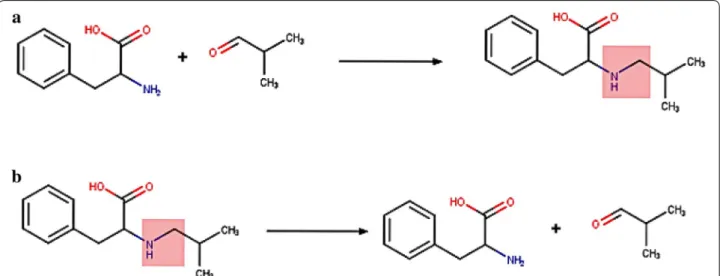
The main aim of the training process is to produce Reverse Reaction Templates (RRT) for use during ret-rosynthetic analysis. As the name suggests, RRT’s are synthetic transformation rules which work conversely to decompose, i.e. transform, products into building blocks. Each RRT is derived from a class of highly similar reac-tions from which annotation data pertinent to the tem-plate, e.g. number of reactions, can be calculated. The process takes as input a set of reactions with atom map-ping in place and, sequentially, reverses and standardizes the reactions followed by the extraction of an extended reaction core. During reversal, the two sides of the reac-tion, left-hand (reactants) and right hand (products) are exchanged. Agents, i.e. structures above and below the reaction line (e.g. catalysts, solvents), remain in their original place (Fig. 1).
Standardization of the reaction includes, among others, removal of duplicate fragments, removal of fragments that do not participate in the reaction and handling reac-tions where there has been an obvious failure of the atom mapping process. The extraction of the extended reaction core requires that the main reaction core is first defined by identifying atoms whose properties (e.g. atomic sym-bol, connectivity, ring membership, etc) change during the reaction. If any of these atomic properties change from one side of a reaction that atom is considered a changing atom, part of the reaction core [8]. A reaction example illustrating the changing atoms forming the reaction core is shown in Fig. 2.
In this case, all numbered atoms are considered chang-ing atoms. Atoms 2 and 3 retain the same connectivity and neighbors during the reaction, but their ring mem-bership changes, and given that ring memmem-bership is one of the atom properties perceived, those atoms are clas-sified as changing, and part of the reaction core. If ring information were omitted from the atom typing used, they would not be perceived as part of the core. In order
to accommodate varying user preferences the software has been implemented to allow flexible atom type defini-tion. A full listing of the properties implemented can be found in Additional file 1: (SI 1).
A reaction is however not completely defined by just the changing atoms, or reaction core. Across a given reaction type, there will be a great diversity of different behaviors of such reactions such as varying yields, dif-ferent catalysts needed, difdif-ferent solvents, temperatures, etc. These differences can be attributed to the larger context of the reaction core as embedded within the molecule. To capture more of this context, we apply a recursive Morgan-like expansion [11] around the reac-tion core, and capture reacreac-tion contexts of varying radii which, in essence, represent circular neighborhoods of different size. The radius zero context will be the reac-tion core itself, while a radius 3 context will include both the core atoms, and all atoms that are within 3 bonds of any atom in the core. The use of such shell-based reac-tion cores is common in retrosynthetic analysis applica-tions as for example in [2] where they are referred to as
Fig. 2 A heterocycle forming reaction from US patent number US20030149264A1. The reaction core consists of all numbered atoms 1, 2, 3, 4, 5
reactive centers. In RTSA the extended reaction cores are represented using a unique smiles-like format referred to as signatures in this paper.
Reaction clusters are defined through grouping reac-tions sharing identical extended reaction cores at specific path lengths. Since extended reaction cores are repre-sented as canonicalized smiles-like signature strings sim-ple string matching suffices for the grouping operation. Clearly what gets grouped together will be a function of the radius selected. The larger the radius, the more “unique” reaction clusters there will be. Note that the use of a unique, canonicalized signature as the extended reaction core provides for a concise, easy to compare and comprehend representation that is flexible enough to accommodate any atom property needed. Figure 3 pre-sents an example of reaction clusters defined using RTSA signatures.
Upon completion of this stage all input reactions have been reversed, standardized and their extended reaction cores have been extracted, represented as signatures and used to group reactions into homogeneous clusters. Each cluster, containing reactions sharing identical extended core is used to define retrosynthetic analysis transforma-tion rules. Note that the choice of atom properties used to characterize each atom is crucial to the overall RTSA process since they influence the outcome of key steps such as the comparison of reaction extended cores and the definition of clusters (see “Results” section).
Each reaction cluster is profiled using data from the reactions it contains. The resulting profile, typically summarization statistics on frequency and other avail-able reaction properties, is stored for subsequent use
as annotations to the corresponding reaction cluster. Finally, a single RRT template is selected from each clus-ter for use during retrosynthetic analysis. The choice of RRT from each cluster is insignificant as it is only used for retrieving the reaction signature that will serve as part of the retrosynthetic analysis transformation rule. The results of the training process are stored in an RRT-Repository for later use. Figure 4 outlines the steps of the RTSA-Train process. It is important to note that while the process may begin with very large numbers of reac-tions, this grouping procedure will typically result in far fewer representative reactions (see “Results” section).
RTSA‑design
During run time, the method takes an input hypothesis chemical structure and traverses the RRT-Repository attempting to run each reverse reaction template to decompose the structure. Attempts that result in failure due to no substructure match to the template, typically the overwhelming majority, are discarded. Successful RRT run attempts produce the structures of building blocks needed for the forward reaction to take place. In essence, each successful RRT run decomposes an input chemical structure into constituent reactants and pro-vides information on the forward reaction type needed. Moreover, examples of past successful reactions of the same type are readily available through a lookup in the cluster of reactions of the matching RRT. In a subse-quent step, the necessary building blocks derived from the application of an RRT may be searched for ability in accessible inventory databases. When avail-able building blocks are found a synthetic route can
Input:
collecon of atom mapped reacons
1. Reverse reacons
2. Clean/standardize reacons 3. Calculate reacon signatures
Idenfy Reacon Core (RC) Idenfy extended RC
Recursively calculate circular neighborhood of RC
Consider atom type: atomic symbol, charge, ring membership, aromac, … Define reacon signature in smiles-like format
4. Define reacon classes using reacon signatures 5. For each reacon cluster:
Select representave reacon example
Define RRT (Reverse Reacon Template) from cluster representave
Output: RRT-Repository; a collecon of RRTs annotated with parent reacon ID
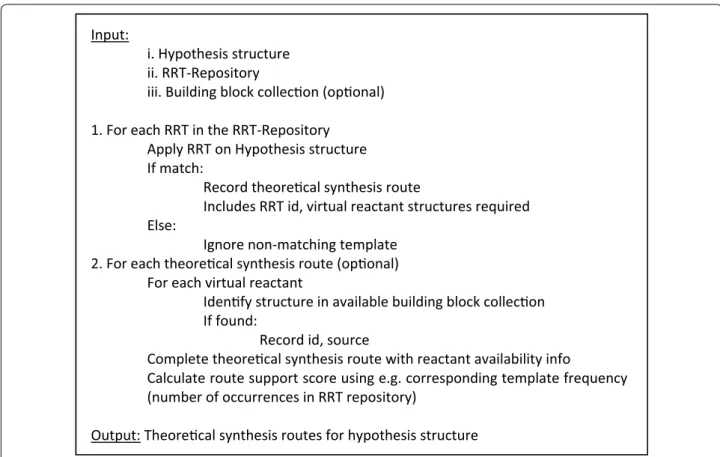
be completed since necessary information required for attempting synthesis, including building blocks source and IDs, is available. Theoretical synthetic routes may be scored and ranked using annotation information (e.g. number of reaction examples, average yield) from the reaction cluster of the corresponding RRT. The RTSA-Design process is detailed in Fig. 5.
As described above the RTSA-Design process only searches for one-step synthetic routes since it requires that synthons resulting from successful RRT matching be present in accessible building block structure data-bases such as ZINC [7]. Alternatively, instead of abort-ing when buildabort-ing blocks are not available, the process may recursively treat such structures as new hypotheses to retrosynthetically analyze, thus enabling the process to identify multi-step synthesis routes. RTSA-Design could iterate until all synthons are found in a building block database, no successful RRT matching is found or some predefined depth is reached. As multi-step syn-thetic routes are more complex and thus more likely to fail in the lab they would typically be scored lower than single-step routes. However, such routes may serve as an idea generator to chemists searching for routes to novel chemical structures.
Implementation
In this section we provide implementation details for key components of RTSA, namely rxn_standardize which cleans and standardizes reactions, rxn_signature which calculates reaction cores and retrosynthesis which ret-rosynthetically analyzes hypothesis structures using reverse reaction templates. The source code for these tools, as well as the procedure which reverses the reac-tions is provided through the LillyMol GitHub project at [4].
rxn_standardize
Experience tells us that many sources of reactions con-tain significant amounts of unusable data, due to some combination of poor data entry, and/or errors in pre-vious processing. The purpose of this tool is to ingest a stream of reactions, apply fixes where possible, or discard erroneous input. Since we are interested in retrosynthetic reactions, any forward reaction that produces multiple fragments as products will not be suitable and can be typically discarded. Also discarded are reactions where no structural change is observed between reactants and products, e.g. purifications.
Input:
i. Hypothesis structure ii. RRT-Repository
iii. Building block collecon (oponal)
1. For each RRT in the RRT-Repository Apply RRT on Hypothesis structure
If match:
Record theorecal synthesis route
Includes RRT id, virtual reactant structures required Else:
Ignore non-matching template 2. For each theorecal synthesis route (oponal)
For each virtual reactant
Idenfy structure in available building block collecon If found:
Record id, source
Complete theorecal synthesis route with reactant availability info
Calculate route support score using e.g. corresponding template frequency (number of occurrences in RRT repository)
Output: Theorecal synthesis routes for hypothesis structure
Where problems with the atom mapping are detected, for example duplicate atom map numbers, rxn_stand-ardize provides an option to discard the existing atom mapping and, attempt to re-map the reaction. Although the built-in atom mapping was never intended to be comprehensive and is therefore not generally robust, this fix can “save” many reactions that would otherwise be discarded. Fragments not participating in the reac-tion, i.e. fragments with no atoms mapped or with no atoms whose type changes due to the reaction, can be removed. Similarly, atoms which either appear or dis-appear from the product side of the reaction can be handled so that subsequent RTSA tools can gener-ate a correct and complete retrosynthetic path. Since the underlying LillyMol toolkit relies on Kekule rep-resentations of molecules, reactions can be switched to consistent Kekule forms in reagents and products. Duplicate fragments can also be discarded and other cleaning steps can be performed including removal of reactions with too large products or ensuring that the reaction name is a continuous alphanumeric string.
rxn_signature
Extracting reaction signatures, the extended reaction cores, is a crucial step of the RTSA process. To achieve this the algorithm first assigns atom types to each atom. Atom type choice is user selectable, and the components of that type will determine whether or not an atom is considered a changing atom—part of the reaction core. The current implementation enables consideration of a large number of atomic properties to determine whether or not an atom has changed during a reaction includ-ing the atomic number, aromaticity, unsaturation, rinclud-ing membership, formal charge, connectivity, smallest ring size, pi electron count and implicit hydrogen count (see Additional file 1 for a full listing of available atom proper-ties). Once the reaction core atoms have been identified, the tool will record that set of atoms as the zero-radius reaction core. This is written as a form of unique smiles which contains the atomic symbol and a numeric label set by combining integer values corresponding to each of the contributing atomic properties (see “Results” sec-tion, Fig. 7). Subsequent layers are added to the core and those layers are also written, up to the maximum radius specified by the user. Since the tool writes a unique, text representation of the core, and variants, it is then straightforward to group reactions based on these repre-sentations via string matching methods.
After members of the same family of reaction are identified, a representative (template) at each radius can be selected. While the choice of template reaction is arbitrary, it will usually be desirable to select a reaction
containing a relatively small number of atoms, just for clarity.
retrosynthesis
Once a set of RRT reactions has been identified, based on the atom types and radius that has been selected, those template reactions can be used for deconstruc-tion experiments. Template reacdeconstruc-tions are read in, changing atoms identified, and the signature, based on the specified radius, is converted to a substructure query representation. The defined substructure que-ries are subsequently used to process target molecules. Upon the presentation of a target molecule each reac-tion substructure query attempts a match. For those reactions which match, the corresponding retrosyn-thetic reaction is performed resulting in the decon-struction of the target molecule into one or more products. Those products, in essence the virtual reac-tant structures required to perform a reaction to gener-ate the target molecule, can then be looked up in any available structure database.
Note that a number of the steps in the process can be run using parallel processing techniques to reduce required run time. For example, each reaction template can be matched independent of the other reactions.
Results
In order to present the capabilities of RTSA we have selected to train the method on a set of publicly avail-able reactions and provide application examples illus-trating the results it can produce. The current source code implementation of RTSA is available [4] including useful wrappers for the analysis presented below. All times reported below were obtained on runs performed on a Linux workstation with an Intel Xeon 12-core pro-cessor and 64 GB RAM.
Data
RTSA‑train on patent reactions
In a first step, Dataset 1 was processed to generate a file containing reaction smiles followed by a unique ID. The patent reactions, already atom-mapped as described in [10], were then standardized using rxn_standardize. The reactions were then reversed, transformed to con-tain “+” instead of “.” symbols as required by the RTSA code and subjected to a second standardization process, also with rxn_standardize. A total of 293,008 reactions were rejected during standardization for reasons mostly related to the presence of multiple products or for hav-ing a too large product (our standardization only allowed products with a maximum size of 40 heavy atoms). Reaction signatures were calculated for the remaining 1,515,930 successfully reversed and standardized reac-tions using the rxn_signature tool for radii 0, 1 and 2. The atom types chosen captured information for atomic number (Z), aromaticity (A), number of connections (C), formal charge (O), ring bond count (R), smallest ring size (S) and unsaturation (U) which is the current default set-ting of this tool. Reaction signatures were successfully generated for all of the attempted reactions. In order to obtain reverse reaction templates simple string matching was used to compare reaction signatures at each radius and define unique instances and their frequency count. Through this process a total of 83,942 unique signa-tures were defined for radius 0, 180,862 for radius 1 and 325,873 for radius 2. Each unique reaction signature rep-resented a group of reactions with size 1 or greater.
The coverage of each RRT set, i.e. the number of reac-tions whose signature is represented in the RRT set,
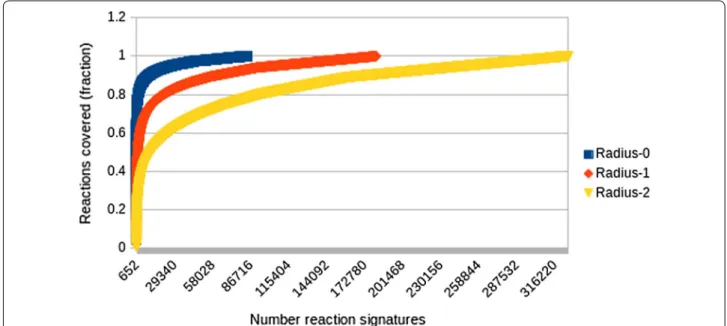
elsewhere referred to as condensation numbers [2], pro-vide insights for the diversity of the reaction types in Dataset 1. Figure 6 plots the fraction of reaction exam-ples covered by reaction signatures of different size. As shown a small number of reaction signatures cover a large number of reaction examples with less specific sig-nature types such as those at radius 0 exhibiting a higher coverage as expected. This finding is in agreement with results reported previously by Law et al. [8] and Christ et al. [2] among others.
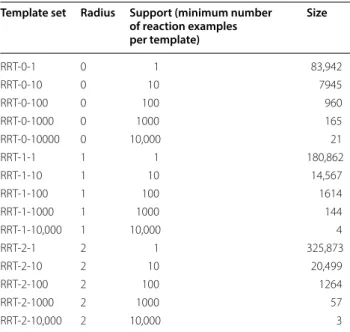
In order to increase our confidence in the reaction transformation rules represented by the various sig-natures we post-processed the results to select subsets which have varying numbers of supporting examples. Table 1 displays the number of reaction signatures (and RRT) for Dataset 1 reactions for radii 0, 1 and 2 with sup-port of 10, 100, 1000 and 10,000 examples. The subset of reaction signatures of radius 0 supported by at least 10 examples is just 7945 out of 83,942 (9.4%). The cor-responding numbers for radii 1 and 2 are 14,567 (8%) and 20,499 (6.3%). This very large compression from the initial starting set goes a long way towards improv-ing run time performance durimprov-ing RTSA-Design and addressing the scalability issue faced by direct search methods. Moreover, high support of a template indicates popularity of the corresponding reaction among practic-ing chemists and, thus, increased confidence in the syn-thetic routes proposed by the subsequent RTSA-Design step. The python script used for preparation of RRT repositories from patent grants reactions can be found in SI 2 (see Additional file 2).
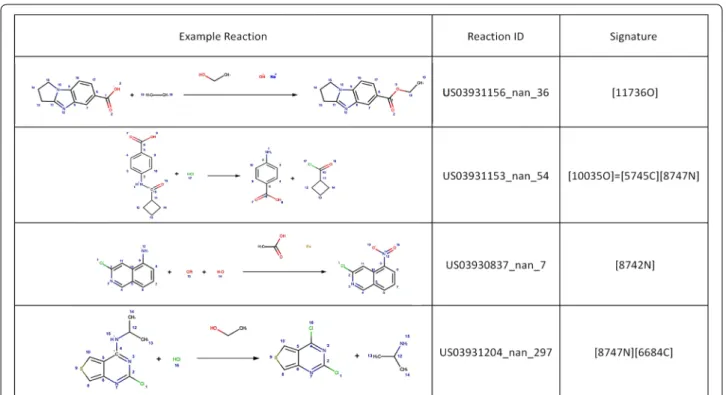
Visual inspection of the reaction templates reveals that common reaction types are captured by the RRT’s extracted. Figure 7 presents the reaction signatures cor-responding to the RRT of radius 0 with the highest sup-port, i.e. frequency of reaction examples. Examples of
reverse reaction templates sharing the 4 signatures with the highest support are shown in Fig. 8. As shown, the most supported reaction type involves a transformation rule with a single changing Oxygen atom, in this case an ester hydrolysis (Fig. 8a). Next is the amide coupling signature exemplified by a Schotten–Baumann reaction for the synthesis of an amide from amine and acid chlo-ride (Fig. 8b), a reaction with a single changing nitrogen shown by a nitro reduction (Fig. 8c) and a nucleophilic aromatic substitution widely known as SnAR (Fig. 8d).
RTSA‑design application on approved drugs
In order to assess the RTSA methodology capabilities Dataset 2 containing 919 FDA approved drugs has been subjected to retrosynthetic analysis using the RRT-Repositories prepared by training on Dataset 1 reactions and the tool RTSA (see Additional file 3: SI 3). The pur-pose of RTSA is to support synthetic chemists in identi-fying realistic routes to prepare a compound of interest. With this purpose in mind, we chose Dataset 1, a typi-cal set of compounds, as targets and assess the success of RTSA both quantitatively, i.e. number of routes found per target and qualitatively, via reviewing the specific routes of a compound of interest.
Overall, RTSA-Design successfully identified theo-retical synthesis routes for the majority of the query
Table 1 RRT sets extracted used for RTSA validation
Template set Radius Support (minimum number of reaction examples per template)
Size
RRT-0-1 0 1 83,942
RRT-0-10 0 10 7945
RRT-0-100 0 100 960
RRT-0-1000 0 1000 165
RRT-0-10000 0 10,000 21
RRT-1-1 1 1 180,862
RRT-1-10 1 10 14,567
RRT-1-100 1 100 1614
RRT-1-1000 1 1000 144
RRT-1-10,000 1 10,000 4
RRT-2-1 2 1 325,873
RRT-2-10 2 10 20,499
RRT-2-100 2 100 1264
RRT-2-1000 2 1000 57
RRT-2-10,000 2 10,000 3
structures. This comes as no surprise since the reaction collection used for RRT extraction is both diverse and substantially extensive as shown in the training section above. Note that for the purposes of this RTSA-Design demonstration no synthon look-up in building block databases was undertaken so all theoretical routes iden-tified are reported. In a realistic scenario, where actual synthesis might have been considered, a search for the identification of synthons in available structure col-lections would have indicated which of the theoretical routes could potentially be executed. Detailed results of the retrosynthetic analysis runs are displayed in Table 2 below.
As expected the tool successfully decomposes more structures from Dataset 2 using templates extracted with radius 0 which are more abstract than the more specific templates of radius 1 and 2. Similarly, the subsets of tem-plates with higher support have a smaller coverage when compared to template subsets with less support since the former are fewer in absolute numbers. However, the level of confidence in the proposed routes is higher for those proposed by the most specific RRT, in this case those of radius 2 with higher support. In the case of the RRT set with support of at least 1000 reactions RRT’s of radius 0 have a near 100% coverage (917/919) while RRT’s of radii 1 and 2 identified routes for 835 and 284 of the drug structures which corresponds to 90% and
31% respectively. A similar trend of decreasing coverage when using templates of increasing support is observed for all radii. Overall, compromising with a minimum sup-port of 100 reaction examples exhibited adequate cover-age even for radius 2 (756/919; 82%). Time requirements for RTSA-Design of Dataset 2 varied depending on the Fig. 8 Examples of reverse reaction templates exemplifying the 4 signatures of radius 0 with the highest support in Dataset 1. Note that the templates are reversed, i.e. the original products are to the left-hand side of the figure
Table 2 Synthetic route identification for 919 known drug structures using RTSA-Design and a range of RRT-Repositories
RRT set RTSA results (structures
with at least one route) Coverage Average number of routes
RRT-0-10 917 917/919 922,449/917
RRT-0-100 917 917/919 101,309/917
RRT-0-1000 917 917/919 21,255/917
RRT-0-10000 831 831/919 3319/831
RRT-1-10 916 916/919 24,209/916
RRT-1-100 905 905/919 9497/905
RRT-1-1000 835 835/919 4076/835
RRT-1-10000 327 327/919 423/327
RRT-2-10 841 841/919 6620/841
RRT-2-100 756 756/919 2344/756
RRT-2-1000 284 284/919 455/284
RRT set used. As expected the least time, less than 2 s, was required for running the RRT-2-10,000 set with only 3 templates that resulted in 53 route definitions. The use of RRT-0-10 with 7945 templates that resulted in 922,449 routes took approximately 6 min while set RRT-2-10 with 20,499 templates producing 6620 routes required only 75 s. It can thus be concluded that the time needed for RTSA-Design runs is proportional to the number of routes identified and that higher numbers of RRT do not necessarily translate to longer run times especially if those templates are highly specific as in the case of using signatures of radius 2 or higher. In general, templates rep-resenting smaller, more abstract signatures will match more frequently to hypothesis chemical structures, trig-ger the generation of more theoretical routes and require more time. This observation can also be seen in Table 2 listing the average number of routes theoretically possi-ble per input target structure which corresponds to the template matches to each target structure in the test set. As noted previously the training set contains reactions for little over 50% of the compounds in the test set. Anal-ysis of the RTSA-Design results showed that the method was able to identify the original routes for those com-pounds (subject to signature frequency restrictions) and, additionally, provide alternative synthetic paths.
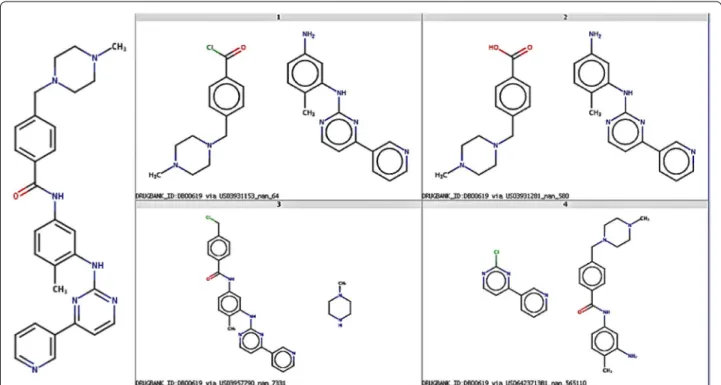
Figure 9 below presents multiple theoretical synthetic routes using radius 2 and support 100 for Gleevec
(DrugBankID:DB00619), one of the 919 drugs in the test set used in this exercise. The four routes shown, a selection of those proposed, present the variety of syn-thetic routes possible.
The four routes shown in Fig. 9 represent common reaction types employed by medicinal chemists. Each of the routes is displayed as a pair of synthons which, when processed with appropriate conditions will react to form the target compound shown to the left. The first of the routes, top-left, corresponds to an amide Schotten–Baumann synthesis combining an acid chlo-ride and a primary amine. The second route shown at top-right, is another common amide bond formation via the combination a primary amine with a carboxylic acid. Route 3, bottom-left, uses an amine and an alkyl halide in a reaction widely known as N-alkylation. The final route shown, bottom-right, is a nucleophilic aro-matic substitution (SnAR) combining a primary amine with a NAS-electrophile. A look-up of the synthons into the popular ZINC database indicated that all of the reactants are available for purchase (see Additional file 4: SI 4).
The source of the reaction transformation rule, i.e. the original reaction example that was used to define the cor-responding RRT, is shown in the description accompany-ing each of the synthon pairs. For example, the source for the top-left route is US03931153_nan_64 (USPTO patent
number US03931153, paragraph number not reported— ‘nan’, row number in input reaction examples file 64).
Conclusions
The need for synthetic route identification arises frequently in drug discovery and development as well as other chemi-cal processes involving new chemichemi-cal structure design or identification of optimal synthetic paths. For inspiration, chemists traditionally have resorted to product or reac-tion-based search in collections of past reaction exam-ples. Recently, several computational methods capable of designing synthetic routes have been reported in the litera-ture [2, 3, 8, 18, 19]. In this paper we have presented RTSA, a data-driven RA technique developed to address the needs of a fast-paced discovery chemistry organization. RTSA learns RRT’s from collections of reaction examples and applies them for the deconstruction of target structures into synthons. Post-processing of the identified routes, for example searching for the presence of synthons in avail-able building block databases or using any of the synthons as input to a new RTSA search can optionally be applied depending on the specific use case.
The implementation of RTSA as well as a fully func-tional example of its application to learn from a public patent reaction collection and to identify possible routes for a set of known drugs is provided as part of this paper. As demonstrated in this example RTSA can quickly derive RRT’s of varying length and complexity from mil-lions of reaction examples and identify routes for large numbers of target compounds in minutes. The speed, flexibility and reaction rule interpretation simplicity of RTSA enable its regular use during structure design so as to inform research chemists of the feasibility of their designs and, thereby, the ease of experimental testing of their hypotheses.
It is the opinion of the authors that the impact of data-driven computational approaches in synthetic route design and drug discovery research at large will only increase in the coming years. Software tools that can learn from prior synthetic attempts and apply these learnings to identify feasible synthetic paths, such as RTSA, will routinely support researchers in efforts to synthesize novel chemical structures or identify alterna-tive viable routes to a compound of interest. Combined with advances in automated synthesis systems [6] and algorithmic methods for in silico drug design [12] RTSA-like methods have the potential of revolutionizing eve-ryday discovery and development practices in the not so distant future [13].
Additional files
Additional file 1. Supporting information 1 (SI1) contains a list of all the atomic properties supported by RTSA to determine changing atoms during a reaction; used for reverse reaction template definition and application.
Additional file 2. SI2 contains the python script rtsa_train.py which was used for the preparation of RRT repositories as described in the Results section of this paper.
Additional file 3. SI3 lists the commands used to retrosynthetically analyze the test set of approved drugs as described in the Results section of this paper.
Additional file 4. SI4 includes the structure and ZINC numbers for all building blocks shown in Fig. 9.
Abbreviations
RA: Retrosynthetic analysis; eLN: electronic laboratory notebook; RTSA: ReT-roSynthetic analysis method; RRT : Reverse reaction template.
Authors’ contributions
All authors have contributed equally to the design of the RTSA method and the preparation of this manuscript. IW has implemented the RTSA core code in C++. JW has investigated the application of RTSA on several reaction data-sets and defined the application workflow. CAN has implemented the python script provided for performing the experimental investigation described in the results and performed the needed software runs. All authors read and approved the final manuscript.
Acknowledgements
The authors would like to acknowledge the contributions of Drs. Thierry Masquelin and Alexander Godfrey whose insightful comments and sugges-tions helped shape RTSA requirements and Drs. Christine Humblet and Scott Sheehan for their strong encouragement during the implementation of the project. JW and CN would like to thank Dr. Tad Hurst for refinements to the C++ source and Drs. Ingvar Lagerstedt and Gordon (Zhen) Huang for their contributions that enabled the opensourcing of this code as part of the Lil-lyMol project. CN would also like to dedicate this work to his prematurely lost mentor Terence K. Brunk (1950-2017) who had been one of his main initiators to the world of chemoinformatics during their tenure at Bioreason, Inc. Competing interests
The authors declare that they have no competing interests. Availability of data and materials
Dataset 1 is available from https ://figsh are.com/artic les/Chemi cal_react ions_from_US_paten ts_1976-Sep20 16_/51048 73.
Availability and requirements
Project name: RTSA is distributed as a part of the LillyMol chemoinformatics toolkit; Project home page: https ://githu b.com/EliLi llyCo /Lilly Mol; Operating system(s): The software has been developed and tested on Linux Red Hat 6.9 and 7.4; Programming language: C++; Other requirements: GCC 6.2.0 or higher, zlib 1.2.11 or higher. License: Apache License, Version 2.0. Restrictions: The software is distributed as is for use freely by academics and non-academ-ics alike.
Funding
•fast, convenient online submission
•
thorough peer review by experienced researchers in your field
• rapid publication on acceptance
• support for research data, including large and complex data types
•
gold Open Access which fosters wider collaboration and increased citations maximum visibility for your research: over 100M website views per year
•
At BMC, research is always in progress.
Learn more biomedcentral.com/submissions
Ready to submit your research? Choose BMC and benefit from:
Publisher’s Note
Springer Nature remains neutral with regard to jurisdictional claims in pub-lished maps and institutional affiliations.
Received: 15 September 2018 Accepted: 20 December 2018
References
1. Bruns RF, Watson IA (2012) Rules for identifying potentially reactive or promiscuous compounds. J Med Chem 55:9763–9772. https ://doi. org/10.1021/jm301 008n
2. Christ CD, Zentgraf M, Kriegl JM (2012) Mining electronic laboratory note-books: analysis, retrosynthesis, and reaction based enumeration. J Chem Inf Model 52:1745–1756. https ://doi.org/10.1021/ci300 116p
3. Coley CW, Rogers L, Green WH, Jensen KF (2017) Computer-assisted retrosynthesis based on molecular similarity. ACS Cent Sci 3:1237–1245.
https ://doi.org/10.1021/acsce ntsci .7b003 55
4. Computational Chemistry and Chemoinformatics Group ELaC (2018) LillyMol Public Code. https ://githu b.com/EliLi llyCo /Lilly Mol
5. Corey EJ (1991) The logic of chemical synthesis: multistep synthesis of complex carbogenic molecules (Nobel Lecture). Angew Chem Int Ed Engl 30:455–465
6. Godfrey AG, Masquelin T, Hemmerle H (2013) A remote-controlled adaptive medchem lab: an innovative approach to enable drug dis-covery in the 21st Century. Drug Discov Today 18:795–802. https ://doi. org/10.1016/j.drudi s.2013.03.001
7. Irwin JJ, Sterling T, Mysinger MM, Bolstad ES, Coleman RG (2012) ZINC: a free tool to discover chemistry for biology. J Chem Inf Model 52:1757– 1768. https ://doi.org/10.1021/ci300 1277
8. Law J et al (2009) Route Designer: a retrosynthetic analysis tool utilizing automated retrosynthetic rule generation. J Chem Inf Model 49:593–602.
https ://doi.org/10.1021/ci800 228y
9. Lowe DM (2012) Extraction of chemical structures and reactions from the literature. University of Cambridge, Cambridge
10. Lowe DM (2017) Chemical reactions from US patents (1976-Sep2016).
https ://figsh are.com/artic les/Chemi cal_react ions_from_US_paten ts_1976-Sep20 16_/51048 73.. Accessed 3 Sep 2018
11. Morgan HL (1965) The generation of a unique machine description for chemical structures–a technique developed at chemical abstracts service. J Chem Doc 5:107–112
12. Nicolaou CA, Brown N (2013) Multi-objective optimization methods in drug design. Drug discov Today Technol 10:e427–435. https ://doi. org/10.1016/j.ddtec .2013.02.001
13. Peplow M (2014) Organic synthesis: the robo-chemist. Nature 512:20–22.
https ://doi.org/10.1038/51202 0a
14. Plehiers PP, Marin GB, Stevens CV, Van Geem KM (2018) Automated reaction database and reaction network analysis: extraction of reaction templates using cheminformatics. J Cheminform 10:11. https ://doi. org/10.1186/s1332 1-018-0269-8
15. Ravitz O (2013) Data-driven computer aided synthesis design. Drug Discov Today Technol 10:e443–449. https ://doi.org/10.1016/j.ddtec .2013.01.005
16. Reaxys. https ://www.elsev ier.com/solut ions/reaxy s. Accessed October 28, 2018
17. Scifinder. http://www.cas.org/produ cts/scifi nder Accessed June 16, 2018 18. Segler MHS, Preuss M, Waller MP (2018) Planning chemical syntheses with
deep neural networks and symbolic AI. Nature 555:604–610. https ://doi. org/10.1038/natur e2597 8
19. Szymkuc S et al (2016) Computer-assisted synthetic planning: the end of the beginning. Angew Chem Int Ed Engl 55:5904–5937. https ://doi. org/10.1002/anie.20150 6101