Address for correspondence Dr. Tabinda Baig
Department of Dermatology Unit-I, Mayo Hospital, Lahore
E-mail: [email protected]
Original Article
Quality of life in patients of hirsutism
Tabinda Baig, Shahbaz Aman, Muhammad Nadeem, Atif Hasnain Kazmi
Department of Dermatology Unit-I, King Edward Medical University/ Mayo Hospital, Lahore
Abstract Objectives: To determine the impact of hirsutism on quality of life (QoL) using Dermatology Life Quality Index (DLQI) in female patients.
Patients and Methods: An observational study was carried out at the Department of Dermatology,
King Edward Medical University/ Mayo Hospital, Lahore from March 1, 2012 to August 31, 2012. A total of 200 female patients suffering from hirsutism, of any severity, with age 16 years or above who themselves were able to understand and fill the DLQI questionnaire in Urdu version, were enrolled in our study. Using the DLQI questionnaire consisting of ten questions, patients were asked to score on a scale from 0-3 for each of ten items. The data were analyzed after compiling the results. The higher the DLQI score, the poorer was the QoL.
Results: Mean age of the patients was 26.12±5.83 years. Mean DLQI score of all patients was 17.9±5.78. The findings indicated several areas where hirsutism had an impact on individual’s QoL, particularly in relation to symptoms and feelings, daily activities and personal relationships. Patients with moderate hirsutism and severe hirsutism had mean DLQI score of 18.2±5.57 and 17.88±5.74 respectively. Mean DLQI scores were highest for Q2 (symptoms and feelings).
Conclusion Hirsutism causes a ‘very large effect’ on patients’ quality of life. Impairment of QoL is greater in female patients irrespective of marital status and severity (either moderate or severe) of hirsutism. Longer duration of disease leads to poorer quality of life.
Keywords
Hirsutism, quality of life, DLQI
Introduction
The word ‘hirsutism’ is derived from a Latin
word ‘hirsutus’ meaning ‘hairy.1It is defined as
excessive growth of thick, long, dark and terminal hair in women at androgen dependent sites of body including moustache, beard area, upper chest, buttocks, pubic region and
abdomen.2 Hirsutism is a common disorder
affecting upto 10% women between the ages of
18-45 years.3 Severity of hirsutism can be
assessed by Ferriman and Gallwey score.4
Etiology of hirsutism includes either increased production of androgens due to polycystic
ovaries, congenital or delayed adrenal
hyperplasia, obesity, hyperinsulinemia,
hyperprolactinemia, Cushing’s disease, ovarian
tumors, adrenal gland tumors, certain
medications e.g. danazol, phenytoin,
levonorgestrel, abuse of androgenic substances,
androgenic oral contraceptive agents or
increased sensitivity of hair follicles to
androgens.4 Hirsutism occurring in the presence
of normal ovulation and menstruation is termed
as idiopathic hirsutism.5
Hirsutism in teenagers is a common cause of bullying, social isolation and poor academic
most cases and is primarily a cosmetic concern, even then quality of life of hirsute patients is seriously impaired. Hirsutism causes profound stress in affected women due to cosmetic and
psychosexual implications.6Hirsute women have
social phobia, insecurity about interpersonal relationships, shattered confidence and profound
psychological sequlae.7
Quality of life (QoL) is defined as capacity to perform the daily activities appropriate to person’s age and his or her major role in life. The role could be paid employment, schooling,
house-work or self-care.8 Several indices are
available in the form of questionnaires to measure the extent of disability caused by skin
diseases.9 In order to detect the impact of
hirsutism on QoL in our society, a ten-item DLQI was used. It is valid, simple and practical questionnaire designed to measure the extent of
disability caused by various skin conditions.10
The present study was planned in order to determine the impact of hirsutism on quality of life. The measurement of QoL can help improve patient care and outcomes in many ways e.g. it
can indicate need for supportive or
psychological intervention, widen the
parameters of benefit, aid in decision making and health care policy.
Methods
It was a questionnaire-based study. The study protocol was approved by the Hospital Ethical Committee. The study was carried out at the Department of Dermatology, King Edward Medical University/ Mayo Hospital, Lahore during the period from March 1, 2012 to August 31, 2012. A full medical history and clinical assessment of hirsute patients, with informed consent, was taken. Demographic characteristics like name, age, marital status, address, body
mass index, duration of hirsutism and Ferriman and Gallwey scores (F-G scores) of hirsutism were recorded. Two hundred female patients of ≥18 years, having hirsutism for last one year or more, with a F-G score >6, (moderate: F-G score 8-15 and severe: F-G score16-36), who could themselves fill the questionnaire in Urdu version, were enrolled.
Patients with normal or irregular menstruation, with or without polycystic ovarian disease and normal/ abnormal hormone profiles were included. Patients diagnosed of having other dermatoses involving face e.g. melasma, acne, nevi etc. and with hypertrichosis due to local disease, systemic illness or drugs were excluded.
Table 1 Dermatology life quality index (questionnaire).
1. Over the last week, how itchy, sore, painful or stinging has your skin been?
2. Over the last week, how embarrassed or self-conscious have you been because of your skin?
3. Over the last week, how much has your skin interfered with you going shopping or looking after your home or garden?
4. Over the last week, how much has your skin influenced the clothes you wear?
5. Over the last week, how much has your skin affected any social or leisure activities? 6. Over the last week, how much has your skin
made it difficult for you to do any sport? 7. Over the last week, has your skin prevented
you from working or studying? If "No", over the last week how much has your skin been a problem at work or studying?
8. Over the last week, how much has your skin created problems with your partner or any of your close friends or relatives?
9. Over the last week, how much has your skin caused any sexual difficulties?
10. Over the last week, how much of a problem has the treatment for your skin been, for example by making your home messy, or by taking up time?
All the patients were instructed to fill a DLQI
questionnaire (Table 1) that included ten
questions covering six different domains of QoL e.g. symptoms and feelings (Q1, 2), daily activities(Q3, 4), leisure activities (Q5, 6), work and schooling (Q7), personal relationships (Q8, 9) and treatment of disease (Q10). Patients were asked to score on a scale from 0-3, for each of 10 questions, how they felt their lives have been affected by the disease over the preceding week. The response for each question could be 0=not at all, 1=a little, 2=a lot and 3=very much. Total score ranged from 0-30. The higher the score, the poorer was quality of life and vice versa.
The data were entered into SPSS version 11 for analysis. Study variables included age, mass and DLQI scores. Descriptive statistics were used. For quantitative variables like age and DLQI scores, mean and standard deviation were calculated. Data were stratified for severity of hirsutism (F-G score=8-15, 16-36) to address effect modifier.
Results
A total of 200 female patients diagnosed clinically as hirsutism were enrolled in the study. Mean age of patients was 26.12±5.83 years. Severity of DLQI n the study population
is shown in Table 2. Ninety seven (48.5%) were
married while one hundred three (51.5%) were unmarried. According to severity of hirsutism (Table 3), none of the patients had mild hirsutism (F-G score <8), there were 20 patients with moderate hirsutism (F-G score 8-15) and 180 patients had severe hirsutism (F-G sore 16-36). Mean duration of disease was 5.28±3.79 years. Minimum duration of disease was 1 year
and maximum 25 years. Mean BMI was
26.09±5.59 and a trend towards obesity was noted.
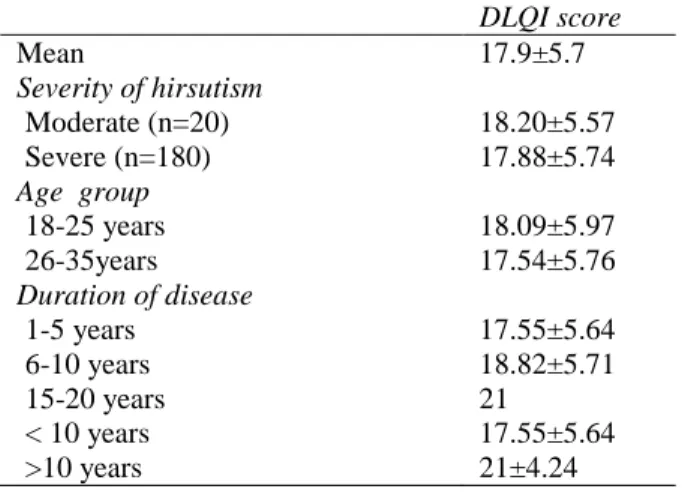
Mean DLQI score of total sample size was 17.9±5.78. Regarding the mean DLQI scores of patients with respect to severity of hirsutism using F-G score, patients with moderate hirsutism had a mean DLQI score of 18.20±5.57 while value for severe hirsutism was 17.88±5.74 (Table 3).
Mean DLQI score was higher in patients with hirsutism for >10 years (21±4.24) while lesser duration had a lower value of DLQI (17.55±5.64). Patients in a younger age group (15-25 yrs) had mean DLQI score of 18.09±5.97 and middle aged group (26-35) had 17.54±5.76 which is comparable in both groups. Mean DLQI score for each of ten questions revealed that highest score was determined for Q2 which is reflective of patient’s feelings followed by Q4 showing an impact on daily activities and Q8
related to personal relationships (Figure 1).
Table 2 Severity of DLQI score in the study population (n=200).
Number of patients DLQI score
2 0-1
4 2-5
18 6-10
109 11-20
67 21-30
Table 3 DLQI score with respect to severity of hirsutism (n=200).
DLQI score
Mean 17.9±5.7
Severity of hirsutism
Moderate (n=20) 18.20±5.57
Severe (n=180) 17.88±5.74
Age group
18-25 years 18.09±5.97
26-35years 17.54±5.76
Duration of disease
1-5 years 17.55±5.64
6-10 years 18.82±5.71
15-20 years 21
< 10 years 17.55±5.64
>10 years 21±4.24
Mean scores
Questions Figure 1 Mean score of questions in dermatology life quality ndex.
Discussion
Hirsutism refers to excessive growth of terminal hair in women with characteristics and distribution as seen in males in androgen
responsive areas.11 Severity of hirsutism is
assessed by Ferriman and Gallwey score.4
Patients with Ferriman and Gallwey score of >6 were enrolled. Mean age of the patients in our study was 26.12±5.83 years with a range of
15-40 which is similar to the study of Sohbati et
al.12 in which mean age was 27.24±6.67 years.
Mean DLQI score in our study patients was 17.9±5.71 which is higher than scores in the
study of Loo et al.13 where mean DLQI scores
were 12.8±8.5. Our study population had a poorer quality of life and hence high DLQI scores probably because of relatively longer duration of hirsutism, lack of awareness of medical causes of hirsutism by both patients and family, difficult and delayed access and referral to concerned medical specialists, lack of treatment facilities in the periphery, problems of
affordability of expensive photo-epilation
procedures, long waiting lists for treatment with
laser in the government hospitals and poor compliance of drugs and adjuvant topical therapy due to lack of proper counseling and poor motivation in patients who are uneducated and belong to low socio-economic status.
Mean DLQI score was also calculated with respect to age group of patients. These results suggested that patients in the younger age group (15-25 years) had poorer quality of life and slightly high DLQI scores compared to age group 26-35 years but slightly less than the scores of middle aged women (>35 years). So, again this was suggestive that hirsutism is almost equally traumatizing to both middle aged and young patients as both these groups are in reproductive age and usually have problems of subfertility or infertility, acne, menstrual irregularities and cosmetic disability associated with hirsutism.
between 2-5 which shows that hirsutism had small effect on their life, 18 (9%) patients scored between 6-10 showing that hirsutism was moderately affecting their life, 109 (54.5%) patients had a score in the range of 11-20 which meant a very large effect of hirsutism on patients, life and 67 (33.5%) patients scored between 21-30 which indicated an extremely large effect of hirsutism on patients’ life. These results suggest that major portion of our study population (88%) was suffering from very large to extremely large negative impact of hirsutism on their quality of life. These results indicate severe impairment of QoL in patients with hirsutism.
Mean BMI score in our study population was 26.09 ± 5.59 and a trend towards obesity was noted. This finding is consistent with the study
by Sotudeh, et al.14 in which hirsutism scores of
overweight and obese women (BMI ≥ 25 kg/m2
) were higher than lightweight women.
In our study, 97 (48.50%) patients were married and 103 (51.5%) patients were unmarried. It was noted that married females had a poor sexual life and interpersonal relations with their husbands.
This is in consistence with study by Drozdol et
al.15 in which married women with PCOS and
hirsutism had deteriorated marital sexual relations. Overall, DLQI scores of married women were not greatly different from unmarried females in our study, which suggests that hirsutism not only disrupts quality of life of married females but has a great negative impact on unmarried females too, due to negative body image and their hesitance in entering into a new intimate relationship like marriage. Secondly, unmarried females with hirsutism are considered unfeminine and infertile by the general population; hence getting married itself becomes a big problem for these patients.
In our study population, no patient had mild hirsutism (F-G score <8). There were 20 patients who had moderate hirsutism (F-G score 8-15) and remaining 180 patients had severe hirsutism (F-G score 16-36). Mean DLQI score of patients with moderate hirsutism was 18.20±5.57 and those with severe disease was 17.88±5.74. As DLQI scores are very close in both groups, these results suggest that quality of life of patients was almost equally affected with moderate and severe hirsutism which means whatever the degree of hirsutism, it is markedly disturbing to patients. None of the patients had mild disease because our population has a trend to present late in disease either due to lack of awareness, affordability issues or lack of proper medical personnel access in the periphery.
Duration of disease was also asked from the patients. Mean duration of disease in this study was 5.28±3.79 years. In the present study, two patients who had hirsutism for last 15-20 years had poor quality of life with DLQI score of 21 followed by DLQI score of 18.82±5.71 in 62 patients who were affected for 6-10 years. Maximum number of patients (121) had disease duration of 1-5 years with mean DLQI scores of 17.55±5.64. These results show that patients with longer duration have more impact on their quality of life. DLQI scores of patients in 1-5 year group and 6-10 year group are markedly comparable showing an almost equal bad impact on their quality of life. Internationally, much work has not been done on hirsutism of longer durations probably because of trend of immediate referral and access to medical facilities in foreign countries. Therefore, comparison of this aspect of our study was not possible.
and Q No. 8 (personal relationships). High disruption of personal relationships is in
accordance with Sohbati et al.12 study in which
social functioning in SF-36 sections had the most inverse correlation with DLQI scores in females with hirsutism.
These effects on QoL can be markedly reversed by proper counseling, medical treatment, cosmetic measures and especially with photo-epilation procedures. This is proved by many studies. One study showed improvement in DLQI scores in 38 patients with severe facial hirsutism where DLQI scores fell by 5 points over a 6-month period, following laser
epilation.13In another study, hirsute females had
DLQI scores of 9.42 ± 5.99 which reduced to
3.12±340 after laser treatment.16
In the light of above discussion and
observations, it is suggested that due to significant physical, psychological, and social morbidity associated with hirsutism, clinicians must have an empathic attitude towards these patients and psychological aspect of disease should never be neglected. Moreover, patients strongly require mental support from physicians, family and community members in addition to
medical treatment in order to reduce
psychological morbidity. To emphasize the importance of QoL assessment in patients with hirsutism, further similar studies should be carried out preferably with larger study population to document the gravity of problem.
Conclusion
Hirsutism has a very large effect on patients’ quality of life with marked negative impact on personality, daily activities and interpersonal relationships. Impairment of QoL is greater in obese females in reproductive age group, irrespective of marital status and severity (either
moderate or severe) of hirsutism. Longer duration of disease leads to poorer quality of life.
References
1. Hirsutism [online] 2009 [cited 2012 Sep
12]. Available from
URL:http://www.en.wikipedia.org/hirsut ism.
2. Blondell RD, Patel VR. Hirsutism. In: Paulman PM, Qulman AA, Harrison JD, eds. Taylor’s 10-minute Diagnostic Manual: Symptoms and Signs in the Time Limited Encounter, Ist edn. Philadelphia: Lippincott Williams and Wilkins; 2006. P. 322-6.
3. Ganguly T, Karnik P. Hair in health and disease: an Introduction. In: Preedy V, ed. Handbook of Hair in Health and Disease, 1st edn. Netherlands: Wageningen Academics; 2012. P.7-13. 4. Messanger AG, de Berker DAR, Sinclair
RD. Disorders of hair. In: Burns T, Breathnachs S, Cox N, et al,eds. Rook’s Text Book of Dermatology, 8th edn. UK: Wiley-Blackwell publications; 2010: 66.80-4.
5. Hantash MB, Reddy BY. Dermatological manifestations of hirsutism. Elston DM, ed. [online] 2009 [cited 2011 Apr 15].
Available from:
URL:http://:www.emedicine medscape.com/article/1072031-overview.
6. Mofid A, Seyyed A, Linaghi SA, et al. Polycystic ovary syndrome and mental health: a review. Obstet Gynecol Surv 2006; 619(1): 723–32.
7. Castillo Y. Understanding the social and emotional experiences of females with polycystic ovary syndrome [dissertation] Texas: Faculty of Graduate School of Education Texas Univ; 2008.
8. Schipper H, Clinch J, Olwey C. Quality of life studies: definition and conceptual issues. In: Spiker B, ed. Quality of life and pharmacoeconomics in clinical trials, 2nd edn. Philadelphia: Lippincott-Raven; 1996: 11-23.
10. Basra MKA, French R, Gatt RM et al. The Dermatology life quality index 1994-2007: A comprehensive review of validation of data and clinical results. Br J Dermatol 2008;159:997-1035.
11. Hirsutism [online] 2006 [cited 2012 sep
17]. Available
from:URL:http://www.dundee.ac.uk/med ther/tayendoweb/hirsutism.htm.
12. Sohbati S. The effect of hirsutism on quality of life in Kerman [dissertation]. Kerman: University of Medical Sciences, Kerman, Iran; 2008.
13. Loo WJ, Lanigan SW. Laser treatment improves quality of life of hirsute females. Clin Exp Dermatol 2006;31:753-6.
14. Sotudeh G, Mirdamadi SR, Siassi F et al. Relationship of overweight and obesity with hormonal and metabolic parameters in hirsute women. Acta Medica Irania. 2003;41:37-42.
15. Drosdzol A, Skrzypulec V, Mazur B et al. Quality of life and marital sexual satisfaction in women with polycystic ovary syndrome. Folia Histochemica et Cytobiologica. 2007;45:93-7.