ISSN: 2147-611X
International Journal of Education
in Mathematics, Science and
Technology (IJEMST)
www.ijemst.com
An Examination of Cross Sectional
Change
in
Student’s
Metaphorical
Perceptions towards Heat, Temperature
and Energy Concepts
Harun Celik Kırıkkale University
To cite this article:
Celik, H. (2016). An examination of cross sectional change in student’s metaphorical
perceptions towards heat, temperature and energy concepts.
International Journal of
Education
in
Mathematics,
Science
and
Technology,
4
(3),
229-245
.
DOI:10.18404/ijemst.86044
This article may be used for research, teaching, and private study purposes.
Any substantial or systematic reproduction, redistribution, reselling, loan, sub-licensing,
systematic supply, or distribution in any form to anyone is expressly forbidden.
Authors alone are responsible for the contents of their articles. The journal owns the
copyright of the articles.
Volume 4, Number 3, 2016
DOI:10.18404/ijemst.86044
DOI:
…
An Examination of Cross Sectional Change in Student’s Metaphorical
Perceptions towards Heat, Temperature and Energy Concepts
Harun Celik
Article Info
Abstract
Article History
Received: 07 July 2015
In science teaching, metaphors are important tools for understanding meaningful learning and conceptual formation by the help of daily life language. This study aims to evaluate how the concepts of heat, temperature and energy are perceived by students in secondary school science classes and how the perceptions of these concepts vary in terms of metaphors depending on grade level (5th, 6th, 7th and 8th grades). The study group of the present research consists of 226 students selected from 5th, 6th, 7th and 8th graders through criterion sampling method. The descriptive method was used in the study and the data was collected by metaphor questionnaire. According to the findings, 176 metaphors were generated by students under four categories “formal/scientific metaphors”, “Abstract metaphors”, “Environmental/daily metaphors” and “misconception metaphors”. When the findings were examined, it was seen that though there were some misconception detected about the concepts of heat, temperature and energy, conceptual changes in the other three categories vary depending on grade level. This variety needs to be discussed in relation to cognitive development and daily life. Some suggestions were made about the place and importance of metaphors in concept teaching for researchers and practitioners.
Accepted: 25 December 2015
Keywords
Conceptual change Energy
Heat Metaphor Temperature
Introduction
An individual has a tendency to get to know and understand the physical world around. This requires, parallel to observations and inquiries, individuals to make sense of the relations and constructs between concepts, which is an important factor for them to generate new information (Driver, 1989; Schwartz, 1993). Concepts represent organized information possessed by an individual about anything such as an object, an event, a quality and a relationship (Klausmeier, 1992); it is an association formed in the mind of an individual when any object is mentioned (Çepni, 2005). As the subjects and concepts involved in the science course are abstract and theoretical, students may experience some difficulties in comprehending them (Başer, 2006; Harrison, Grayson & Treagust, 1999; Özmen, 2003); thus, they may develop negative attitudes towards science (Hannover & Kessel, 2004). As concepts are viewed to be the units of abstract thinking and to exist in thoughts rather than in the real world, it seems to be normal for students to have difficulties in making sense of them. People can communicate with and understand each other by means of concepts. Thus, formation and acquisition of concepts accurately are of vital importance (Sinan, 2009).
Metaphor and Analogy in Concept Teaching
When the use of analogies and metaphors in education is examined, they seem to be instructional models including comparisons of similarities between two systems or elements (Forceville, 2002), but conducting these comparisons in different ways. There is a great amount of discussion in literature about how to define the concepts of metaphor and analogy. Aubusson, Harrison and Ritchie (2006) argue that calling B as A is suitable for a metaphor and stating that A is like B is suitable for an analogy. The difference between an analogy and a metaphor is whether modeling is clear or not by definition of comparison (Taber, 2001). While, similarities are considered during analogy making, similarities, differences, adequacies and inadequacies between the analog and the target concept should be formed by students with the guidance of the teacher in class (Kesercioğlu, Yılmaz, Çavaş & Çavaş, 2004). In order to show the differences between a metaphor and an analogy, Taber (2001) uses this statement “An atom is like a small part of the solar system” as an example for analogy and “An atom is a part of the solar system” as an example of a metaphor. Duit (1991) stresses that while analogies are used to clearly and comparatively show the identities in the structures of two phenomena or concepts having similar characteristics, metaphors are used for the comparison of two ideas by emphasizing their related qualities indirectly or implicitly. So, metaphors have vital roles for understanding the world. Due to metaphors, people choose a known concept for understanding an unknown concept, and try to simulate them to each other (Brookes, 2006; Cameron, 2002; Kövecses, 2010; Lakoff & Johnson 1980). According to Lundegard (2015) metaphor is a speaking figure that a concept is changed temporarily for another person. So, it is clear that to make analogies, individual can make use of environment and his own daily life.
In traditional sense, metaphor is a figure of an utterance emerging as a result of a change of the literal meaning of an expression. On the basis of this change of meaning, there is a similarity relationship. Metaphor resulting from the use of a concept instead of another which exhibits some similarity to the other does not have any semantic novelty; thus, it does not provide any new information about reality and its perception. In the Conceptual Metaphor Theory proposed by Lakoff and Johnson (2010), metaphor is defined as an action taking place in mind before in language. According to this Conceptual Metaphor Theory, metaphor does not mean understanding a word based on another word; yet, understanding a zone of a concept based on a zone of another concept. Many of the concepts important to us need to be comprehended through some other abstract concepts or concepts that cannot be clearly experienced (e.g. emotions, thoughts, time). This requirement leads to metaphoric definition in our conceptual system. Within a process where metaphoric descriptions affect our conceptual system, through conceptual changes, the world, which is real for us, may also change and our style of perceiving the world and going into action based on this perception may also be affected (Lakoff & Johnson, 2010). At that point, metaphors can be reflected not only with words but also with pictures and figures and with images in a figurative manner. According to Lakoff and Johnson (1980), schematic images are the basis of using language and understanding abstract concepts. Besides, conceptual metaphor theory has been developed based on identifying systematic and common patterns in metaphoric statements used for reflecting our conceptual knowledge structure and mapping (Amin, Jeppsson & Haglund, 2015).
The concepts of metaphor and image can be influential factors throughout the professional development of teachers (Ritchie & Russell, 1991). Being a component of personal practice-based information, images bring about personal and professional experiences. An image may consist of a dynamic picture of our mind or an observation metaphorically describing a situation. In short, images can be visual or verbal. Metaphors are related to images. That is, a metaphor can be a verbal statement in the formation of an image or remind a described image (Weade & Ernst, 1990). In addition to this, metaphoric images in conceptual caricatures may arouse an emotion, interest or a creative idea (Cameron, 2002). When literature is examined, it is seen that the concepts of metaphor, mental image and image are used interchangeably. In literature, these concepts assume an important role in concept teaching in the fields of both natural sciences and social sciences (Saban, 2004; Saban, 2009). For example, visual metaphors are graphical structures using story, game, activity, and natural or artificial structures, which are easily identified and have similarities, for making target content more understandable (Dent-Read, Klein & Eggleston, 1994). So, in the process of learning, relationship of similarity may be set by the help of visual formats to increase the remembrance, understanding, motivation and attention (Eppler, 2006).
According to Boers (2004), metaphoric themes are a framework allowing the unification of information. Newly acquired information can be easily retrieved from memory if it is unified well in a network (Baddeley, 1992). Moreover, as teaching of figurative expressions according to metaphoric themes will trigger the strategy of learning by grouping, retrieval of information will be easier (Lazar, 1996).
understand our environment (Lakoff & Johnson, 1980) because through metaphors, similarities between new information and prior information can be elicited and thus links can be created. Indeed, experimental research on the issue shows that instruction given by emphasizing metaphorical themes makes positive contributions to students’ potential to remember (Boers, 2000). Saban (2008) argues that metaphors can be used as a powerful “pedagogic tool” in eliciting, understanding and changing mental images possessed by pre-service teachers in relation to certain phenomena during their teacher training process. At that point, while analogies can be an important part of a scientific explanation, they are not a part of a figurative language in daily life. In daily life, instead of analogies, metaphors are used in spoken language (Taber, 2001; Brookes, 2006; Lancor, 2012). Another use of metaphors in education is related to conceptual fallacies or alternative concepts. Erroneous or deficient analogies may lead to development of alternative concepts by learners. While constructing connected structures, dissimilar elements also need to be reflected. In order to indicate the potential risk in concept teaching, Glynn (1991) likened analogies to a double-edged sword. Here, it has been pointed out that the students may have conceptual misunderstanding.
Apart from their use in daily life, metaphors have been used for educational purposes for a long time. It is seen that teachers, consciously or unconsciously, generally use metaphors to explain ideas, concepts and abstract things. Metaphors facilitate the understanding of scientific concepts. Teaching-oriented metaphors have a power to play a key role to change students’ perceptions of the world (Sanchez, Jose & Victor, 2000).
On the formation of the conceptual metaphors viewed to be the corner stone of our conceptual system, cultural factors are as much influential as cognitive factors because for people to precisely understand metaphors, they also need to understand their connotations and associations (Çalışkan, 2013). That is, metaphors used in teaching of concepts can be under the influence of cultural and environmental factors as well as cognitive factors. Thus, factors affecting learning seem to have potential to influence metaphor generation process. Within this context, while metaphors are classified, the emphasis was made to conceptual-factual basis as a part of scientific definition, to familiar feelings and objects around individual and to concept misunderstandings that may occur in the process of analogies.
In literature, there are some classifications related to the use of metaphors and metaphoric structures in science teaching. According to Cameron (2002), metaphors can be generated during the process of learning scientifically defined; that is, formulized concepts. These are;
1. If formal/scientific concepts have been metaphorically structured, learners are in need of comprehending theoretical structure of the metaphor that is a part of their own knowledge and discourse.
2. Though different from the definitions formulized by scientists, informal or partial explanation of the theory of scientific concepts can be metaphorically structured.
3. Metaphors can be pedagogically used as a springboard in the reduction of alternative concepts for conceptual restructuring.
Hansen, Baumer, Richland & Tomlinson (2011) focused on the use of metaphors and creativity in science teaching and based on the metaphor “a cell is a city”, evaluated students’ metaphor selection process in three stages. In this regard, they reported that the first reason for selection is that it is a complex metaphor with its many constituents; the second one is that many teachers used this metaphor in their former education, and the third one is that in the textbooks used as a part of formal education associations are made to this metaphor. Therefore, more research should focus on the importance of the metaphor in teaching of concepts because of its contribution to meaningful learning as a part of formal education.
The Concepts of Heat, Temperature and Energy
On the construction of basic physical concepts in mind, prior experiences are quite influential. The problem experienced here is that our experiences determined to be conceptual fallacies to a great extent negatively affect our new learning. In studies conducted with male students having formal education about thermal physics, it was reported that they identified certain things as hot or cold by touching based on their former experiences (Carlton, 2000). By children aged at 4-5, heat is mostly described as a substance and by children aged at 8, heat is defined as something that is dynamic and liquid. In later ages, the dominant opinion about heat is that it functions like liquid flowing through the organs of our body (Carlton, 2000; Erickson, 1979).
According to Yürümezoğlu, Ayaz and Çökelez (2009), energy is directly or indirectly related to concepts in science and other scientific disciplines. Hewson and Hamlyn (1984) argue that metaphorical thinking for the comprehension of the concept of heat as a form of energy at early ages provides a great advantage. Learners may sometimes use the concepts of heat, temperature and energy to describe a state or may sometimes use them interchangeably. Moreover, though science-related concepts are formally taught at school, students are also exposed to many of these concepts including heat and temperature in their natural environments and surroundings through their observations and erroneous use of the people in their close circle and this may be disadvantageous for them in terms of constructing many of these concepts in their minds (Karamustafaoğlu, Özmen & Ayvacı, 2004). Aydoğan, Güneş and Gülçiçek (2003) stress that while students usually confuse the concept of heat with temperature; they view temperature as a type of energy like heat. As thermodynamic concepts based on the concepts of heat, temperature and energy has wide range of application in many fields of science and technology, it constitutes an important issue in physics. Research on physics education shows that students experience difficulties in the meaningful construction of the concepts of heat, temperature, work, energy, entropy and thermodynamic in their minds (Kulkarni & Tambade, 2013).
What this study aims is to draw attention to the problems which are encountered on the definition of concepts, limited to heat, temperature and energy respectively. Here, two basic situations have to be discussed. First is the perception of heat, energy and temperature by the individuals and the second is the usage of them for the other. Therefore, this study takes these two concerns into consideration and it aims to contribute to the literature of science education. According to Bloom (1992), contrary to the popular belief, ways through which children think and construct information are not simple. Their personal experiences, emotions, metaphors and interpretation frameworks lead to the formation of unique construction patterns. How the students formed the science concepts by the help of metaphors has revealed the importance of this study.
In literature, the studies which are conducted on metaphor issue mainly have the purpose of classifying the metaphors, consisted upon concepts such as school, teacher, program, environment, science, interactive whiteboard, earth, so on and so forth. Being different from the studies whose targets are the metaphor production and analysis, this study focuses on examining the value of metaphors in a cross-sectional way as well as the metaphor production regarding these three concepts which are often used interchangeably in a wrong way. Unlike the above-mentioned research mostly focusing on the analysis of metaphors related to general concepts (Akturk, Mihci & Celik, 2015; Özdemir, 2012; Saban, 2008), the study aims to analyze the formation and cross-sectional change processes of metaphors. So, visual and verbal metaphors towards the concepts of heat, energy and temperature which may be used in the place of one another were analyzed from the point of categories. Thus, in the secondary school education, the cross-sectional change of concepts for the students was questioned.
Method
Participants
In the study, for the determination of the participants, one of the purposeful sampling methods, criterion sampling method and easily accessible sampling method were used together. The fundamental premise of criterion sampling method is to investigate all the cases meeting a set of criteria determined in advance. Here, it is possible to use a set of criteria developed beforehand or a set of criteria developed by the researcher (Yıldırım & Şimşek, 2011). In the study, the basic criterion set by the researcher is to provide variability of data by selecting a private course bringing students from different schools with different socio-economic levels together. On the other hand, within the scope of private course activities, to be able to reach the sample by easily accessible sampling method provided convenience to the study, because this method can easily be accessible or compose sample from the part of population (Bhattacherjee, 2012).
In this context, the study was limited to the concepts of heat, temperature and energy. In 2013, it was conducted with the participation of 226 students in total, studying in secondary schools (5th, 6th, 7th and 8th graders) in Kırıkkale, Turkey. Of the participants, 110 (48.6%) are boys and 116 (51.4%) are girls. The distribution of the students across grade levels are as follows; 27 fifth graders (11.9%), 61 sixth graders (27%), 70 seventh graders (31%) and 68 eight graders (30.1%).
Assessment Tools and Data Analysis
Worksheets were given to each student to elicit the metaphors possessed by them in relation to the basic science concepts found in the unit of Heat-Temperature. The worksheets included the concepts of melting, expansion, boiling, condensing and evaporation. The worksheet prepared for each concept consists of two parts: the first part aims to investigate the metaphor possessed by the student about the related concept. For this purpose, on the top of each worksheet, this sentence is written “To me, heat means ……….. because ………”. The first part of this sentence is for students to express the metaphor in their minds and the second part of the sentence is for students to express the reason for writing the metaphor (Saban, 2009). In the second part of the worksheet, the students were asked to draw a picture of their metaphor and they were given 40 minutes to complete the task. All the worksheets were completed with the handwritings of the students and the collected documents made up the document resource of the study (Appendix 1: Sample Metaphors)
Qualitative research yields multi-faceted heterogenic information pieces including complex meaningful structures. Metaphors are a good means of reducing this complex structure in clearly constructed designs (Schmitt, 2005). Metaphor analysis was conducted based on the writings and drawings of the participants. The data of this study were analyzed through five-stage systematic data analysis used by Saban (2009). These five stages are as follows:
1. Coding and Eliminating Stage: At this stage, the documents produced by the students were collected, the metaphors developed by them were examined and then analyzed through content analysis method (Yıldırım & Şimşek, 2011). The metaphors found in this way were entered into Excell program and ordered. During the process of classification, the metaphors were examined in relation to the meanings they carried and then they were coded. Following the coding process, based on the codes assigned to the metaphors, the metaphors developed by the participants were classified according to grade levels and concepts. During the process of coding, the worksheets of the participants were enumerated and then the worksheets of 42 participants were subjected to the operation of elimination. Reasons for the elimination are stated as follows: not doing at least one of the 3 activities on the worksheets distributed to the participants; not stating the reason for writing the metaphor, not doing one of the two tasks to be done for each metaphor, writing multiple and unrelated metaphors while conducting the tasks and illegible writing.
2. Construction of a Sample Metaphor Chart: After the completion of the classification of the students’ works
for the three concepts, 176 valid metaphors were obtained.
of metaphors in concept learning process, Camaron (2002) indicated that the scientific structure can be used as a tool in constructing a scientific structure (formal), in forming the informal structure of scientific structure like abstract and daily life, and finally in correcting the concept mistakes. When the importance of metaphors and their role in conceptual change were thought together, the common characteristics were examined and then four categories for each concept were formed. These four categories, which were constructed for metaphors and corresponded to the concepts, are; (1) formal/scientific metaphors (including scientific definition), (2) abstract metaphors, (3) environmental/daily life metaphors and (4) metaphors including misconception.
4. Reliability and Validity Stage: At the validity stage of the study, the metaphors formed by the students were reflected into the study without making any change on their explanation sentences and drawings. Opinions of two experts from the field of science education were sought to establish the reliability and agreement was reached in terms of elimination of the works having a poor content, formation of the sample metaphor list and categorization of the metaphors by classifying them; opinions of the researchers and experts complied with each other to a great extent. Inter-rater agreement percentage and Cohen Kappa coefficient were used to establish the reliability of the scale. Scale reliability account for the nominal distribution exhibits Weighted Kappa coefficient (Weighted Kappa) was used. Thus, inter-rater agreement ratio was found to be 84%. As this value is higher than 70%, the scale can be said to be reliable (Şencan, 2005).
5. Conversion of the Metaphors to Qualitative Data: At this stage, the metaphors corresponding to each concept were tabulated and the number and percentage of the students writing each constructed metaphor were calculated. In this connection, frequency and percentage tables of metaphors in categories were formed and in light of these tables, interpretations were made. Moreover, Figures were plotted to show how the related concepts change across grade levels; that is, from fifth grade to eight grade.
Results
The students generated 176 different and valid metaphors related to the concepts of heat, temperature and energy. These metaphors were subsumed under four categories for each concept. As this study was planned in such a way that each student would generate a metaphor, there are totally 226 metaphors in the tables formed to show the metaphors. The sum of frequency values is equal to the number of students participating in the study. On the other hand, the metaphors presented in Table 1, Table 3 and Table 5 are the metaphors dominant in terms of their importance and frequency. The metaphor whose frequency is one is reflected with its code name.
1. Metaphors Developed in relation to the Concept of Heat
Percentages and frequencies of the metaphors developed in relation to the concept of heat are presented in Table 1.
Table 1. Metaphors developed for the concept of heat; percentages and frequencies
Metaphors f % Metaphor f % Metaphor f %
Sun 44 19,5 Thermometer 4 1,8 Iron 2 0,9
Temperature 33 14,6 Calorimeter Cup 4 1,8 Food 2 0,9
Energy 18 8,0 Electric heater 3 1,3 Friendship 2 0,9
Fire 15 6,6 Summer holiday 3 1,3 Blanket 2 0,9
Stove 14 6,2 Body 3 1,3 Calorie 1 0,4
Red 12 5,3 Atom 2 0,9 Love 1 0,4
Heater 8 3,5 White 2 0,9 Mother 1 0,4
Central heating 5 2,2 Lava 2 0,9 Freedom 1 0,4
Oven 4 1,8 Yellow 2 0,9 Others 37 15,9
Total 226 100
calorimeter, central heating, gas cooker, atom particle, summer, yellow and specific heat etc. The second most frequently generated metaphor related to the concept of heat is temperature and this indicates a conceptual fallacy. In the other metaphors, the concept of heat is associated with the sources of heat, colors, conversion and affective aspects. Sözbilir (2003) argues that different scientific definitions of the concept of heat are made including textbooks. For instance, besides definitions such as “heat comes from the sun”, “heat is an internal energy”, “heat comes from energy”; based on derived concepts such as “heat capacity” and “heat flow”, different connotations of heat can also be developed because these connotations are connected with the personal lives of individuals. Indeed, in literature, metaphor is widely cited in relation to learning how to learn and it is generally seen as an element of reflective learning (Russell & Hrycenko, 2006).
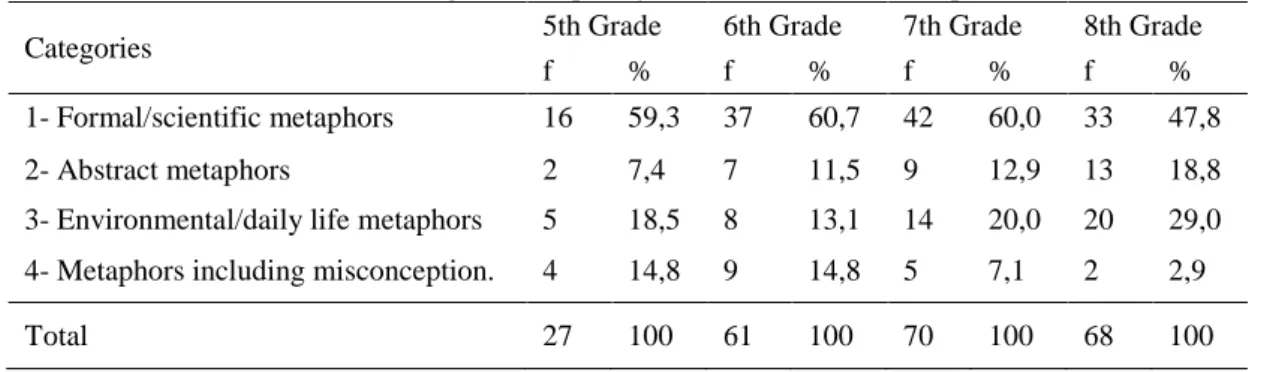
Table 2. Percentage and frequency distributions of the metaphors
Categories 5th Grade 6th Grade 7th Grade 8th Grade
f % f % f % f %
1- Formal/scientific metaphors 16 59,3 37 60,7 42 60,0 33 47,8
2- Abstract metaphors 2 7,4 7 11,5 9 12,9 13 18,8
3- Environmental/daily life metaphors 5 18,5 8 13,1 14 20,0 20 29,0 4- Metaphors including misconception. 4 14,8 9 14,8 5 7,1 2 2,9
Total 27 100 61 100 70 100 68 100
Cross-sectional change of the metaphors classified in Table 2 based on the four categories and grade levels is presented in Figure 1 according to grade levels.
Figure 1. Cross-sectional change of the metaphors
As can be seen in Figure 1, from 5th grade towards 8th grade, metaphors in the formal/scientific metaphors category (1) are gradually replaced by the metaphors in the category of environmental/daily life metaphors (3). A similar connection can be formed for the category of abstract concepts (2) because while there is a descending trend in the first category, there is an ascending trend in the second category. This does not mean that there is a decrease in the students’ basic- scientific concepts. On the contrary, this means that parallel to the increase in the students’ interaction with life and environment, they can associate their formal/scientific knowledge with the functioning of items and objects around them and daily life (Anderson & Krathwohl, 2010; Demirel, 2012). It is seen that there is a decrease in conceptual fallacies (4) from 5th grade towards 8th grade.
Metaphors Developed in relation to the Concept of Temperature
Table 3. Metaphors developed for the concept of temperature; percentages and frequencies
Metaphor f % Metaphor f % Metaphor f %
Sun 37 16,4 Family 5 2,2 Combi boiler 2 0,9
Thermometer 22 9,7 Tea-coffee 5 2,2 Substance 2 0,9
Heat 20 8,8 Red 4 1,8 Love 2 0,9
Summer months 19 8,4 Water 4 1,8 Soup 2 0,9
Fire 12 5,3 Holiday 4 1,8 Flower 1 0,4
Stove 9 4,0 Friendship 4 1,8 Spa 1 0,4
Degree 8 3,5 Sweating 3 1,3 Celsius 1 0,4
Heating 7 3,1 Yellow 3 1,3 Electric stove 1 0,4
Central heating 6 2,7 Cold 3 1,3 Body 1 0,4
Energy 6 2,7 UFO 2 0,9 Soldier 1 0,4
Air 6 2,7 Blanket 2 0,9 Others 21 9,3
Total 226 100
Two hundred and twenty six participants of the study generated 62 different metaphors for the concept of temperature. These metaphors were classified considering their frequencies in Table 3. In relation to the concept of temperature, the metaphors developed are associated with thermometer, Celsius and degree as well as heat, sources of heat and affective color of heat and these connotations prove that there are some misconceptions held by the students related to the concepts of heat and temperature (Aydoğan, Güneş & Gülçiçek, 2003; Ericson & Tiberghien, 1985; Gönen & Akgün, 2005; Kesidou & Duit, 1993; McDermott, 2003). For instance, there are some misconceptions in relation to ideas that heat can be measured with a thermometer and temperature can be transferred from one place to another like a form of energy.
Table 4. Percentage and frequency distributions of the metaphors developed in relation to the concept of temperature into the categories
Categories 5th Grade 6th Grade 7th Grade 8th Grade
f % f % f % f %
1- Formal/scientific metaphors 13 48,1 46 75,4 46 65,7 35 50,7
2- Abstract metaphors 3 11,1 3 4,9 5 7,1 12 17,4
3- Environmental/daily life metaphors 4 14,8 7 11,5 17 24,3 18 26,1
4- Metaphors including misconception. 7 25,9 5 8,2 2 2,9 3 4,3
Total 27 100 61 100 70 100 68 100
Figure 2. Cross-sectional change of the metaphors generated by the students in relation to the concept of temperature in 5th, 6th, 7th and 8th grades.
Metaphors Developed in relation to the Concept of Energy
Percentages and frequencies of the metaphors developed in relation to the concept of energy are presented in Table 5.
Table 5. Metaphors developed for the concept of energy; percentages and frequencies
Metaphor f % Metaphor f % Metaphor f %
Running 17 7,5 Electric tools 6 2,7 Human 3 1,3
Heat 13 5,8 Carbohydrate 5 2,2 Accumulator 2 0,9
Force 12 5,3 Lamp 5 2,2 Baklava 2 0,9
Electricity 11 4,9 Movement 5 2,2 Energy plants 2 0,9
Mobility 10 4,4 Light 5 2,2 Vitamin 2 0,9
Nutrients 8 3,5 Mechanic energy 5 2,2 Mitochondria 2 0,9
Battery 8 3,5 Wind rose 4 1,8 Courses 2 0,9
Sport 8 3,5 Solar energy 4 1,8 Child 2 0,9
Bulb 7 3,1 Solar panel 3 1,3 Speed 2 0,9
Chocolate 6 2,7 Lightning 3 1,3 Food 2 0,9
Energy drink 6 2,7 Force 3 1,3 Health 2 0,9
Sun 6 2,7 Investment of effort 3 1,3 Happiness 1 0,4
Work 6 2,7 Gas-Petrol 3 1,3 Swimming 1 0,4
Lamp 6 2,7 Saving 3 1,3 Others 20 8,8
Total 226 100
of the target concept (Lakoff & Johnson, 1980). According to Lancor (2012), energy, related to the
context
, can be conceptualized in different manners. The concept of energy is dealt with in many disciplines primarily in physics, chemistry and biology (Goldrin & Osborne, 1994; Küçük, Çepni & Gökdere, 2005; Taber, 1989). So, this is noticeable for the reason of different alternative concepts.Table 6. Percentage and frequency distributions of the metaphors developed in relation to the concept of energy into the categories
Categories
5th Grade 6th Grade 7th Grade 8th Grade
F % f % f % f %
1- Formal/scientific metaphors 6 22,2 39 63,9 24 34,3 34 49,3
2- Abstract metaphors 1 3,7 3 4,9 7 10,0 5 7,2
3- Environmental/daily life metaphors 16 59,3 15 24,6 38 54,3 25 36,2 4- Metaphors including misconception. 4 14,8 4 6,6 1 1,4 4 5,8
Total 27 100 61 100 70 100 68 100
Frequency and percentage distributions of the metaphors generated in relation to the concept of energy into four categories according to grade levels are presented in Table 6 and their cross-sectional change is presented in Figure 3.
Figure 3. Cross-sectional change of the metaphors generated by the students in relation to the concept of energy in 5th, 6th, 7th and 8th grades.
As can be seen in Figure 3, from 5th grade to 8th grade, metaphors in the basic concepts category (1) are gradually replaced by the metaphors in the category of environmental metaphors (3). This does not mean that there is a decrease in the basic-scientific concepts of the students. On the contrary, this means that with the increase in the students’ interaction with life and environment, they can associate their formal/scientific knowledge with the functioning of items and objects around them and daily life (Demirel, 2012; Anderson & Krathwohl, 2010). In the number of the abstract metaphors (2) generated by the students, an increase is noticed towards higher grades. It is observed that there is a decrease in misconception (4) from 5th grade to 8th grade. However, in Figure 3, an increase in the misconception is observed in 8th grade. This may be because of the difficulties experienced by 8th graders while studying the subjects of force-energy relationship in “electricity for our life” unit and magnetic field within science-technology course (Demirci & Çirkinoğlu, 2004).
Discussion
concepts of heat and temperature and objected to a circle in which heat generates transferred energy, heat concentration generates temperature and different temperatures generate heat flow. Because this process is thought as support the formation of alternative concepts for heat and temperature. However, according to Taber (2000), while describing heat on a mind map constructed on the concepts of heat and temperature, in addition to the definition of internal energy as kinetic energy and the electrostatic potential energy concepts should be highlighted. It is emphasized that when change of state and temperature are constructed together with these concepts, alternative concepts in heat, temperature and energy can be reduced or meaningful learning can be realized. Here, another factor to be evaluated can be the student’s readiness level because Dewey (2007) argues that the starting point of learning should be experiences already possessed by students or the capacity developed during this experiential process lays the ground for all the future learning. In this case, metaphors constructed over the language of daily life can be seen as an intermediary tool of solution.
While formal/scientific metaphors are developed, a change is observed from 5th grade to 8th grade. With the increasing grade level, formal/scientific metaphors are replaced by metaphors associated with environment and daily life. Formal/scientific metaphors category (1) and the category of metaphors from environment/daily life included in graphs 1, 2 and 3 are associated with each other. Correspondingly increasing the students’ life experiences and grade levels, their patterns of assigning meaning to objects in their environment also differ (Demirel, 2012). Şimşek and Tezcan (2008) state that children’s development of opinions about science concepts can be evaluated at three stages being “those related to the child”, “those related to the concept” and “those related to learning environment”. For instance, while a 5th grader is generating a metaphor for the concept
of heat, he/she can tell “energy” or “fire”, an 8th grader or a 7th grader can generate an “iron” or “radiator” metaphor. This does not mean that formal/scientific knowledge gets lost or decreases. At this level, the student is now aware of his/her formal/scientific knowledge (Anderson & Krathwohl, 2010). Thus, by using the characteristics of formal/scientific knowledge, the student can develop new abstract metaphors related to his/her environment. That is, formal/scientific knowledge existing initially continues to be present in the later years and grades and its characteristics can be transferred to different objects and cases. As much of our social reality can be comprehended through metaphoric concepts and our comprehension of physical world is partially metaphoric, metaphor plays a very important role in the determination of what is real (Lakoff & Johnson, 2010). Moreover, when the metaphors obtained in relation to association of concepts with environment are examined, it is seen that associations with environment gradually increase from 5th grade towards 8th grade. This is a positive finding in terms of the functionality of Science-Technology/Natural Sciences programs having been implemented in national science programs since 2000. It is seen that the students generate their metaphors in relation to subjects they have studied.
Within the study, it was found that the students experience many misconceptions in relation to the concepts of heat, temperature and energy. Kulkarni and Tambade (2013) reported the same finding. Yet, there is a decrease observed in the number of the misconception held by the students with the increasing grade level. The students experience some difficulties while developing abstract thinking skill related to the concept of energy because the concept of energy can be erroneously associated with the terms of force and power. Taber (1989) suggests that terms used in science classes to talk about energy should be taught step by step. This is an important suggestion for concept teaching. For instance, in Graph 3, it is seen that that misconceptions about the concept of energy, contrary to the general trend, display a tendency to increase in 8th grade. This may be because the students could not correctly construct the link between the concepts of energy and force. Therefore, the students may hold misconceptions such as gaining energy by means of simple machines or these lay the ground for the formation of alternative concepts. In a similar manner, based on the definition of the force, the students may interchangeably use terms such as “spending energy”, “applying force” or “investing effort” and this may result in the formation of misconceptions relating the concepts of work, force, energy and power (Diakidoy, Kendeou & Ioannides, 2003; Küçük, Çepni & Gökdere, 2005). This may be associated with the transfer of information from daily life to formal education rather than the periods of cognitive development.
students may prefer to keep the alternative concepts that are the products of their socio-cultural environments and may show resistance to any conceptual change (Karamustafaoğlu, Özmen & Ayvacı, 2004).
Conclusion
In this study, investigating the metaphors reflected by the students in relation to the concepts of heat, temperature and energy and how these metaphors change through grade levels, the findings were revealed related to concept teaching and conceptual change. The metaphors formed by students were developed compliant with the cognitive development stages proposed by Piaget. Towards higher grades, the metaphors that are more abstract and more related to environment/daily life were produced. In addition, another important finding seen in the cross-sectional change graphs was that with increasing grade level, the students’ formal/scientific metaphors were gradually replaced by abstract and environmental/daily life metaphors. Topics covered by the content of the curriculum, students are thought to affect the metaphors they produced.
On the formation of misconceptions particularly in relation to concepts closely associated with each other, lack of meaningful learning in formal education and students’ poor level of readiness seem to be influential. The misconceptions detected in relation to the concepts of heat, temperature and energy concur with those reported in the literature. During the learning process, metaphors were found to be an important instructional tool in constructing daily life-related analogies for learning to be permanent. In terms of learning activities, students’ practices for setting metaphoric connections to the concepts as an active teaching tool for the students may be helpful for understanding and true structuring of concepts.
In the science-related courses of secondary and high school curricula, heat and temperature are among the concepts that students have most difficulty in. Especially the definition of temperature, which is often stated as “It is the average kinesthetic energy of substance molecule”, signifies a lack of constructing the conceptual form as well as the emphasis on energy, which is a conceptual mistake. Here, the student learns heat and temperature concepts together on the process of learning a new concept. As it is stated in the example, the student explains the concept of temperature with the help of energy though the formal definition is not constructed properly. An example given for heat, temperature and energy is possibly used for each concept on its own. Accordingly, Goldring and Osborne (1994) states that energy is such an intense concept that students should construct it properly because it is a part of many science-related courses and it is a subject to many diverse research. Otherwise, many alternative concepts can be developed; thus, our experiential knowledge about concepts should be correctly constructed as early as possible, because different concepts can be used in place of each other indirectly in formal school programs and mistakenly in daily life (Sözbilir, 2003). In order for the proper construction of concepts in the mind, thereby, the concepts and their sub-components can be taught by making use of concept maps, as developed by Taber (2000) in accord with the student’s level. Also, the activities can be designed by forming appropriate metaphoric match-ups from the students’ life.
Recommendations
According to Lakoff and Turner (1989), metaphorical nature of many abstract concepts provides a set of evidence for cognitive psychologists and other researchers showing that it is unnecessary to discuss whether our all thoughts are metaphoric or not because it is well known that cognitive structures of human are shaped by metaphors. At the same time, metaphors motivate meaningful learning. Therefore, instead of having students take notes of what they have learned during the lesson in institutions of formal education, they should be provided with opportunities to reflect what they have learned in the lesson through their own words and drawings. This is believed to contribute to the occurrence of permanent learning and acquisition of skills needed for daily life. Drawing pictures or symbolic representations is an effective means of generating representations in mind not based on language (Manzano, Pickering & Pollock, 2008).
At this point, some proposals were developed for researchers related to the findings from the study in which the change of metaphors in concept teaching was examined. The effect of teaching model supported by metaphors on learning products may be misunderstood experimentally with other teaching methods and techniques. The effect of learning activities related to metaphors on living skills may be examined. For providing the true structuring of basic science concepts like heat, temperature and energy examined within the scope of this study, the studies that aim to reach the models by using examples of metaphors may contribute to the literature on a large scale. Metaphors formed for every concept may be classified from detailed analyses with wider samples. In this context, researchers may conduct studies on forming a conceptual model by analyzing the metaphors given by students for each concept. This study aims to point out the issues through the metaphors which are created for only three basic science concepts. It analyzes these metaphors by taking environmental factors and ways of thinking into consideration in a secondary school level, cross-sectional way. In conjunction with this purpose, created metaphors for each and every concept can be classified through larger samples and detailed analyses in further academic degrees.
References
Akturk, A. O., Mihci, S., & Celik, I. (2015). Metaphors of high school students about the concept of “interactive whiteboard”. International Journal of Education in Mathematics, Science and Technology, 3(2), 120-131.
Amin, G. T., Jeppsson, F., & Haglund, J. (2015). Conceptual metaphor and embodied cognition in science learning: introduction to special issue. International Journal of Science Education, 37(5-6), 745-758. DOI: 10.1080/09500693.2015.1025245
Anderson, L. W., & Krathwohl, D. R. (2010). Öğrenme, öğretim ve değerlendirme ile ilgili bir sınıflama (D.A. Özçelik, Trans.). Ankara: Pegem Akademi. (Original work published 2001)
Aubusson, A. G. Harrison, & S. M. Ritchie, (2006). Metaphor and analogy in science education. In: P. J. Aubusson, Harrison, A. G., & Ritchie, S. M. (Eds.), Metaphor and analogy: Serious thought in science education (pp. 1–9). Netherlands: Springer.
Aydoğan, S., Güneş, B., & Gülçiçek, Ç. (2003). Isı ve sıcaklık konusunda kavram yanılgıları. G.Ü. Gazi Eğitim Fakültesi Dergisi, 23(2), 111-124.
Baddeley, A. (1992). Is working memory working? The fifteenth Bartlett lecture.The Quarterly Journal of Experimental Psychology, 44(1), 1-31.
Başer, M. (2006). Fostering conceptual change by cognitive conflict based instruction on students’ understanding of heat and temperature concepts . Eurasia J. Math. Sci. & Tech. Ed., 2(2), 96-114. Bhattacherjee, A. (2012). Social Science Research: Principles, Methods, and Practice, Createspace, Seattle,
WA, http://www.amazon.com/Social-Science-ResearchPrinciples-Practices/dp/1475146124/.
Bloom, J. W. (1992). The development of scientific knowledge in elemantary school children: a context of meaning perspective. Science Education, 76(4), 399–413.
Boers, F. (2000). Metaphor awareness and vocabulary retention. Journal of Applied Linguistics, 21(4), 553-571. Boers, F. (2004). Expanding learners’ vocabulary through metaphor awareness: What expansion, what learners,
what vocabulary. In M. Achard & S. Niemeier (Eds.), Cognitive linguistics, second language acquisition and foreign language teaching (pp. 211–232). Berlin, New York: De Gruyter.
Brookes, D. T. (2006). The role of language in learning physics. Unpublished doctoral dissertation, The State University of New Jersey, New Brunswick, NY.
Brookes, D. T., & Etkina, E. (2007). Using conceptual metaphor and functional grammar to explore how language used in physics affects student learning. Physical Review Special Topics-Physics Education Research, 3(1), 010105.
Cameron, L. (2002). Metaphor in science education: A discourse focus. British Educational Research Journal, 28(5), 637-674.
Carlton, K. (2000). Teaching about heat and temperature. Phys. Educ., 35, 101–105.
Close, H. G., & Scherr, R. E. (2015). Enacting Conceptual Metaphor through Blending: Learning activities embodying the substance metaphor for energy. International Journal of Science Education, 37(5-6), 839-866. DOI:10.1080/09500693.2015.1025307
Creswell, J. W. (2007). Qualitative İnquiry And Research Design: Choosing Among Five Traditions (2nd Ed). Thousand Oaks, CA: Sage
Çalışkan, N. (2013). Kavramsal anahtar modeli ile metafor ve deyim öğretimi. Bilig, 64, 95-122.
Çelik, H., & Çakır, E. (2015). The examination of metaphoric perception on the effects of heat on substance. International Online Journal of Educational Sciences, 7(2), 244-264.
Çökelez, A., & Yalçın, S. (2012). İlköğretim 7. sınıf öğrencilerinin atom kavramı ile ilgili zihinsel modellerinin incelenmesi. İlköğretim Online, 11(2), 452-471.
Dagher, Z. R. (1995). Analysis of analogies used by science teachers. Journal of Research in Science Teaching, 32(3), 259-270.
Demirci, N., & Çirkinoğlu, A. (2004). Öğrencilerin elektrik ve manyetizma konularında sahip oldukları ön bilgi ve kavram yanılgılarının belirlenmesi. Türk Fen Eğitimi Dergisi, 1(2), 116-138.
Demirel, Ö. (2012). Öğretim ilke ve yöntemleri öğretme sanatı. Pegem Akademi. 19. Baskı: Eylül 2012, Ankara.
Dent-Read, C. H., Klein, G., & Eggleston, R. (1994). Metaphor in visual displays designed to guide action. Metaphor and Symbolic Activity, 9(3), 211–232.
Dewey, J. (2007). Deneyim ve eğitim. (S, Akıllı, Trans.). Ankara: ODTÜ Yayıncılık (Original work published 1998)
Diakidoy I-A. N., Kendeou, P., Ioannides, C. (2003). Reading about energy: The effects of text structure in science learning and conceptual change. Contemporary Educational Psychology 28(3), 335-356. doi:10.1016/S0361-476X(02)00039-5
Driver, R. (1989). Students’ conceptions and the learning of scince. International Journal of Science Education, 11, 481-490.
Duit, R. (1991). On the role of analogies and metaphors in learning science. Science Education, 75(6), 649–672. Duit, R., & Treagust, D. F. (2003). Conceptual change: A powerful framework for improving science teaching
and learning. International Journal of Science Education, 25(6), 671-688, DOI: 10.1080/09500690305016
Eppler, M. J. (2006). A comparison between concept maps, mind maps, conceptual diagrams, and visual metaphors as complementary tools for knowledge construction and sharing. Information visualization, 5(3), 202-210.
Erickson, G. L. (1979). Children’s conceptions of heat and temperature, Science Education, 63(2), 221-230. Ericson, G., & Tiberghien, A. (1985). Children's ideas in science. In: R. Driver, E. Guesne, & A. Tiberghien
(Eds.), Heat and temperature (pp. 52-84). Philadelphia, PA: Open University Press.
Forceville, C. (2002). The identification of target and source inpictorial metaphors. Journal of Pragmatics 34(1), 1–14.
Glynn, S. M. (1991). Explaining science concepts: A teaching-with-analogies model. In S. M. Glynn, R. H. Yeany, & B. K. Britton (Eds.), The psychology of learning science (pp. 219-240). New Jersey: Lawrence Erlbaum Associates.
Goldring, H., & Osborne, J. (1994). Students’ diffuculties with energy and related concepts. Physics Education, 29, 26-32.
Gönen, S., & Akgün, A. (2005). Isı ve sıcaklık kavramları arasındaki ilişki ile ilgili olarak geliştirilen çalışma yapraklarının uygulanabilirliğinin incelenmesi. Elektronik Sosyal Bilimler Dergisi, 3(11), 92-106. Gürdal, A., Şahin, F., & Çağlar, A. (2001). Fen eğitimi-ilkeler, stratejiler ve yöntemler. İstanbul: Marmara
Üniversitesi Yayın No: 668, Atatürk Eğitim Fakültesi Yayın No:39.
Hannover, B., & Kessel, U. (2004). Self-to-prototype matching as a strategy for making academic choices. Why high-school students do not like math and science. Learning and Instruction, 14(1), 51-68.
Hansen, J., Baumer, E. P. S., Richland, L., & Tomlinson, B. (2011). Metaphor and creativity in learning science. In American Educational Researchers Association Annual Conference (AERA). (New Orleans, Louisiana) http://www.ics.uci.edu/~wmt/pubs/Tomlinson_CF17.pdf
Harrison, A. G., Grayson, D. J., & Treagust, D. F. (1999). Investigation a grade 11 student’s evolving conceptions of heat and temperature. Journal of Research in Science Teaching, 36, 55-87.
Harrison, A. G., & Treagust, D. F. (2006). Metaphor & analogy in science education. In: P. J. Aubusson, E. G. Harrison, & S. M. Ritchie (Eds.), Teaching and learning with analogies (pp. 11-24). Dordrecht: Springer Netherlands.
Hewson, P. W. (1992). Conceptual change in science teaching and teacher education. National Center for Educational Research, Documentation, and Assessment, Madrid, Spain.
https://www.learner.org/workshops/lala2/support/hewson.pdf
Hewson, M. G., & Hamlyn, J. (1984). The influence of intellectual environment on conceptions of heat. European Journal for Science Education, 6(3), 245–262.
Indurkhya, B. (2010). On the role of metaphor in creative cognition. In Proceedings of the International Conference on Computational Creativity: ICCC-X, Lisbon, Portugal (pp. 51-59).
Inhelder, B., & Piaget, J. (1958). The growth of logical thinking from childhood to adolescence: An essay on the construction of formal operational structures. (A. Parson, & S. Milgram, Trans.). New York: Basic Books. (Original work published 1955)
Kesercioğlu, T., Yılmaz, H., Çavaş, H. P., & Çavaş, B. (2004). İlköğretim fen bilgisi öğretiminde analojilerin kullanılması.“Örnek uygulamalar”. Ege Üniversitesi Ege Eğitim Dergisi, 1(5), 27-35.
Kesidou, S., & Duit, R. (1993). Students'conceptions of the second law of thermodynamics- aninterpretive study. Journal of Research in Science Teaching, 30(1), 85-106.
Kırıkkaya, E. B., & Güllü, D. (2008). İlköğretim beşinci sınıf öğrencilerinin ısı-sıcaklık ve buharlaşma-kaynama konularındaki kavram yanılgıları. Elementary Education Online, 7(1), 15-27.
Klausmeier, H. J. (1992). Concept learning and concept teaching. Educational Psychologist, 27(3), 267-286. Kövecses, Z. (2010). Metaphor: A practical introduction. Second Edition. New York: Oxford University Press. Köse, S., Bağ, H., Sürücü, A., & Uçak, E. (2006). Fen bilgisi öğretmen adaylarının canlılardaki enerji
kaynaklarıyla ilgili görüşleri. International Journal of Environmental and Science Education, 1(2), 141-152.
Köseoğlu, F., & Tümay, H. (2013). Bilim eğitiminde yapılandırıcı paradigma: Teoriden öğretim uygulamalarına. Ankara: Pegem Akademi.
Kulkarni, V. D., & Tambade, P. S. (2013). Assessing the conceptual understanding about heat and thermodynamics at undergraduate level. European J Of Physics Education, 4(2), 9-16.
Küçük, M., Çepni, S., & Gökdere, M. (2005) Turkish primary school students’ alternative conceptions about work, power, and energy. Journal Of Physics Teacher Education Online, 3(2), 22-29.
Lakoff, G., & Johnson, M.(1980). Conceptual metaphor in everyday language. The Journal Of Philosophy, 77 (8), 453-486.
Lakoff, G., & Johnson, M. (2010). Metaforlar: Hayat, anlam ve dil (G. Y. Demir, Trans.). İstanbul: Paradigma. (Original work published 1980)
Lakoff, G., & Turner, M. (1989). More than Cool Reason: A Field Guide to Poetic Metaphor. Chicago/London: University of Chicago Press.
Lancor, R. (2012). Using metaphor theory to examine conceptions of energy in biology, chemistry, and physics. Science & Education, 23(6), 1245-1267.
Lazar, G. (1996). Using figurative language to expand students' vocabulary. ELT journal, 50(1), 43-51.
Lubben, F., Netshisuaulu, T., & Campell, B. (1999). Students’ Use of Cultural Metaphors and Their Scientific Understandings Related to Heating. Science Education, 83(6), 761-774.
Lundegård, I. (2015). Learning from metaphors. Cultural Studies of Science Education, 10(3), 695-705.
Marzano, R. J., Pickering, D. J., & Pollock, J. E. (2008). Etkili Sınıf Yönetimi Stratejileri (S. Sakacı Trans.), İstanbul: Rethouse Eğitim Kitapları, SEV Matbaacılık ve Yayıncılık Eğitim Tic. A.Ş. (Original work published 2003)
Mcdermott, L. C. (2003). Improving student learning in sciences. Physical Science News, 4(2), 6-10. MEB, (2013). Fen bilimleri dersi öğretim programı. Ankara: MEB Yayınları.
Moser, K. S. (2000). Metaphor analysis in psychology: method, theory, and fields of application. Forum:
Qualitative Social Research [On-line journal], 1(2). Available from
http://www.qualitative-research.net/fqs-texte/2-00/2-00moser-e.htm.
Özdemir, S. M. (2012). Eğitim programı kavramına ilişkin öğretmen adaylarının metaforik algıları. Kuramsal Eğitim Bilim Dergisi, 5(3), 369-393.
Özmen, H. (2003). Kimya öğretmen adaylarının asit ve baz kavramlarıyla ilgili bilgilerini günlük olaylarla ilişkilendirebilme düzeyleri. Kastamonu Eğitim Dergisi. 11(2), 317-324.
Ritchie, M. S., & Russell, B., (1991). The construction and use of a metaphor for science teaching. Research in Science Education, 21(1), 281-289.
Russell, T., & Hrycenko, M. (2006). Metaphor and analogy in science education. In: P. J. Aubusson, E. G. Harrison, & S. M. Ritchie (Eds.), The role of metaphor in a new science teachers’learning from Experience (pp. 131-142). Netherlands: Springer.
Saban, A. (2004). Giriş düzeyindeki sınıf öğretmeni adaylarının “öğretmen” kavramına ilişkin ileri sürdükleri metaforlar. Türk Eğitim Bilimleri Dergisi, 2(2), 131-155.
Saban, A. (2008). Okula ilişkin metaforlar. Kuram ve Uygulamada Eğitim Yönetimi, 14(3), 459-496.
Saban, A. (2009). Öğretmen adaylarının öğrenci kavramına ilişkin sahip oldukları zihinsel imgeler. Türk Eğitim Bilimleri Dergisi, 7(2), 281-326.
Sanchez, A., Jose M. B., & Victor, M. (2000). Desing of virtual reality systems for education: a cognitive approach. Education and Information Technologies, 5(4), 345-362.
Schmitt, R. (2005). Systematic metaphor analysis as a method of qualitative research. The Qualitative Report, 10(2), 358-394.
Scwartz, D. L. (1993). The construction and anological transfer of symbolic visualizations, Journal Of Research in Science Teaching, 30(10), 1309-1325.
Slavin, R. E. (2013). Eğitim psikolojisi-kuram ve uygulama (G. Yüksel, Trans. Ed.) Ankara: Nobel Yayın. (Original work published 2011)
Sözbilir, M. (2003). A review of selected literature on students’misconceptions of heat and temperature. Boğaziçi University Journal of Education, 20(1), 25-41.
Şencan, H. (2005). Sosyal ve davranışsal ölçmelerde güvenirlik ve geçerlilik. Ankara: Seçkin Yayınları.
Şimşek, C. L., & Tezcan, R. (2008). Çocukların fen kavramlarıyla ilgili düşüncelerinin gelişimini etkileyen faktörler. İlköğretim Online, 7(3), 569–577.
Taber, K. S. (1989). Energy-- by many other names. School Science Review, 70(252), 57–62.
Taber, K. S. (2000). Finding the optimum level of simplification: the case of teaching about heat and temperature. Physics Education, 35(5), 320-325.
Taber, K. S. (2001). When the analogy breaks down: modelling the atom on the solar system, Physics Education, 36(3), 222-226
Vygotsky, L.S. (2012). Thought and Language. (A. Kozulin, Trans. Ed.). London: The MIT Press . (Original work published 1962)
Weade, R., & Ernst, G. (1990). Pictures of life in classrooms, and the search for metaphors to frame them. Theory into Practice, 29(2), 133-140.
Yıldırım, A. & Şimşek, H. (2011). Sosyal Bilimlerde Nitel Araştırma Yöntemleri(8. Baskı). Ankara: Seçkin Yayıncılık.
Yürümezoğlu, K., Ayaz, S., & Çökelez, A. (2009). İlköğretim ikinci kademe öğrencilerinin enerji ve enerji ile ilgili kavramları algılamaları. Necatibey Eğitim Fakültesi Elektronik Fen ve Matematik Eğitimi Dergisi (EFMED), 3(2), 52–73.
Author Information
Harun Celik
Education Faculty, Kırıkkale University, 71450, Kırıkkale, Turkey.
APPENDIX 1: Sample Metaphors
“Temperature reminds me of stove; because when we burn stove, environment becomes hot” (8 th Grade- 63 th Boy Student)
“Heat is similar to the sun for me; because
sunlights warm the inside and give me
temperature” (7 th Grade- 56 th Girl Student)