MOLECULARPHARMACOLOGY Mol Pharmacol 90:726–737, December 2016 Copyrightª2016 by The American Society for Pharmacology and Experimental Therapeutics
Discovery and Characterization of Novel GPR39 Agonists
Allosterically Modulated by Zinc
s
Seiji Sato, Xi-Ping Huang, Wesley K. Kroeze, and Bryan L. Roth
Department of Pharmacology (S.S., X.-P.H., W.K.K., B.L.R.) and National Institute of Mental Health Psychoactive Drug Screening Program (X.-P.H., B.L.R.), School of Medicine, University of North Carolina, Chapel Hill, North Carolina
Received July 13, 2016; accepted September 15, 2016
ABSTRACT
In this study, we identified two previously described kinase inhibitors— 3-(4-chloro-2-fluorobenzyl)-2-methyl-N -(3-methyl-1H-pyrazol-5-yl)-8-(morpholinomethyl)imidazo[1,2-b]pyridazin-6-amine (LY2784544) and 1H-benzimidazole-4-carboxylic acid, 2-methyl- 1-[[2-methyl-3-(trifluoromethyl)phenyl]methyl]-6-(4-morpholinyl)-(GSK2636771)—as novel GPR39 agonists by unbiased small-molecule-based screening using a b-arrestin recruit-ment screening approach (PRESTO-Tango). We characterized the signaling of LY2784544 and GSK2636771 and compared their signaling patterns with a previously described“GPR39-selective” agonist N
-[3-chloro-4-[[[2-(methylamino)-6-(2-pyridinyl)-4-pyrimidinyl]amino]methyl]phenyl]methanesulfonamide (GPR39-C3) at both canonical and noncanonical signaling pathways. Unex-pectedly, all three compounds displayed probe-dependent and pathway-dependent allosteric modulation by concentrations of zinc reported to be physiologic. LY2784544 and GS2636771 at GPR39 in the presence of zinc were generally as potent or more potent than their reported activities against kinases in whole-cell assays. These findings reveal an unexpected role of zinc as an allosteric potentiator of small-molecule-induced activation of GPR39 and expand the list of potential kinase off-targets to include understudied G protein–coupled receptors.
Introduction
G protein–coupled receptors (GPCRs) transduce extracellu-lar stimuli into intracelluextracellu-lar signals, have crucial roles in virtually all of human physiology, and are the targets for about one-third of currently marketed drugs (Overington et al., 2006; Rask-Andersen et al., 2014). When agonists bind to GPCRs, signals are transduced into cells via a number of Gaproteins, or b-arrestins, and other interacting proteins. In the human genome, there are about 350 nonolfactory GPCRs, of which about 100 are still orphans, i.e., their endogenous ligands are yet unknown (Vassilatis et al., 2003; Fredriksson and Schiöth, 2005; Bjarnadóttir et al., 2006; Regard et al., 2008; Komatsu et al., 2014; Roth and Kroeze, 2015), or alternatively, they are very poorly annotated with respect to ligands, whether endogenous or surrogate. In the current study, we report on the discovery of novel surrogate ligands for GPR39, previously described as a zinc receptor (Holst et al., 2007).
GPR39 is a member of the ghrelin peptide receptor family. Although the ligands of the nonorphan receptors in this family are all peptides [ghrelin, growth hormone secretagogue receptor (Kojima et al., 1999); neurotensin, NTSR1 and NTSR2 (Tanaka et al., 1990; Vita et al., 1998); motilin, MLNR (Feighner et al., 1999); neuromedin U, NMUR1 and NMUR2 (Kojima et al., 2000; Bhattacharyya et al., 2004)], GPR39 has been reported to be a Zn21metal ion–sensing receptor (Holst et al., 2007). Other
divalent metal ions, such as Ni21, Cd21, Cr21, and Fe21, have also been reported to activate GPR39 (Holst et al., 2007; Huang et al., 2015). GPR39 is widely expressed in several organs, including the gastrointestinal tract, pancreas, thyroid, brain, and others (Popovics and Stewart, 2011).
GPR39 has been reported to be associated with type 2 di-abetes (Holst et al., 2009; Verhulst et al., 2011) and depression (Młyniec and Nowak, 2015; Młyniec et al., 2015a,b,c). GPR39 has been found to be expressed in mouse intestinal fibroblast-like cells (Zeng et al., 2012), human colon adenocarcinoma HT-29 cells (Yasuda et al., 2007; Cohen et al., 2012, 2014), rat colon BRIN-BD11 cells (Moran et al., 2016), and mouse pancreatic epithelial NIT-1 cells (Fjellström et al., 2015). All of these cell types respond to Zn21via various signal transduction pathways. Early studies reported the peptide obestatin to be a
This work was supported by the National Institutes of Health [Grant U01-MH104974].
dx.doi.org/10.1124/mol.116.106112.
s This article has supplemental material available at molpharm. aspetjournals.org.
ABBREVIATIONS: AZ1395, 3,4-bis-(2-imidazol-1-ylethoxy)-benzonitrile; AZ4237, 6-[(4-chlorophenyl)methyl]-7-hydroxy-5-methyl-pyrazolo[1,5-a] pyrimidine-3-carboxylic acid; AZ7914, 6-(3-chloro-2-fluoro-benzoyl)-2-(2-methylthiazol-4-yl)-3,5,7,8-tetrahydropyrido-[4,3-d]pyrimidin-4-one; DMEM, Dulbecco’s modified Eagle’s medium; FBS, fetal bovine serum; GPCR, G protein–coupled receptor; GPR39-C3, N -[3-chloro-4-[[[2-(methylamino)-6-(2-pyridinyl)-4- pyrimidinyl]amino]methyl]phenyl]methanesulfonamide; GSK2636771, 1H-benzimidazole-4-carboxylic acid, 2-methyl-1-[[2-methyl-3-(trifluoromethyl)phenyl]methyl]-6-(4-morpholinyl)-; HBSS, Hanks’balanced salt solution; HEK293T, human embryonic kidney 293T; HTLA, HEK293-derived cell line containing stable integrations of a tetracycline transactivator–dependent luciferase reporter and a b-arrestin2–tobacco etch virus fusion gene; IBMX, 3-isobutyl-1-methylxanthine; LY2784544, 3-(4-chloro-2-fluorobenzyl)-2-methyl-N -(3-methyl-1H-pyrazol-5-yl)-8-(morpholinomethyl)imidazo[1,2-b]pyridazin-6-amine; PAM, positive allosteric modulator; PBS, phosphate-buffered saline; PTEN, phosphatase and tensin homolog deleted from chromosome 10; RLU, relative luminescence units.
GPR39 agonist (Zhang et al., 2005), but subsequent work failed to reproduce these results (Lauwers et al., 2006; Holst et al., 2007; Zhang et al., 2007). Zn21stimulates signaling via the Gq
andb-arrestin pathways, as well as the Gs pathway (Holst et al., 2007). Recently, three groups reported small-molecule agonists for GPR39 (Boehm et al., 2013; Peukert et al., 2014; Fjellström et al., 2015). However, the signaling pathways induced by these agonists, and their relationship to Zn21concentrations, remain to
be elucidated. Additionally, the physiologic significance of each GPR39 signaling pathway remains unclear. Here, we provide an approach for discovering new GPR39 agonists useful for illumi-nating GPR39 signaling pathways. We exemplify two compounds and elucidate how their signaling is allosterically modulated by Zn21.
Materials and Methods
Compounds. The following libraries were screened in quadrupli-cate using a modified TANGOb-arrestin recruitment assay (Barnea et al., 2008; Kroeze et al., 2015) for activity at GPR39: NCC-1 (446 compounds; National Clinical Collection), NIMH X-901 (271 com-pounds; National Institute of Health Clinical Collection, Bethesda, MD),
Prestwick (1120 compounds; Illkirch, France), Tocris (1280 compounds; Bristol, UK), Selleckchem (1836 compounds; Munich, Germany), and Spectrum (2400 compounds; MicroSource, Gaylordsville, CT) at a drug concentration of 10mM to which transfected cells was exposed, following the previously published method (Kroeze et al., 2015). Daughter libraries were prepared and kept at220°C until use. 3-(4-Chloro-2-fluorobenzyl)-2-methyl-N-(3-methyl-1H-pyrazol-5-yl)-8-(morpholinomethyl)imidazo [1,2-b]pyridazin-6-amine (LY2784544), 1H-benzimidazole-4-carboxylic acid, 2-methyl-1-[[2-methyl-3-(trifluoromethyl)phenyl]methyl]-6-(4-morpholinyl)-(GSK2636771),N -[3-chloro-4-[[[2-(methylamino)-6-(2-pyridinyl)-4- pyrimidinyl]amino]methyl]phenyl]methanesulfonamide (GPR39-C3), and obestatin were obtained from Selleckchem, MedChem Express (Monmouth Junction, NJ), Xcessbio (San Diego, CA), and Sigma-Aldrich (St. Louis, MO), respectively.
Site-Directed Mutagenesis. The His17Ala/His19Ala mutation in GPR39 was introduced using the GPR39-TANGO construct (Kroeze et al., 2015) as a template, PrimeSTAR Max (TAKARA Clontech, Mountain View, CA) as the polymerase, and the following primers: 39T-H17AH19A_S: 59- GACGCTAGCGCTGTGCCGGAGTTTGAAG-TGGC -39, 39T-H17AH19A_A: 59- CACAGCGCTAGCGTCAA-TAATCTGGCTACAGT-39. Mutations were confirmed by sequencing (Eton Bioscience Inc., Research Triangle Park, NC). For assess-ment of G protein–mediated signaling, GPR39-TANGO con-structs were“de-TANGO-ized”by introduction of a stop codon
immediately following the GPR39 open reading frame using the primers TangoUniStopCleanF (59 -GACGCACCTAGCTCGAGTCTA-GAGGGCCCG-39) and TangoUniStopCleanR (59 -CTCGAGC-TAGGTGCGTCCACCGGTATCGAT-39), and confirmed by sequencing.
TANGO Assay. HTLA cells [a human embryonic kidney 293 (HEK293) cell line stably expressing a tetracycline transactivator– dependent luciferase reporter and a b-arrestin2–tobacco etch virus fusion gene] were a gift from the laboratory of R. Axel (Columbia University, New York, NY) and were maintained in Dulbecco’s modified Eagle’s medium (DMEM) supplemented with 10% fetal bovine serum (FBS), 100 U/ml penicillin, 100mg/ml streptomycin, 2mg/ml puromycin, and 100mg/ml hygromycin B in a humidified atmosphere at 37°C in 5% CO2. TANGOb-arrestin recruitment assays were carried out as described
by Kroeze et al. (2015). All experiments were performed in quadruplicate. Results expressed as relative luminescence units (RLU) were exported into Excel spreadsheets (Microsoft, Redmond, WA), and analyses were done using GraphPad Prism (GraphPad Software, La Jolla, CA). To calculate fold change, wells without compounds and without Zn21were used as“basal”; results were finally expressed as log2-fold change.
PRESTO-Tango GPCR-ome Profiling.The PRESTO-Tango GPCR-ome assay was performed as previously described (Kroeze et al., 2015). HTLA cells were cultured in poly-L-Lys–coated 384-well white clear-bottom cell culture plates (Greiner, Monroe, NC) in DMEM supplemented with 10% dialyzed FBS at a density of 10,000 cells/well in a total volume of 50ml 1 day before transfection. The next day, 40 ng/well DNA was transfected into each well using the calcium phosphate precipitation method. The following day, the medium was aspirated from the plate and replaced with 50ml/well fresh DMEM containing 1% dialyzed FBS and 100mM ZnCl2, with or without 1mM
compound, and incubated overnight. DRD2 and 1mM quinpirole were set on every plate as a positive control for this assay. The detection step was performed using the method described by Kroeze et al. (2015). All experiments were done in quadruplicate. Results expressed as RLU were exported into Excel spreadsheets, and analyses were done using GraphPad Prism. The mean fold change for each receptor was calculated as (mean RLU with ligand/mean RLU without ligand).
Inositol Phosphate Accumulation Assay.Inositol phosphate accumulation assays were performed as in previous reports (https:// pdspdb.unc.edu/pdspWeb/content/PDSP%20Protocols%20II%202013-03-28.pdf; Storjohann et al., 2008). HEK293T cells were maintained in DMEM supplemented with 10% FBS, 100 U/ml penicillin, and 100mg/ml streptomycin. Cells were transfected with 20mg of receptor DNA per 15-cm cell-culture dish and incubated overnight at 37°C in a humidified 5% CO2incubator. The next day, 30,000 cells/well were
seeded into poly-L-lysine–coated 96-well plates in 100ml/well DMEM supplemented with 10% dialyzed FBS, 100 U/ml penicillin, and 100 mg/ml streptomycin. After attaching to the plate, cells were incubated for 16 hours as described earlier in inositol-free DMEM (United States Biological, Salem, MA) containing 10% dialyzed FBS and 1mCi/well of myo-[3H]inositol (PerkinElmer, Waltham, MA). On
the following day, cells were washed with 100ml of drug buffer [1 Hanks’ balanced salt solution (HBSS), 24 mM NaHCO3, 11 mM
glucose, and 15 mM LiCl, pH 7.4] and treated with 100ml of drug buffer containing drug and 0.3% bovine serum albumin (Sigma-Aldrich) in quadruplicate for 1 hour at 37°C in a 5% CO2incubator.
After treatment, drug solution was removed by aspiration, and 40ml of 50 mM formic acid was added to lyse cells for 30 minutes at 4°C. After cell lysis, 20ml of the acid extract was transferred to each well of a polyethylene terephthalate 96-well sample plate (1450-401; PerkinElmer) and mixed with 75ml of PerkinElmer RNA Binding YSi SPA Beads (RPNQ0013) at a concentration of 0.2 mg beads/well and incubated for 30 minutes at room temperature. Bead/lysate mixtures were then counted with a Microbeta Trilux counter (Perkin-Elmer, Boston, MA). Data were exported into Excel spreadsheets and analyzed using GraphPad Prism.
cAMP Accumulation Assay.Receptor-mediated Gs pathway sig-naling was measured using a split-luciferase receptor assay (GloSensor cAMP assay; Promega, Madison, WI). In brief, HEK293T cells were
transiently cotransfected with receptor DNA and the GloSensor cAMP reporter plasmid (GloSensor 7A). The following day, transfected cells were plated into poly-L-lysine–coated 384-well white clear-bottom cell culture plates in DMEM supplemented with 1% dialyzed FBS (Omega Scientific, Tarzana, CA), 100 U/ml penicillin, and 100mg/ml streptomy-cin at a density of 15,000 cells/well in a total volume of 40ml. The next day, culture medium was removed by aspiration, and cells were incubated with 20ml of 4 mM luciferin (GoldBio, St. Louis, MO) prepared in drug buffer (20 mM HEPES, 1 HBSS, and 0.3% bovine serum albumin, pH 7.4) for 30 minutes at 37°C. Next, cells were incubated with 10ml of a 3concentration of drug at room temperature for 15 minutes. Following drug treatment, cells were incubated with 10 ml of a 4concentration of ZnCl2solution in drug buffer, or drug buffer alone,
for 15 minutes at room temperature. Luminescence was then counted using a Microbeta Trilux luminescence counter (PerkinElmer). All experiments were performed in quadruplicate and exported into Excel spreadsheets, which were then analyzed using GraphPad Prism. To calculate fold change, wells without compounds and without Zn21were used as“basal.”
Cell Enzyme-Linked Immunosorbent Assay. To confirm cell surface expression of the FLAG-tagged GPR39 and its mutants, immunohistochemistry was done using cells plated into 384-well plates, as described earlier, at 10,000 cells/well. Cells were fixed with 20ml/well 4% paraformaldehyde for 10 minutes at room temperature. After fixation, cells were washed twice with 40ml/well of phosphate-buffered saline (PBS) at pH 7.4. Blocking was done with 20ml/well 5% normal goat serum in PBS for 30 minutes at room temperature. After
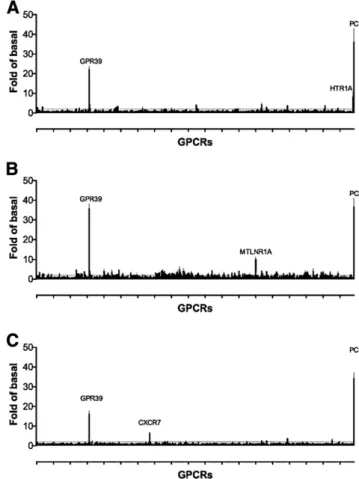
Fig. 2.GPCR-ome (PRESTO-Tango) analysis of three compounds: GPR39-C3 (A), LY2784544 (B), and GSK2636771 (C). These assays were performed using 1mM concentrations of each compound with 100mM ZnCl2. The results are the mean6S.E.M. of quadruplicate
blocking, 20 ml/well anti-FLAG–horseradish peroxidase–conjugated antibody (Sigma-Aldrich) diluted 1/10,000 was added and incubated for 1 hour at room temperature. This was followed by two washes with 80ml/well PBS. Then, 20ml/well SuperSignal Enzyme-Linked Immu-nosorbent Assay Pico Substrate (Sigma-Aldrich) was added, and luminescence was counted using a MicroBeta Trilux luminescence counter. Expression of mutants was normalized by using expression of wild-type receptors as 100% and untransfected cells as 0%. As previously stated, all experiments were done in quadruplicate.
Fluorescent Imaging Plate Reader Assay. HT-29 (ATCC) and PC-3 (obtained from Kim Laboratory, The Lineberger Comprehensive Cancer Center, University of North Carolina, Chapel Hill) were maintained in 10% FBS, McCoy’s 5A medium (Gibco, Thermo Fisher Scientific, Waltham, MA) plus 10% FBS, and DMEM plus 10% FBS, respectively. The cells were seeded into poly-L-Lys–coated 384-well black clear-bottom cell culture plates in each medium supplemented with 10%
dialyzed fetal bovine serum at a density of 10,000 cells/well in a total volume of 50ml 1 day before assay. The following day, medium was discarded, and cells were loaded with 20ml/well of 1Fluo-4 Direct Calcium dye (20 mM HEPES, 1 HBSS, 2.5 mM probenecid, pH 7.40) (Thermo Fisher Scientific). Plates were incubated for 60 minutes at 37°C. The fluorescent imaging plate reader was programmed to take 10 readings (1 read per second) first as a baseline before addition of 10ml of 3 drug solutions. The fluorescence intensity was recorded for 2 minutes after drug addition.
Results
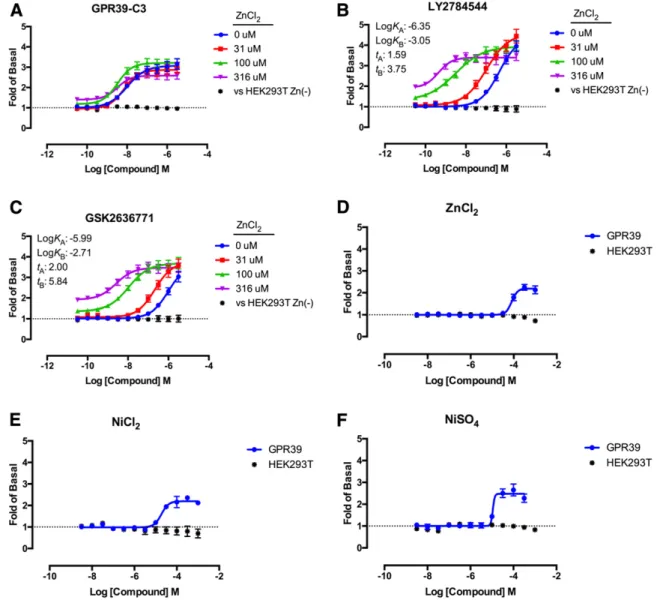
Discovery of Novel GPR39 Agonists. The TANGO b-arrestin recruitment assay was used to screen several compound libraries (Materials and Methods), totaling Fig. 3. Concentration-dependent and GPR39-dependentb-arrestin recruitment as measured by the TANGO assay in response to GPR39-C3 (A), LY2784544 (B), or GSK2636771 (C) in the presence of various concentrations of Zn2+. (D) Zn2+stimulations were carried out at several different
incubation times with Zn2+from 5 minutes to 6 hours, followed by washing and incubation with fresh medium or overnight incubation with Zn2+. The results are expressed as the fold of basal and are the mean6S.E.M. of three independent experiments, each performed in quadruplicate.
TABLE 1
Pharmacological parameters of results shown in Fig. 3, A–C
Top and bottom are expressed as fold of basal, and log EC50is expressed as logged EC50(M). ZnCl2
316mM (N= 3) 100mM (N= 8) 31.6mM (N= 3) 10mM (N= 3) 3.2mM (N= 3) 0mM (N= 8)
GPR39-C3
Top 0.0460.00 30.2760.57 22.0360.71 23.2360.88 26.8161.92 33.2562.31 Bottom 0.0160.00 1.0960.36 0.9860.21 0.9960.20 0.9560.19 1.0060.16 Log EC50 28.6360.17 27.9960.04 27.0960.06 26.7260.06 26.4060.11 26.2260.11
Hill slope 0.8260.24 1.5260.17 0.7960.07 0.8360.08 0.7260.07 0.6960.05 LY2784544
Top 0.0360.00 23.1660.52 11.3860.45 7.9960.33 6.5960.51 7.1060.78 Bottom 0.0160.00 0.8960.25 1.0260.12 0.9760.06 0.9260.05 1.0060.03 Log EC50 28.9360.27 28.1760.04 26.8660.06 26.2660.04 26.0360.07 25.8160.11
Hill slope 1.1060.66 1.4560.15 1.2860.17 1.6160.20 1.5160.25 1.2760.16 GSK2636771
Top 0.0360.00 22.5660.59 22.9663.48 10.8460.99 .153.7 .73.15 Bottom 0.0060.00 0.8360.21 1.0560.16 0.9960.04 0.9760.05 1.0060.03 Log EC50 27.9660.29 27.0760.04 25.4260.16 25.3160.07 .-4.07 .-4.25
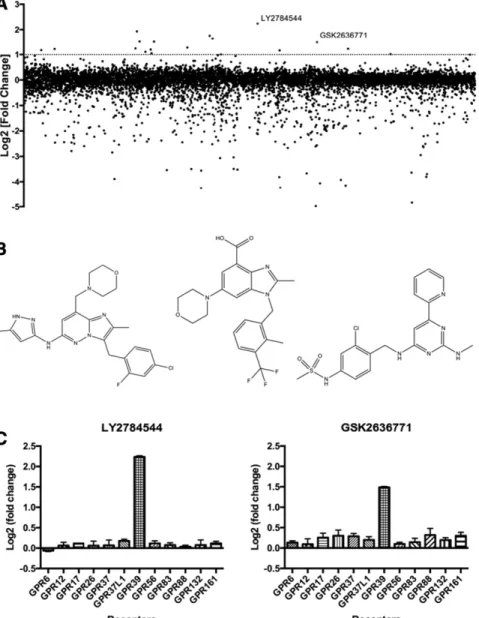
approximately 5000 unique compounds, for agonist activity at GPR39 in the absence of Zn21. Approximately 20 compounds showed activities over 2-fold higher than basal (i.e., log2-fold change . 1) (Fig. 1A); after exclusion of promiscuous com-pounds that also activated other GPCR targets (data not shown), the JAK2 inhibitor LY2784544 and the PI3Kb in-hibitor GSK2636771 were identified as GPR39 agonists (Fig. 1A). The structures of these compounds are similar to each other, but are markedly different from the GPR39-C3 com-pound that has previously been reported to be an agonist at GPR39 (Fig. 1B; Peukert et al., 2014). When tested at 11 other GPCRs, neither of these compounds showed agonist activity (Fig. 1C). Additionally, we also tested obestatin, which has previously been reported to be a GPR39 agonist (Zhang et al., 2005), for activity at GPR39 and found it to be inactive (Supplemental Fig. 1A); we then tested obestatin for activity at 320 GPCRs using the PRESTO-Tango method (Kroeze et al., 2015; Manglik et al., 2016) and found it to be inactive at
all targets tested (Supplemental Fig. 1B), both in the presence and absence of Zn21. Additionally, we performed a GPCR-ome analysis (Kroeze et al., 2015; Manglik et al., 2016) for all three GPR39 agonist compounds, i.e., GPR39-C3, LY2784544, and GSK2636771. At 1mM concentrations, and in the presence of 100mM ZnCl2, each compound showed obvious activity at only one receptor in addition to GPR39: HTR1A by GPR39-C3, MTLNR1A by LY2784544, and CXCR7 by GSK2636771, respectively (Fig. 2, A–C). Thus, these compounds are highly specific agonists at GPR39. These activities were subse-quently confirmed with concentration-response curves (Sup-plemental Fig. 2).
Allosteric Modulation of GPR39b-Arrestin Recruitment Activity. Since Zn21had previously been reported to be an agonist at GPR39, and because it seemed unlikely that these compounds might be interacting at the zinc site, we wondered if zinc allosterically modulated the GPR39 agonist activity of small molecules. We used the previously reported GPR39
Fig. 4.Concentration-dependent and GPR39-dependent phosphatidylinositol hydrolysis (Gq pathway) in response to GPR39-C3 (A), LY2784544 (B), or GSK2636771 (C) with various concentrations of Zn2+. According to an allosteric operational model, the allosteric parameters were calculated
(Kenakin, 2012).tAis the orthosteric agonist (LY2784544 and GSK2636771) efficacy parameter. Since allosteric modulators in this study showed
agonist activity, the allosteric modulator efficacy (tB) is therefore greater than 0. Concentration-dependent and GPR39-dependent PI hydrolysis (Gq
pathway) in response to ZnCl2(D), NiCl2(E), and NiSO4(F). Black dots show response to compounds in untransfected HEK293T cells. The results are
agonist GPR39-C3 (Peukert et al., 2014), as well as the two compounds discovered in our screens, LY2784544 and GSK2636771 (Fig. 1), at various concentrations of Zn21in the TANGO assay (Fig. 3). Zn21alone showed very little activity in
this assay (Fig. 3D). However, all three compounds showed a Zn21-dependent increase in potency and efficacy up to a Zn21
concentration of 100mM (Fig. 3, A–C); at a Zn21concentration of 316 mM, no activity was seen, presumably due to the toxic effects of Zn21at such high concentrations. In an attempt to determine whether responses to Zn21could be seen with shorter exposures to its potentially toxic effects, we exposed GPR39-expressing HTLA cells to Zn21for various times, followed by a washout, and continued incubation overnight; longer exposures to higher concentrations of Zn21were apparently toxic to cells, but significantb-arrestin recruitment activity was not seen at any concentration, or with any length of exposure (Fig. 3D). The efficacy and potency values for these three compounds at various Zn21concentrations are shown in Table 1; all three compounds showed Emax values between 20- and 30-fold above basal at 100mM Zn21. Interestingly, GPR39-C3 showed marked activity
in the absence of Zn21, whereas LY2784544 and GSK2636771 had minimal or no activity in the absence of zinc. Taken together, the results shown in Table 1 indicate that Zn21acts as a positive allosteric modulator (PAM) of the activity of GPR39-C3 in terms of efficacy only, whereas Zn21was a PAM for the activities of LY2784544 and GSK2636771 in terms of both efficacy and potency. It should be noted that all three compounds were apparently toxic to HTLA cells at high concentrations, and therefore, data from these high concentrations were excluded from this analysis. We also tested whether LY2784544 could act as an antagonist to the GPR39-C3 response at various Zn21
concentrations, and found that LY2784544 did not antagonize the GPR39-C3 response (Supplemental Fig. 3). Together, our results suggest that Zn21stabilizes a conformation of GPR39 that can be further activated to recruitb-arrestin by LY2784544. In addition, Ni21was also shown to be an agonist of GPR39 in
b-arrestin recruitment activity (Fig. 4), as had previously been reported using a bioluminescence resonance energy transfer assay (Holst et al., 2007).
Allosteric Modulation of GPR39 Gq-Mediated Signaling. We also measured GPR39-mediated Gq pathway signaling using a phosphatidylinositol hydrolysis assay. As
can be seen in Fig. 4, A–C, all three tested compounds stimulated Gq signaling. The Zn21dependence of responses to LY2784544 (Fig. 4B) and GSK2636771 (Fig. 4C) was much greater than that of GPR39-C3 (Fig. 4A), with leftward shifts of more than 1000-fold compared with less than 10-fold for GPR39-C3. At the higher Zn21 concentrations, all three
compounds were much more potent with respect to Gq signaling (Fig. 4, A–C) than they were in b-arrestin re-cruitment (Fig. 3), showing EC50values in the low nanomolar range (Table 2). The allosteric parameters were calculated according to the Black-Leff Ehlert model (Kenakin, 2012). The allosteric modulator efficacy values (tB) were greater than 0, indicating that Zn21is a PAM agonist (Fig. 4, B and
C). All three compounds showed a maximal efficacy of 3- to 4-fold over basal (Table 2). The maximal efficacy of all three compounds at GPR39 in Gq signaling was not affected by Zn21concentration (Fig. 4, A–C; Table 2), although Zn21and Ni21stimulated GPR39-mediated Gq signaling on their own (Fig. 4, D–F; Table 3). Interestingly, the potency of Ni21was slightly higher than that of Zn21. All of these divalent metal
ions showed steep Hill slopes (.2.5) (Table 3), which we interpret to mean that divalent metal ions can act as their own PAMs at GPR39. The concentrations at which Zn21was active in this assay, i.e., in the high micromolar range, were comparable to those seen in vivo (Foster et al., 1993; Caroli et al., 1994; Lu et al., 2012). Zinc has been estimated at 200– 320 mM in vivo in hippocampus mossy fibers (GPR39 is enriched in the hippocampus) (Frederickson et al., 1983) and at levels.100mM during synaptic transmission (Assaf and Chung, 1984). The concentrations we used in our experi-ments (3.4–340mM) are in this range. Taken together, these
TABLE 2
Pharmacological parameters of results shown in Fig. 3, A–C
Top and bottom are expressed as fold of basal, and log EC50is expressed as logged EC50(M). ZnCl2
316mM (N= 4) 100mM (N= 4) 31.6mM (N= 4) 0mM (N= 4)
GPR39-C3
Top 2.5960.06 3.2160.08 2.8760.08 3.0760.10 Bottom 1.4060.09 1.1860.11 0.9660.10 1.0060.10 Log EC50 28.4960.13 28.4860.10 28.1660.11 28.0060.12
Hill slope 1.2960.46 1.2060.30 1.1860.30 0.9460.23 LY2784544
Top 3.4060.38 3.9460.30 4.5760.12 4.4160.07 Bottom 1.9260.07 1.3160.11 1.0760.22 1.0060.22 Log EC50 29.3660.14 28.5160.14 26.9860.16 26.3560.19
Hill slope 1.3060.18 0.6360.17 0.7960.15 0.9460.59 GSK2636771
Top 3.4760.09 3.6860.12 3.7560.27 3.6860.63 Bottom 1.9160.15 1.3660.12 1.0860.08 1.0160.05 Log EC50 28.6060.18 27.9760.13 26.6760.14 25.9960.25
Hill slope 1.0160.38 0.8660.20 1.0160.25 1.0160.28
TABLE 3
Pharmacological parameters of results shown in Fig. 4, D–F
Top and bottom are expressed as fold of basal, and log EC50is expressed as logged EC50(M).
ZnCl2(N= 3) NiCl2(N= 3) NiSO4(N= 3)
Top 2.1960.06 2.2060.08 2.5860.10 Bottom 1.0060.03 0.9860.04 1.0060.05 Log EC50 24.0960.05 24.7360.07 24.8860.08
results led to the conclusion that GPR39-C3, LY2784544, GSK2636771, Zn21, and Ni21 can all act as agonists of
GPR39-mediated Gq signaling, and that Zn21 is a PAM of the responses of GPR39-C3, LY2784544 and GSK2636771.
Allosteric Modulation of GPR39 Gs-Mediated Signaling. In addition, we measured GPR39-mediated Gs path-way signaling (i.e., cAMP production) as described (seeMaterials
and Methods). All three tested compounds, i.e., GPR39-C3,
Fig. 5. Concentration-dependent and GPR39-dependent cAMP (Gs) responses, as measured by the Glosensor assay, to GPR39-C3 (A), LY2784544 (B), or GSK2636771 (C) with various concentrations of Zn2+. Responses in the absence of Zn2+are shown in (D), (E), and (F). Responses to ZnCl
2, NiCl2, and NiSO4are
shown in (G) and (H) and (I), respectively. The results are the mean6S.E.M. of at least three independent experiments performed in quadruplicate.
TABLE 4
Pharmacological parameters of the results shown in Fig. 4, A–C
Top and bottom are expressed as fold of basal, and log EC50is expressed as logged EC50(M). ZnCl2
316mM (N= 3) (100N= 13)mM 31.6(N= 3)mM (10N= 3)mM 3.16(N= 3)mM (N0= 13)mM
GPR39-C3
Top 22.7660.89 7.6860.15 3.1860.13 N.D. N.D. N.D. Bottom 2.3360.24 1.3860.05 1.2960.04 N.D. N.D. N.D. Log EC50 27.0560.07 26.7260.04 26.1760.08 N.D. N.D. N.D.
Hill slope 0.8760.10 1.0160.08 1.7060.45 N.D. N.D. N.D. LY2784544
Top 18.8660.38 7.2460.19 1.9660.07 N.D. N.D. N.D. Bottom 2.0460.21 1.2060.10 1.1260.03 N.D. N.D. N.D. Log EC50 27.7560.05 27.3760.08 26.4760.08 N.D. N.D. N.D.
Hill slope 1.1460.12 1.1360.37 3.3163.73 N.D. N.D. N.D. GSK2636771
Top 16.4160.51 4.8060.12 N.D. N.D. N.D. N.D. Bottom 1.9360.18 1.1060.05 N.D. N.D. N.D. N.D. Log EC50 27.1260.06 27.0960.05 N.D. N.D. N.D. N.D.
Hill slope 1.1060.14 1.2960.17 N.D. N.D. N.D. N.D.
LY2784544, and GSK2636771, showed Zn21-dependent Gs
signal-ing (Fig. 5, A–C; Table 4). Importantly, even GPR39-C3 showed a dramatic Zn21dependency of this response, despite not doing so in
eitherb-arrestin recruitment (Fig. 3A) or Gq signaling (Fig. 4A). In untransfected cells, or in the absence of Zn21, neither of the compounds showed GPR39-mediated Gs pathway signaling (Fig. 5, D–F). At high concentrations, i.e., 30mM and higher, Zn21and Ni21also acted as weak partial agonists of GPR39-mediated Gs
pathway signaling (Fig. 5, G–I; Table 5). Thus, GPR39-C3, LY2784544, GSK2636771, Zn21, and Ni21can all act as agonists
of GPR39-mediated Gs signaling, and additionally, Zn21is a PAM for the Gs-mediated responses of GPR39-C3, LY2784544, and GSK2636771.
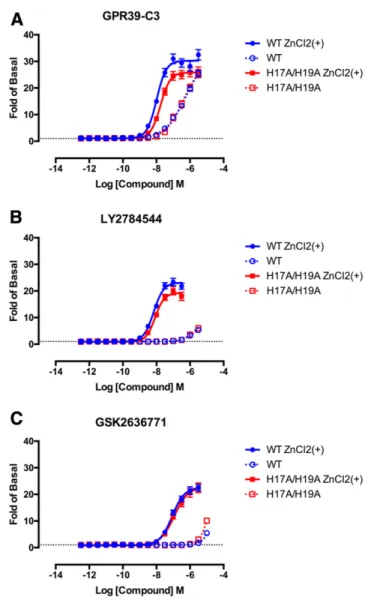
Effects of Mutation of N-Terminal Histidine Residues on GPR39-Mediated Signaling. A previous study showed that mutation of two N-terminal histidine residues to alanine (H17A/H19A) in GPR39 led to a dysfunction in GPR39-mediated Gq signaling (Storjohann et al., 2008) such that Zn21-stimulated signaling was completely abolished. We wished to study the effects of these mutations further with respect to both various signaling pathways and various agonists and PAMs. First, using cell enzyme-linked immunosorbent assay, we estab-lished that the H17A/H19A double mutant of GPR39 was expressed similarly to the wild-type GPR39, both in the TANGO constructs as well as the“de-TANGO-ized”constructs (Supple-mental Fig. 4). In Fig. 6 and Table 6, it can be seen that the H17A/H19A double mutant of GPR39 had little effect on b-arrestin recruitment activity in response to both the three small-molecule compounds of interest, as well as the activity of Zn21as a PAM of these responses. The double mutation completely abolished Gq signaling stimulated by either Zn21or
Ni21 (Fig. 7, D–F), consistent with the report by Storjohann et al. (2008). The double mutation had little or no effect on Gq signaling stimulated by GPR39-C3, LY2784544, or GSK2636771 in either the presence or absence of 100mM Zn21(Fig. 7, A–C; Table 7). As with Gq signaling, the double mutation com-pletely abolished Gs signaling stimulated by either Zn21 or Ni21 (Fig. 8, D–F). However, the double mutant showed re-duced Gs signaling stimulated by GPR39-C3, LY2784544, or GSK2636771 with respect to both potency and efficacy (Fig. 8, A–C; Table 8).
Discussion
Here, we report the discovery of novel GPR39 agonist scaffolds and the identification of zinc as a GPR39 PAM. These are the first results to identify zinc as a potent and frequently pathway- and probe-specific allosteric modulator for small-molecule GPR39 agonists. To discover these GPR39 agonists, we used a b-arrestin recruitment assay to screen several compound libraries comprising more than 5000 unique
compounds for agonist activity at the orphan GPCR GPR39, which had previously been reported to be a divalent metal ion zinc receptor. Two compounds were found that had selective activity at GPR39—the JAK2 inhibitor LY2784544 and the PI3Kb inhibitor GSK2636771 (Figs. 1 and 2). In additional studies, we showed that Zn21is an allosteric modulator of the
responses of GPR39 to LY2784544 and GSK2636771, and that the allosteric actions of Zn21on these responses were stronger
than for the selective GPR39 agonist, GPR39-C3 (Fig. 3). Currently, LY2784544 is being evaluated in patients with myeloproliferative neoplasm in two phase I trials to investigate dose and schedule (MC-JHTA, NCT01134120; and I3X-MC-JHTC, NCT01520220) and a phase II study to investigate efficacy (I3X-MC-JHTB, NCT01594723) (Ma et al., 2013). Additionally, GSK2636771 is being tested in a phase I/II trial in patients with phosphatase and tensin homolog (PTEN)– deficient advanced solid tumors (NCT01458067) (Thorpe et al., 2015). Indeed, when the potencies for activating GPR39 in the presence of Zn21were calculated, we found their EC50values TABLE 5
Pharmacological parameters of results shown in Fig. 5, G–I
The results are the mean6S.E.M. of five independent experiments performed in quadruplicate. Top and bottom are expressed as fold of basal, and log EC50is expressed as logged EC50(M).
ZnCl2(N= 7) NiCl2(N= 5) NiSO4(N= 5)
Top 4.2260.20 2.9960.07 3.2460.12 Bottom 0.9560.02 0.9360.02 0.9260.02 Log EC50 23.4260.04 24.0460.04 23.9160.06
Hill slope 2.6260.57 1.7560.24 1.2560.16
Fig. 6.Concentration-dependent b-arrestin recruitment responses of wild-type (WT) and H17A/H19A mutant receptors to GPR39-C3 (A), LY2784544 (B), and GSK2636771 (C) in the presence and absence of 100mM Zn2+as measured by the TANGO assay. The results are the
were in the sub- to single-digit nanomolar range in whole-cell assays. By comparison, the potency of LY2784544 in whole-cell assays for inhibition of JAK2 proliferation was 20 nM (Ma et al., 2013), whereas GSK2636771 had a potency of 7–114 nM in whole-cell assays (Qu et al., 2015). These results indicate that, in terms of the cellular context, the activities at GPR39 could predominate.
Given that these compounds are being tested in clinical trials, it should be of interest to establish whether they activate off-targets. Also, if side effects of these compounds are found, it may be possible to link the side effects to the off-targets rather than the targets and, thus, to provide clues as to the physiologic function(s) of orphan off-targets. In a clinical study of LY2784544, diarrhea, nausea, anemia, and transient increases in serum creatinine, uric acid, and potassium have been reported and attributed to a “typical tumor lysis syndrome” (Tefferi, 2012); however, it seems conceivable that at least some
of these effects might be due to activation of GPR39. In-terestingly, GPR39 is highly expressed in human colorectal adenocarcinoma HT-29 cells, and Zn21and a GPR39 agonist stimulated Gq signaling and promoted survival in these cells (Cohen et al., 2012, 2014; Boehm et al., 2013). By using the fluorescent imaging plate reader assay, we have shown that GPR39-C3, LY2784544, and GSK2636771 strongly activate the Gq pathway in HT-29 cells (Supplemental Fig. 5). Since LY2784544 shows modulator activity in the presence of physiologic concentrations of Zn21, it will be important to determine in clinical trials whether its side effects are due to its activity at GPR39.
Moreover, Zn21induced increased cell growth and survival
in GPR39-expressing human prostate cancer PC-3 cells (Dubi et al., 2008; Asraf et al., 2014). Importantly, prostate tissue is rich in Zn21(Györkey et al., 1967; Zaichick et al., 1997). In the absence of Zn21, the selective PI3Kbinhibitor GSK2636771
TABLE 6
Pharmacological parameters of results shown in Fig. 6
Top and bottom are expressed as fold of basal, and log EC50is expressed as logged EC50(M).
WT H17A/H19A
ZnCl2(+) (N= 8) ZnCl2(2) (N= 8) ZnCl2(+) (N= 5) ZnCl2(2) (N= 5)
GPR39-C3
Top 30.2760.57 33.2562.31 25.8760.55 29.0762.02 Bottom 1.0960.36 1.0060.16 1.0860.34 1.0060.24 Log EC50 27.9960.04 26.2260.11 27.7660.04 26.4360.10
Hill slope 1.5260.17 0.6960.05 1.5160.18 0.8460.10 LY2784544
Top 23.1660.52 7.1060.78 19.2660.56 7.2360.97 Bottom 0.8960.25 1.0060.03 0.9160.27 1.0060.06 Log EC50 28.1760.04 25.8160.11 28.0760.04 25.9160.12
Hill slope 1.4560.15 1.2760.16 1.6160.23 1.5760.38 GSK2636771
Top 22.6160.59 N.D. 22.8560.93 N.D. Bottom 0.83160.21 1.0060.03 0.9160.27 1.0060.07 Log EC50 27.06860.04 .24.00 26.9460.06 .24.00
Hill slope 1.17960.11 1.5960.86 1.0560.13 1.70360.75
N.D., could not determine; WT, wild type.
Fig. 7. Concentration-dependent phosphatidylinositol hydrolysis responses (Gq pathway) to GPR39-C3 (A), LY2784544 (B), and GSK2636771 (C) in the presence and absence of 100mM Zn2+at wild-type (WT) and H17A/H19A mutant receptors. Concentration-dependent PI hydrolysis responses (Gq
significantly decreases cell viability in p110b-reliant PTEN-deficient PC-3 cells (Weigelt et al., 2013). In the present study, we discovered that GSK2636771 could promote GPR39-selective intracellular signaling, which was markedly enhanced by the divalent metal ion Zn21 (Figs. 3–5). Addi-tionally, we have confirmed GPR39- and Gq-mediated Ca21
release in PC-3 cells after stimulation with GPR39 ago-nists in the presence of Zn21(Supplemental Fig. 6). Since
GSK2636771 has been developed as a potential treatment of PTEN-deficient advanced solid tumors, including colorectal cancer, it may be important to consider possible off-target effects of this compound due to its actions at GPR39. In addition, and more generally, our approach shows that new activities for compounds and new modulators for poorly annotated GPCRs can be discovered by screening modestly sized libraries of already-known small molecules.
The divalent metal ion Zn21has been reported to
allosteri-cally modulate GPCR function, not only GPR39 but also
5HT1A-serotonin (Barrondo and Sallés, 2009; Satała et al., 2015), a(1A)-adrenoreceptor (Ciolek et al., 2011), and b 2-adrenergic receptor (Swaminath et al., 2002). Furthermore, the divalent metal ion Zn21can stimulate GPR68 (Abe-Ohya et al., 2015) and GPRC6A (Pi and Quarles, 2012; Pi et al., 2012) in the micromolar to millimolar range. Interestingly, Zn21
modu-lates GPR39 activity via the Gq, Gs, andb-arrestin pathways (Holst et al., 2007). Other divalent cations, including Ni21(Holst
et al., 2007) and even Cr21, Fe21, and Cd21(Huang et al., 2015), can also activate GPR39. In general, most GPCRs can modulate one G protein signaling pathway in addition to theb-arrestin pathway, although there are many exceptions. Our data show that LY2784544 and GSK2636771 can strongly stimulate Gq (Fig. 4), Gs (Fig. 5), andb-arrestin (Fig. 3) pathways. However, the mechanisms of stimulation of these compounds may not be the same and may not be shared with Zn21or GPR39-C3. For example, the Zn21-dependent enhancement of potency in the
Gq and b-arrestin pathways induced by LY2784544 and
TABLE 7
Pharmacological parameters of results shown in Fig. 7
Top and bottom are expressed as fold of basal, and log EC50is expressed as logged EC50(M).
WT H17A/H19A
ZnCl2(+) (N= 4) ZnCl2(2) (N= 4) ZnCl2(+) (N= 3) ZnCl2(2) (N= 3)
GPR39-C3
Top 3.2160.08 3.0760.10 3.7260.14 3.7560.22 Bottom 1.1860.11 1.0060.10 1.0760.17 1.0360.11 Log EC50 28.4860.10 28.0060.12 28.3060.14 27.1760.14
Hill slope 1.2060.30 0.9460.23 1.0160.29 0.9060.23 LY2784544
Top 3.9460.12 4.4160.38 3.7760.13 3.8560.16 Bottom 1.3160.22 1.0060.07 1.0960.27 1.0360.04 Log EC50 28.5160.16 26.3560.14 28.7260.18 26.2360.07
Hill slope 0.6360.15 0.9460.18 0.8860.29 1.1560.15 GSK2636771
Top 3.6860.12 3.6860.63 3.7460.12 3.0060.11 Bottom 1.3660.12 1.0160.05 1.1460.15 1.0160.02 Log EC50 27.9760.13 25.9960.25 28.1660.13 25.9960.05
Hill slope 0.8660.20 1.0160.28 0.9560.24 1.3560.16
WT, wild type.
Fig. 8. Concentration-dependent cAMP production (Gs pathway) to GPR39-C3 (A), LY2784544 (B), and GSK2636771 (C) in the presence and absence of 100mM Zn2+at wild-type (WT) and H17A/H19A mutant receptors as measured by the Glosensor assay. Concentration-dependent cAMP production (Gs
pathway) to ZnCl2(D), NiCl2(E), or NiSO4(F) at wild-type or H17A/H19A mutant receptors as measured by the Glosensor assay. The results are the
GSK2636771, which have similar structures, is much greater than that induced by GPR39-C3 (Figs. 3 and 4), although clearly additional studies are needed to clarify the molecular details responsible for these intriguing signaling differences.
The potency and efficacy of Zn21 alone in the b-arrestin pathway are quite small (Fig. 3). In the TANGO assay, which requires overnight incubation with ligand, the toxicity of high concentrations of Zn21 prevented measurement of b-arrestin recruitment at these concentrations. However, it has been shown that Ni21can stimulateb-arrestin recruitment to GPR39 using a bioluminescence resonance energy transfer assay (Holst et al., 2007), and presumably, this would be similar to Zn21. In comparison with the activities of GPR39-C3, LY2784544, and GSK2636771, our results show that the responses to Zn21alone are quite small. We conclude that Zn21acts as a small-molecule PAM agonist at GPR39 for these two pathways.
Stimulation of the Gs (cAMP) pathway by compounds acting at GPR39 followed a very different pattern when compared with the Gq and b-arrestin pathways. The divalent cations Zn21 and Ni21 stimulated this pathway on their own;
additionally, the GPR39-C3 compound, even without Zn21, showed significant Gs activity (Fig. 5). This is in agreement with a previous study (Peukert et al., 2014), which showed an EC50value of 60 nM and an efficacy of 64% of the activity shown by 25 mM forskolin. Another study found that the GPR39 agonists AZ1395, 3,4-bis-(2-imidazol-1-ylethoxy)-benzonitrile; AZ4237, 6-[(4-chlorophenyl)methyl]-7-hydroxy-5-methyl-pyrazolo[1,5-a]pyrimidine-3-carboxylic acid; AZ7914, 6-(3-chloro-2-fluoro-benzoyl)-2-(2-methylthiazol-4-yl)-3,5,7,8-tetrahydropyrido-[4,3-d]pyrimidin-4-one also stimulated cAMP responses without Zn21(Fjellström et al., 2015); however, the phosphodiesterase inhibitor 3-isobutyl-1-methylxanthine (IBMX) was used in that study, which makes estimation of the
“true”pharmacological parameters of these compounds difficult. Our results showed that all three compounds, i.e., GPR39-C3, LY2784544, and GSK2636771, had similar and significant Zn21
dependency in their Gs responses, and were thus acting as PAM agonists with respect to Zn21in the Gs pathway.
The differences in the activities of the divalent cations and GPR39-C3, LY2784544, and GSK2636771 at GPR39 suggest
that there may be multiple binding sites or modes for divalent cations in GPR39. It has already been shown that two histidine residues in the N terminus (H17 and H19) are involved in Zn21activity, since the Gq pathway response to
concentrations of Zn21less than 1 mM is completely abolished by alanine substitution of these residues (Storjohann et al., 2008). Our results confirm these observations, and the re-sponse to Ni21was also abolished by these mutations (Fig. 7). Additionally, the Gs (cAMP) response to Zn21 was also
abolished by these mutations (Fig. 8). Thus, we conclude that H17 and H19 form one binding site for Zn21 in GPR39.
However, the H17A/H19A double mutation did not affect the activity of zinc or the zinc dependency of the activities of GPR39-C3, LY2784544, and GSK2636771 in the Gq or b-arrestin recruitment assays (Figs. 6 and 7). From this, we conclude that there must be an additional zinc-binding site in GPR39, that the zinc-binding sites act independently of each other, and that the H17/H19 zinc-binding site is orthosteric, whereas the yet-unknown additional site is allosteric.
In conclusion, here we report that the previously described
“selective” kinase inhibitors LY2784544 and GSK2636771 have unexpectedly selective PAM agonist activity with respect to Zn21at GPR39. All tested compounds induced Gq, Gs, and b-arrestin signaling, and those responses are modulated by the divalent metal ion Zn21acting as a PAM agonist. We also
clarified the roles of key residues in GPR39 relating only to divalent metal ion agonist activity by using mutagenesis. Although several ligands for GPR39 have been reported, whether there are endogenous ligands other than divalent metal ions for GPR39 is still not clear. Additionally, the physiologic functions of GPR39 signaling in vivo remain to be determined, and the scaffolds described here may provide starting points for novel chemical probes for GPR39.
Authorship Contributions
Participated in research design:Sato, Huang, Kroeze, Roth. Conducted experiments:Sato, Huang, Kroeze.
Performed data analysis:Sato, Huang, Kroeze.
Wrote or contributed to the writing of the manuscript:Sato, Kroeze, Roth.
TABLE 8
Pharmacological parameters of the results shown in Fig. 8, A–C
The results are the mean6S.E.M. of least eight independent experiments, each in quadruplicate. Top and bottom are expressed as fold of basal, and log EC50is expressed as logged EC50(M). The statistical significance of the difference in values between the wild type (WT) and mutant was determined using a one-sidedttest.
WT H17A/H19A
ZnCl2(+) (N= 13) ZnCl2(2) (N= 13) ZnCl2(+) (N= 8) ZnCl2(2) (N= 8)
GPR39-C3
Top 7.6860.11 N.D. 6.0160.13* N.D. Bottom 1.3860.17 N.D. 1.3760.18 N.D. Log EC50 26.7260.10 N.D. 26.4960.12* N.D.
Hill slope 1.0160.37 N.D. 1.2260.22 N.D. LY2784544
Top 7.2460.20 N.D. 4.8660.13* N.D. Bottom 1.2060.06 N.D. 1.1760.04 N.D. Log EC50 27.3760.05 N.D. 27.0860.05* N.D.
Hill slope 1.1360.12 N.D. 1.3560.17 N.D. GSK2636771
Top 4.8060.12 N.D. 3.8460.12* N.D. Bottom 1.1060.05 N.D. 1.0660.03 N.D. Log EC50 27.0960.05 N.D. 26.4660.06* N.D.
Hill slope 1.2960.17 N.D. 1.2060.16 N.D.
References
Abe-Ohya R, Ishikawa T, Shiozawa H, Suda K, and Nara F (2015) Identification of metals from osteoblastic ST-2 cell supernatants as novel OGR1 agonists.J Recept Signal Transduct Res35:485–492.
Asraf H, Salomon S, Nevo A, Sekler I, Mayer D, and Hershfinkel M (2014) The ZnR/GPR39 interacts with the CaSR to enhance signaling in prostate and salivary epithelia.J Cell Physiol229:868–877.
Assaf SY and Chung S-H (1984) Release of endogenous Zn21from brain tissue during activity.Nature308:734–736.
Barnea G, Strapps W, Herrada G, Berman Y, Ong J, Kloss B, Axel R, and Lee KJ (2008) The genetic design of signaling cascades to record receptor activation.Proc Natl Acad Sci USA105:64–69.
Barrondo S and Sallés J (2009) Allosteric modulation of 5-HT(1A) receptors by zinc: Binding studies.Neuropharmacology56:455–462.
Bhattacharyya S, Luan J, Farooqi IS, Keogh J, Montague C, Brennand J, Jorde L, Wareham NJ, and O’Rahilly S (2004) Studies of the neuromedin U-2 receptor gene in human obesity: evidence for the existence of two ancestral forms of the receptor. J Endocrinol183:115–120.
Bjarnadóttir TK, Gloriam DE, Hellstrand SH, Kristiansson H, Fredriksson R, and Schiöth HB (2006) Comprehensive repertoire and phylogenetic analysis of the G protein-coupled receptors in human and mouse.Genomics88:263–273. Boehm M, Hepworth D, Loria PM, Norquay LD, Filipski KJ, Chin JE, Cameron KO,
Brenner M, Bonnette P, Cabral S, et al. (2013) Chemical probe identification platform for orphan GPCRs using focused compound screening: GPR39 as a case example.ACS Med Chem Lett4:1079–1084.
Caroli S, Alimonti A, Coni E, Petrucci F, Senofonte O, and Violante N (1994) The Assessment of Reference Values for Elements in Human Biological Tissues and Fluids: A Systematic Review.Crit Rev Anal Chem24:363–398.
Ciolek J, Maïga A, Marcon E, Servent D, and Gilles N (2011) Pharmacological characterization of zinc and copper interaction with the human alpha(1A)-adrenoceptor. Eur J Pharmacol655:1–8.
Cohen L, Azriel-Tamir H, Arotsker N, Sekler I, and Hershfinkel M (2012) Zinc sensing receptor signaling, mediated by GPR39, reduces butyrate-induced cell death in HT29 colonocytes via upregulation of clusterin.PLoS One7: e35482.
Cohen L, Sekler I, and Hershfinkel M (2014) The zinc sensing receptor, ZnR/GPR39, controls proliferation and differentiation of colonocytes and thereby tight junction formation in the colon.Cell Death Dis5:e1307.
Dubi N, Gheber L, Fishman D, Sekler I, and Hershfinkel M (2008) Extracellular zinc and zinc-citrate, acting through a putative zinc-sensing receptor, regulate growth and survival of prostate cancer cells.Carcinogenesis29:1692–1700.
Feighner SD, Tan CP, McKee KK, Palyha OC, Hreniuk DL, Pong SS, Austin CP, Figueroa D, MacNeil D, Cascieri MA, et al. (1999) Receptor for motilin identified in the human gastrointestinal system.Science284:2184–2188.
Fjellström O, Larsson N, Yasuda S, Tsuchida T, Oguma T, Marley A, Wennberg-Huldt C, Hovdal D, Fukuda H, Yoneyama Y, et al. (2015) Novel Zn21Modulated GPR39 Receptor Agonists Do Not Drive Acute Insulin Secretion in Rodents.PLoS One10:e0145849.
Foster MC, Leapman RD, Li MX, and Atwater I (1993) Elemental composition of secretory granules in pancreatic islets of Langerhans.Biophys J64:525–532. Frederickson CJ, Klitenick MA, Manton WI, and Kirkpatrick JB (1983) Cytoarchitectonic
distribution of zinc in the hippocampus of man and the rat.Brain Res273:335–339. Fredriksson R and Schiöth HB (2005) The repertoire of G-protein-coupled receptors
in fully sequenced genomes.Mol Pharmacol67:1414–1425.
Györkey F, Min KW, Huff JA, and Györkey P (1967) Zinc and magnesium in human prostate gland: normal, hyperplastic, and neoplastic.Cancer Res27:1348–1353. Holst B, Egerod KL, Jin C, Petersen PS, Østergaard MV, Hald J, Sprinkel AME,
Størling J, Mandrup-Poulsen T, Holst JJ, et al. (2009) G protein-coupled receptor 39 deficiency is associated with pancreatic islet dysfunction.Endocrinology150: 2577–2585.
Holst B, Egerod KL, Schild E, Vickers SP, Cheetham S, Gerlach L-O, Storjohann L, Stidsen CE, Jones R, Beck-Sickinger AG, et al. (2007) GPR39 signaling is stimu-lated by zinc ions but not by obestatin.Endocrinology148:13–20.
Huang X-P, Karpiak J, Kroeze WK, Zhu H, Chen X, Moy SS, Saddoris KA, Nikolova VD, Farrell MS, Wang S, et al. (2015) Allosteric ligands for the pharmacologically dark receptors GPR68 and GPR65.Nature527:477–483.
Kenakin TP (2012) Biased signalling and allosteric machines: new vistas and chal-lenges for drug discovery.Br J Pharmacol165:1659–1669.
Kojima M, Haruno R, Nakazato M, Date Y, Murakami N, Hanada R, Matsuo H, and Kangawa K (2000) Purification and identification of neuromedin U as an en-dogenous ligand for an orphan receptor GPR66 (FM3). Biochem Biophys Res Commun276:435–438.
Kojima M, Hosoda H, Date Y, Nakazato M, Matsuo H, and Kangawa K (1999) Ghrelin is a growth-hormone-releasing acylated peptide from stomach.Nature402: 656–660.
Komatsu H, Maruyama M, Yao S, Shinohara T, Sakuma K, Imaichi S, Chikatsu T, Kuniyeda K, Siu FK, Peng LS, et al. (2014) Anatomical transcriptome of G protein-coupled receptors leads to the identification of a novel therapeutic candidate GPR52 for psychiatric disorders.PLoS One9:e90134.
Kroeze WK, Sassano MF, Huang X-P, Lansu K, McCorvy JD, Giguère PM, Sciaky N, and Roth BL (2015) PRESTO-Tango as an open-source resource for interrogation of the druggable human GPCRome.Nat Struct Mol Biol22:362–369.
Lauwers E, Landuyt B, Arckens L, Schoofs L, and Luyten W (2006) Obestatin does not activate orphan G protein-coupled receptor GPR39.Biochem Biophys Res Commun351:21–25.
Lu J, Stewart AJ, Sleep D, Sadler PJ, Pinheiro TJT, and Blindauer CA (2012) A molecular mechanism for modulating plasma Zn speciation by fatty acids.J Am Chem Soc134:1454–1457.
Ma L, Clayton JR, Walgren RA, Zhao B, Evans RJ, Smith MC, Heinz-Taheny KM, Kreklau EL, Bloem L, Pitou C, et al. (2013) Discovery and characterization of
LY2784544, a small-molecule tyrosine kinase inhibitor of JAK2V617F. Blood Cancer J3:e109.
Manglik A, Lin H, Aryal DK, McCorvy JD, Dengler D, Corder G, Levit A, Kling RC, Bernat V, Hübner H, et al. (2016) Structure-based discovery of opioid analgesics with reduced side effects.Nature537:185–190.
Młyniec K, GawełM, Librowski T, Reczynski W, Bystrowska B, and Holst B (2015a) Investigation of the GPR39 zinc receptor following inhibition of monoaminergic neurotransmission and potentialization of glutamatergic neurotransmission.Brain Res Bull115:23–29.
Młyniec K, GawełM, and Nowak G (2015b) Study of antidepressant drugs in GPR39 (zinc receptor⁻/⁻) knockout mice, showing no effect of conventional antidepressants, but effectiveness of NMDA antagonists.Behav Brain Res287:135–138. Młyniec K and Nowak G (2015) Up-regulation of the GPR39 Zn21-sensing receptor and
CREB/BDNF/TrkB pathway after chronic but not acute antidepressant treatment in the frontal cortex of zinc-deficient mice.Pharmacol Rep67:1135–1140.
Młyniec K, Singewald N, Holst B, and Nowak G (2015c) GPR39 Zn(21)-sensing re-ceptor: a new target in antidepressant development?J Affect Disord174:89–100. Moran BM, Abdel-Wahab YH, Vasu S, Flatt PR, and McKillop AM (2016) GPR39
receptors and actions of trace metals on pancreatic beta cell function and glucose homoeostasis.Acta Diabetol53:279–293 Springer Milan.
Overington JP, Al-Lazikani B, and Hopkins AL (2006) How many drug targets are there?Nat Rev Drug Discov5:993–996.
Peukert S, Hughes R, Nunez J, He G, Yan Z, Jain R, Llamas L, Luchansky S, Carlson A, Liang G, et al. (2014) Discovery of 2-Pyridylpyrimidines as the First Orally Bioavailable GPR39 Agonists.ACS Med Chem Lett5:1114–1118.
Pi M and Quarles LD (2012) GPRC6A regulates prostate cancer progression.Prostate
72:399–409.
Pi M, Wu Y, Lenchik NI, Gerling I, and Quarles LD (2012) GPRC6A mediates the effects of L-arginine on insulin secretion in mouse pancreatic islets.Endocrinology
153:4608–4615.
Popovics P and Stewart AJ (2011) GPR39: a Zn(21)-activated G protein-coupled receptor that regulates pancreatic, gastrointestinal and neuronal functions.Cell Mol Life Sci68:85–95.
Qu J, Rivero RA, Sanchez R, and Tedesco R (2015) inventors, GlaxoSmithKline, assignee. Benzimidazole derivatives as PI3 kinase inhibitors. U.S. patent 14/ 712,991. 2015 May 15.
Rask-Andersen M, Masuram S, and Schiöth HB (2014) The druggable genome: Evaluation of drug targets in clinical trials suggests major shifts in molecular class and indication.Annu Rev Pharmacol Toxicol54:9–26.
Regard JB, Sato IT, and Coughlin SR (2008) Anatomical profiling of G protein-coupled receptor expression.Cell135:561–571.
Roth BL and Kroeze WK (2015) Integrated Approaches for Genome-wide In-terrogation of the Druggable Non-olfactory G Protein-coupled Receptor Super-family.J Biol Chem290:19471–19477.
Satała G, Duszynska B, Stachowicz K, Rafalo A, Pochwat B, Luckhart C, Albert PR,
Daigle M, Tanaka KF, Hen R, et al.(2015) Concentration-dependent dual mode of Zn action at serotonin 5-HT1A receptors: in vitro and in vivo studies.Mol Neurobiol DOI: 10.1007/s12035-015-9586-3[published ahead of print].
Storjohann L, Holst B, and Schwartz TW (2008) Molecular mechanism of Zn21
agonism in the extracellular domain of GPR39.FEBS Lett582:2583–2588. Swaminath G, Steenhuis J, Kobilka B, and Lee TW (2002) Allosteric modulation of
b2-adrenergic receptor by Zn(21).Mol Pharmacol61:65–72.
Tanaka K, Masu M, and Nakanishi S (1990) Structure and functional expression of the cloned rat neurotensin receptor.Neuron4:847–854.
Tefferi A (2012) JAK inhibitors for myeloproliferative neoplasms: clarifying facts from myths.Blood119:2721–2730.
Thorpe LM, Yuzugullu H, and Zhao JJ (2015) PI3K in cancer: divergent roles of isoforms, modes of activation and therapeutic targeting.Nat Rev Cancer15:7–24. Vassilatis DK, Hohmann JG, Zeng H, Li F, Ranchalis JE, Mortrud MT, Brown A, Rodriguez SS, Weller JR, Wright AC, et al. (2003) The G protein-coupled receptor repertoires of human and mouse.Proc Natl Acad Sci USA100:4903–4908. Verhulst PJ, Lintermans A, Janssen S, Loeckx D, Himmelreich U, Buyse J, Tack J,
and Depoortere I (2011) GPR39, a receptor of the ghrelin receptor family, plays a role in the regulation of glucose homeostasis in a mouse model of early onset diet-induced obesity.J Neuroendocrinol23:490–500.
Vita N, Oury-Donat F, Chalon P, Guillemot M, Kaghad M, Bachy A, Thurneyssen O, Garcia S, Poinot-Chazel C, Casellas P, et al. (1998) Neurotensin is an antagonist of the human neurotensin NT2 receptor expressed in Chinese hamster ovary cells. Eur J Pharmacol360:265–272.
Weigelt B, Warne PH, Lambros MB, Reis-Filho JS, and Downward J (2013) PI3K pathway dependencies in endometrioid endometrial cancer cell lines.Clin Cancer Res19:3533–3544.
Yasuda S, Miyazaki T, Munechika K, Yamashita M, Ikeda Y, and Kamizono A (2007) Isolation of Zn21as an endogenous agonist of GPR39 from fetal bovine serum.J Recept Signal Transduct Res27:235–246.
Zaichick VYe, Sviridova TV, and Zaichick SV (1997) Zinc in the human prostate gland: normal, hyperplastic and cancerous.Int Urol Nephrol29:565–574. Zeng F, Wind N, McClenaghan C, Verkuyl JM, Watson RP, and Nash MS (2012) GPR39
is coupled to TMEM16A in intestinal fibroblast-like cells.PLoS One7:e47686. Zhang JV, Klein C, Ren PG, Kass S, VerDonck L, Moechars D, and Hsueh AJW
(2007) Response to Comment on“Obestatin, a peptide encoded by the ghrelin gene, opposes ghrelin’s effects on food intake”.Science315:766.
Zhang JV, Ren PG, Avsian-Kretchmer O, Luo CW, Rauch R, Klein C, and Hsueh AJ (2005) Obestatin, a peptide encoded by the ghrelin gene, opposes ghrelin’s effects on food intake.Science310:996–999.