RESEARCH ARTICLE
Adaptive introgression from distant
Caribbean islands contributed to the
diversification of a microendemic adaptive
radiation of trophic specialist pupfishes
Emilie J. Richards, Christopher H. Martin*
Biology Department, University of North Carolina at Chapel Hill, Chapel Hill, North Carolina, United States of America
Abstract
Rapid diversification often involves complex histories of gene flow that leave variable and conflicting signatures of evolutionary relatedness across the genome. Identifying the extent and source of variation in these evolutionary relationships can provide insight into the evolutionary mechanisms involved in rapid radiations. Here we compare the discor-dant evolutionary relationships associated with species phenotypes across 42 whole genomes from a sympatric adaptive radiation of Cyprinodon pupfishes endemic to San Salvador Island, Bahamas and several outgroup pupfish species in order to understand the rarity of these trophic specialists within the larger radiation of Cyprinodon. 82% of the genome depicts close evolutionary relationships among the San Salvador Island species reflecting their geographic proximity, but the vast majority of variants fixed between spe-cialist species lie in regions with discordant topologies. Top candidate adaptive introgres-sion regions include signatures of selective sweeps and adaptive introgresintrogres-sion of genetic variation from a single population in the northwestern Bahamas into each of the specialist species. Hard selective sweeps of genetic variation on San Salvador Island contributed 5 times more to speciation of trophic specialists than adaptive introgression of Caribbean genetic variation; however, four of the 11 introgressed regions came from a single distant island and were associated with the primary axis of oral jaw divergence within the radia-tion. For example, standing variation in a proto-oncogene (ski) known to have effects on jaw size introgressed into one San Salvador Island specialist from an island 300 km away approximately 10 kya. The complex emerging picture of the origins of adaptive radiation on San Salvador Island indicates that multiple sources of genetic variation contributed to the adaptive phenotypes of novel trophic specialists on the island. Our findings suggest that a suite of factors, including rare adaptive introgression, may be necessary for adaptive radiation in addition to ecological opportunity.
a1111111111 a1111111111 a1111111111 a1111111111 a1111111111 OPEN ACCESS
Citation: Richards EJ, Martin CH (2017) Adaptive
introgression from distant Caribbean islands contributed to the diversification of a microendemic adaptive radiation of trophic specialist pupfishes. PLoS Genet 13(8): e1006919. https://doi.org/10.1371/journal.pgen.1006919
Editor: James Mallet, Harvard University, UNITED
STATES
Received: March 3, 2017
Accepted: July 12, 2017
Published: August 10, 2017
Copyright:©2017 Richards, Martin. This is an open access article distributed under the terms of theCreative Commons Attribution License, which permits unrestricted use, distribution, and reproduction in any medium, provided the original author and source are credited.
Data Availability Statement: All datasets used for
this study have been deposited in Dryad (doi:10. 5061/dryad.33418) and the NCBI Short Read Archive (SRA) under BioProject PRJNA394148 and PRJNA391309.
Funding: This study was funded by a Daphne and
Author summary
Groups of closely related species can rapidly evolve to occupy diverse ecological roles, but the ecological and genetic conditions that trigger this diversification are still highly debated. We examined patterns of molecular evolution across the genomes of a recent radiation of pupfishes that includes two trophic specialists. Despite apparently widespread ecological opportunities and gene flow across the Caribbean, this radiation is endemic to a single Bahamian island. Using the whole genomes of 42 pupfish we found evidence of extensive and previously unexpected variation in evolutionary relatedness among Carib-bean pupfish. While adaptive introgression appears to be rare across the genomes of the San Salvador Island species, it may have introduced adaptive variants important in the evolution of the complex phenotypes of the specialists. Four of the 11 candidate adaptive introgression regions contain genes with known effects on jaw morphology in zebrafish or associated with pupfish jaw size, the primary axis of phenotypic divergence between species in this system. Our findings that multiple sources of genetic variation contribute to the San Salvador Island radiation suggests that a complex suite of factors, including hybridization with other species, may be necessary for adaptive radiation in addition to ecological opportunity.
Introduction
Adaptive radiations are central to our understanding of evolution because they generate a wealth of ecological, phenotypic, and species diversity in rapid bursts. However, the mecha-nisms that trigger rapid bursts of trait divergence, niche evolution, and diversification charac-teristic of classic adaptive radiations are still debated. The availability of resources in new environments with few competitors has long been seen as the major force driving adaptive radiations [1–3], but it is a longstanding question why only some lineages rapidly diversify in response to such ecological opportunities while others do not [4–9].
While gene flow can impede or reverse diversification among incipient species by reducing genetic differentiation and subsequent recombination can break down locally adapted haplo-types [10–13], it can also introduce adaptive genetic variants [14,15] and/or genetic incompati-bilities [16–18] that initiate or contribute to the process of speciation. A growing number of studies have identified gene flow and genome-wide introgression across a range of adaptive radiations [19–26], contributing to the emerging view that gene flow is pervasive throughout the history of many young rapidly diversifying groups and may be necessary for adaptive radi-ation. Examples of adaptive radiations with histories of extensive hybridization include Helico-niusbutterflies [27–29], Darwin’s finches [21,30–32],Anophelesmosquitos [20,33], and cichlids [24,25,34–39]. The hybrid swarm hypothesis [40] proposes that hybridization among distinct lineages can introduce genetic diversity and novel allele combinations genome-wide that may trigger rapid diversification in the presence of abundant ecological opportunity. However, it is still unclear how often hybridization is necessary for rapid diversification, as opposed to simply being pervasive throughout the history of any young rapidly diversifying group [25,41]. One of the only examples with strong evidence of hybridization leading to ecological and species diversification is that of several hybrid species within a radiation of
Helianthussunflowers [42–47]. However, these may simply represent examples of multiple homoploid speciation events within an already radiating lineage rather than a hybrid swarm scenario. So while there is convincing evidence that hybridization can facilitate diversification among species pairs (but see [26,38] for a potential multispecies outcome of hybridization), it decision to publish, or preparation of the
manuscript.
Competing interests: The authors have declared
is still unclear whether gene flow is a major factor constraining adaptive radiation in some lin-eages or if ecological opportunity is the sole constraint.
The adaptive radiation of San Salvador Island pupfishes provides an outstanding system to compare the contributions of different sources of genetic variation to rapid diversification and the role of gene flow in the evolution of complex phenotypes. Pupfish species of the genus
Cyprinodoninhabit saline lakes and coastal areas across the Caribbean and Atlantic and nearly all pupfishes are allopatric, dietary generalists consuming algae and small invertebrates [48]. In contrast, threeCyprinodonspecies live sympatrically in the hypersaline lakes of San Salvador Island and comprise a small radiation that has occurred within the past 10,000 years based on the most recent glacial maximum when these lakes were dry due to lowered sea levels [49–51]. This radiation is composed of the widespread generalist algae-eating speciesCyprinodon varie-gatusand two endemic specialists that coexist with the generalist in all habitats in some lakes. These specialists have adapted to unique trophic niches using novel morphologies: the mollus-civoreCyprinodon brontotheroideswith a unique nasal protrusion and the scale-eater Cyprino-don desquamatorwith enlarged oral jaws and adductor mandibulae muscles [48,52]. Surveys of populations living on neighboring islands in the Bahamas and phylogenetic analyses with otherCyprinodonspecies indicate that these specialist species are endemic to the hypersaline lakes of San Salvador Island and that both specialists arose from a generalist common ancestor during this recent radiation [53].
The currently available ecological and genetic data on the group provides little indication as to why this radiation is localized to a single island. Variation in ecological opportunity among hypersaline lake environments in the Caribbean does not appear to explain the rarity of this radiation [53]. This finding suggests a potentially important role for sufficient genetic variation to respond to abundant, underutilized resources in these environments. However, a hybrid swarm hypothesis about the origins of the radiation does not appear to explain its rarity either: genetic diversity is comparable among islands and gene flow occurs among all Caribbean islands investigated, not only into San Salvador Island [53]. Novel traits and increased rates of diversification associated with them are well documented in this system [48,53,54], but understanding the rarity of this adaptive radiation requires a thorough investigation of the underlying genetic variation that accompanies these rare ecological transitions. A recent study investigating the genetic basis of trophic specialists in this radiation revealed very few regions underlying these phenotypes [55]. Only thousands of variants out of 12 million were fixed between the scale-eater and molluscivore species. Since genetic divergence is limited to partic-ular regions, localized rather than genome-wide investigations of the genome will be impor-tant for understanding how genetic variation, possibly originating outside of San Salvador Island, has contributed to the exceptional phenotypic diversification restricted to this island. Here, we use a machine-learning approach to identify regions of the genome with different evolutionary relationships among 42 pupfish genomes sampled from the San Salvador Island radiation, two distant Caribbean islands, and 3 additional outgroups. We then scan the genome for evidence of localized introgression with pupfish populations outside of San Salva-dor Island and compare the relative contributions of adaptive introgression from two distant islands and hard selective sweeps to the divergence of each specialist species.
Results
Extensive variation in patterns of evolutionary relatedness across the
genome
To identify localized patterns of population history across the genome, we used the machine-learning approach SAGUARO. SAGUARO combines a hidden Markov model with a
organizing map to characterize local topologies across the genome among aligned individuals [56]. This method does not require anya priorihypotheses about the relationships among indi-viduals, but rather infers them directly from the genome by finding regions of consecutive nucleotides with a similar pattern of genetic differentiation, building hypotheses about relation-ships among individuals from these genetic differences, and then assigning regions of the genome to these hypothesized local topologies. Since smaller segments with fewer informative SNPs are more likely to be incorrectly assigned to a hypothesized topology by chance (pers. comm. M.G. Grabherr), we tested various minimum SNP filters for reducing the amount of short, uninformative segments assigned to topologies by chance and found that increasingly stringent filters over 20 SNPs did not substantially reduce the number of uninformative seg-ments. Using this approach and our 20 SNP filter, we partitioned the genome into a total of 15 unique topologies across 227,248 genomic segments that ranged from 101–324,088 base pairs in length (median: 852 bp) (S1andS2Figs;S1 Table). The 15thtopology was uninformative about either species or population level relationships, so it was removed from downstream analyses.
The most prevalent history across 64% of the genome featured the expected species phylog-eny for this group from previous genome-wide studies [48,53,57], in which all individuals from San Salvador Island grouped by species into a single clade with distant relationships to outgroup generalist pupfish populations from other islands in the Caribbean, Death Valley in California, and a second radiation in Mexico spanning the most divergent branch of the Cypri-nodontree (Fig 1). Unlike previous genome-wide phylogenies [53,57], and with the exception of a few individuals that grouped with molluscivores by lake, the generalists on San Salvador Island form a discrete clade from the molluscivores and scale-eaters.
Within this dominant topology, scale-eatersfrom six lakes on San Salvador Island fell into one of two separate clades: small-jawed individuals from Osprey Lake, Great Lake, and Oyster Pond and large-jawed individuals from Crescent Pond, Stout Lake, Osprey Lake, and Little Lake (Fig 1). Molluscivores did not form a single clade as individuals from some lakes (Cres-cent Pond and Moon Rock) were more closely related to generalists from the same lake than molluscivores from other lakes, similar to previous genome-wide phylogenies [57]. Another topology covering 10% of the genome was very similar to the dominant one, differing only in the relationships among San Salvador Island generalists (S1 Fig). Additional topologies span-ning 7.6% of the genome featured a single San Salvador Island clade but also depicted a closer relationship between San Salvador Island and the outgroups as well as groupings of all three San Salvador Island species by lake in Crescent Pond and Moon Rock Pond. When combined with the dominant topology, only 82.6% of the genome supported the expected San Salvador Island clade (S1 Table).
In other regions of the genome, San Salvador Island did not form a single clade (Fig 2A–2C
andS2 Fig,S1 Table). The most frequently observed alternative relationships depicted special-ist individuals as a clade outside of the San Salvador Island group and sspecial-ister to all the outgroup
Unexpectedly, all 14 informative topologies separated scale-eaters into groups of small- and large-jawed individuals and the relationships between these two groups and other species dif-fered across different regions of the genome. In some regions, the small-jawed scale-eater indi-viduals were sister to the large-jawed scale-eaters (Figs1,2B and 2C,S1andS2Figs). In other regions, the small-jawed scale-eaters were more closely related to the generalists and mollusci-vores (Fig 2A,S1andS2Figs). These small-jawed scale-eaters may be a product of ongoing hybridization between species on San Salvador Island or a new ‘occasional’ scale-eating eco-morph, perhaps representing an intermediate yet viable stage on the evolutionary path towards large-jawed scale-eaters, in which scales form the majority of their diet [54]. The presence of homozygous genotypes in all five individuals of small-jawed scale-eaters for variants fixed in both large-jawed scale-eaters and generalists is not consistent with first generation hybrids (S2 Table). They also do not fit the ancestry proportions expected in F2hybrids (χ2= 429.6, P= 5.16e-94). We might expect increased linkage disequilibrium (LD) in the small-jawed scale-eaters if they represent recent hybridization events between distinct populations. Consistent with this idea, LD decays more slowly in the small-jawed scale-eaters (after approximately Fig 1. The most common topology estimated in SAGUARO showing a monophyletic San Salvador Island clade covered 64% of the genome. San Salvador Island generalists (red), molluscivores (green), large-jawed scale-eaters (dark blue), small-jawed scale-eaters
(light blue), and outgroup species (black) in the Caribbean, California, and Mexico. Other topologies featuring a monophyletic San Salvador Island clade are presented inS1 Fig.
https://doi.org/10.1371/journal.pgen.1006919.g001
120 kb) than in the three San Salvador Island species (after approximately 50kb:S3 Fig). How-ever, strong LD and long haplotype blocks may also result from other evolutionary phenomena like recent population bottlenecks (e.g. [58]). Demographic modeling with a larger sample will be needed to distinguish whether these small-jawed scale-eaters represent hybrids from ongo-ing or recent gene flow on San Salvador Island or a potential new ecomorph.
Localized introgression into both specialists from across the Caribbean
We examined signals of introgression from two distant pupfish generalist populations in the Caribbean: Lake Cunningham, New Providence Island in the Bahamas (described as the endemic speciesCyprinodon laciniatus[59]) and Etang Saumatre / Lac Azuei in the
Fig 2. Alternative topologies estimated in SAGUARO showing San Salvador Island specialists grouping with outgroups. (A) The
large-jawed scale-eater topology covered 3.77% of the genome, in which large-large-jawed scale-eater individuals showed a sister relationship to outgroup pupfish species. (B) The molluscivore topology covered a non-overlapping 3.12% of the genome, in which molluscivores showed a sister relationship to outgroup pupfish species. (C) The combined scale-eater topology covered a non-overlapping 1.66% of the genome, where all scale-eaters (along with two generalists from Stout’s Lake) showed a sister relationship to the outgroup pupfish species. Additional alternative topologies are presented inS2 Fig.
Dominican Republic (described as the endemic speciesCyprinodon bondi[60]).C.laciniatus
exhibits morphological variation not observed in other generalist species, including laciniated scales and variation in oral jaw size [59], although not the extreme oral jaw morphologies observed in the specialists, and is an interesting candidate for looking at adaptive introgression of variants involved in oral jaw size morphology on San Salvador Island.C.bondiis a generalist species of thevariegatuscomplex from the south-eastern end of the range of Greater Antillean pupfish and introgression with San Salvador Island populations would suggest that Caribbean-wide gene flow may have contributed to the adaptive radiation on San Salvador Island. We characterized the genomic landscape of introgression in the three San Salvador Island species usingf4statistics that were initially developed to test for introgression among human popula-tions [61–63].
Genome-widef4tests provided evidence of introgression between Caribbean outgroups and San Salvador Island.f4values significantly deviated from the null hypothesis of no intro-gression (f4= 0) in the scale-eater/molluscivore (Z = 4.2,P= 2.67x10⁻⁵), and scale-eater/gener-alist combinations (Z = 4.67,P= 3.01x10⁻⁶), but were not significant in the molluscivore/ generalist combination (Z = -1.63,P= 0.103).
Whenf4was calculated in windows, we found that 181 10-kb regions out of 100,260 (0.18%) contained significant evidence of introgression betweenC.laciniatusorC.bondiand the San Salvador Island specialists (Fig 3A). Introgressed regions were scattered across the genome in 107 of the 9,259 scaffolds in our dataset. These regions were not typically concen-trated in one section of the genome, with the largest cluster within a single scaffold containing 12% of the total (Fig 3A).
The genomic regions with significant evidence of introgression varied between the two specialists (Fig 3B and 3C): only 15 regions from the 176 and 112 regions with significant evi-dence of introgression were shared between generalist/scale-eater and generalist/molluscivore comparisons, respectively. This suggests that admixture with other Caribbean populations occurred multiple times and independently for each specialist or that different introgressed regions were used by the two specialists after a single admixture event (seeS4–S6Figs for full Manhattan plots).
We also tested for introgression with the small-jawed scale-eaters excluded to search for potential introgression with the large-jawed scale-eaters alone (S7 Fig). Introgressed regions were less variable between the two groups of scale-eaters, with 122 of 209 candidate introgressed regions shared. The 87 introgressed regions unique to the large-jawed scale-eaters suggest that some introgression may have occurred between populations on other Caribbean islands and the large-jawed scale-eater population independently from the small-jawed scale-eaters.
Regions of low diversity and low recombination may be biased when genome-wide tests of introgression, such as thef4statistic, are applied to genomic windows [64]. To assess whether our introgressed regions were the result of this bias, we looked atπestimates across the detected regions of introgression in comparison to the genome-wide estimates (mean Dxy= 0.007; meanπscale-eater =0.0048; meanπmolluscivore =0.0054) and variance inf4statistic values.f4statistics do appear slightly sensitive to the level of diversity in a region, with variance inf4values having a weak negative correlation with mean scaffoldπ(Pearson’sr= -0.18;S8
Fig), and a weaker correlation between the value off4andπ(Pearson’sr= -0.013;S9 Fig). However, in selecting our top candidate introgressed regions, we assessedπin all three San Salvador Island species and looked for other signals of introgression to complement thef4test. This included pairwise estimates of Dxybetween each San Salvador Island species and
out-groups, TREEMIX analyses used to infer admixture events on population graphs [63], pres-ence of alternative topologies in the regions, and maximum likelihood trees supporting close relationships between outgroups and either of the specialists.f4outliers that appeared in
extensive regions of low diversity in all three San Salvador Island species and did not have sup-porting evidence from other statistics or trees were excluded from the list of candidates as potential false positives in areas of low recombination (n = 2;S10andS11Figs).
Multiple sources of genetic variation underlie species divergence
The relationships observed in the three alternative topologies (Fig 2) underlie most of the divergence observed between the molluscivores and scale-eaters: 75% and 88% of the fixed SNPs between molluscivores and large-jawed scale-eaters and molluscivores and all scale-eat-ers, respectively, fall within these topologies that make up less than 5% of the genome in total. Many of these regions contained candidate genes previously associated with variation in Cypri-nodonjaw size within the San Salvador Island radiation [55]: 18 of the 31 candidate jaw genes occurred in the combined scale-eater topology and 1 candidate region in the molluscivore topology.
Fig 3. Variable introgression from distant Caribbean islands across the genomes of the San Salvador Island trophic specialists.
Manhattan plot of the f4values between the C. laciniatus from New Providence Island, Bahamas, C. bondi from Etang Saumatre, Dominican
Republic and (A) molluscivores and scale-eaters on San Salvador Island, (B) molluscivores and generalists from San Salvador Island, (C) scale-eaters and generalists on San Salvador Island. Alternating gray/black colors indicate different scaffolds from the largest 170 scaffolds of the genome. Dotted red lines mark the permutation based significance threshold. Full Manhattan plots for each comparison are presented inS3–S5Figs.
We also assessed the relative contributions of different sources of genetic variation to the divergence between the two specialists (also seeS12 Fig). Selective sweeps of introgressed variation from our two focal outgroups contributed 5 and 8 times less to species divergence between the scale-eaters and molluscivores, respectively, than sweeps of other sources of genetic variation (Fig 4). Adaptive introgression in regions of high divergence among the spe-cialists appears to be rare, occurring in only 0.006 and 0.016% of the scale-eater and mollusci-vore genomes, respectively. The higher percentage in the molluscimollusci-vore genome may be due to stronger bottlenecks in their past than in the scale-eaters, rather than more selective sweeps in this species. Within individual lakes, molluscivores have lower genetic diversity than both scale-eaters and generalists [57]. When segments are additionally separated based on topology assigned by SAGUARO, the alternative topologies contained a greater proportion of regions with introgressed genetic variation and selective sweeps than those regions assigned to the dominant topology. None of the fixed SNPs in adaptive introgression candidates occurred in a segment assigned to the dominant topology (S12 Fig).
Adaptive introgression contributed to localized adaptive radiation
In general, selective sweeps of introgressed genetic variation that contributed to species diver-gence between the specialists were rare. However, four of the 11 candidate adaptive introgres-sion regions contained genes with known craniofacial effects in model organisms or have been Fig 4. Contributions of selection and introgression to species divergence in the San Salvador Island specialists. Venn diagrams of
the contribution of different sources of genetic variation to speciation in this system based on fixed SNPs between the molluscivore and combined scale-eaters, significant f4values of introgression, hard selective sweeps (the lower 2% of the simulated distribution of Tajima’s D
values) in (A) combined scale-eaters and (B) molluscivores. We calculated the percentage of I) Introgression: regions that contain introgressed genetic variation from the Caribbean contributing to species divergence but not under a selective sweep, II) Selective Sweeps: regions that have undergone strong selective sweeps from genetic variation on San Salvador Island that did not introgress from our two outgroup populations, III) Adaptive introgression: adaptively introgressed regions not contributing to species divergence, and IV) Adaptive introgression involved in speciation: regions that have undergone selective sweeps of introgressed variation that contributed to species divergence of the two specialist species. The percentage of 10-kb windows not assigned to the above categories is provided below each Venn diagram. Overlap of these categories with the dominant and alternative topologies is provided inS12 Fig.
https://doi.org/10.1371/journal.pgen.1006919.g004
strongly associated with oral jaw size variation in the specialists [55], the primary axis of diver-sification in this system (Table 1andS3 Table). Only one of these, the proto-oncogeneski, has both known craniofacial effects and was associated with jaw size variation in the specialists.Ski
encodes for a corepressor protein involved in the SMAD-dependent transcription growth fac-tor B pathway [65–67]. Mutations inskicause marked reductions in skeletal muscle mass, depressed nasal bridges, and shortened, thick lower jaw bones in mice [68,69] and malformed craniofacial cartilage and shortened lower jaws in zebrafish [70]. These phenotypic changes are remarkably similar to the novel craniofacial morphologies in San Salvador Island mollusci-vore pupfishes, including increased nasal/maxillary protrusion, shortened lower jaw, and thicker dentary and articular bones [52].
The candidate adaptive introgression region spans the start ofskiand contains three fixed SNPs, one in the 3’ untranslated region, one in the 3rdcodon position of an exon, and one in an intron. This region contains a signature of high absolute genetic divergence between the two specialists and a selective sweep in the molluscivore (Fig 5). This region also features low nucleotide diversity within scale-eaters and negative estimates of Tajima’s D, although this does not appear to be as strong as in the molluscivores. Several lines of evidence point towards the introgression ofskivariants between molluscivores andC.laciniatus. Genetic differentia-tion is minimal between molluscivores andC.laciniatus(Dxy= 0.0011) (Fig 5) and higher in
Table 1. Adaptive introgression candidates in San Salvador Island specialists. These 11 candidate regions feature significant f4values and signatures
of selective sweeps in specialists, SNPs fixed between specialists, and low genetic divergence (Dxy) between C. laciniatus and one of the specialists. The
number of fixed SNPs that were in coding positions of a gene are provided in parentheses after the total number in the region. The specialist(s) with a selective sweep detected in the 98thpercentile of the SweeD composite likelihood ratio test and the lowest levels of genetic diversity (π) and Tajima’s D estimates within
the 2% lower tail of the simulated Tajima’s D distribution are listed for each region.
Gene f4 Sweep TREEMIX Directionality Fixed SNPs
Segregating in generalist?
Lowπ Low Tajima’s D GO terms
ski† 0.261** molluscivores C. laciniatus!molluscivores 3(1) Yes molluscivore molluscivore SMAD binding, cartilage
development
rbms3 -0.274* scale-eaters 1(0) Yes scale-eater scale-eater RNA binding
pard3† -0.223** scale-eaters 57(0) Yes scale-eater/
molluscivore
scale-eater embryonic eye morphogenesis, neuroblast proliferation
NA† 0.255** scale-eaters 14(-) Yes scale-eater/
molluscivore
scale-eater/ molluscivore
-nbea -0.28** molluscivores 40(0) Yes scale-eater/
molluscivore
molluscivore synapse assembly, dendrite development
celf4 0.246** scale-eaters 27(0) Yes scale-eater/
molluscivore
scale-eater mRNA binding, alternative mRNA splicing
NA -0.279** molluscivores/ scale-eaters
1(-) Yes molluscivore molluscivore
-ltbp2 -0.255** molluscivores C. laciniatus!scale-eaters 2(0) Yes molluscivore molluscivore microfibril proliferation, calcium ion binding, srbd1 0.269* molluscivores/
scale-eaters
C. laciniatus!molluscivores 19(0) Yes scale-eater/ molluscivore
molluscivore nucleic acid binding, RNA binding
srbd1 -0.267** molluscivores/ scale-eaters
C. laciniatus!scale-eaters 20(0) Yes scale-eater/
molluscivore
molluscivore nucleic acid binding, RNA binding
mcu -0.228** molluscivores 7(0) Yes scale-eater/
molluscivore
molluscivore/ scale-eater
mitochondrial calcium homeostasis
*P-value = 0.001;
**P-value<0.001;
†
gene associated with oral jaw size morphology in San Salvador Island pupfish [55]; (-) unannotated region
all other pairwise comparisons (Dxy>0.013) between the two specialists and two outgroup Caribbean pupfish species (S4 Table), indicating gene flow between the molluscivores on San Salvador Island and the generalistC.laciniatuson New Providence Island. Taking a closer look at the genetic variation in this region, we observe that theskiSNPs fixed in the San Salva-dor Island molluscivores are homozygous inC.laciniatusand segregating in the generalists (Fig 6A), suggesting that they occur at an appreciable frequency in the generalists. The sur-rounding molluscivore genetic background of the fixedskiSNPs is very similar toC.laciniatus
(Fig 6B). In this 10-kb region, only 62 SNPs differ between the molluscivores andC.laciniatus
in our sample. Segments of this region were assigned to the combined scale-eater topology (Fig 2C) and a maximum likelihood tree of the SAGUARO segment containing these three fixed SNPs featuresC.laciniatusin a clade with molluscivores (S13 Fig).
Fig 5. Candidate adaptive introgression region in craniofacial development gene ski. Fixed variants in this region were previously
associated with pupfish oral jaw size [55]. Row 1 shows the topology assigned by SAGUARO to segments along a 600-kb scaffold (dark grey: dominant topology; blue: large-jawed scale-eater topology; light blue: combined scale-eater topology; green: molluscivore topology; light grey: all other topologies; white: unassigned segments). Row 2 shows average f4value across non-overlapping 10-kb windows
between mollsucivores/scale-eaters. Shaded grey box shows region annotated for ski gene with exons in red. Row 3 shows average Fst
value across non-overlapping 10-kb windows between molluscivores/scale-eaters (turquoise). Row 4 shows between-population
divergence (Dxy) across non-overlapping 10-kb windows between molluscivores/scale-eaters (purple) and molluscivores/C. laciniatus
(grey-dashed). Row 5 shows within-population diversity (π) across non-overlapping 10-kb windows (blue-dashed: scale-eater; green-dashed: molluscivores; red: generalist). Row 6 shows Tajima’s D across non-overlapping 10-kb windows (blue-dashed: scale-eater; green-dashed: molluscivores; red: generalists).
https://doi.org/10.1371/journal.pgen.1006919.g005
In addition toski, one other adaptively introgressed candidate region with known craniofa-cial effects in fish lies in the RNA-binding proteinrbms3, a posttranscriptional regulator in the same SMAD-dependent transcription growth factor B pathway. Mutations in this gene cause cartilage and neural crest related abnormalities in zebrafish [71]. This region contains a non-coding SNP fixed in the San Salvador Island scale-eaters that is homozygous inC.laciniatus
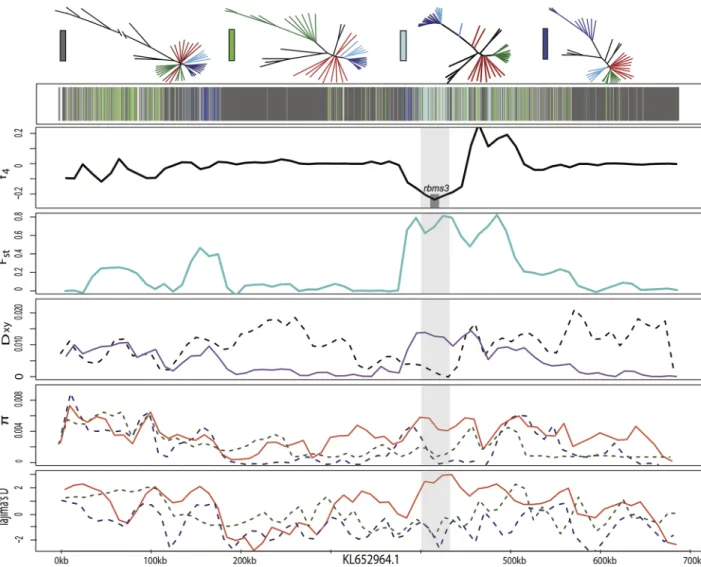
and segregating in the generalist population, a signature of high absolute genetic divergence between the two specialists, and a selective sweep in the scale-eater (Fig 7). Several lines of evi-dence point towards the introgression ofrbms3variants between scale-eater andC.laciniatus. First, genetic differentiation is minimal between scale-eaters andC.laciniatus(Dxy= 0.002) and higher in all other pairwise comparisons (Dxy>0.0104) between the two specialists and two outgroup Caribbean pupfish species (S4 Table). Segments of this region were assigned to the combined scale-eater topology (Fig 2C) and a maximum likelihood tree of the segment containing the fixed SNP featuresC.laciniatusin a clade with scale-eaters (S14 Fig). Similar to the pattern we find inrbms3, another candidate region previously associated with oral jaw size variation on San Salvador Island spanningpard3contained fixed scale-eater variants shared withC.laciniatus, strong genetic similarity in the surrounding region between the two and signs of a selective sweep in the scale-eaters (S15andS16Figs,Table 1).
In an unannotated candidate adaptive introgression region which has previously been asso-ciated with oral jaw size variation on San Salvador Island, we find a slightly different pattern than those mentioned above. The direction of introgression appears to be betweenC. lacinia-tusand the molluscivores, but is under a selective sweep in the scale-eaters (S17andS18Figs,
Table 1andS3 Table). We also see a similar pattern innbea, where the direction of introgres-sion appears to be betweenC.laciniatusand scale-eaters but is under a selective sweep in the molluscivores (S19andS20Figs,Table 1andS3 Table).Nbeaencodes for a scaffolding protein Fig 6. Genetic diversity surrounding the fixed variant in ski region assigned to the combined scale-eater topology. (A) The 3’
untranslated region variant fixed between the two specialists. The number of individuals with the haplotype(s) are located in parentheses next to species names. The other two fixed SNPs follow the same pattern across species as the SNP shown.(B) A comparison of the San Salvador Island genotypes (green = molluscivore; red = generalists; blue = scale-eater) with the C. laciniatus genotype (black) across an 8-kb window surrounding the fixed variant (orange arrow). The alleles that do not match the alleles of C. laciniatus are highlighted with black bars. The arrow points to the conflicting genotypes in the surrounding 8-kb region of the SNPs.
involved in neurotransmitter release and synaptic functioning and has been identified as a can-didate gene for non-syndromic autism disorder [72–74]. In zebrafish, mutations disrupt elec-trical and chemical synapse formation and cause behavioral abnormalities such as decreased startle response [75]. Introgression in this regions is of interest because behavior is another axis of divergence between specialists in this system alongside craniofacial traits, as the species vary in mate choice [76,77], aggression, and prey capture behavior [54]. Both of these candi-date regions feature nearly equivalent negative Tajima’s D statistics and low nucleotide diver-sity in the both of the specialists. The regions do not appear to be under strong selection in the generalist populations on San Salvador Island, so the signatures of selective sweeps in both spe-cialists most likely stem from parallel molecular evolution in these regions rather than purify-ing selection in the ancestral population. Seven of 11 candidate regions show this pattern of Fig 7. Candidate adaptive introgression region in craniofacial development gene rbms3. Row 1 shows the topology assigned by
SAGUARO to segments along a 700-kb scaffold (dark grey: dominant topology; blue: large-jawed scale-eater topology; light blue: combined scale-eater topology; green: molluscivore topology; light grey: all other topologies; white: unassigned segments). Row 2 shows average f4
value across non-overlapping 10-kb windows between mollsucivores/scale-eaters. Shaded grey box shows region annotated for rbms3 gene. Row 3 shows average Fstvalue across non-overlapping 10-kb windows between molluscivores/scale-eaters (turquoise). Row 4
shows between-population divergence (Dxy) across non-overlapping 10-kb windows between molluscivores/eaters (purple) and
scale-eaters/C. laciniatus (grey-dashed). Row 5 shows within-population diversity (π) across non-overlapping 10-kb windows (blue-dashed: eater; green-dashed: molluscivores; red: generalists). Row 6 shows Tajima’s D across non-overlapping 10-kb windows (blue-dashed: scale-eater; green-dashed: molluscivores; red: generalists).
https://doi.org/10.1371/journal.pgen.1006919.g007
equivalent low diversity and negative Tajima’s D statistics in both specialists (Table 1andS3 Table).
The other 6 adaptive introgression candidates contained genes with a variety of functions including angiogenesis, calcium ion binding, embryonic eye morphogenesis, and RNA bind-ing (Table 1) and had similar patterns to those mentioned above. Four of these regions feature low genetic diversity in both specialists. Two of these candidates lie in consecutive regions of the genesrbd1, which encodes for an RNA binding protein, and it appears that one has intro-gressed between the molluscivores andC.laciniatusand the other between scale-eaters andC.
laciniatus. Both of these regions appear to be under a selective sweep in both of the specialists (Table 1andS3 Table).
Overall, potential adaptive variants contributing to species divergence among the specialists appear to be coming from New Providence Island in the northern Caribbean, rather than the southern Caribbean (Table 1andS3 Table). Since it is impossible to infer the directionality of gene flow directly fromf4values, we used TREEMIX [63] to visualize gene flow in adaptively introgressed regions. Across the candidate adaptive introgression regions, we found evidence of an admixture event directly fromC.laciniatusinto the molluscivores inskiandltbp2andC.
laciniatusinto scale-eaters insrbd1(Fig 8andS5 Table). This suggests that genetic variation found on New Providence Island introgressed into the San Salvador Island radiation. There is no direct evidence from the TREEMIX population graphs of admixture fromC.bondiinto a specialist in the candidate regions (S5 Table), and DxybetweenC.bondiand the specialists in
pairwise comparisons is greater than those found betweenC.laciniatusand specialists across these regions (S3 Table). Both lines of evidence suggest that the highf4values in these regions stem from gene flow betweenC.laciniatusand the specialists rather thanC.bondi.
Discussion
Diverse sources of genetic variation contributed to a highly localized
adaptive radiation
Our investigation of genetic variation reveals that multiple sources of genetic variation were important for the assembly of the complex phenotypes associated with the novel ecological transitions seen only on San Salvador Island, Bahamas. While species divergence appears to mostly come from selective sweeps of variation from San Salvador Island (Fig 4), rare adaptive introgression has also played a role in the radiation (Table 1; Figs5and7,S15,S17andS19
Figs). The adaptive introgression we found in this study has come from large admixture events into San Salvador Island from a generalist pupfish population on another Bahamian island approximately 300 km away. In contrast, we found no evidence of introgression from a gener-alist population 700 km away in the Dominican Republic in our top candidate regions (Table 1
andS5 Table), although it is impossible to rule out that candidate adaptive variants may also exist in this population at lower frequencies. Importantly, our limited sampling of one individ-ual from each of two distant islands suggests that long-distance adaptive introgression is com-mon and arises from abundant genetic variation found in only some parts of the Caribbean. An intriguing implication of these findings is that adaptive variants within the San Salvador Island radiation may have been partly assembled from the overlap of different pools of stand-ing variation distributed across different parts of the Caribbean.
Fig 8. Introgression into the specialists on San Salvador Island from C. laciniatus. TREEMIX population graphs for three
candidate adaptive introgression regions showing gene flow from C. laciniatus into the molluscivores in the (A) ski region (change in composite log-likelihood with increase in number of migration events: m = 0, LnL: -320; m = 1, LnL: 81; m = 2, LnL: 93), (B) C.
laciniatus into the large-jawed scale-eaters in the ltpb2 region (m = 0, LnL: 11; m = 1, LnL: 62; m = 2, LnL: 137; m = 3, LnL: 62),
and (C) in the srbd1 region (m = 0, LnL: -17; m = 1, LnL: -11; m = 2, LnL: 74; m = 3, LnL: 68).
https://doi.org/10.1371/journal.pgen.1006919.g008
which introgressed fromC.laciniatus, another pupfish species on an island 300 km away (Figs
5,6and8A,Table 1). The best candidate for scale-eaters was a region containing a single fixed variant in the generbms3(Fig 7,Table 1), which is also present inC.laciniatus. Other candi-date regions contained genes with functions in behavior, angiogenesis, calcium ion binding, embryonic eye morphogenesis, and RNA binding (Table 1).
We rarely know the source of candidate variants involved in diversification or the contribu-tions of multiple sources of genetic variation to rapid diversification. Genomic investigacontribu-tions of other adaptive radiations have also inferred roles for multiple genetic sources contributing to rapid diversification. For example, in the apple maggot fly, ancient gene flow from Mexican populations introduced an inversion affecting key diapause traits that aided the sympatric host shift to apples in the United States [78]. Hybridization within Darwin’s finches also appears to play a role in the origin of new lineages through adaptive introgression of functional loci con-tributing to beak shape differences between species [21]. In aMimulusspecies complex, intro-gression of a locus affecting flower color appears to have been a driver of adaptation in the early stages of their diversification [79]. However, even in case studies demonstrating multiple sources of genetic variation, the relative contributions to the diverse ecological traits in these radiations still remain unknown in most cases (but see [80]).
The genomic landscape of introgression differs between sympatric
trophic specialists
Only 10% of all introgressed regions in either the molluscivore or scale-eater were shared between the two. This minimal overlap may reflect the complexity of different performance demands. Performance in the two specialists involves very different sets of functional traits (i.e. higher mechanical advantage and a novel nasal protrusion in the molluscivores vs. enlarged oral jaws and adductor muscles in the scale-eaters [54]) and divergent selective regimes (narrow and shallow vs. wide and deep fitness valleys [53,81,82]). The extensive vari-ability in the genetic variation that introgressed between the two specialists may reflect multi-dimensional adaptation to two distinct trophic niches in this radiation, rather than variation along a linear axis (e.g. see [83–88]).
Did introgression trigger adaptive radiation?
Although introgression is rare and localized across the genome, it was likely important for the assembly of the complex phenotypes observed on San Salvador Island (e.g.ski and rbms3). Our findings suggest two alternative possibilities. One intriguing possibility is that rare introgres-sion of the necessary adaptive alleles into San Salvador Island may have been required to trig-ger the radiation in the presence of ecological opportunity. Indeed, a paradox in this system is why generalist populations in hypersaline lakes on neighboring islands with similar levels of ecological opportunity, lake areas, and overall genetic diversity have not radiated [53]. Alterna-tively, adaptive radiation on San Salvador Island may have initiated from standing andde novo
variation and only later benefited from introgressed alleles to further refine species pheno-types. Of course, these scenarios are not mutually exclusive and may vary across loci. Based on our TREEMIX analysis, introgression fromC.laciniatusinto the molluscivores brought theski
variants (Fig 8A), but the candidate adaptive variants in this region are also segregating in the generalist population (Fig 6).
[89]. Using mutation rate estimates ranging from 5.37x10⁻⁷(phylogeny-based estimate of
Cyprinodonsubstitution rate [90]) to 1.32x10⁻⁷mutations site-1year-1(estimated from a cichlid pedigree estimate of the per generation mutation rate [91] using a pupfish generation time of 6 months), introgression of theskiadaptive haplotype fromC.laciniatusinto the molluscivore specialist occurred between 5,700 to 23,500 years ago. The 10,000 year age estimate of the San Salvador Island radiation (based on estimates of dry lakes on the island [49–51]) falls within this window. This suggests the intriguing scenario in which widespread introgression during the last glacial maximum may have triggered adaptive radiation within pupfish populations isolated in the saline lakes of San Salvador Island during their initial formation. The 10-fold larger land mass of the Great Bahama Bank during this time could have created the opportu-nity for larger pupfish populations and greater genetic diversity. These pupfish populations would have been connected more extensively across the region than currently by the increased expanses of coastline habitats on the exposed bank. However, these are only exploratory infer-ences of the directionality of gene flow and timing of introgression. They should be confirmed with demographic analyses focused on testing different scenarios of admixture into San Salva-dor Island (e.g. [26,90,92–95]).
While there are rare and convincing examples of hybridization leading to homoploid speci-ation (reviewed in [47]), no study, including ours, has yet provided convincing evidence that hybridization was directly involved in triggering an adaptive radiation. For example, while there is strong evidence in Darwin’s finches that adaptive introgression of a loci controlling beak shape has contributed to phenotypic diversity of finches in the Galapagos, this hybridiza-tion occurred between members within the radiahybridiza-tion [21]. Similarly, a recent study argued that hybridization between ancestral lineages of the Lake Victoria superflock cichlid radiations and distant riverine cichlid lineages fueled the radiations, based on evidence of equal admix-ture proportions across the genomes of the Victorian radiations from the riverine lineages and the presence of allelic variation in opsins in the riverine lineages which are also important in the Victoria radiation [38]. However, the timing of introgression and necessity of introgressed alleles for initiating adaptive radiations remains unclear in these systems, including our own. Admittedly, hybridization as the necessary and sufficient trigger of adaptive radiation is a diffi-cult prediction to test.
Those examples with more direct evidence linking hybridization to adaptation and repro-ductive isolation within a radiation are often special cases where a single introgressed adaptive allele automatically results in increased reproductive isolation. Examples include introgressed adaptive loci controlling wing patterns inHeliconiusbutterflies involved in mimicry and mate selection [28,96], a locus controlling copper tolerance inMimulusthat is tightly associated with one causing hybrid lethality [16], and loci contributing to differing insecticide resistance in the M/S mosquito mating types [97–99]. While these cases provide convincing evidence that adaptive introgression can facilitate both ecological divergence and reproductive isolation, it is still unclear whether this introgression has actually triggered or simply contributed to the ongoing process of adaptive radiation.
Truly addressing the question of whether adaptive introgression triggered the radiation on San Salvador Island will require a better understanding of the timing of introgression and the necessity of introgressed variation for the speciation process. Although we have candi-date alleles (e.g. inskiandrbms3) that we think play a role in the evolution of complex spe-cialist phenotypes, it still remains unclear what minimal set of alleles is necessary for the major ecological transitions in this system. Knowledge of the age of variants important for these transitions, and whether these variants are present and adaptive in the other non-radi-ating lineages of Caribbean generalist populations is needed. Estimation of the age of intro-gressed variation relative to standing orde novocould also shed light on whether adaptive
introgression simply contributed to an ongoing diversification process or triggered it on San Salvador Island.
A new small-jawed scale-eating species within the radiation?
We also found evidence of a distinct clade of small-jawed scale-eaters, separate from the large-jawed scale-eaters (Figs1and2). The consistent clustering of this clade across the genome sug-gests that they may be a distinct, partially reproductively isolated population on San Salvador Island, rather than a product of hybridization between generalists and scale-eaters in the lakes where they exist sympatrically (Figs1and2;S1andS2Figs). They have only been observed in six lakes connected to the Great Lake System on San Salvador Island (Great Lake, Mermaid’s Pond, Osprey Pond, Oyster Pond, Little Lake, and Stout’s Lake), but not in isolated lakes such as Crescent Pond. Consistent with this pattern of occurrence, F2hybrid phenotypes
resem-bling the scale-eaters have previously been shown to have extremely low survival and growth rates in these isolated lakes [81].
Small-jawed scale-eaters may represent a viable intermediate ecotype on the evolutionary path toward more specialized scale-eating. Small-jawed scale-eater diets appear to be consis-tent with intermediate levels of scale-eating. Preliminary gut conconsis-tent analyses revealed that scales were found in the stomachs of 33% of small-jawed scale-eaters (n= 33) compared to 91% of large-jawed scale-eaters (n= 53). The idea that specialization can open the door to fur-ther specialization has been seen in ofur-ther systems, including pollinator syndromes for bees, hummingbirds, and hawkmoths inMimulus[100–102], Darwin’s ground finch specializing on blood on two islands in their range [103], and transitions in mammals between omnivory, carnivory, and herbivory [104]. If small-jawed scale-eaters represent an ecotype stepping stone on the path toward more specialized scale-eating, we might expect regions of the genome to reflect a nested relationship between the large-jawed and small-jawed scale-eaters. We see this predicted pattern in the combined scale-eater topology that underlies most of the fixed vari-ants between the two scale-eating species (Fig 2).
If the small-jawed scale-eaters were instead the result of recent or recurrent hybridization events, we would expect certain patterns of large-jawed scale-eater and generalist ancestry across their genomes. For example, if they represent F1hybrids, they should have equal
ances-try from the two parental species across their genomes. The lack of fit in all five small-jawed scale-eater individuals to the ancestry proportions excepted if they represent F1hybrids, F2
hybrids, or backcrosses to parental species (S2 Table) suggests that the small-jawed scale-eaters are not the result of such recent hybridization events, although they might have resulted from more complicated scenarios of hybridization that do not follow these simple patterns of ances-try [105,106]. LD does appear to be stronger in the small-jawed scaler-eaters than in the three San Salvador Island species (S3 Fig), a pattern expected in recent hybrids of distinct popula-tions. These small-jawed scale-eaters may indeed be the products of ongoing or recent gene flow on San Salvador Island. A reconstruction of the history of gene flow among San Salvador Island species from demographic modeling with a larger sample, along with estimates of selection and reproductive isolation in the small-jawed scale-eaters, will be needed to assess whether they represent the products of ongoing gene flow on San Salvador Island or a potential new ecomorph.
Conclusion
radiation is localized to small regions across the genome that are obscured by genome-wide summaries of the history of the radiation. Species divergence appears to mostly come from selective sweeps of standing orde novogenetic variation on San Salvador Island, but rare adap-tive introgression events may also be necessary for the evolution of trophic specialists. This genomic landscape of introgression is variable between the specialists and has come from large admixture events from populations as far as 700 km across the Caribbean, although all top adaptive introgression candidates appear to have introgressed from a population 300 km away in the northwestern Bahamas. Our findings that multiple sources of genetic variation contrib-ute to the San Salvador Island radiation suggests a complex suite of factors, including rare adaptive introgression, may be required to trigger adaptive radiation in the presence of eco-logical opportunity.
Methods
Study system and sampling
Individual pupfish were caught in hypersaline lakes on San Salvador Island in the Bahamas with either a hand or seine net in 2011, 2013, and 2015. Samples were collected from eight iso-lated lakes on this island (Crescent Pond, Great Lake, Little Lake, Mermaid Pond, Moon Rock Pond, Oyster Lake, Osprey Lake, and Stout’s Lake) and one estuary (Pigeon Creek). 13 Cypri-nodon variegatuswere sampled from all eight lakes on San Salvador Island; 10C. brontother-oideswere sampled from four lakes; and 14C.desquamatorwere sampled from six lakes. The specialist species occur in sympatry with the generalists in only some of the lakes. Individual pupfish that were collected from other localities outside of San Salvador Island served as out-groups to the San Salvador Island radiation, includingC.laciniatusfrom Lake Cunningham, New Providence Island in the Bahamas,C.bondifrom Etang Saumatre lake in the Dominican Republic,C.diabolisfrom Devil’s Hole in California (collected as a dead specimen by National Park Staff in 2012), as well as captive-bred individuals of extinct-in-the-wild speciesC.simus
andC.mayaoriginating from Laguna Chichancanab, Quintana Roo, Mexico. Fish were eutha-nized by an overdose of buffered MS-222 (Finquel, Inc.) following approved protocols from University of California, Davis Institutional Animal Care and Use Committee (#17455) and University of California, Berkeley Animal Care and Use Committee (AUP-2015-01-7053) and stored in 95–100% ethanol. Only degraded tissue was available forC.diabolis, as described in [90]. Field research and export/collection permits were authorized by the BEST Commission in the Bahamas, the Ministry of Protected Areas and Biodiversity in the Dominican Republic, and the U.S. Fish & Wildlife Service and National Park Service.
Genomic sequencing and bioinformatics
DNA was extracted from muscle tissue using DNeasy Blood and Tissue kits (Qiagen, Inc.) and quantified on a Qubit 3.0 fluorometer (Thermofisher Scientific, Inc.). Genomic libraries were prepared using the automated Apollo 324 system (WaferGen Biosystems, Inc.) at the Vincent J. Coates Genomic Sequencing Center (QB3). Samples were fragmented using Covaris sonication, barcoded with Illumina indices, and quality checked using a Fragment Analyzer (Advanced Analytical Technologies, Inc.). Nine to ten samples were pooled in four different libraries for 150PE sequencing on four lanes of an Illumina Hiseq4000.
2.8 billion raw reads were mapped from 42 individuals to theCyprinodonreference genome (NCBI,C.variegatusAnnotation Release 100, total sequence length = 1,035,184,475; number of scaffold = 9,259, scaffold N50, = 835,301; contig N50 = 20,803) with the Burrows-Wheeler Alignment Tool [107] (v 0.7.12). Duplicate reads were identified using MarkDupli-cates and BAM indices were created using BuildBamIndex in the Picard software package
(http://picard.sourceforge.net(v.2.0.1)). We followed the best practices guide recommended in the Genome Analysis Toolkit [108](v 3.5) to call and refine our SNP variant dataset using the program HaplotypeCaller. We filtered SNPs based on the recommended hard filter criteria (i.e. QD<2.0; FS<60; MQRankSum<-12.5; ReadPosRankSum<-8) [97,108] because we lacked high-quality known variants for these non-model species. Our final dataset after filter-ing contained 16 million variants and a mean sequencfilter-ing coverage of 7.2X per individual (range: 5.2–9.3X).
Characterization of genomic heterogeneity in evolutionary relationships
among individuals
We used the machine learning program SAGUARO [56] to identify regions of the genome that contain different signals about the evolutionary relationships across San Salvador Island and outgroupCyprinodonspecies. Saguaro combines a hidden Markov model with a self-orga-nizing map (SOM) to characterize local phylogenetic relationships among individuals without requiringa priorihypotheses about the relationships. When diploid data is used, the SOM selects one allele at random for training. This method infers local relationships among individ-uals in the form of genetic distance matrices and assigns segments across the genomes to these topologies. These genetic distance matrices can then be transformed into neighborhood join-ing trees to visualize patterns of evolutionary relatedness across the genome. Three indepen-dent runs of SAGUARO were started using the program’s default settings and each was allowed to assign 15 different topologies across the genome. To determine how many topolo-gies to estimate, analogous to a scree plot [109,110], we plotted the proportion of the genome explained by each hypothesized topology and looked for an inflection point (S21 Fig). We also looked at the neighborhood joining trees to assess whether additional topologies were infor-mative about the evolutionary relationships among individuals (S21 Fig). The 15thtopology and additional topologies that we investigated tended to be uninformative about the evolution-ary relationships among individuals and represented less than 0.5% of the genome. We excluded the last topology (15th) from downstream analyses due to lack of genetic distinction at both the level of populations and species included in the proposed genetic distance matrix and the low percentage of the genome assigned to it. The 14 topologies included in down-stream analyses and the total percentages of the genome assigned to them were robust across all three independent runs. These topologies also appeared to be fairly robust to the influences of poorly mapped regions in the genome. We generated a mask file to identify poorly mapped regions in our dataset using the program SNPable (http://bit.ly/snpable; k-mer length = 50, and ‘stringency’ = 0.5) and removed these segments from downstream analyses of the topolo-gies. Rerunning the SAGUARO analysis on the masked dataset resulted in very similar trees across the 14 different topologies, with the exception of several generalist individuals grouping with molluscivores in the molluscivore topology (S22 Fig).
Comparison of linkage disequilibrium among San Salvador Island
species
We calculated LD within each of the San Salvador Island species and compared it to estimates for the small-jawed scale-eaters to look for patterns of high linkage consistent with recent hybridization events. Pairwise LD across the largest scaffold in our dataset (4.2 Mb) was calcu-lated for each species using the ‘r2 inter-chr’ function in PLINK v1.90 [111] for five individu-als. These were chosen from a pool of individuals from Great Lake system populations (average genome-wide Fst<0.05 across these lakes for each of the species) to balance the
compare LD decay between species. LD may be overestimated for each of the species due to the small number of individuals available to calculate it from in this study, and should be com-pared to estimates from other studies with caution.
Characterization of introgression patterns across the genome
We characterized the heterogeneity in introgression across the genome usingf4statistics that were initially developed to test for introgression among human populations [61–63]. Thef4 statistic tests if branches among a four-taxon tree lack residual genotypic covariance (as expected in the presence of incomplete lineage sorting and no introgression) by comparing allele frequencies among the three possible unrooted trees. A previous study [53] provided evi-dence of potential admixture with the Caribbean outgroup species used in this study, prevent-ing their use in a D-statistic framework which requires designation of an outgroup with no potential introgression.
To look for evidence of gene flow across the Caribbean, we focused on tests of introgression with the two outgroup clades from our sample that came from other Caribbean islands in the Bahamas and Dominican Republic. Based on the tree ((P1, P2),(C.laciniatus,C.bondi)),f4 sta-tistics were calculated for all three possible combinations of P1,P2 among the pooled popula-tions of generalists, scale-eaters, and molluscivores on San Salvador Island. Thesef4statistics were calculated using the population allele frequencies of biallelic SNPs and summarized over windows of 10 kb with a minimum of 50 variant sites using a custom python script (mod-ified from ABBABABA.py created by Simon H. Martin, available onhttps://github.com/ simonhmartin/genomics_general; [64]; our modified version is provided in the supplemental material), allowing for up to 10% missing data within a population per site. All 10 molluscivore and 14 scale-eater individuals from San Salvador Island were used in the tests for comparison to the molluscivore and combined scale-eater topologies, respectively. In another calculation off4statistics across the genome, the 5 small-jawed scale-eater individuals were excluded for the comparison to the large-jawed scale-eater topology. Although only single individuals from New Providence Island, Bahamas and the Dominican Republic were used to representC. laci-niatusandC.bondiin thef4tests, the individuals that were sequenced are a random sample from these populations and should be representative. This resulted in 100,276f4statistics (meanf4= -2x10⁻⁴) calculated across the genome for the test that included all scale-eaters and 100,097f4statistics (meanf4= -9x10⁻⁵) for the test excluding the small-jawed scale-eaters.
We conducted 1,000 permutations of thef4test to evaluate the significance off4values in sliding windows across the genome. For each permutation, individuals from the four original populations were randomly assigned without replacement to one of the four populations based on the tree ((P1,P2),(P3,P4)) to assess how likely a givenf4value would be observed by chance within our empirical dataset. We calculated the 1% tails of this null distribution and used these thresholds for our candidate introgressed regions (i.e. significant at alpha = 0.02). The null distribution illustrating the 1stand 99thquantiles for all combinations of the sliding windowf4test are provided in the supplementary material (S23 Fig). Each candidate intro-gressed region was assigned aP-value by counting the number of permutations that had anf4 value greater than (or lesser than if thef4value was negative) or equal to the observed value.
It is difficult to distinguish between genetic variation that is similar among taxa due to introgression from a hybridization event and that from ancestral population structure, so some of the regions with significantf4values may represent the biased assortment of genetic variation into modern lineages from a structured ancestral population [51]. A recent simula-tion study [64] found that extending the use of genome-wide introgression statistics such as Patterson’s D statistic to small genomic regions can result in a bias of detecting statistical
outliers mostly in genomic regions of reduced diversity. Although it hasn’t been formally tested,f4statistics may be subject to the same biases, so we additionally considered the nucleo-tide diversity present in outlierf4regions in downstream analyses by comparingπacross the detected regions of introgression in comparison to scaffold- and genome-wide estimates among the three San Salvador Island species.
Comparison of patterns of introgression to patterns of genetic
divergence and diversity
We then calculated several population genetic summary statistics in sliding windows across the genome to compare to thef4patterns of introgression: Fst, between-population nucleotide
divergence (Dxy), within-population nucleotide diversity (π) for pairwise species comparisons, and Tajima’s D estimates of selection in each species. Dxybetween molluscivores and
scale-eaters was calculated over the same 10-kb windows as thef4tests using the python script pop-GenWindows.py created by Simon Martin (available onhttps://github.com/simonhmartin/ genomics_general; [64]). Since our vcf file contained only variant sites and this script does not factor the missing sites into the calculation ofDxyby assuming they are invariant, we post-hoc incorporated the missing sites as invariant sites in the calculation ofDxy. Missing sites in our dataset may include poorly aligned regions with lots of variants, so by assuming the missing sites are all invariant,Dxymay be underestimated in this study and should be compared to diversity values from other organisms with caution.
The remaining statistics were calculated in non-overlapping sliding windows of 10 kb using ‘wier-fst-pop’, ‘window-pi’, and ‘TajimaD’ functions in VCFtools v.0.1.14 [112]. Negative val-ues of Tajima’s D indicate a reduction in nucleotide variation across segregating sites [113], which may result from hard selective sweeps due to positive selection. To determine regions of the genome potentially under positive selection, we created a null distribution of Tajima’s D values expected for each of three species under neutral coalescent theory using ms-move [114], a program that adds more flexibility in incorporating introgression events into the coalescent simulator ms [115]. Based on the demographic history estimated for the three San Salvador Island species in a previous study [55], we incorporated a 100-fold decrease in population size approximately 10,000 years ago (-eN 0.8 0.01) and an introgression event from one population into another to mimic introgression between a San Salvador Island species and an outgroup population at the beginning of the radiation (ex. -ej 0.8 2 1 –ev 0.8 2 1 0.1). We estimated the null distribution of Tajima’s D for 100,000 loci for 10–14 individuals with a variable number of segregating sites (ranging from 50 to the maximum observed in a 10-kb window of the genomes of each species). We modeled the timing of introgression from approximately 6,000– 23,000 years (based on the rough estimate of the timing of introgression ofskiin this study) with 10% of population composed of migrants (although the distribution appeared robust to variations in this fraction). Tajima’s D values were calculated from the simulated loci using the ‘sample stats’ feature available in the ms package [114]. The simulated introgression event and bottleneck skewed the null distribution towards negative Tajima’s D values (S24 Fig). Win-dows from the observed genomes that had Tajima’s D values in the lower 2% tail of the null distribution were considered candidate regions for selective sweeps.


![Fig 5. Candidate adaptive introgression region in craniofacial development gene ski. Fixed variants in this region were previously associated with pupfish oral jaw size [55]](https://thumb-us.123doks.com/thumbv2/123dok_us/8272742.2191047/11.918.154.858.110.661/candidate-adaptive-introgression-craniofacial-development-variants-previously-associated.webp)