Cytokinin induces genome-wide binding of the type-B
response regulator ARR10 to regulate growth and
development in
Arabidopsis
Yan O. Zuboa,1, Ivory Clabaugh Blakleyb,1, Maria V. Yamburenkoa, Jennifer M. Worthena, Ian H. Streeta,
José M. Franco-Zorrillac, Wenjing Zhangd, Kristine Hilla,2, Tracy Rainesd, Roberto Solanoe, Joseph J. Kieberd, Ann E. Loraineb,3, and G. Eric Schallera,3
aDepartment of Biological Sciences, Dartmouth College, Hanover, NH 03755;bDepartment of Bioinformatics and Genomics, University of North Carolina at
Charlotte, Kannapolis, NC 28081;cGenomics Unit, Centro Nacional de Biotecnología (CNB)-Consejo Superior de Investigaciones Científicas (CSIC), 28049
Madrid, Spain;dDepartment of Biology, University of North Carolina at Chapel Hill, NC 27599; andeDepartment of Plant Molecular Genetics, CNB-CSIC,
28049 Madrid, Spain
Edited by Peter H. Quail, University of California, Berkeley, Albany, CA, and approved June 1, 2017 (received for review December 19, 2016)
The plant hormone cytokinin affects a diverse array of growth and development processes and responses to the environment. How a signaling molecule mediates such a diverse array of outputs and how these response pathways are integrated with other inputs remain fundamental questions in plant biology. To this end, we character-ized the transcriptional network initiated by the type-BARABIDOPSIS RESPONSE REGULATORs (ARRs) that mediate the cytokinin primary response, making use of chromatin immunoprecipitation sequenc-ing (ChIP-seq), protein-bindsequenc-ing microarrays, and transcriptomic ap-proaches. By ectopic overexpression of ARR10,Arabidopsis lines hypersensitive to cytokinin were generated and used to clarify the role of cytokinin in regulation of various physiological responses. ChIP-seq was used to identify the cytokinin-dependent targets for ARR10, thereby defining a crucial link between the cytokinin primary-response pathway and the transcriptional changes that me-diate physiological responses to this phytohormone. Binding of ARR10 was induced by cytokinin with binding sites enriched toward the transcriptional start sites for both induced and repressed genes. Three type-B ARR DNA-binding motifs, determined by use of protein-binding microarrays, were enriched at ARR10 binding sites, confirming their physiological relevance.WUSCHELwas identified as a direct target of ARR10, with its cytokinin-enhanced expression resulting in enhanced shooting in tissue culture. Results from our analyses shed light on the physiological role of the type-B ARRs in regulating the cytokinin response, mechanism of type-B ARR activa-tion, and basis by which cytokinin regulates diverse aspects of growth and development as well as responses to biotic and abiotic factors.
type-B ARR
|
two-component system|
protein-binding microarray|
transcriptional cascade|
WUSCHELC
ytokinins are phytohormones that play critical roles throughout plant growth and development (1–3). They were initially dis-covered and named over a half-century ago based on their ability to stimulate plant cell division in tissue culture (4). In the decades since their discovery, they have been found to regulate a variety of plant processes, including the stimulation of chloroplast develop-ment, modulation of shoot and root developdevelop-ment, delay of leaf senescence, and regulation of metabolic processes, in particular those related to source–sink relationships (1, 2). In addition, cyto-kinins regulate plant responses to biotic and abiotic stresses (5–7). The initial pathway for cytokinin signal transduction is a multi-step phosphorelay that incorporates cytokinin receptors, histidine-containing phosphotransfer proteins, and type-B response regula-tors (1, 2). These relay the cytokinin signal from the membrane to the nucleus, where the type-B response regulators function as tran-scription factors to regulate gene expression. InArabidopsis thaliana, there are 3 cytokinin receptors (ARABIDOPSIS HISTIDINE KINASEs; AHKs), 5 phosphotransfer proteins (ARABIDOPSISHISTIDINE-CONTAINING PHOSPHOTRANSFER PROTEINs;
AHPs), and 11 type-B response regulators (ARABIDOPSIS
RESPONSE REGULATORs; ARRs). Genetic analysis has dem-onstrated roles for each of these families in a variety of cytokinin-regulated processes.
The type-B ARRs mediate the primary transcriptional re-sponse of Arabidopsis to cytokinin (8–11). The type-B ARRs appear to function similar to prokaryotic response regulators, many of which are also transcription factors (12). The type-B ARRs contain the evolutionarily conserved receiver domain, diagnostic for a response regulator, in their N-terminal region. The C-terminal extensions are of variable length and contain a DNA-binding Myb-like domain as well as sequences involved in activation and nuclear localization (13, 14). The receiver do-main is thought to inhibit transcriptional activity of the type-B ARR because truncations that remove the receiver domain as well as phosphomimic mutations in the receiver domain con-stitutively activate cytokinin responses in planta (8, 14–16). Ge-netic analysis indicates that the type-B ARR family members ARR1, ARR10, and ARR12 play the most substantial roles in the regulation of transcriptional and physiological responses to
cyto-Significance
Cytokinins, like other plant hormones, affect a diverse array of plant growth and development processes and responses to the environment. How a signaling molecule mediates such a diverse array of outputs and how these response pathways are integrated with other inputs remain fundamental questions in plant biology. An integrated set of approaches was used to define the targets of the type-B response regulators, a key set of transcription factors that control cytokinin-dependent gene expression. Results shed light on the physiological role of the type-B ARRs in regulating the cytokinin response, mechanism of type-B ARR activation, and basis by which cytokinin regulates diverse aspects of growth and de-velopment as well as responses to biotic and abiotic factors.
Author contributions: Y.O.Z., I.C.B., J.M.F.-Z., R.S., J.J.K., A.E.L., and G.E.S. designed research; Y.O.Z., I.C.B., M.V.Y., J.M.W., I.H.S., W.Z., K.H., T.R., A.E.L., and G.E.S. performed re-search; Y.O.Z., I.C.B., M.V.Y., J.M.W., I.H.S., J.M.F.-Z., T.R., R.S., A.E.L., and G.E.S. analyzed data; and Y.O.Z., I.C.B., M.V.Y., J.M.W., I.H.S., J.M.F.-Z., J.J.K., A.E.L., and G.E.S. wrote the paper.
The authors declare no conflict of interest.
This article is a PNAS Direct Submission.
Data deposition: Sequence data reported in this paper have been deposited in the Se-quence Read Archive (BioProject nos.PRJNA286779andPRJNA263839).
1Y.O.Z. and I.C.B. contributed equally to this work.
2Present address: Centre for Plant Molecular Biology, Developmental Genetics, University of Tübingen, 72076 Tuebingen, Germany.
3To whom correspondence may be addressed. Email: [email protected] or george.e. [email protected].
This article contains supporting information online atwww.pnas.org/lookup/suppl/doi:10. 1073/pnas.1620749114/-/DCSupplemental.
PLANT
BIO
LOGY
PNAS
through the ubiquitin-proteasome pathway (15, 17, 18).
The response of theArabidopsistranscriptome to cytokinin has been characterized in over a dozen studies involving a va-riety of plant growth conditions, tissues, and treatment regimes (19, 20). Although we have extensive information on cytokinin-regulated gene expression, we have only limited information on which genes are direct targets of the type-B ARRs. Among the genes most consistently induced in response to cytokinin are the type-A ARRs, which encode a second family of response regulators that negatively regulate cytokinin responses (21, 22). The type-A ARRs are primary-response genes, based on the ability of cytokinin to induce their expression in the presence of cycloheximide (21). In addition, chromatin immunoprecipita-tion has been used to identify binding sites of type-B ARRs involved in regulation of theSHY2andLAX2genes to control auxin responses (23, 24) and ofPR1andPR2to control defense responses (25), indicating that these are also primary-response genes. These studies are consistent with transcriptional regu-lation by the type-B ARRs, but the extent of such direct tran-scriptional regulation in control of the cytokinin response remains to be elucidated.
In this study, we took advantage of the enhanced stability of ARR10 compared with the other type-B ARRs to generate
Arabidopsislines hypersensitive to cytokinin and to clarify the role of cytokinin in regulation of various physiological responses. We also used protein-binding microarrays to characterize the DNA binding sites for ARR1 and ARR10. Finally, we used chroma-tin immunoprecipitation sequencing (ChIP-seq) to identify the cytokinin-dependent targets for ARR10, thereby defining a crucial link between the cytokinin primary-response pathway and the transcriptional changes that mediate physiological responses to this phytohormone. The findings from ChIP-seq also lend insight into the mechanism by which type-B ARRs regulate gene expression, and support the existence of a transcriptional cascade operating downstream of the type-B ARRs.
Results
Elevated Expression of the Type-B Response RegulatorARR10Results in a Hypersensitive Response to Cytokinin.To explore the effects of cytokinin hypersensitivity onArabidopsis, we expressedARR10as a GFP fusion driven by the CaMV 35Spromoter in anarr1 arr10 arr12 loss-of-function mutant background. The rationale for this strategy is as follows. First,ARR10was used because it functionally overlaps with ARR1andARR12 in playing a substantive role in regulating the cytokinin transcriptional response, but the ARR10 protein is likely more stable than these type-B ARRs (26). Second, thearr1 arr10 arr12background was used because this triple mutant abolishes the majority of cytokinin-mediated gene expression and renders the plant largely insensitive to cytokinin for physiological responses (10, 11). Thearr1 arr10 arr12cytokinin-insensitive line can therefore be used to assess functionality of the ARR10-GFP fusion and also eliminates members of the type-B ARR family that could compete with ARR10 for activation and binding sites. Third, theCaMV 35Spromoter was used to drive ectopic overexpression, because the native expression of the type-B ARRs is low and likely restrictive for signaling (26, 27). We also expressed 35S:ARR10: GFPin a wild-type background for comparison. Analysis by qRT-PCR confirmed that the four lines in the arr1 arr10 arr12 back-ground (lines a1, a2, a3, and a4) and the two lines in the wild-type background (lines w1 and w2) exhibited substantially elevated ex-pression of ARR10compared with its native expression level in wild type (Fig. 1A).
Analysis of hypocotyl and root growth responses to cytokinin supports hypersensitivity of the 35S:ARR10:GFP transgenic lines. Exogenous cytokinin inhibits hypocotyl growth in the dark and primary root growth of wild-type seedlings, thearr1 arr12and
arr1 arr10 arr12 mutants exhibiting cytokinin hyposensitivity or
transgene is functional, as it restores cytokinin sensitivity to
arr1 arr10 arr12 in the root and hypocotyl assays as well as rescues the mutant’s primary root abortion phenotype (Fig. 1B
andCandFig. S1) (10, 11). In the absence of cytokinin, two lines (lines a1 and a3) in thearr1 arr10 arr12background have shorter hypocotyls and all four lines have shorter roots in the absence of exogenous cytokinin than the wild type, consistent with an en-hanced response to endogenous cytokinin levels. All four lines in thearr1 arr10 arr12background exhibit a substantially heightened response in the presence of cytokinin (Fig. 1BandDandFig. S1). The pronounced effects on root growth are due to a heightened inhibition of cell expansion as well as of cell proliferation (Fig. 1E
and F). Cytokinin hypersensitivity is also observed when 35S: ARR10:GFPis expressed in the wild-type background, although the effect of the transgene in the absence of exogenous cytokinin is more pronounced in thearr1 arr10 arr12background (Fig. 1Band
CandFig. S1).
Cytokinin is a positive regulator of cell proliferation and growth in the shoot, contrasting with its negative regulation of cell pro-liferation and growth in the primary root. Loss of type-B response regulators (arr1 arr10 arr12mutant) results in a substantial decrease in leaf size compared with wild type, this effect on growth in the mutant being primarily due to a decrease in cell proliferation, al-though a decrease in leaf cell area is also observed (Fig. S2Aand
B). Expression of 35S:ARR10:GFP in the arr1 arr10 arr12 back-ground complemented the leaf growth phenotype of the mutant (Fig. S2AandC). In addition, the later larger leaves of the35S: ARR10lines exhibited an increase in cell number compared with wild type, consistent with hypersensitivity to endogenous cytokinin resulting in greater cell proliferation in the shoot.
The hypersensitive ARR10 lines also exhibit an enhanced tran-scriptional response to cytokinin (Fig. 1GandH). The cytokinin-mediated induction ofARR7,ARR15, andCKX5and the repression ofHKT1were examined (8, 20, 28, 29).ARR7andARR15encode type-A ARRs and are primary-response genes,CKX5 encodes a cytokinin oxidase, andHKT1encodes a gene whose product is re-sponsible for removing sodium ions from the root xylem. The cytokinin-dependent regulation of these genes is severely attenu-ated in the cytokinin-insensitive arr1 arr12mutant (thearr1 arr10 arr12mutant was not used for comparison because its primary root prematurely aborts) (Fig. 1G). Consistent with the physiological responses to cytokinin,ARR10-GFPoverexpression resulted in in-creased transcript levels for ARR7, ARR15, and CKX5 and de-creased transcript levels forHKT1following cytokinin treatment at all cytokinin concentrations examined, this effect being observed in both thearr1 arr10 arr12and wild-type backgrounds (Fig. 1Gand
H). The basal transcript level ofHKT1was also substantially reduced in theARR10transgenic lines, consistent with a heightened response to endogenous cytokinin. Taken together, these results are consistent with the hypothesis that the cytokinin hypersensitivity found in the
ARR10 lines is due to an enhanced ability to mediate cytokinin-regulated gene expression. Furthermore, the use of thearr1 arr10 arr12loss-of-function background appeared to result in a heightened hypersensitivity compared with use of the wild-type background based on the hypocotyl, root, and molecular response assays.
Genome-Wide Identification of Candidate Targets for ARR10. We exploited the hypersensitive35S:ARR10:GFPlines as a means to identify direct targets of type-B ARRs by chromatin immunopre-cipitation/DNA sequencing. For the ChIP-seq analysis, we exam-ined the hypersensitive lines a1 (two biological replicates) anda2
Fig. 1. 35S:ARR10:GFPlines exhibit hypersensitivity to cytokinin. (A) Cytokinin-hypersensitive lines expressing35S:ARR10:GFPexhibit greaterARR10expression than wild type based on qRT-PCR analysis. Results for four independent lines of35S:ARR10:GFPin thearr1;10;12background (a1, a2, a3, and a4) and two in-dependent lines in the wild-type background (w1 and w2) are shown. Expression was normalized to a tubulin (At5g62700) internal control, and is presented as relative to the wild-type control. (A,Inset) Relative ARR10-GFP protein levels from 7-d-old seedlings based on immunoblot analysis with an anti-GFP antibody (GFP-Ab); LC, loading control. (B) Hypocotyl growth dose–response assay to cytokinin (BA) (n=30). Error bars indicate SE (not shown if smaller than symbol). (C) Root growth dose–response assay to cytokinin (BA) (n=30). The increase in root length from day 4 to 7 was measured. Error bars indicate SE (not shown if smaller than symbol). (D) Primary root tips of 7-d-old wild-type and35S:ARR10:GFP-a1seedlings treated with DMSO vehicle (−) or 1μM BA (+). (Scale bars, 0.2 mm.) (EandF) Hypersensitive lines have shorter roots due to effects on both root cell elongation (E) and cell proliferation (F). Root epidermal cell lengths from the elongation zone (n≥10;P<0.05) and root apical meristem (RAM) size based on the number of cortex cells (n≥5;P<0.05) were determined for 7-d-old roots at the BA concentrations indicated. Error bars indicate SE. Same letters indicate no significant difference by an ANOVA applying Tukey HSD post test (na, conditions with no data due to phenotypic severity). (G)35S:ARR10:GFPlines exhibit a hypersensitive molecular response to cytokinin compared with wild type (Wt) and the cytokinin-insensitivearr1 arr12mutant in a dose–response analysis. Expression is plotted on a log10 scale. Relative transcript levels of cytokinin-responsive genes from 6-d-old roots were examined by qRT-PCR. Seedlings were treated for 2 h with the indicated BA concentrations. Expression was normalized to a tubulin (At5g62700) internal control, and is presented as relative to the Wt untreated control. Transcript levels of the cytokinin-inducible genesARR7,ARR15, andCKX5and the cytokinin-repressed geneHKT1were examined. Error bars indicate SE. (H) Analysis of35S:ARR10: GFPlines w1, w2, and a2 compared with wild type by qRT-PCR (oP<0.05,ooP<0.01, for comparison of BA treatment with untreated for each line,ttest; *P<
0.05, **P<0.01, for comparison of transgenic lines with the analogous wild-type treatment condition, one-way ANOVA with post hoc Holm multiple-comparison calculation;n=3).
PLANT
BIO
LOGY
PNAS
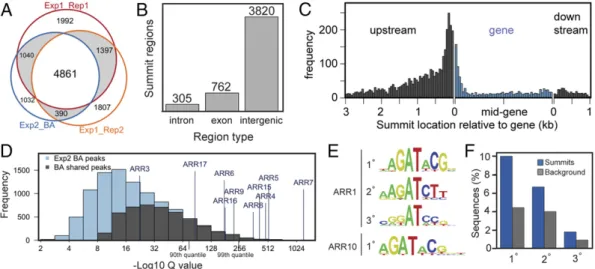
DNA regions bound in the three samples, with 4,861 summits in common for all three samples (Fig. 2A). The peak summits were found in introns, exons, and intergenic regions, the greatest number of summits being found in the intergenic regions that would include the gene promoters (Fig. 2B), this also being the case when nor-malized per kilobase of region type (19% introns, 19% exons, 67% intergenic regions). The maximum peak frequency occurred near the transcription start sites (TSSs) (Fig. 2C), such binding being consistent with a classic regulatory role for ARR10 in the control of gene expression.
ARR10 is predicted to bind to DNA regions associated with the type-A ARRs, which are cytokinin primary-response genes (8, 21, 22). As shown in Fig. 2D, ARR10 binding peaks are found asso-ciated with the type-AARRs, with 9 out of 10 of the ARR10 binding peak summits occurring in the promoter regions of the type-A
ARRs. The peaks exhibit a range ofQvalues, spanning much of the frequency region defined by the overlapping set of 4,861 binding sites. Thus, the ARR10-GFP ChIP-seq analysis extracts a set of known targets (type-AARRs), consistent with the ChIP-seq binding sites being of functional significance.
ARR10 Binding Sites Identified by ChIP-Seq Are Enriched for Type-B ARR DNA-Binding Motifs. ARR10 targets are predicted to be enriched for type-B ARR-binding motifs. To characterize the DNA-binding motifs for ARR1 and ARR10, we used the PBM11 protein-binding microarray (31, 32). ARR1 bound with high affinity to primary (AGATACGG;Escore 0.49250), secondary (AAGATCTT;
E score 0.49080), and tertiary (CGGATCCG; E score 0.48626) motifs (Fig. 2E). These motifs all contain a core (A/G)GAT se-quence previously identified as critical and sufficient for type-B ARR binding (14). The ARR10 protein fusion exhibited partial insolubility with decreased binding efficiency to the protein-binding microarray (PBM), yielding a background of high–G/C-content probes. However, when this background is removed, the same
These three extended binding motifs are the same as those recog-nized by the type-B response regulators ARR11 and ARR14 (32) and are also consistent with the more abbreviated ARR-binding motifs identified by Weirauch et al. (33), indicating that the sub-family-1 type-B ARRs all share a similar DNA-binding specificity. Sequences based on the primary, secondary, and tertiary DNA-binding motifs for the type-B ARRs are all enriched at the ARR10 binding sites identified by ChIP-seq (Fig. 2F), confirming their physiological relevance. Although they were enriched for these extended motifs, we note that many of the summits lack such mo-tifs. These summits are likely to contain core regions (6 bp or less) of the binding motif that, although sufficient for binding, are often too short to be clearly diagnostic for enrichment or contain type-B ARR binding sites diverged from the consensus.
DNA Binding of ARR10 Is Associated with Genes Transcriptionally Regulated by Cytokinin. We identified 4,004 candidate gene tar-gets based on their proximity to the ARR10 binding peaks (Dataset S1), and refer to these as ARR10 candidate targets. Gene targets were then identified by comparison with datasets for genes that are differentially expressed (DE) in response to cytokinin. For this purpose, we made use of an RNA-seq dataset derived from whole seedlings (1,162 DE genes) (20), a new RNA-seq dataset derived from roots (1,221 DE genes) and shoots (39 DE genes), and two microarray datasets derived from shoot tissue (720 and 121 DE genes) (11, 20). We also compared the candidate targets to the “golden list,” a set of genes identified by meta-analysis of 13 cytokinin transcriptome studies that represent robustly DE genes (226 DE genes) (20). In addition, we took advantage of a microarray study in which cytokinin-dependent gene regulation was compared in wild type to the arr1 arr10 arr12mutant (11), incorporating genes that are differentially regulated between these two genotypes into our analysis (1,001 DE genes). In all, 2,848 nonredundant DE genes were identified through these expression
studies. Of these, 804 corresponded to a candidate gene target (Dataset S2); we refer to these 804 genes as ARR10 targets.
The ARR10 candidate targets were substantially enriched for cytokinin DE genes based on our analysis of the golden list for cytokinin-regulated gene expression as well as the RNA-seq information. The golden list contains 158 up-regulated and 68 down-regulated genes (20). Of the up-regulated genes, 76 (48%) correspond to an ARR10 candidate target; of the down-regulated genes, 17 (25%) correspond to an ARR10 candidate target. For the up-regulated DE genes, those supported by a higher number of
microarray experiments are more likely to be associated with an ARR10 binding peak (Dataset S2). Overall, golden list genes are more likely to be near ARR10 peaks than randomly chosen genes (2.3% of the candidate genes have a golden list entry compared with 0.7% predicted for a random occurrence), these genes are more often up- than down-regulated, and ARR10 peaks are most commonly upstream rather than internal to the golden list genes. Similarly, in a comparison of the type-B ARR candidate targets with 1,162 DE genes identified as cytokinin-regulated in an RNA-seq analysis (20), 310 of the DE genes (26.7%) corresponded to an
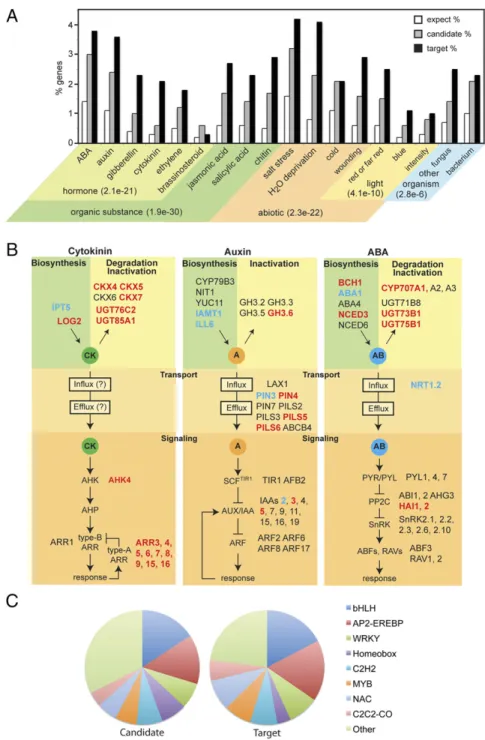
Fig. 3. Enriched GO categories for ARR10 candidate and target genes. (A) GO analysis, showing representative responses that exhibit enrichment for candidate and target genes. The % of candidate and target genes represented by each GO category is compared with the % expected frequency if not enriched. General GO categories of responses are given withPvalues in parentheses. (B) Cytokinin regulates hormone responses through ARR10-mediated control of hormone bio-synthesis, inactivation and degradation, transport, and signaling. ARR10 candidate genes are listed for the hormones cytokinin, auxin, and ABA. Targets con-firmed by expression are in bold and highlighted red if induced by cytokinin, and blue if inhibited by cytokinin. (C) Distribution of transcription factor families among candidate and target genes.
PLANT
BIO
LOGY
PNAS
dicted by chance), with 78.1% of the DE genes being up-regulated. We characterized the cytokinin-induced and -repressed ARR10 target genes in terms of their position relative to the TSS and for enrichment of type-B ARR-binding motifs (Fig. S3). There is no apparent difference between the up- and down-regulated target genes in terms of ARR10-binding location relative to the TSS, both exhibiting what one might expect from a random selection from the overall set of peak–gene associations. However, substantial differ-ences are observed when we examine type-B ARR motif enrichment for the up- and down-regulated genes. The primary, secondary, and tertiary ARR-binding motifs are enriched at binding sites near DE genes (ARR10 targets), but this enrichment is mostly due to the contribution from the up-regulated genes, which are enriched for all three motifs (Fig. S3B). Interestingly, although the tertiary binding motif is more rare, it alone of the three motifs exhibited significant enrichment at binding sites among the down-regulated genes.
Gene Ontology Analysis. Gene ontology (GO) analysis for the ARR10 targets and candidate targets revealed enrichment for similar biological processes (Fig. 3AandDataset S3). The similarity of the GO-enriched processes suggests that the genes identified in the ARR10 candidate-target dataset that lacked verification by expression information (ARR10 target dataset) are also likely to be
expression may require additional regulatory factors, occur during a different developmental state, or exhibit longer-term kinetics for induction, because transcriptomic analyses have focused on the short-term response to cytokinin. The GO analysis points to extensive involvement of ARR10 in the control of hormonal responses, including abscisic acid (ABA), auxin, gibberellin, cyto-kinin, ethylene, brassinosteroids, jasmonic acid, and salicylic acid. Examination of the targets associated with cytokinin, auxin, and ABA reveals multiple regulatory points, including biosynthesis, degradation/inactivation, transport, and signal transduction (Fig. 3B). These data point to the extensive cross-talk that can occur between cytokinin and other hormonal signaling pathways in the control of growth and development. The GO analysis also links ARR10 activation, and hence cytokinin, to both abiotic (salt and drought stress, cold, and light) and biotic stimuli (Fig. 3A).
Our data also support a transcriptional cascade operating in the cytokinin signaling pathway based on GO analysis for molecular function, in which “sequence-specific DNA-binding transcription factor activity”(GO:0003700) is the most highly enriched category. This is the case for both the ARR10 candidate target (11.3% of the genes compared with 6.6% expected; Pvalue 2.1E-18) and ARR10 target (15.2% of the genes compared with 6.6% expected;
Pvalue 2.2E-13) genes. Multiple families of transcription factors
Fig. 4. Cytokinin-dependent binding of ARR10 to promoter regions of targets. (A) Immunoblot analysis for ARR10-GFP in input and ChIP samples with anti-GFP antibody. (B) Cytokinin induction of ARR10 binding to DNA. Boxplot analysis for ARR10 binding to peaks associated with induced or repressed genes (All) as well as the subset of those genes that belong to the golden list (Gold) (20). Fold enrichment is calculated based on the amount of binding found in the presence of cytokinin relative to that in the absence of cytokinin and is log2-transformed. (C) Representative binding profiles based on the IGB viewer for cytokinin induction of
ARR10 binding to selected genes whose expression is induced in response to cytokinin. Fold enrichment for each sample (IP/input) was computed by MACS using bdgcmp. The range starts at 1 (IP=input), and the maximum varies per panel (12.9 forARR5; 23 forARR7; 12.4 forARR15; 6.5 forSHY2; 8.6 forUBC16). (D) ChIP–
qRT-PCR to confirm cytokinin-enhanced binding of ARR10-GFP to target genes in the35S:ARR10:GFPtransgenic line (n=3; error bars indicate SE). *P<0.05, **P<
are implicated as ARR10 targets, with members of the bHLH, AP2-EREBP, and WRKY families being among the most abun-dant (Fig. 3C). Additionally, when the transcription factor (TF) subset of genes is examined based on GO analysis for biological processes, we find the TF gene sets are implicated in the same types of responses found for the overall ARR10 candidate-target and target genes (e.g., responses to organic substances, hormones, abiotic stimuli, light, and other organisms). This supports a model in which type-B ARR regulation of these processes is controlled in part by regulation of the expression of additional TFs that then provide specificity to the downstream responses.
ARR10 Exhibits Cytokinin-Dependent Binding to DNA Targets.To de-termine how cytokinin regulates the DNA binding for the type-B ARRs, ChIP-seq for35S:ARR10:GFP(line a2) was performed in the absence or presence of cytokinin (BA). Cytokinin did not affect the protein levels of ARR10-GFP protein under the conditions used for ChIP (Fig. 4A). The ChIP-seq analysis revealed cytokinin treatment
resulting in an overall increase in DNA binding for ARR10. There was a 2.32-fold enrichment on average for binding to targets and a 2.05-fold enrichment for binding to candidates in response to cytokinin. Cytokinin-dependent binding for ARR10 was particularly pro-nounced for target genes induced by cytokinin (Fig. 4BandFig. S3C). The ChIP-seq binding profiles for ARR10, in the absence and presence of cytokinin, for a select group of induced genes are shown in Fig. 4C. Binding profiles are shown for the type-A response regulatorsARR5,ARR7, andARR15, primary-response genes all of which have a type-B ARR binding site(s) located near the TSS. Binding profiles are also shown forSHY2, a primary-response gene that encodes a regulator of auxin responses (23) and that has two separate peaks of ARR10 binding in its promoter. Similarly,
UBC16, which encodes an F-box protein whose expression is re-producibly induced in response to cytokinin (20), also has two separate peaks in its promoter. In all these cases, although the basal level of binding varies, there is a substantial increase in binding following the 30-min treatment with exogenous BA.
Fig. 5. WUSCHELis a type-B ARR target. (A) Cytokinin induces binding of ARR10 to theWUSpromoter based on ChIP-seq analysis. Fold enrichment (IP/input) range is from 1 to 8 for each panel. (B)35S:ARR10:GFPlines exhibit hypersensitive induction ofWUSexpression by cytokinin compared with wild type and the cytokinin-insensitivearr1 arr10 arr12mutant. Expression was determined by qRT-PCR in 4-d-old green seedlings exposed for 0, 2, or 24 h to 10μM BA. Cytokinin induction of the primary-response genesARR7andARR15is shown for comparison. Expression was normalized to a tubulin (At5g62700) internal control, and is presented as relative to the wild-type untreated control. Error bars indicate SE. Red letters are for statistical comparison between genotypes at each of the three time points, and blue letters are for statistical comparison over time within each genotype; same letters indicate no significant difference (ANOVA with post hoc Holm multiple-comparison calculation;P<0.05;n=3). (C) Cytokinin induction ofWUSexpression is suppressed in single and double type-BARRmutants. qRT-PCR and statistical analyses were performed as inB. (D) Analysis of callus and shoot growth on CIM media. (D,Left) 2,4-D, 10μg/L. (D,Right) 2,4-D, 30μg/L. Kinetin concentrations are indicated. Pictures were taken after 4-wk growth of the hypocotyl explants. (E) qRT-PCR showing the effect on expression ofWUSandCLV3. RNA was isolated from hypocotyls immediately after excision (0 d) or following 7- and 14-d incubation on CIM containing 100μg/L kinetin and 10μg/L 2,4-D. Error bars indicate SE (*P<0.05, **P<0.01, for comparison of mutant lines with wild type at each time point; one-way ANOVA with post hoc Holm multiple-comparison calculation;n=3).
PLANT
BIO
LOGY
PNAS
binding of ARR10 to these five targets (ARR5, ARR7, ARR15,
SHY2, and UBC16) in line a2 (Fig. 4D). Similarly, we also con-firmed cytokinin induction of ARR10 binding to these targets by using a separate transgenic expression line, in this case anARR1: ARR10-Mycline (Fig. 4E). HereARR10expression is driven from the ARR1 promoter, resulting in lower and more restricted ex-pression than is found using theCaMV 35Spromoter (26). Thus, these ChIP-based analyses demonstrate that cytokinin stimulates ARR10 binding to the promoters of primary targets, consistent with a model in which cytokinin-mediated posttranslational changes (e.g., phosphorylation of the receiver domain) regulate the DNA target affinity of ARR10.
There is also a trend toward increased binding of ARR10 for those targets repressed by cytokinin (Fig. 4BandFig. S3C), although this is not as pronounced as for the induced genes, suggesting the involvement of other regulatory factors and/or longer-term kinetics for such changes to occur. We confirmed cytokinin-dependent binding of ARR10 to the promoter region ofSCL3and to an in-tron ofAUX1(Fig. 4DandF), having recently shown that cyto-kinin inhibits the expression ofAUX1(34).
Type-B ARRs Target WUSCHEL to Control Shoot Initiation.WUSCHEL
(WUS) is among the genes revealed to be a candidate target of ARR10 based on the ChIP-seq analysis (Fig. 5A). WUS is a homeodomain transcription factor that plays a key role in the es-tablishment and maintenance of the shoot apical meristem (SAM) (35, 36). Previous work has demonstrated a role of cytokinin in maintaining activity of WUS within the organizing center of the SAM, withWUSexpression increasing in response to exogenous cytokinin application (37). However, it was not previously known whetherWUSwas a direct target for the type-B ARRs. Our ChIP-seq analysis reveals a cytokinin-dependent binding peak for ARR10 upstream of theWUS TSS, consistent with classical reg-ulation ofWUSgene induction by ARR10. This region of theWUS
promoter does not contain extended type-B binding motifs (Fig. 2E), but does contain shorter core type-B ARR binding sites that, as noted earlier, are sufficient for interaction (14).
Cytokinin-dependent binding of ARR10 to theWUSpromoter suggests a role for type-B ARRs in regulatingWUSexpression. We performed a functional analysis of this hypothesis with the type-B
ARR loss-of-function mutants as well as the35S:ARR10:GFP hy-persensitive lines (Fig. 5BandC). Treatment of wild-type seedlings with cytokinin induces the expression ofWUS, but the kinetics of
WUSinduction differs markedly from that of the well-characterized type-A ARRs that, like many other cytokinin-regulated primary-response genes, exhibit a rapid induction that peaks within a few hours of treatment and then decreases (28); WUSexhibited sub-stantially higher expression after a 24-h compared with a 2-h cyto-kinin treatment (Fig. 5BandC). Cytokinin induction ofWUSwas abolished in the cytokinin-insensitive triple mutantarr1 arr10 arr12
and accentuated in the35S:ARR10:GFPhypersensitive lines, these last exhibiting a pronounced elevation in WUSexpression at 24 h compared with wild type (Fig. 5B). Analysis of single- and double-mutant combinations of type-B ARRs supports functional overlap in the gene family such thatARR1,ARR10, andARR12all play roles in mediating the cytokinin-dependent induction ofWUS(Fig. 5C).
Based on the hypersensitivity of the35S:ARR10:GFP lines to cytokinin, coupled with the cytokinin-dependent binding of ARR10 toWUS, we predicted that the lines might exhibit altered shooting ability. We explored this possibility in tissue culture, as cytokinin plays a critical role in the induction of WUSexpression and the induction of shooting in tissue culture (38). Hypocotyls from35S: ARR10:GFP lines a1 and a2 both formed shoots on callus-induction medium (CIM) (Fig. 5D), bypassing the usual require-ment for moverequire-ment onto shoot-induction medium (SIM). This ability to form shoots on CIM occurred across a limited range of auxin and cytokinin concentrations. Notably, under the low auxin
little or no ability to form callus much less shoots, regardless of the cytokinin level. These other lines included a wild-type control as well as the cytokinin-insensitive linesarr1 arr12andarr1 arr10 arr12. In addition, we did not observe shooting with the35S:ARR10:GFP
lines in the wild-type background, only in the arr1 arr10 arr12
background (Fig. 5D). On CIM containing a higher level of auxin (30μg/L 2,4-dichlorophenoxyacetic acid; 2,4-D), no shooting was observed, only callus formation (Fig. 5D). The cytokinin-insensitive lines exhibited a decreased ability to form callus in comparison with wild type as predicted. The35S:ARR10:GFPlines exhibited greater levels of callus formation than wild type at the lower cy-tokinin concentrations (0 to 30 μg/L kinetin) but reduced callus formation in comparison with wild type at the higher cytokinin concentrations (100 to 1,000 μg/L kinetin). No callus or shoot formation was observed when hypocotyls were placed on CIM lacking the auxin 2,4-D.
We examined the molecular characteristics coinciding with shoot induction in35S:ARR10:GFPlines a1 and a2, the prediction being that these would exhibit heightened expression of key genes in-volved in the production of the SAM. For this purpose, hypocotyls were placed on CIM containing 10 μg/L 2,4-D and 100μg/L ki-netin, conditions under which we observed good shoot formation in the transgenic lines (Fig. 5D). At 7 d, the transgenic lines had initiated callus growth at the ends of the hypocotyl explants but did not yet display greening or shoot formation. By 14 d, callus had begun to green and form leaves.WUSexpression was slightly ele-vated in hypocotyls of the35S:ARR10lines before incubation on CIM, and was hyperinduced in the transgenic lines after transfer to CIM (Fig. 5E).CLV3, which is induced in response toWUS(38), was also hyperinduced in the transgenic lines in comparison with the wild-type control when placed on CIM (Fig. 5E). The ability of cytokinin to induceWUSexpression was lost in thearr1 arr10 arr12
triple mutant (Fig. 5E). These data are thus consistent with cyto-kinin stimulating shoot formation in the hypersensitive lines through type-B ARR-mediated up-regulation ofWUSexpression.
Discussion
In this study, we took advantage of the enhanced stability of ARR10 compared with the other type-B ARRs to generate
Arabidopsislines hypersensitive to cytokinin and clarify the role of cytokinin in regulation of various physiological responses. We used protein-binding microarrays to characterize the DNA binding sites for ARR1 and ARR10. Finally, we used ChIP-seq in conjunction with transcriptome analysis to identify the cytokinin-dependent targets for ARR10, thereby defining a crucial link between the cytokinin primary-response pathway and the transcriptional changes that mediate physiological responses to this phytohormone. As discussed below, results from our analyses shed light on the physi-ological role of the type-B ARRs in regulating the cytokinin re-sponse, the mechanism of type-B ARR activation, and the basis by which cytokinin regulates diverse aspects of growth and develop-ment as well as responses to biotic and abiotic factors.
substantial increase in leaf area compared with wild type occurring with the later leaves. A role of type-B ARRs in regulating both cell number and cell size is consistent with loss-of-function analysis, both loss- and gain-of-function approaches indicating a greater role overall for the type-B ARRs in control of cell proliferation than for cell expansion. A decrease in leaf cell number has also been noted in cytokinin-deficient as well as cytokinin-insensitiveahkreceptor mutant plants (40, 41). Our results also point to competition among the type-B ARRs for target binding and gene regulation, based on the finding that ARR10 exhibits a greater hypersensitive response in a mutant background lacking ARR1 and ARR12 than in the wild-type background. The enhanced stability of ARR10 compared with ARR1 and ARR12 may result in its exhibiting greater transcriptional activity (17, 26).
ARR10 bound DNA in a cytokinin-dependent manner, sup-porting a binding mechanism similar to that of the prokaryotic response regulators. Like the type-B ARRs, many prokaryotic re-sponse regulators contain a receiver domain and a separate DNA-binding domain. The receiver domain is autoinhibitory, phosphor-ylation on the conserved Asp residue resulting in a conformational change to an“active” state that allows for binding to target se-quences (42). Similarly, according to this model, Asp phosphory-lation of the type-B ARRs in response to cytokinin would relieve autoinhibition by the receiver domain and allow for binding of the Myb-like domain to target sequences containing the conserved binding motifs. Consistent with such a model is the fact that type-B ARR proteins are present independent of cytokinin, regulation of type-B ARR activity being primarily through phosphorylation rather than turnover (16, 43); this contrasts with a hormone-regulated transcriptional activator such as EIN3 involved in ethylene signaling, which is stabilized in the presence of ethylene (44). Targets for ARR10 include both up- and down-regulated genes, consistent with the type-B ARRs being required for both induction and repression of cytokinin-dependent gene expression (11). Al-though ARR10 binding sites are enriched near the TSS for both up- and down-regulated genes, the extended type-B ARR-binding motifs as determined by PBM analysis were primarily enriched for the up-regulated genes, suggesting that the type-B ARRs exhibit higher affinity for these up-regulated targets. Binding to the down-regulated targets may thus involve binding to the minimal type-B ARR motif (14), with affinity increased by additional transcrip-tional regulators that provide specificity for negative regulation, the type-B ARRs not having apparent repressor activity themselves.
GO analysis of the ARR10 targets is consistent with the pleiotropic nature of cytokinin. Binding targets relate to hor-monal control of growth and development, as well as interactions that control various biotic and abiotic responses. These roles have been previously reported for cytokinin (1, 2), and one fundamental question has been how a signaling molecule medi-ates such a diverse array of outputs and how these response pathways are integrated with other inputs. Analysis of our binding data supports several transcriptional mechanisms in-volved in cytokinin pleiotropy. First, subnetworks of gene targets are identified that mediate hormonal cross-talk with cytokinin to control growth and development, as well as to how cytokinin mediates responses to biotic and abiotic stimuli. For example, hormonal cross-talk by cytokinin is mediated by the regulation of gene expression involved in the biosynthesis, degradation/ inactivation, transport, and signal transduction of multiple other phytohormones. Not only does cytokinin regulate the activity of other hormones, the cytokinin-dependent binding of ARR10 to primary targets and resulting changes in expression (e.g.,CKXs,
IPT, type-A ARRs) will negatively regulate cytokinin activity itself, thereby allowing for desensitization and adaptation to the hormone. Second, transcription factors were highly enriched among the ARR10 targets, consistent with the type-B ARRs operating at the top of a transcriptional cascade in the cytokinin signaling pathway (11, 20). The transcription factors can serve as another means to indirectly regulate subnetworks for particular
responses. In addition, they may function with the type-B ARRs to combinatorially regulate expression of targets, as recently found with a DELLA protein (45), which can allow for greater specificity in regulation.
We identified WUS as a direct target of ARR10, functional analysis indicating that ARR1, ARR10, and ARR12 all regulate its expression.WUSencodes a homeodomain TF that plays a key role in the establishment and maintenance of the shoot apical meristem (35, 36).WUSis transcriptionally induced by cytokinin but does not generally appear in large-scale transcriptomic studies of cytokinin-regulated genes, likely due to its limited region of expression and long-term kinetic response to the hormone. By enhancing expres-sion ofARR10, we increased the sensitivity ofWUSexpression to cytokinin and affectedWUS-dependent transcriptional processes. Interestingly, the homeobox TFs were more enriched in the ARR10 candidate-target dataset than the ARR10 target dataset, these often being genes such asWUSthat are tightly regulated and function within limited tissues and at specific stages of develop-ment to control morphogenesis; for example,PHABULOSAis only in the ARR10 candidate-target dataset, but its expression has been found to be repressed by cytokinin to regulate cell proliferation at the root meristem (46). Heightened expression of WUS in the
ARR10 cytokinin-hypersensitive lines facilitated shoot induction, pointing to how modulation of cytokinin sensitivity may serve as a means to enhance plant regeneration in tissue culture.
Materials and Methods
Detailed materials and methods are described inSI Materials and Methods.
Plant Materials, Growth Conditions, and Growth Assays.Wild-type and the
arr1-3 arr12-1andarr1-3 arr10-5 arr12-1mutant lines ofA. thalianawere grown as previously described (11). To generate the35S:ARR10:GFPconstruct, a genomic copy ofARR10was amplified (Table S1) and recombined into pEarleygate103 (47), and the construct was then introduced into wild type and thearr1-3 arr10-5 arr12-1triple mutant (48). Effects of cytokinin on root and hypocotyl growth were assayed as described (9, 11). Root meristem size was determined by counting cortical cell number as described (49).
Expression Analysis. Quantitative real-time PCR was performed using SYBR Premix Ex Taq (TaKaRa Bio; RR041A) with primer pairs for the genes of interest (Table S1) andβ-TUBULIN3(At5g62700) as a normalization control. RNA-seq to examine the cytokinin response in wild-type seedlings was performed as de-scribed (20), but roots and shoots were separated following cytokinin treat-ment and processed independently; sequence data are available from the National Center for Biotechnology Information (NCBI) Sequence Read Archive under BioProject no. PRJNA286779.
Protein-Binding Microarrays.The DNA-binding domains from ARR1 and ARR10 were amplified fromArabidopsiscDNA (Table S1) and cloned into pMAL-c2x (New England Biolabs), and the DNA-binding specificities were determined using protein-binding microarrays (PBM11) (31, 32).
Chromatin Immunoprecipitation and Analysis.Seedlings were grown for 2 to 3 wk and then treated with either 5μM BA or a DMSO vehicle control in liquid media for 30 min to examine cytokinin induction. Tissue cross-linking, chro-matin isolation, and immunoprecipitation were performed as described (50). ChIP-seq was performed with line a1 (two biological replicates treated with cytokinin) and line a2 (treated with and without cytokinin) of35S:ARR10:GFPin thearr1 arr10 arr12background. Sequencing read information is given inTable S2. Sequence data are available from the NCBI Sequence Read Archive under BioProject no. PRJNA263839. ChIP-seq data may also be accessed through the Quickload server for the open-source Integrated Genome Browser (IGB) to aid in visualization (bioviz.org) (51). Peaks were called by comparing the IP with the input derived from each sample separately using MACS2 (version 2.1.0) (30). Summit regions were defined by restricting peaks to 100 bp in either direc-tion. Overlapping summit regions from different samples were merged using BEDTools (52), and a consensus peak defined whether this merged overlap included all three cytokinin-treated samples. The 4,861 ARR10 consensus peaks were associated with genes (“candidate targets;”Dataset S1) based on the closest downstream gene from each strand within 1.5 kb of the binding summit, as well as accepting any gene to which the peak was internal. Candidate-gene targets were correlated with several cytokinin expression datasets (Dataset S2)
PLANT
BIO
LOGY
PNAS
edu/cgi-bin/vpweb/) (53). For ChIP–qRT-PCR, two or three biological replicates were examined as indicated, withTUA4(AT1G04820),TUB3(AT5G62700), and
EIF4A1(AT3G13920) as controls.
dation Grants IOS-1022053 and IOS-1238051 (to G.E.S., J.J.K., and A.E.L.) and IOS-1456487 (to G.E.S.) and Spanish Ministry for Science and Innovation Grant BIO2013-44407-R and Fundacion UAM Grant 2015007 (to R.S.).
1. Kieber JJ, Schaller GE (2014) Cytokinins.Arabidopsis Book12:e0168.
2. Hwang I, Sheen J, Müller B (2012) Cytokinin signaling networks.Annu Rev Plant Biol 63:353–380.
3. Sakakibara H (2006) Cytokinins: Activity, biosynthesis, and translocation.Annu Rev Plant Biol57:431–449.
4. Miller CO, Skoog F, Okomura FS, von Salta MH, Strong FM (1956) Isolation, structure, and synthesis of kinetin, a substance promoting cell division.J Am Chem Soc78: 1375–1380.
5. Ha S, Vankova R, Yamaguchi-Shinozaki K, Shinozaki K, Tran LS (2012) Cytokinins: Metabolism and function in plant adaptation to environmental stresses.Trends Plant Sci17:172–179.
6. Choi J, Choi D, Lee S, Ryu CM, Hwang I (2011) Cytokinins and plant immunity: Old foes or new friends?Trends Plant Sci16:388–394.
7. Argueso CT, Ferreira FJ, Kieber JJ (2009) Environmental perception avenues: The interaction of cytokinin and environmental response pathways.Plant Cell Environ32:1147–1160. 8. Sakai H, et al. (2001) ARR1, a transcription factor for genes immediately responsive to
cytokinins.Science294:1519–1521.
9. Mason MG, et al. (2005) Multiple type-B response regulators mediate cytokinin signal transduction inArabidopsis.Plant Cell17:3007–3018.
10. Ishida K, Yamashino T, Yokoyama A, Mizuno T (2008) Three type-B response regulators, ARR1, ARR10 and ARR12, play essential but redundant roles in cytokinin signal trans-duction throughout the life cycle ofArabidopsis thaliana.Plant Cell Physiol49:47–57. 11. Argyros RD, et al. (2008) Type B response regulators ofArabidopsisplay key roles in
cytokinin signaling and plant development.Plant Cell20:2102–2116.
12. Schaller GE, Shiu SH, Armitage JP (2011) Two-component systems and their co-option for eukaryotic signal transduction.Curr Biol21:R320–R330.
13. Imamura A, et al. (1999) Compilation and characterization ofArabidopsis thaliana response regulators implicated in His-Asp phosphorelay signal transduction.Plant Cell Physiol40:733–742.
14. Hosoda K, et al. (2002) Molecular structure of the GARP family of plant Myb-related DNA binding motifs of theArabidopsisresponse regulators.Plant Cell14:2015–2029. 15. Kim K, et al. (2012) Cytokinin-facilitated proteolysis ofARABIDOPSISRESPONSE REGULATOR
2 attenuates signaling output in two-component circuitry.Plant J69:934–945. 16. Kurepa J, Li Y, Perry SE, Smalle JA (2014) Ectopic expression of the phosphomimic
mutant version ofArabidopsisresponse regulator 1 promotes a constitutive cytokinin response phenotype.BMC Plant Biol14:28.
17. Kim HJ, Chiang YH, Kieber JJ, Schaller GE (2013) SCF(KMD) controls cytokinin signaling by regulating the degradation of type-B response regulators.Proc Natl Acad Sci USA 110:10028–10033.
18. Kurepa J, Li Y, Smalle JA (2014) Cytokinin signaling stabilizes the response activator ARR1.Plant J78:157–168.
19. Brenner WG, Ramireddy E, Heyl A, Schmülling T (2012) Gene regulation by cytokinin inArabidopsis.Front Plant Sci3:8.
20. Bhargava A, et al. (2013) Identification of cytokinin-responsive genes using micro-array meta-analysis and RNA-seq inArabidopsis.Plant Physiol162:272–294. 21. Brandstatter I, Kieber JJ (1998) Two genes with similarity to bacterial response regulators
are rapidly and specifically induced by cytokinin inArabidopsis.Plant Cell10:1009–1019. 22. To JP, et al. (2004) Type-AArabidopsisresponse regulators are partially redundant
negative regulators of cytokinin signaling.Plant Cell16:658–671.
23. Dello Ioio R, et al. (2008) A genetic framework for the control of cell division and differentiation in the root meristem.Science322:1380–1384.
24. Zhang W, Swarup R, Bennett M, Schaller GE, Kieber JJ (2013) Cytokinin induces cell division in the quiescent center of theArabidopsisroot apical meristem.Curr Biol23:1979–1989. 25. Choi J, et al. (2010) The cytokinin-activated transcription factor ARR2 promotes plant
im-munity via TGA3/NPR1-dependent salicylic acid signaling inArabidopsis.Dev Cell19:284–295. 26. Hill K, et al. (2013) Functional characterization of type-B response regulators in the
Arabidopsiscytokinin response.Plant Physiol162:212–224.
27. Mason MG, Li J, Mathews DE, Kieber JJ, Schaller GE (2004) Type-B response regulators display overlapping expression patterns inArabidopsis.Plant Physiol135:927–937. 28. D’Agostino IB, Deruère J, Kieber JJ (2000) Characterization of the response of the
Arabidopsisresponse regulator gene family to cytokinin.Plant Physiol124:1706–1717. 29. Mason MG, et al. (2010) Type-B response regulators ARR1 and ARR12 regulate
expres-sion of AtHKT1;1 and accumulation of sodium inArabidopsisshoots.Plant J64:753–763. 30. Zhang Y, et al. (2008) Model-based analysis of ChIP-seq (MACS).Genome Biol9:R137. 31. Godoy M, et al. (2011) Improved protein-binding microarrays for the identification of
DNA-binding specificities of transcription factors.Plant J66:700–711.
32. Franco-Zorrilla JM, et al. (2014) DNA-binding specificities of plant transcription factors and their potential to define target genes.Proc Natl Acad Sci USA111:2367–2372.
33. Weirauch MT, et al. (2014) Determination and inference of eukaryotic transcription factor sequence specificity.Cell158:1431–1443.
34. Street IH, et al. (2016) Cytokinin acts through the auxin influx carrier AUX1 to reg-ulate cell elongation in the root.Development143:3982–3993.
35. Laux T, Mayer KF, Berger J, Jürgens G (1996) The WUSCHEL gene is required for shoot and floral meristem integrity inArabidopsis.Development122:87–96.
36. Mayer KF, et al. (1998) Role of WUSCHEL in regulating stem cell fate in the Arabi-dopsisshoot meristem.Cell95:805–815.
37. Gordon SP, Chickarmane VS, Ohno C, Meyerowitz EM (2009) Multiple feedback loops through cytokinin signaling control stem cell number within theArabidopsisshoot meristem.Proc Natl Acad Sci USA106:16529–16534.
38. Gordon SP, et al. (2007) Pattern formation during de novo assembly of the Arabi-dopsisshoot meristem.Development134:3539–3548.
39. Letham DS (1971) Regulators of cell division in plant tissues XII: A cytokinin bioassay using excised radish cotyledons.Physiol Plant25:391–396.
40. Werner T, Motyka V, Strnad M, Schmülling T (2001) Regulation of plant growth by cytokinin.Proc Natl Acad Sci USA98:10487–10492.
41. Riefler M, Novak O, Strnad M, Schmülling T (2006)Arabidopsiscytokinin receptor mutants reveal functions in shoot growth, leaf senescence, seed size, germination, root development, and cytokinin metabolism.Plant Cell18:40–54.
42. Gao R, Stock AM (2009) Biological insights from structures of two-component pro-teins.Annu Rev Microbiol63:133–154.
43. Kim HJ, et al. (2006) Cytokinin-mediated control of leaf longevity by AHK3 through phosphorylation of ARR2 inArabidopsis.Proc Natl Acad Sci USA103:814–819. 44. Guo H, Ecker JR (2003) Plant responses to ethylene gas are mediated by SCF(EBF1/
EBF2)-dependent proteolysis of EIN3 transcription factor.Cell115:667–677. 45. Marín-de la Rosa N, et al. (2015) Genome wide binding site analysis reveals transcriptional
coactivation of cytokinin-responsive genes by DELLA proteins.PLoS Genet11:e1005337. 46. Dello Ioio R, et al. (2012) A PHABULOSA/cytokinin feedback loop controls root growth
inArabidopsis.Curr Biol22:1699–1704.
47. Earley KW, et al. (2006) Gateway-compatible vectors for plant functional genomics and proteomics.Plant J45:616–629.
48. Bent AF, Clough SJ (1998)Agrobacteriumgerm-line transformation: Transformation ofArabidopsiswithout tissue culture.Plant Molecular Biology Manual, eds Gelvin SB, Schilperout RA (Kluwer Academic, Dordrecht, The Netherlands), 2nd Ed, pp 1–14. 49. Perilli S, Sabatini S (2010) Analysis of root meristem size development.Methods Mol
Biol655:177–187.
50. Zhu JY, Sun Y, Wang ZY (2012) Genome-wide identification of transcription factor-binding sites in plants using chromatin immunoprecipitation followed by microarray (ChIP-chip) or sequencing (ChIP-seq).Methods Mol Biol876:173–188.
51. Freese NH, Norris DC, Loraine AE (2016) Integrated Genome Browser: Visual analytics platform for genomics.Bioinformatics32:2089–2095.
52. Quinlan AR, Hall IM (2010) BEDTools: A flexible suite of utilities for comparing ge-nomic features.Bioinformatics26:841–842.
53. Katari MS, et al. (2010) VirtualPlant: A software platform to support systems biology research.Plant Physiol152:500–515.
54. Le J, Vandenbussche F, Van Der Straeten D, Verbelen JP (2001) In the early response ofArabidopsisroots to ethylene, cell elongation is up- and down-regulated and uncoupled from differentiation.Plant Physiol125:519–522.
55. Feng G, Qin Z, Yan J, Zhang X, Hu Y (2011)ArabidopsisORGAN SIZE RELATED1 regulates organ growth and final organ size in orchestration with ARGOS and ARL. New Phytol191:635–646.
56. Aickin M, Gensler H (1996) Adjusting for multiple testing when reporting research results: The Bonferroni vs Holm methods.Am J Public Health86:726–728. 57. Gao Z, et al. (2008) Heteromeric interactions among ethylene receptors mediate
signaling inArabidopsis.J Biol Chem283:23801–23810.
58. R Core Team (2014)R: A Language and Environment for Statistical Computing(R Found Stat Comput, Vienna).
59. Pagès H, Aboyoun P, Gentleman R, DebRoy S (2015) Biostrings: String Objects Rep-resenting Biological Sequences, and Matching Algorithms. R package version 2.34.1. 60. Lawrence M, Gentleman R, Carey V (2009) rtracklayer: An R package for interfacing
with genome browsers.Bioinformatics25:1841–1842.
61. Langmead B, Trapnell C, Pop M, Salzberg SL (2009) Ultrafast and memory-efficient alignment of short DNA sequences to the human genome.Genome Biol10:R25. 62. Finkelstein R (2013) Abscisic acid synthesis and response.Arabidopsis Book11:e0166. 63. Ljung K (2013) Auxin metabolism and homeostasis during plant development.