Effects of Virtual Acoustics on Dynamic Auditory Distance Perception
Atul Rungta Nicholas Rewkowski Roberta Klatzky Ming Lin Dinesh Manocha
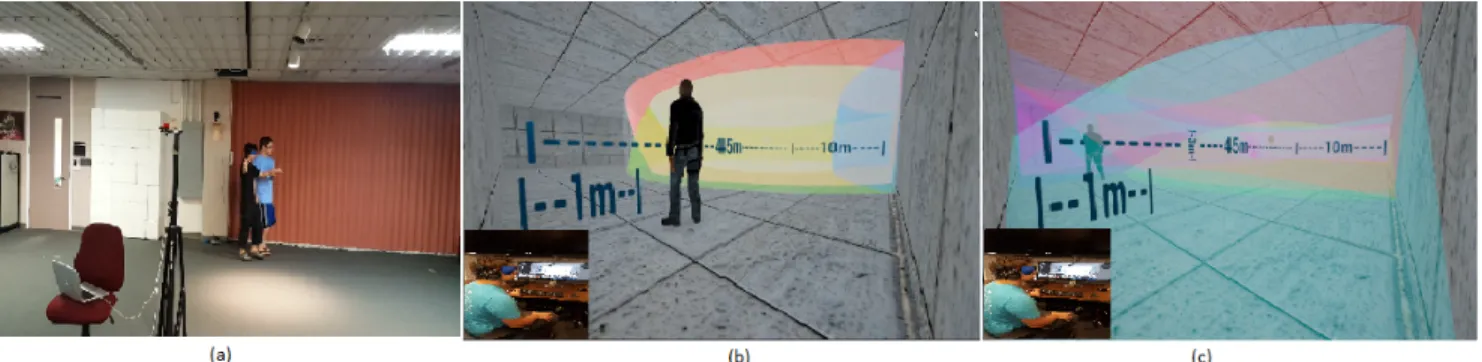
Figure 1: Effects of reverberation on acoustic distance perception in dynamic environments. (a) our training setup in a real-world environment with a user being trained; (b) a blindfolded subject taking the study (inset) and the reverberation pattern shown in different colors; (c) the subject moving along a path and experiencing dynamic reverberation. Our study shows that accurate ray-tracing-based reverberation produces a consistently higher perception of distance compared to a commonly-used approximate technique based on a parametric reverberation filter.
ABSTRACT
Sound propagation encompasses various acoustic phenomena in-cluding reverberation. Current virtual acoustic methods, ranging from parametric filters to physically-accurate solvers, can simu-late reverberation with varying degrees of fidelity. We investigate the effects of reverberant sounds generated using different prop-agation algorithms on acoustic distance perception, i.e. how far away humans perceive a sound source. In particular, we evaluate two classes of methods for real-time sound propagation in dynamic scenes based on parametric filters and ray tracing. Our study shows that the more accurate method shows less distance compression as compared to the approximate, filter-based method. This suggests that accurate reverberation in VR results in a better reproduction of acoustic distances. We also quantify the levels of distance com-pression introduced by different propagation methods in a virtual environment.
1 INTRODUCTION
Realistic sound effects can increase the sense of presence or immer-sion in virtual environments. In fact, some researchers and devel-opers consider spatial audio and sound rendering as VR’s second sense1. Recent hardware developments in virtual reality have re-sulted in renewed interest in the development of fast techniques to generate plausible or realistic sounds on commodity hardware.
Sound in virtual environments has received less attention than visual rendering and effects. Over the last decade, many new al-gorithms have been proposed for sound propagation and render-ing. However, there is relatively less investigation on evaluating the perceptual effectiveness of these methods in virtual environ-ments [17, 24, 33].
One of the most important acoustic effects is reverberation, which corresponds to the sound reaching the listener after a large number of successive temporally dense reflections with decaying amplitudes. Reverberation is known to have multiple perceptual
1https://www.youtube.com/watch?v=Na4DYI-WjlI
effects on humans, including auditory distance perception, environ-ment size estimation, degraded localization, and degraded speech clarity [30].
Some of the widely used techniques for virtual acoustics are based on artificial reverberation filters. The first set of such algo-rithms were proposed in the early 1960s, and they have been reg-ularly used for music production, games, and VR. These methods low runtime overhead and most game and VR engines use such filters to generate propagation or reverberation effects. Recent ad-vancements in computing power and algorithmic methods have re-sulted in physically-accurate techniques for simulating reverbera-tion at interactive rates based on ray tracing [26], wave-based meth-ods [20], and ray-wave coupling [32]. However, some of these ac-curate techniques [20, 32] have a considerably higher precomputa-tion or runtime overhead as compared to artificial filters. An open issue is whether the increase in the physical accuracy of sound prop-agation leads to an increase in perceptual differentiation.
In this paper, we evaluate and quantify the relative benefits of dif-ferent propagation methods for auditory distance perception in VR. In general, distances tend to be under-estimated or under-perceived in virtual environments and this can have considerable impact on the resulting simulation or training applications [8]. Distance per-ception has been actively studied with respect to visual and aural cues. In particular, it is known that distance perception in vision, as assessed by direct walking, is accurate to more than 20 meters [18]. Auditory distance perception, in contrast to visual cues, is compres-sive [19]. In reverberant environments, there is less compression in terms of auditory distance perception [14]. One of the most impor-tant distance cues is the loudness of the sound and this cue can be estimated more accurately when the energy ratio of the direct and reverberant sound is available. Some of the earlier work on audi-tory distance perception was based on setting up physical environ-ments, using appropriate sound sources, and performing the stud-ies. However, prior studies of auditory distance perception have been affected by the issues that arise in terms of controlling and quantifying the actual sound stimulus to the ears of the users in a physical scene. In contrast, virtual acoustic techniques can provide more flexibility and less expensive solutions in terms of evaluating auditory distance perception [6]. In that regard, the recent devel-opments in interactive and physically-accurate sound propagation
methods can provide unique capabilities for performing novel ex-periments using virtual acoustics.
Main Results: We evaluate the impact of different reverberation algorithms on auditory distance perception in virtual environments. Our main focus is to evaluate the distance compression character-istics of approximate vs. accurate interactive reverberation algo-rithms. The objective is to determine if increase in physical ac-curacy leads to an increase in perceptual differentiation. In terms of approximate reverberation, we use a parametric Schroeder fil-ter [30] and perform dynamic calibration to improve its perfor-mance in terms of reverberation effects. The accurate propagation effects are computed using a fast acoustic ray-tracer that can per-form 50−100 orders of specular and diffuse reflections at inter-active rates to compute dynamic late reverberation on a multi-core PC [26]. As the source or the receiver moves, the reverberation is recomputed and used for auralization.
A key issue in the use of parametric filter is tuning of various pa-rameters and that can change the reverberation. In order to tune these filters for distance perception, we present a dynamic cali-bration algorithm that uses theRT60(reverberation time) andDRR
(direct-to-reverberant ratio) parameters. These two parameters are computed from the impulse response based on the accurate ray trac-ing algorithm. The Schroeder filter was appropriately scaled and spliced on the early part of the impulse response, starting at the ap-proximate onset time of reverberation to match theRT60 andDRR
of the ray-traced impulse response. In this way, our calibration al-gorithm tends to compute the best tuned filter for auditory distance perception.
We conducted two separate studies to test auditory distance per-ception in virtual environments. The first study (static scene) is used to evaluate the effects of two reverberation methods in two rectangular-shaped rooms of different sizes for sources that were close to the listener, i.e., between 1m−5m. The source and listener were at static locations. The second study (dynamic scenes) stud-ied the effects of two reverberation methods in a large rectangular-shaped room for sources that were far away from the listener, i.e. between 10m−40m. Furthermore, the listener in this study was moving in the environment, and thereby the reverberation effects perceived by the listener change. We analyze the results from these studies and observed the following results in VR:
• Auditory distance perception shows substantial compression in virtual environments and can be well-represented using a power-function. Our power functions are similar to those re-ported by Zahorik [33], though the exponents are different.
• In case of a static scene, awell-tuned or calibratedparametric reverberation filter can exhibit similar compression and per-ceived distance as the ray-traced reverberation method. The filter parameters,RT60andDRR, were matched to ray-traced generated impulse response parameters. This study indicates that in case of a static environment, only theDRRis sufficient for a consistent and similar result.
• In case of dynamic scenes, a well-tuned or calibrated para-metric reverberation filter shows similar compression charac-teristics as the accurate ray tracing method. However, the perceived distance is consistently higher for the ray tracing method. This finding indicates that matching theDRRs of two method is not sufficient for distance perception in dynamic scenes. Instead, the full impulse response for the given source and listener positions also plays an important role in terms acoustic distance estimation. This result suggests that accu-rate reverberation methods can lead to better reproduction of acoustic distances.
The rest of the paper is organized as follows. In Section 2, we give a brief overview of prior work in acoustic simulation and auditory
distance perception. In Section 3, we discuss the calibration method used to match the filter to the impulse response. We describe our study for the static scene in Section 4 and present the experiment for the dynamic scene in Section 5. Section 6 analyzes the results.
2 RELATEDWORK ANDBACKGROUND
In this section, we give a brief overview of sound propagation, including the computation of impulse responses and tion. We also review many techniques for generating reverbera-tion based on precomputed filters, geometric propagareverbera-tion and wave-based propagation.
2.1 Acoustic Impulse Response and Reverberation The acoustic impulse response filter refers to how an environment behaves when provided with an impulse for a given source and listener position in the environment. In particular, it captures the acoustic signature of an environment and gives us an idea of how a source would sound in that particular source-listener position con-figuration. In the real-world, acoustic impulse response measure-ments are widely used to characterize the acoustic characteriza-tion of an environment [16]. The impulse response can be used to study the acoustic characteristics of an environment and derive important acoustic metrics such asRT60(reverberation time), DRR
(direct-to-reverberant energy ratio),C80(clarity),D50(definition),
G (strength), Onset (onset delay), dir (onset direction), etc.
Reverberation: Reverberation is the acoustic phenomenon of re-peated sound reflections in an environment. Reverberation lends large environments a characteristic impression of spaciousness, and plays a crucial role in the acoustic design of buildings, concert halls, etc. The two key characteristics for measuring this property are re-verberation time (RT60) and the direct-to-reverberant ratio (DRR).
RT60is defined as the time it takes for the sound in the environ-ment to decay by 60 dB.RT60is one of the most important param-eters in room and architectural acoustics and provides an approxi-mation of how long the reverberation effects will last in a given en-vironment. For example, the recommended reverberation time for a classroom is 0.4−0.6 seconds and is about 1.8−2.2 seconds for a concert hall. Empirically,RT60is computed using the well-known Sabine’s equation:
RT60≈0.1611sm−1V
Sa, (1)
whereVis the volume of the space,Sis the total surface area, anda
is the average absorption coefficient of the surfaces. This formula-tion doesn’t require the exact impulse response of the environment and is mostly used to estimate to the actualRT60 in simple,
rect-angular rooms. The more accurate way of computing theRT60 is
based on reverse cumulative trapezoidal integration to compute the decay of the impulse response and then use a linear least-squares fit to compute the slope of the decay from 0 dB to−60 dB [16].
The DRR is another well-known metric related to reverberation, and is formulated based on the energy ratio between the energy of the sound coming directly from the source and its reflections. Given the acoustic impulse response, the DRR can be estimated from the impulse responses by evaluating the onset and decay characteristics. Mathematically, DRR can be expressed as:
DRR=10log10(X(T0−C:T0+C)
2
X(T0+C+1 :Tn)2
), (2)
whereX is the approximated integral of the impulse response,T0
2.2 Sound Propagation
At a broad level, sound propagation deals with modeling how sound waves reflect, scatter, and diffract around obstacles as they travel through an environment. These techniques are used to measure the impulse response, which is composed of the direct sound, early re-flections, and reverberation. The early reflections correspond to the sound reaching the listener after a small number of reflections and are used to localize the sound source(s). Sound propagation has been an active area of research in computational acoustics and vir-tual environments for many decades. At a broad level, prior prop-agation methods can be classified into: use of parametric filters, geometric propagation, and wave-based propagation.
2.2.1 Parametric Filters
Some of the simplest algorithms to model reverberation are based on parametric or artificial reverberation filters [13] that capture the statistics of reverberant decay using a small set of parameters. The three main categories are delay networks, convolution-based algo-rithms, and physical room models [30]. These are widely used in games and virtual environments because of their low runtime over-head. Typically the designer or artists divide a large scene into dif-ferent reverberation zones or regions and compute separate filters for each region. Moreover, different filters are interpolated at run-time to generate smooth acoustic responses. Many techniques have been proposed to automatically compute the reverberation parame-ters [4, 3].
2.2.2 Geometric Acoustic Methods
These algorithms are based on ray tracing and its variants (e.g., beam tracing or frustum) and assume that the sound travels along linear rays. Different techniques have been proposed to compute specular and diffuse reflections [15, 1, 31]. They work well for high frequency sources, though some approximate techniques have also been proposed to approximate low-frequency effects such as edge diffraction. Over the last decade, many faster algorithms for interactive ray tracing have been proposed to accelerate sound prop-agation and these methods can exploit the parallel capabilities of current multi-core CPUs and GPUs. Earlier, interactive ray tracing algorithms were limited to compute only the early reflections [9, 28] in dynamic scenes, while late reverberation was estimated using statistical approximation or precomputation methods [2]. Recently, interactive techniques have been proposed to compute higher order specular and diffuse reflections using ray tracing [27, 26]. These algorithms are able to compute 50−100 orders of reflections in dy-namic scenes at interactive rates on a multi-core desktop PC by ex-ploiting the coherence of the sound field and performing backward ray tracing. This enables us to accurately compute early reflections as well as dynamic late reverberation effects. In this paper, one of our goals is to evaluate the psycho-acoustic characteristics of these dynamic late reverberation algorithms for auditory distance percep-tion.
2.2.3 Wave-based Simulation
The wave-based algorithms numerically solve the acoustic wave equation and compute the sound pressure field and impulse re-sponses. Recently, many precomputation techniques have been proposed for interactive applications [29, 22, 20, 32]. As com-pared to geometric methods, these algorithms are able to accurately model low frequency effects, but the time complexity increases as the fourth power of the frequency. As a result, they are only prac-tical for low to medium range frequencies (e.g., less than 1 or 2 KHz). Furthermore, they are limited to static scenes due to the high precomputation overhead.
2.3 Acoustic Distance Perception
There is considerable work in perception and VR literature on dis-tance perception based on visual and/or aural cues [8]. This in-cludes work in VR on spatial perception with visual displays, au-diovisual environments, and auditory displays [21, 25, 23, 12]. In-terestingly, distance compression was observed in all such virtual environments. Other work includes the study of auditory percep-tion in the presence of visual informapercep-tion [7].
In terms of acoustic cues, most of the earlier research was on directional aspects of auditory localization [33]. Over the last few decades, there is considerable work on auditory distance percep-tion as well as use of virtual acoustic techniques [6]. This includes evaluation of how well can humans estimate the stationary sound sources. Most of these studies suggest that listeners systematically underestimate distances to faraway sound sources.
3 CALIBRATINGFILTERPARAMETERS
In this section, we present the details of the Schroeder filter used to generate reverberation effects. We also describe our dynamic calibration algorithm adjusts some parameters of this filter.
3.1 Schroeder Filter
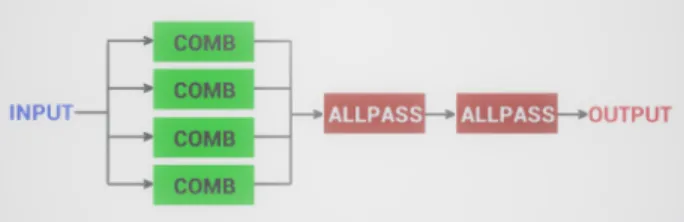
We use the Schroeder filter as an approximation method to com-pute reverberation. This filter is one of the oldest, most commonly used digital reverberation algorithms. It is easy to set up and cus-tomize to produce plausible reverberation characteristics in an en-vironment. An artificial reverberator must have a flat frequency response and should be able to produce the desired density of re-flections. The Schroeder filter uses a parallel bank of comb filters connected to a series of all-pass filters, as shown in Figure 2. The comb filters generate a repeated version of the input signals, while the all-pass filters keeps the frequency gain of the input as constant. The parallel-bank of comb filters combined with a series of all-pass filters serves as a means to control the final output sound with a greater resolution. The overall specification of the Schroeder filter is controlled by different parameters, such as:
Room size: This parameter specifies size of the room for which reverberation is being generated. Larger rooms tend to have longer reverb times.
Pre-delay: This parameter specifies the time it takes sound to reflect once.
Damping: It specifies the amount of attenuation applied to the high-frequency content of the sound.
Wet Gain: This parameter specifies the amount of energy contained by the reverberation relative to the direct sound.
Dry Gain: It specifies the amount of energy contained by the direc-tion sound relative to the reverberadirec-tion.
Figure 2: Schroeder reverberation filter: We highlight various com-ponents used in the design of such a filter. The comb filters produce reflections of the input sound, while the all-pass filters control the reverberator’s wet and dry mix.
3.2 Calibration of Impulse Responses
filter formation. Since we are comparing two methods of reverber-ation, we need to make sure that early part of the impulse response for the two methods is exactly the same in our experiments. As a re-sult, two versions of the impulse responses were computed for each source, listener position - the first one is the full impulse response computed using the ray tracer [26] and the second one without the reverberant tail that contains only the early part of the impulse re-sponse as shown in Figure 3(a) & (b). We compute theRT60 and
DRR using the full impulse response, and adjust the parameters of the Schroeder filter till these parameters match.
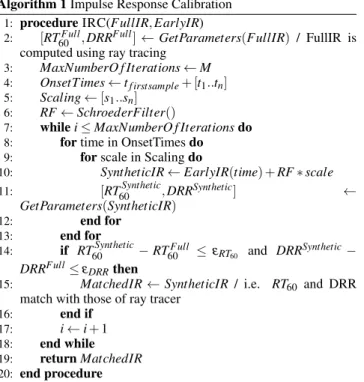
Algorithm 1Impulse Response Calibration 1: procedureIRC(FullIR,EarlyIR) 2: [RTFull
60 ,DRRFull]←GetParameters(FullIR) / FullIR is
computed using ray tracing 3: MaxNumberO f Iterations←M
4: OnsetTimes←tf irstsample+ [t1..tn] 5: Scaling←[s1..sn]
6: RF←SchroederFilter()
7: whilei≤MaxNumberO f Iterationsdo 8: fortime in OnsetTimesdo 9: forscale in Scalingdo
10: SyntheticIR←EarlyIR(time) +RF∗scale
11: [RT60Synthetic,DRRSynthetic] ←
GetParameters(SyntheticIR)
12: end for
13: end for
14: if RT60Synthetic−RT60Full ≤ εRT60 and DRR
Synthetic−
DRRFull≤εDRRthen
15: MatchedIR←SyntheticIR / i.e. RT60 and DRR match with those of ray tracer
16: end if 17: i←i+1 18: end while 19: returnMatchedIR
20: end procedure
Algorithm 1 gives the details of calibration scheme.
SchroederFilter is a generic Schroeder reverberation genera-tor that produces a series of repeated, decaying impulses. The
GetParametersfunction computes theRT60andDRR, as described
in the previous section. TheOnsetTimes defines a linear space of reverberation onset times. Typically, late reverberation starts aroundtf irstsample=80ms[10] from the first impulse, so this space defines a time domain fromtf irstsample+t1totf irstsample+tn. This linear space is used to determine the time at which the synthetic (Schroeder filter) reverberation is added to the early part of the impulse response. The Scaling, on the other hand, determines the space of multipliers that scales the synthetic reverberation computation. For each pair{time,scale}, the synthesized impulse response is constructed and itsRT60 and DRR are evaluated. If these values match theRT60andDRRof the full impulse response, based on the just-noticeable difference (JND) of the respective parameters(εRT60,εDRR), it corresponds to a considered a calibrated,
matched impulse response.
4 EXPERIMENT1: STATIC LISTENER IN A REVERBERANT ENVIRONMENT
In this section, we give an overview of the static scene used in our evaluation. This study is based on a static sound source and a static listener.
4.1 Participants
Twelve subjects took part in the study with informed consent. The ages ranged from 20 to 31 (mean = 25.2 and SD = 2.7). It include
Figure 3: (a) The full impulse response computed using the ray-tracer; (b) The early part of the impulse response computed us-ing the ray tracer (usus-ing a different time scale); (c) The output of a generic Schroeder-reverberator; (d) The calibrated Schroeder filter with matchingRT60andDRRvalues as those of (a)
Figure 4: The two rooms used for the experiments. The red dots show the 7 randomly generated azimuths where the sources were kept. The numbers 1..7 indicate the distances at uniformly sampled points between [1m-5m] from the listener for both rooms. The sub-jects were placed 1m away from the wall.
one female and eleven males. All subjects reported normal hearing.
4.2 Apparatus
The set up consisted of a Dell T7600 workstation and the sound was delivered via a pair of Beyerdynamic DT990 PRO headphones. The subjects were blindfolded for the study. The software to com-pute theRT60 and DRRis based on open-source MATLAB code
[11]. The calibration and auralization were performed using in-house software, also written in MATLAB.
4.3 Stimuli
impulse responses per source using the two reverberation methods - Schroeder reverberation filter and interactive ray tracing using the calibration scheme described above. The impulse responses were then convolved with the sound signal for auralization. The source sound power was 78dB.
4.4 Design & Procedure
The environments were created to emulate a highly-reverberant room, similar to what a painted indoor room with no windows would sound. The calibration algorithm described above was used to match theRT60andDRRof the two reverberation methods, i.e., the Schroeder filter and interactive ray tracing. This was a within-subject study and all of the within-subjects experienced the acoustic ef-fects from both methods of reverberation for all seven sources in the two rooms. The subjects were blindfolded, and the sound was delivered through headphones. This way we can accurately evalu-ate the acoustic effects. In the absence of variable head-orientation, a generic HRTF-filter-based spatialization was used, as the evalua-tions only involved sources in the azimuthal plane. All the distance estimates were in meters.
Before starting the experiment, the subjects were given an idea of the size of meter by showing them a meter-long strip of tape. After that, they were blindfolded and four sound clips were played: 1maway at 30◦ to the left, 1maway at 30◦ to the right, 5maway at 30◦ to the left, and 5maway at 30◦ to the right. The subjects were familiarized that these are the kind of sounds they should ex-pect, without giving them the actual distances associated with these clips. The clips were rendered using the interactive ray tracing al-gorithm. The subjects were asked to rate the distances in meters on a scale of 1m−10m. The same metric was used in the subsequent experimental trials.
This was a within-subject study, and each subject rated the com-plete set of 7 source positions within two rooms. The order of the sound files was randomized before starting a block of trials, and three such blocks were conducted, giving a total of 42 evaluations per subject (7 source positions×2 rooms×3 blocks). The sub-ject’s head orientation was kept fixed, and the sound clip for each source position was played in a loop, until the listener responses. The subjects were allowed to take breaks. The experiment took an average of fifteen minutes per subject. No fatigue was reported.
4.5 Results
A 4-way ANOVA on block, distance, room, and reverberation method shows significant effects for distance (F(6,66) =56.46, p
<0.01) and room(F(1,11) =12.52, p<0.01), but none for the reverberation method or block. The two-way interaction between distance and room also shows significance (F(6,66) =11.23,p<
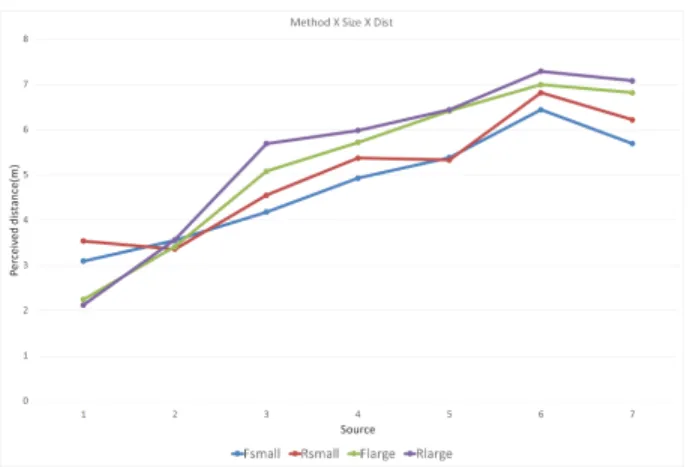
0.01). This indicates that the room size has an effect on the per-ception of distance despite the distances being the same in the two rooms (Figure 5). On the other hand, the reverberation method doesn’t seem to affect the distance estimate. This can be explained if we take into account the fact that distance perception is a func-tion of theDRRand since theDRRswere matched closely, in a static scene, the distance perception is similar. Moreover, the big-ger room also has higher DRR values compared to the smaller one. The two reverberation methods did not noticeably affect the perception of distance in either of the rooms. There is a signif-icant two-way interaction between method and block, however,
F(2,22) =4.4,p=.024. The pattern of this effect is modestly greater distance estimate in Block 1 for the ray tracing algorithm (mean 5.6m) relative to the Schroeder filter (mean 4.9m). As this effect was absent in subsequent blocks, the effect size was small. No further block effects were observed.
The results indicate that our method is sensitive to both distance and moderating effects (i.e., room size) for a static environment with sources relatively near to the listener. The absence of
con-Figure 5: The average values as judged by the subjects in the two rooms for the two reverberation methods in the static scene. Fs-mall (blue), RsFs-mall (red), Flarge (green), Rlarge (purple) represent small room with filter, small room with ray tracing, large room with filter, and large room with ray-tracing, respectively. The effect of the reverberation method (approximate vs. accurate) is null on the per-ception of distance, which is to be expected in a static scene where listeners would tend to use just theDRR and intensity for the dis-tance estimation. Due to our calibration routine, we ensured that the DRR of the Schroeder filter matched that of the interactive ray tracing method. These results suggest that auditory distance perception in static scenes is mainly governed by the DRRs.
sistent effects of reverberation method over the present distances, together with the indication that larger rooms would increase per-ceived distance, motivated us to perform a second experiment with two changes: First, the room size was increased to a much larger value, 45m, allowing an expanded range of simulated distances. Second, dynamic cues to auditory distance perception, based on listener’s movement, were added. The purpose was to determine if accurate reverberation would expand perceived distance under these conditions.
Figure 6: The room used for the experiment. The path marked in red is the walking path along which the subject walks. The sound sources are perpendicular to the walking path kept at increasing dis-tances from it. The labels 1-7 show the different disdis-tances sampled uniformly from the range [10-40]m
5 EXPERIMENT2: MOVINGLISTENER IN AREVERBERANT ENVIRONMENT
5.1 Participants
Seventeen participants took part in the study with informed consent. Their ages ranged from 19 to 47 (mean = 25.9 and SD = 7.4. Four females, thirteen males). The participants were recruited from the students and staff at the university. All participants reported normal hearing.
5.2 Apparatus
The set up consisted of a Dell T7600 workstation and the sound was delivered via a pair of Beyerdynamic DT990 PRO headphones. The subjects were blindfolded for the study. The software to compute theRT60andDRRwas based on open-source MATLAB code [11].
The calibration and auralization were done using in-house software, also written in MATLAB.
5.3 Stimuli
The source was a pre-recorded, broadband sound of human clap-ping. The virtual environment consisted of a rectangular room 45m×10m×3mwith highly reflective walls to create a highly-reverberant environment with an eight meter walking path as shown in Figure 6. Seven omnidirectional sound sources were kept at in-creasing distances from the center of the path starting from 10mup to 40min increments of 5m. The sources were all kept at the same height of 1.7mfrom the floor. This value was chosen, assuming a standard listener height of 1.7min the virtual environment. Sound was rendered by constructing two impulse responses per source and using the two reverberation methods - Schroeder filter and interac-tive ray tracing - and convolving them with the source signal. The source sound power was 78dB. The details on how the impulse re-sponses were generated are described below.
5.4 Design & Procedure
A rectangular room was chosen as it provides the ‘best-case’ sce-nario for the reverberation filter. The environment was created to emulate a highly-reverberant environment similar to a painted, con-crete room with no windows. As mentioned in Section 2, the DRR is one of the main parameters in distance perception. In order to make sure we’re comparing theunderlying methodsand not the spe-cific parameters, we ensured that theRT60and theDRRare same for both reverberation methods.
5.4.1 Training
Before the participants started the experiments, they completed a training task. The training part of the experiment took place in a real-world setting. An 8mlong walking path was constructed and the sound sources were placed at 3mand 6 from the center of the walking path, starting with 3m. The participants were blindfolded before being led into the room so as to not give them an idea of the room dimensions. The dry (without reverberation) sound clip was played from a Harmon/Kardon HK 195 desktop speaker. The participants were asked to point at the sound source with their right hand and keep pointing at the source as they walked along the 8m
path. Since the participants were blindfolded, they were helped by the test administrators as they walked down the path. Once they reached the end of the path, the participants were asked to give their best evaluation (in meters) as to how far they thought the sound source to be when it seemed closest to them. The training task was then repeated with the source moved to 6m. The subjects were told the actual distances at the end of the training. The training exercise was not meant to be an exact replica of the experiment as it was not possible to construct a physical room with the same kind of rever-berance, as the one in the virtual environment. Instead, the training was meant to give the participants a feeling as to what to expect and how to make judgements. Please refer to the supplementary video on how the training was performed.
5.4.2 Method
This was a within-subject study and all the participants experienced both methods of reverberation. The walking in the virtual environ-ment was not controlled by the participants; instead, the 81 im-pulse responses per source were sampled such that each imim-pulse response contributed to 0.1m of the total 8m for a human travel-ing at the average speed of 1.39m/s. The contributions from each of these 81 impulse responses/sources were spliced together (with interpolation) to create a sound file for each source. This sound file was played to the participants and they were asked to give the same estimate as they performed in the training, i.e., the perceived distance (in meters) of the sound when it seemed to be the closest to them. The impulse responses were spatialized using a generic HRTF-filter. The participant’s head orientation was fixed and they were always looking straight ahead. Each participant rated the com-plete set of 7 source positions×2 reverberation methods with the order of the sources randomized for each block, giving a total of 42 (7 source positions×2 methods×3 blocks) judgements. The total time for the experiment, including the training, took around 15 minutes. The participants were allowed to take breaks between blocks, as required. No fatigue was reported.
5.5 Results
A 3-way ANOVA on block, distance, and reverberation method shows the significant effects of method (F(1,16) =15.29, p <
0.01) and distance (F(6,96) =29.12, p<0.01). All two-way inter-actions (block-distance, block-method, distance-method) failed to show significance indicating that the reverberation method and dis-tance effects are independent. This finding indicates that the shape of distance compression is statistically the same for both the rever-beration methods and the ray tracing algorithm exhibits an overall tendency to give longer distances.
The null effect of block indicates that we should average over blocks in presenting data and that averaging does not obfuscate any trends in data - it only makes the data cleaner.
6 ANALYSIS
In this section, we analyze the results of our studied performed in the static and dynamic scenes. Acoustic distance perception is a complex phenomenon, and few studies have characterized its ef-fect in virtual environments. Nevertheless, acoustic distance per-ception forms an important component of immersion in virtual en-vironments and helps provide additional cues to the perception of the soundscape.
6.1 Data Fitting
Zahorik [33] performed a comprehensive study of acoustic distance perception in virtual environments that assesses the weights as-signed to the principal cues. To analyze the data, [33] fitted a power function of the form:
Dr=kdra, (3)
whereDris the perceived distance,kis a constant,ais the power-function exponent that determines the power-function’s rate of growth or decay, anddris the actual source distance.
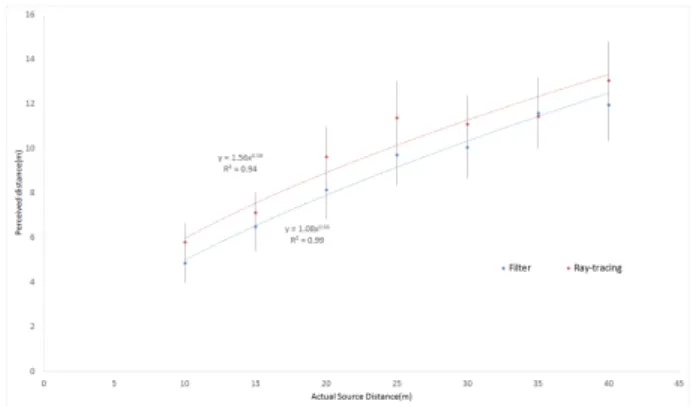
In our present data, the power function fit on the data generated the following functions:
Daccurater =1.56d0r.58, (4) and
Drf ilter=1.08dr0.66. (5) TheR2accurate is 0.94 while theR2f ilteris 0.99; thus both functions account well for the observed variability in the mean perceived dis-tance. The exponents exceed by∼50% the average value found by Zahorik [33] for a stationary listener.
Figure 7: The power function fit of the distance data for the Schroeder filter (in blue, bottom curve) and interactive ray tracing (in red, top curve) algorithms. This plot suggests that the compression of perceived distance relative to simulated distance was comparable across both methods of generating reverberation. The distance per-ceived with accurate ray tracing algorithm exceeds that obtained with the filter method by essentially a constant amount.
The similarity of the power-function exponent for the two rever-beration methods confirms the lack of interaction between physi-cal distance and method in the ANOVA, which indicates that the compression of perceived distance relative to simulated distance was comparable across both methods of generating reverberation. The effect of the greater multiplicative parameter for the accurate method is to move the responses closer to the true values for all dis-tances measured in our study and any measured beyond this range of 10m – 40m. Any over-estimation resulting from a multiplicative parameter> 1.0 would be expected for much smaller distances. The statistically confirmed result is that across the range of values examined here, the distance perceived with accurate ray tracing al-gorithm exceeds that obtained with the filter method by essentially a constant amount.
The degree of compression observed here with virtual sound must be evaluated relative to the compressive perception found in reverberatory environments with real sound. If we take the data from [14] to provide a standard, linear compression of 0.7 is to be expected with verbal report. The linear fits to the present data were reasonable for filter and accurate (values ofR2f ilter and R2accurate, respectively), and the corresponding slopes were 0.24 and 0.23. In this context, we can estimate the additional compression due to sim-ulation as a multiplicative factor on the order of13giving us a good idea what to expect in terms of perceived distance when using vir-tual acoustics.
6.2 Discussion
The results in the static scene seem to suggest that matching the DRRs of the approximate method based on Schroeder filter to that of ray tracing method may provide the same level of accuracy in terms distance perception. However, in case of dynamic scenes that
is not sufficient and the accurate ray-tracing algorithm results in better distance estimates. Interestingly, in most applications, the parameters of the Schroeder filter are tuned by an artist or by us-ing some presets for a set of different environments. It is not clear whether those methods can ensure that the DRRs of the Schroeder filter would match those computed using the accurate ray-tracing method. Our Algorithm 1 provides an automatic mechanism to compute Schroeder filter with little manual efforts. Moreover, the reverberation filters are mostly designed for rectangular rooms, and are based on Sabines Equation. It is not clear whether they will pro-vide the same level of reverberation effects or distance estimates for non-rectangular rooms.
7 CONCLUSIONS, LIMITATIONS,ANDFUTUREWORK In this paper, we studied the impact of different sound propagation algorithms on auditory distance perception. In particular, we com-pared the performance of approximate techniques based on para-metric filters with accurate techniques based on interactive ray trac-ing in static and dynamic scenes. Our study shows that although the compression characteristics of two methods are similar, the more accurate propagation method results in less distance compression in VR, especially in dynamics scenes with a moving listener. This finding suggests that accurate reverberation effects in a VR sys-tem can be perceptually useful for different applications. This work has some limitations. The geometric acoustic methods are accurate at high frequencies, and it would be useful to combine them with wave-based methods for low frequencies. Besides sound intensity and DRR, there are many cues other that may affect auditory dis-tance perception, including the at-the-ear spectrum due to the sound absorbing properties of the air and binaural differences [34], and it would be useful to evaluate them as part of future work. We would also like to extend our evaluation to environments with mov-ing sound sources, dynamic obstacles, nonrectangular scenes, and varying the level of reverberation. It would be useful to combine our results with other cues (e.g., visual perception). Ultimately, we hope to develop good VR systems with multi-modal capabilities (including sound), where researchers from other fields (e.g., psy-chology) can evaluate different hypothesis.
REFERENCES
[1] J. B. Allen and D. A. Berkley. Image method for efficiently simulat-ing small-room acoustics. The Journal of the Acoustical Society of America, 65(4):943–950, April 1979.
[2] L. Antani, A. Chandak, L. Savioja, and D. Manocha. Interactive sound propagation using compact acoustic transfer operators. ACM Trans. Graphics, 31(1):7:1–7:12, 2012.
[3] L. Antani and D. Manocha. Aural proxies and directionally-varying reverberation for interactive sound propagation in virtual environ-ments.Visualization and Computer Graphics, IEEE Transactions on, 19(4):567–575, 2013.
[4] R. S. Bailey and B. Brumitt. Method and system for automatically generating world environment reverberation from game geometry. U.S. Patent Application 20100008513, 2010.
[5] S. Boustila, D. Bechmann, and A. Capobianco. Evaluation of factors affecting distance perception in immersive virtual environments dur-ing virtual visits of houses. InProceedings of the 27th Conference on L’Interaction Homme-Machine, IHM ’15, pages 8:1–8:10, New York, NY, USA, 2015. ACM.
[6] A. W. Bronkhorst and T. Houtgast. Auditory distance perception in rooms.Nature, 397(6719):517–520, 1999.
[7] E. R. Calcagno, E. L. Abreg´u, M. C. Egu´ıa, and R. Vergara. The role of vision in auditory distance perception.Perception, 41(2):175–192, 2012.
[9] T. Funkhouser, I. Carlbom, G. Elko, G. Pingali, M. Sondhi, and J. West. A beam tracing approach to acoustic modeling for interac-tive virtual environments. InProc. of ACM SIGGRAPH, pages 21–32, 1998.
[10] T. Hidaka, Y. Yamada, and T. Nakagawa. A new definition of bound-ary point between early reflections and late reverberation in room impulse responses. Journal of the Acoustical Society of America, 122(1):326–332, 2007.
[11] C. Hummersone. Impulse response acous-tic information calculator. https://www. mathworks.com/matlabcentral/fileexchange/
42566-impulse-response-acoustic-information-calculator.
[12] V. Interrante, B. Ries, and L. Anderson. Distance perception in im-mersive virtual environments, revisited. InIEEE Virtual Reality Con-ference (VR 2006), pages 3–10. IEEE, 2006.
[13] J.-M. Jot and A. Chaigne. Digital delay networks for designing artifi-cial reverberators. InAES Convention, 1991.
[14] R. L. Klatzky, Y. Lippa, J. M. Loomis, and R. G. Golledge. Encoding, learning, and spatial updating of multiple object locations specified by 3-d sound, spatial language, and vision.Experimental Brain Research, 149(1):48–61, 2003.
[15] A. Krokstad, S. Strom, and S. Sorsdal. Calculating the acoustical room response by the use of a ray tracing technique.Journal of Sound and Vibration, 8(1):118–125, July 1968.
[16] H. Kuttruff. Acoustics: An Introduction. Taylor and Francis, New York, 2007.
[17] P. Larsson, D. Vastfjall, and M. Kleiner. Better presence and perfor-mance in virtual environments by improved binaural sound rendering. InAudio Engineering Society Conference: 22nd International Confer-ence: Virtual, Synthetic, and Entertainment Audio. Audio Engineering Society, 2002.
[18] J. M. Loomis and J. M. Knapp. Visual perception of egocentric dis-tance in real and virtual environments. Virtual and adaptive environ-ments, 11:21–46, 2003.
[19] J. M. Loomis, Y. Lippa, R. L. Klatzky, and R. G. Golledge. Spatial up-dating of locations specified by 3-d sound and spatial language. Jour-nal of Experimental Psychology: Learning, Memory, and Cognition, 28(2):335, 2002.
[20] R. Mehra, N. Raghuvanshi, L. Antani, A. Chandak, S. Curtis, and D. Manocha. Wave-based sound propagation in large open scenes using an equivalent source formulation. ACM Trans. on Graphics, 32(2):19:1–19:13, 2013.
[21] J. Meng, J. J. Rieser, and B. Bodenheimer. Distance estimation in virtual environments using bisection. InProceedings of the 3rd Sym-posium on Applied Perception in Graphics and Visualization, APGV ’06, pages 146–146, New York, NY, USA, 2006. ACM.
[22] N. Raghuvanshi, J. Snyder, R. Mehra, M. Lin, and N. Govindaraju. Precomputed wave simualtion for real-time sound propagation of dy-namic sources in complex scenes.ACM Trans. on Graphics (Proc. of ACM SIGGRAPH), 29(3), 2010.
[23] M. R´ebillat, X. Boutillon, ´E. Corteel, and B. F. Katz. Audio, visual, and audio-visual egocentric distance perception by moving subjects in virtual environments. ACM Transactions on Applied Perception (TAP), 9(4):19, 2012.
[24] A. Rungta, S. Rust, N. Morales, R. Klatzky, M. Lin, and D. Manocha. Psychoacoustic characterization of propagation effects in virtual envi-ronments.ACM Transactions on Applied Perception (TAP), 13(4):21, 2016.
[25] C. S. Sahm, S. H. Creem-Regehr, W. B. Thompson, and P. Willem-sen. Throwing versus walking as indicators of distance perception in similar real and virtual environments. ACM Transactions on Applied Perception (TAP), 2(1):35–45, 2005.
[26] C. Schissler and D. Manocha. Interactive sound propagation and ren-dering for large multi-source scenes. ACM Transactions on Graphics (TOG), 36(1):2, 2016.
[27] C. Schissler, R. Mehra, and D. Manocha. High-order diffraction and diffuse reflections for interactive sound propagation in large environ-ments.ACM Transactions on Graphics (TOG), 33(4):39, 2014. [28] M. Taylor, A. Chandak, Q. Mo, C. Lauterbach, C. Schissler, and
D. Manocha. Guided multiview ray tracing for fast auralization.IEEE
Transactions on Visualization and Computer Graphics, 18:1797– 1810, 2012.
[29] N. Tsingos, C. Dachsbacher, S. Lefebvre, and M. Dellepiane. Instant sound scattering. InProceedings of the Eurographics Symposium on Rendering, pages 111–120, 2007.
[30] V. Valimaki, J. D. Parker, L. Savioja, J. O. Smith, and J. S. Abel. Fifty years of artificial reverberation.Trans. Audio, Speech and Lang. Proc., 20(5):1421–1448, July 2012.
[31] M. Vorl¨ander. Simulation of the transient and steady-state sound prop-agation in rooms using a new combined ray-tracing/image-source al-gorithm.The Journal of the Acoustical Society of America, 86(1):172– 178, 1989.
[32] H. Yeh, R. Mehra, Z. Ren, L. Antani, D. Manocha, and M. Lin. Wave-ray coupling for interactive sound propagation in large complex scenes.ACM Trans. Graph., 32(6):165:1–165:11, 2013.
[33] P. Zahorik. Assessing auditory distance perception using virtual acoustics. The Journal of the Acoustical Society of America, 111(4):1832–1846, 2002.