DISCONTINUOUS HOUSES, SETTLEMENT STRUCTURES, AND SOCIAL ORGANIZATION IN LATE EARLY HELLADIC AND MIDDLE HELLADIC GREECE
Rebecca Worsham
A dissertation submitted to the faculty at the University of North Carolina at Chapel Hill in partial fulfillment of the requirements for the degree of Doctor of Philosophy in the Department
of Classics (Classical Archaeology).
Chapel Hill 2015
iii ABSTRACT
Rebecca Worsham: Discontinuous Settlement Structures and Social Organization in Late Early Helladic and Middle Helladic Greece
(Under the direction of Donald Haggis)
This dissertation examines the replacement of domestic architecture in the Peloponnese from Early Helladic III (ca. 2200-2000 BC) to the early Mycenaean period (ca. 1700-1400 BC). Based on Tringham’s “continuous house” model and subsequent scholarship, I argue that many of these houses were cyclically destroyed and rebuilt, and explore methods for investigating this
phenomenon in context using cross-cultural comparanda. I suggest a wide-spread experience of the
house as a physical manifestation of the cycles of the living household—the house is rebuilt on the
occasion of the death of the household head. This phenomenon is particularly visible in the Argolid.
Elsewhere in the Peloponnese, the replacement of the house is very often divorced from natural
generational cycles and instead works to create a link with older abandoned architecture and
presumably the lineages represented by these material remains. The destruction/rebuilding cycle—
regardless of whether it marked real familial patterns or fictive claims of descent—was often (if
inconsistently) marked by other ritual action, including feasting/termination rites. Occasionally these
rites included the burial or caching of feasting debris or offerings with the destroyed house
architecture itself, parallel to the common practice of intramural burial in these settlements, itself
acting further to create and maintain “place” for a kinship group within the community.
House-rebuilding, however, functioned beyond place-creation in the renewal and definition of the household
itself. It is in this way both continuous with the past and actively breaking from it in order to
iv
This idea corresponds to previous assessments of the treatment of settlements especially at
the end of the period. At this time, settlements were abandoned, transformed into cemeteries, or
totally reorganized, and new settlements were founded. These changes are likely to represent efforts
to create more cohesive regional communities, capable of more effective interaction with other
communities within an increasingly “global” Mediterranean network. I argue that the mechanism for
creating these new communities was derived in part from the understanding of built space and the
v
TABLE OF CONTENTS
LIST OF FIGURES………..viii
LIST OF ABBREVIATIONS……….xi
INTRODUCTION………...1
CHAPTER 1: The Discontinuous “Continuous House”……….9
Comparative Cases of House-Killing………15
House-Killing and Ritual Action………...21
House Destruction, Replacement, and Cycles of Renewal………32
The “Continuous House” in EH III-LH I/II Culture………..39
CHAPTER 2: House Series in the EH III-LH I/II Peloponnese………47
Catalogue: Achaia………..50
Aigion………50
Ayios Athanasios/Katarraktis………54
Drakotrypa (Katarraktis/Pharai)……….57
Helike……….61
Catalogue: Arcadia………66
Asea………66
Catalogue: Argolid……….73
Argos………..73
vi
Berbati………98
Lerna………..…..103
Tiryns………...132
Catalogue: Corinthia ………...147
Korakou………147
Tsoungiza……….152
Catalogue: Elis……….165
Olympia………165
Pisa………...174
Catalogue: Laconia………..176
Ayios Stephanos………..176
Menelaion………195
Catalogue: Messenia………198
Epano Englianos: Deriziotis Aloni………..198
Katarrachaki/Koukounara………200
Malthi………...202
Nichoria………219
Peristeria………..223
Discussion………225
Overview and Methodology………227
Short-Term Rebuilding………233
Long-Term Rebuilding………238
vii
Achaia: Pagona………243
Argolid: Megali Magoula (Galatas)……….244
Argolid: Midea……….245
Argolid: Mycenae………246
Corinthia: Aetopetra……….247
Corinthia: Gonia………...248
Corinthia: Zygouries………249
Elis: Kavkania………..249
Laconia: Geraki………250
Messenia: Voroulia (Tragana)……….251
Conclusions………..251
CHAPTER 3: The Discontinuous Settlement………..256
Transitional Planned Settlements………261
Reorganized Settlements………..264
Settlements and Houses………...269
Discussion and Conclusions………272
APPENDIX 1: Summary Catalogue of House Series……….276
viii
LIST OF FIGURES
Figure 1.1: “Chieftain’s House” series identified by Caskey (1965) east of the tumulus at Lerna. Figure 1.2: Composite plan of Lerna IV, and Houses D and M of Lerna V, indicating frequency of rebuilding at the site throughout this period.
Figure 1.3: Sequence of houses in the East Sector of Lerna. Figure 1.4: Wiersma’s (2013) types of house replacement.
Figure 1.5: Wiersma’s (2013) examples of “building upon” versus true rebuilding. Figure 1.6: Partial displacement of the houses at Opovo.
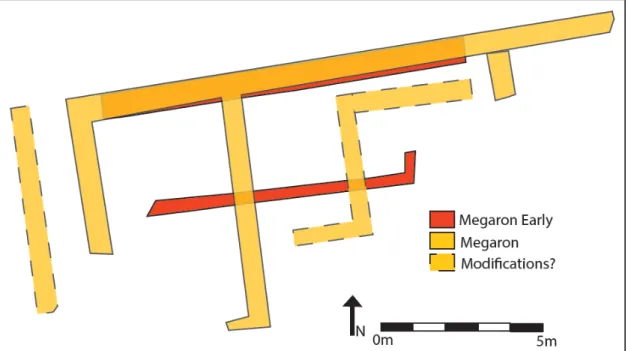
Figure 2.1: Aigion Megaron Series.
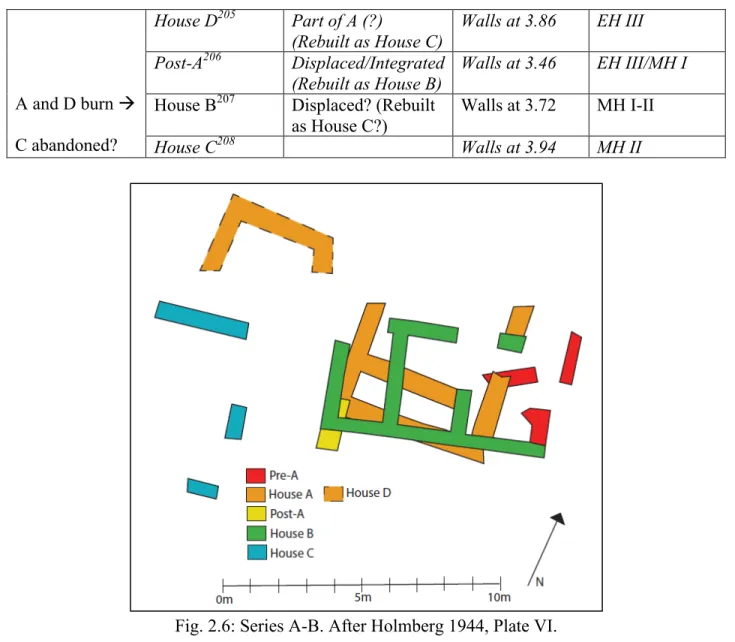
Figure 2.2: Ayios Athanasios Megaron Series Figure 2.3: Drakotrypa Aithousa Series. Figure 2.4: “Corridor House” Series. Figure 2.5: “West Building” Series. Figure 2.6: Series A-B.
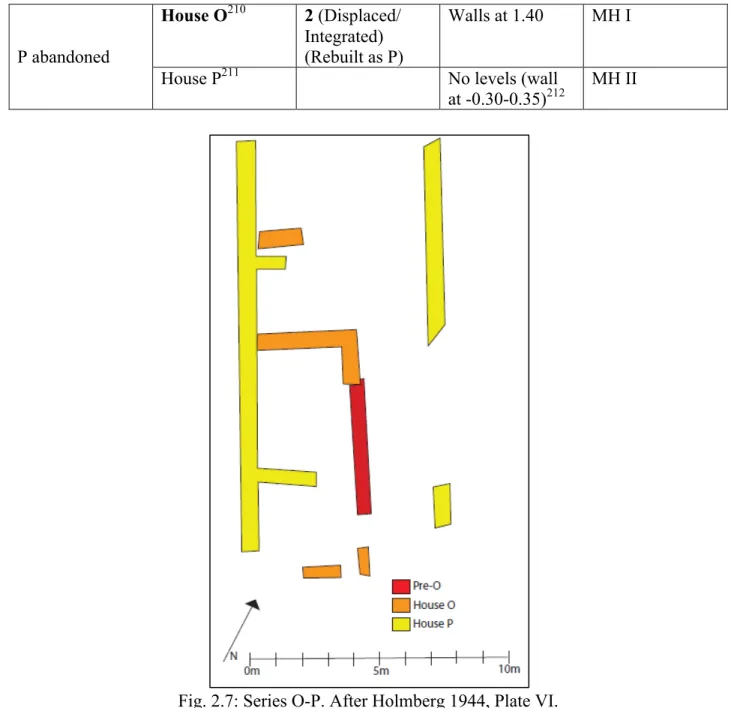
Figure 2.7: Series O-P. Figure 2.8: Series K-N.
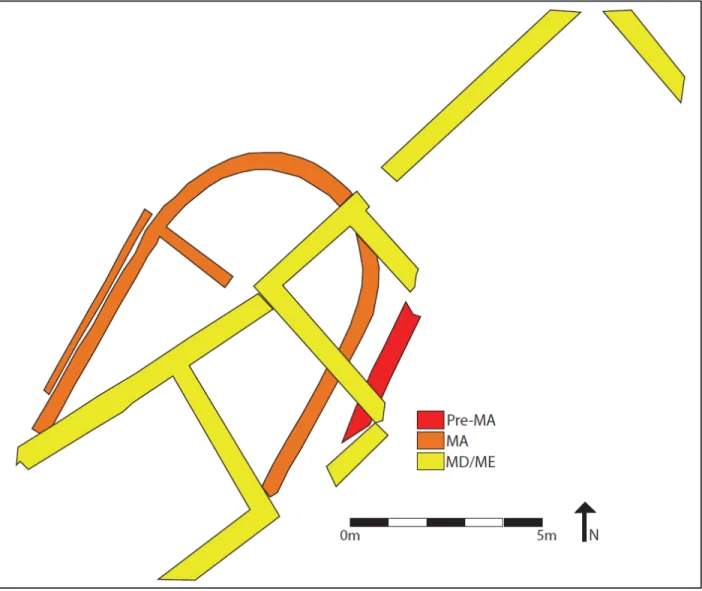
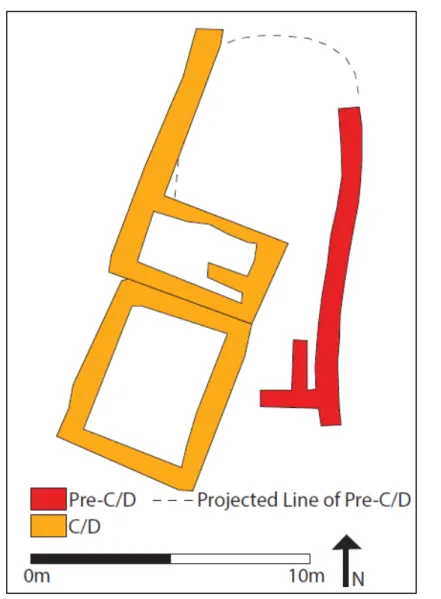
Figure 2.9: Sector Delta House Series. Figure 2.10: Series Pre-MA-MD/ME. Figure 2.11: Series C/D.
ix Figure 2.17: House A Series.
Figure 2.18: Chieftain’s House Series. Figure 2.19: North Apsidal House Series. Figure 2.20: Series W-4-W-56.
Figure 2.21: Series W-63-W-70. Figure 2.22: Series W-95-W-138. Figure 2.23: Series W-94-W-101. Figure 2.24: Series W-105-W-109. Figure 2.25: Series W-113-W-116. Figure 2.26: Series W-124-W-125. Figure 2.27: Series W-124-W-125. Figure 2.28: Series W-166-W-173. Figure 2.29: Series W-214-House BS. Figure 2.30: Series 23-20.
Figure 2.31: Series 18-24. Figure 2.32: Series D-M.
Figure 2.33: Unterburg Late “West Sequence” Series. Figure 2.34: House 161 Series.
Figure 2.35: House 168 Series Figure 2.36: Series D2-D1.
x
Figure 2.40: Series A-C. Figure 2.41: House E Series. Figure 2.42: EU 7 Series. Figure 2.43: Series J-L. Figure 2.44: House I Series. Figure 2.45: House II Series. Figure 2.46: House IV Series. Figure 2.47: House V Series. Figure 2.48: West House Series. Figure 2.49: Delta Series. Figure 2.50: Eta I Series. Figure 2.51: Alpha IV Series.
Figure 2.52: Beta I and Beta III Series. Figure 2.53: Zeta Series.
Figure 2.54: Alpha V Series. Figure 2.55: Nu Series. Figure 2.56: Lambda I Series. Figure 2.57: Terrace Houses Series. Figure 2.58: Series AB-M.
Figure 2.59: Koukounara Megaron Series.
xi Figure 2.63: Series D20-D18-21.
Figure 2.64: Series D33-D27, D33-D34.
Figure 2.65: Series D40, D43-D46-North Quarter Magazines. Figure 2.66: Series D63-D65-North Quarter Magazines. Figure 2.67: Series D69/71-D68.
Figure 2.68: Series V-2-Post V-2 (Wall G).
Figure 2.69: House series plotted against average house duration. Figure 2.70: House series plotted against overall series duration.
Figure 2.71: Twenty-year groupings of average house duration for each series plotted against average overall series duration for each group.
Figure 2.72: Average number of houses within each house series plotted against the duration of the series.
Figure 2.73: Average number of houses within each house series plotted against the average duration of house use.
Figure 2.74: Start and end dates for short-term series. Figure 2.75: Start and end dates for long-term series.
Figure 2.76: Total numbers of houses (or house subphases) during each period, divided according to inclusion in short- or long-term series.
Figure 3.1: Percentage of total number of settlements reported by Hope Simpson and Dickinson (1979) experiencing discontinuities at important transitions within the Bronze Age from EH II to LH III.
xii
LIST OF ABBREVIATIONS Chronology
EBA Early Bronze Age EH Early Helladic MBA Middle Bronze Age MH Middle Helladic LBA Late Bronze Age LH Late Helladic
Journals (after the Archaeological Institute of America) AA Archäologischer Anzeiger
AJA American Journal of Archaeology AR Arhcaeological Reports
Archaeology Archaeology Magazine ArchDelt Archaiologikon Deltion
BCH Bulletin de correspondance hellénique BSA Annual of the British School at Athens
Hesperia Hesperia: The Journal of the American School of Classical Studies at Athens JAnthArch Journal of Anthropological Archaeology
JAS Journal of Archaeological Science OpAth Opuscula Atheniensia
1 INTRODUCTION
This dissertation is in many ways a product of the recent academic interest in reuse of earlier material in archaeological contexts.1 More specifically, it originates in an observation made first at Lerna by John Caskey, who documented a series of five sequentially constructed houses at the east side of the tumulus covering the House of the Tiles.2 All of these houses dated to the Early Helladic III period (Lerna IV; ca. 2200-2000 BC), and so indicated the
reconstruction of this house roughly every sixty years. This type of “nested” domestic
construction and reconstruction has more recently been taken up in a number of studies. Donald Haggis, for example, has interrogated this phenomenon as a characteristic of “dynamic” versus “static,” more agglomerative approaches to settlement structure, comparing settlements on mainland Greece with those of Crete.3 Erika Weiberg and Michael Lindblom, contrasting
rebuilding practices at Lerna and Tiryns, consider how intensively the earlier structure is reused.4 Vertically integrated replacement acts as an “incorporative” building strategy, while
displacement is more “substitutive,” deliberately breaking with the past. Cornelia Wiersma follows a similar model, handling choices of rebuilding on a spectrum of faithfulness to the original house plan.5 I treat each of these perspectives in greater detail in the following chapter,
1 For the Bronze Age specifically, see the interest particularly in the reuse of tombs in, for instance, Preston (2005).
2 Caskey 1965.
3 Haggis 2013.
4 Weiberg and Lindblom 2014.
2
but it is worth emphasizing here that they all approach rebuilding as a gauge of either the
rejection or maintenance of the social category represented by the previous structure. Rebuilding may therefore act as a useful barometer of and tool for social change.
I have endeavored here to approach rebuilding particularly in this active role, stressing its performative aspects and function in recreating social groupings. The recent interest in this phenomenon, particularly relating to the end of the Early Bronze Age on the Greek mainland and the transition into the Middle Helladic (ca. 2000-1700 BC) period, makes a more comprehensive consideration of the reconstruction of domestic architecture timely. In particular, how
widespread was this practice, both at Lerna and more broadly in the EH III-MH community? What are the characteristics of house replacement; how was it enacted and how did it function; who was doing it and why? Though Wiersma addresses some of these questions briefly, it is not the focus of her study and is therefore not explored to any great degree.6 Similarly, as a result of her very different research questions, she is unable to consider a series of houses as a whole, rather than one house at a time. The association of house-rebuilding with the EH III and early MH period has led naturally to a broad timeframe for this study, until the end of the early Mycenaean period, around LH I/II (ca. 1700-1400 BC). This era has traditionally been
understood as a major time of transition, from the “collapse” at the end of EH II to the incipient states of the early Mycenaean period.7 As I have noted above, house-replacement functions in bringing about social change, and reflects changing attitudes toward past social structures. It is therefore worth asking, what role, if any, did rebuilding practices have during this important transitional period?
6 Wiersma 2013, esp. 199-201, 209-211, and 219-220.
3
The Middle Helladic period has itself also been a subject of increasing interest since Dickinson’s pioneering work on the rise of Mycenaean culture, as well as Nordquist’s influential publication on MH Asine.8 Scholarship on MH houses and settlements more specifically has been a growing area of interest since 2010 and the publication of a number of site-specific and synthetic studies in the Mesohelladika volume.9 Wiersma has likewise recently published a comprehensive catalog of excavated MH settlements and published houses.10 In general, intensive work on the MH mainland has focused on the Argolid, and particularly on the three major sites of Lerna,11 Asine,12 and Aspis-Argos.13 These three sites form the focus of a project run through the Groningen Institute of Archaeology and directed by Sofia Voutsaki.14 Voutsaki’s project has already provided a number of critical insights into the social, political, and economic changes occurring in the Argolid as Mycenae rose in power, eventually dominating the region and beyond.15 This approach has been valuable, but, as has been emphasized by Wiersma, there are few regional studies available for comparison, complicating the identification of different patterns or trajectories of development.16
8 Dickinson 1977; Nordquist 1987.
9 Philippa Touchais, et al., 2010.
10 Wiersma 2013.
11 Banks 2013; Zerner 1978.
12 Nordquist 1987; Voutsaki 2010a.
13 Touchais 1998; Philippa-Touchais 2010.
14 Voutsaki 2007.
15 Voutsaki 2005; 2010b.
4
I have unfortunately done little to correct this problem here. I have adopted somewhat arbitrary geographical boundaries, considering only the mainland Peloponnese, for a number of reasons. The first is the availability of information and the high number of extensive, published excavations in the Peloponnese, and especially the Argolid, Corinthia, and Messenia. The second is that, in spite of very active rebuilding activities in Thessaly—Pefkakia is perhaps the best example of this phenomenon—it is debated to what extant these more peripheral areas can be said to be part of the same cultural milieu as, for instance, Korakou and Nichoria.17 Already in the expanse of the Peloponnese there is strong evidence for regional development; as I argue below, the Argolid is very much the most active area in rebuilding behavior. Similarly, Thessaly especially, but maybe as far south as Boeotia, engages very deliberately in tell-building, entailing very close and frequent reconstruction of houses almost by definition. There are certainly also tell-sites in the Peloponnese, but in Thessaly they seem to be a characteristic part of the culture. Perhaps in part because of this, settlements also seem to undergo specific changes (outlined in Chapter 3 below) at an earlier point in Thessaly than in the broader Peloponnese. Though parallel changes are seen at Kolonna in the Saronic Gulf, and perhaps elsewhere, it is far from clear that different portions of the Greek mainland are not undergoing very different experiences for the time period under consideration here. On the other hand, the published material from Attica, Kolonna, and perhaps Kea does display interesting parallels with the Peloponnesian material, possibly acting as a single community tied by the Saronic Gulf, and it would be useful to include it in a future study.
I argue here for the central role of the physical structure of the house in creating and maintaining the social identity of the household. This function is primarily demonstrated in the
17 See Pantou (2010b) for an assessment of the major sites around Mycenaean Volos, which in many ways is quite
5
treatment of the house, which follows the life-cycles of its inhabitants. Essentially, the house is born and dies with the family, though likely not on a one-to-one level. Regular floor replacement and hearth renewal also speak to the episodic renewal of this house; on ethnographic parallels, these may take place yearly as part of a natural cycle, or be more occasional, marking marriages or births. House replacement may be frequent, practiced every generation or so, as at Lerna particularly, but in general throughout the Argolid, or it may be infrequent, marking the adoption of a past that is much more distant than the previous generation. Both types of replacement are likely to represent particular claims about descent and “place,” and both result in a redefinition of the family group with the creation of the new house. As Wiersma has suggested, this practice is particularly popular early in the period—though I see it continuing at a fairly high rate at least until LH I.18 Likewise, rebuilding seems to me to continue throughout the Mycenaean period, though its social role has in some ways changed. The importance of this practice in creating social identity and (somewhat literally) place within the extended family group and community is underscored, as I argue below, by the adoption of the destruction/rebuilding paradigm for the reorganization of settlement space during the early Mycenaean period.
This approach has implications for the development of the Mycenaean palace-states, for which these reorganized settlements are a precondition. Similarly, the primacy of the house in negotiating social identity and as a symbol of the kinship group is a defining feature of
Mycenaean society, and it is for this reason alone worth considering the treatment of the house leading up to this moment. The contribution of this study is its identification of the house and household as the basic unit of social organization throughout the MH period and well into the Mycenaean era. Lineage as a structuring principal of Mycenaean society has been widely
6
acknowledged, particularly in considerations of the mortuary material. But this study also highlights the destabilizing role of the house and lineage group in MH and early Mycenaean society. That is, house replacement is essentially individualizing, defining one family group in contrast to others, and probably marking a transition in household leadership on the occasion of the death of an influential leader. Though it brings people together in the creation of a new social group, it also opposes them to the earlier group and to “outsiders” in general. This process is, then, ultimately destabilizing, and settlements and societies formed from these groups must eventually break down into their constituent parts, as households continued to identify outside of the larger social grouping.
Contents
In the following pages, I handle many of these issues, focusing on the rebuilding of houses and the re-creation of the built space episodically from EH III until LH I/II. I hope to show that the renewal of the built space—especially at the level of the house but also at the level of the settlement—was a primary means of effecting the renewal and redefinition of a social group, here either the family/kinship group or the broader community of the settlement. To put it simply, building expresses belonging. In my first chapter, I handle house-rebuilding as a
recurring, cross-cultural phenomenon. I establish likely social meanings for this practice based on ethnographic studies, and define characteristic features, including possible accompanying ritual action and how such features may be identified in the archaeological record. A case-study considering some of the more prominent houses at Lerna illustrates these points.
7
(in EH II or LH III, for example). This chapter is arranged alphabetically according to general geographical region. For each site I have provided a sequence of every series of houses (including each individual house, approach to rebuilding, change in level, and date, as well as method of destruction, where known). I go on to consider briefly the overall pattern of rebuilding at each site, as well as the approximate site-wide rate of rebuilding (i.e., how popular was this practice at each site), and any evidence for accompanying ritual behavior marking house
replacement (including house-burning, house burial, termination deposits, and intramural burial). I have been rather generous with this evidence in an effort to determine how widespread such ritual action may be. Following this catalogue of house series, I discuss overall patterns of house replacement. In short, houses are replaced either generationally or supra-generationally, and series fall broadly into these two groups. These groups represent two different types of rebuilding with different—if related—social functions. It is worth noting here that house
replacement seems to be actively practiced in EH II as well, prominently in corridor-house type structures. These early examples are also worth considering in future studies.
My third and concluding chapter briefly considers settlement change as it is represented by various “discontinuities”—abandonments and new foundations—proposed by Joseph Maran for the transition to the Late Bronze Age on the Greek mainland.19 I focus on new, highly organized settlements, drawing here to some degree on material outside of the Peloponnese. These settlements are either totally new foundations or result from the destructive reorganization of earlier habitations, wiping out the previous plan entirely in certain cases. Such replacement and rebuilding appears to adopt certain elements of house-replacement, likely deliberately, in an effort to create more cohesive communities out of disparate households. In other words,
8
9
CHAPTER 1: THE DISCONTINUOUS “CONTINUOUS HOUSE”
The ritual phenomenon of “house-killing” is probably best attested in studies of the Neolithic period, ranging from the Vinča culture of Southeastern Europe to Anatolia and Çatalhöyük.20 In general, this practice has not been located in considerations of later periods in European contexts and in particular in the majority of the Greek mainland. As Haggis has recently noted, however, there are several prominent examples of a ritual elaboration of house destruction and the deliberate “burial” of the structure, including most notably the Toumba building at Lefkandi and the much earlier House of the Tiles at Lerna.21 Indeed, Haggis argues
that this ritualization of the destruction of the physical house is a specific characteristic of
mainland Greek cultures during the Bronze Age, noting the series of houses at the east side of the tumulus at Lerna as an example. Here, as originally observed by Caskey, houses are constructed, destroyed, and built anew after the same plan and orientation as the previous houses, but at a slight offset (Fig. 1.1).22 That is, they deliberately do not use the previous foundations, nor do
they make agglomerative additions to the house or redesign it in any significant way. Haggis
20 See Tringham (2000) and Stevanović (2002) for the Balkan material. See Cessford and Near (2005) for that from
Çatalhöyük. Episodes of house-killing have also been identified in New World contexts in Mesoamerica, discussed further below.
21 Haggis, 2013. Weiberg (2007, 155-185, and especially 168-170) has also recently discussed this idea for the
House of the Tiles at Lerna. The publication of the Lerna IV material by Banks (2013) has called the identity of the tumulus-builders there into questions. She proposes that it was not the “new” Lerna IV inhabitants that constructed the clear memorial to the house, but instead that it was the last act of the inhabitants of Lerna III. Weiberg (2007, 178-81) makes a similar argument, though I would suggest with her thatthis is more or less a false distinction, and that either way the idea that the area of the tumulus remained inviolate for any length of time demonstrates the respect that the occupants of Lerna IV had for the structure.
10
links this phenomenon—his “dynamic structure”— to “network” social strategies and
understands it as highly individuating practice, opposing it to the more agglomerative, “static,” “corporate” building style of contemporary cultures on Crete.23
Fig. 1.1: “Chieftain’s House” series identified by Caskey (1965) east of the tumulus at Lerna. House A corresponds to Banks (2013) W-1, B to W-36, C to W-86, D to W-90, and VA to
Zerner’s (1978) 98A.
Haggis’ argument depends on two major suppositions: first, that the destruction of these buildings was deliberate and ritualized and can be identified as such archaeologically; and second, that this type of ritual destruction and replacement of the building is a prominent feature of mainland Bronze Age culture(s) in particular (versus Crete). Returning to the example from Lerna, Caskey identifies no fewer than five iterations of a single house (though probably part of a larger complex) constructed after the same plan and orientation over a period of roughly 300 years on the E side of the tumulus over the House of the Tiles. On average, then, this house
11
appears to have been dismantled or “killed” and reconstructed with only slightly shifted
foundations every 60 years or so, and more frequently if individual building phases identified by Banks are incorporated into this model.24 Weiberg provides an even lower estimate of about 25 years—or as little as half of that time—for the lifespan of a house in Lerna IV (Fig. 1.2).25
24 Banks 2013.
12
Fig. 1.2: Composite plan of Lerna IV, and Houses D and M of Lerna V, indicating frequency of rebuilding at the site throughout this period. Tumulus indicated in dotted lines. North at top.
13
This replacement of the house has obvious implications for household memory and the relationship with the past, a phenomenon that Tringham has referred to as “the continuous house.”26 Specifically, she goes on to argue that the regular replacement of domestic structures— both at tell and non-tell sites—is a strategy executed by the household to perpetuate the “place” of the house physically and symbolically within the living and ancestral communities.27
Moreover, as Haggis emphasizes, the deliberate use of what Tringham has called “partial vertical superimposition” or “partial horizontal displacement” on the MH mainland represents “a
conscious design principal in the building process; a deliberate decision of the builders in successive phases to disengage themselves from the physical confines of the earlier house.”28 There is, then, both an obvious respect for the continuity of the household space and a
discontinuous desire to “renew” the space on a regular basis, probably related to the life cycle of the living household and perhaps the household head more particularly.29 This aspect of
discontinuity is important to the understanding of the motivations of the house builders, who seem to be interested in both association and disassociation with what came before—that is, both the destruction of the old house, and its rebirth through re-construction. It is not the same house, but a separate, and new dwelling for a redefined social group; thus, the discontinuous house.
In her catalog of EH III-LH I/II domestic architecture, Corien Wiersma considers 272 individual probable domestic structures across 50 mainland Greek sites. Though she does
26 Tringham 2000.
27 Tringham 2000, 121-127.
28 Tringham 2000, 117; Haggis 2013, 76. Stevanović (1997, 355) also proposes that horizontal displacement of
houses in at least the Neolithic setting could have served the further purpose of facilitating access to soils for building adjacent to the construction site. In her examples, however, even the horizontally displaced houses seem to make an effort to maintain a spatial relationship with the previous structure, as well as to break away from it.
14
consider the issue of rebuilding to some degree, discussed below, she does not interrogate the nature of house destruction or abandonment to any great degree. In general, she stresses the prevalence of apparent simple abandonment or desertion of these houses; for the 226 catalog entries for which she is able to make some comment about the end of the use-life of a particular structure, just over half (116 total) are suggested to have been deserted. About 13% (29) of the houses were modified or rebuilt in some way, while an additional 36% (81) suffered various forms of destruction. The abundance of simple desertions in Wiersma’s study is partially a result of her reasonable use of this category as sort of default when little or no information about the end of the building’s use-life is given by the excavator. Additionally, 29 of the 50 sites offer fewer than five structures for the period considered, further complicating the diachronic
consideration of house series. For the purposes of this study, major modifications or rebuilding of houses, because in many cases they must have required at least the partial dismantling of the original structure, are considered with house destructions.
Of Wiersma’s houses that can more or less confidently be said to have been destroyed, between 63 and 69 of the 81 are noted to have been fire-related, while 4 to 10 are attributed to earthquake damage. An additional 8 houses are simply listed as “destroyed” or “collapsed,” again as a result of ambiguous information provided by the excavators. No discussion of the deliberateness of these destructions, or of how to determine how deliberate the destruction of any of these houses may have been, is made. In many cases, the excavation of these houses was not done in such a way that any evidence of intentionality of destruction was recovered—this is a question that excavators simply were not asking of the material record, again partially explaining the incidence of assumed desertions. While working with the remaining data to determine
15
challenges, it is approached here from several different angles, with examples drawn from the primary site at which this phenomenon has been observed, Lerna.
In this chapter, I consider first comparative cases of cyclical and ritualized house destruction, primarily by fire; these case studies emphasize the difficulty and labor investment involved in burning mudbrick or other clay-based constructions, in turn suggesting the
importance of the ritualized conflagration of architecture to the social groups involved. I then consider ritual “termination” or “dedication” deposits associated with house-killing particularly in Mesoamerican cultures, and the possible application of this approach to MH material. A recent micromorphology-based study at Mitrou has emphasized the relatively fast accumulation of material as a result of the frequent replacement of houses.30 This phenomenon is also considered as an aspect of the cyclical treatment of houses, probably reflecting the generational cycles of the kinship group. Finally, Wiersma’s treatment of rebuilding is briefly considered, along with the problem of “tell” versus “open” settlement plans.
Comparative Cases of House-Killing
Before examining this phenomenon more deeply in the context of the Middle Helladic settlements of Greece, examples of which form the focus of the following chapter, it is
worthwhile to return to the parallel cases provided by the Neolithic communities of the Balkan and Anatolian regions, which may help to illuminate the house-cycle proposed here. For the houses at Çatalhöyük , a high degree of spatial continuity is proposed by Cutting.31 These structures, however, generally follow closely the boundary walls of the preceding dwelling, perhaps suggesting—along with other features of the settlement, such as the closely-packed,
30 Karkanas and Van de Moortel 2014.
16
though not strictly agglomerative, settlement plan—that it should be more readily identified with Haggis’ “static” settlements. Cessford and Near argue that houses began to be deliberately burnt in Levels VII and VI.B of the settlement, basing this idea on criteria developed by Stevanović, including the heat of the fire, an apparent multiplicity in the points at which the burning started (multiple ignition points), and the failure to repair the building, which is generally destroyed further either before or after the fire.32
Though they do not comment on why the buildings were burnt specifically, they do associate the destruction itself with the transition between abandonment and reuse of the domestic space.33 Interestingly, the rise in an apparently ritualized destruction of the house corresponds to a contemporary decrease in the amount of time that buildings were occupied before abandonment, from about 85-135 years to about 5-45 years.34 This development is
suggestive of a shift in the understanding of the use-life of the house, strongly identifying it with the generational cycle of the household.35 The situation provides a good parallel for that
proposed for Lerna.
Perhaps most cogent, however, are the apparent destruction practices of the Vinča culture of the Balkans, which have been explicitly associated with ideas of lineage by Tringham and Stevanović.36 Throughout the Neolithic, and in some areas beyond, the houses of this
32 Cessford and Near 2005, 174; Stevanović 1997. The actual process of burning clay-built structures has been tested
a number of times in experimental archaeology (Bankoff and Winter 1979; Coockson and Akar 2008), in general confirming the high resistance of even wattle-and-daub construction to incineration. Mudbrick construction in particular has been adopted for use in modern construction specifically for its fire-retardant qualities (County Fire Authority, Victoria, Australia, 2014).
33 Cessford and Near 2005, 182.
34 Cessford and Near 2005, 175.
35 Matthews 2005.
17
group seem to have been consistently and regularly burned over a surprisingly large geographic distribution. Indeed, the phenomenon appears to be so methodical in the archaeological record, that Stevanović is able to argue that the design and materials (wattle and daub) of the domestic structures were deliberately selected with the ultimate aim of destruction by fire in mind.37 Stevanović emphasizes the role of this intentional conflagration in “sealing off” the house “from possible future utilitarian use,” while simultaneously producing a focal point for memory in the remains of the house.38 That is, both the actual burning of the house and the ruins themselves provide a means of creating, maintaining, and accentuating continuity of place for these
households.39 The accessibility and visibility of the destruction process and later the ruined house are therefore of paramount importance, encouraging the partial (but not total) displacement of the following house; however, the new house also actively integrated portions of the older, destroyed house into itself, symbolically both distinguishing and relating the old and new households.40 As at Çatalhöyük, then, these houses, and their constructions and deconstructions, are presented by Tringham and Stevanović as manifestations of the household cycle, though here this relationship is made unequivocal.
37 Stevanović 1997, 385.That is, in the terms of Walker and Schiffer (2006), symbolic performance preferences
must have outweighed even structural concerns for the selector(s) of the household, encouraging the acquisition and use of wattle-and-daub technologies over other possible construction materials, including mudbrick and wood. Stevanović (1997, 362-380) makes a convincing case for the deliberate destruction of these houses, citing the high heat of the fire, which exceeds the temperature reachable without additional fuel, as well as multiple ignition points.
38 Stevanović 1997, 385.
39 Stevanović 1997, 387.
40 Stevanović 1997, 388. Stevanović goes on to note that “even though a burned and collapse house becomes
18
Common to both of these examples is the use of fire in the ritualized destruction of the house.41 All of the Neolithic studies cited above emphasize the importance of the transformative effect of fire on the structure of the house. That is, while the house would have been destroyed, certain elements of the house, including particularly wattle and daub, mudbrick, and other clay construction materials, would actually have been baked and effectively made permanent.42 The implication of destruction by fire, then, is dual, evoking discontinuity and death on the one hand and continuity, preservation and memory on the other. Again, this has obvious implications for the social group that the house represents, and reinforces the apparent need to punctuate clearly the household cycle and to re-create periodically (episodically?) the household itself. In a similar vein, Cessford and Near remark:
Burning buildings rather than simply demolishing them and filling them with materials creates a vivid and memorable spectacle. Performance and spectacle clearly played an important role in the life of Çatalhöyük’s inhabitants and the impression created by burning down buildings or groups of buildings would have been profound. Although fire can destroy the intimate locations and objects of individual and group histories, upon which some memories rely, the spectacle of burning creates other memories. In a sense burnt buildings can be viewed as offerings on a grand scale.43
The “spectacle” of fire, though, is incidental to the destruction process, and a similar memorable, emotional communitas might have been achieved through the collective effort required on the part of the household group (or more extended social networks) to demolish the house by hand, not unlike modern barn-raising. This is particularly true if the destruction of the house can be
41 Stevanović (1997, 382-385) and Tringham (2000, 124) counter the idea of the prevalence of accidental fires,
noting the extreme difficulty of burning clay-covered houses. They note ethnographic parallels for burning houses for other reasons, including pest control and misfortune in the household (untimely death, etc.), but emphasize the cyclicality of the process as a sign of the social function of this practice (Tringham 2000, 124; Stevanović 1997, 386).
42 Tringham 2000, 123; Stevanović 1997, 388.
19
associated with the death of a prominent member of the household group.44 A similar,
complementary feeling of renewal may have been evoked in the consequent re-construction of the house. This secondary effect must have been equally important, perhaps achieving the recreation of the social group associated with the house.45 Both the destruction and
reconstruction of the house, then, must have been imbued with ritual meaning.
The ritual nature of the destruction of the houses at Lerna may be indicated by the
assemblages left (or not left) within them at the moment of destruction. Perhaps the best example of this can be found in Caskey’s “Chieftain’s House,” Bank’s Building W-1, among the largest structures erected during this period at the site. Here, the articulated skeleton of a calf was discovered lying on the floor, “on its side and neatly disposed, as if the animal deliberately had been laid to rest here or, by some mischance, had died here and had been covered over when the next building in the area was constructed above.”46 The completeness of this skeleton in
conjunction with the tentative proposal of the deliberate dismantling of the building forwarded by Caskey and later by Banks may indicate its use as some sort of sacrifice or offering prior to the construction of the overlying Building, W-36. 47 Certainly prolonged exposure would have
44 The close association of house and household cycles may be corroborated further by Milka’s (2010, 437-438)
work on Lerna, which identifies a pattern of house use, destruction, and burial before the construction of another house over the graves in the area east of the Tumulus at Lerna (Area BE).
45 This idea corresponds well with ideas of materiality and social poweradvocated by Walker and Schiffer (2006).
Through various processes, including particularly its construction and use, the house—like any other artifact—is imbued with social meaning, and serves as an expression of the social presence and influence of a certain group. Walker and Schiffer (2006, 73): “Building on Nielsen’s [1995] study, we begin with the general premise that social power is the ability to affect, prescriptively and proscriptively, the interactions of others with artifacts” (emphasis original).
46 Banks 2013, 41. Banks cautions, however, that the animal may have been associated with an undetected
pit/bothros associated with a later building. This addendum does not seriously hamper the interpretation of this animal as a ritual deposit, as other examples of the deposition of animals possibly associated with the destruction of the house are generally found with destruction debris in bothroi, discussed further below. See also Reese (2013, 449-453) and Gejvall (1969, 29-34) for a general discussion of the cattle remains of Lerna.
47 Caskey 1965, 146; Banks 2013, 40. Neither Caskey nor Banks fully explains the reasoning behind the suggestion
20
resulted in the loss of much of the skeleton in what was apparently an active area of the settlement.
Likewise in the Eastern Sector were two cases of animals deposited in bothroi. In the first of these cases (Bothros B-85), the skeleton of a dog was found mixed with ash and coarse ware sherds; the north wall of the subsequent building (W-90) was laid over this deposit.48 The second example included two piglets inserted into a jar within a bothros (B-45) filled with burned debris, and is clearly ritual in nature, interpreted by Banks as a foundation deposit.49 It is notable that this building was also isolated by Rutter for its unusual pottery assemblage, containing a three-spouted jar (the “Hydra”) perhaps indicative of ceremonial drinking.50 For these reasons, this building has been suggested to have a function beyond the strictly domestic. It is equally possible that the ceramic deposit can also be associated with a ritual occurring at the time of the
destruction of the building, particularly since it is also “severely burned.”51 If this is the case, then both the construction and destruction of Building W-52 are ritually marked, the implications of which are discussed further below. As Weiberg observes in her consideration of the deposition of 16 figurines near the hearth in the “Sanctuary” at Lithares, “under the circumstances of this
Building W-36. Indeed, Caskey (1965, 146) interprets Building W-1 as a largely temporary structure, that would have stood “only a year or two; possibly ten or fifteen years; probably not much longer.”
48 Banks 2013, 175, 176. See also Reese (2013, 453-455) and Gejvall (1969, 14-18) for a discussion of the dog at
Lerna.
49 Banks 2013, 114: “A unique feature of the structure was what appeared to be a foundation bothros, B-45, which
lay under the east wall of the first stage of the structure and contained at the bottom the skeletons of two new-born piglets, which had been squeezed into the neck of IV.1 transitional to IV.2 Solidly Painted and Unburnished jar P411. Packed with stones in the top 0.30 m to provide support for the wall above, the bothros was filled with ashy earth down to the bones, and it would appear that burning was part of the deposition ritual.” Reese (2013, 440) puts the age of these piglets at less than one year.
50 Rutter 1995, Cat. P520;Rutter 2008.
21
specific act, perhaps rather than a place for ceremony, it [the Sanctuary] should be seen as illustrating a time for ceremony” (emphasis added).52
House-Killing and Ritual Action
Similar deposits to those described here have been recovered in Central American archaeology, particularly in the ruined settlements of the Maya. Though obviously much removed in time and space, the interpretive framework provided by these studies is useful in approaching the Middle Helladic material. These contexts, referred to as “termination deposits,” are characterized by the accumulation of cultural material over (or within) the use-surface and left unsealed, representing, as noted by Stanton, Brown, and Pagliaro, ritual “performed for a variety of different reasons, including the initiation of new construction episodes, warfare, and structure abandonment.”53 They go on to assert, however, that “all termination deposits appear to have one thing in common: the intent to ritually ‘kill’ an object, structure, person, or place.”54 Based partially on ethnographic material, the authors propose that termination ritual often included the intentional demolition of architecture, particularly in an elite context.55 The nature of these deposits is, however, ambiguous, largely as a result of their resemblance to domestic refuse and the difficulty of determining intention in the destruction of a building
archaeologically.56
52 Weiberg 2007, 98.
53 Stanton, Brown, and Pagliaro 2008, 235.
54 Stanton, Brown, and Pagliaro 2008, 235.
55 Stanton, Brown, and Pagliaro 2008, 236. They cite Stross (1998), considering modern Mesoamerican practices,
for their ethnographic parallels.
22
In an effort to overcome some of these challenges, Pagliaro, Garber, and Stanton have assembled a useful list of criteria for the identification of a particular type of termination
ceremony, interpreted as a “desecratory” ritual, intended not just to “kill” the structure but also to sever the ties of the previous occupant to the space.57 While not all of these criteria can be
applied to Middle Helladic contexts, it is illustrative to quote them here: 1. intensive burning,
2. intentional structural damage,
3. deposition of white marl (possibly signifying ritual burial [death?] or purification, depending on the context),
4. breaking and scattering of pottery (scattering rituals being an important part of elite rituals including blood sacrifice),
5. rapid deposition,
6. dense concentration of sherds with sharp breaks (due to the erosional protection of rapid breakage and deposition in a large deposit), and
7. large quantities of elite artifacts (which might better be stated as ritual artifacts).58 Similar ritual remains are likely to characterize termination deposits in general. Such deposits have also been found in a stratigraphically sequential series of three to four rituals, including a burial, at a “common” Maya house discussed by Garber, Driver, Sullivan, and Glassman, suggesting that these ceremonies can be a regular and cyclical process at many levels of the social spectrum.59 It is worth noting that in their study of related ritual/abandonment processes in the American Southwest, LaMotta and Schiffer emphasize the pervasiveness of these types of activities cross-culturally.60 This phenomenon is similar to the one I am proposing for Lerna,
57 Pagliaro, Garber, and Stanton 2003; Stanton, Brown, and Pagliaro 2008, 237. Pagliaro, Garber, and Stanton are
primarily concerned with “desecration” of a space or building during times of conflict by conquering (and generally external) groups. They note, however, that the ritual is also an act of “undedication,” perhaps a less charged term.
58 Stanton, Brown, and Pagliaro 2008, 237-238. Originally published by Pagliaro, Garber, and Stanton (2003, 79-80)
with fewer explanatory comments. So-called “reverential termination ritual deposits,” basically signifying a more positive attitude toward the previous structure and its inhabitants on the part of the agents of destruction and deposition, are similar in content, perhaps suggesting that they should be less sharply distinguished.
59 Garber, Driver, Sullivan, and Glassman 1998.
23
though one-to-one correlation should not be expected, and does not appear here. Nonetheless, this list provides a useful starting point for interrogating MH house destruction.
24
25
Building W-1, Caskey’s “Chieftain’s House” at the east of the tumulus, is separated from the succeeding Building W-36 by relatively little soil.61 In addition to the articulated skeleton of a calf, this material contained the handle of a marble vessel—the so-called “Chieftain’s cup”— noted by Caskey and Banks as a probable import with Anatolian and Minoan parallels.62 Banks explicitly links this cup, which is equipped with a hole in the bottom and a separately carved disc to fill it, with ritualized activities probably related to Rutter’s proposed Anatolian-derived
ceremonial drinking; Rutter himself points out in addition that the cup may predate its context by up to two centuries, suggesting its value as an heirloom item.63 Notably, several additional fragments of this cup were found within a bothros (B-15) associated with the earliest floor level of the subsequent building, W-36.64 The same bothros also contained several terracotta vessels, including an ouzo cup, bass bowl, cup, pedestal-footed cup, and tankards, as well as a “large bag” of animal bones. A handful of other objects were found in the fill of the bothros, including perforated stone discs and additional stone tools. The stone cup and the terracotta vessels, however, were concentrated at the bottom of the bothros with the bones and loose fill on top of them. Rutter does not comment on the condition of the breaks in particular, noting only that several of the vessels are worn from use; the pottery is in general near-complete and broken into a few large fragments, though portions of each piece are missing.65 Banks proposes that the
61 I return to deposition between the use-phases of the house below.
62 Caskey 1956, 164; Banks 1967, 227-230; Banks 2013, 41, 94. Caskey originally associates the handle with the
House of the Tiles, but observes that it was found “in and above the burnt debris [of the House of the Tiles].” It is not improbable that this “burnt debris” could be associated with Building W-1, immediately overlying the House of the Tiles.
63 Banks 1967, 229; Banks 2013, 94; Rutter 2008, 465.
64 Banks 2013, 400.
26
bothros may have acted as a storage area for these vessels before it “served for refuse
disposal.”66 Based on her description of the stratigraphy of the bothros, however, as well as the possible scattering of the stone and ceramic vessels, it is perhaps more likely that these vessels form a deposit that was deliberately buried, perhaps as a part of a termination/dedication ritual for the transition to the new Building W-36.
Two other bothroi (B-69a, B-69b) associated with a later phase of use of this structure may confirm the continuation of this practice prior to the construction of the following house in this area, Building W-86. Particularly the second of these bothroi contained many whole vessels (seven with completely preserved profiles) in a “soft ashy fill” with a number of carbonized remains.67 Rutter again comments on the apparent wear from usage on several of these pieces, but notes one in particular (P709, a bass bowl) for having sharp breaks in addition to signs of secondary burning.68 Another of the vessels (P713, a rim-handled cup) is a probable import, though no objects of clear ritual significance were found in this context.69 Banks interprets this deposit as “the household crockery of the family of the headman, which was thrown into a cooking pit located near the large central hearth when the next building was about to be
constructed on this site.”70 While Banks’ characterization of this context is one of disposal rather than one of ritual caching, it seems to correspond closely to both the possibly ritual bothros deposit associated with the previous phase of the building (B-15) and to the criteria for a
66 Banks 2013, 94.
67 Banks 2013, 147-148, 403; Rutter 1995, 159-161, Cat. P704-P716.
68 Rutter 1995, 160, Cat. P709.
69 Rutter 1995, 160, Cat. P713. Banks (2013, 148) lists, in addition to the ceramics, a bone scraper or polisher, a few
obsidian tools, and a “medium bag” of (unworked) bones.
27
termination/dedication ritual deposit described above, with the greatest difference being that the materials are collected and—perhaps—ritually buried in association with the construction of the new building. At the least, these deposits appear to mark the transition between old and new structures. In this case, the evidence of burning—or even of cooking—is again also significant, as it may indicate feasting activity or the actual ritual destruction of the house.
The subsequent building on this site, Building W-86, had multiple phases, with numerous associated bothroi that were noted for the extreme burning evident in their fill. Banks, however, suggests that at least some of this may be related to metalwork in the area, which seems a likely explanation given the presence of six individual crucibles in bothros B-102.71 She goes on to propose that metalworking may have been a prestige activity “associated with the community’s headman,” capitalizing on access to valuable raw material as well as restricted technological knowledge. If this is the case, then metalworking tools may have become status objects, which would make them appropriate for ritual deposition.72 This suggestion may also explain the unusual number of crucibles in this single deposit, though they may simply represent debris from the destruction of the house. The next iteration of Building W-86 is associated with multiple bothroi containing a large amount of ash and bones, including bothros B-85 with the canine skeleton, probably to be associated with the destruction of the building or the construction of the subsequent Building W-90. Following this house, there is little evidence for any kind of ritual deposition, though the house series continues into the MH, discussed briefly by Zerner.73
71 Banks 2013, 169. The crucibles are as yet unpublished.
72 Kayafa (2010, 709-710), however, notes the slow development and spread of metalwork during at least the MH
period, suggesting that it was not effective or necessary as a result of the kinship-based organization of MH culture. That is, MH culture “did not rely on the display of wealth for maintaining its status and authority” (709).
73 Zerner 1978, 31-38. Banks’ Building W-90 is equivalent to Zerner’s (32) House 99D (while the preceding
28
Unfortunately, Zerner gives little information on the contents of these houses. Nonetheless, it is at minimum clear that this house series underwent a number of probable ritual events marking transitions between houses, with the remains of the ritual and house destruction possibly—if inconsistently—cached in assorted bothroi.
A similar series of episodes of ritual caching of a termination/dedication deposit may also be attested by an assemblage discussed at length by Rutter and Banks and associated with the final use phase of Building W-9 and the subsequent construction of Building W-52, as well as with the transition from Building W-52 to Building W-56. These structures are situated to the east of the tumulus and to the south of and partially overlying Caskey’s “Chieftain’s House.” In the earliest in the series, Building W-9, an unusually large assemblage of 22 vessels was
scattered over the area, but concentrated in the western room.74 This assemblage is identified as purely domestic in character by Banks, and the relatively fragmentary nature of the pottery may argue against its being any sort of termination ritual deposit.75 Likewise, little or no effort seems to have been made to cache this material in bothroi, as suggested for the buildings above, though one bothros (B-6) observed to post-date the use-life of the structure contained ash, a grainy fill
however, comments on the alternating construction of cemeteries and houses following 98A, with House 100 and Rooms 3 and 5 built in the approximate area in the following years. Again, however, no details are given.
74 Banks 2013, 48-49. These ceramics were originally divided between two floors identified in this room, though
Banks (2013, 48) observes numerous joins between levels, suggesting that these pots were part of the same deposit. The supposed later floor was separated from the floor below by only a centimeter at the eastern (interior) side of the room, but roughly 20cm at the western (exterior) side. Based on the significant slope of the upper floor, it may be more likely that it represents melt from the more substantial exterior walls on this side, or from the slumping of the roof during or following the destruction of this building by fire. I therefore agree with Banks that these vessels are likely to represent one deposit. Rutter (1995) does not examine this assemblage as a whole, but confirms that it is highly dispersed, with several joining fragments recovered from outside the house in dump like deposits to the south (see, for example, Cat. P120, which was assembled from 20 fragments in four different pottery groups; see Banks 1995, 4-5 for an explanation of these groups). This scattering is almost certainly due to the intensity of building in this area, but does suggest that if these vessels do represent a ritual deposit, its sanctity was not respected in future rebuildings.
29
that may represent organic remains, and bones.76 Nonetheless, the concentration of the material in this room—the eastern room had apparently been cleared—in conjunction with the evidence for the burning destruction of the building and the subsequent foundation ritual demonstrated by the bothros with the two piglets, may indicate feasting and/or drinking activity prior to the building’s demolition.
The foundation/dedication deposit itself (B-45), mentioned above, contained the two piglets in a jar heavily worn from use, as well as a few obsidian tools in an ashy fill, apparently preceding the erection of the subsequent structure, Building W-52.77 No further details are given for the deposit or possible contemporary features in this area. Associated with the floor of the first phase of W-52, however, was large assemblage of ceramics, including the three-spouted ritual vessel with Anatolian parallels, known by the excavators as the “Hydra” (Cat. P520), as well as 17 other fully restorable pieces and fragments of up to 64 additional vessels, of which 19 are catalogued by Rutter.78 The ceramics vary in state of preservation, ranging from complete to extremely fragmentary (150+ sherds), and many show signs of secondary burning. In one case, Rutter notes that the burning is likely to have occurred following the destruction of the pot.79 The assemblage was associated with a bothros, B-54, into which the floor of the room extended and which contained eight complete pots and fragments of three others, including the “Hydra.” Two
76 The bothroi associated with Building W-9 are 2-6, and 26 (Banks 2013, 49-51; 51 and 399 for Bothros
B-6). No details were recorded for the fill of Bothroi B-2 and B-26, the only other bothroi actually contained within Building W-9.
77 Banks 2013, 114-116; Rutter 1995, 124, Cat. P411.
78 Rutter 1995, Cat. P412, P413, P466, P494, P515, P517, P520, P540, P541, P564, P571, P597, P615, P633, P636,
P641, P645, P655, P658; Rutter 2008, 464, 467, referencing Mellink 1969. Total numbers are taken from Banks (2013, 117), who comments in addition that 40 of these vessels are represented by uncatalogued sherds in storage at the Archaeological Museum of Argos.
30
other bothroi, B-55 and B-56, were associated with the use-life of the building and contained an array of tools and bones.80 All of this material was sealed by the burned debris of the building.
An intriguing—if somewhat dubious—possibility is presented by the continuation of the floor into Bothros B-54. That is, if this bothros, noted for its unusual size (1.34m by 1.5m) and depth (1.35m) by both Rutter and Banks, was functional in rituals associated with the destruction of this building, it may have been purposefully made to contain ritual debris, as suggested for other bothroi above. If this is the case, then the implication is that the floor was either re-laid or renewed specifically for this ritual, possibly explaining the filling of the top of the other two bothroi in this room with a yellow clay similar to that of the floor, though Banks had attributed this soil to fallen and melted construction materials.81 A multi-stage ritual process for house-killing/termination could therefore be suggested. For this house series, then, the sequence of possible ritual activity as discussed here progresses as follows: 1.) Possible termination
assemblage for Building W-9; 2.) Foundation/dedication deposit underlying Building W-52; 3.) Termination assemblage for Building W-52, possibly involving multiple steps of preparation and execution.
Evidence for subsequent ritual on the site of this structure for the following buildings is more elusive. Bothros B-62 may serve a caching function for a termination ritual deposit
containing remnants of a feasting ritual for Building W-56, constructed following the destruction by fire of Building W-52, but is hardly conclusive; subsequent building changed type, number, and orientation of structures dramatically. Though the ritual nature of these assemblages and the
80 Banks 2013, 119, 402.
81 This theory has the obvious problem that a ritual caching function becomes less credible for the other two bothroi
31
suggested function of bothroi in caching them are certainly debatable, it is worth noting that two bothroi (B-4 and B-57) in the area of the western room of Building W-52 were marked with upright slabs, a behavior not dissimilar to the treatment of human burials at the site.82 At least 12 bothroi of a total of about 223 were marked in a similar fashion, or with rings of stones around their tops; perhaps more notably, 63 of 158 bothroi (40%) for which Banks was able to recover some description of the fill contained burned material.83 At least at Lerna, then, bothroi may have functioned at least on specific occasions as receptacles for the remains of termination/dedication rituals, which are similar in content to those expected among the Maya. At minimum, they must have contained the burned rubble of the houses. A similar function for pits found at Opovo filled with destruction debris has been suggested for the Vinča culture by Tringham.84
Pagliaro, Garber, and Stanton explicitly associate these rituals with Maya notions of cyclicality, “in which one cycle of life must be terminated before the next may begin.”85 Such
82 No human remains were recorded for these bothroi; rather, B-4 (G154) contained fragments of two jars and two
obsidian bladelets (Banks 2013, 50), while B-57 (G155) contained fragments of two jars, a bass bowl, and a “small bag” of bones, some burned (Banks 2013, 122). Cavanagh and Mee (1998) do not systematically document stelae in EH III and MH contexts, noting their presence chiefly in the Shaft Graves (28). For Lerna specifically, Blackburn (1970, 179-189 and individual catalog entries) comments on 17 graves with possible or definite markers for the MH period (Graves 12, 21, 35, 50, 55, 78, 103, 126, 136, 154, 162, 166, 167, 172, 173, 182, 213), compared to 14 total for the 15 other contemporary sites she considers (294); of these, the bolded examples, seven total, may have had stele-like markers. Certainly this is a small percentage (0.03%) of the total number of graves (228), and none from the EH III period were marked. Perhaps noteworthy, however, is that bothroi exhibited the same range of markings as graves, including not only stelae but also rings of stones (Banks 2013, 414-415; for the graves, see the unbolded catalog numbers above in Blackburn 1970). An additional possible parallel treatment of the “dead” house and the actual dead may be indicated by the association of MH burials with burnt material, indicating the use of fire as a part of the burial process (Cavanagh and Mee 1998, 32-33).
83 Banks 2013, 399-412; these include: 4, 25, 57, 65, 78, 79, 87, 94, 129, 138, 166,
B-202. Bothroi with explicitly mentioned ash or burned debris include: B-5, B-6, B-7, B-19, B-22, B-23, B-25, B-31, B-32, B-36, B-38, B-45, B-46, B-52, B-54, B-57, B-59, B-62, B-63, B-67, B-68, B-69a/b, B-73, B-78, B-81, B-83, 84, 85, 89, 93, 94, 95, 101, 102, 103, 104, 106, 107, 108, 109, 116, 118, B-123, B-131, B-135, B-139, B-140, B-141, B-142, B-147, B-150, B-153, B-163, B-165, B-175, B-183, B-186, B-187, B-191, B-196, B-207, B-218, B-223. Black soil, which may or may not represent burning, brings the number up to 69 (B-10, B-37, B-80, B-146, B-151, B-210). A total of 65 bothroi of the 223 were not described as regards the fill.
84 Tringham 2000, 126.
32
ideas are manifested in many aspects of Mesoamerican archaeology, and perhaps most notably in the sacred calendars. While EH III and MH Greece have no such concrete manifestations of a cyclical understanding of time, it is clear that at least at Lerna on certain occasions, the transition from old to new house was ritually marked. Indeed, periodic—cyclical—renewal seems to have played a major role not only in the domestic sphere, but also possibly in funerary structures. Cavanagh and Mee describe the construction of MH tumuli as “a series of consecutive layers, like the skins of an onion.”86 This implies a semi-regular rebuilding or the tumulus, perhaps partially practically necessitated by erosion, but also likely to have been of ritual significance. Related may be the outward expansion of tumuli, as at Marathon.87 This need to mark transitions or renewals seems, then, to have been a pervasive element in MH culture. This idea is explored further in domestic contexts below.
House Destruction, Replacement, and Cycles of Renewal
A similar argument has been made by Nicole Boivin in her consideration of Neolithic floor-laying practices at Çatalhöyük, which she bases on her ethnographic work in Rajasthan, India.88 Boivin observes that the renewal of plaster floors in modern Rajasthan is linked to several temporal cycles, including the lifecycle of the individual, the lifecycle of the
house/household, and the annual cycle.89 Wall-plastering is also occasionally linked to these cycles, while additions and reductions to the house are linked to the cycles of the household, and in particular to marriage and death. In this case, the house and all of its constituent parts,
becomes a record of events in the lives of its occupants. Though the complicated relationships
86 Cavanagh and Mee 1998, 30.
87 Cavanagh and Mee 1998, 30.
88 Boivin 2000.
33
between these cycles and a high degree of variation in practice in Rajasthan prevented Boivin from pinpointing an overarching pattern in the plastering of these houses, she is nonetheless able to draw conclusions concerning the occasion of plastering walls and floors at Çatalhöyük.90 In the case of the walls, replastering seems to have been carried out in specific areas (north wall of Area 154 in Building 5) on at least an annual basis, probably tied to natural cycles and to be associated with the renewal of the structure. A high level of consistency in application may be indicative of the ritual nature of the practice.91 Floor-plastering seems to be more varied, and, where it is associated with burial, may have more to do with the life-cycles and identities of household members. In at least one area of Building 1 it also seems to have been annually renewed. Boivin has also suggested that plastering cycles may be related to the “birth” and “death” of houses.92
Similar phenomena have also been observed on the Greek mainland: for the Neolithic period, Makri in Northern Greece, and, more pertinently, for the Middle Bronze Age, Mitrou in East Lokris.93 The case in Makri is interesting in that it may indicate—in addition to those temporalities identified by Boivin—the additional level of community cycles, which I would argue is essential to the understanding of these practices. Panagiotis Karkanas and Nikos
Efstratiou here propose that, although the same regularity of plastering could not be observed at Makri as Boivin had observed at Rajasthan and proposed for Çatalhöyük, houses in the central area of the settlement surrounding a (common?) storage facility appear to have been formally re-plastered together at intervals of about 33 years, reflecting a decision made at the level of the
90 Boivin 2000, 382.
91 Boivin 2000, 383.
92 Boivin 2000, 384. Matthews 2005.