The Journal of Nutrition
Community and International Nutrition
Adiposity and Chronic Inflammation in Young
Women Predict Inflammation during Normal
Pregnancy in the Philippines
1–3
Thomas W McDade,
4,5* Judith B Borja,
6,7Fe Largado,
6Linda S Adair,
8and Christopher W Kuzawa
44Department of Anthropology and Institute for Policy Research, Northwestern University, Evanston, IL;5Child and Brain Development
Program, Canadian Institute for Advanced Research, Toronto, Canada;6University of San Carlos Office of Population Studies
Foundation, Inc., and7Department of Nutrition and Dietetics, University of San Carlos, Cebu City, Philippines; and8Carolina Population
Center and Department of Nutrition, University of North Carolina, Chapel Hill, Chapel Hill, NC
Abstract
Background:Rates of overweight and obesity are on the rise globally, and excess adipose tissue may contribute to
elevations in inflammation during pregnancy, leading to pregnancy complications and adverse birth outcomes.
Objective:The purpose of this study was to evaluate adiposity and inflammation in young women as predictors of
inflammation in the third trimester of pregnancy in a community-based sample of healthy women.
Methods:Female participants (24–30 y) in a prospective observational cohort study (Cebu Longitudinal Health and
Nutrition Survey) were contacted between 2009 and 2014 to identify new pregnancies. A total of 309 women provided
data from 409 pregnancies. An in-home interview was scheduled for the third trimester to collect pregnancy
informa-tion, anthropometric measurements, and a blood sample. Circulating C-reactive protein (CRP) was measured with a
high-sensitivity immunoassay. Data collected from assessments in 2005 and 2009 were used to assess body mass index (BMI)
and CRP in young adulthood, before pregnancy. Robust regression models were implemented to evaluate BMI and CRP
in young adulthood as predictors of pregnancy CRP.
Results:Pre-pregnancy BMI was a stronger predictor of third-trimester circulating CRP than BMI in the third trimester. No
association was found between pregnancy weight gain and CRP. Pre-pregnancy CRP was a significant predictor of CRP in
pregnancy, independent of BMI.
Conclusions:Levels of overweight/obesity and inflammation in young adulthood, before pregnancy, are important
predictors of inflammation in the third trimester of pregnancy. These results may have implications for addressing the
growing concern about the contribution of obesity to adverse birth outcomes, and they suggest that factors that influence
the regulation of inflammation, before pregnancy and independent of adiposity, may be important in shaping the
in-flammatory response to pregnancy. J Nutr2016;146:353–7.
Keywords:
inflammation, obesity, C-reactive protein, pregnancy, cohort studies, PhilippinesIntroduction
Mild increases in inflammation are a normative part of healthy
pregnancy, but higher levels of inflammation during
pre-gnancy are associated with adverse birth outcomes (1, 2). For
example, circulating concentrations of C-reactive protein (CRP)
are elevated slightly among healthy pregnant women (3, 4), but
higher-than-normal concentrations in the third trimester predict
lower birth weight of offspring (5), preterm delivery (6), chronic
placental villitis (7), and preeclampsia (8). Increased inflammation
during pregnancy is also associated with gestational diabetes (9)
and risk of neurobehavioral disorders in offspring (10, 11).
Pregnancy complications and adverse birth outcomes increase
offspring risk of cardiovascular and metabolic diseases in
adult-hood, underscoring the importance of the gestational environment
to trajectories of health for the next generation (12, 13).
Adipose tissue is an important site of proinflammatory
cytokine production, and higher concentrations of CRP, outside
of pregnancy, are consistently associated with measures of
overweight and obesity (14, 15) and with elevated risk of
1
Supported by NIH, theEunice Kennedy ShriverNational Institute of Child Health and Human Development grant 1R01 HD054501 and the Biological Anthropology Program at the National Science Foundation grant BCS-1440564.
2
Author disclosures: TW McDade, JB Borja, F Largado, LS Adair, and CW Kuzawa, no conflicts of interest.
3
The content is solely the responsibility of the authors and does not necessarily represent the official views of the NIH or the National Science Foundation. Additional support was also provided by the Institute for Policy Research at Northwestern University.
*To whom correspondence should be addressed. E-mail: [email protected].
ã2016 American Society for Nutrition.
cardiovascular disease (16) and type 2 diabetes (17). Obesity in
pregnancy also increases risk of gestational diabetes (18) and
preeclampsia and preterm delivery (19, 20). Chronic or
dysregulated inflammation, driven in part by excess adipose
tissue, may therefore be an important contributor to pregnancy
complications and adverse birth outcomes.
With rates of obesity on the rise, in the United States and
globally (21), several studies have documented positive
associ-ations between overweight/obesity and inflammation during
pregnancy (22). However, most prior studies have recruited
women after they become pregnant, with few studies that
included measures of adiposity and inflammation before
nancy. Considering these factors in adulthood, before
preg-nancy, may be important for 2 reasons:
1
) individual differences
in levels of adiposity and inflammation are apparent in
adult-hood and may be important determinants of how women respond
to the inflammatory stress of pregnancy;
2) identifying women who
are at increased risk of dysregulated inflammation during pregnancy,
before they become pregnant, may provide options for intervention
that reduce risk of pregnancy complications.
The aim of this study is to investigate the predictors of CRP in
the third trimester of pregnancy among a cohort of women in the
Philippines. The analysis uses data from a large, ongoing cohort
study with several rounds of data collection before the
pregnancy, to address the following specific objectives:
1
)
evaluate whether BMI (in kg/m
2) during pregnancy or BMI
before pregnancy is a stronger predictor of CRP in the third
trimester and
2
) investigate whether CRP concentration before
pregnancy predicts CRP in the third trimester, independently of
BMI. The Philippines is a lower-middle income nation
under-going substantial economic, dietary, and lifestyle changes, and it
exemplifies current trends toward rising rates of overweight and
obesity globally and associated increases in cardiovascular and
metabolic diseases (23, 24).
Methods
Participants and data collection.The Cebu Longitudinal Health and Nutrition Survey is an ongoing birth cohort study that began in 1983 with the recruitment of a community-based sample of 3327 pregnant women (25). Offspring were followed through multiple rounds of data collection, including surveys in young adulthood when participants were 20–22 (2005) and 24–26 (2009) y old. Cebu City is the second-largest urban area in the Philippines, and the CLNHS is notable for the diverse social, economic, and physical environments of study participants, who inhabit agrarian communities, dense urban settlements, and middle-class neighborhoods. Attrition in the Cebu Longitudinal Health and Nutrition Survey is primarily because of factors related to out-migration, and rates of refusal during initial recruitment were low (<4%) (25).
Between 2009 and 2014, when participants were 24–30 y old, women were contacted at 6-mo intervals to identify new pregnancies. An in-home interview was scheduled for the third trimester. Over the 5-y period of pregnancy tracking the individual rate of pregnancy was 1.32 pregnancies per woman with a total of 82.7 pregnancies/y in the sample. Rate of refusal was 1.2% of participants in the cohort, primarily because of loss of contact, presumably resulting from out-migration. All data were collected under conditions of informed consent with institutional review board approval from Northwestern University.
Anthropometric measures were collected with the same standardized procedures at each survey (26). Women provided information on household demographic characteristics and socioeconomic status, preg-nancy complications, and timing of last menstrual period. The mean gestational timing of data collection was 29.6 wk from last menstrual period, with 90% of interviews conducted between 26.0 and 35.4 wk.
Blood samples were collected as finger stick capillary whole blood, dried on filter paper [dried blood spots (DBS)], for the analysis of CRP.
Each participantÕs finger was cleaned with alcohol, and a sterile, disposable microlancet was used to deliver a controlled, uniform puncture. Whole blood was placed directly on standardized filter paper commonly used for neonatal screening (Whatman 903; GE Healthcare). This relatively noninvasive blood collection protocol minimizes pain and inconvenience to the participants, and it facilitates the collection of blood samples despite the constraints of field-based research settings (27). After collection, DBS cards were allowed to dry at room temperature for;4 h and were stored in gas-impermeable bags at220°C before shipment. Samples were express shipped to the United States where they were stored at230°C before analysis.
Data from the 2005 and 2009 surveys were used to assess BMI and CRP in young adulthood, before pregnancy. In 2005 and 2009, height and weight were measured with the same standardized procedures. In 2005, venous blood samples were collected and measured for high-sensitivity CRP, as described previously (14). BMI data from 2009 were used to define pre-pregnancy BMI, unless women were pregnant at the time of the survey, in which case BMI values from 2005 were used (n= 62). Complete anthropometric, sociodemographic, and CRP data were available for 409 pregnancies from 309 women. Over the 5-y period of pregnancy tracking, 89 women were pregnant twice, and 11 women were pregnant 3 times.
Measurement of circulating CRP.Samples were analyzed for CRP in the Laboratory for Human Biology Research at Northwestern University with the use of a modified high-sensitivity enzyme immunoassay protocol previously developed for use with DBS (28). Prior validation of assay performance indicates that the DBS CRP method produces results that are comparable with gold standard plasma-based clinical methods, with a lower limit of detection of 0.03 mg/L (28). To minimize between-assay variation, all samples were analyzed by the same technician with the use of a single lot of capture antibody, detection antibody, and calibration material. Between-assay CVs for low, mid, and high control samples included with all runs were 11.8%, 9.6%, and 8.1%, respectively.
Before data analysis, DBS results were converted to plasma equiv-alent values with the use of a conversion formula that was based on 69 matched DBS and plasma samples (29). DBS samples were analyzed with the same procedures, lot number of reagents, and technician as applied to the study DBS samples. Plasma samples were analyzed for high-sensitivity CRP in a high-throughput clinical laboratory on the Beckman Coulter Synchron DXC platform. The correlation between DBS and plasma concentrations was high (Pearsonr= 0.98), and the resulting Deming regression conversion formula was as follows: plasma (mg/L) = 1.643DBS (mg/L).
Data analysis.Third-trimester CRP was the dependent variable in all analyses, and CRP values were log-transformed (base 10) to normalize the distribution. Pearson correlation coefficients were used to investigate the strength of bivariate associations, and pairedt test was used to examine the difference in logCRP in young adulthood and logCRP in pregnancy. A series of multivariate least-squares regression models were implemented to determine the extent to which BMI and CRP before pregnancy and BMI in pregnancy predicted CRP in pregnancy. To facilitate interpretation, median CRP values are presented in the text and inFigure 1, and untransformed values are presented inFigure 2, based on predictions from the final regression model. Descriptive statistics in the text are means6SDs, except for CRP, which is presented as median (IQR). Regression coefficients areb(95% CI).
Preliminary analyses indicated that the timing of data collection in the third trimester was not significantly associated with CRP (b= 0.01; 95% CI:20.03, 0.05;P= 0.7) and was therefore not considered further. Women who were pregnant in the 2005 survey were not included in this analysis because they did not have a CRP measurement when they were not pregnant.
Several variables were considered as potential confounders/modifiers of associations with pregnancy CRP. Multiple measures of socioeco-nomic status (education level, home ownership, assets) were assessed as part of the pregnancy interview. Information on pregnancy complica-tions was also collected, including self-reports of gestational diabetes, high blood pressure, urinary tract infection, and placenta previa. Overall, 19.2% of the pregnancies were associated with$1 complica-tion. Information on diet during pregnancy was also considered. Women were asked to report on the number of meals and snacks they typically eat in a day and the frequency of fast-food consumption in a month. They were also asked to report on what foods they usually eat for breakfast, lunch, dinner, and snack. This information was summarized by category, to provide measures of the daily frequency of consumption of the following foods: meat (pork, beef, goat, chicken), fish and crustaceans, bread/baked goods, and rice (various preparations).
Results
Mean pre-pregnancy BMI in the sample was 21.4
6
3.5, mean
BMI in the third trimester was 24.5
6
3.4, and women gained
7.3
6
5.0 kg from their pre-pregnancy weight (Table 1). With
the use of WHO-recommended BMI cutoff values, 15.3% of the
women were overweight or obese as young adults, before
pregnancy. However, WHO analyses have also acknowledged
increased risk of cardiovascular and metabolic diseases in Asian
populations, including the Philippines, at BMI < 25 (31). After
prior research in this cohort (32), the use of 23 as the BMI cutoff
for overweight and 25 as the BMI cutoff for obesity indicated a
rate of overweight/obesity of 27.3%. Consistent with prior
reports that levels of central body fat are higher among some
Asian population at a given BMI value compared with white/
European populations (33), mean waist-hip ratio in the sample
was 0.88, and 81.4% of the sample was >0.85, the WHO cutoff
for increased metabolic risk (34).
Median CRP before pregnancy was 0.3 mg/L (IQR: 0.09, 1.3
mg/L), and it increased significantly in the third trimester to 1.8
mg/L (IQR: 1.0, 3.1 mg/L) (
t
=
2
17.5,
P
< 0.001, for difference
between logCRP before and during pregnancy). Pregnancy CRP
was positively associated with BMI before pregnancy (Figure 1).
Similarly, concentration of CRP in young adulthood was
positively associated with BMI in young adulthood, as reported
previously in this cohort (14). As expected, pre-pregnancy BMI
and BMI in the third trimester of pregnancy were highly
correlated (r
= 0.80,
P
< 0.001).
We next examined the predictors of third-trimester CRP in
multivariate regression analyses. In preliminary analyses we
found that primiparous women had significantly lower CRP
during pregnancy (
b
=
2
0.11; 95% CI:
2
0.20,
2
0.02;
P
< 0.05).
We therefore included this variable and maternal age (b
= 0.05;
95% CI:
2
0.05, 0.14;
P
= 0.4) in subsequent models.
BMI during pregnancy was significantly and positively
associated with CRP (b
= 0.028; 95% CI: 0.015, 0.041;
P
<
0.001). The association between pre-pregnancy BMI and CRP,
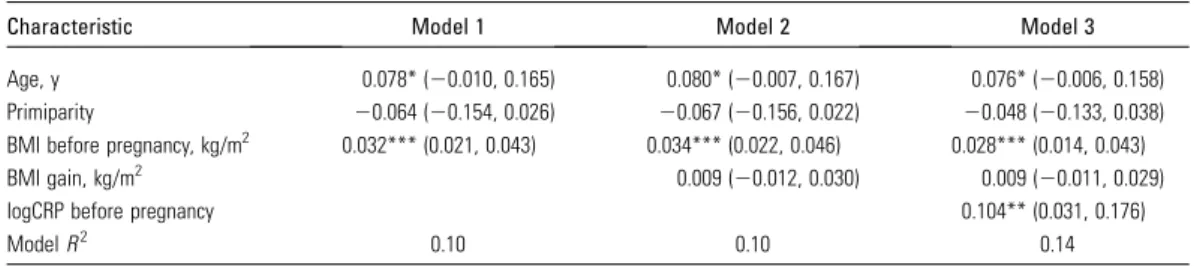
however, was slightly stronger (Table 2, model 1), and the model
R
2was higher (0.10 compared with 0.09), indicating a larger
proportion of explained variance in logCRP. When both BMI
variables were considered simultaneously, pre-pregnancy BMI
was a significant predictor of CRP (b
= 0.025; 95% CI: 0.007,
0.043;
P
< 0.01), whereas BMI in pregnancy was not (
b
= 0.009;
95% CI:
2
0.012, 0.030;
P
= 0.4).
Because BMI values before and during pregnancy were highly
correlated, it is difficult to distinguish their independent
associa-tions with CRP. We therefore calculated a variable that represented
BMI gain in pregnancy (BMI
pregnancy2
BMI
pre-pregnancy), which is
only moderately correlated with the BMI before pregnancy (r
=
2
0.28,
P
< 0.001) and third-trimester BMI (
r
= 0.35,
P
< 0.001).
Because height did not change across the pre-pregnancy and
pregnancy measurements, BMI gain can also be interpreted as
representing weight gain during pregnancy. BMI gain was not a
significant predictor of third-trimester CRP, whereas
pre-pregnancy BMI remained a strong predictor (Table 2, model 2).
FIGURE 1 Median CRP concentration during young adulthood andpregnancy in relation to pre-pregnancy BMI in young women in the Philippines. The number of women in each BMI category is presented above the open bars; the number of pregnancies in each BMI category is presented above the closed bars. There were 409 pregnancies in 309 women overall. CRP, C-reactive protein.
We next evaluated whether CRP, measured before pregnancy,
was an independent predictor of CRP in the third trimester.
When considered in a model with age and primiparity,
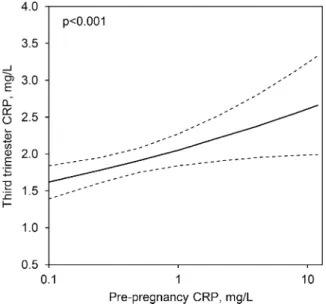
pre-pregnancy CRP was a strong and significant predictor of CRP in
pregnancy (b
= 0.136; 95% CI: 0.064, 0.207;
P
< 0.001). When
pre-pregnancy BMI was added to the model, pre-pregnancy CRP
remained as an independent predictor of CRP in the third
trimester, and the association between pre-pregnancy BMI and
pregnancy CRP was attenuated (Table 2, model 3). The model
R
2is higher when pre-pregnancy CRP is included (0.14
compared with 0.10), further underscoring the predictive value
of pre-pregnancy CRP. Figure 2 shows CRP in pregnancy as a
function of CRP before pregnancy, independent of BMI and
other covariates in the final model.
Finally, we considered several sets of variables as potential
confounders of associations with pregnancy CRP (results not
shown). Measures of socioeconomic status (home ownership,
maternal education, household assets) did not approach
signif-icance as predictors of pregnancy CRP. We also confirmed that
the pattern of results did not differ across primiparous compared
with multiparous pregnancies by running separate models for
each. Similarly, pregnancy complications, and measures of food
frequency, did not modify patterns of association between
pregnancy CRP and other variables in the final model.
Discussion
Pregnancy is an inflammatory event, and effective regulation of
inflammation is an important part of healthy pregnancy.
Inflammation is also associated with overweight and obesity,
but the extent to which additional adipose tissue, before or
during pregnancy, may contribute to excessive inflammation is
not known. In this study we take advantage of data from a
prospective cohort study to investigate the extent to which BMI
and inflammation in young adulthood, before pregnancy, predict
the inflammatory response to pregnancy.
Consistent with prior research, across a wide range of
populations, we find a positive association between BMI and
CRP in pregnancy (35–37). However, our results suggest that
BMI in adulthood, before pregnancy, is a stronger predictor of
CRP in pregnancy. Cross-sectional studies do not include
pre-pregnancy BMI, raising the possibility that prior reports of an
association between BMI and CRP in pregnancy reflect the
strong correlation between BMI before pregnancy and BMI in
pregnancy. Consistent with this idea, a study of healthy pregnant
women (9) documents a strong positive association between
pre-pregnancy BMI and late second/early third-trimester CRP,
with no association between CRP and pregnancy weight gain.
Similarly, we find no association between pregnancy weight gain
and CRP in our sample.
The clinical implications of our findings are not clear and will
require additional research. Elevations in CRP are a normative
part of healthy pregnancy (3, 4), but excessive inflammation was
associated with adverse birth and developmental outcomes in a
wide range of populations globally (5–11). Our results may have
important implications for addressing growing concern about the
contribution of overweight and obesity to adverse birth outcomes,
because it appears that limiting weight gain during pregnancy
may not be effective in reducing levels of inflammation.
To the best of our knowledge, this study is the first to report
an association between the level of systemic inflammation in
adulthood, before pregnancy, and the inflammatory response
to pregnancy. We find a strong positive association that is
independent of BMI. Although prior research has emphasized
the potential for synergy between pregnancy and adiposity
for increasing levels of inflammation during gestation (22, 36),
our findings suggest that additional factors that contribute to the
regulation of inflammation, before pregnancy and independent of
adiposity, may be important in shaping the inflammatory response
to pregnancy. For example, prior research has identified nutritional
and microbial exposures in infancy (38, 39) and psychosocial
stressors in childhood (40) as important determinants of chronic
inflammation in adulthood. These kinds of exposures, during
sensitive periods of immune development, may therefore have
lasting effects on the inflammatory response to pregnancy (41).
A major strength of our study is the use of a large, prospective,
community-based cohort, with measures of adiposity and
inflam-mation collected before pregnancy. A limitation is our use of
single CRP measures to assess chronic inflammation, both in
adulthood and during pregnancy. Similarly, because we have only
1 pregnancy CRP measure, we cannot determine the level of
inflammation earlier in gestation. In addition, the average BMI in
our sample is relatively low at 21.4, compared with an average
BMI of
;
26 for comparably aged young women in the United
States (42). As such, generalizability may be limited, although we
TABLE 2 Linear regression coefficients that describe the associations between age, parity, BMI before pregnancy, BMI gain in pregnancy, and circulating CRP before pregnancy and log-transformed circulating CRP in the third trimester in young women in the Philippines1
Characteristic Model 1 Model 2 Model 3
Age, y 0.078* (20.010, 0.165) 0.080* (20.007, 0.167) 0.076* (20.006, 0.158) Primiparity 20.064 (20.154, 0.026) 20.067 (20.156, 0.022) 20.048 (20.133, 0.038)
BMI before pregnancy, kg/m2 0.032*** (0.021, 0.043) 0.034*** (0.022, 0.046) 0.028*** (0.014, 0.043) BMI gain, kg/m2 0.009 (20.012, 0.030) 0.009 (20.011, 0.029)
logCRP before pregnancy 0.104** (0.031, 0.176)
ModelR2 0.10 0.10 0.14
1Values areb(95% CI);
n= 409 pregnancies from 309 women. *P,0.10, **P,0.01, and ***P,0.001. TABLE 1 Descriptive characteristics of the study participants1
Characteristic Value
Age, y 27.061.5 (24.4–30.2)
Parity 2.861.6 (1–10)
Education, y 12.064.2 (1–23) Waist-hip ratio, before pregnancy 0.8860.04 (0.78–0.96) BMI, kg/m2
Before pregnancy 21.463.5 (14.9–34.8) Third trimester 24.563.4 (16.6–38.2)
1Values are means6SDs (range),
note that the patterns of association between BMI, pregnancy,
and CRP in our sample are consistent with prior research in the
United States and other international settings. In addition, the
range of BMI in our sample includes a substantial number of
overweight/obese individuals, and most women in our sample had
waist-hip ratio above the WHO cutoff for increased metabolic
risk, which should enhance generalizability to more obesigenic
environments. Additional research in this and other populations
may generate novel insights into the factors that contribute to
inflammation during pregnancy, with implications for birth
outcomes and trajectories of health in the next generation.
Acknowledgments
TWM, JBB, and CWK designed the research, conducted the
research, and provided essential materials; FL and LSA conducted
the research and provided essential materials; and TWM
performed statistical analysis, wrote the paper, and had primary
responsibility for final content. All authors read and approved the
final manuscript.
References
1. Challis JR, Lockwood CJ, Myatt L, Norman JE, Strauss JF, Petraglia F. Inflammation and Pregnancy. Reprod Sci 2009;16:206–15.
2. Romero R, Gotsch F, Pineles B, Kusanovic JP. Inflammation in pregnancy: its roles in reproductive physiology, obstetrical complica-tions, and fetal injury. Nutr Rev 2007;65:S194–202.
3. Watts DH, Krohn MA, Wener MH, Eschenbach DA. C-reactive protein in normal pregnancy. Obstet Gynecol 1991;77:176–80.
4. Kuzawa CW, Adair LS, Borja J, McDade TW. C-reactive protein by pregnancy and lactational status among Filipino young adult women. Am J Hum Biol 2013;25:131–4.
5. Lowe LP, Metzger BE, Lowe WL, Jr., Dyer AR, McDade TW, McIntyre HD. Inflammatory mediators and glucose in pregnancy: results from a subset of the Hyperglycemia and Adverse Pregnancy Outcome (HAPO) Study. J Clin Endocrinol Metab 2010;95:5427–34.
6. Sorokin Y, Romero R, Mele L, Wapner RJ, Iams JD, Dudley DJ, Spong CY, Peaceman AM, Leveno KJ, Harper M, et al. Maternal serum interleukin-6, C-reactive protein, and matrix metalloproteinase-9 con-centrations as risk factors for preterm birth <32 weeks and adverse neonatal outcomes. Am J Perinatol 2010;27:631–40.
7. Ernst LM, Grobman WA, Wolfe K, Huang MH, McDade TW, Holl JL, Borders AE. Biological markers of stress in pregnancy: associations with chronic placental inflammation at delivery. Am J Perinatol 2013;30:557–64. 8. Teran E, Escudero C, Calle A. C-reactive protein during normal pregnancy and preeclampsia. Int J Gynaecol Obstet 2005;89:299–300. 9. Retnakaran R, Hanley AJG, Raif N, Connelly PW, Sermer M, Zinman B. C-reactive protein and gestational diabetes: the central role of maternal obesity. J Clin Endocrinol Metab 2003;88:3507–12. 10. Saliba E, Henrot A. Inflammatory mediators and neonatal brain
damage. Biol Neonate 2001;79:224–7.
11. Ponzio NM, Servatius R, Beck K, Marzouk A, Kreider T. Cytokine levels during pregnancy influence immunological profiles and neurobehavioral patterns of the offspring. Ann N Y Acad Sci 2007;1107:118–28. 12. Gluckman PD, Hanson MA, Cooper C, Thornburg KL. Effect of in
utero and early-life conditions on adult health and disease. N Engl J Med 2008;359:61–73.
13. Kuzawa CW, Quinn EA. Developmental origins of adult function and health: evolutionary hypotheses. Annu Rev Anthropol 2009;38:131–47. 14. McDade TW, Rutherford JN, Adair L, Kuzawa C. Population differ-ences in associations between C-reactive protein concentration and adiposity: comparison of young adults in the Philippines and the United States. Am J Clin Nutr 2009;89:1237–45.
15. Ford ES, Giles WH, Mokdad AH, Myers GL. Distribution and correlates of C-reactive protein concentrations among adult US women. Clin Chem 2004;50:574–81.
16. Ridker PM, Buring JE, Shih J, Matias M, Hennekens CH. Prospective study of C-reactive protein and the risk of future cardiovascular events among apparently healthy women. Circulation 1998;98:731–3.
17. Pradhan AD, Manson JE, Rifai N, Buring JE, Ridker PM. C-reactive protein, interleukin 6, and risk of developing type 2 diabetes mellitus. JAMA 2001;286:327–34.
18. Chu SY, Callaghan WM, Kim SY, Schmid CH, Lau J, England LJ, Dietz PM. Maternal obesity and risk of gestational diabetes mellitus. Diabetes Care 2007;30:2070–6.
19. Baeten JM, Bukusi EA, Lambe M. Pregnancy complications and outcomes among overweight and obese nulliparous women. Am J Public Health 2001;91:436–40.
20. Siega-Riz AM, Siega-Riz AM, Laraia B. The implications of maternal overweight and obesity on the course of pregnancy and birth outcomes. Matern Child Health J 2006;10:S153–6.
21. Popkin BM, Gordon-Larsen P. The nutrition transition: worldwide obesity dynamics and their determinants. Int J Obes Relat Metab Disord 2004;28:S2–9.
22. Denison FC, Roberts KA, Barr SM, Norman JE. Obesity, pregnancy, inflammation, and vascular function. Reproduction 2010;140:373–85. 23. Adair LS. Dramatic rise in overweight and obesity in adult Filipino
women and risk of hypertension. Obes Res 2004;12:1335–41. 24. Tanchoco CC, Cruz AJ, Duante CA, Litonjua AD. Prevalence of
metabolic syndrome among Filipino adults aged 20 years and over. Asia Pac J Clin Nutr 2003;12:271–6.
25. Adair LS, Popkin BM, Akin JS, Guilkey DK, Gultiano S, Borja J, Perez L, Kuzawa CW, McDade T, Hindin MJ. Cohort profile: the Cebu Longitu-dinal Health and Nutrition Survey. Int J Epidemiol 2011;40:619–25. 26. Lohman TG, Roche AF, Martorell R. Anthropometric Standardization
Reference Manual. Champaign, IL: Human Kinetics Books; 1988. 27. McDade TW, Williams S, Snodgrass JJ. What a drop can do: dried
blood spots as a minimally invasive method for integrating biomarkers into population-based research. Demography 2007;44:899–925. 28. McDade TW, Burhop J, Dohnal J. High-sensitivity enzyme immunoassay
for C-reactive protein in dried blood spots. Clin Chem 2004;50:652–4. 29. McDade TW. Development and validation of assay protocols for use
with dried blood spot samples. Am J Hum Biol 2014;26:1–9. 30. Rogers WH. Regression standard errors in clustered samples. Stata Tech
Bull 1993;13:19–23.
31. WHO Expert Consultation. Appropriate body-mass index for Asian populations and its implications for policy and intervention strategies. Lancet 2004;363:157–63.
32. Dahly DL, Gordon-Larsen P, Emch M, Borja J, Adair LS. The spatial distribution of overweight and obesity among a birth cohort of young adult Filipinos (Cebu Philippines, 2005): an application of the Kulldorff spatial scan statistic. Nutr Diabetes 2013;3:e80.
33. Wang J, Thornton JC, Russell M, Burastero S, Heymsfield S, Pierson RN. Asians have lower-body mass index (BMI) but higher percent body-fat than do whites - comparisons of anthropometric measurements. Am J Clin Nutr 1994;60:23–8.
34. World Health Organization. Waist circumference and waist-hip ratio: report of a WHO expert consultation. WHO: Geneva; 2011. 35. Madan JC, Davis JM, Craig WY, Collins M, Allan W, Quinn R,
Dammann O. Maternal obesity and markers of inflammation in pregnancy. Cytokine 2009;47:61–4.
36. Christian LM, Porter K. Longitudinal changes in serum proinflamma-tory markers across pregnancy and postpartum: effects of maternal body mass index. Cytokine 2014;70:134–40.
37. Stewart FM, Freeman DJ, Ramsay JE, Greer IA, Caslake M, Ferrell WR. Longitudinal assessment of maternal endothelial function and markers of inflammation and placental function throughout pregnancy in lean and obese mothers. J Clin Endocrinol Metab 2007;92:969–75. 38. McDade TW, Rutherford J, Adair L, Kuzawa CW. Early origins of
inflammation: microbial exposures in infancy predict lower levels of C-reactive protein in adulthood. Proc Biol Sci 2010;277:1129–37. 39. McDade TW, Metzger MW, Chyu L, Duncan GJ, Garfield C, Adam EK.
Long-term effects of birth weight and breastfeeding duration on inflammation in early adulthood. Proc Biol Sci 2014;281:20133116. 40. Danese A, Pariante CM, Caspi A, Taylor A, Poulton R. Childhood
maltreatment predicts adult inflammation in a life-course study. Proc Natl Acad Sci USA 2007;104:1319–24.
41. McDade TW. Early environments and the ecology of inflammation. Proc Natl Acad Sci USA 2012;109:17281–8.