Diversity and Inclusion Strategic Plan
National Archives and Records Administration
A Message from the Archivist
It is with great pleasure that I present the National Archives and Records Administration’s (NARA) first Diversity and Inclusion Strategic Plan. This Plan will serve as a road map to guide our efforts in making NARA a leader in creating and sustaining a high-performing workforce that embraces diversity and empowers all employees to achieve their full potential.
As the Archivist of the United States, I strongly recognize and embrace the diversity that our employees bring to NARA. I intend to foster a workplace where each employee is valued and everyone is encouraged to maximize their potential and their commitment to serve our customers. Our ability to serve people from all walks of life is enhanced by the positive and creative power that comes from our diversity.
To meet the challenges of the 21st century, we must continuously strive for a workforce that reflects America, and promote an environment that values individual respect, dignity and professional growth. Our ability to attract, develop, and retain a quality diverse workforce is the key to NARA’s success.
All of us must make NARA a place where each individual is appreciated, honored, and rewarded on the basis of their professional achievement and contribution. This will require the personal commitment and support of every NARA employee.
Please join me in supporting NARA’s diversity and inclusion efforts by treating everyone with respect, being open to the ideas and perspectives of others, and learning more about diversity. I look forward to working together to use the principles of diversity to achieve our mission.
DAVID S. FERRIERO
Table of Contents
Executive Summary ... 4
Mission, Vision and Values Statements ... 7
Current State ... 8
Challenges ... 18
Goals, Strategies and Actions ... 21
Goal 1: Workforce Diversity ... 22
Goal 2: Workplace Inclusion ... 25
Goal 3: Sustainability ... 28
Looking Towards the Future ... 32
Appendices ... 33
Appendix A. Process Used in Developing, Evaluating and Updating the Diversity and Inclusion Strategic Plan ... 34
Appendix B. NARA’s Workforce Trend Analysis for Minorities, Women, Veterans, Disabled Veterans, and Individuals with Disabilities ... 36
Appendix C. Government-wide Action Plan ... 39
Appendix D. Crosswalk of Additional Diversity Plans at NARA ... 42
Executive Summary
The National Archives and Records Administration (NARA) employs approximately 3,000 employees. These talented and diverse men and women carry out our mission to serve
American democracy by safeguarding and preserving the records of our Government, ensuring that the people can discover, use and learn from this documentary heritage. NARA recognizes that a commitment to equal opportunity, diversity, and inclusion is critical to accomplishing its mission.
On August 18, 2011, President Obama issued Executive Order 13583-- Establishing a
Coordinated Government-wide Initiative to Promote Diversity and Inclusion (D&I) in the Federal Workforce, which calls for all federal agencies to develop and implement a strategic plan for Diversity and Inclusion. In the Executive Order, the President emphasizes his commitment to promoting the Federal workplace as a model of equal opportunity, diversity and inclusion. Specifically, he states “Our Nation derives strength from the diversity of its population and from its commitment to equal opportunity for all. We are at our best when we draw on the talents of all parts of our society, and our greatest accomplishments are achieved when diverse
perspectives are brought to bear to overcome our greatest challenges.” Therefore, NARA has an obligation to be a model employer and to comply with Executive Order 13583.
NARA’s Diversity and Inclusion Strategic Plan establishes a foundation for addressing the workforce challenges and opportunities that face us today. The plan is based on guidance provided by the U.S. Office of Personnel Management (OPM) – guidance that defines “diversity” and “inclusion” and lays out a comprehensive, integrated, and strategic focus on diversity and inclusion.
This plan is a companion document to NARA’s Strategic Human Capital Plan, Federal Equal Opportunity and Recruitment Plan (FEORP), Strategic Plan for the Recruitment, Hiring and Retention of Individuals with Disabilities and Veterans Operational Plan (VOP). Taken together, we are confident that these plans will enable NARA to make significant contributions toward achieving and maintaining a highly skilled and diverse workforce. Our Diversity and Inclusion Strategic Plan sets forth goals, strategies and action items to ensure NARA’s ability to
successfully recruit, hire, promote, educate and retain a more diverse workforce, and to create a culture that encourages collaboration, flexibility, and fairness to enable individuals to
PURPOSE AND SCOPE
This plan outlines basic policy, legal authority, and responsibilities for the administration of NARA’s Diversity and Inclusion Strategic Plan. It further provides goals and strategies to provide a shared direction for our workplace diversity and inclusion efforts.
The Diversity and Inclusion Strategic Plan applies to all positions in all pay plans, unless specifically exempt by statute.
APPROACH
The U.S. Office of Personnel Management (OPM) sets policy and provides guidance to federal agencies on the development and administration of model strategies for diversity and inclusion in the workplace. Specifically, OPM has created the Guidance for Agency-Specific Diversity and Inclusion Strategic Plans which provides agencies with a format, including identifying goals, sample actions and practices, and measurements, to assist agencies in their adherence to Executive Order 13583 – Establishing a Coordinated Government-Wide Initiative to Promote Diversity and Inclusion in the Federal Workforce. NARA’s Diversity and Inclusion Strategic Plan follows this format.
Pursuant to OPM’s guidance, this plan identifies overarching goals, strategies and actions to help guide NARA’s diversity and inclusion efforts. The plan will be reviewed annually to assess progress and incorporate revisions as necessary. Progress will be monitored as part of NARA’s Human Capital Accountability System. On a five-year cycle, we will initiate a full update to the Diversity and Inclusion Strategic Plan to establish new or revise existing goals and strategies. See Appendix A for details on our process for developing, evaluating, and updating our Diversity and Inclusion Strategic Plan.
LEGAL AUTHORITY
Pursuant to Executive Order 13583 – Establishing a Coordinated Government-Wide Initiative to Promote Diversity and Inclusion in the Federal Workforce, executive departments and agencies are directed “to develop and implement a more comprehensive, integrated, and strategic focus on diversity inclusion as a key component of their human resources strategies.”1
EQUAL EMPLOYMENT OPPORTUNITY (EEO) POLICY
It is the policy of the National Archives and Records Administration to prohibit discrimination and to ensure equal employment opportunity for all applicants and employees without regard to race, color, religion, sex, sexual orientation and genetic information, national origin, age or disability.
1 Derived from the Office of Personnel Management’s (OPM) Government-Wide Diversity and Inclusion
ROLES AND RESPONSIBILITIES
A. The Chief Human Capital Officer (CHCO) is responsible for: 1. Overseeing the planning and implementation of this plan; 2. Communicating the plan to NARA’s managers and employees; 3. Certifying that the plan exists and is current; and
4. Submitting reports to OPM as necessary.
B. The Diversity and Inclusion Division (HD) is responsible for: 1. Annually developing and updating the plan;
2. Recommending and implementing the strategies and programs identified within the plan;
3. Implementing changes to programs and procedures to eliminate practices that act as barriers to a diverse and inclusive workplace; and
4. Preparing reports and responding to inquiries about program activities. C. The Talent Management Division (HT) is responsible for:
1. Conducting recruitment and hiring practices that aligns with the plan; 2. Implementing strategies to increase recruitment, hiring and retention of
diverse applicants; and
3. Providing advice and assistance to selecting officials when vacancies occur in underrepresented occupations.
D. The Learning and Development Division (HL) is responsible for establishing
structures and strategies that enable supervisors and staff to pursue developmental opportunities that support a diverse and inclusive work environment.
E. Supervisors and managers are responsible for complying with the objectives of this plan by fostering employee engagement, managing human capital effectively, managing the administrative aspects of the work unit and providing equal
employment opportunity for all staff to promote workforce diversity and inclusion. F. Employees are responsible for practicing positive, constructive work habits in the
workplace, working cooperatively with other staff members, recognizing and respecting others and their individualities, and working towards a more diverse and inclusive work culture by eliminating stereotypes and generalizations.
Mission, Vision and Values Statements
NARA’s diversity and inclusion (D&I) efforts are guided by the following vision, mission and agency values that emphasize workforce diversity, workplace inclusiveness and accountability.D&I Vision
NARA values all employees by embracing their diverse talents, perspectives, and experiences, and fostering inclusion that inspires innovation, encourages respect and promotes unlimited success.
D&I Mission
To attract and sustain a diverse workforce by recruiting, hiring, developing and retaining high-performing employees who work collaboratively to carry out the mission of NARA.
NARA Values
Our diversity and inclusion efforts support the following NARA values:
We are a diverse staff unified by our strong commitment to protect records, help people use them, and support and open and responsive government.
We want to do our personal best and make our agency the world’s best archives. We believe in:
An open, inclusive work environment — built upon respect, communications,
integrity, and collaborative team work.
Encouraging creativity and investing in innovation — to build our future
Pursuit of excellence through continuous learning — becoming smarter all the
Current State
In an effort to identify appropriate actions for NARA that respond to OPM’s strategic goals for diversity and inclusion, it is important to first examine the strengths and weaknesses of the workforce representation for the Agency. In the following paragraphs, statistical data is presented regarding NARA’s workforce representation for minorities and women, veterans, disabled veterans, and persons with disabilities. This data highlights areas of focus to be used to develop policies and practices for attracting, developing, and retaining a talented and diverse workforce at NARA. More detailed workforce demographics and trend analysis is provided in Appendix B.
Minorities and Women Representation
NARA’s Federal Equal Opportunity Recruitment Program (FEORP) plan provides data on the Agency’s workforce representation for minorities and women. The data for the charts and figures provided in this section is derived from NARA’s 2012 FEORP plan, which reports on Fiscal Year (FY) 2011 data, effective as of September 30, 2011.
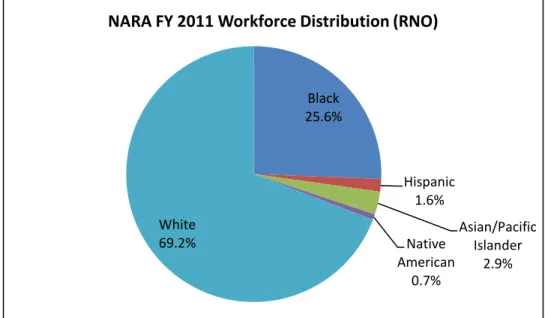
In FY 2011, NARA’s full-time permanent (FTP) workforce representation by race and national origin (RNO) was 69.2 percent white, 25.6 percent Black, 2.9 percent Asian/Pacific Islander, 1.6 percent Hispanic and 0.7 percent Native American. (See Figure 1)
Figure 1 – NARA's FY 2011 Workforce Distribution by Race and National Origin (RNO)
Black 25.6%
Hispanic 1.6%
Asian/Pacific Islander
2.9% Native
American 0.7% White
69.2%
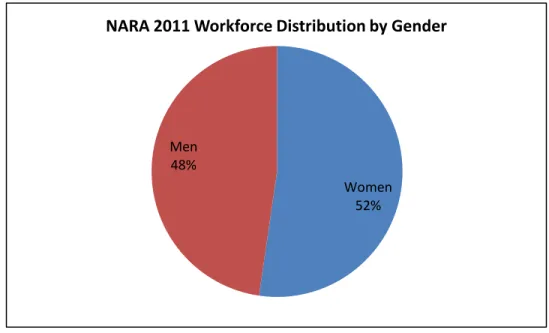
Women comprised 52.3 percent of NARA’s FTP workforce in FY 2011. (See Figure 2) Figure 2 – NARA’s FY 2011 Workforce Distribution by Gender
When evaluating the composition of NARA’s workforce to determine underrepresentation of minorities and women against standard groups, NARA measures itself against the Federal Civilian Workforce2 (FCW) and the Relative Civilian Labor Force3 (RCLF). The FCW is defined by OPM as full and part-time permanent non-military employees working in non-Postal Executive Branch agencies of the U.S. Government. The RCLF is defined as those occupations in the Civilian Labor Force (non-institutionalized individuals 16 years of age or older, employed or unemployed, U.S. citizens and non-U.S. citizens) that are directly comparable to occupations at NARA.
As shown in Figure 3 below, FY 2011 representation for some groups – specifically, women and Blacks - compare favorably to both the FCW and the RCLF. However, with the exception of these two groups, all others are underrepresented at NARA when compared to the FCW. In particular, Hispanics are significantly underrepresented in NARA, comprising just 1.6 percent of the workforce as compared to the 7.7 percent of the FCW and 10.7 percent of the RCLF. Representation rates for Asian/Pacific Islanders and Native Americans are also below those in both the RCLF and the FCW.
2 Federal Civilian Workforce (FCW) – Permanent employees from non-postal Federal Executive Branch
agencies participating in the Office of Personnel Management’s (OPM) Central Personnel Data File (CPDF).
3 Relative Civilian Labor Force (RCLF) – Data computed from the U.S. Census Bureau Equal
Employment Opportunity (EEO) Data Tool that is filtered on relevant Census Occupational Codes
Women 52% Men
48%
Figure 3 – Graph of NARA’s FY 2010 & FY 2011 Workforce Distribution by Minorities and Women vs. Federal and Relevant Civilian Labor Workforce
Grade Cluster Information by RNO and Gender
NARA’s FY 2011 workforce representation for minorities is on par with the Federal government for all grade clusters except for grades 13-15. Workforce representation of minorities in FY 2011 for grades 13-15 was 17.4 percent. There is an 8.8 point difference as compared to the Federal government with 26.2% for minorities in these grades. NARA’s FY 2011 workforce representation for women is on par with most grade levels when compared to the Federal government and exceeds the Federal government when compared to grades 9-12 and 13-15. In FY 2011, NARA’s representation of women in grades 9-12 was 55 percent as compared to the Federal government at 45.8 percent. And representation of women in grades 13-15 at NARA in FY 2011 was 44.8 percent as compared to the Federal government with 38 percent.
Figure 4 compares the RNO and gender distribution of NARA’s workforce by grade cluster to that of FCW percentages.
Black Hispanic Asian/Pacific Islander
Native
American Women
NARA 2010 26.6% 1.4% 2.5% 0.6% 51.9%
NARA 2011 25.6% 1.6% 2.9% 0.7% 52.3%
FCW 17.9% 7.7% 5.5% 1.8% 43.7%
RCLF 10.5% 10.7% 3.7% 1.4% 46.8%
0.0% 10.0% 20.0% 30.0% 40.0% 50.0% 60.0%
Figure 4 – NARA FY 2011 Grade Cluster Information (RNO and Women)
Supervisory and Non-Supervisory Workforce by RNO and Gender
Women and minorities comprise a smaller percentage of NARA’s supervisory workforce than they do of the supervisory workforce. While minorities comprise 32 percent of our non-supervisory workforce, they comprise only 18 percent of non-supervisory positions4. Likewise, while women comprise 53 percent of our non-supervisory workforce, they comprise only 45 percent of supervisory positions. (See Figures 5 & 6)
Figure 5 shows the distribution of minorities in supervisory versus non-supervisory positions at NARA.
4
15.29%
1.75%
1.00%
82.21%
Supervisory
Black Asian/P.I. Hispanic Non-minority
47% 53%
Non-Supervisory
Male Female 55%
45%
Supervisory
Male Female
28.75%
2.65% 0.66% 0.18%
66.40%
Non-Supervisory
Black Asian/P.I. Native American Hispanic Non-minority
Figure 5 – NARA FY 2011 Supervisory vs. Non-supervisory Workforce (RNO)
Figure 6shows the distribution of women in supervisory versus non-supervisory positions at NARA.
Black
3% Asian/P.I. 6%
Non-minority
91%
Executive Level RNO
Male 74% Female
26%
Executive Level Gender
Executive Level Representation by RNO and Gender
When compared to the rest of the Federal Government, minorities and women are
underrepresented in executive level positions at NARA. NARA defines executive level positions as positions classified under the Senior Level (SL), Senior Executive Service (SES),
Administratively Determined (AD) or Executive (EX) pay schedule. Minorities comprise only 9 percent of executive positions and women comprise 26 percent of executive positions5. When compared to the Federal workforce (FW), NARA’s percentages for minorities and women in executive positions fall below OPM’s FY 2010 numbers6. Workforce representation of
minorities at the senior pay levels for the FW was 18.1 percent in FY 2010. Women represented 31.2 percent of senior positions for the FW in FY 2010.
Figure 7 shows the distribution of women and minorities in executive level positions at NARA. Figure 7 - Executive Level RNO and Gender
Mission Critical Occupational (MCO) Representation by RNO and Gender
The majority of NARA’s workforce (58.9 percent) holds one of three Mission Critical Occupations (MCOs), (i.e. 1420 Archivist, 1421 Archives Specialist and 1421 Archives Technician).
Figure 8 below shows the RNO and gender of NARA's mission critical occupations.
5Data extracted as of March 13, 2012 from NARA's Performance Measurement and Reporting System
(PMRS)
6 Source – OPM’s FEORP Report for FY 2010. The FY 2010 Report is the most current published
Figure 8 - NARA's FY 2011 MCO Representation by RNO and Gender7
Distribution by Veteran Status
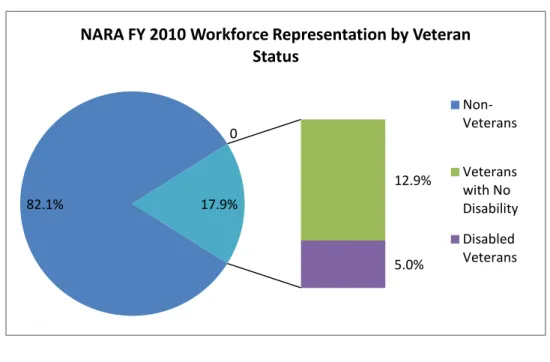
NARA’s workforce representation for Veterans is strong and exceeds the rate for comparable Federal Agencies8. In FY 2010, NARA’s workforce representation for FTP and documented Veterans was 484 employees (17.9%) and the number of disabled veterans employed at NARA was 136 (5.0%). (See Figure 9)
Figure 9 – NARA's FY 2010 Workforce Distribution by Veteran Status
7
The RCLF does not identify the 1420 and 1421 series separately.
8
NARA FY 2010 Veteran data is the most recent published data available for this population.
82.1%
0
12.9%
5.0% 17.9%
NARA FY 2010 Workforce Representation by Veteran Status
Non-Veterans
Veterans with No Disability Disabled Veterans
NARA compares its Veterans workforce representation against two sources: Government-Wide Veterans (GWV) and Comparable Federal Agencies (CFA) 9. GWV data is derived from OPM’s Enterprise Human Resources Integration – Statistical Data Mart system, (September 30, 2010). This data is drawn from approximately 123 Federal Executive Agencies, and includes agencies that have a Direct Hiring Authority for recruiting and hiring military Veterans, such as the Department of Defense (DoD), the Department of Homeland Security (DHS), the Department of Veterans Affairs (VA), and the Department of Transportation (DoT). CFA Veteran data is
collected from the same source as GWV data; however, it excludes those Federal Executive agencies that have a Direct Hiring Authority to recruit and hire military Veterans.
NARA’s FY 2009 and 2010 workforce representation for Veterans fell below the GWV percentages. (See Figure 10)
Figure 10 - FY 2009 & FY 2010 Veteran Representation at NARA vs. Government-Wide Veterans (GWV)
However, when compared to CFA, which excludes those Agencies that have a Direct Hiring Authority, NARA’s FY 2009 and 2010 percentages for FTP Veterans exceeded the CFA percentages. (See Figure 11)
9
The most current published GWV and CFA Veterans data is from FY 2010.
All Veterans (%) Disabled Veterans (%)
NARA FY 2009 17.84% 4.63%
NARA FY 2010 17.89% 5.03%
GWV 2009 25.80% 6.50%
GWV 2010 26.30% 7.00%
0.00% 5.00% 10.00% 15.00% 20.00% 25.00% 30.00%
Figure 11 - FY 2009 & FY 2010 Veteran Representation at NARA vs. Comparable Federal Agencies (CFA)
Distribution by Disability Status
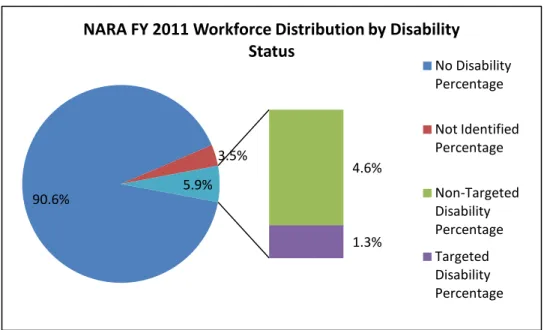
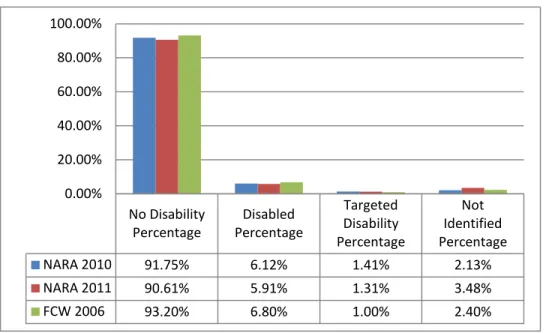
FTP employees with a self-reported disability comprised 5.9 percent of NARA’s workforce in FY 2011; FTP employees with a self-reported targeted disability comprised 1.3 percent of the workforce. (See Figure 12)
Figure 12 – NARA's FY 2011 Workforce Distribution by Disability Status
All Veterans (%) Disabled Veterans (%)
NARA FY 2009 17.84% 4.63%
NARA FY 2010 17.89% 5.03%
CFA 2009 12.15% 2.57%
CFA 2010 12.25% 2.82%
0.00% 5.00% 10.00% 15.00% 20.00%
90.6%
3.5%
4.6%
1.3% 5.9%
NARA FY 2011 Workforce Distribution by Disability Status
No Disability Percentage
Not Identified Percentage Non-Targeted Disability Percentage Targeted Disability Percentage
When compared to the FCW, NARA’s percentage of FTP employees with a disability was below the FCW percentage of 6.80 percent10. However, the percentage of NARA employees with a targeted disability exceeded the FCW percentage of 1.00 percent. (See Figure 13)
Figure 13 – NARA's FY 2010 & FY 2011 Workforce Distribution by Disability Status vs. Federal Civilian Workforce
10
The most recent published FCW data about persons with disabilities is from 2006.
No Disability Percentage
Disabled Percentage
Targeted Disability Percentage
Not Identified Percentage NARA 2010 91.75% 6.12% 1.41% 2.13% NARA 2011 90.61% 5.91% 1.31% 3.48% FCW 2006 93.20% 6.80% 1.00% 2.40%
0.00% 20.00% 40.00% 60.00% 80.00% 100.00%
Challenges
NARA is currently ranked last among large agencies in the annual “Best Places to Work in the Federal Government” rankings. Despite our last place ranking, we are committed to
transforming NARA into a great place to work. Indeed, “A Great Place to Work” is one of six transformational outcomes recently declared by NARA to bring about positive organizational change.
Through our analysis of Federal Employee Viewpoint Survey (EVS) data and follow-on input from employee focus groups, NARA has identified four primary challenge areas: Leadership, Communication, Training and Development, and Diversity. Specific to diversity and inclusion, our analysis of EVS findings tells us that NARA employees continually express dissatisfaction in the area of promoting diversity in the workplace11. Although over half of NARA’s respondents believe their supervisors and team leaders are committed to a workforce representative of all segments of society, positive responses for items related to promoting diversity in the
workplace, (e.g. recruiting minorities and women, training in awareness of diversity issues, mentoring, etc.) lags behind the government-wide average by 13 percentage points.
Additionally, responses to items that measured employee confidence in managers, supervisors, and team leader’s ability to work well with employee of different backgrounds, remained 10 percentage points lower than the government-wide average.
In focus group discussions held with managers and staff as part of developing this D&I plan, participants also reported problems in communication and collaboration across the Agency. In addition, employees expressed concern about a lack of structures and strategies in place to prepare and enable managers and supervisors to develop and manage diversity in the
workplace. Details of the challenges that NARA faces with regards to diversity, inclusion, and sustainability are discussed in the paragraphs below.
Recruiting and hiring quality employees who represent a diverse segment of society in the midst of severe budget cuts and hiring freeze. NARA’s Strategic Plan (Preserving the Past to Protect the Future) identifies a specific goal for the Agency to be able to recruit and develop a diverse workforce through innovative approaches. With the reality of budget cuts to NARA’s 2012 operating budget, uncertainty about future funding, and the implementation of a hiring freeze in November 2011, financial and budgetary constraints will have a major impact on NARA's efforts to increase a diverse workforce solely through recruitment and new accessions. Instead, NARA will need to focus its strategies for diversity on developing and retaining current employees and creating a workplace culture that emphasizes fairness, respect, opportunity, equal access, communication and teamwork for all.
Retaining high quality, high performing employees. The impact of budget cuts, which create an additional strain on already stretched resources, may contribute to a variety of factors that lead to employee attrition at NARA. Employees have expressed concerns over growing workloads, low-graded jobs, lack of opportunities for development, and unclear paths for promotion or advancement. These perceptions may result in higher rates of attrition. Further, low representation of minorities in senior level (GS 13-15) positions and executive leadership positions may contribute to the notion that
opportunity for minorities at these levels is limited. Creating opportunities to develop, promote, and advance a more diverse workforce at the executive level and higher graded positions (GS 13-15) is an important challenge to retaining quality and high performing minorities in the Agency. And finally, creating a work environment that is supportive to persons with disabilities is another challenge to retaining highly qualified employees with disabilities. One strategy identified in NARA’s Strategic Plan for the Recruitment, Hiring, and Retention of Individuals with Disabilities is to educate managers and supervisors on effective tools for recruiting, hiring, and retaining employees with disabilities, such as the Schedule A special hiring authority. Another strategy is to ensure that managers and supervisors possess the necessary skills and resources to provide reasonable accommodations to employees and qualified job applicants.
Building a more diverse talent pool for NARA. NARA is challenged to build a diverse talent pool of qualified candidates from varied backgrounds who have experience and education in areas that are related to NARA’s mission critical occupations -- the 1420 (Archivist) and 1421 (Archives Specialist/Archives Technician) occupational series. The Department of Education reports that of the approximately 200,000 Bachelor’s and Master’s degrees in the fields of library science, social science and history conferred in 2008-2009, only 25 percent of those were granted to minorities12. NARA has been relatively successful in recruiting qualified students from diverse backgrounds for archival internships. However, the challenge lies in converting these student positions into full-time permanent positions. An additional challenge for NARA is to develop effective workforce planning strategies that aid in the transition of qualified students from interns to full-time permanent NARA employees.
Develop strategies for effective communication to enhance understanding and bridge differences up, down, and across the Agency. Lack of effective communication is a common theme identified by many employees in general across the Agency. NARA is challenged to create open lines of communication that can travel up, down, and across the Agency and that value and respect the diversity of thoughts, ideas, and opinions of all its employees without fear of reprisal. Focus group participants acknowledged a reluctance of co-workers to openly engage in conversations related to diversity.
Further, employee feedback indicates that many managers, supervisors, and employees possess a limited or vague definition of the term “diversity” or how diversity impacts their work units. Additionally, NARA is challenged to find effective modes of
communication that provide information to a greater percentage of employees,
12 National Center for Education Statistics, 2008-2009, Tables 297 and 300. 2008 – 2009 is the most
including those who work in regional offices and who do not have regular access to a computer or the Internet at work. On the other hand, there are employees who complain of information over-load and survey fatigue. As NARA works to expand and experiment with new communication strategies (particularly those that involve social media), a key challenge will be to ensure that information reaches all NARA employees throughout the Agency. Finally, there exists a perception that there is a communication divide between NARA’s offices located in the Washington, DC area and those offices located “outside the beltway”. Eliminating this division and creating effective bridges of communication across all of NARA nationwide is another challenge to be addressed.
Create a Positive Workplace Culture. Creating a positive workplace culture at NARA aligns directly with NARA’s transformational outcome to create a great place to work. When all groups at NARA feel welcomed and fully supported, then the positive outcome is that a great place to work is created for everyone -- employees and customers. A key challenge to creating a positive workplace culture is addressing the prevailing attitudes, thoughts and feelings that guide decisions at every level of the Agency on a daily basis. These decisions have the power to either promote or hinder the ability for all
employees, including those of diverse backgrounds, to be recruited, hired, advanced and promoted and to work effectively within their units. The 2011 Partnership for Public Service (PPS) workplace analysis report on Best Places to Work in the Federal Government found that NARA was ranked at the bottom of other Federal agencies for supporting diversity with a score of 49.6%; down 2.6 points from the 2010 survey13. PPS marks supporting diversity as an area for improvement for the Agency.
Demonstrate agency commitment towards building diversity and inclusion at NARA and help lead NARA’s workforce by example. It is crucial for senior leadership to state, communicate, and document their support for diversity initiatives at NARA to
employees at all levels. Involvement of upper management in the planning and conducting of diversity initiatives is central. Clear delineation of the roles and
responsibilities of every employee towards carrying out diversity activities within the Agency is critical. And finally, assignment of adequate resources and budget to ensure that diversity activities are fully supported is essential.
13
The support for diversity category measures the extent to which employees believe that actions and policies of leadership and management promote and respect diversity.
Goals, Strategies and Actions
The U.S. Office of Personnel Management (OPM) has established three diversity and inclusion strategic goals for the Federal Government, which are articulated in their Guidance for Agency-Specific Diversity and Inclusion Strategic Plans. The three goals are:
Workforce Diversity: Recruit from a diverse, qualified group of potential applicants to secure a high-performing workforce drawn from all segments of American society; Workplace Inclusion: Cultivate a culture that encourages collaboration, flexibility, and fairness to enable individuals to contribute to their full potential and further
retention; and
Sustainability: Develop structures and strategies to equip leaders with the ability to manage diversity, be accountable, measure results, refine approaches on the basis of such data, and institutionalize a culture of inclusion.
In support of these goals, OPM has identified seven Government-wide strategies for enhancing diversity and inclusion. NARA’s approach to each of the OPM goals and strategies is discussed in the following pages.
Specific tactical actions to address each goal and strategy are stated in this section as well. These include both Government-wide actions recommended by OPM (see Appendix C), and NARA-specific actions developed as a result of our own internal benchmarking, focus group, and survey activities. In addition, we have included actions already underway as part of NARA’s Strategic Human Capital Plan, Federal Equal Opportunity and Recruitment Plan (FEORP),
Strategic Plan for the Recruitment, Hiring, and Retention of Individuals with Disabilities, and Veterans Operational Plan (VOP). Appendix D provides a crosswalk of NARA’s existing diversity plans and strategies and how those correlate to this plan.
NARA has several existing diversity plans (i.e., Federal Equal Opportunity Recruitment Plan (FEORP), Veterans Operational Plan (VOP) and the Strategic Plan for the Recruitment, Hiring and Retention of Individuals with Disabilities (IWD)) that have individually guided our diversity recruitment and outreach efforts to date. The implementation of these plans has afforded NARA valuable gains in the areas of diversity outreach and recruitment. Highlights of our accomplishments include the following:
Expansion of NARA’s Summer Diversity Internship Program from one intern in 2007 to 22 interns in 2011. The Summer Diversity Internship Program is now a cornerstone of NARA’s diversity outreach efforts. In 2011, interns hired through this program
represented 37 percent of all intern hires for that year. Participants in the Summer Diversity Internship Program are fully funded by NARA.
As a result of targeted recruitment efforts in FY 2011, NARA saw an increase of new hire representation among Hispanic/Latinos (1.24 percent over FY10) and Asians (2.96 percent over FY10);
Continued use of the Department of Veterans Affairs (VA) Compensated Work Therapy Program (CWTP), which is used to purchase contract labor to assist in the accessioning, relocation, trans-shipment and disposal of records. In FY11, two additional Federal Records Centers utilized the CWTP and NARA was able to convert 9.7 percent of program participants to full-time, permanent employees;
Publication of a Veterans Recruitment Guide for supervisors, hiring managers, and recruiters to educate them about the employment and advancement of veterans at NARA;
Creation and distribution of a recruitment brochure targeted specifically to Veterans, which includes photos and quotes of veterans employed at NARA; and
Creation of the Disability Resource Center website on NARA’s intranet that shares relevant information regarding topics about disabilities to NARA managers, supervisors and employees.
The above mentioned plans will now work in conjunction with our D&I plan to further enhance our diversity recruitment and outreach efforts, as discussed below.
Recruitment and Outreach
NARA places a particular emphasis on recruiting for our Mission Critical Occupations –
Archivists and Archives Specialists/Archives Technicians. Together, these occupations comprise
Goal 1: Workforce Diversity
Recruit from a diverse, qualified group of potential applicants to secure a
high-performing workforce drawn from all segments of American society.
the largest percentage (58.9 percent) of our permanent workforce and therefore provide the most opportunities to enhance diversity.
We utilize a variety of recruitment and outreach methods in an attempt to reach the broadest cross-section of applicants. These include: attending career fairs and professional networking events; posting recruitment advertisements on diversity websites; and partnering with
colleges/universities and minority-serving organizations to host interns. Student Internships and Partnerships
Through our unpaid internship program, NARA has hosted approximately 160 highly qualified diverse interns through direct relationships with colleges/universities over the past five years and has continued to strengthen partnerships with intern organizations for our summer diversity internship program.
In addition to our internship programs, NARA also attends recruitment and networking events and partners with other Federal agencies with a specific focus on veterans and individuals with disabilities to most effectively enhance NARA’s efforts in these areas. Such partnerships and events have included but are not limited to a nation-wide inter-agency agreement with the Department of Veterans Affairs Compensated Work Therapy Program and partnering with the Department of Health and Human Services to host a National Disability Employment Awareness Program to create awareness of issues affecting persons with disabilities in the workplace.
Strategy 1.1 Design and perform strategic outreach and recruitment to reach all segments of society.
Actions:
Attend networking and recruitment events at colleges and universities, including Historically Black Colleges and Universities (HBCUs), Hispanic Serving Institutes (HSIs) and Tribal Colleges and Universities (TCUs) to educate attendees on NARA’s mission and to promote intern and employment opportunities
Continue to partner with minority serving organizations to host interns through our annual Summer Diversity Internship Program
Revamp NARA’s network of recruiters referred to as Diversity Champions
Conduct benchmarking efforts in order to better understand and implement strategies that have yielded other Federal agencies successes in the areas of minority recruitment, hiring and retention
Make use of social media as a source of “Student Ambassadors” (e.g., creation of a NARA student/intern alumni Facebook page to enable former students/interns to share their experiences and connect with potential students/interns).
Strategy 1.2 Use strategic hiring initiatives for people with disabilities and for veterans, conduct barrier analysis, and support Special Emphasis Programs (SEPs), to promote diversity within the workforce.
Actions:
Analyze and incorporate EEO data (e.g., workforce demographics, hiring statistics, and turnover statistics) as a formal component of NARA’s workforce planning process Review and analyze NARA workforce data in comparison to the Federal government-wide and Relevant Civilian Labor Force data to identify barriers and develop methods to eliminate barriers
Continue use of Schedule A hiring authority for people with disabilities and Veteran hiring authorities to recruit and retain a diverse workforce
Continue to maximize the visibility of vacancy announcements by posting them on USAJobs.gov, NARA’s career website and with universities/organizations with a high concentration of minorities, women, and individuals with disabilities and Veterans.
Research has demonstrated that, while organizations may have diversity in their midst,
employees may not perceive that they are appreciated and included in the workplace. For this reason, building inclusive workplaces ensures that all employees feel included, connected, and engaged. NARA has several initiatives and programs in place that cultivate a supportive, welcoming, inclusive and fair work environment. However, as indicated in the Challenges section, NARA must begin to focus more efforts on improving workplace inclusiveness. Leadership Development
NARA currently provides several leadership development courses - Introduction to Supervision, Advanced Supervision Concepts, and Team Leader Development. Work is underway to enhance these courses, and add new courses to NARA’s Leadership Development Curriculum. The goal is to expand NARA’s leadership development offerings into a robust curriculum where
individuals can target their leadership development needs to the leadership role they hold at NARA. Leaders will participate in courses as “mini-cohorts” and will extend their learning beyond the classroom by participating in structured activities both before and after attending their formal classroom training. Courses and content are being designed around NARA’s core competencies, which have embedded principles of diversity and inclusion. NARA's Learning and Development staff work with presenters (NARA staff and/or contractors) to ensure their
courses and content integrate these principles in meaningful and actionable ways, and also visually reflect the diversity of our staff, and the unique and challenging work they do. In addition, NARA is evaluating the potential for offering more formal Leadership Development Programs for new or emerging managers. These programs would offer a more prescribed approach to new and continuing management development at NARA.
In addition to the leadership curriculum that NARA has developed, NARA is developing an agency-wide Mentoring Network Program, which, once negotiated with union representatives and leadership, will be piloted with targeted groups.14 The program goals include making the program available to interested employees to NARA employees at all levels and locations. The goal is to enable a diverse pool of trained mentors to engage in targeted, intentional,
competency-based mentoring relationships unconstrained by organizational and geographical boundaries. The mentoring program will be configured so that there are intentional mentor “engagements” (e.g., discussions, activities, scenarios, reading assignments, job shadow opportunities, etc.) at specific milestones in the mentoring relationship. NARA will ensure that
14
FCIP ADP program participants currently have mentoring relationships as part of their requirements. Supervisor and Managers will be included in the pilot group of mentors.
Goal 2: Workplace Inclusion
Cultivate a culture that encourages collaboration, flexibility, and fairness to
enable individuals to contribute to their full potential and further retention.
principles and tenets of diversity and inclusion are embedded in each of these engagements – if not called out specifically – to provide further exposure and experience with the unique
learning opportunities they create. Workplace Flexibilities
NARA recognizes that having flexible workplace policies that encourage engagement and empowerment can have many benefits such as increased productivity and employee retention rates. As such, NARA encourages employees to take advantage of flexible scheduling options (e.g., alternative work schedules) and telework to assist them in better balancing work and personal responsibilities. As of the first quarter of FY 2012, 26 percent of eligible employees participated in NARA’s telework program, which exceeded NARA's own internal performance target of 12 percent. In addition, NARA has established a number of health and wellness
programs to promote healthy lifestyles and enhance the quality of employee work life. Sample offerings include a 24-hour Employee Assistance Program available to all NARA employees; an innovative wellness program that offers eligible employees up to 24 hours of excused absence to establish a fitness regimen; on-site fitness facilities and Weight Watchers programs in some NARA locations; and lactation rooms and on-site daycare in some NARA locations.
Workplace Environment
NARA strives to create a positive work environment for an employee’s first day on the job. During new employee orientation, all employees view a welcome message from the Archivist, receive a tour of their facility and are given a notebook of information that acclimates them to NARA. NARA has also created a new employee resources website where they are able to view an introductory video on employee benefits and receive access to an interactive course that presents a comprehensive overview of the agency. In addition, NARA is implementing a new onboarding system (Entrance on Duty System - EODS) in December 2012 to help eliminate many paper-based processes associated with the in-processing of new employees.
Another way in which NARA has cultivated a supportive and equitable work environment is by maintaining a robust reasonable accommodation program to ensure that individuals with disabilities enjoy full access to equal employment opportunity at NARA. NARA’s reasonable accommodation is guided by the policy directive NARA 303 – Processing Reasonable
Accommodation Requests for Employees and Applicants with Disabilities. Over the past several years, NARA has enhanced its reasonable accommodation program by appointing an advisor to address all reasonable accommodation matters, providing ongoing training for supervisors and employees on the process, and utilizing the Department of Defense's Computer/Electronic Accommodations Program.
NARA recognizes the AFGE Council 260 as the exclusive representative of bargaining unit employees with respect to conditions of employment. The AFGE Council 260 leadership holds regular meetings with the Archivist to discuss various employment concerns on behalf of bargaining unit employees. In addition, NARA employees have formed three main affinity
groups – the Archives Assembly, the Afro-American History Society (AAHS) and National Archives Recreation Association (NARARA). Each of these groups also meet with the Archivist on a regular basis to discuss issues of a non-bargainable nature. The Archives Assembly is an organization of present and former NARA employees that provide a forum for employee communication on professional and program issues. The AAHS’s objectives are the promotion, study, dissemination, and collection of information and materials relating to the history and culture of African Americans. Lastly, NARARA provides an opportunity for NARA employees, retirees, contractors, and volunteers to work as a team to provide recreational, social, charitable, and educational opportunities.
Strategy 2.1 Promote diversity and inclusion in leadership development programs.
Actions:
Mandatory participation for all NARA managers and supervisors in leadership development courses - Introduction to Supervision, Advanced Supervision Concepts, and Team Leader Development
Expand current leadership curriculum to include courses and content that are designed around NARA’s core competencies
Implement NARA's agency-wide Mentoring Network Program
Strategy 2.2 Cultivate a supportive, welcoming, inclusive and fair work environment.
Actions:
Encourage and expand employee use of wellness programs already in place
Revise and re-issue NARA’s telework policy and provide updated guidance, training and tools to help expand the use of telework throughout NARA
Expand new employee orientation process to provide for additional training, development, and networking opportunities
Implement new automated onboarding system (Entrance on Duty System – EODS) Establish a centralized budget for all reasonable accommodations
Provide training for all employees, managers and supervisors on the reasonable accommodation process
Continue support of regular quarterly meetings between employee affinity groups and the Archivist
Sustainability is largely about building accountability into NARA’s management of diversity. This starts by embedding diversity into our mission and the way we work, and by establishing a sense of shared accountability among all NARA staff. NARA has taken steps to promote
sustainability through integrating and aligning diversity and inclusion with our mission, identifying goals and values for diversity and inclusion, incorporating diversity and inclusion into our supervisory/managerial performance plans, and focusing on employee engagement to make NARA a great place to work.
Integration and Alignment with NARA’s Mission
Diversity and inclusion is integrated and aligned with NARA’s Strategic Plan. Under the Government Performance and Results Act (GPRA) goals are set at several levels and aligned with NARA’s strategic plan. Specifically, NARA strategic plan goal number 6, “We will equip NARA to meet the changing needs of our customers”, is the basis for all human capital goals and measures. Each goal is supported by long range performance targets (LRPTs). Diversity and inclusion is reflected in LRPT 6.2, “By 2016, the percentages of NARA employees in
underrepresented groups match that of the Civilian Labor Force”. We further identify fiscal year target metrics and milestones, for fiscal year 2012 these are:
Target Metric 6.2.1 - Increase the number of employees in underrepresented groups relative to their representation in the CLF.
Target Metric 6.2.2 - Achieve 65 percent positive response rate for Annual Employee Survey questions referencing workforce diversity
Demonstrating Commitment to Diversity and Inclusion
NARA is currently undertaking a 5-year Transformation effort. This effort has generated opportunities to integrate diversity and inclusion into our organizational culture. As part of the transformation, NARA identified six transformational outcomes. They are:
One NARA, working as one NARA and not just as component parts.
Out in front, embracing the primacy of electronic information in all facets of our work and positioning NARA to lead accordingly.
An agency of leaders, fostering a culture of leadership, not just as a position but as the way we all conduct our work.
Goal 3: Sustainability
Develop structures and strategies to equip leaders with the ability to manage
diversity, be accountable, measure results, refine approaches on the basis of
such data, and institutionalize a culture of inclusion.
A great place to work, transforming NARA into a great place to work that trusts and empowers all of our people, the agency’s most vital resource.
A customer-focused organization, creating structures and processes to allow our staff to more effectively meet the needs of our customers.
An open NARA, opening our organizational boundaries to learn from others
In addition, NARA has identified a set of shared values that support and will ultimately help us realize our transformational outcomes, collaboration, innovation and learning:
NARA Values
We are a diverse staff unified by our strong commitment to protect records, help people use them, and support and open and responsive government.
We want to do our personal best and make our agency the world’s best archives. We believe in:
An open, inclusive work environment — built upon respect, communications, integrity, and collaborative team work.
Encouraging creativity and investing in innovation — to build our future
Pursuit of excellence through continuous learning — becoming smarter all the time about what we know and what we do in service to others.
Incorporating Diversity and Inclusion into our Supervisory/Managerial Performance Plans In an effort to instill greater accountability for diversity goals among NARA managers and supervisors, NARA developed and implemented two new critical elements for inclusion in all managerial and supervisory performance plans during fiscal year 2011. While the first critical element addresses supervisory responsibilities for fostering employee engagement, managing human capital and the administrative aspects of the work unit, the second critical element addresses supervisors’ responsibilities for promoting equal employment opportunity, diversity and inclusion in the workplace. All managers and supervisors received mandatory training on these new critical elements, and we began using them in fiscal year 2012 to formally hold managers and supervisors accountable for their performance in helping to promote and enhance diversity within NARA. We will continue to ensure that managers and supervisors are working towards fostering employee engagement and promoting equal employment
STRATEGIES AND ACTIONS
Building a “Great Place to Work”
For NARA, engaging employees means developing and maintaining a work environment and culture that stimulates all employees to go above and beyond to achieve organizational success. The critical conditions conducive for employee engagement include effective
leadership, work that provides meaning to employees, and the opportunity for employees to learn/grow on the job. The Human Capital Office is focused on building tools and helping staff implement activities and programs that will have a long-term impact on employee engagement, increasing the number of employees who are motivated and willing to apply discretionary effort to accomplish tasks that are key to attaining NARA mission and goals. Part of this initiative includes evaluating options to create an online environment in which staff can participate and collaborate, feel trusted, empowered, and safe to offer their views on how to make NARA a great place to work.
There are several benefits in having a more favorable employee perception of workforce diversity and inclusion. Research shows that organizations with greater diversity tend to bring a richer set of ideas, perspectives and approaches to accomplishing work. The act of recognizing diversity also allows for those employees with these talents to feel needed and have a sense of belonging, which in turn increases their productivity, commitment to the organization and overall workplace satisfaction.
Strategy 3.1 Demonstrate leadership accountability, commitment, and involvement regarding diversity and inclusion in the workplace.
Actions:
Establish new Lead Diversity and Inclusion Program Manager (GS-14) position Integrate and align diversity and inclusion with NARA's Strategic Plan and Strategic Human Capital Plan
Demonstrate commitment to diversity and inclusion through NARA’s values Administer additional training to NARA managers and supervisors to support accountability for diversity and Inclusion critical elements in performance plans Strategy 3.2 Fully and timely comply with all Federal laws, regulations, Executive orders, management directives, and policies related to promoting diversity and inclusion in the Federal workforce.
Actions:
Submit timely reports related to promoting diversity and inclusion to OPM as required Strategy 3.3 Involve employees as participants and responsible agents of diversity, mutual respect and inclusion.
Actions:
Evaluate options to create an online environment in which staff can participate and collaborate to share their ideas on how to make NARA a great place to work. Continue to conduct focus groups at NARA locations to collect feedback on issues regarding workplace diversity.
Looking Towards the Future
We recognize that our goals are ambitious and that implementation of our first Diversity and Inclusion Strategic Plan may be met with communication and learning curve challenges, including how NARA defines diversity and inclusion. However, we are committed to achieving these goals. By taking a strategic approach to diversity and inclusion -- one that aligns two-way communication, outreach, hiring, retention, and creating a culture of inclusiveness with the agency’s strategic goals and priorities -- NARA is confident that we will positively impact the success of our workforce in the long-term.
In order to achieve our goals, our next steps will involve assessing NARA’s readiness through activities such as benchmarking from other Federal agencies and sponsoring focus groups, surveys and feedback opportunities with our internal stakeholders. The results of such activities will assist us in gathering best practices that NARA may be able to implement, as well as being able to better capture employee’s experiences and feelings regarding the diversity and
inclusion culture at NARA.
We will review our plan annually to assess progress and incorporate revisions as necessary. While a full update is planned for a five year cycle, NARA will continue to engage agency leaders, supervisor, managers, and staff in order to ensure that diversity and inclusion become a part of their daily decision making and thought processes, thereby becoming ingrained in NARA’s culture.
Appendix A. Process Used in Developing, Evaluating and Updating
the Diversity and Inclusion Strategic Plan
To enhance diversity and inclusion at NARA, a new Diversity and Inclusion Division was created in the Office of Human Capital on October 9, 2011. One of the first priorities of the newly established office was to develop and implement a Diversity and Inclusion Strategic Plan for NARA. The plan development was in line with Executive Order 13583, issued by President Obama to establish a coordinated government-wide initiative to promote diversity and
inclusion in the Federal workplace and in response to an identified action item on the Employee Viewpoint Survey Task Force agency-wide action plan to improve employee satisfaction with regards to diversity.
Analisa Archer, our Chief Human Capital Officer established a Diversity and Inclusion (D&I) Team with representatives from the Diversity and Inclusion Division (HD) and Human Capital Planning and Accountability (H-PA) to develop NARA’s Diversity and Inclusion Strategic Plan. This team met over a series of eight planning sessions from December 2011 to March 2012. The D&I Team identified NARA’s diversity and inclusion mission, vision, and current
environment. The group also reviewed the government-wide diversity and inclusion goals and strategies15 and discussed what these mean for NARA.
In order to get a broad perspective from NARA’s Management Team and staff on various diversity and inclusion challenges facing the agency, the work group consulted with the union and facilitated multiple focus groups, engaging participants in a discussion around the following questions.
What do you feel are NARA’s major challenges regarding diversity and inclusion? What do you think are the barriers to fully leveraging diversity in the workplace? What concrete steps would you like to see taken to improve the diversity climate at NARA?
Information generated from these discussions was incorporated into this Strategic Diversity and Inclusion Plan. The D&I team also invited feedback in response to a blog post, “Enhancing Diversity and Inclusion at NARA, January 11, 2012” and established a general e-mail box, [email protected], to solicit ideas and comments from staff.
The Diversity and Inclusion Strategic Plan will be reviewed annually to assess progress and incorporate revisions as necessary. Goals will be assessed by leveraging the metrics identified for each strategy to measure progress, create accountability, and make adjustments as needed.
15
Executive Order 13583 requires agencies to identify a strategic diversity plan for recruiting, hiring, training, developing, advancing, promoting and retaining a diverse workforce. The Office of Personnel Management (OPM) subsequently issued operational guidance that mapped out the required three government-wide goals and seven strategies to include in agency plans.
Monitoring progress against goals and strategies is embedded into NARA’s Human Capital Accountability System16. As part of this continual assessment, HD will report quarterly to the CHCO on the overall status, identifying if items are on track, if there are significant
accomplishments to share, and if there are barriers or pending decisions to resolve to make progress. This information then feeds into our Human Capital Management Report17 – a required annual report to the Office of Personnel Management (OPM) on all NARA human capital activities.
On a five year cycle, we will initiate a full update to the Strategic Diversity and Inclusion Plan to establish or revise existing goals and strategies. This update will include consultation with stakeholders, including the Management Team, staff and the union. We will gather stakeholder input through targeted outreach including briefings, focus group meetings, surveys, NARA Notices, and other communication channels to solicit information regarding challenges, ongoing and planned initiatives, and resource requirements.
While the full update is planned for a five year cycle, HD will continue to engage agency leaders, managers, offices, and staff to keep the conversation going about diversity and inclusion, identifying ways to break through barriers, sharing success stories, and featuring best practices.
16
The human capital accountability system provides procedures and standards for assessing and monitoring agency performance in all aspects of human capital management. A robust human capital accountability system helps to ensure that NARA’s human resources (HR) programs and operations are contributing effectively to the mission and strategic goals of the agency. The Office of Personnel
Management (OPM) requires all federal agencies to have a human capital accountability system.
17
The Human Capital Management Report (HCMR) focuses on organizational performance results and includes an assessment of our human resources programs, decisions, and actions in compliance with law, regulation, and the merit system principles. Also, it identifies specific improvement and corrective actions needed to address programmatic, operational, and compliance deficiencies.
Appendix B. NARA’s Workforce Trend Analysis for Minorities,
Women, Veterans, Disabled Veterans, and Individuals with Disabilities
The following tables are provided as a source to show NARA's workforce trend analysis for minorities, women, veterans, disabled veterans and individuals with disabilities over the past two fiscal years as compared to the FCW and RCLF.
Workforce Distribution for Minorities and Women
NARA experienced a decrease of a 1 point ratio change for Blacks during the period from 2010 to 2011. A slight increase occurred during this period for Hispanics (0.20%), Asian and Pacific Islanders (0.40%), Native Americans (0.10%), and Women (0.40%). Comparisons for NARA’s 2011 workforce distribution were higher than the 2011 FCW and RCLF rates for Blacks and women. However, NARA’s workforce distribution rates for Hispanics, Asian and Pacific Islanders, and Native Americans falls below the FCW and RCLF. (See Table 1)
Table 1 – Comparison of NARA Workforce Distribution for Minorities and Women vs. Federal and Relevant Civilian Workforce Percentages
Black Hispanic Asian/Pacific
Islander
Native American
Women
NARA 201018 26.6% 1.4% 2.5% 0.6% 51.9%
NARA 201119 25.6% 1.6% 2.9% 0.7% 52.3%
Ratio Change20 -1.00 0.20 0.40 0.10 0.40
FCW 201121 17.9% 7.7% 5.5% 1.8% 43.7%
RCLF 200022 10.5% 10.7% 3.7% 1.4% 46.8%
Workforce Distribution by Veteran Status
A slight ratio increase was found for Veterans (0.05%) and disabled Veterans (0.40%) during the period from 2009 to 2010. These increases translated to a large percentage difference for Veterans (5.45%) and disabled Veterans (14.29%) in this period. When comparing NARA’s workforce distribution for Veterans and disabled Veterans against Government-wide rates (GWV), the percentages fall below the GWV. (See Table 2)
18
Data Source - NARA FEORP, FY 2011 - Table 1
19
Data Source - NARA FEORP, FY 2012 - Table 1
20 Formula: Ratio Change = NARA 2011 (%) – NARA 2010 (%) 21
Data Source - NARA FEORP, FY 2012 - Figure 1
22
Table 2 - Veteran Representation at NARA vs. Federal Civilian Labor Force (FCLF)
All Veterans All Veterans (%) Disabled
Veterans
Disabled Veterans (%)
NARA FY 200923 459 17.84% 119 4.63%
NARA FY 201024 484 17.89% 136 5.03%
% Difference25/
Ratio Change26
5.45% 0.05 14.29% 0.40
GWV 200927 512,240 25.80% 128,170 6.50%
GWV 201028 542,641 26.30% 145,062 7.00%
However, when NARA compares its workforce representation for Veterans and disabled
Veterans against Comparable Federal Agencies (FCA), those Federal Executive agencies that do not have a direct hiring authority to recruit and hire military veterans, then NARA’s percentages exceeds those of the CFA. (See Table 3)
Table 3 - Veteran Representation at NARA vs. Comparable Federal Agencies (CFA) without Special Hiring Programs
All Veterans All Veterans (%) Disabled
Veterans
Disabled Veterans (%)
NARA FY 200929 459 17.84% 119 4.63%
NARA FY 201030 484 17.89% 136 5.03%
% Difference31/
Ratio Change32
5.45% 0.05 14.29% 0.40
CFA 200933 88,140 12.15% 18,674 2.57%
CFA 201034 91,438 12.25% 21,039 2.82%
Workforce Distribution by Disability Status
NARA’s workforce distribution decreased by 0.21 points for persons with a disability and 0.10 points for persons with a targeted disability over the period from 2010 to 2011. The
percentage of NARA employees with a disability falls below the FCW, but the rate for NARA employees with a targeted disability exceeds the FCW. (See Table 4)
23
Data Source - Veterans Operational Plan FY2011 - FY2013, Table 1 (DRAFT)
24
Data Source - Veterans Operational Plan FY2011 - FY2013, Table 1 (DRAFT)
25 Formula: Percent Difference = (No. NARA FY2010 – No. NARA FY2009)/No. NARA FY2009 * 100 26 Formula: Ratio Change = NARA FY2010 (%) – NARA FY2009 (%)
27
Data Source - Employment of Veterans in the Federal Executive Branch, FY 2010 - Table 1
28
Data Source - Employment of Veterans in the Federal Executive Branch, FY 2010 - Table 1
29
Veterans Operational Plan FY2011 - FY2013, Table 1 (DRAFT)
30
Veterans Operational Plan FY2011 - FY2013, Table 1 (DRAFT)
31 Formula: Percent Difference = (No. NARA FY2010 – No. NARA FY2009)/No. NARA FY2009 * 100 32 Formula: Ratio Change = NARA FY2010 (%) – NARA FY2009 (%)
33
Employment of Veterans in the Federal Executive Branch, FY 2010 - Table 1C
34
Table 4 - Representation of NARA employees with Disabilities vs. Federal Civilian Workforce (FCW)
No Disability Disabled Targeted
Disability
Not Identified
NARA 201035 91.75% 6.12% 1.41% 2.13%
NARA 201136 90.61% 5.91% 1.31% 3.48%
Ratio Change37 -1.14 -0.21 -0.10 1.35
FCW 200638 93.20% 6.80% 1.00% 2.40%
35
MD-715, FY2011 - Table B1
36
MD-715, FY2011 - Table B1
37 Formula: Ratio Change = NARA FY2010 (%) – NARA FY2009 (%) 38
OPM - Federal Civilian Employment Distribution By Disability Status Executive Branch Agencies, Worldwide, September 30, 2006 - Table 4