IN VITRO COMPARISON OF PHYTASES FROM TWO
MICROBIAL SOURCES
*1E. A. ADEYEYE, 1O.O. ODUGUWA, 2F. A. IGBASAN
AND C.F.I. ONWUKA1
1Department of Animal Nutrition, College of Animal Science and Livestock Production,
University of Agriculture, Abeokuta. Post code 110001. Ogun State. Nigeria.
2Department of Animal Production and Health, School of Agriculture and Agricultural
Technology, University of Technology, P.M.B 704, Akure, Ondo State. Nigeria. *
Corresponding author: [email protected] Tel: +2348137301998
this form is poorly digested and as such low availability for poultry (VanDerKlis and Ver-steegh, 1996).
For the utilisation of phytate and others che-lating minerals, hydrolysis of the ester type bounded phosphate groups of phytic acid by phytase is necessary (Rimbach et al., 1994). Phytase (Myo-inositol hexaphosphate phos-phohydrolase) belongs to a specific group of phosphate that is capable of hydrolysing
ABSTRACT
The chemical properties of two different commercial microbial phytases (Natuphos and Ronoxyme P) were compared. Natuphus production was based on the use of a recombinant of Aspergillus niger strain while the Ronoxyme P was from Peniophora lycii. The enzymes were studied for their optimum pH, optimum temperature and enzyme stability, resistance to protease and stability in digesta super-natants. The phytases were found to exhibit different properties depending on source of the phytase gene and production organism. An optimum pH of 5.5 was recorded for the enzyme from Peniophora
lycii while pH of 5.0 was recorded for the enzyme from Aspergillus niger. Both phytases had 500C as their optimum temperature. The result of the enzyme - stability in aqueous solution indicated that the
Peniophora lycii phytase was more thermo-stable than the Aspergillus niger phytase. Incubation of the
phytases preparations with porcine proteases revealed that Aspergillus niger was more resistant to pepsin and trypsin than Peniophora. Incubation of the phytases in digesta supernatants from various segments of the digestive tract of hens revealed that digesta from the small intestine (SI) inactivated the enzymes most efficiently. Nevertheless, the enzyme from Peniophora lycii retained more activity than the enzyme from Aspergillus niger in all of the gastrointestinal tract (GIT). In conclusion, phyta-ses of various microbial origins behave differently with respect to their in vitro properties, which could be of importance for future developments of phytase preparation.
Key words: Properties, microbial phytases, digesta, proteolytic stability, supernatant
INTRODUCTION
Cereals, legumes and oilseeds products con-stitute the major sources of nutrients in poultry diets. Phosphorus (P) is one of the essential elements present in these products, which has not been maximally utilised due to the form in which they are present in the ingredients. About 2/3 of P present in these feedstuffs occur as phytates (Myo-inositol hexaphosphate, Insp6), the salts of phytic
acid (Jongbloed et al., 1993). Phosphorus in
Journal of Natural Sciences, Engineer-ing and Technology ISSN - 2277 - 0593
phytate to a series of lower phosphate esters of myo-inositol and inorganic phosphate (Pi) according to Sebastian et al. (1998). Two types of phytase are known: 3-phytase (E.C 3.1.3.8) and 6-phytases (E.C 3.1.3.26), indicating the initial attack of susceptible phosphate ester bond. Barknik and Szafran-ska (1987) reported that phytase is present in most cereals. Apart from endogenous phytase from plant ingredients, phytase has been isolated from fungi, bacterial and yeast as well as from rumen and soil microorgan-isms (Ullah, 1998; Harland and Frolich, 1989. With the industrial production of mi-crobial phytase there has been an increasing interest in the use of phytase to improve animal performance and utilisation of phy-tate phosphorus (PP) according to Ohwota (2001) and Igbasan (2002).
The supplementary effects of microbial phytase on the utilisation of phytate phos-phorus and on the performance of broilers and layers have been well documented (Simons et al., 1990; Sebastian et al., 1997; Rama Rao et al., 1999; Igbasan, 2002). Ma-jority of the studies on phytase enzymes has been performed on the superficial informa-tion of the enzyme provided as marketing strategies by the manufacturers. However, the efficiency of any enzyme preparation as feed additive with regard to improving P availability for the animal depend not only on the type, inclusion rate and the level of activity present, but also on the bio-chemical characteristics of the enzyme. These properties determine the stability during feed processing and during their pas-sage through the GIT. For the evaluation of the effectiveness of phytase preparations as feed additive, in vitro properties like opti-mum temperature, temperature stability, optimum pH, proteolytic stability and sta-bility in digesta supernatants are of utmost
important.
MATERIALS AND METHODS
Estimation of phytase activity
Determination of phytase activities based on the estimation of inorganic orthophosphate released on hydrolysis of phytic acid was routinely performed at 370C following the
method described by Engelen et al. (1984). One unit of enzyme activity was defined as the amount of enzyme that liberates 1micro-mole of orthophosphate per minute under assay conditions. All measurements were performed in duplicate and repeated in some cases where there was discrepancy in dupli-cate values.
Determination of Optimum pH
The phytases were incubated with substrate solution, which was prepared in three differ-ent buffer solutions, 200mM glycerine pH 2.0-3.0; 200mM sodium (Na) acetate buffer pH 3.5-6.5 and 200mM Tris-HCl buffer pH 7.0-9.0. All buffers were supplemented with 1mM CaCl2. The substrate solution
con-tained 120mM-phytic acid (C6H6P6Na12)
while the phytases were diluted in 200mM Na acetate buffers pH 5.5. Two millilitres of the enzyme preparation was pre-incubated at the assay temperature for 5 minutes and the enzymes reactions were initiated by addition of 4ml of the substrate solution. The pH of the mixtures was adjusted to different pH before incubation at 370C for 60 minutes.
The incubation was terminated by the addi-tion of 4ml of the colour mixture (Potassium heptamolybdate + potassium vanadate). The reagents were prepared as described by Engelen et al. (1994). The activities of the enzyme were determined using spectropho-tometer.
Determination of optimum temperature
solution which was prepared in three differ-ent buffer solutions 200mM glycerine pH 2.0-3.0; 200mM sodium (Na) acetate buffer pH 3.5-6.5 and 200mM Tris-HCl buffer pH 7.0-9.0. All buffers were supplemented with 1mM CaCl2. The substrate solution
con-tained 120mM-phytic acid (C6H6P6Na12)
while the phytases were diluted in 200mM Na acetate buffers pH 5.5. Two millilitres of the enzyme preparation was pre-incubated at the assay temperature for 5minutes and the enzymes reactions were initiated by the addition of 4ml of the sub-strate solution. The pH of the mixtures was prepared to correspond to the determined optimum pH of the phytases. The mixtures were incubated for 60 minutes at 30, 40, 50, 60, 65, 70 and 800C. Their activities were
measured on the basis of inorganic ortho-phosphate released (Engelen et al., 1994).
Enzyme stability
The phytases were pre-incubated at 50, 60, and 700C for 10, 20, 40, 60, and 120
min-utes. After the pre-incubation periods the samples were cooled on ice for 30 minutes. They were re-incubated at 370C and the
re-sidual activities of the enzymes were deter-mined as described above.
Protease resistance
This was investigated using pepsin (stomach mucosa) and trypsin (pancreas secretion). The pepsin was suspended with 0.1mHCl (pH 2.0) and trypsin was dispersed in 0.1m sodium hydrogen carbonate (pH 7.0).
Pepsin assay
One millilitre of freshly prepared pepsin solution was carefully mixed with 1ml of a freshly prepared phytase solution in a test tube. The mixture was incubated in a water bath at pH 2.0 and 370C for 0 and 45
min-utes. After incubation, 1ml of the solution
was diluted (1:9) with buffer solution (pH 5.5) and thoroughly mixed. Two millilitres of the solution was incubated with 4ml of the substrate solution for 60 minutes at 400C
and pH 5.5 and phytase activities were deter-mined as described for pH behaviour.
Trypsin assay
One millilitre of freshly prepared trypsin so-lution was carefully mixed with 1ml of phy-tase solution. The mixture was incubated for 0 and 45 minutes at 400C and pH 7.0.
Dilu-tions and pH adjustments for phytase activ-ity measurements were the same as described for pepsin (Engelen et al., 1994).
Stability in Digesta supernatants
Digesta samples were collected from ten ma-ture chickens which were killed convention-ally. Samples were collected from the crop, stomach (gizzard and proventriculus), duo-denum (pylorus to entrance of bile ducts), jejunum (bile duct entrance to meckel's di-verticulum) and ileum (meckel's diverticulum to the ileo-cecal junction). The pH of the digesta samples was determined using a pH metre. The pH readings were: 4.84, 3.72, 6.18, 6.26 and 7.45 for crop, stomach, duo-denum, jejunum and ileum respectively. The samples were used immediately or frozen at -200C until use. The digesta samples were
di-luted 1:1 in distilled thoroughly mixed and centrifuged at 4000rpm for 5minutes. Super-natants were recovered and their pH values were adjusted to correspond to the initial pH values of the different segments of the GIT. The recovered supernatants were held in ice/water bath until use. For assay, 1ml of digesta supernatant was mixed withn1ml of the enzyme solution and the mixture was incubated for 0 and 20minutes at 400C. For
the residual phytase activity measurement, 1ml of the solution was diluted (1:9) with buffer solution (pH 5.5). Two (2ml) of the
solution was then incubated with 4ml of the substrate solution at 400C for 60 minutes.
The activities of the enzymes were then de-termined using spectrophotometer.
RESULTS AND DISCUSSION
Optimum pH
The plots of the activities against the pH are shown in Figure 1. The enzyme from Penio-phora lycii displayed considerable activities between pH 3.5-6.5 and pH 3.5-6.0 for As-pergillus niger. At least 50 -100% of the activi-ties of the enzymes were found in these pH range .The Aspergillus niger had its optimum activity at pH 5.0 while the enzyme from Peniophora lycii had its optimum activity at pH 5.5.
The production of free phosphate by phy-tate hydrolysing enzymes in the GIT of monogastric animals is heavily dependent on the optimal pH of the enzyme prepara-tion. The enzymes studied showed pH opti-mal at 5.0 and 5.5 for Aspergillus niger and Peniophora lycii, respectively. This is typical for fungal phytases (McNah, 1993; Shimizu, 1993; Dvoakova, 1998; Wyss et al., 1999a; Vahjen and Simons, 1999 and Igbasan et al., 2000). These pH values occur generally in the upper part of the GIT of poultry (Sebastian et al., 1998; Igbasan et al., 2000), indicating that the enzymes may preferen-tially be active in this region of the GIT of the host animals. Although, it should be noted that enzymatic activities was deter-mined using pure substrate and under stan-dardised conditions, conditions to be en-counter by the enzyme in the host animals would probably be far different.
Optimum temperature
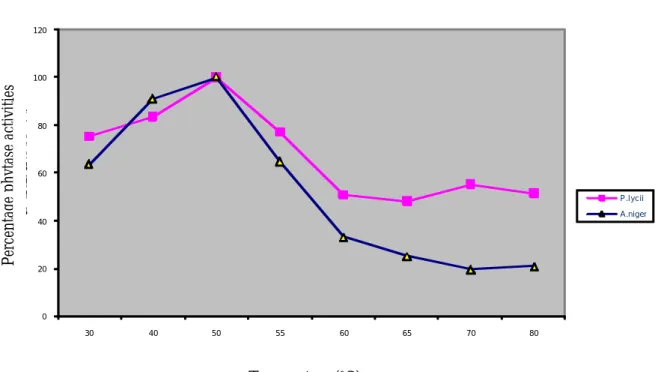
The percentage activities of the phytases at different temperature are shown in Figure 2. The enzyme from Peniophora lycii displayed
considerable activities at each of the tem-peratures examined. At least 50-100% of the activities was found in this temperature ranges, having its highest activity measured at 500C. While the enzyme from Aspergillus niger displayed considerable activities (50-100%) at temperatures of 30-550C. The
opti-mum temperature for this enzyme is the same as for the enzyme from Peniophora lycii. The optimum temperature (500C) of the
en-zymes is higher than the temperature (380C)
obtainable in the body. Therefore, only be-tween 70-80% of maximal phytase activities could occur in the body.
Enzyme stability
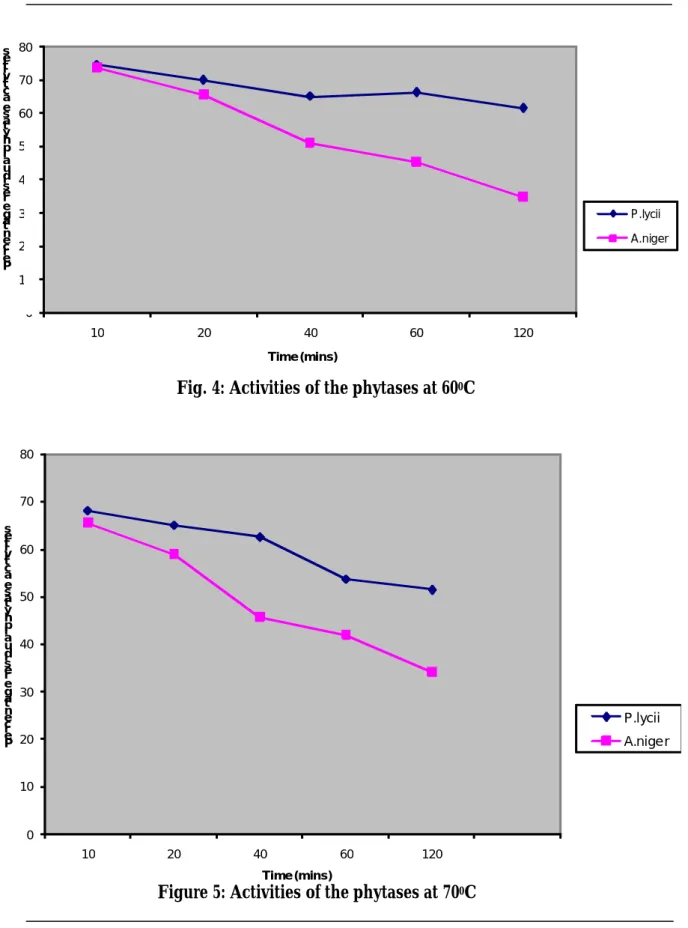
The results of further assays to investigate the stability of the enzymes in aqueous solu-tion after short and long incubasolu-tion at 50, 60 and 700C are shown in Figures 3, 4 and 5.
From the results, it is clear that the enzymes lose activities as the incubation time in-creases with increasing temperature. Figures 4 and 5 indicated that enzyme from Aspergil-lus niger loses activities faster than the enzyme from Peniophora lycii. The optimum tempera-ture (500C) recorded for these enzymes
agreed with the previous studies (Shimizu, 1993; Dvoakova, 1998; Igbasan et al., 2000 and Lessan et al., 2001). The results of the thermo-stability of the enzymes preparation studied agreed with the result of Igbasan et al. (2000) and Lessan et al. (2001). The report of Lessan et al. (2001) indicated that the re-sidual activity for phytases from Aspergillus niger and Peniophora lycii were 52 and 62%, re-spectively, after a long incubation for 60 minutes at 800C in sodium acetate buffer at
pH 5.5. For an enzyme to be attractive for widespread application as feed additive, it should be able to withstand temperature conditions necessary for pre-treatment of feed. The thermo-stability of the enzymes in aqueous solution does not properly reflect
stability in feed pelleting process. For screening of enzyme thermo-stability, meas-urement in aqueous solution is adequate but an accurate prediction of heat inactivation during pelleting cannot be made on this ba-sis. Therefore, direct pelleting trial is neces-sary.
Protease resistance
The results of the resistance of the phytases to protease are presented in Table 1. The results indicate that the tested phytases are susceptible to the protease inactivation when incubated for 0 and 45 minutes. Both phytases are more susceptible to inac-tivation by pepsin than trypsin. Also, the susceptibility of the phytase from Peniophora lycii is higher than that of the phytase from Aspergillus niger.
Susceptibility of feed enzymes to proteolytic degradation is crucial as the rate and site of inactivation of an enzyme is determined by this property. This result agreed in part with the report of Igbasan et al. (2000). The dif-ferences in these findings could be due to the phytase preparation condition and the ratio of phytase to proteases. Rodriguesz et al. (1999) reported that Aspergillus niger phy-tase was gradually inactivated with increas-ing pepsin. The inactivation effect of pepsin will be of little important due to the opti-mum pH conditions of the phytases (5.0 and 5.5), which is the pH that conditions the environment of the crop. Among mi-crobial wild type phytases there are resis-tance enzymes that gradually differ in their susceptibility to proteolytic degradation. These properties need more consideration in further development of feed enzymes.
Stability in digesta supernatants
The results of incubating the phytases in
digesta supernatants from different segments of the GIT of chickens are presented in Table 2. The results represented the stability in digesta of each segment of the GIT inde-pendent of the result in the preceding seg-ment. The most pronounced effect on the activity of the phytases was observed in su-pernatants from the small intestine (SI). While the phytases retained most of their initial activity in the crop and a reasonable amount of activity was retained in the stom-ach. The results also indicated that the phy-tase from Peniophora lycii shows a better per-formance in all the segments of the GIT than the phytase from Aspergillus niger.
The present result demonstrates that the crop of chickens will be the site of highest phytase activity followed by the stomach (proventiculus and gizzard) with negligible activities in the duodenum, jejunum and il-eum. Lie Bert et al. (1993) had reported simi-lar findings with broiler chickens of 3-4 weeks of age. The present results agreed in part with the report of Igbasan et al., (2000) who reported that the most pronounced effect of the activity of the enzyme from Pen-iophora lycii was observed in supernatant from the stomach. A likely explanation for the present result could be that the phytases were inactivated in the presence of unsuit-able pH conditions. Unlike the temperature condition that remained fairly constant within the GIT of chicken, the pH showed considerable variation depending on the site of the GIT examined and the nature of feed ingested.
The phytases suffers considerable loss of activities in the SI due to high pH and the action of secreted proteolytic enzymes pre-sent in this region. The result of stability in digesta supernatants confirmed the results obtained for protease resistance as well as optimum pH.
Table 1: Percentage residual phytase activities after 1hour incubation at 400C in a
solution containing proteases
Name of phytase Pepsin (%) Trypsin (%)
Aspergillus niger 47.4 42.2
Peniophora lycii 44.0 45.2
Table 2: Percentage residual phytase activities after 1hour incubation at 400C in
digesta supernatants from various segments of the digestive tract
Name of Phytase Crop Stomach Duodenum jejunum Ileum
Aspergillus niger
Peniophora lycii
93.8 98.8
81.4 83.7
45.6 59.6
38.3 51.2
36.8 49.5
0 20 40 60 80 100 120
2 2.5 3 3.5 4 4.5 5 5.5 6 6.5 7 7.5 8 8.5 9 P
e rc e n ta g e p h y ta s e a c ti v it ie s .
pH
Figure1.Determination of optimun pH during phytase production.
P.ly ci i (%) A.niger(%)
Fig 1: Determination of optimum pH during phytase production
pH
P
er
ce
n
ta
ge
p
h
yt
as
e
ac
ti
vi
ti
0 20 40 60 80 100 120
30 40 50 55 60 65 70 80
P e rc e n ta g e p h y ta s e a c ti v it ie s
Temperature (0C)
P.l yc ii A.niger
Figure 2: Determination of optimum temperature during phytase production
P
er
ce
n
ta
ge
p
h
yt
as
e
ac
ti
vi
ti
es
Temperature (0C)
0 20 40 60 80 10 0 12 0
10 20 40 60 120
P e rc e n ta g e r e s id u a l p h y ta s e a c ti v it ie s
Time (mins)
P.ly ci i A.niger
Figure 3: Activities of the phytases at 500C
Time (mins.)
P
er
ce
n
ta
ge
r
es
idu
al
p
h
yt
as
e
ac
ti
v
it
ie
0 10 20 30 40 50 60 70 80
10 20 40 60 120
P e rc e n ta g e r e s id u a l p h y ta s e a c ti v it ie s
Time (mins)
P.lycii A.niger
Fig. 4: Activities of the phytases at 600C
0 10 20 30 40 50 60 70 80
10 20 40 60 120
P e rc e n ta g e r e s id u a l p h y ta s e a c ti v it ie s
Time (mins)
P.lycii A.nige r
CONCLUSION
The use of fungal phytases as feed supple-ment has proved effective in alleviating the negative effects of phytate in livestock diets. However, an enzyme in which there is com-mercial interest should fulfil a series of pre-defined quality criteria. In the case of phy-tate degrading enzymes, which are added to the animal feed, these criteria includes high specific activity, broad substrate specificity, a broad pH optimum and good stability during storage, feed pelleting and passage through the GIT (Wyss et al., 1999b). Thermo-stability is a particular important issue as feed pelleting is commonly per-formed at temperature between 65 and 900C and naturally occurring phytases
hav-ing the required level of thermo-stability for application in animal feeding have not been found in nature thus far. The poor thermo-stability of the phytase especially those of fungal origin are therefore still a major con-cern for animal feed application. Therefore, the search for determinant of thermo-stability will continue to arouse research interest.
ACKNOWLEDGMENTS
The authors gratefully acknowledge the in-put of Professor V.A. Aletor (Professor of Nutritional Biochemistry) and the analytical laboratory works by Mr Mike Oguntokun of the Federal University of Technology, Akure.REFERENCES
Bartnik, M., Szafranska, I. 1987. Changes in phytase content and phytase activity dur-ing germination of some cereals. Journal of cereal Sc., 5:23-28.
Dvoakova, J. 1998. Phytase sources, prepa-ration and exploitation. Folia
microbiologi-cal., 43:323-338.
Engelen, A.J., VanderHeeft, F.C., Rands-dorp, H.G., Smith, E.L.C. 1994. Simple and rapid determination of phytase activity. Journal. Association off Analytical chemist, Inter., 77: 760-764.
Harland, B.F., Frolich, W. 1989. Effects of phytase from yeasts on phytate reduction in Nowegian whole wheat flour. Cereal Chem., 66:357.
Igbasan, F.A. 2002. Influence of microbial phytase supplementation of broiler on per-formance and availability of phosphorus and calcium. Proc. 27th Ann. NSAP Conf Akure,
P:19-22.
Igbasan, F.A., Manner, A.K., Miksch, G., Morris, R., Farouk, A., Simons. O. 2000. Comparative studies on the in vitro properties of phytases from various microbial origins. Archives of Anim. Nutri., 53: 353-373.
Jongbloed, A.W., Kemme, P.A., Mroz, Z. 1993. The role of microbial phytases in pig production. In: Wenk. C and Boessinger. M (Eds). Enzymes in Animal Nutrition. Proc. of the
1st symp. Kartause Ittingen, Switzerland,
P. 172-180.
Liebert, F.C., Weeke, F.J. Schoner 1993. Phytase activities in different gut contents of chickens as dependent on level of phospho-rus and phytase supplementation. In: Enzymes
in Animal Nutrition proceeding of the 1st symp.
Kartanse Ittingen, Switzerland, P. 202-205. Mc.Nah, J.M. 1993. Optimal use of en-zymes for special ingredients. In: Enen-zymes in animal nutrition. Proc of the 1st symp. Kartanse
Ohwota, K.S. 2001. Alternative energy sources in poultry feed production. The role of enzyme. Workshop. Poultry Association of Nigeria Lagos.
Rama Rao, S.O., Rao. V., Ravindran Reddy, V., Rama Subba Reddy. 1999. Enhancement of phytase phosphorus avail-ability in the diets of commercial broilers and layers. Animal Feed Science and Tech., 79: 211-222.
Rimbach, G., Ingelmann, H.J., Pallauf, J. 1994. Role of phytase in the dietary bioavailability of minerals and trace ele-ments. Ernahrungs for schung, 39: 1-10. Roche, Ronoxyme P. 1999. a new phy-tase for animal feeds. Novo Nordisk P. 2-6. Rodriguez, E., Porres, J.M., Han, Y., Lei, X.G. 1999. Different sensitivity of re-combinant Aspergillus niger phytase (r-phy A) and Escherichia coli pH 2.5 acid phos-phates (r-APPA) to trypsin and pepsin in vitro. Archives of Biochemistry and Biophysics, 365: 262-267.
Sebastian, S., Touchburn, S.P., Chavez, E.R. 1998. Implications of phytic acid and supplemental microbial phytase in poultry nutrition: a review. World poultry Journal, 54: 27-47.
Sebastian, S., Touchburn, S.P., Chavez, E.R., Lague, P.C. 1997. Apparent digesti-bility of protein and amino acids in broiler chickens fed a corn-soy bean diet supple-mented with microbial phytase. Poultry Sci-ence, 76: 1760-1769.
Shimizu, M. 1993. Purification and
charac-terization of a phytase and acid phosphatase produce by Aspergillus oryzae KI. Bioscience, bioavailability and biochemistry, 57: 1364-1365. Simons, P.C.M., Versteegh, H.A.J., Jongbloed, A.W., Kemme, P.A., Shump, P., Bos, K.D., Wolter, M.G.E., Beu-dehker, R.F., Verschoor, G.J. 1990. Im-provement of phosphorus availability by mi-crobial phytase in broilers and pigs. British Journal Nutrition, 64: 525-540.
Ullah, A.H.J. 1988. Production, rapid puri-fication and catalytic characterization of ex-tra cellular phytase from Aspergillus ficuum. Prep. Bichem., 18:443.
VanDerklis, J.D., Versteegh, H.A.J. 1996. Phosphorus nutrition of poultry. In: Hare-seign. W and Cole. D. J. A. (Eds.). Recent ad-vances in Animal Nutrition, P. 71-83.
Vahjen, W., Simons, O. 1999. Biochemical characteristics of non-starch polysaccharide hydrolyzing enzyme preparation designed as feed additives for poultry and piglets nutri-tion. Archive Animal Nutrition, 52:14.
Wyss, M.R., Brugg, A., Kroronberger, R., Reny, Fimbel, G., Oesterhelt, M., Leh-mann, Vanloon, 1999. Biochemical charac-terization of fungal phytases (myo-inositol hexakis phosphate phosphohydrolyases): catalytic properties. Applied 1. Environmental microbiology, 65: 367-373.
Zhang, X., Roland, D.A., Mc Daniel, G.R., Rao, S.K. 1999. Effect of Natuphos phytase supplementation to feed on per-formance and ilea digestibility of protein and amino acids of broilers. Poultry Science, 78: 1567-1572.