Introduction
Children’s sexual education is a significant issue which affects children’s and community’s future.[1] Children must receive sexual education appropriated to their age so that they can maintain a healthy attitude toward sex, and thus improve their sexual health.[2] The ultimate goal pursued by sexual education to children and teenagers is teaching them skills and values so that they can decide responsibly with regard to their sexual and social relations.[3] Children who have not received a proper sexual education might adopt improper information from unreliable sources.[4] Several Iranian studies indicate the improper sexual education offered to children and teenagers, as well as the inadequate knowledge of parents and teachers on this subject.[5‑7] Therefore, it is the responsibility of all health providers, including midwives, to fulfill this responsibility either through offering
Address for correspondence: Dr. Farnaz Farnam, Department of Reproductive Health, School of Nursing and Midwifery, Tehran University of Medical Sciences, Tohid Square, Tehran, Iran.
E-mail: [email protected]
Access this article online
Website: www.ijnmrjournal.net
DOI: 10.4103/ijnmr.IJNMR_96_18
Quick Response Code: Abstract
Background: Midwives, as the first family trainers, play a significant role in the proper formation of children’s sexual identity. Virtual education allows flexible learning for an unlimited number of students. This study aims to examine the influence of virtual education on midwifery students’ knowledge of child sexual training. Materials and Methods: This study was conducted as a clinical trial from March 2015 to March 2016, on 75 midwifery students studying in two state universities in Tehran, Iran. By flipping a coin, universities were randomly divided into intervention and control groups. Through census sampling, all students of one university were recruited as the intervention group (40 students) and those of the other university were recruited as the control group (35 students). The education offered to the intervention group included eight 1‑h virtual education sessions consisting of PowerPoint, audio and video files. Both groups’ knowledge was assessed before and 3 months after the completion of the course. A researcher‑made questionnaire was used to measure students’ knowledge based on certain scenarios. T‑pair and t‑test (p < 0.05) were used for within‑group and between‑group analyses, respectively. Results: The mean score difference of sexual knowledge before and after education was 17.60 and 1.59 in the intervention and control groups, respectively; an independent t‑test showed a significantly higher level in the intervention group (t73 = 6.86, p = 0.001). Conclusions: When in‑class learning in the field of child sex training is not feasible for various constraints, virtual education can be used as a feasible and effective method.
Keywords: Iran, knowledge, midwifery, sex education, virtual education
The Effect of Virtual Education on Midwifery Students’ Knowledge of
Child Sexual Training
Original Article
Samira
Mohamadi-Bolbanabad1,
Farnaz Farnam1,
Minoo Pakgohar1
1Department of Reproductive Health, School of Nursing and Midwifery, Tehran University of Medical Sciences, Tehran, Iran
How to cite this article: Mohamadi-Bolbanabad S, Farnam F, Pakgohar M. The effect of virtual education on midwifery students’ knowledge of child sexual training. Iranian J Nursing Midwifery Res 2019;24:337-42.
Received: July, 2018. Accepted: May, 2019.
This is an open access journal, and articles are distributed under the terms of the Creative Commons Attribution‑NonCommercial‑ShareAlike 4.0 License, which allows others to remix, tweak, and build upon the work non‑commercially, as long as appropriate credit is given and the new creations are licensed under the identical terms.
For reprints contact: [email protected]
consultation to families or as a health expert at schools offering such sexual education to children and teenagers.[8‑10] Midwives are directly in touch with families, especially mothers, and thus providing education and consultation to women, and beyond that, to the families and the community is deemed as one of their responsibilities.[11] Therefore, having an adequate capability for training parents on child sex education is mandatory for midwives. The results obtained by some studies have indicated that a lack of adequate knowledge on sexual education due to educational curricula of universities in this field can be problematic for the medical staff, including midwives.[12,13] Thus, to improve their knowledge and skills, their educational curricula must contain sexual education as well.
On the other hand, effective education is impeded by inadequate human and financial resources. Virtual education has been recommended as one of the solutions to removing such impediments and constraints.
Virtual education counts as one of the novel methods of education that allows both the trainer and trainee to fill the existing educational gap through proper technical accessories, even though they are temporally and spatially far from one another.[14] The flexibility offered by virtual education and removal of costly commuting for attending the courses counts as one of the advantages of electronic education over traditional education.[15] In spite of the obvious advantages of virtual education, researches show some important disadvantages. It may take a long time to design and develop Web‑Based Training (WBT) courses at the beginning, because new technologies always require time, experience, and money to take full advantage of their capabilities.[16] Other serious problems of these methods would be the absence of any interaction between learners and instructors and among colleagues, and difficulty to control or regulate activities such as cheating.[17] Considering the necessity to train midwives in this field and the emphasis placed by all universities on virtual education, this research was planned and conducted. As its main objective, this study pursues to assess the effects of virtual educational intervention on the knowledge of midwifery students in the field of Child Sex Education (CSE).
Materials and Methods
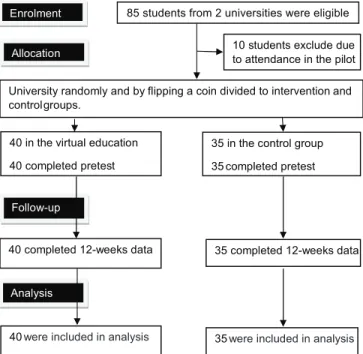
This is a clinical trial study (IRCT201607039975N3), conducted in Tehran, Iran, from March 2015 to March 2016. The study was conducted on all 75 students studying in the sixth and eight semesters of Midwifery, Bachelor’s Degree Program, at two state universities (Shahid Beheshti University of Medical Sciences and Tehran University of Medical Sciences). Randomization of the study subjects was not possible due to the risk of information exchange (contamination bias) among the students of one university. Therefore, the two universities were randomly, by flipping a coin, divided into intervention and control groups [Figure 1]. Through census sampling, all students of Tehran University of Medical Sciences were recruited as the intervention group (40 students) and those of Shahid Beheshti University of Medical Sciences were considered as the control group (35 students). Both groups had received the regular university course on sexuality in the fifth semester, consisting of eight 2‑h sessions on adult sexuality. This course did not cover any issues on CSE. The intervention group received additional virtual education. The inclusion criteria included having passed the sexual disorder course, having not attended any workshops on sexual issues within the past 6 months, and participant’s intention to take part in the study; the exclusion criteria were “not responding to the questions in one or more sessions after the study time.” Eligible candidates were called and, after explaining the objectives of the study to them, those willing to participate were recruited for the research and their verbal and written consent was obtained. The pretest was conducted on both groups, and researcher’s
email address and phone number were provided to both groups. The intervention group was familiarized with Dropbox and Google Drive, as well as the assessment method in one session. Then the educational material including PowerPoint, audio, and video files were provided to the participants through Dropbox and Google Drive. The training material was comprised eight 1‑h educational sessions together with related clips that were provided to the students twice a week. The training material included the following items: (1) child sexual training: significance, obstacles, and remarks; (2) midwife’s role in sexual education, some required skills for educational training; (3) behaviors, tendencies, and questions on pregnancy and sexuality of children age 0–6 years; (4) behaviors, tendencies, and questions on pregnancy and sexuality of children age 6–12 years; (5) puberty in girls; (6) puberty in boys; (7) education on the privacy of children and how to deal with children’s sexual concerns (such as masturbation); and (8) sexual abuse prevention skills (such as the ability to say no). To make sure the course material had been studied by the intervention group members, students were asked some questions provided at the end of each session on the Internet, and the links to the course materials of the next session were provided only when the questions were answered by the group members. Three months after the end of the course, posttest was administered to both groups. Pre‑ and posttest questions were the same, but they were different from the questions provided at the end of each session. To observe the ethical aspects, the links to the educational material on CSE were provided to the control group after the completion of the study.
A researcher‑made questionnaire, comprised two sections, served as the tool for measuring knowledge in the field of
85 students from 2 universities were eligible 10 students exclude due to attendance in the pilot University randomly and by flipping a coin divided to intervention and controlgroups.
40 in the virtual education 40 completed pretest
35 in the control group 35 completed pretest
40 were included in analysis 35 were included in analysis
40 completed 12-weeks data 35 completed 12-weeks data Enrolment
Allocation
Follow-up
Analysis
CSE. One checklist dealt with respondents’ demographic characteristics including age, marital status, and the number of children. The second section included 33 questions on knowledge in four subsections: children’s sexual behavior (5 questions), children’s questions on sexuality (6 questions), principles of child sexual education (17 questions), and children’s sexual concerns (5 questions). The questions were raised in the form of scenarios and the students were requested to choose the proper actions as a correct decision made. To obtain the final knowledge score, the sum of correct choices was considered in which 0 and 68 indicated the lowest and highest scores of knowledge, respectively. As the number of questions and acquired scores were not of equal terms, the scores were converted to a 0–100 scale for the convenience of comparison between the various aspects of knowledge. A score lower than 40 was considered as a low level of knowledge. To ensure the validity of the questionnaire, the questions were based on the most recent scientific literature, and then were submitted to 15 faculty members specialized in reproductive and sexual health and child psychiatry. The initial review indicated that 33 of 37 questions were approved with CVI 88% and CVR 90%. Test–retest was used to ensure the reliability of the questionnaire. The questionnaire was administered to 15 midwifery students; the same questions were administered to the students 2 weeks later. A correlation coefficient of 78% and 96% was obtained for pre‑ and posttests, respectively. Individuals attending the introductory part of the study were eliminated from the study population. There was no dropout during the study.
Chi‑square, Fisher’s exact test, and independent t‑test were used to ensure homogeneity in the two groups. The results at baseline and after 3 months within each group were compared with paired t‑test. The results yielded by the two intervention and control groups were evaluated through an independent t‑test. The results were expressed as the mean (standard deviation), and p < 0.05 was considered statistically significant and all analyses were conducted by SPSS version 21 for Windows (SPSS IBM, New York, USA). Ethical considerations
At first, the necessary scientific permissions were obtained from Research Deputy and Ethical Committee of Tehran University of Medical Sciences under approval number IR.TUMS.VCR.REC.1395.217 dated July 2016. Then, the study was registered and approved by the Iranian Registry of Clinical Trials. Participants were apprised of the nature of the study, and verbal and written informed consent was obtained from those willing to participate.
Results
There was no significant difference between the two groups in demographic characteristic. About 75.50% of the participants (n = 35) in the intervention group and 71.40%
of the respondents (25 individuals) in the control group were single. There were no significant differences between the two groups in their marital status (Chi‑square, p = 0.08), the number of children (Fisher’s exact, p = 0.08), and the mean (standard deviation) of respondents’ age (t‑test,
p = 0.438).
Quite unexpectedly, the mean score of knowledge obtained by the students in the field of sexual education prior to the training course was not equal in the two groups, which stood at a significantly higher level in the intervention group in the paired t‑test (p = 0.001). Therefore, although paired t‑test showed that the mean score of knowledge in the intervention group was significantly higher than that in the control group 3 months after intervention, it could not be regarded as a reliable indicator of the positive effect of the intervention (p = 0.001) [Table 1]. Consequently, the mean difference in both groups’ knowledge before and after intervention was obtained by paired t‑test. Then the two means were compared by independent t‑test.
Difference between changes in the score means (SD) in the general knowledge of midwifery students in intervention and control groups stood at 17.60 (11.40) and 1.59 (2.10), respectively; the independent t‑test showed a significantly higher range in the intervention group (p = 0.001). Paired
t‑test in the intervention group showed a significant improvement in all aspects of CSE (p = 0.001). In the control group, paired t‑test indicated that the mean score change in children’s questions on sexuality (p = 0.023) and children’s sexual behavior (p = 0.031) was significant
[Table 1].
Discussion
This research was aimed at determining the effect of virtual education on midwifery students’ knowledge in the field of CSE. Quite unexpectedly, midwifery students’ knowledge was significantly higher in the intervention group than that in the control group before the intervention. It was so despite the fact both groups of students had received the same educational curriculum, were of the same age and marital status, and were studying in the same educational semester of nearly the same educational quality.
However, the low score of knowledge in both groups before the test indicates the inadequate attention and time allocated to this subject in educational curriculum (100% of control and 48% of intervention groups attained a score less than 40). Similarly, another study showed that even though sexual health consultation is one of the educational objectives of midwifery major, midwives’ skill and knowledge in this subject proves unsatisfactory.[18] Also, other studies showed that medical staff did not possess the adequate knowledge, and sexual education should be taken more seriously.[19,20]
The obtained results showed that the mean difference in the general score of knowledge between pre‑ and
postintervention was significantly higher (p = 0.001) in the intervention group than that in the control group. This finding reconfirms another study showing that the intervention group’s knowledge was significantly higher than that in the control group 4 weeks after providing sexual health education to nursing students.[21] Conforming to these results, the study on Malaysian medical students showed that holding a training course on sexual health led to a significant increase in their knowledge of sexuality from 41.21 to 44.06 (p ≤ 0.05).[22] Furthermore, some research maintained that the inclusion of educational material on sexuality in the curriculum of medical majors bears a positive effect on students’ knowledge.[23] It can thus be concluded that providing training to midwifery students on CSE has improved their knowledge.
The difference in the pre‑ and postintervention score of control group’s knowledge is worth to note. One possibility is that the pretest questions have motivated the students to respond to the scenarios and has created some curiosity within them; this indicates students’ interest in CSE, or generally in sexual training, or their need for such training. Similar findings show such occasional increases in the score of control groups over time in special topics such as sexuality.[21]
The results of this study also confirm the positive effects of virtual education on student’s knowledge. Conforming to these results, other studies showed that students’ cognitive learning score increased dramatically from 0.80 to 15.90 after virtual education (p = 0.03).[24] It seems that in virtual education the presented material can be reused, and students are flexible with regard to the time they spend on education; these might have caused the increase in midwifery students’ awareness of sexual training. As maintained by some theorists, virtual education provides greater educational chances to students and thus increases the performance and efficiency of the faculties.[25]
On the other hand, one randomized control trial showed that long‑term knowledge retention was the same in medical students in both web‑based and printed materials, while web‑based education accompanied by printed materials took less study time.[26] One possible explanation for the positive effect of virtual education in this study could be the control of the student activity for overcoming the “less study time” problem. As mentioned previously, to make sure the course material had been studied by intervention group members, students were asked some questions at the end of each session on the Internet, and the links to the course materials of the next session were Table 1: Comparison of knowledge’s score of midwifery students about child sex education in two groups of
intervention and control before and after educational intervention Control (n=35)
Mean (SD) Intervention (Mean (SD)n=40) between groups (independent Compare the mean score changes t‑test) Child sexual concerns
Pretest 29.30 (10.40) (18.50) 45.50 t=2.53, df=73, p=0.014
Posttest (10.70) 30.50 ((11.40 57.10
Score changes 1.10 (2.10) 10.60 (5.20)
Compare the score changes within group (Paired t‑test) t=0.92, p=0.361 t=3.21, p=0.001 Principal of sex education
Pretest (7.20) 21.50 (9.40) 36.40 t=7.52, df=73, p=0.001
Posttest (7.20) 22.60 (11.90) 55.90
Score changes 1.14 (3.90) 19.50 (13.80)
Compare the score changes within group (Paired t‑test) t=1.39, p=0.175 t=9.01, p=0.001 Child sexual questions
Pretest (14.90) 27.50 16.50)).0045 t=3.45, df=73, p=0.001
Posttest (15.00) 29.90 (16.90) 61.80
Score changes 2.33 (3.50) 16.80 (8.20)
Compare the score changes within group (Paired t‑test) t=2.09, p=0.023 t=4.42, p=0.001 Child sexual behaviors
Pretest
Pretest (9.80) 24.60 (4.10) 3.29 (12.40) 37.22 (5.18) 5/45 t=5.58, df=73, p=0.001
Posttest (13.80) 27.40 (13.20) 57.50
Score changes 2.80 (3.20) 20.20 (13.80)
Compare the score changes within group (Paired t‑test) t=2.25, p=0.031 t=7.52, p=0.001 Total score of knowledge about child sex education
Pretest (6.20) 24.30 (8.90) 39.70 t=6.86, df=73, p=0.001
Postest (6.50) 25.90 (8.90) 57.30
Score changes 1.59 (2.10) 17.60 (11.40)
Compare the score changes within group (Paired t‑test) t=2.17, p=0.037 t=8.26, p=0.001 SD: Standard deviation
provided only when the questions had been answered by group members.
Also, according to a systematic review, 33 of 60 studies showed that in comparison to traditional learning, virtual education for undergraduates’ health professions has general positive effects on their knowledge, 24 studies reported neutral effects, and 3 studies reported negative effects.[27] In one of these three studies, otolaryngology education was presented in the virtual format. These researchers demonstrated that students in the virtual group spent less time on the study and gained a fewer level of knowledge at the posttest in comparison to the control group.[28] It seems that the complexity of the subject can influence the effectiveness of virtual education. Sex education programs, in contrast to some others such as otolaryngology, feature easy and tangible issues to which obvious explanations exist. Furthermore, topics related to sexuality are generally interesting subjects that do not need any especial motivation for pursuing. Recruitment of a nonmatched control group can be considered as one of the limitations of this study.
Conclusion
Students’ poor knowledge on CSE at the beginning of the study indicates the necessity for devoting more time to sexual education topics in the educational curriculum of medical students. Considering the fact that a shortage of financial and human resources has always impeded effective education, virtual education can be replaced as an effective method especially for tangible and interesting issues such as sex education.
Acknowledgments
The present study is the result of the research proposal that was approved by the Tehran University of Medical Sciences (Grant No;32160‑28‑02‑95).
Financial support and sponsorship
Tehran University of Medical Sciences, Tehran, Iran Conflicts of interest
Nothing to declare.
References
1. De Freitas C. Keys to Your Child’s Healthy Sexuality. Barrons Educational Series Incorporated. New York; 1998. p. 1.
2. Collins RL, Strasburger VC, Brown JD, Donnerstein E, Lenhart A, Ward LM. Sexual media and childhood well‑being and health. Pediatrics 2017;140(Suppl 2):S16‑66.
3. Ecker N, Kirby D. International Guidelines on Sexuality Education: An Evidence Informed Approach to Effective Sex, Relationships and HIV/STI Education. United Nations Educational, Scientific and Cultural Organization; 2009. p. 2. 4. Almeida ACCHd, Centa MdL. Parents experience with the
sexual education of their children: Implications for nursing care. Acta Paulista Enferm 2009;22:71‑6.
5. Martin J, Riazi H, Firoozi A, Nasiri M. A sex education program for mothers in Iran: Does preschool children’s sex
education influence mothers’ knowledge and attitudes? Sex Educ 2018;18:219‑30.
6. Tabatabaie A. Constructing the ideal Muslim sexual subject: problematics of school‑based sex education in Iran. Sex Educ 2015;15:204‑16.
7. Abedini E, Tabibi Z, Ziaee P, Zarezade Kheibari S. A qualitative study on mothers experiences from sex education to female adolescents underlining cultural factors. J Fund Ment Health 2016;18:202‑11.
8. Javadnoori M, Roudsari RL, Hasanpour M, Hazavehei SM, Taghipour A. Female adolescents’ experiences and perceptions regarding sexual health education in Iranian schools: A qualitative content analysis. Iran J Nurs Midwifery Res 2012;17:539. 9. DeJong J, Jawad R, Mortagy I, Shepard B. The sexual and
reproductive health of young people in the Arab countries and Iran. Reprod Health Matters 2005;13:49‑59.
10. Farnam F, Pakgohar M, Mirmohammadali M, Mahmoudi M. Effect of sexual education on sexual health. Sex Educ 2008:8:159‑68.
11. Dranser M, Cooper M, Nolte A. Myles Textbook for Midwives: African Edition. London: Churchill Livingstone; 2006. p. 126. 12. Khadivzadeh T, Ardaghi M, Mazloum SR, Modaresi E. The
relationship between midwifery students’ attitudes towards couples’ sexual relationships and their clinical skills in providing sexual health of counseling services. J Midwifery Reprod Health 2016;4:530‑9.
13. Erfanian F, Khadivzadeh T. Evaluation of midwifery students’ competency in providing intrauterine device services using objective structured clinical examination. Iran J Nurs Midwifery Res 2011;16:191‑96.
14. Larsson M, Eurenius K, Westerling R, Tydén T. Evaluation of a sexual education intervention among Swedish high school students. Scand J Public Health 2006;34:124‑31.
15. Vaghari Z, Hejazi Z, Abiri S and Saeidi‑Rezvani M. Evaluation of parents’ attitude and function on child sexual education. The
9th national congress of Eshragh, Family and Sexual Education;
2005. p. 343‑60 [In Persian].
16. James G. Advantages and disadvantages of online learning. Retrieved 17 Aug 2011.
17. Arkorful V, Abaidoo N. The role of e‑learning, advantages and disadvantages of its adoption in higher education. International Journal of Instructional Technology and Distance Learning 2015;12:29‑42.
18. Khadivzadeh T, Ardaghi M, Mazloum SR, Modaresi E. The relationship between midwifery students’ attitudes towards couples’ sexual relationships and their clinical skills in providing sexual health of counseling services. J Midwifery Reprod Health 2016;4:530‑9.
19. Haboubi N, Lincoln N. Views of health professionals on discussing sexual issues with patients. Disabil Rehabil 2003;25:291‑6.
20. Sidi H, Loh SF, Mahadevan R, Puteh SEW, Musa R, Wong CY,
et al. Knowledge and attitude on sex among medical students of a Malaysian university: A comparison study. Asia Pac Psychiatry 2013;5(S1):103‑9.
21. Sung S‑C, Lin Y‑C. Effectiveness of the sexual healthcare education in nursing students’ knowledge, attitude, and self‑efficacy on sexual healthcare. Nurs Educ Today 2013;33:498‑503.
22. Low W. Impact of sexual health course on Malaysian university students. Med J Malaysia 2004;59:443‑9.
23. Tessler Lindau S, Goodrich KG, Leitsch SA, Cook S. Sex in the curriculum: The effect of a multi‑modal sexual history‑taking
module on medical student skills. Sex Educ 2001;8:1‑9.
24. Lavender DT, Omoni G, Lee K, Wakasiaki S, Campbell M, Watiti J, et al. A pilot quasi‑experimental study to determine the feasibility of implementing a partograph e‑learning tool for student midwife training in Nairobi. Midwifery 2013;29:876‑84. 25. Frehywot S, Vovides Y, Talib Z, Mikhail N, Ross H, Wohltjen H,
et al. E‑learning in medical education in resource constrained low‑and middle‑income countries. Hum Resour Health 2013;11:4.
26. Bell DS, Fonarow GC, Hays RD, Mangione CM. Self‑study
from web‑based and printed guideline materials: A randomized, controlled trial among resident physicians. Ann Intern Med 2000;132:938‑46.
27. George PP, Papachristou N, Belisario JM, Wang W, Wark PA,
et al. Online eLearning for undergraduates in health professions: A systematic review of the impact on knowledge, skills, attitudes and satisfaction. J Glob Health 2014;4.
28. Kandasamy T, Fung K. Otolaryngology Interactive Internet‑based cases for undergraduate otolaryngology education. Otolaryngol Head Neck Surg 2009;140:398‑402.