Megan Wolff. What is Good Programming and How Do You Know?: An Examination of the Assessment Criteria of Teens and Teen Librarians in Young Adult Programming.. A Master’s Paper for the M.S. in L.S degree. April, 2017. 77 pages. Advisor: Brian W Sturm
This study describes interviews of adolescents between the ages of thirteen and nineteen attending teen programs at public libraries in southeastern North Carolina and of the teen librarians running those programs. The interviews were conducted to determine the different assessment criteria used by teens and teen librarians when assessing teen programs in public libraries.
Subjects at six different teen programs at four public libraries were used to explore the similarities and differences in assessment of teen programs. In these North Carolina public libraries, teens and teen librarians use both similar and dissimilar criteria to measure program success.
Headings:
Libraries--Public Services
WHAT IS GOOD PROGRAMMING AND HOW DO YOU KNOW?: AN EXAMINATION OF THE ASSESSMENT CRITERIA OF TEENS AND TEEN
LIBRARIANS IN YOUNG ADULT PROGRAMMING
by Megan K Wolff
A Master’s paper submitted to the faculty of the School of Information and Library Science of the University of North Carolina at Chapel Hill
in partial fulfillment of the requirements for the degree of Master of Science in
Library Science.
Chapel Hill, North Carolina April 2017
Approved by
I.
I
NTRODUCTIONIn public libraries there are programs to serve all different ages of patrons. Some of these programs are designed specifically with the teenager or young adult in mind. Teens are deemed too old for the traditional storytime but too young or
otherwiseuninterested in adult programming. Libraries strive to serve these patrons as they serve others--by providing them with programming targeted at them and their interests. The struggle to design programming which supports teens’ needs while
remaining enjoyable has remained a balancing act throughout the history of teen/YA programming. Teenagers are markedly different from adults in many ways--physical, mental, emotional, social, and it makes sense that their programming is designed specifically for them.
or the limitations of a fill-in-the-blank or check-box surveys. While some might argue that the rise of teen advisory boards have enabled more feedback regarding programming, the advisory boards are not present in all libraries and furthermore, change based on their advice is still regulated by adults. In my research, I have interviewed teens and their librarians and asked about programming, how they decide which programs were good and bad, successful and unsuccessful. Understanding appeal factors of teens could increase attendance at programs and further justify their need to administrators. In addition to this, understanding what teens want from their programming allows the librarian to better design the program so the goals of both librarian and attendees are met.
II.
L
ITERATURER
EVIEWII. A. Adolescent Development
Adolescence is typically known as a time of change. Teenagers, as many adolescents are called, are in a stage of development characterized by physical, mental, social, and emotional change. Teens are beginning to shake off the trappings of childhood and try on adult roles, preparing for their future as mature and responsible adults.
Understandably, this process is often difficult and uncomfortable, and an understanding of what is developing and changing in the minds and bodies of teens may lend a greater understanding of their behaviors.
large amount of time to make generalizations about. A ten or eleven-year-old’s
development is vastly different from that of a fifteen-year-old which is vastly different from that of a nineteen-year-old. To better specify areas of development within
adolescence, it is commonly broken down into three developmental stages--early, middle, and late adolescence, (Rapp, Nichols, Nichols, 1998);Steinberg, 2011a;Goossens, 2006a). Though the exact ages differ by a few years, early adolescence is defined as taking place approximately from the age of ten until the age of thirteen to fifteen. Middle adolescence is defined as taking place from approximately the age of fourteen until the age of
seventeen. Late adolescence varies widely, starting at approximately the age of seventeen and lasting from nineteen to twenty-two years of age. Adolescence, then, is seen as starting at the age of ten and lasting in some cases until age twenty-two.
Over the years, development and behavior have been studied by a number of psychologists. Some of the notable ones are Sigmund Freud, Erik Erikson, Jean Piaget, G. Stanley Hall, and Peter Blos. Freud was known for his focus on the physical and the sexual; he proposed that the focus of adolescence was on genital sexuality, “the ending of
Freud also theorized that there was a latency period between genital fascination and puberty, when the subject could make use of their genitals with another person and become sexually active. In addition to those theories, he suggested that delay or upset taking place in any of the stages could cause an ‘unnatural’ focus or fascination with that area later in the subject’s life. (Freud, 1910). Freud is known as “the father of modern psychology” and many of the later psychologists such as Erikson based their own theories on portions of Freud’s. Despite the fact that many of his theories have not held
up to the test of time, Freud is the bedrock on which other psychologists built their own theories and therefore, cannot be ignored when considering contributions to the study of development.
Erikson characterized stages of life by the internal conflicts going on within the person and characterized adolescence by the conflicts “identity versus role confusion”, taking place around the time of ages 12 to 18 and “intimacy versus isolation”, (Meece,
2002a) taking place from about 18 until middle adulthood. Each stage is associated with certain ‘virtues’ which are gained by the successful navigation of the conflict.
“According to the theory, successful completion of each stage results in a healthy
personality and the acquisition of basic virtues. Basic virtues are characteristic strengths which the ego can use to resolve subsequent crises,” (McLeod, 2013.) The conflict “identity v. role confusion” is focused around the virtue of fidelity. Fidelity involves
conflict between intimacy and isolation-forming close and intimate relationships with other non-family members. Successful connection formation leads to stable, committed relationships in which both participants demonstrate care and feel safe within that relationship. Unsuccessful connections or lack of connection may lead to isolation, loneliness, and depression, (McLeod, 2013). These virtues, fidelity and love, are
especially important for teenagers to learn to function within relationships and society as a whole. Fidelity allows teens to work with, befriend, form relationships with, and otherwise interact with those different than themselves; love introduces teens to a different kind of intimacy and allows them to explore having support from significant persons in their lives who are not related to them.
Piaget believed that each stage of life was “characterized by qualitatively different
ways of organizing information and learning about the world” (Meece, 2002a), that “intelligence is something that grows and develops through a series of stages,” and that
children do not become more intelligent as they age, but rather the very way of thinking
changes (Cherry, 2016a). It was he, in fact, who originally suggested that children think
differently from adults. During adolescence, according to Piaget, the brain was in the ‘formal operations’ stage of development. The formal operations stage, which Piaget said
begins around the age of twelve and lasts into adulthood, included the ability to think about abstract concepts, logical thought, deductive reasoning, and systematic planning, (Cherry, 2016b). Just as young children might not understand the humor of their parents or siblings, they are unable to think in the same ways. Adolescents in the formal
unbalanced scale and a set of weights, having children of various ages determine where the weights and fulcrum of the scale should be places to achieve a balanced scale. “It
wasn't until around age 13 that children could use logic to form a hypothesis about where to place the weights to balance the scale and then complete the task” (Cherry, 2016b). With these operations, the teenager’s brain is able to think in ways needed to deal with
hypothetical situations, higher-level maths and sciences which involve working with numbers and forces which are not able to be physically touched or manipulated, as well as greater abilities to examine ideas and concepts from multiple perspectives. Debates are one demonstration of such perspective-switching. Debate teams, which usually are found in high schools and the occasional middle school, require the debaters to study the topics they will be debating and be able to argue both sides of the issues, providing evidence and points in favor of each. A child would become confused with facts and quotes that lead to different conclusions, whereas a teenager capable of looking at ideas from multiple perspectives and making judgements about truth, are able to think about the nature of truth and evidence in a way that younger children simply are not.
Hall believed that humans were wired for different biological stages and that these stages were as distinct as the stages of caterpillar to chrysalis to butterfly. Adolescence was characterized by “storm and stress” which structurally reformed adolescents as they swung between twelve ‘oppositions’:
1. Inertness and excitement 2. Pleasure and pain
5. Good and bad conduct 6. Solitude and society 7. Sensitiveness and dullness 8. Curiosity and apathy 9. Knowing and doing
10. Conservation and iconoclasm 11. Sense and intellect
12. Wisdom and folly (Goossens, 2006b; Hall, 1904).
The teenager, Hall believed, had been physically incapable of higher emotions or actions in childhood and as they swung between extremes, they were “continually re-asserted” because “these higher emotions are not permanently inherited yet.” (Goossens,
2006b; Hall 1904). The higher emotions and actions he referred to are control over more basic self-serving urges. Altruism, generosity, and the ability to hold one’s tongue would be examples of these higher emotions, which Hall believed that children were not
physically capable of. It was not, in Hall’s opinion that children chose to be selfish or rude or easy to anger but that they were biologically incapable of repressing those urges and performing more ‘evolved’ behaviors.
Blos ascribed to a school of thought referred to as object relations theory which stated, “Object relations or object representations are (mostly unconscious) inner
representations with one’s relationships with important people in one’s life, such as one’s parents,” and that the goal of adolescence was to “[shed] outdated forms of dependency
2006b,). As young children, a parent was the object upon which the child focused their affection; however, during adolescence, that dependency is discarded or shifted to the metaphorical back burner and new objects of affection are chosen or existing objects of affection are raised in importance in the teen’s life. The shifting of the relationships and
determining the persons upon which to bestow affection is the one of the main struggles of adolescence, according to Blos. This is a commonly viewed phenomenon in teenagers; friends and significant others raise in importance and these peers are who the teen spends most of their time with. Parental and sibling relationships may wane in importance and the opinions of family members seem to matter significantly less than the opinions of their peers.
Though these psychologists looked at development and adolescence through different lenses, the key point was understanding the human being. As a human being, the adolescent is going through a large number of changes in their bodies and minds.
Through examining these changes, it is hoped that the reader will gain a greater understanding of adolescents and their behavior.
Physical
When thinking of physical development in adolescence, the natural first thought is of puberty. Puberty, “a coordinated series of hormones and physical growth changes that
development of primary sex characteristics including enlargement of the uterus, vagina, clitoris and labia as well as that of the testicles, scrotum, and penis, depending on the biological sex of the person (Alsakar & Flammer, 2006; Meece, 2002b). In biosex females, menstruation will occur and in biosex males, the first ejaculation will occur during puberty, both of these preparing the body for sexual reproduction and parenthood. Secondary sex characteristics also develop; in biosex females, breasts begin development and in all sexes, pubic hair growth begins. In biosex males, it is common for facial hair to begin growth as well (Alsakar & Flammer, 2006;Meece, 2002b;Susman & Dorn, 2009).
These physical changes are easily observable, especially to the teens whose bodies are changing so rapidly. Suddenly having jeans that are an inch too short, a shirt that has become too tight because of the broadening of shoulders or breast growth, (or both), and hair growing in places it never grew before can be unsettling for teenagers. Many become very conscious of their own bodies as well as others’ bodies. The timing of pubertal changes can affect teens’ self-image and behavior as well. Studies suggest that
girls who develop female sex characteristics sooner may have more psychological and behavioral issues, (Aro & Taipale, 1987; Caspi & Moffitt 1992; Ge, Conger & Elder, 1996; Magnusson, Stattin, & Allen, 1885); Simmons & Blyth, 1987). Boys, in contrast, seem to have positive effects from early maturation, including feeling more attractive, self-confident, and sure of themselves (Graber, Lewinsohn, Seely, & Brooks-Gunn, 1997; Tobin-Richards, Boxer, & Peterson, 1983).
Causing many of these physical changes are hormones, the chemicals which can change the body in incredible ways. “The function of the hormone system is to
hormones a bit like a chemical event coordinator; their job is to make sure all the body systems are on the same page. Three different parts and systems work together in this effort: the pituitary gland which controls hormones in general, the hypothalamus which is the part of the brain that controls the pituitary gland, and the gonads which are the testes or ovaries. The entire system is often referred to in short as HPG. Though all sexes produce both androgens, which are typically known as ‘male’ hormones, and estrogens,
which are typically known as ‘female’ hormones, during puberty and adolescence, biosex females begin producing more estrogens than androgens and the reverse occurs in biosex males, (Steinberg, 2011b; Alsakar & Flammer, 2006). These hormones affect the
physical development of teens. In addition to these hormones, another hormone called cortisol is also important. Cortisol is a hormone produced in times of stress and in the teenage years which are full of stress, cortisol can also be present in high levels
(Steinberg, 2011b). It serves a function, to alert the brain in times of stress that there is danger, though in this case the danger may be of failing a class or losing a friend rather than survival. Teenagers are not puppets driven by hormones, but rather people learning to deal with how their bodies are biologically changing and reacting. Despite the popular stereotype of teenagers as hormone-saturated moody persons known to jump from highs to lows and back again, Steinberg and Morris claim that there is very little evidence for this stereotype in scientific studies (Steinberg & Morris, 2001).
2011b; Alsakar & Flammer, 2006). Phase delay is exactly as the name suggests, an off-setting of a pattern, namely the pattern of sleep. This is due, in part, to a hormone called melatonin which helps the body regulate its sleeping and waking cycle. “During puberty,
the time of night at which melatonin levels begin to rise changes, becoming later and later as individuals mature physically” (Steinberg, 2011b). Teens dozing in their first class of the day, then, may not be because they are lazy or bored, but rather because their brain is still producing melatonin and telling the body that it is time for sleep, not for
pre-calculus.
Mental
The brain is arguably the most important part of the human body. Controlling every muscle, every thought, every function and action a person takes, the brain is the control center of the body, and during adolescence it is going through major changes. One of the large changes is synaptic pruning, a process through which less-used synapses, or connecting paths between neurons, are eliminated. Instead of having multiple paths to multiple neurons, the brain keeps the ones which are used most
(Steinberg, 2011c). Some scientists believe that the principle of “use it or lose it” applies
to these synaptic connections. The brain of a teenager is not completely different from that of an adult, but it is in some significant ways: synaptic connections, what parts of the brain are developing, and how the brain is being used.
mid-to-late twenties. With synaptic pruning going on in this area as well as myelination, a sort of protective fatty coating around important neurons, it is not as functional as that of an adult (Steinberg, 2011c). In the brain, grey and white matter are the two main types; grey matter is primarily neurons, whereas white matter is connective material between
neurons. Allegorically, the grey matter is a location and the white matter is the pathway to and from that location. A number of MRI studies have shown that while grey matter peaks around the age of twelve before decreasing, the white matter in adolescent brains is still growing and making connections (Blakemore, 2012). Synaptic pruning is occurring and the brain is choosing which information pathways to keep and which to kill. For teens this means that they are forgetting things. Connections are being cut or strengthened based on use. The teenage brain is doing some metaphorical spring cleaning and deciding what knowledge to keep; basic addition and subtraction may be kept because it is used often while the names of their teachers in elementary school may be removed to make room for more useful connections. Synaptic pruning is the brain’s way of building stronger connections and maintaining those instead of trying to maintain a larger number of weak connections.
capability to plan increases, and they are more able to have foresight, set goals for
themselves, and plan for the future (McNeely & Blanchard, 2009b). Within the prefrontal cortex, connections are being created and reinforced, making it easier for the brain to process information more efficiently, and, equally important, connections are being made with other parts of the brain, allowing it to utilize more than one area (Steinberg, 2011c). Interestingly, the brain of a teenager, though it has the same parts as an adult’s and is developing into one, processes information using different parts of the brain. In a study done examining mentalizing and processing, different parts of the brain were being used more in adolescents than in adults and vice versa (Blakemore, 2012). In a similar study, adolescents’ brains were monitored while they were asked to read and react to social scenarios; adolescents’ brains responded more strongly to some emotions than adults’ did
(Blakemore, 2012). As the brains of adolescents develop, they become able to process information faster and more efficiently. Their brains can hold and process more
information (the specific term for this is called processing capacity) and are increasingly able to inhibit their responses to stimuli. These new storage and processing abilities could mean an increase in the speed at which they are able to respond or inhibit a response; these improved reactions are linked with the greater self-control shown as adolescents age (Kuhn, 2009). With the same inputs, teens process and output information and reactions very differently than adults, which can be attributed to those still-developing processing methods and speeds.
Piaget’s formal operations stage with more complexity and abstraction in thinking
themselves and others is tied in with a teen’s desire to determine their identity. “Who am I?” they ask. The questions they use to determine this answer do involve complex, often
abstract thought. Vocations, beliefs both moral and religious, sexual orientation, goals and ideals, their role in society, and what sort of person they want to be are all examined. It is common in this stage for teens to “try on” different identities and see if they fit (Latham & Gross, 2014). Teens’ views of themselves change as do how they define
themselves. As children, they were often labeled or identified by adults in their lives and then their peers; older teens begin to look at themselves through their own lenses rather than through the perspective of another person (Steinberg & Sheffield Morris, 2001). The abstract thinking they take part in during the examination of their own identities, the identities of others, and how they fit into the world wasn’t possible before this
development; children are capable of abstract thought to a point but adolescence allows teenagers to deepen the levels of abstraction in which they can think and imagine themselves and their worlds.
Social & Emotional
As bodies and minds develop, so too do adolescents’ emotional capacities and social relationships. During this time, adolescents begin the “normal process of
separating themselves from parents to find their places in the world. At the same time, relationships with peers increase in importance,” (Latham & Gross 2014). This is not to
say that parental support and involvement are no longer needed, quite the opposite in fact. During this time of trying on identities and determining their own beliefs, the
(Steinberg & Sheffield Morris, 2001). Finding their own places in the world is a portion of identity development. Adolescents must determine who they are and what they believe. As children, self-descriptors were often related to abilities and interpersonal characteristics and they used their peers as social comparisons (Meece, 2002c). How adolescents view themselves shifts, now focusing on personal beliefs and standards rather than social comparisons to others (Steinberg & Sheffield Morris, 2001). “During the
second decade of life young people are figuring out their self-concept and self-esteem, in part, through five developmental tasks: becoming independent, achieving mastery or a sense of competence, establishing social status, experiencing intimacy, [and] determining sexual identity” (McNeely & Blanchard, 2009c).
The beginnings of independence from parents can manifest in a variety of ways. For example, teens may begin questioning and trying to negotiate rules, especially regarding curfews and other limits (McNeely & Blanchard, 2009a). How teens and their self-esteem develops depends heavily on parental demandingness and responsiveness: how parents expect their children to comply with their demands and now sensitive they are to their child’s needs, signals, and states (Côté, 2009). Like any other learning
process, developing independence is done in steps, and support on the part of parents and other role models modelling what responsible independence looks like can help ease the transition. Teens will make errors of judgement and stretch their boundaries, but this is all part of the learning process. Along with developing independence, adolescents will also begin to develop their own morals and values.
child believes is moral is handed to them by an authority figure, usually a parent or other adult. As the child grows, morality is still somewhat defined by authority figures but relies more heavily on community standards. The rules are adhered to for the
maintenance of order rather than because someone told them they are true (Latham & Gross, 2014). Some teens are still in this stage and their decisions about what is good for the community may be different than their parents’ or other adults’. Other teens may be
developing their own morals and values and are in the final stage: postconventional morality. Kohlberg did not expect anyone under the age of 20 to reach this stage, if at all. In postconventional morality, people think about fairness and morality in a more complex way, about basic human rights, about whether society itself is good and fair and
upholding those values (Latham & Gross, 2014). As previously stated, some of the morals teens are experimenting with will be the same as their parents, some will not. Teens will develop moral ideals and select role models to emulate based on those ideals (McNeely & Blanchard, 2009a). This moral development is intertwined with the
developing independence of adolescents; the morality and fairness of rules may come into question, as may rights and privileges of the adolescent (McNeely & Blanchard, 2009a).
a variety of people and groups, not simply the one with which they identify most
strongly. Though larger social structures are important in the life of a teen, more intimate relationships are equally, if not more important. Intimate relationships do not refer just to romantic or sexual relationships, though the term may apply to both of those. “Intimacy
refers to close relationships in which people are open, honest, caring, and trusting. Intimacy usually is learned first with parents and within same-sex friendships, and that knowledge is later applied to romantic relationships” (McNeely & Blanchard, 2009c).
While adolescence is when romantic and sexual relationships form, a teen’s idea and expectation of intimacy in a relationship is based on the relationships which they have or have had with family members, mentors, and friends. “Young people need guidance in
cultivating and navigating social and romantic relationships. It is important to understand what a healthy relationship is and to develop emotional and communication skills”
(Latham & Gross, 2014). Adults can provide advice in how to navigate friendships and first romantic relationships; the importance of mutual respect, honesty, and open communication should be emphasized as well as what things are not acceptable in a relationship such as violence, controlling behavior, and manipulation. Young people dealing with these things for the first time may need a mentor to talk to them about how they should treat others in relationships as well as how they should expect to be treated. This advice applies regardless of sexual orientation or gender identity; all people deserve a relationship which is respectful and healthy.
2009a). Depending on the society in which teens live, the people with whom they interact daily may be more or less accepting of their sexual orientation and identities, especially if that orientation or identity differs from that of the majority--cisgendered heterosexual. “For gay and lesbian youth, schools can be a dangerous, as well as hostile, environment. Many choose to remain silent about their homosexuality. Those who choose to “come out” as teenagers risk verbal and physical abuse” (Meece, 2002d). A study done in 1997
reported that the average high school student heard homophobic or antigay epithets twenty-five times per day (Carter, 1977). One may think that conditions for lesbian, gay, bisexual, transgender, queer/questioning, intersex, asexaul (LGBTQIA+) students in schools would have improved since 1997. However, the Gay, Lesbian & Straight
Education Network (GLSEN) put out a study in 2013 showing that “Seventy-four percent
were verbally harassed in the past year because of their sexual orientation and 55 percent because of their gender expression. As a result of feeling unsafe or uncomfortable, 30 percent missed at least one day of school in the past month” (Kosciw, Greytak, Palmer, &
Boesen, 2013). With statistics like these, the importance of support and acceptance from parents, mentors, and peers cannot be overstated. Sexual orientation and gender
expression are parts of a teenager’s identity and should be accepted as any other portion
Summary
Adolescence is a time of change and shifting roles. With changing bodies, minds which are thinking in new ways, and emotions which may have never before been experienced, being a teenager isn’t easy. For healthy development, a teen/young adult
should have role models who they can come to with questions, resources which provide factual, relevant information, and relationships with community members of all ages. It is a common saying that “it takes a village to raise a child” and a teenager is no different,
though childhood is ending for them. Teens learn from each other, from their parents, teachers, and librarians. Though they are figuring many complicated things out for themselves like identity and morality, the support of a community is crucial. The library should be a safe, community location which teens can come to for various purposes, information-seeking and leisurely alike. As a space which is geared towards self-driven learning and curiosity, the local library can be one of the most important locations in a teen’s life and it is the job of the library to be sure that they are doing everything they can
to support that growth.
II. B. History of Teen/Young Adult Services
Library services have included services to young people since the beginning of the American public library. One of the earliest American public libraries specifically for children, opened in 1803 with books for children from nine to sixteen years of age (Bernier, 2010). However, as time passed and services were divided to provide age-appropriate resources and services, specifically an adult department and a children’s
services existed before 1957 and fell under the umbrella of the children’s department, this year specifically is when I will begin the abridged history. In 1957 the Young Adult Services Division (YASD) became separate from the Children’s Division in the
American Library Association, or ALA, (Bernier, 2010). In this separation from the Children’s Division, Young Adult (YA) library history really begins as a “named”
service.
Though it is mostly in complaint that students are consuming the time of the reference librarian and leaving little time for adults with “serious work,” Albert Monheit makes the argument for a Young Adult Department in larger libraries with enough resources, leaving these services with the children's librarian in smaller or less-equipped libraries (Monheit, 1962). He states that “We have made a fetish out of teen-age work, as we have out of book selection, the story hour, and enthusiastic programs of all types.”
This conditional attitude towards teen services, stating that they should only be available in larger libraries with more resources, is one which does a great disservice to the teen user. Teen users deserve library service in all libraries and making their services conditional implies that the users themselves are less important than the adult or child users. Like any other people, young adults need to feel welcome and as though they belong in the library, wherever in it they choose to go. During the late fifties and into the sixties, young adult services were mostly geared towards those youth already using the library. Though outreach efforts were made towards “disadvantaged youth,” the general consensus seemed to be “our first duty is to those who read, those who use the library
facilities, who appreciate the exchange of ideas and opinions based on reading or
the appeal to middle class values become readily apparent,” notes one researcher
reflecting on the decade (Craver, 1988, p 25). The small and medium-sized libraries’ groups for teens usually included a book discussion group or book reviewing group or club. Doris Watts sang the praises of such groups in her column in Wilson Library Bulletin entitled “The Public Library and the Teen-age”, where she describes the groups
as “the most rewarding to your teenagers and for you” (Watts, 1960, p.260)and that “books come alive to young people when their impact is shared”.
It is unsurprising that the library considered books to be its most useful resource in programming, though some noted that in rural areas with disadvantaged youth. “Many of these young people are slow learners and will not be interested in a book oriented program” (Kentucky Department of Libraries 1966), and, for outreach purposes,
suggested games, sports equipment to be checked out (with the hope of introducing sports books after the equipment was checked out by a teen a few times), and hootenanies to “[get] the young people in the habit of coming to the library with the idea of its general entertainment and socializing value” (Kentucky Department of Libraries 1966). Those
non-users and offering programs to help shape them into the type of patron already using the library.
Through the sixties and into the late seventies, the trend of programs continues in the same style--geared mainly towards the middle class educated user. Young adults used the library for reasons other than programming. A survey of Indiana libraries in 1970 of students and young adults “Suggest[s] strongly that help with school work may in fact
have been the single most important motivation in bringing survey respondents to the library” (Wilder, Philip S., Jr. 1970). It is these users which would have been the main
attendees of library programs--students of middle school, high school, and college. When a New York library without programs for young adults surveyed the patrons in that age group, “Particularly great interest was shown in job opportunities workshops,
crafts/hobbies workshops and film/music programs,” which is the sort of programming
that was being provided in other libraries at the time (Gratch, Bonnie 1978). Exemplary young adult services recognized by the Office of Education were similar to the programs of previous years as well as some newer ideas, such as the establishment of Teen Centers, paperback racks of books in “places where young adults congregate”, as well as a folk
music program which involved young adults performing and listening to others perform folk music (Raffel, 1972). While outreach programs did exist prior to then, they were mostly the kind mentioned previously, intended to ‘hook’ non-users and help them to
In 1978, Chelton states “The overall goal within which specific library objectives are determined should be ‘to provide adolescents with conditions for healthy
development’”(Chelton, 1978;), a shift from the themes of previous years. She also
provides suggested guidelines to make the library more welcoming for young adults including giving young adults a separate room where they can interact, listen to music, including young adults in policy setting in the library, including more programming, and creating a network for those working with adolescents to talk, exchange ideas, and offer advice. She states that expecting teens to work in the silent study halls common of libraries at the time “is absurd if adolescent needs are considered” (Chelton, 1978). Her
insistence that young adults need a place of their own in the library is backed up in a public library training guide which states, “Disadvantaged young adults need to feel at ease in the library and are more likely to use the collection if they have ‘a place of their own’” (Harris, 1974). This was, and continues to be, true of young adults, disadvantaged
or not.
As the eighties arrived, technology also became more prevalent and libraries embraced the boom. The New York Library system began using a computerized card catalogue and also brought in ‘microcomputers’ for their patrons to use, giving each patron one hour a week. One library also put a computer in the young adult’s reading room which many of the young patrons used for gaming (“New York library”, 1986;). In
Menlo Park California, a computer literacy project called ComputerTown, a collaboration between a Menlo Park nonprofit and the Menlo Park library, introduced computers into their library. “Although playing games [was] the most popular ComputerTown activity,
library reminds me of a poolroom of years ago because that was the local hangout for kids. Now they hang out at the computers” (Harvie, 1981). The presence of computers in
the library became a draw, another way to bring in patrons who might not be able to afford computers at home or whose schools did not have them. The popularity of gaming and arcades at the time also made free computer usage for gaming a hot commodity. Libraries were aware of the trend towards technology and knew that to survive in an increasingly digital age they had to keep up with those trends, or at the very least follow along. Computer use and compact disk checkout where services increasingly offered by public libraries (Ervin, 1986; By, 1986). Computer books for young adults offered learning opportunities for teens, learning to design and build computer programs (Carter, 1984). Though not programming in the same context of previous years, bringing
technology into the library was programming which allowed teens to take charge of their own learning. Computer use, though categorized generally as library programming and services, was driven by the students. In this program, they learned at their own pace and focused on their own interests. If they tried something on the computer and didn’t like it, they didn’t have to sit through the rest of a program, they could immediately switch tasks
to something they felt would be more interesting.
Though the technological boom was undoubtedly an important shift, another notable event was the YASD’s first Hi-Low list, books which were of high interest to
introducing the young adult reader of low reading level to books for the purpose of reading enjoyment without the tone of ‘improvement’ for the user. Without this tone, the
message became that the library was offering materials for young adults rather than for the purpose of making them ‘better’. Changes in librarians and staff working with young
adults also occurred during this decade--the ALA released competencies which all librarians working with young adults should be able to demonstrate (“Young adults deserve”, 1982). School Library Journal published an article about the obstacles which
existed to providing excellence in youth services, including: funding, lack of support, lack of time, new types of programming being ‘risky’ in that they had never been done
before (Boegen, 1986). In the same article, however, was the note that the library did not just provide literacy; it provided self-esteem and positive reinforcement that the young adult patrons needed. “‘Do you know how often we are put down?’ they asked. ‘Do you
know how many people tell us we are not good, that we’ll never make it? Do you know how hard it is?’” (Boegen, 1986). In addition to the competencies provided by the ALA,
patrons all made the eighties an important time which led the way into the nineteen nineties.
The nineties continued the technology trend that the eighties set, with programs which included websites for teen services departments, information service centers which allowed computer access and aides to help users, and a program called ‘Bits and Bytes’
which trained teens in technology to become tech assistants for kids, other teens, and families (“Excellence in library”, 1994; “Excellence in library”, 1997; “Excellence in library”, 2000). Seattle’s public library provided a week-long tech program to young
teens in middle and early high school to encourage curiosity and interest in technology as well as to teach the teens how to do research and utilize technology for homework. This particular program gave priority to low-income students and those who did not have a computer or internet access at home (“Excellence in library”, 2000), combining the library’s goals of outreach, literacy, and resource usage. Another program of the decade
utilized video equipment to allow teens to make commercials for books, the best of which were broadcast on the local PBS station in the afternoons (“Excellence in library”, 1994),
a project that combined reading and technology, and encouraged creativity.
adult users (“Directions for library”, 1993). Some libraries allowed specific programs
after-hours where teens could use the library (“Excellence in library”, 1994; “Excellence in library”, 1997). This increasing respect for young adults and allowance for their spaces
and their expression was also shown in the numerous creative programs offered, from play-reading to music to writing and poetry contests or evenings ( “Excellence in
library”, 1994; “Excellence in library”, 1997; “Excellence in library”, 2000). The trend
towards allowing teens to have their own spaces and their own agency rather than a presentation-style program or one which sought to ‘improve’ the attendees is
undoubtedly the most important development in young adult services for this decade. With this trend came an increase in one which began back in the sixties--teen advisory boards and councils. With the ability to voice their opinions, participate in their
communities through the library, and gain skills for later employment through programs involving teens in the library itself, young adults were beginning to be seen through a different lens. The new perspective viewed these young people not as the gum-smacking menaces described by Albert Monheit in 1962, but rather as assets who could provide valuable contributions to the library community.
As the new millennium dawned so did Web 2.0, a term coined in 1999 by Darcy DiNucci referring to a more interactive world wide web, one where sites were no longer just to be viewed but also to be participated in. A talk by David Lee King entitled ‘Emerging Trends, 2.0, and Libraries’, addressed what web 2.0 was and how libraries
could use it to interact with patrons. A good portion of the suggestions were based around social media, blogging, and “reach[ing] customers where they are” (King,David Lee
adults who were active on social media was a natural progression of the movement towards teen spaces. Now, however, the teen spaces being created by libraries were not only physical but digital. A library with a MySpace, a Flickr, or a blog allowed
interaction in a medium in which teens were increasingly comfortable. Unlike the old library websites which were to look at, these web pages were a way to connect--they allowed teens to comment and make suggestions, chat, and interact with the library from wherever they accessed technology. A feature in Public Libraries noted three benefits to the library and the teens: “broadening the reach of the library’s young adult programs and
services; enabling the library to better support teens’ healthy social development; and facilitating opportunities for public librarians to teach teens how to engage in safer online interactions” (Agosto, D.E. 2009). Book discussions, a staple of young adult services
since the beginning, were now available on websites that the library created or other outside sites, refreshing the practice so young adults could interact with each other and discuss the books without having to meet at a specific time and place, with the ability to think about and type questions and opinions before ‘saying’ them. Admittedly, this is a
less-than-ideal situation for teens without access to the internet or a computer, but it is a step which follows with the own-spaces concept which became more prevalent in the nineties, moving it into a more digital environment.
This is not to say, however, that the trend towards teen spaces and teen-directed activities was lessened by the digital access now available. The 2004 “Excellence in
and allowing them to have a space in the library as well as opportunities to contribute has benefits for both teens and libraries. A study done by the University of Chicago found many potential benefits for teens, including social development, job skills, and positive-relationship-building. It also found potential benefits for libraries such as broadening library culture, teen employees, and connecting the library to youth organizations, and community benefits such as making the library more comfortable for other community members, visibility on issues, and youth programs which provide services to the community (Spielberger, 2004). Asking young adults what they want or need, building relationships with them, and generally empowering them so that they can make --and help the library staff make--the library into a place which is welcoming to other young adults allows them to bring their assets to the library.
The maker-movement has stretched from the first decade of the new millennium through the past ten years. Though not decade-specific, I thought it necessary to mention this meshing of dedicated spaces and technology. American Libraries magazine points out that “While makerspaces are not a new concept—library programs have featured
needle crafting, building, and upcycling for years—they have taken on a decidedly new technological twist” (“Issues and Trends”, 2016). The first makerspace was begun at the Fayetteville Free Library in New York; the FFL created the “Fab Lab” in 2011, (McCue,
TJ 2011) and other spaces followed. The 4th Floor at Chattanooga Public Library and the ‘Labrary’ run by Harvard University Library (Goldenson, J., & Hill, N. 2013). Though
these spaces. In libraries so often, there is a sense of restriction on how a space should be used, which limits the freedom to claim that space and use it for experimenting and creating which are often noisy, messy processes. Makerspaces embrace the multiple literacies that are used in daily life and learning to ‘read’ in those ‘languages’ rather than
sticking to the traditional paper-and-ink print literacy.
In the last ten years, the ‘own spaces’ movement has continued and evolved,
urging library staff to make teen services even more teen-planned and teen-directed. “[T]he idea of teen ownership in defining and maintaining both physical and virtual spaces” (Trouern-Trend, 2012) is increasingly the focus of modern teen services, as is the
principle of connected learning--learning which occurs when the interests and hobbies of learners intersect with learning goals, also stated as learning which is peer-supported, interest-driven, and academically-oriented (Subramaniam, 2016). Giving teens a space to claim as their own is vital; “it allows an individual to experiment with and negotiate one’s identity” (Malin, 2012) and a space to do that learning with their peers. As they
learn, experiment, and determine who they are, they also share these things with the other teens in the space, the library staff, and the community. It is suggested that “it is
beneficial to view YA spaces from an expanded perspective of the functions and interactions taking place within them (Kuhlmann, 2014), or rather to see the space as a place where things happen--different types of learning and growth, some of it caused by the library’s materials and programs, some not.
librarian. Planning a program you think would be fun with no input from the teens who are going to attend isn’t likely to get as good of a turnout as a program that the teens helped plan, something they’re invested in. In her book “Real World Teen Services”,
Jennifer Velásquez passionately advocates for programming centered on teens, not just with teens in mind. “The goal,” she says, “is to have teen programming planned and
implemented by teens, not for teens,” (Velásquez, 2015). This is backed up in an earlier article which states “Our role is as a guide, collaborator, and supporter of teen interests and needs,” (Trouern-Trend, 2012). The key to this is “respecting that teens as the
experts of their own thoughts, behaviors, preferences, and needs” (“Transforming Young Adult”, 2013) rather than trying to project needs onto them. The early library services did
this, deciding what their young adult patrons needed and then giving it to them. The library is seen through many lenses--a learning institution, a community institution, a civic institution (Malin, 2012).Teens participating in this space, which allows them to state their wants and their needs, allows not only the teen themselves a space to grow but also for them to become active in those institutions as well.
Since the inception of YALSA in 1957, some of the same programs and services are still provided. Reader’s advisory, book talks, homework and research help, book
partners in designing programming and services” (Subramaniam, 2016). Librarians and
libraries must resist the urge to plan for teens rather than with them. An enormous part of this is going to be building community relationships, building relationships with the teens, and having an open dialogue with them. Teen services can continue forward with librarians and teens as team members rather than a teacher and student.
My research in the different ways which teens and librarians assess programming ties in with the themes of partnership and cooperation with teen users. By talking to teen program attendees, asking what they think and how they judge programs and then
comparing those responses to ones given by librarians, programs can be better outlined or planned with what teens want in mind. A dialogue can begin about programming in the library and what teens think about it, opening doors to empower those teens to suggest, plan, and even help run young adult programs in the future.
II. C. Evaluation
When running programs, librarians and libraries must evaluate them to determine if the programs are meeting the objectives set out for them when the program was
planned. These objectives can vary from the number of attendees to desired learning outcomes, and they are a way to determine if the library programs in question are successful. In the foreword to “The Measurement and Evaluation of Library Services”, Herbert Goldhor states “Evaluation is one of the most important steps in the
so, to what extent” (Lancaster, 1977). One of the staple evaluations of library programs is
the attendance measure, also known as the head count. Because libraries have to justify the worth of their programs to higher administration, the simplest way to do this is pass on the number of patrons served. Within this measure, however, there are different breakdowns of those numbers, which can provide more helpful information.
In a broader approach, the library could look at attendance annually to determine overall how YA programs are doing. Provided that the library knows the service
population, it is possible to determine the young adult program attendance per young adult by taking the annual young adult program attendance and dividing it by the young adult population of the library’s service area (Walter, 1995). If demographic data of the
population is available, that can also be used to determine who is showing up and thus evaluate how your programs are being received by different age groups, races, and
education levels. Because of the possibility of error and the low numbers that this method would create, it is not often used. Less generally, categorizing attendees by age in various ways is one way to break down attendance numbers, especially in teen/young adult programming. “How many are from the target age group and how many are older or younger? Are you counting parents or other adults who attend YA programs?” (Flowers,
scheduled on a teacher work day and thus there were children in the library in greater numbers than usual at a time they were not typically using it.
Other evaluations are based on inputs and if the planning for the program was adequate; “Was there enough time to complete the project? Did you run out of food or supplies? Was there enough staff to help?” (Frew, 2008). Inputs are a poor way to
evaluate programs, however. Outcomes-based evaluations, as the name suggests, look at outcomes set out for the program and whether or not those outcomes are being achieved. “Outcomes generally measure benefits or changes for the user after participating in the program or activity” (Flowers, 2012). These evaluations can be collected through
observation of the teens attending, a formal or informal test before and after the program, an interview with the teens, or the use of evaluation forms on either the teens attending, the librarian running the program, or both. One evaluation sheet asks for the programs objectives, a description of the program, contact information of participants, list of resources used, and any comments the librarian has, including what they would change (Boegen, 1986). When taking personal information from program attendees, especially minors, the staff member evaluating needs to be careful about keeping that information private. Other evaluations include similar outlines but include other factors such as how the program furthers the library’s overall mission, costs of the program including time
costs and monetary costs, how the program could be improved, and how involved teens were in the planning and running of the program, (Flowers, 1952- 2012). In that
are useful for other reasons, are not good ways to evaluate the program itself. The involvement level of teens in planning and running the program could be an evaluative measure if teen involvement and ownership was one of the original program goals. Some evaluations focus on the attendees themselves; what they thought of it (on a scale of ‘terrible’ to ‘excellent’), and how likely they are to come back (Flowers, 1952- 2012).
Other of the aforementioned evaluation techniques such as interviews and
observations are similarly structured, making notes of which outcomes or goals are being accomplished, what behaviors the teens are displaying, whether those behaviors are demonstrations of the program’s desired outcomes, and what that might suggest. In
observations especially, it is important to note that these are open to interpretation. Some find it helpful to determine before the observations what specifically the observers are looking for and other would prefer to look at the collected data and look for trends and patterns within it.
II. D. Synthesis
When examining young adult development it becomes clear that there is no “one-size fits all” approach to adolescence. Teens who are the same age can be at vastly
adult programming more suited towards what teens want and need, they, the teens, should be consulted not just in the form of fill-in-the-blank questionnaires, but by having honest conversations about what makes a program good or bad. They should feel as though they have ownership of the library programming designed for them and the first step towards that is listening to their voices.
III.
M
ETHODSWhen collecting data, the data falls into two main types, qualitative and quantitative. Quantitative data are data which take the form of numbers and
measurements, whereas qualitative data are data which do not take the form of numbers and most of the time, though not all of the time, take the form of words (Punch, 2016). This research deals with the opinions and evaluations of subjects of teen library
programs. Taking into account the sorts of data being collected, it made more sense methodologically to use qualitative methods. Opinions are difficult to quantify
numerically without oversimplifying them, and the researcher wanted to be able to take the data and examine it in its original richest form.
“The use of interviews as a data collection method begins with the assumption that the participants’ perspectives are meaningful, knowable, and can be made explicit and that their perspectives affect the success of the project” (Westat, 2016). Because the
about the interview or the questions therein, and using visual, audio, and behavioral cues to collect contextual information which might otherwise be lost in surveys, an interview over phone, or some other media (Maxim 1999). Individual interviews were preferable to focus groups not only to limit the interviewees from influencing each other with their own biases but also to avoid embarrassment or discomfort among their peers; most of the subjects were teenagers and highly sensitive to their standing among other people their age.
Because all answers will be entirely anonymous and the subjects will be giving out no identifying information, the IRB determined that I was not required to ask for prior consent and could merely approach the teens after the program to do the interviews. The interviews were done in a quiet but public part of the library, and subjects were assured that they were welcome to leave or not answer a question at any time and furthermore that doing so would have no negative consequences. The questions I asked teens in the semistructured interview are as follows:
● I just want to reassure you that everything you say here is completely confidential.
Your name will never be listed and nothing you say will be told to anyone who works here. Do you have any questions about your privacy before we get started?
● Can you confirm that you are between the ages of 13 and 19?
● What was the program you just attended about?
○ What did the librarian do?
○ What did you do?
● How would you rate the program on a scale of 1-10, 1 being completely awful
○ Can you talk a little more about that?
○ What do you mean by “______”?
● If the library put on this program again, would you attend (provided it fit within
your schedule)?
○ Why/Why not?
○ What would make you want to come again?
● What could the library change to make this program better?
● Is there something you would have done differently if you were running the
program?
● What should all library programs have?
● What should library programs never have?
● Any other remarks on the program?
● What do you think the goal of the program was?
○ Do you think it was achieved?
The questions asked of the librarians running the program were in a similar vein. They are included below.
● I just want to reassure you that everything you say here is completely confidential.
Your name will never be listed, and nothing you say will be told to anyone who works here. Do you have any questions about your privacy before we get started?
● Can you confirm that you are the staff member who planned and/or ran the teen
program? Please be specific as to your role.
● What were the desired outcomes for this program? Please be specific.
● How successful do you think the program was on a scale of 1 to 10, 1 being the
worst it could be and 10 being the best it could be?
● Are there any other measures or outcomes that you used to measure the success of
this program?
● If you run this program again, what would you change?
○ Please be specific as to why you would make these changes.
● Do you think that the teens enjoyed the program? Why or why not?
● When planning programs for teens, are there any ‘must-haves’ or ‘must-dos’ that
are necessary for every teen program?
○ If so, what are they and why are they necessary?
● Are there any ‘must-nots’ that all teen programming should avoid having or
doing?
○ If so, what are they and why should they be avoided?
● Are there any other remarks you would like to make about the program?
Semistructured interviews were the best suited for this particular study, more flexible than the traditional structured interview but with some structure to keep the discussion on-topic. “Researchers often choose to use semistructured interviews because they are aware that individuals understand the world in varying ways” (Wildemuth, 2009). The looser interview structure allows for wording to be adjusted to help
the conversation/interview process. Especially when working with teenagers who are still developing emotionally and mentally, the ability to be flexible and ‘go with the flow’ of
the conversation is of utmost importance, thus my decision to use semistructured interviews rather than structured interviews.
IV.
P
ROPOSALThe current method of assessing young adult programming could be improved by determining how the young adult attendees assess the programs and comparing those methods to the methods currently used by library staff. The aim of my research is to determine the criteria by which teens assess the programs designed for them and the criteria by which librarians assess those same programs. By examining the similarities and differences in these assessment criteria, library programs can be better designed to fulfill those criteria. Better-designed programs can reach more young adult patrons and fulfill the library’s goal of providing lifelong learning services for all.
V.
O
VERVIEW OFR
ESEARCHOver the course of the research, I attended six different library programs for teenagers at four different libraries in eastern North Carolina. Two of the programs were devoted to video games and/or gaming, two were book clubs, one was a program
programs were also interviewed after the program to best determine their thoughts and opinions while the events were still fresh in their minds. Because the programs that I attended varied in topic area, some of the interview subjects’ comments were specific to
those kinds of programming.
VI.
L
IBRARIAND
ESIREDP
ROGRAMO
UTCOMESIn the programs put on, librarians had a variety of goals or outcomes they
intended for the program to achieve. The desired outcomes of each program are listed in Table 1, shown below.
Table 1
Program 1 ● Social development
● Challenge library stereotypes held by teens and their parents
● Show that [the library] listens to teens and wants to do things which they are interested in
Program 2 ● Create a meeting and social space for
LGBT+ teens and allies
● Create an opportunity for teens to express themselves
● Create a place for teens to feel safe and welcome
Program 3 ● Understanding of computer
programming
● Learn that instructions should be clear
● Learn to fix mistakes
● Have a good experience making mistakes which [can be fixed and] turn out great
● Learn mistakes are a good thing
● Interact with other teens
Program 4 ● Interact with other teens
● Share [their] passion for reading
● Encourage kids/teens to read
● Encourage teens to take their knowledge and pass it on
● Encourage teens to become library patrons
● Encourage teens to check out books
Program 5 ● Keep teens occupied after school
● Create a place to vent energy built up by sitting in school all day
● Play games, relax, unwind, and have fun
Program 6 ● Create a safe space after school
● Create a place to relax after school
● Give teens time to have fun after school
● Springboard into other library services and literacy
Though the programs were on different topics and had different outcomes, there were some commonalities among the programs’ desired outcomes. All of the programs
had social interaction or development among teens as one of their desired program outcomes. In four of six of the programs, this was stated directly while in the remaining two it was implied as a result of other stated outcomes. One librarian juxtaposed the program with school, where “they’ve had to sit quietly, they’ve had to act right” and the
library program where “They can come in here, they can be a little loud, they can hang out with their friends.” In another program the staff member in charge tried to regularly
with their peers in that development. The fact that this is a desired outcome in all teen programs surveyed shows that the programs are being designed with adolescent development in mind as well as what the teen attendees might find enjoyable, educational, or entertaining.
Programs 2, 5, and 6 had “creating a place for teens” as an outcome, though the
intended use of that space was different from program to program. Programs 2 and 6, wanted to create a space where teens could feel safe and Program 5, wished to create a space for teens to have fun and relax. Though a feeling of safety is necessary for
relaxation, safety was not a stated goal of the created space in the Program 5. This move towards giving teens a place for them in the library matches well with the current trend in libraries to create a space for teens, not just individual activities or programs, and
provides the adolescent attendees not only a location in which programming takes place but one in which they can experiment, play, and develop as they grow into adulthood.
writing, or something else, the library is telling teens they are allowed to experiment. They are allowed to ‘try on’ different aspects of their identity or different ideas and
perspectives. Allowing that experimentation to occur in a place where teens feel comfortable to have conversations and figure out their views and opinions is key to developing independent thinkers. Expressing themselves in various ways enables
adolescents to examine things in a new light and try to understand ideas in ways new and different than they did previously. Teen librarians understand this and are demonstrating that they care about the teens and their development by creating outcomes which
encourage that development.
Some of the other important goals of the programs were more focused on the library itself. Other desired outcomes included [the teens] becoming library patrons and using other library services, changing the perspective that teens and their parents had on libraries, and guiding teens into other library programs and services which they might find useful or enjoyable. Just as the participating teens moved from children’s
VII.
N
UMBERR
ESULTS ANDA
VERAGESIn both groups interviewed, subjects were asked to give the program a number score from one to ten, one indicating the worst the program could have been and ten indicating the best the program could have been. The scores for the programs as given by the librarians are depicted in Table 2. The scores for the programs as given by the teens are depicted in Table 3. In Program 3, one of the interviewed teens was not a teen attending the program, but rather was assisting with the program as part of a volunteer experience. Because that teen was within the age range, attended the program, and offered a different perspective on the program than the average attendee, I have included their response. It is important to note that different numbers of teens were interviewed at each program due to the different number of attendees overall as well as the teenage attendees’ willingness to be interviewed.
Table 2
Program Number Librarian Score Given
Program 1 8
Program 2 6
Program 3 7
Program 4 5
Program 5 9
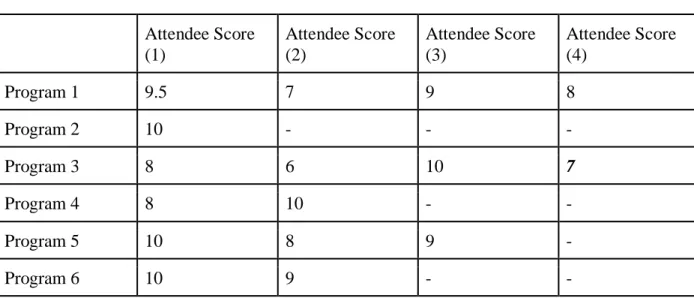
Table 3
Attendee Score (1)
Attendee Score (2)
Attendee Score (3)
Attendee Score (4)
Program 1 9.5 7 9 8
Program 2 10 - - -
Program 3 8 6 10 7
Program 4 8 10 - -
Program 5 10 8 9 -
Program 6 10 9 - -
Taking these scores and averaging them in the case of teen responses, the score for each program is compared in the graph below, entitled “Average Program Score” and labeled as Chart 1. In this chart, it is clearly observable that the scores given to the program by the teens, averaged, was in all cases higher than the score given to the
program by the librarians running it. This could be for a number of reasons including that the teens’ scores are taken from multiple participants and averaged whereas the librarian
Chart 1
VIII.
S
UCCESSM
EASURESLibrarian Success Measures
When asked how they determine if a program was successful, the most popular responses were observations that the staff members made of the teenage attendees. Every librarian interviewed cited comments the teens made during and about the program, the mood and behavior of teens during and after the program, or interactions they witnessed between the teen attendees. While oftentimes public library administration determines a program’s success by the number of attendees, the librarians chose measures that
examined the quality of the attendees’ experience rather than simply counting them. “Numbers don’t tell the story of the relationships that are formed or the comments that
success,” one librarian explained in their interview. Another librarian agreed in a similar statement, saying “I won’t even say that [interacting] is the most important measure, I’d say it’s the only measure”. Across the board, librarians were using qualitative measures
based on observation to determine success.
Attendance was also an important measure, but with some adjustments made. One librarian used a ratio to measure attendance success; “If there’s hardly any kids in the
library and I have six kids [in the program], it’s a good turnout, but if there’s forty kids out there and there’s five in here, that’s not a good turnout for me.” While five or six
attendees would look similar if only measured by who was in the room, when comparing that number to the total number of teenagers using the library at the time the appeal of the program to teens in the library is measured. Five teens attending a program might look poor on paper but if those five teens are the only teens in the library, the librarian has successfully hooked 100% of the demographic present. This does not take into account teens who do not use the library and do not attend programs, but that subject will be discussed in a later section. Another librarian used attendance numbers as a measure, but took that number and compared to the average number of teens in the program. If the average number of attendees was three and five teens attended, the program was deemed more successful than a program which averaged eleven teenagers and had only five at the particular session observed.