#>*•ͣͣͣ•ͣ ^ ^^'^^"fSS^^'^-'
ABSTRACT
The-Ping Chen. Preliminary Evaluation of Reaction Products from
Enzymatic Oxidation of Phenolic Pollutants (Under the direction of
DR. MICHAEL D. AITKEN)The enzymes horseradish peroxidase (HRP), chloroperoxidase
(CPO) and polyphenol oxidase (PPO) were studied for their ability
to oxidize the compounds o-cresol, p-cresol, 2-chlorophenol,
chlorophenol, nitrophenol and pentachlorophenol. Except for
4-nitrophenol, all the compounds could be completely or partially
degraded under the experimental conditions. Enzyme stability was
studied, including thermal, peroxide dependent and mechanism-based
(suicide) inactivation in the presence of phenolic substrates. HRP
did not exhibit significant mechanism-based inactivation, in
contrast to CPO and PPO. Different substrates also had different
influence on HRP, CPO and PPO stability. Reaction products from
phenolic pollutant oxidation were evaluated and compared using C^g
#
CONTENTS
Page
LIST OP FIGURES iii
LIST OF TABLES vl
ACKNOWLEDGEMENT vii
1. INTRODUCTION ... 1
Use of Enzymes in Water and Wastewater Treatment
Applications ... 2
Objectives and Scope of Research ... 6
2. BACKGROUND AND LITERATURE REVIEW ... 8
Enzymes ... 8
Radicals ... 9
Enzymes Used in this Research...12
Horseradish Peroxidase ... 12
Chloroperoxidase ... 16
Polyphenol Oxidase ... 22
Enzyme Inactivation... 24
HRP... 24
CPO... 26
PPO... 28
Previous Work on Pollutant Oxidation by HRP,
CPO and PPO...28Potential Characteristics of Reaction Products .... 30
3. EXPERIMENTAL METHODS ... 35
Enzymatic Reactions ... 3 5
Enzyme Preparations ... 36
Enzyme Assays ... 37
Reagents and Analytical Methods ... 38
Standard Solutions Preparation ... 38
Analytical Methods for Hydrogen Peroxide ... 38
C,3 Column HPLC Analysis... 39
Size-exclusion Analysis ... 40
UV/Visible Scanning ... 40
Reagents... 41
4. RESULTS OF PRELIMINARY EXPERIMENTS ... 42
Horseradish Peroxidase ... 42
Enzyme Inactivation... . 42
Influence of H^O^ Addition Rate on Removal
of o-Cresol...49Effect of H^O^ Addition Rate on the D^ijuamic Response
of the HRP/H^O^/o-Cresol System... 54
Chloroperoxidase...,... 56
Polyphenol Oxidase...,. ,... 64
Inactivation Studies ... ... 64
Effects of Enzyme Concentration and H^flrogen Peroxide
on PPO Activity... 68
Discussion... 72
5. REACTION PRODUCT CHARACTERIZATION ... 77
Characteristics of Products Obtained Under Standard Conditions... 79
o-Cresol... 79
p-Cresol... 85
2-Chlorophenol ... 89
4-Chlorophenol ... 99
Pentachlorophenol (PCP) ... 104
4-Nitrophenol ... 104
Products Obtained from Combinations of Enzymes .... 104
Other Experiments... 113
Discussion... 116
6. CONCLUSIONS AND RECOMMENDATIONS . . . ... . . 120
Engineering Implications of this Research ... 121
Recommendations ... 123
7. REFERENCES... 125
LIST OF FXGX7RES
Figure Page
2.1 Structure of Ferriprotoporphyrin IX or Hemin ... 13
2.2 Proposed Reaction Mechanism for
Chloroperoxidase-Catalyzed Reactions...»...21
2.3 Mechanism Proposed for Inactivation of HRP by
Molecular Oxygen...27
2.4 Reaction Products from HRP Peroxidation of p-Cresol . 32
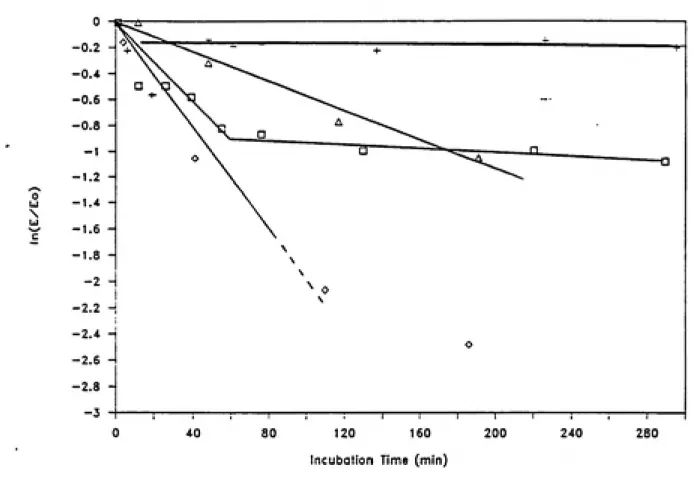
4.1 Inactivation of HRP as a Function of pH in the Presence
or Absence of Hydrogen Peroxide...43
4.2 Effect of Reductant Substrate (o-Cresol) on Peroxide
Dependent Inactivation of HRP... 46
4.3 At pH 4, The Effect of Other Reductant Substrates on
Reaction Activity of HRP...47
4.4 At pH 7, The Effect of Other Reductant Substrates on
Reaction Activity of HRP...48
4.5 Time Course of Residue Enzyme Activity During Oxidation
of o-Cresol by HRP Under Different Reaction
Conditions... . 52
4.6 Time Course of o-Cresol Removal by HRP Under Different
Reaction Conditions...55
4.7 Time Course of Hydrogen Peroxide Concentration During
Oxidation o-Cresol by HRP Under Different Reaction
Conditions... 57
4.8 Inactivation of CPO as a Function of pH in the Presence
or Absence of Chloride Ion...58
4.9 Effect of Hydrogen Peroxide and pH on Inactivation of
CPO in the Presence of Chloride Ion (20 mM)...59
4.10 Inactivation of PPO as a Function of pH...65
4.11 Effect of Reductant Substrate on Reaction Activity of
PPO at pH 4.5...66
4.12 Effect of Reductant Substrate on Reaction Activity of
PPO at pH 7...67
4.13 Effect of pH and Stirring on Inactivation of PPO During
Figure Page
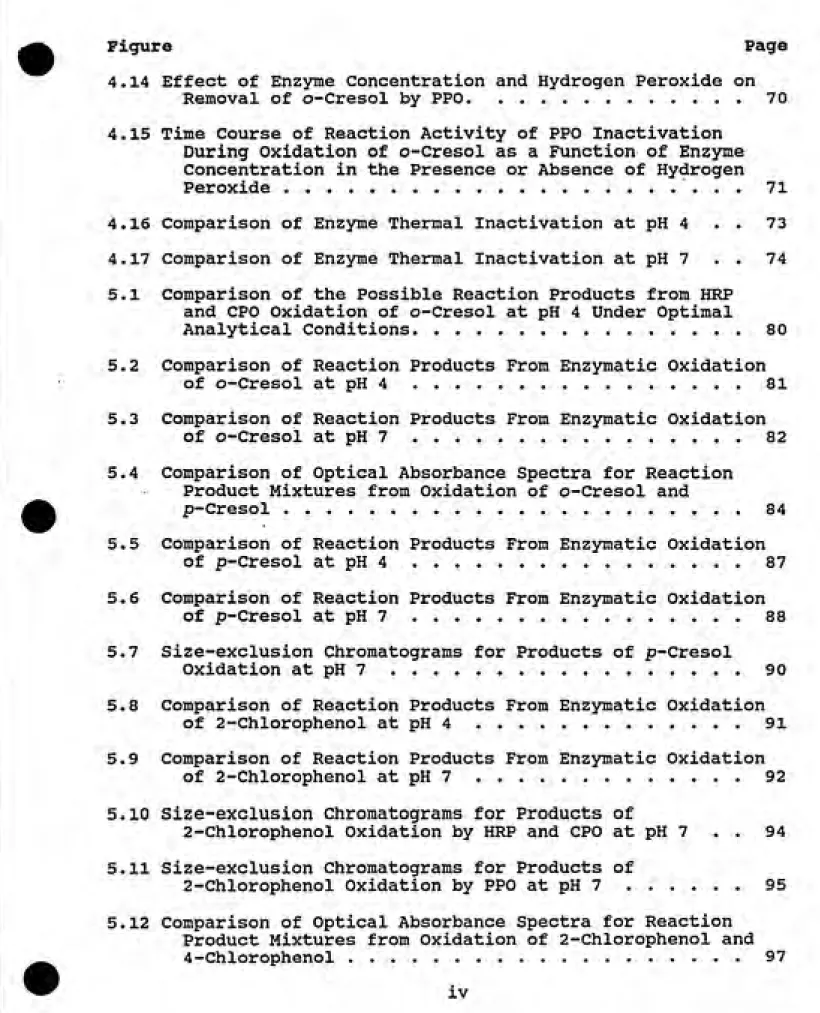
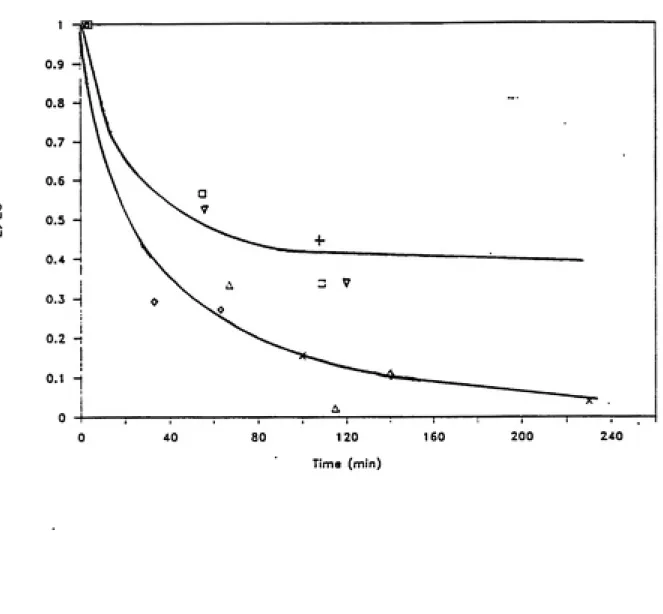
4.14 Effect of Enzyme Concentration and Hydrogen Peroxide on
Removal of o-Cresol by PPO...70
4.15 Time Course of Reaction Activity of PPO Inactivation
During Oxidation of o-Cresol as a Function of Enzyme
Concentration in the Presence or Absence of Hydrogen Peroxide...71
4.16 Comparison of Enzyme Thermal Inactivation at pH 4 . . 73
4.17 Comparison of Enzyme Thermal Inactivation at pH 7 . . 74 5.1 Comparison of the Possible Reaction Products from HRP
and CPO Oxidation of o-Cresol at pH 4 Under Optimal
Analytical Conditions...80 5.2 Comparison of Reaction Products From Enzymatic Oxidation
of o-Cresol at pH 4...81
5.3 Comparison of Reaction Products From Enzymatic Oxidation of o-Cresol at pH 7...82
5.4 Comparison of Optical Absorbance Spectra for Reaction
Product Mixtures from Oxidation of o-Cresol and
p-Cresol...84
5.5 Comparison of Reaction Products From Enzymatic Oxidation of p-Cresol at pH 4...87 5.6 Comparison of Reaction Products From Enzymatic Oxidation
of p-Cresol at pH 7...88
5.7 Size-exclusion Chromatograms for Products of p-Cresol
Oxidation at pH 7...90 5.8 Comparison of Reaction Products From Enzymatic Oxidation
of 2-Chlorophenol at pH 4...91
5.9 Comparison of Reaction Products From Enzymatic Oxidation of 2-Chlorophenol at pH 7...92 5.10 Size-exclusion Chromatograms for Products of
2-Chlorophenol Oxidation by HRP and CPO at pH 7 . . 94
5.11 Size-exclusion Chromatograms for Products of
2-Chlorophenol Oxidation by PPO at pH 7...95
5.12 Comparison of Optical Absorbance Spectra for Reaction
Figure Page
5.13 Comparison of Reaction Products From Enzymatic Oxidation
of 4-Chlorophenol at pH 4...100
5.14 Comparison of Reaction Products From Enzymatic Oxidation
of 4-CHlorophenol at pH 7...101
5.15 Size-exclusion Chromatograms for Products of
4-Chlorophenol at pH 7...102
5.16 Comparison of Reaction Products From Enzymatic Oxidation
of Pentachlorophenol at pH 4...105
5.17 Comparison of Reaction Products From Enzymatic Oxidation
of Pentachlorophenol at pH 7...106
5.18 Reaction Products from Combinations of HRP and PPO Acting
.on o-Cresol at pH 7...108
5.19 Reaction Products from Combinations of CPO and PPO Acting
on o-Cresol at pH 7...109
5.20 Reaction Products from Combinations of HRP and CPO Acting
on o-Cresol at pH 7... 110
5.21 Reaction Products from Combinations of HRP and PPO Acting
on 2-Chlorophenol at pH 7...Ill
5.22 Effect of pH on Product Distribution From Oxidation of o-Cresol...114
5.23 Reaction Product Distribution with Time Course for PPO
Oxidation of o-Cresol (without HjOj)...115
' ^^^gf«B?eigf*
lilST OF TABIiES
Table Page
1.1 Phenolic Pollutants Regulated as Hazardous Constituents
Under RCRA or in Wastewater Discharges...3
2.1 Types of Free Radical Reactions...^ .... 11
2.2 Optimal pH for Oxidation of Phenols in HRP/HjOj
System...17
4.1 Estimated Rate Coefficients for Inactivation of HRP
as a Function of pH and Hydrogen Peroxide
Concentration ... 44
4.2 Effect of Peroxide Addition Rate on HRP Inactivation,
Extent of o-Cresol Removal and Peroxide Consumption Stoichiometry at pH 4...50
4.3 Effect of Total Peroxide Added and Peroxide Addition
Rate on Stoichiometry of Peroxide Consumed per
o-Cresol Removed by HRP at pH 4...53
4.4 Initial Rate of Hydrogen Peroxide Consumption During
o-Cresol Oxidation Under Batch and Semi-batch
Reaction Conditions... 60
4.5 Estimated Rate Coefficients for Inactivation of CPO
as a Function of pH, Hydrogen Peroxide Concentration
and Chloride Concentration ...60
4.6 Residual Activity of Chloroperoxidase During
Oxidation of p-Cresol and 2-Chlorophenol
at pH 4 and 7...61
4.7 Residual Activity of Chloroperoxidase During
Phenol Oxidation at pH 4...63
4.8 Residual Activity of Chloroperoxidase During
Phenol Oxidation at pH7...63
5.1 Visible Characteristics of o-Cresol Reaction
Products as a Function of Time...86
5.2 Visible Characteristics of 2-Chlorophenol
Reaction Products as a Function of Time...98
5.3 Visible Characteristics of 4-Chlorophenol
ACKNOWLEDGEMENT
I am deeply indebted to Dr. Michael D. Aitken for his patience, encouragement and guidance through this effort. Especially his enormous helps of completing this report. I also would like to thank my committee Dr. Louis M. Ball and Dr. Philip C. Singer for their valuable suggestions. A special thanks is also extended to James A. Jersey and Richard M. Lelachear, for their technical guiding on analytical work and personal encouragement. Finally, I would like to thank my fellow students and the staff at
UNC Department of Environmental Science and Engineering for their
^Off^'^j'-^fiV'T^jf''- • - - C'-^'^F^SSK--'^
1. INTRODUCTION
The public debate over the environment has changed dramatically
recently, particularly in the focus on treatment and disposal of
hazardous waste. In 1985, nearly 3,000 treatment, storage and
disposal (TSD) facilities were regulated under the Resource
Conservation and Recovery Act (RCRA) in the United States (Wentz,
1989). These facilities managed a total of 247 million tons of
hazardous waste. An additional 322 million tons of hazardous waste
was handled by units exempt from RCRA reporting requirements.
Federal and state governments as well as private industries have
spent tremendous amounts of money on controlling and cleaning up
hazardous waste. The annual cost for complying with RCRA plus
Superfund cleanup is estimated to be in the range of $10 to $20
billion (7th National RCRA bulletin, 1990). In the future, the
cleanup of only 45 Department of Energy (DOE) facilities may cost
$92 billion over the next 21 years (Porter, 1989) . The vast
majority of hazardous waste (by weight) is aqueous (Chemical
Manufacturers Association and Engineering-Science, Inc., 1986).
Together with contaminated groundwater and industrial wastewater,
the volume of aqueous mixtures requiring treatment to remove
hazardous pollutants is enormous.Phenolic compounds are among the potentially toxic pollutants
found in hazardous waste and in contaminated groundwater. In
addition, a number of phenolic chemicals are targeted in
regulations governing wastewater discharges. For example, among
the list of organic "Priority Pollutants" used in regulating
wastewater discharges under the National Pollutant Discharge
Elimination System (NPDES) , 11 of a total of 129 are phenols
(Patterson, 1985). Phenolic compounds also are identified in the
recently promulgated Organic Chemicals, Plastics and Synthetic
Fibers (OCPSF) Category Effluent Limitations Guidelines,
Pretreatment Standards, and New Source Performance Standards (40
CFR Part 414) (Federal Register, 1987). Major sources of phenolic
refineries, petrochemical production, coal mining and textile mills
(Patterson, 1985)• Specific phenols regulated as priority
pollutants, in the OCPSF regulations and in RCRA are listed in
Table 1.1.
A number of technologies are available for removing phenolic
contaminants from aqueous mixtures (Patterson, 1985). Solvent
extraction is an attractive method for highly concentrated waste. Thermal treatment (incineration, wet air oxidation) and carbon
adsorption have also been used. Solvent extraction has limitations
associated with solvent loss and recontamination, and questionable
market value of the recycled compounds. Thermal methods are
costly, and therefore are applied only in special situations. Carbon adsorption is a good tool to remove phenolic compounds, but fast breakthrough is a common problem when concentrated wastes are applied.
Biological degradation, chemical oxidation (such as ozonation or the Fenton reaction) and carbon adsorption are very popular in handling wastewaters with lower concentrations of phenolic
pollutants (Patterson, 1985). However, chemical oxidation becomes
more expensive as the concentration of the waste stream increases, and is particularly inefficient when the target compound(s) form only a small fraction of the waste. Carbon adsorption suffers from similar disadvantages. Biological treatment is typically the least costly way of treating industrial wastewaters, but it too has limitations. In particular, it is difficult to control biological systems to provide consistent removal of target chemicals to low residual levels. Also, biological processes require a certain level of operator sophistication to perform adequately.
Use of Enzymes in Water and Wastewater Treatment Applications
The use of isolated enzymes has been proposed as a new means of
Table 1.1
Phenolic Pollutants Regulated as Hazardous Constituents
Under RCRA or in Wastewater Discharges
Compound
Regulatory Program(s)^
2-sec-butyl-4,6-dinitrophenol chlorophenols 4-chloro-m-cresol 2-chlorophenol o-cresol m-cresol p-cresol 2-cyclohexyl-4,6-dinitrophenol 2,4-dichlorophenol 2,6-dichlorophenol 2,4-dimethylphenol 4,6-dinitro-o-cresol 2,4-dinitrophenol 2-nitrophenol 4-nitrophenol 2,4-dinitrophenol 4,6-dinitro-o-cresol pentachlorophenol phenol 2,3,4,6-tetrachlorophenol 2,4,5-trichlorophenol 2,4,6-trichlorophenol RCRA RCRA RCRA
OCPSF, RCRA, PP
RCRA RCRA RCRA RCRA
OCPSF, RCRA, PP
RCRA
OCPSF, RCRA, PP
RCRA RCRA, PP OCPSF, PP OCPSF, RCRA OCPSF OCPSF RCRA, PP
OCPSF, RCRA, PP
RCRA RCRA
RCRA, PP
PP = priority pollutants; other abbreviations as defined in the
treating contaminated groundwater or industrial wastewater.
Removal of specific chemicals would be more predictable and more
easily engineered with isolated enzymes than with a conventional
mass culture biological system. The equipment envisioned for an
enzymatic treatment process would resemble that required for a
typical chemical treatment process. However, an enzymatic process
would be more efficient and economical (in terms of chemical consumption) than conventional chemical processes.
The major advantages of enzymes are their specificity and their
high stoichiometric efficiency in catalyzing chemical reactions.
Based on these inherent advantages, the following situations might
be suited to applying isolated enzymes in wastewater treatment
(Aitken, 1988):
(i) Pretreatment of wastewater to remove certain target
compounds selectively. This could make the wastewater non-toxic
or non-inhibitory to a subsequent biological treatment system, or
could exempt subsequent treatment units from hazardous waste
regulation. Selective removal of target compounds also could be
used to meet industrial wastewater pretreatment standards before
discharge to a Public Owned Treatment Works (POTW).
(ii) Treatment of dilute wastewater or contaminated
groundwater, for which mass culture biological treatment might not
be feasible.(iii) Effluent polishing to meet discharge standards for specific chemicals or for whole-effluent toxicity.
(iv) Treatment of wastes produced intermittently or in isolated
situations (such as remote contaminated sites), where on-line
biological treatment may not be feasible.
(v) In-plant treatment of concentrated waste streams to remove
potentially toxic compounds before they are mixed with other
wastewaters.
There also are some potential disadvantages associated with
applying enzymes in wastewater treatment:
(i) If enzyme specificity is too strict, the enzyme
range of pollutants of interest that it could transform).
(ii) Many enzymes of interest still are not commercially
available, so that initial costs may be very expensive.
(iii) A given enzyme typically only catalyzes one step in an
overall reaction pathway, and cannot destroy the target compound
completely to carbon dioxide and water. Reaction products may not
be less objectionable than the parent compound in some cases.
(iv) There are many factors which will have an influence on
enzyme performance in the wastewater treatment environment, which are rarely known in advance in most situations.
Most of these disadvantages can be addressed through applied research and development of enzymatic treatment processes.
While most enzymes have very narrow specificity for their naturally occurring substrate(s), several classes of enzymes have the capability to catalyze the transformation of a wide range of related compounds. The enzymes with relatively broad specificity may be useful in wastewater treatment because there is a potential to apply them in removing certain groups of xenobiotic chemicals, for which highly specific enzymes have not evolved in nature
(Aitken et al., 1989). Peroxidases and other oxidases such as
laccase and polyphenol oxidase are examples of non-specific enzymes. Several enzymes in these classes from microbial and plant
sources have been shown to catalyze the oxidation of phenolic
pollutants in vitro. These enzymes and the range of phenolic
pollutants reported to be oxidized by them are summarized in Appendix A. Appendix A also identifies reaction products or
product characteristics reported in each reference. More details
on phenolic pollutant oxidation by these enzymes are discussed in
Chapter 2.
In most previous research on enzymatic removal of phenolic
pollutants, the investigators reported success on the level of removing the target compounds only. As shown in Appendix A, the reaction products are only very crudely characterized or not characterized at all. Most commonly, observations of color change
possible, and also critical, to arrange the reaction conditions to achieve virtually complete removal of target compounds, it is clear that the products of enzymatic reaction must be characterized before feasibility of enzyme treatment processes can be fully established (Aitken et al., 1989). Ultimately, the products should be more biodegradable, less toxic, or otherwise more amenable to subsequent treatment than the parent compound.
Objectives and Scope of Research
Enzymes are defined and named according to the reaction(s) they catalyze, and not by their source or other characteristics. However, individual enzymes from different organisms may have different reaction mechanisms, even though they catalyze the same reaction. This is especially true for peroxidases, which are enzymes that catalyze the oxidation of organic substrates by hydrogen peroxide. Differences in reaction mechanisms among the peroxidases and other phenol oxidizing enzymes are discussed in Chapter 2. The purpose of this research project was to evaluate
whether such differences would result in different reaction
products, or product distributions, for oxidation of phenols by different enzymes. Most of the phenol oxidizing enzymes produce reactive intermediates, such as phenoxy radicals, that form stable final products in post-enzymatic reactions. For this reason, the influence of reaction conditions on final reaction products was also addressed. As an example of such effects, the type of reaction product formed from the oxidation of aromatic substrates
by horseradish peroxidase varies significantly as the starting
concentration of the substrates changes (Fiessinger et al, 1984; Potter et al, 1985). The reaction pH also could influence the
distribution of reaction products by affecting rates of elementary
reactions leading to the final products.
This research project was the first part of a broader effort to
characterize products from enzymatic oxidation of phenolic
chemical structure, biodegrability, amenability to other subsequent forms of treatment, and toxicity. With this information it will be possible to evaluate whether reaction products are of further concern, and to develop guidelines for maximizing the formation of less toxic or more easily removed products in. practice. For example, some enzymatic reactions lead to precipitation of the phenolic compounds. With a better understanding of conditions that lead to precipitation, it might be possible to control reaction conditions to increase or decrease precipitate formation as
desired.
The specific objectives of this project were: preliminary chemical characterization of reaction products; comparison of products from different phenol oxidizing enzymes believed to have different reaction mechanisms; evaluation of the effect of reaction pH on reaction product distribution; and preliminary kinetic evaluation 'of each enzyme to understand its behavior under different reaction conditions. The enzymes selected for study were horseradish peroxidase (HRP), chloroperoxiadase (CPO) from the fungus Caldariomyces fumago and polyphenol oxidase (PPO) from mushroom Agaricus bisporus. As shown in Appendix A, all of these enzymes have been observed to oxidize phenolic compounds, and all of them are commercially available (in laboratory quantities) . The
target compounds selected for study were o-cresol (2-methylphenol),
p-cresol (4-methylphenol) , 2-chlorophenol, 4-chlorophenol,
4-nitrophenol, and pentachlorophenol. Experimental results include preliminary kinetic evaluations of each enzyme and qualitative HPLC characterization of products. HPLC work primarily consisted of
C^g reversed phase chromatography, although some preliminary work
with a size-exclusion column also is presented. The HPLC results
from the C^g column provide qualitative information on the number
of observable products from each combination of enzyme/target
compound/reaction pH, and on the relative hydrophobicity of
products. Also, selected results of uv/vis scanning and visual
2. BACKGROUND AND LITERATURE REVIEW
Relatively little work has been done to date on the use of
enzymes in waste treatment applications. It is appropriate,
therefore, to provide background information on properties of enzymes that are relevant to such applications. Some information on the catalytic mechanisms of the three enzymes used in this project is also provided, to illustrate unique features of each enzyme. Possible characteristics of reaction products from enzymatic oxidation of phenols are reviewed as well.
Enzymes
Enzymes are proteins (with a few exceptions) that catalyze
chemical reactions in biological systems. Enzymes are highly
specific for their substrate(s) and have great catalytic power. They accelerate reactions by providing a new reaction pathway in which the transition state (the highest energy species) has a lower free energy and hence is more accessible than in the uncatalyzed reaction. The specificity of enzyme-substrate interactions arises
mainly from hydrogen bonding, which often is stereospecific, and
the three-dimensional shape of the active site, which rejects molecules that do not have a sufficiently complementary shape.
Enzymes can also be inhibited by chemical species that are not
substrates. A competitive inhibitor prevents the substrate(s) from binding to the active site, and a non-competitive inhibitor decreases the turnover number (number of substrate molecules
converted to product per unit time at a single catalytic site when
the enzyme is fully saturated with substrate). (Stryer, 1988) A variety of factors influence the rates and extents of enzyme
catalyzed reactions. One of the most important factors is reaction
pH. For example, acid-base characteristics of substrates can
result in pH-dependent variation in such properties as binding to
objectives of this project, pH could also affect the properties of
the products resulting from enzymatic reaction.
The properties of enzymes also change as a function of pH.
Probably the most significant effect of pH on enzymes is on the
extent of protonation of ionizable amino acid residues. Ionization
of active site residues involved in catalytic steps is responsible
for most of the variability in enzyme activity as a function of pH.
Amino acid residues outside the active site are also subject to
pH-dependent ionization. Thus, pH changes can affect the solubility of an enzyme, or change its three-dimensional conformation to a
point where the enzyme becomes inactive; sometimes the pH-dependent
inactivation is irreversible. Other effects of pH on enzyme
activity could include variation in redox potentials for active
site functional groups in enzymes catalyzing redox reactions.
(Aitken, 1988; Dixon and Webb, 1979)
Enzymes are normally quantified according to catalytic activity with respect to a standard substrate. Rather than providing enzyme concentrations in molar or mass units, enzyme quantities typically
are measured in catalytic units; one unit is often defined as that
amount of enzyme reiquired to convert one micromole of substrate or
form one micromole of product (whichever is most easily measured) per minute. While there has been some effort to standardize the
substrate used in defining activity for an individual enzyme, it
is often difficult to compare different enzymes, even if the range
of substrates they can act on overlap. In this project, each of the three enzymes used has a unique substrate and assay conditions for quantifying enzyme amounts. Mass concentrations of enzyme are provided in this report where possible. One of the enzymes was purchased as a solution, with the enzyme quantity specified in units; an approximate conversion to mass units is given in Chapter
3, Experimental Methods.
Radicals
project because the oxidation of phenols by at least two of the three enzymes studied proceeds through radical mechanisms. A radical is a molecular species containing one or more unpaired electrons. A common way that radicals are generated is hemolytic cleavage of a chemical bond through thermolysis,, photolysis or radiolysis. Radicals also can be produced by one-electron transfer (from transition metals, from other radicals, or from the surface
of an electrode). Radicals are normally highly reactive species,
and can react with molecules (radical transfer reactions), with transition metals, or with other radicals. Different types of radical reactions are summarized in Table 2.1. In general, radical transfer reactions always are in competition with radical-radical interactions. When reactivity of a radical with a compound is low, alternative radical-radical reactions will predominate. Reactions of radicals with transition metals or other radicals typically results in the formation of relatively stable (less reactive) products. Because radical-radical reaction rates depend on the square of the radical concentration, such reactions become increasingly favored over reactions of radicals with non-radical species as the rate of radical formation increases.
Phenoxy radicals are formed as a result of one-electron oxidation of phenols, and are relatively stable in a thermodynamic sense (that is, they participate less readily in radical transfer reactions than other radicals do; Nonhebel et al., 1978). Stability of phenoxy radicals is due to the resonant character of the radical, in which the unpaired electron is delocalized:
Table 2.1
Types of Free Radical Reactions (from Aitken, 1988)
Reaction and Schematic
Representation Examples
(i). combination(coupling):
X- + Y- -ͨ X-Y
(ii). disproportionation:
X- + Y-Z-W -^ XY + Z=W
(iii). addition:
X' + Y=Z -^
X-Y-Z-(iv). fragmentation:
Y-Z- -^ Y- + Z
(v). radical transfers:
X- + Y-Z -^ X-Y +
Z- + Z-
CHj-E0{ + HOg"
C2H6
H2O2 + O2
•CHjOH + O2 -ͨ -O-O-CHjOH •O-O-CHjOH -* CHjO +
HOj-- oxidizing radical:
•OH + HCO, H2O + COj'
- reducing radical:
CO2" + Oj -» CO2 + ©2*
(vi). reaction with transition metal:
- oxidation of metal:
X- + M"* + H* ^ XH + M^"*^^*
- reduction of metal:
X"- + M^ ^ X'^W M<"-'''*
H02-+ Cu* + H* -* HjOg + CUg*
O2" + Cu^* -" '^2 + Cu*
The letter X is used to represent a parent radical. Y, Z and W represent atoms or functional groups. In reactions (v), if Y is a functional group rather than an atom, the reaction is referred to
as a substitution. Names of radicals given in examples are: (i) .
methyl radical; (ii). hydroperoxyl radical; (iii)• methanol radical, methanol peroxy radical; (v) . hydroxy1 radical, formate
The result of radical-radical interaction among phenoxy radicals
is the linkage of two aromatic rings by carbon or by
carbon-oxygen bonds. Consequently, radical coupling can lead to a variety of biphenyls and diphenyl ethers. The actual number and relative distribution of these products will depend on steric factors, which may inhibit certain radical-radical reactions, and on ring substituents, which can block a ring carbon from becoming a radical
center (Ortiz de Montellano and Grab, 1987; Valoti et al., 1989).
Other possible products formed from the reactions of phenoxy
radicals are discussed below.
Enzymes Used in this Research
Horseradish Peroxidase [EC 1.11.1.7]^ Peroxidases are enzymes
that catalyze the oxidation of a variety of organic and inorganic
compounds by hydrogen peroxide or other peroxides. All known
peroxidases from plants contain the prosthetic group hemin or ferriprotoporphyrin IX at the active, site (Figure 2.1). The molecular weight of HRP is 40,500, with 18.4% by weight carbohydrate content (Dunford and Stillman, 1976). HRP has been an active subject of biochemical research for over 50 years, and the complete amino acid sequence of HRP is now known (Dunford and
Adeniran, 1986).
Oxidation reactions catalyzed by HRP proceed by oxidation of the enzyme active site, which then oxidizes the substrate. The reaction mechanism of HRP is normally illustrated by the following cycle (Dunford and Stillman, 1976):
HRP + H2O2 ->
ͣ
Compound I (HRP-I) + Ep (2.1)
HRP-I + AH2 -* Compound II (HRP-II) + "AH (2.2)
HRP-II + AHj ^ HRP + -AH +H2O (2.3)
^ The designation "[EC...]" following each enzyme name refers
CH = CH, C"J
CH=CH
HOOCCHjCH, CHjCHjCOOH
Figure 2.1. Ferriprotoporphyrin IX or Hemin, Also Called
Protoferriheme
In this mechanism, HRP refers to the native enzyme (whose
oxidation state can be expressed as P-Fe(III)*, where P represents
protoporphyrin), and Compounds I and II represent oxidized intermediates. Compound I (or HRP-I) is oxidized by two electrons relative to the native enzyme, and is represented as an oxyferryl
protoporphyrin cation radical (("P*)-Fe(IV)-O, where 'P* is the
cation radical of protoporphyrin; note one of the oxygen atoms from peroxide remains bound to the active site iron). Compound I can be reduced by one electron to form Compound II, in which the added electron returns to the porphyrin while the iron remains in the
Fe(IV) state (P-Fe(IV)-OH*) . Compound II in turn can be reduced
by one electron back to the native enzyme. In subsequent
discussion, the electron donating substrate is referred to as
"reductant substrate" or simply as "substrate." (Dunford and
Stillman, 1976; Aitken, 1988)
The rate controlling step in this HRP reaction mechanism is the conversion of HRP-II to the native enzyme (eq. 2.3) (Dunford and Stillman, 1976; Sakurada et al., 1990). By operating with a small
molar fraction of HjOg and a large fraction of substrate, it is
possible to make HRP-I formation (eq. 1) a rate controlling step. Because HRP-I reacts with the same substrates as HRP-II, it is nearly impossible to make HRP-I reduction (eq. 2.2) a rate controlling step. The spontaneous decay of HRP-I is always greater than that of HRP-II if there is no endogenous electron donor
(Dunford and Stillman, 1976).
Normally, as indicated above, HRP-I will undergo two one-electron reduction steps to revert to the native enzyme. Some substrates, including iodide and hydrogen sulfite anions (Dunford and Stillman, 197 6), reduce HRP-I directly to the native enzyme. For iodide, the cycle would be:
HRP + HjOj -^ HRP-I + HjO (2.4)
HRP-I + I' ^ HRP + I* (or 10') (2.5)
Substrates which reduce HRP-II to the native enzyme fall into
the easily oxidized category and the reaction is influenced by a
group in the enzyme with pK^ value of 8.6. Only the acid form of
this group is reactive as shown by studies carried out up to pH 11 (Dunford and Stillman, 1976; Dunford and Adeniran, 1986) . Dunford and Adeniran (1986) reported that o-substituted phenols are more reactive than jn- and p-substituted phenols. The relative reactivity of o-substituted phenols was explained in terms of steric hindrance, which is minimal for a single o-substituent.
Other general descriptions of substitutent effects can be found in
Kersten et al. (1990), Sakurada et al. (1990) and Bordwell and Cheng (1991) . Iodide ion is difficult to oxidize by HRP, and
involves an acid group on the enzyme with pK^ about 0. The
intermediate category of substrates, including ferrocyanide and p-aminobenzoic acid, follows a combined mechanism compared to the
other two. The catalytic effect of the group with pKg 8.6 is
dominant in neutral and alkaline solution but is superseded by theeffect of the acid group of pK^ near zero in acid solutions.
Another oxidized form of HRP is referred to as Compound III, which is oxidized by three electrons relative to native enzyme.
The possible pathways leading to HRP-III are: (a) HgOj reacts with
HRP-II; (b) addition of superoxide anion to native enzyme; and (c) reduction of the heme ferric iron to ferrous iron (ferroperoxidase) followed by oxygen addition. Compound III contains two oxygen atoms, but it is still not clear whether it represents an Fe(II)-superoxide complex or an Fe(III)-dioxygen complex (e.g.,
P-Fe(II)-02 or P-Fe (III)*-02') . When HRP is incubated with excess
hydrogen peroxide in the absence of reductant substrates, spontaneous formation of Compound II will ultimately lead to formation of Compound III as the predominant form of the enzyme. In general the reactions of HRP-III are much slower than those of HRP-I and HRP-II. (Dunford and Stillman, 1976; Hewson and Dunford,
1976; Arnao et al., 1990a and 1990b; Ma and Rokita, 1988).
It is widely reported and accepted that HRP is only effective within a certain pH range, normally 4 to 9, with optimum pH around
1981). However, application of the HRP/HjOj system for removing
color from bleach plant effluent resulted in a narrow range of
effective pH, with an optimum around 5 (Paice and Jurasek, 1983). Below pH 4, HRP has been shown to be readily inactivated (Claus and Filip, 1990). However, the oxidation of methoxybenzenes by HRP has been reported to have an optimum around pH 3 (Kersten et al., 1990) . It also has been reported that there are different pH optima for HRP catalyzed oxidation of different substrates (Klibanov and Alberti, 1980), as shown in Table 2.2. Some investigators have even shown that there are two optimum peaks (pH 6 and pH 7.5) for certain reactions (Danner et al., 1973). These differences in pH range and optima reflect the complexity of enzymatic catalysis and the factors involved, such as differences among substrates and reaction conditions, as well as potential differences in enzyme concentration and purity.
Chloroperoxidase [EC 1.11.1.10]. CPO is a heme glycoenzyme produced by the fungus Caldariomyces fumago. It has a molecular weight of approximately 42,000, about 25% carbohydrate, with predominantly acidic amino residues and an isoelectric pH (pi) in
the range of 3.2 to 4.0 (Thomas et al., 1970a). The structural
gene of CPO has recently been isolated, cloned, and sequenced (Kadima and Pickard, 1990a).
Like HRP, chloroperoxidase catalyzes the peroxide dependent oxidation of a variety of inorganic and organic substrates. CPO catalyzes typical peroxidatic reactions in two successive one-electron steps. A variety of phenols, including monomethylphenols, dimethylphenols and monochlorophenols have been shown to be
degradable by CPO; chlorophenols were reported to be most easily
oxidized by CPO, followed by monomethyl- then dimethylphenols
(Carmichael et al. , 1985). This is contrary to expectations, since
chloro-substitution should result in higher oxidation potentials than methyl substitution (Bordwell and Cheng, 1991).
CPO has some other unique characteristics. First, CPO has the
Table 2.2
Optimal pH for Oxidation of Phenols in HRP/HjOj
System (from Klibanov et al., 1980)
Phenol Optimal pH^
Phenol 3.5
Guaiacol 5.5
jn-Methoxyphenol 5.5
p-Methoxyphenol 7.0
o-Cresol 4.0
;n-Cresol 4.0
p-Cresol 5.5
o-Chlorophenol 7.0
m-Chlorophenol 7.0
p-Chlorophenol 5.5
o-Aminophenol 3.5 m-Aminophenol • 5.5
Resorcinol 3.5
5-Methylresorcinol 3.5
2,3-Dimethylphenol 4.0
2,6-Dimethylphenol 5.5
^H at which the maximum extent of target
ͣ
"ͣ'¥^^?^^''>^'?^*''!?^ps
peroxidases cannot do. The ability to oxidize chloride allows CPO to catalyze halogenation reactions when certain organic substrates
are present in the CPO/HgOj/Cl' system. In the chlorination of
anisole, the product distribution corresponds to attack by an
electrophilic reagent (CI*?) when the reaction is catalyzed by CPO.
Such product distribution is in contrast to a free radical mechanism when sulfuryl chloride, benzoyl peroxide and light are used to generate chlorine atoms. Thus halogenation reactions seem to involve the direct conversion of CPO Compound I back to the native enzyme with the acceptance of two electrons from the chloride ion. (Dunford and Stillman, 1976; Thomas et al., 1970b)CPO also has the ability to catalyze reactions formerly thought to be unique to the heme-containing enzyme catalase, although catalase is more efficient in catalyzing these reactions (the normal function of catalase is disproportionation of hydrogen peroxide) (Dunford and Stillman, 1976; Thomas et al., 1970a and 1970b; Libby et al. , 1989). For example, ethyl alcohol is oxidized to acetaldehyde by CPO as well as by catalase. Similarly the
catalatic reaction lYi^O^ -* 2H2O + Og is catalyzed by CPO (Dunford
and Stillman, 1976). Both of these reactions are further examples of CPO's ability to catalyze two-electron oxidations. In addition, CPO can catalyze the evolution of oxygen from ethyl hydrogen peroxide and m-chloroperbenzoic acid, a reaction not catalyzed by either catalase or HRP. By analogy with organic mechanisms for the decomposition of peracids, these results indicate that Compound I may contain a reactive oxygen atom (Thomas et al., 1970a). Further evidence for accessibility of the oxygen atom in Compound I is provided by the fact that CPO can catalyze certain oxygen transfer reactions, which HRP cannot do (Ortiz de Montellano and Grab, 1987; Ortiz de Montellano et al., 1987).
CPO has optical spectra quite different from HRP; for example, when CPO is reduced to the ferrous state it has properties very similar to the monooxygenase enzyme cytochrome P-450. Like
cytochrome P-450, CPO has an absorbance peak at 450 nm for its
m
#
found for most ferrous heme protein-CO complexes (Dunford and Stillman, 1976). The oxygen transfer reactions referred to above
are also analogous to those catalyzed by cytochrome P-450.
Even though CPO catalyzes the direct oxidation of typical peroxidase substrates such as guaiacol, pyrogallol, and leucommalachite green, other reactions can take place in the
presence of chloride ion. Libby et al. (1989) recently proposed
a detailed mechanism on the function of CI', in which CI' competes with catechol for binding to CPO Compound-I. Catechol binding
initiates a CI'-independent path, in which Compound I acts as the
oxidizing agent for catechol. When CI' binds to Compound-I, it
reacts to yield the oxidized chlorine intermediate which can in
turn oxidize catechol in the Cl'-dependent path. The catalytic
efficiency of catechol oxidation appears to be greater in the
chloride-dependent pathway. If chloride concentration is too high
(> 100 mM), however, chloride acts as a competitive inhibitor of hydrogen peroxide (Libby et al., 1989).
Some organic substrates are susceptible to chlorine addition
via the oxidized chlorine intermediate. Halogenation reactions
and halogen-dependent reactions catalyzed by CPO-I have a marked pH dependence, being faster in acid solutions (Dunford and
Stillman, 1976). A model for the halogenation reactions has been
proposed as (Thomas et al., 1970b; Libby et al., 1989):
AH + X' + HjOj + H* -
ͨ
AX + 2H2O (2.6)
The pH optima for reactions of chloroperoxidase involving
halogen anions (halogenation reactions or halogen-dependent
oxidations) are below 4. For the reaction involving chlorination
of monochlorodimedone, the pH optimum actually changes as the
chloride concentration changes (Thomas et al., 1970b). Iodide
oxidation rate is a complex function of pH, with two apparent peaks
at pH 3 and pH 5 (Thomas et al., 1970a). However, the kinetics of iodine formation are different in these two pH regions. At pH 5, there is a time lag preceding the maximal rate of iodine formation, while at pH 3 the rate of iodine formation is linear (Thomas et al., 1970a). The pH optima for oxidation of typical peroxidase
#
substrates extend over a broad range from pH 4 to 7, depending on
the particular substrate (Thomas et al., 1970a). Carmichael et al. (1985) demonstrated that a variety of phenols were oxidized by CPO over a pH range from 3.5 to 5.5. Kadima and Pickard (1990a) reported that there are pH optima at both 2.7 and 5.5 for oxidation of N,N,N',N'-tetramethyl-p-phenylenediamine by immobilized CPO.
The effects of pH on CPO activity are consistent with the enzyme having two active forms, "acidic" and "neutral." The transition from the neutral to the acidic form of the enzyme occurs between pH 5 and 3. The most likely candidate for titration in this pH region is a carboxyl group.
Various reactions of the CPO catalytic cycle are summarized in Figure 2.2. Important differences between CPO and HRP can be
summarized as follows:
(a) CPO can oxidize chloride ion, whereas HRP cannot. Since both enzymes can oxidize other halogens (bromide, iodide), it isinferred that CPO Compound I is a somewhat stronger oxidant than
HRP-I.
(b) In the presence of CPO and chloride, organic compounds may be oxidized via reactive chlorine intermediates, and halogenation reactions may take place. This has important implications for the types of reaction products to be expected from CPO oxidation of phenols in the presence of chloride.
(c) CPO can catalyze two-electron oxidations with some
substrates, although it is not known to what extent this might occur with phenols. Two-electron oxidation, as opposed to classical one-electron oxidations by peroxidases, also has
implications for reaction product characteristics.
(d) CPO can catalyze direct oxygen transfer reactions. This has potential implications for reaction product characteristics as
well.
(e) CPO has an apparently lower pH optimum than HRP, at least
NJ
COMPOUWO I
hauxe
CJ IMHIBITED
CI
:z i0^
*Hj lai
RH
AH,
A*H O 1
.a
'v^
0>
MATlVe
ͣ
H y'
ͣ
o CI
•^
RCI*H O
E (y*7m
^^
NATlVg
m
Polyphenol Oxidase [EC.1.14.18.1]. PPO is also known as
tyrosinase, cresolase, monophenol monooxygenase and catecholase. It is an enzyme that contains a binuclear copper active site and is involved in the hydroxylation of monophenols (cresolase
activity; reaction (2.7) below) and the two-electron oxidation of
ortho-diphenols to o-quinones (catecholase activity; reaction (2.8) below).
monophenol + O2 -+ o-diphenol + HjO (2.7)
2 o-diphenol + Og -+ 2 o-quinone + 2 HjO (2.8)
A variety of PPO enzymes exist in prokarytes, fungi, higher
plants, insects and even amphibia. The commercially available PPO
is from the cultivated mushroom Agaricus hisporus, and has a copper content of 0.20% to 0.23% by weight (Robb, 1984).
The mechanism proposed for PPO catalyzed oxidation of o-diphenols is (Andrawis and Kahn, 1985; Spird et al, 1981):
tCu(II)Cu(II) ] + AHj -* [Cu(I)Cu(I)] + A + 2H* (2.9)
me-t-tyrosinase deoxytyrosinase
[Cu(I)Cu(I)] +02-^ [Cu(II)Cu(II)02]^' (2.10)
deoxytyrosinase oxytyrosinase
[Cu(II)Cu(II)02]^' + AHj +2H* ^ [Cu(II)Cu(II)] + A + 2H2O (2.11)
where AHj refers to the o-diphenol and A to the o-quinone. For
monophenol, hydroxylation mechanism is also involved:
[Cu(II)Cu(II)02]^" + ROH + 2H* -
ͨ
[Cu(II)Cu(II) ] + R(0H)2 + HjO
(2.12) The requirement for a reduced cofactor is a typical requirement
of a hydroxylation reaction in which one atom of oxygen is added
to the substrate and the other is reduced to water. More complete details of PPO catalytic mechanisms can be found in Spird et al.
(1981) and Robb (1984).
PPO is able to oxidize o-diphenols, but not p-diphenols nor
monophenols, to o-quinones. Hydroxylase function is normally one
hydroxylase activity. Using monophenols as substrates does not
begin immediately after the substrate is added but is preceded by
a lag period; and once underway, the progress curve is linear. The
rate of substrate degradation is propotional to the monophenol
concentration but indirectly proportional to the enzyme
concentration (Robb, 1984).
Most reports indicate that the relation between pH and PPO
activity approximates a sigmoid curve, with either a flat optimum
above pH 5 or sometimes with a peak that subsides to form a broad
shoulder. Kinetic analyses with PPO show only a single protonation
effect on K^ near pH 5; at lower pH copper is displaced from the
active site (Robb, 1984). Phenol oxidation by PPO also depends on
pH; removal efficiency was reported to decrease in the order: 8,
7, 6, 5, 4, 9, 10 (Atlow et al., 1983).
PPO is inhibited by halide ions, azide, benzoate, and EDTA. The
extent of inhibition increases with decreasing pH. Theoretically,
any substrate or inhibitor with a weakly acidic group ionizing in
the pH range 5 to 8 might be expected to show a pH dependence, and
will be a stronger inhibitor at lower pH. One explanation for the
pH dependence of inhibition presumes that a side-chain residue in
the protein with a pK near neutrality is responsible. Others
suggest that the unionized inhibitor shows much stronger inhibition
than the anion, and another hypothesis is that the inhibitor
displaces a hydroxyl ligand from the active site. More detailed
mechanisms for pH effects can be found in Robb (1984) .
The important difference between PPO and the two peroxidases
used in this project is that PPO oxidizes phenolic substrates via
molecular oxygen, not hydrogen peroxide. The ability of PPO to
hydroxylate monophenols obviously should lead to unique reaction
products compared to products from peroxidases. Unlike peroxidases
and another phenol oxidizing enzyme, laccase, PPO has not shown
evidence for a reaction mechanism using free radicals (Robb, 1984).
Enzyme Inactivation
Enzymes work only in a suitable environment. In any proposed commercial application of enzymes, it is important to consider enzyme inactivation and its overall effect on a desired reaction. Many factors will influence enzyme performance and even cause activity loss. The most obvious factors influencing enzyme activity are temperature, pH, and other components of the reaction mixture. Surely for different enzymes the influences of each
factor are different.
Enzyme inactivation mechanisms can be divided into three general types. The first is thermal inactivation, which involves denaturation of the protein with a simultaneous loss of activity (Dixon and Webb, 1979). The second major form of enzyme inactivation is mechanism-based or suicide inactivation, in which products or intermediates formed during the catalytic cycle react with the enzyme irreversibly in a manner leading to loss of activity. A third type of inactivation involves strong binding of an irreversible inhibitor to the active site. Previous work on inactivation of the enzymes used in this project is discussed
briefly below.
HRP. Although hydrogen peroxide is an oxidant in peroxidase catalyzed reactions, much evidence indicates that it also is involved in suicide inactivation of peroxidases. In the absence of reductant substrates and with excess hydrogen peroxide, HRP
follows the kinetic behavior of a suicide inactivation, with
hydrogen peroxide being the suicide substrate (Arnao et al., 1990a and 1990b). Hydrogen peroxide also has been shown to inactivate lactoperoxidase (Jenzer et al., 1986) and lignin peroxidase (Aitken
and Irvine, 1989).
In the absence of a reductant substrate and with excess HjOj,
native HRP yields firstly the active intermediate Compound I, besides a slow inactivation pathway. From Compound I, then
(a) a weak catalase reaction, in which hydrogen peroxide is oxidized by Compound I; and (b) formation of compound III from the
reaction of compound II with excess HjOj. Assuming that HjOj forms
a complex with Compound I, a competition is established between the
catalase pathway and the compound Ill-formation pathway. Two partition ratios, defined as the number of turnovers given by one mole of enzyme before its inactivation, have been calculated. The partition ratio for the catalase pathway is 449, and for the
compound III formation pathway is about 2.0. Thus the number of
effective catalytic cycles for HRP is about two orders of magnitude higher when the enzyme behaves like catalase than when it proceeds
through the compound III formation pathway in the absence of
substrate. In the inactivation pathway, HRP is converted to an inactive verdohaemoprotein, referred to as P-670, when it reacts
with excess HjOj (Arnao et ai., 1990b).
Others have suggested that Compound III formation is critical in irreversible inactivation of peroxidases by hydrogen peroxide, which may involve a subsequent reaction of peroxide with Compound
III. The rate of Compound III spontaneously decompose to native
enzyme is extremely slow. The reader is referred to the literature on lactoperoxidase (Jenzer et al., 1986; Huwiler et al., 1986; Jenzer et al., 1987; Kohler and Jenzer, 1989) and on lignin peroxidase (Cai and Tien, 1989; Wariishi and Gold, 1989; Cai and Tien, 1990; Wariishi et al., 1990) for further information on peroxide dependent inactivation mechanisms.
The reductant substrates for HRP can protect the enzyme from
peroxide dependent inactivation (Arnao et al. , 1990a; Ma and Rokita, 1988). For example, a reductant substrate will compete
with HjOj for reduction of compound I, and typically will have a
Ill, especially the inactivation pathway of P-67 0 formation, are
avoided; they become more relevant, however, as the concentration
of HgOj increases relative to reductant substrate.
Some reductant substrates may themselves be involved in suicide inhibition of peroxidases. For example, p-aminophenol, p-cresol, hydroxyurea, and hydroxylamine are suicide inhibitors for ascorbate peroxidase (Chen and Asada, 1990). Suicide inhibition from these
substrates is believed to be due to the behavior of radicals
generated in the peroxidase reaction. Ma and Rokita (1988) reported that HRP and thyroid peroxidase exhibit mechanism-based
inactivation in the presence of phenols. Ethanenitronate is a suicide inhibitor of both HRP and catalase, presumably acting by covalent modification of the enzyme in a reaction with the ethanenitronate radical (Porter and Bright, 1987). Binding of the p-cresol radical has been reported to be responsible for inactivation of the enzyme dopamine b-hydroxylase (Goodhart et al., 1987) . Inactivation of HRP in the presence of phenols also has
been proposed to involve molecular oxygen, presumably via reaction
of oxygen with phenoxy radicals as illustrated in Figure 2.3 (Ma
and Rokita, 1988).
CPO. The influence of H2O2 on CPO is almost the same as for
HRP, except CPO reportedly has a stronger catalase capability in
the absence of reductant substrates; over 80% of the excess
peroxide was converted to oxygen in one case (Thomas et al., 1970b) . CPO also has been shown to be inhibited at high
concentrations of both HjOj and substrate. Hydrogen peroxide above
20 mM and catechol above 5 mM produced significant inhibition in
the CPO/HjOj/catechol system (Libby et al., 1989). CPO was
inactivated when a substrate that did not serve as a halogen acceptor was included in an incubation mixture containing chloride
and HgOj (Ma and Rokita, 1988) ; by analogy with mechanisms for
suicide inactivation of other peroxidases described above, it is inferred that CPO inactivation occurs through radical intermediates
OH
^ *"2°2
HRP
enzyme
O 6
(T
OH
OH
enzym* oxidation
(inactivalten)
fV"
Figure 2.3. Mechanism Proposed for Inactivation of
ͣ
^jf e=5^^s™?-ͣ-'
•
substrate, chloride plus hydrogen peroxide alone inactivates CPO
at least as rapidly as hydrogen peroxide alone (Thomas et al.,
1970b); it does not appear, therefore, that chloride protects the
enzyme from inactivation.PPO. Thermal stability of PPO exhibits a significant dependence
on pH, with an optimum around pH 7 (Claus and Filip, 1990). PPO
also exhibits characteristics of mechanism-based inactivation
during oxidation of phenols; the extent of inactivation was
reported to be proportional to the initial concentration of phenol
(Atlow et al., 1983). Inactivation mechanisms are likely to be
different than those for HRP and CPO, since PPO catalysis does not
involve radical formation (Robb, 1984). Escribano et al. (1989)
suggest that PPO is inactivated by the quinone product obtained
from catechol oxidation, which is a reactive nucleophile and
therefore may react with amino acid residues in the enzyme. The
partition ratio (number of complete cycles, or turnovers, per
active site before inactivation) for suicide inactivation caused
by catechol is only on the order of 17 (Garcia-Canovas et al.,
1987; Escribano et al., 1989). Robb (1984) also addressed that the
suicide inactivation is more marked with catechol, an active site
directed reagent, than with o-quinone where the chance of
nonspecific reaction is much greater, and the process is
accompanied by loss of copper. PPO is also inactivated by hydrogen
peroxide (Mayer, 1987; Andrawis and Kahn, 1985). Inactivation via
peroxide is independent of pH, and appears to occur through
reaction of peroxide with the active site copper atoms; the enzyme
is protected from HjOj dependent inactivation by competitive
substrate(s) or their anologues, oxygen, and copper chelators
(Andrawis and Kahn, 1985; Mayer, 1987).
Previous Work on Pollutant Oxidation by HRP, CPO and PPO
The literature on enzymatic oxidation of phenolic pollutants is
work, as well as other potential waste treatment applications of
the enzymes used in this project, are discussed in this section.
HRP has been proposed for use in color removal from bleach plant
effluent (Paice et al., 1983), detoxification and removal of
carcinogenic aromatic amines from water (Klibanov and Morris,
1981), and oxidation of taste causing substances in drinking water
(Fiessinger et al., 1984). One important phenomenon observed in
HRP application is that easily removed phenols and aromatic amines
can greatly enhance the enzymatic precipitation of those compounds
which are removed poorly alone (Alberti et al., 1981; Klibanov et
al., 1980). It may be inferred from such results that radical
intermediates of the easily removed substrates undergo reaction
with the less easily removed compounds. If these reactions do
occur, complex reaction products can be expected when mixtures of
substrates are present in an enzymatic treatment system.
Other than the few references on CPO presented in Appendix A,
such as monophenol removal (Carmichael et al., 1985), no work has
been done on pollutant oxidation by. CPO. PPO has been proposed
for use in removing phenols from drinking water (Maloney et al.,
1984) and from industrial wastewater (Atlow et al., 1984), and for
decontamination of polluted soils (Berry and Boyd, 1985; Bollag,
1988) . Davis and Burns (1990) proposed the use of PPO for
decolorization of bleach plant effluent. Like HRP, oxidation of
easily removed compounds by PPO can enhance the removal of
compounds that are difficult to remove alone (Atlow et al., 1983).
It was found that a crude preparation of PPO (mushroom extract)
is as effective for phenol removal as a purified, commercially
obtained version (Atlow et al., 1984).
Davis and Burns (1990) suggested that combinations of enzymes
(HRP and laccase) could be used in industrial wastewater treatment
applications, to extend the range of effluents treatable by
ͣ
^ma?!m^'-~
m
Potential Characteristics of Reaction ProductsAs indicated in Appendix A, very little of the previous work on
enzymatic oxidation of phenols has involved characterization of
reaction products. As discussed above in the section on radicals,
one-electron oxidation of phenols (e.g., by peroxidases) results
in the formation of phenoxy radicals. In HRP oxidation of phenol,
the expected radical coupling products o-o'-diphenol and
p-p'-diphenol have been observed. p-Diphenoquinone also was
observed, presumably as the product of further oxidation of the
p-p'-diphenol formed (Sawahata and Neal, 1982). Danner et al.
(1973) also demonstrated that the diphenols can be oxidized further
by HRP; in fact, o-o-diphenol had a K^ two orders of magnitude
lower than phenol itself. Bollag et al. (1977) illustrated that
laccase (an oxygen dependent enzyme that carries out reactions
analogous to those of HRP) forms dimers, trimers and other
oligomers from oxidation of 2-chlorophenol and 4-chlorophenol.
Oligomers higher than dimers are probably formed through the attack
of dimers and other oligomers by phenoxy radicals, or by further
enzymatic oxidation of the dimers or larger oligomers (Bollag et
al., 1977; Schwartz and Hutchinson, 1981; Simmons et al., 1989;
Valoti et al., 1989).
The product of pentachlorophenol oxidation by lignin peroxidase
has been reported to be 2 , 3, 5, 6-tetrachloro-2 , 5-cyclohexadiene-l,
4-dione (TCHD; 2,3,5,6-tetrachloro-p-benzoquinone) (Mileski and
Bumpus, 1988; Lin and Wang, 1989). Probably the most detailed
analysis of reaction products from enzymatic oxidation of phenols
involves the HRP/H202/p-cresol system; major products derived from
the p-cresol radical include 2-2'-dihydroxy-5,5'-dimethylbiphenyl
and Pummerer's ketone (Hewson and Dunford, 1976). Mechanisms of
formation for these products are illustrated in Figure 2.4. Under
conditions in which p-cresol concentration is substantially higher
than the enzyme concentration, Pummerer's ketone is the major
ratio of enzyme and p-cresol is 1.0 (single turnover experiment),
the only product formed is the biphenyl because no p-cresol is available for the p-cresol radical to react with. Such a result is an extreme example of how enzyme and substrate concentrations can affect the distribution of reaction products.
Only qualitative descriptions of reaction products are given in
other work. In work on 2-chlorophenol removal by HRP, no
precipitate was reported to be formed at low initial 2-chlorophenol
concentration (less than 1 ppm), while at higher initial
concentration (10 to 100 ppm) the solution turned a slight
yellow-green color and a precipitate was observed (Ma and Rokita, 1988).
This illustrates another way in which reaction conditions can
affect reaction products. Others have also reported precipitate
formation from oxidation of phenolic pollutants (see Appendix A).
There are very few reports on the products from removal ofphenolic pollutants by PPO and CPO. As discussed above, PPO
oxidizes phenols to catechols, then oxidizes catechols to
o-quinones. The latter can undergo a nonenzymatic polymerization
to form water-insoluble aggregates (Atlow et al., 1984;
Shuttleworth and Bollag, 1986). Final oxidation products from catechol have been observed to include two aromatic dimers, a
diphenylenedioxide-o-quinone and a tetrahydroxybiphenyl (McBride
and Sikora, 1990). There is an assumption in the literature that
final reaction products from PPO oxidation of phenols will resemble those from oxidation by peroxidases or laccase (Shuttleworth and Bollag, 1986); this assumption is shown to be false in the results
presented in Chapter 5. o-Quinones may also undergo spontaneous
decomposition reactions at both acidic pH and alkaline pH (Mason,
1955; Waite, 1976) , can act as oxidants and are reactive with
nucleophiles (Mason, 1955; Brunmark and Cadenas, 1989). Escribano
et al. (1989) propose that o-quinone can react with water to form
1,3,4- trihydroxybenzene. Oxidation of certain halogenated phenols
by PPO has been observed to be accompanied by partial
dehalogenation; chloride was released from some substrates, such
H,(
p-cresol
CH. H.C'
Pummerer's ketone
OH
" CH.
p-cresol
sjadition
CH,
0 CH. P
r^-(h /*ͣ
-< /r-
<H .^'f
Y H} - f^
V—^
>
J^-^ V-
/T^^
H.C 0 H,C 0
/
OH CH.y
H.c' HO
'aromttiskiion tnd enolixition
2,2' -dihydroxy-5,5' -dimetiiylbiphenyl
and Filip, 1990) . It has also been shown that PPO can oxidize fluorinated tyrosines and release fluoride ion (Phillip et al., 1990).
For CPO, oxidation of ra-cresol, 2,3-dimethylphenol,
2,5-dimethylphenol, 2,6-2,5-dimethylphenol, 3,2,5-dimethylphenol, 4-ethylphenol and 4-chlorophenol all were reported to result in precipitate formation at both pH 3.0 and pH 5.0. Phenol, o-cresol, p-cresol, 2,4-dimethylphenol, 3,5-dimethylphenol, 2-chlorophenol, and 3-chlorophenol had no precipitate formation (Carmichael et al.,
1985).
Little if any fundamental research has been conducted on the effects of reaction conditions on products of enzymatic oxidation of phenols. Possible types of reaction products, and effects of reaction conditions, can be summarized from previous observations or known characteristics of the enzymes and reaction intermediates: (a) The peroxidases HRP and CPO will generate phenoxy radicals as a principal enzymatic reaction. Radical coupling products can be expected to include dihydroxybiphenyls and diphenyl ethers, depending on substituent patterns in the parent compound;
(b) Phenoxy radicals can attack the parent compound or oligomers formed previously to generate higher molecular weight oligomers; one example is the formation of Pummerer's ketone from p-cresol oxidation (Figure 2.4);
(c) Oligomers may be subject to further oxidation, particularly if they contain hydroxy substituents;
(d) Molecular oxygen may react with phenoxy radicals if present in high enough concentration (Ma and Rokita, 1988). The generation of active oxygen species such as superoxide anion could result, with possible consequences for final products from the parent
phenol.
(e) Phenoxy radicals may be oxidized further by one electron to
generate a phenoxonium cation, leading to quinone formation in
aqueous solution (Hammerich and Parker, 1984).
(f) The presence of chloride in CPO catalyzed reactions will
•
oxidation of phenols by the active chlorine intermediate may lead
to products that are different than those formed from direct
oxidation of the parent phenol (in the absence of chloride).
Halogenated products could also be formed.
(g) PPO is presumed to both hydroxylate monoph.enols and to form
quinones from the resulting catechol. Quinones may react further
in post-enzymatic reactions, including precipitation reactions,
unspecified decomposition reactions, adduct formation with
nucleophiles, or formation of trihydroxybenzenes.
(h) The starting concentration of parent phenol and enzyme
apparently has an effect on product characteristics in batch
reactions. This is probably due to reaction of parent compound
with reactive intermediates such as phenoxy radicals or quinones,
which would be in competition with other reactions of those
intermediates. For a fixed rate of formation of the reactive
intermediates (e.g., fixed enzyme concentration and saturating
substrate concentrations), reactions of parent compound with the
intermediate(s) will become more predominant as the concentration
of the parent compound increases.(i) Reaction pH will have an effect on product characteristics.
pH affects rates of enzyme catalysis, other enzyme properties,
parent compound properties, and possibly characteristics of "the
reactive intermediates. pH also could affect the stability of
"final" products (a product that is stable at one pH may not be
stable at another); for example, the products from oxidation of
3. EXPERIMENTAL METHODS
Experimental work was carried out in two phases. Initial work involved preliminary experiments to become familiarized with the
standard assay for each enzyme, to understand the effects of
reaction conditions on enzyme stability and, in the case of peroxidases, to quantify the stoichiometry of peroxide consumption per unit of target compound removed. In the second phase, reaction products from each combination of enzyme/target compound/reaction pH were characterized by HPLC methods. Most of the HPLC work
involved C^g reverse phase (mobile phase more polar than stationary
phase) chromatography. Some preliminary experiments with a size exclusion column were conducted as well. HPLC work is qualitative only because peaks were identified by ultraviolet (uv) detection at 254 nm; since the products are unknown, their extinction
coefficients at 254 nm are unknown as well.
Enzymatic Reactions
Reactions were carried out in 2 mL and 5 mL conical bottom, amber-glass micro reaction vials (Baxter Scientific, Charlotte, NC); triangular stirring vanes were used when neccessary. The typical composition of the reaction mixture was 5 mM buffer, 100
/iM target compound, 130 juM HjOj (for HRP and CPO only) , and enzyme.
Specific enzyme concentrations and other reaction conditions used for a given experiment are provided in explanatory notes in tables and figures in the text. Buffers used were sodium tartrate (for reactions at pH 3.0 and 4.0) , sodium acetate (pH 5.0) and potassium
phosphate (pH 6.0 and 7.0). Reactions were started by adding
hydrogen peroxide (for HRP or CPO) or enzyme (for PPO). Termination of the reaction was controlled either by sampling and analyzing at a certain time or by applying catalase to decompose the remaining hydrogen peroxide.