Caroline E. Wagner. “One record to bind them all”1: A Collection Analysis of the Chapel Hill Public Library’s Adult and Young Adult Graphic Novel Collections. A Master’s Paper for the M.S. in L.S degree. August, 2018. 64 pages. Advisor: Brian Sturm.
For library professionals, the responsibility to facilitate access to information resources includes developing cataloging, labeling, and shelving practices and adapting them to fit new formats added to the collection. As the graphic novel format grows in popularity in public library collections, academic and professional conversations have emerged around the issues of how to catalog, label, and shelve these works.
The Chapel Hill Public Library is interested in supplementing its adult and young adult graphic novel collections and establishing an updated, consistent practice for the
cataloging, labeling, and shelf classification of these works. In order to assess the current state of these collections and practices, a list-checking study and a direct collection analysis utilizing shelf lists were conducted. These analyses identified collection gaps, inconsistencies in practice, and major decision points to be addressed in the next stages of the graphic novel project.
Headings:
Collection development in public libraries – North Carolina
Collection management (Libraries)
Graphic novels
Graphic nonfiction
“ONE RECORD TO BIND THEM ALL”: A COLLECTION ANALYSIS OF THE CHAPEL HILL PUBLIC LIBRARY’S ADULT AND YOUNG ADULT
GRAPHIC NOVEL COLLECTIONS
by
Caroline E. Wagner
A Master’s paper submitted to the faculty of the School of Information and Library Science of the University of North Carolina at Chapel Hill
in partial fulfillment of the requirements for the degree of Master of Science in
LibraryScience.
Chapel Hill, North Carolina
August 2018
Approved by
Table of Contents
Introduction ... 1
Research Questions, Goals, and Contributions ... 5
Literature Review... 7
Alternate Classification Methods for Library Collections ... 7
Readers’ Browsing and Book Selection Behavior ... 8
Popularity and Settings of Graphic Novel Collections ... 9
Unique Challenges and Best Practices for Library Graphic Novel Collections ... 12
Methods ... 16
List-Checking Study Methodology ... 17
Direct Collection Analysis Methodology ... 23
Results ... 29
Collection Analysis, Part 1: List-Checking Study/Collection-Centered Study... 29
Collection Analysis, Part 2: Direct Collection Analysis ... 33
Graphic Nonfiction, Biography, and Memoir ... 33
Graphic Fiction Series ... 35
Properties ... 39
Discussion ... 43
Format-specific Challenges for Collection Analysis and Development ... 43
Next Steps/Decision Points ... 45
Scope and Limitations of Study ... 50
Acknowledgements ... 52
Notes ... 53
Introduction
As library and information science professionals, facilitating access to a wide
selection of information resources for a variety of purposes is one of our core
professional responsibilities. In a public library setting, the responsibility to facilitate
access does not end as soon as collection items are received; the issue of access includes
the creation of cataloging, classification, and labeling schemes that help patrons find the
materials they need. American public libraries have predominantly adopted the Dewey
Decimal Classification (DDC) for their collections, but recent academic and professional
discussion has considered the benefits and drawbacks of DDC relative to alternate
classification systems, primarily in public libraries (Fister, 2009; Hopkins, 2007;
McGrath, 2011; Parrott & Gattullo, 2013) and school media centers (Buchter, 2013;
Goldblatt, 2015). Among those practitioners who support the replacement of DDC with
alternate methods (or, more conservatively, who support the modification of the
standard), one of the core justifications for such a change is that the Dewey Decimal
Classification is poorly suited to the unique characteristics of the populations, collections,
and institutions in question (Buchter, 2013; Fister, 2009; Hopkins, 2007; Parrott &
Gattullo, 2013), whereas other models better support patron needs and better reflect the
Graphic novel2 collections in public libraries are a growing area in which an alternate classification model may facilitate patron browsing and use more effectively
than DDC. Comics and graphic novels have exploded in popularity in recent years
(Behler, 2006; CBLDF, 2018; Hooker, 2012; Williams & Peterson, 2009) and have been
incorporated into grade school (Bitz, 2004; Downey, 2009; MacDonald, 2013; Schwarz,
2002; Seyfried, 2008) and higher education libraries and curricula (Behler, 2006;
Downey, 2009; Finley, 2015; Hoover, 2011; Williams & Peterson, 2009) in addition to
over 95% of public library collections (CBLDF, 2018; Schneider, 2014). These works are
not only appealing to children and teens; adults ages 18-45 comprise a significant portion
of their readership (CBLDF, 2018; Schneider, 2014). In order to continue to serve these
patrons, public librarians should be attentive to the information needs and browsing
patterns of readers of this format.
Despite its widespread use in public libraries, the Dewey Decimal Classification’s
approach of filing all of these works under the 741.5 call number and then by author is
ineffective for shelving graphic novels (Kan, n.d.; Pyles, 2013). This approach is
prohibitive to readers for two main reasons:
● Readers of graphic novels do not typically search or browse by author; they have
favorite publishers (DC, Marvel, Image, Dark Horse) or characters (Spider-Man,
Captain Marvel) that they seek out (Pyles, 2013, para. 12-13). Even readers who
are new to the format may be browsing for a popular character.
● It is common for multiple authors to write story arcs for one character, and for
story arcs to change writers mid-series. When graphic novels are filed by author’s
character, such as Batman, are widely dispersed. In other words, the criticism that
DDC separates topics that intuitively would be shelved together (Hopkins, 2007;
Kaplan, Giffard, Still-Schiff, & Dollof, 2013) holds true for comics as well.
The existing literature on graphic novel cataloging, labeling, and classification
identifies several best practices for these collections. For example, Fee’s (2013)
discussion of cataloging practices emphasizes the importance of shelving items in the
proper reading order, creating a top-level bib record that unites all of the volume or item
records, and numbering volumes instead of distinguishing them with subtitles. Multiple
authors have also suggested shelving graphic novels as a separate format instead of
interfiling them with other print collections; labeling and shelving them by publisher,
then character or franchise, then year, then volume number (as is common practice in
comics shops); and creating nonfiction and biography subsections within the designated
graphic novel section, to keep all works of the same format together (Dickinson, 2007;
Fee, 2013; Hoover, 2011; Pyles, 2013; Shelf Awareness, n.d.; Uong, 2016). Uong (2016)
emphasizes consistency, regardless of the decisions made for a collection or institution.
However, these practices have not been widely implemented in public library collections,
and there are opportunities for technical services staff and other librarians to make
improvements to pre-existing systems.
The Acquisitions and Collections Department at the Chapel Hill Public Library in
Chapel Hill, North Carolina is interested in supplementing its adult and young adult
graphic novel collections and modifying how these collections are shelved, cataloged,
and labeled. Before such a project or reconsideration can be undertaken in a public
state must be conducted. Collection analyses serve many purposes: determining the scope
and depth of a collection, determining how a service community uses the collection,
identifying collection strengths and weaknesses, providing data for deselection, and
identifying problems or inconsistencies in the collection policy or procedures (Evans &
Saponaro, 2012). As such, this kind of assessment is an essential part of any selector’s
job. This paper describes the two-pronged collection analysis of the Chapel Hill Public
Library’s adult and young adult graphic novel collections prior to undertaking the larger
collection project, with the goals of determining the extent to which the cataloging,
labeling, and shelving procedures reflect the practices outlined in the literature,
identifying gaps in collection or series holdings, identifying inconsistencies in recent
Research Questions, Goals, and Contributions
This master’s paper intends to expand upon field experience work conducted
during the Fall 2017 semester at the Chapel Hill Public Library in Chapel Hill, North
Carolina. Prior to revising and updating the practices for the cataloging, labeling, and
shelf classification of the adult and young adult graphic novel collections, a two-pronged
collection analysis (a list-checking study and a direct collection analysis utilizing shelf
lists) will be conducted to identify gaps in the collection and areas in which changes can
be made to make professional practice more consistent, and to determine what would be
required to bring the procedures for handling graphic novels more in line with the
practices outlined in the literature. To guide this research, and to provide insight that will
inform the later stages of this project, the following research questions are proposed:
• To what extent do the CHPL adult and young adult graphic novel collections
contain the titles recommended by established core collection lists? What gaps in
the collection can be identified?
● To what extent do the adult and young adult graphic novel collections reflect
consistent cataloging, labeling, and classification practices?
● To what extent do these collections reflect the recommended practices for graphic
novel cataloging, labeling, and classification as defined by the academic and
● What recommendations can be made to bring the current collection policies and
procedures in line with established best practices?
To address these questions, two distinct collection analysis methodologies will be
applied to the adult and young adult graphic novel collections at CHPL to identify gaps in
the collection, make recommendations for supplementing the collection with new
materials, identify areas in which the existing cataloging, labeling, and classification
practices can be made more consistent, and determine what would be required to bring
the collections into alignment with the practices outlined in the academic and
professional literature.
This project offers multiple contributions to the literature and practice. It
documents the process of applying multiple collection analysis methods to a public
library graphic novel collection, and it may provide guidance and insight into the process
for practitioners interested in undertaking a similar project. It contributes to the small
body of research on graphic novel collections in public libraries, and on the particulars of
determining cataloging, labeling, and classification systems that fit these collections; it
will also extend the discussion of alternate classification systems, which has focused on
public library fiction and nonfiction collections and school library collections, to the
relevant context of graphic novels. Finally, in the immediate present, it provides the data
necessary to inform both the larger graphic novel reorganization project at the Chapel
Literature Review
The academic and professional literature on graphic novel cataloging,
classification, and labeling is relatively limited, but four relevant bodies of literature were
identified to frame this project. This literature review will be divided into four sections to
reflect these areas of study. The first section will discuss the implementation of
classification systems in school and public libraries that provide alternatives to the
Dewey Decimal Classification. The second section provides an overview of the research
on browsing as a finding technique, and the need for classification systems that support
this behavior. The third section addresses broad trends related to graphic novel
collections in a variety of library and educational settings, and the final section highlights
unique characteristics of graphic novel collections for selectors and catalogers and
identifies the recommended practices for handling them in library settings.
Alternate Classification Methods for Library Collections
In recent academic, professional, and popular literatures, there has been
discussion of ways in which public libraries are adopting service models similar to those
found in bookstores. One such change is the adoption of classification methods other than
the Dewey Decimal Classification that make more sense for the nature of the items in the
collection and the ways in which patrons use those collections. These methods have taken
a variety of forms. Several public libraries, including the Perry Branch Library in
Spring, New York, and the Albany Public Library System in Albany, New York
(McGrath, 2011) adopted systems adapted from the BISAC subject categories employed
by the book industry. Genre classification for fiction collections has been implemented at
the Red Hawk Elementary School in Colorado (Buchter, 2013), at the Beaumaris Branch
Library in the City of Bayside, Melbourne (Hopkins, 2007), and the Wedgewood Middle
School in Fort Worth Independent School District (Moreillon, Hunt, & Graves, 2013);
these systems typically divide the collection into genres and identify each genre with
colored tape or labels on the book spines. Similar classifications of nonfiction collections,
such as the system used at the Beaumaris Branch Library in Melbourne, have divided
works into popular subject areas (i.e. “Places”, combining language and travel books)
that unite related topics that the DDC would separate (Hopkins, 2007).
Hybridizations of DDC and other categorization schemes, designed to keep the
specific shelf locations and layers of specificity of Dewey but address the issues of
difficulty of browsing and separation of like subjects, are also possible (Fister, 2009;
Parrott & Gattullo, 2013). Most of these conversations revolve around the
appropriateness (or lack thereof) of Dewey for public and school library fiction and
nonfiction collections.
Readers’ Browsing and Book Selection Behavior
The central argument made by proponents of these changes is that the new
systems better reflect the ways patrons browse the collection and conceptualize how like
things should be grouped together. Gordon (2013, p. E2) echoes this focus, encouraging
library collections to accommodate user characteristics, purposes, and needs?” Many
studies have confirmed that fiction and leisure readers rely primarily on two search
strategies for finding new books to read: known-item searching, in which the title or
author being sought out is known, and serendipitous browsing of bookshelves, displays,
and carts of recently returned items to find an interesting book to read. Library catalogs
serve users relatively well with respect to known-item searches, but less well for
browsing (Mikkonen & Vakkari, 2012; Mikkonen & Vakkari, 2016; Oksanen & Vakkari,
2012; Saarinen & Vakkari, 2013); Oksanen and Vakkari (2012, p.199) state that
“[t]raditionally library catalogs have supported accessing novels if the reader knows the
name of the author or the title of the novel. It is known that about half of the fiction
borrowed is found by browsing, half by known item search. This indicates a need to
develop systems supporting other fiction search tactics than known item search.” In
addition to catalogs themselves, public library layout and shelving systems can facilitate
or inhibit browsing practices, and this is particularly pertinent for graphic novels.
Popularity and Settings of Graphic Novel Collections
Despite historical stereotypes of graphic novels as pulp fiction not worthy of
serious literary consideration, these works have exploded in popularity - and perceived
literary legitimacy - in school, public, and academic libraries in recent decades (Hooker,
2012; Williams & Peterson, 2009). Graphic novels span a variety of genres and subject
matter, including nonfiction and biography, in addition to familiar superhero and fictional
narratives (Behler, 2006), and are “one of the fastest growing categories in publishing
developed to assist collectors who are new to the medium, including those provided by
the Comic Book Legal Defense Fund, Behler (2006), Downey (2009), and Finley (2015).
The majority of the academic literature on graphic novels focuses on their value
as a pedagogical tool with elementary and secondary students. Graphic novels have been
found to be more accessible than prose for many reluctant readers and visual learners, to
help teach English to ESL students, to meet Common Core standards for unorthodox
learning materials, and to support the development of multiple literacies across subject
areas (Bitz, 2004; Downey, 2009; MacDonald, 2013; Schwarz, 2002; Seyfried, 2008).
Behler (2006, p. 17) reflects this perspective, stating, “The graphic novel’s rise in
popularity and sophistication has also grabbed the education community’s attention.
Educators recognize that today’s students are constantly visually stimulated by the media
and have a strong impatience for sitting down and wading through dense text. Graphic
novels cater to young people’s growing affinity for the visual rather than written media. It
is no wonder, then, that graphic novels are often cited as wonderful tools to help get the
“reluctant reader” into books”; Downey (2009) also mirrors this statement. They have
also been used in after-school literacy programs, such as the Comic Book Project in New
York City, which helped urban youth with limited English proficiency develop their
reading, writing, vocabulary, and art skills while telling their own stories through
self-created comic books (Bitz, 2004).
Recent literature has also addressed and advocated for the inclusion of graphic
novels in academic libraries, further cementing perceptions of the medium’s legitimacy
as ‘real’ literature with pedagogical relevance; Behler (2006, p. 16) notes that the “fact
that this particular type of reading experience has far exceeded its day as a boyhood
pastime (if indeed that perception was ever true).” Studies have argued for further
development of graphic novel collections in community and junior colleges, to serve the
leisure reading needs of their students, increase circulation, attract reluctant readers, and
support curriculum and instruction needs (Finley, 2015); and in academic libraries with
juvenile and young adult collections that support teacher education and library science
programs (Downey, 2009; Williams & Peterson 2009). Hoover (2012) makes similar
arguments for their usefulness for librarians who provide research and information
literacy instruction. These studies acknowledge the variety of possible uses for graphic
novels in higher education; Downey (2009, p. 182) states that “[a]cademic libraries
should carry graphic novels in their collections for pleasure reading by students and
faculty, to serve as examples of modern art and graphic design, and for historical value;
but they should also be included in subject-specific curriculum and instruction collections
for education majors preparing for practicum and developing lesson plans.” Although the
literature focuses on meeting literacy objectives for primary and secondary school
students, graphic novels have also been successfully used in adult literacy courses; a
partnership between public libraries and community colleges in California, led by
Morgan Pershing, incorporated graphic novels related to the immigrant experience into
classes for adult English language learners (VaterKrieg, 2014). O’English, Matthews, and
Lindsay (2006) identify several indicators that graphic novels are being taken more
seriously in the academic community. They highlight specific university English
writing and criticism of these works and their inclusion in academic library collections
for both recreational reading and study.
Academic studies and popular media have noted that graphic novel collections
have become extremely widespread in public libraries in the United States; Schneider
(2014, “Conclusion” para. 1) notes that “comic books have become an ingrained part of
public library holdings in the United States. While it is not impossible to find a library
with no comic books or graphic novels, this is now the second study to show that
upwards of 97% of public libraries have them in their collections.” (The first survey cited
was conducted in 2005 by the Comic Book Legal Defense Fund, or CBLDF.) Similar to
school libraries, public library graphic novel circulation continues to grow rapidly, with
circulation being far disproportionate to the percentage of the collection that graphic
novels comprise (MacDonald, 2013). However, MacDonald (2013) also notes that
collections of graphic novels for adult readers are less common than those for children
and teens. Reasons for this lag include space and budget concerns, fear that purchases
will not circulate well, and difficulty determining how to classify or shelve these works.
Unique Challenges and Best Practices for Library Graphic Novel
Collections
Most public libraries shelve their collections - and as a result, their graphic novels
- using the Dewey Decimal Classification; this puts all graphic novels under the 741.5
call number, organized by author (Kan, n.d.). However, this is not intuitive for graphic
novel readers, nor does it reflect the ways in which these readers browse for titles - by
publisher (DC, Marvel, Image) or by character (Batwoman, Captain Marvel, Thor)
Spider-Man, have numerous writers writing that character. Sorting by Dewey Decimal
number and author’s name would divide such franchises into multiple locations on the
shelf. Pyles (2013, para. 10) identifies the resulting information need more directly than
most, stating, ““In addition to a lack of materials available to some users in many library
systems, another concern for this user group is the lack of library classification for
graphic novels. In Library of Congress classification, all graphic novels are in the call
number area PS or NC and those that use Dewey classification, place all graphic novels
in the call number 741.5. Graphic novels are not sorted by author, publisher, character, or
in any way that is appealing to the user or makes them easy to find.”
Discussions regarding cataloging and shelving approaches for graphic novels
center around two initial questions: 1) should they be cataloged under the 741.5 Dewey
Decimal number, or by another identifier, and 2) should they be shelved together as a
format (similar to how audiobooks or DVDs or print fiction are shelved together), or
interfiled with the fiction and nonfiction collections based on call number (Dickinson,
2007)? This is often described as the question of whether graphic novels are considered a
genre or a separate format (CBLDF, 2018; Hoover, 2011; Shelf Awareness, n.d.), and
most scholars and professionals writing on this question agree that they should be
considered a format. Hoover (2011, p.176) reflects this perspective, arguing that
“[t]reating graphic novels as a format or medium, on par with more established and
respected media such as print-only texts and film, is a good first step towards unlocking
their full potential”. Graphic novels may also be separated by age, into collections for
Suggestions for better cataloging and shelving systems for graphic novels to
facilitate browsing and improve circulation have drawn on successful organizational
systems in bookstores and comic shops (Fee, 2013; Kan, n.d.; Pyles, 2013; Shelf
Awareness, n.d.). These suggestions include:
● Shelving graphic novels in a separate, visible area to attract attention, instead of
interfiling them with the fiction and nonfiction collections;
● Labeling and shelving graphic novels by publisher, then character or franchise (a
reader expects all of the Iron Man comics to be together), then year, then volume
or issue number in the story arc; and
● Creating additional subsections for nonfiction and biographical works within the
designated graphic novel section to keep all graphic works together as a format.
As relatively new formats are added to public library collections and substantial
collections are built, technical services librarians and catalogers need to make decisions
about how best to catalog, label, and shelve these items. They may also need to make
changes later, after the introduction of the collection, to adopt new practices as the new
formats gain greater recognition in literature and practice. Graphic novel collections in
public libraries provide a context in which issues surrounding retail-based classification
models, cataloging, and labeling for relatively new formats can be further discussed.
These collections benefit from a classification and shelving system modeled after retail
practices in comic book stores, which is more effective for patron browsing and use than
the traditional Dewey Decimal Classification system. This project undertakes the
novel collections at the Chapel Hill Public Library and the development of such a
Methods
Collection Analysis Overview
Numerous methodological approaches exist for collection analysis, and these can
be classified according to two dimensions: collection-centered vs. use-centered, and
quantitative vs. qualitative (Johnson, 2009). The American Library Association’s 1989
Guide to the Evaluation of Library Collections distinguished collection analysis methods
on the basis of collection- and use-centeredness (Evans & Saponaro, 2012).
Collection-centered methods, sometimes called materials-Collection-centered methods (Baker & Lancaster,
1991) may examine the size, depth, breadth, variety, and coverage of library materials
against an external standard of some kind; these methods include list-checking against
bibliographies, catalogs, or collection standards; comparisons against the catalog
holdings of peer institutions with comprehensive collections in the relevant subject area;
or the solicitation of an expert opinion (Evans & Saponaro, 2012; Johnson, 2009). In
contrast, use- and user-based approaches examine questions related to who is using the
materials, how often they are being used, whether the materials are meeting user needs,
and what user expectations are for the collection (Johnson, 2009). Studies using these
approaches may analyze circulation, in-house use, citation, and interlibrary loan statistics,
and may also employ user opinion studies (Evans & Saponaro, 2012).
The second dimension by which to classify collection analysis methods is whether
in a collection, circulation transactions, interlibrary loan requests, materials budgets, or
electronic transaction logs that count the number of ‘hits’ on a site (Johnson, 2009).
Qualitative analysis compares measurements over time within a library and with other
libraries, and depends on the opinions of selectors and users. Qualitative measures
include list-checking, direct collection checking, collection mapping with Conspectus
levels, user opinion surveys, and focus groups (Johnson, 2009). Regardless of how a
method is classified, each has strengths and weaknesses when applied to particular
collections, and the analysis should always take into account the objectives of the
institution and the collection, as well as the questions driving the analysis (Baker &
Lancaster, 1991).
List-Checking Study Methodology
Around 1900, librarians began using selected bibliographies or lists against which individual library holdings were checked. These lists were prepared by the ALA and its divisions, authoritative librarians, and subject specialists...Libraries also checked references and bibliographies in scholarly works against library holdings. List checking was the primary method of collection analysis until the middle of the twentieth century. (Johnson, 2009, p. 232)
The first component of the analysis was a list-checking study of the adult and
young adult graphic novel collections. List-checking is historically one of the most
popular, well-established methods of collection analysis (Johnson, 2009). It is classified
as a collection-centered method that blends quantitative and qualitative elements, because
the development and selection of the list are subjective decisions, but the result of a
list-checking analysis is a statistical report of the number of titles in a particular collection
To conduct a list-checking analysis, the selector “compares lists of titles
appropriate to the subject area being analyzed against the library’s holdings” (Johnson,
2009, p. 241), and a wide variety of types of lists can be used for this purpose: the
holdings of peer institutions, specialized lists or bibliographies, core collection lists
published by professional or technical organizations, lists of award-winners, annual
subject compilations, course syllabi, publisher catalogs, or lists of frequently cited works
(Baker and Lancaster, 1991; Comer, 1981; Johnson, 2009; Northwestern University,
2018a; Northwestern University, 2018b). The goal of the study is to calculate the
percentage of the titles on the list that the institution in question holds, assuming that a
collection that holds a higher percentage of the listed titles is a more complete, ‘better’
collection (Comer, 1981; Evans & Saponaro, 2012), and that the selected list or lists
reflects the goals of the institution and its collection. List-checking studies offer the
benefits of being relatively easy to apply and appropriate for small libraries, subject area
collections, and library consortia; in addition, many lists are available that meet the needs
of a variety of institutions, and these lists can be used as purchase guides to fill gaps and
weaknesses found in the collection (Baker & Lancaster, 1991; Evans & Saponaro, 2012).
One of the challenges inherent in list-checking studies is the need to locate or
develop a core collection list or bibliography that is both comprehensive and up-to-date,
while still appropriate to the scope and scale of the project; the Northwestern University
Library notes that “it is becoming more difficult to find such works that are both
excellent and updated” (2018b, para.1). Since no single list exists that meets these
requirements for a public library graphic novel collection, a composite graphic novel
lists available at no cost online. The following lists were compiled to produce the two
final composite lists4:
1. The Graphic Novel Reporter site, one of several websites maintained by
The Book Report Network, compiles graphic novel reviews, interviews
with creators, and core lists “specifically designed for bookstores,
libraries and other outlets seeking to feature comics.” Core lists are
available for adult graphic novels, teen graphic novels, adult manga, and
teen manga; the most recent list available is from 2015. All four core lists
were incorporated into the final list. The curators of the lists remove titles
from the list once they are out of print in order to provide the most useful
information to selectors (Graphic Novel Reporter, 2018).
2. The Diamond Bookshelf website, designed by Diamond Comic
Distributor for educators and librarians, is another popular online
resource that supplies graphic novel reviews, professional articles related
to collections and programming, and additional resources for librarians
and educators interested in building graphic novel collections. Some of
these resources are their core collection lists for multiple age groups,
which are “compiled taking into account literary quality, entertainment
value and age group suitability” (Diamond Comic Distributors, 2018d).
The Perennial Core Lists for adults (18+), older teens (16+), and young
adults (13+) were incorporated into the composite lists to supplement the
GNR lists (Diamond Comic Distributors, 2018a-c). The Diamond
however, only the Fall 2017 and Spring 2018 biennial lists are currently
posted to the website, and an email exchange with the Diamond
Bookshelf staff revealed that most of the biennial lists created between
2015 and 2017 were not archived. As a result, the biennial lists were not
used on account of the gaps in coverage.
3. The Young Adult Library Services Association (YALSA), a division of
the American Library Association, publishes annual lists of Great
Graphic Novels for Teens (YALSA, 2018). Both a Top 10 list and an
overall annual list are released, and selectors often use these “best of”
lists when making purchase decisions. The titles from the Top Ten lists
from 2007-2018 (the 2007 list is the earliest available) were added to the
composite list to provide a cross-check against the Graphic Novel
Reporter and Diamond Bookshelf teen lists, and to help fill in the gap in
coverage of 2016-2018 titles.
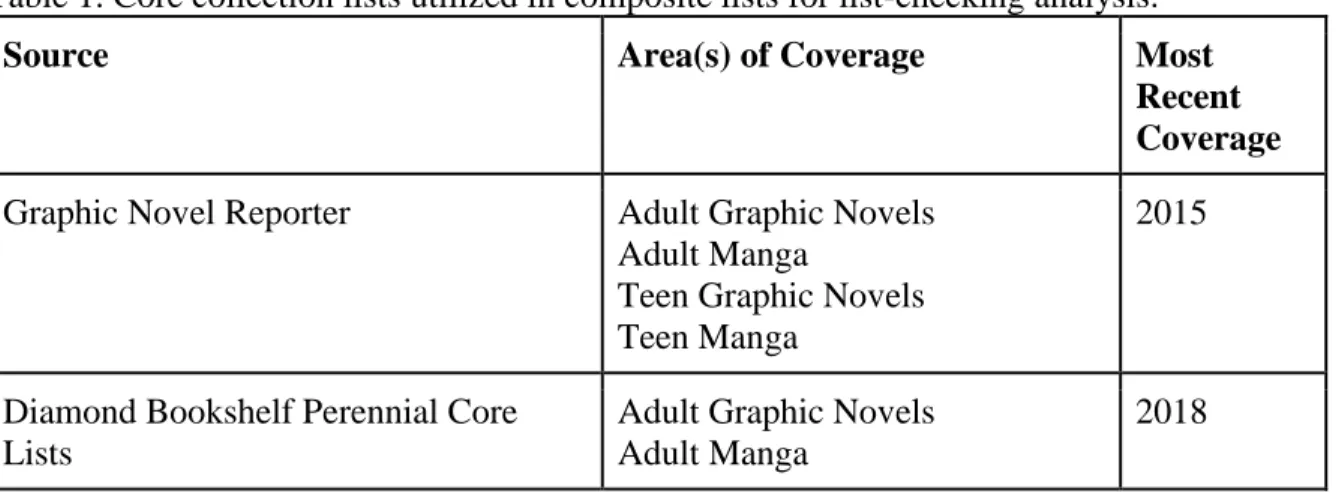
The sources used to create the composite core collection lists are summarized in
table 1 below:
Table 1. Core collection lists utilized in composite lists for list-checking analysis.
Source Area(s) of Coverage Most
Recent Coverage
Graphic Novel Reporter Adult Graphic Novels
Adult Manga
Teen Graphic Novels Teen Manga
2015
Diamond Bookshelf Perennial Core Lists
Adult Graphic Novels Adult Manga
Older Teens (16+) Graphic Novels
Older Teens (16+) Manga Young Adult (13+) Graphic Novels
Young Adult (13+) Manga
YALSA Top 10 Great Graphic Novels for Teens Lists
Teen Graphic Novels Teen Manga
2018
Each of the lists was copied as appropriate into a graphic novel spreadsheet and a
manga spreadsheet in Google Sheets for ease of manipulation, sorted alphabetically by
title, and checked by hand to remove any duplicate entries for titles appearing on multiple
core lists. In addition to the title and creator fields derived from the original list
documents, additional fields were added to the spreadsheet to identify the original
publication date, publisher, genre (fiction, property, nonfiction, biography or memoir,
comic strip collection), whether the title is a series or monograph, whether the title is held
in the collection, and (if the title is a series) if the holding is complete. The distinction
between fiction series and properties relates to the ownership of the characters and
intellectual property. Properties refer to characters created for and owned by a
corporation, such as DC, Marvel, Dark Horse, or Valiant. The most easily recognized of
these are the DC and Marvel superhero comics, and graphic novel spin-offs of movies
and television series (unless a creator-owned series came first and was later optioned for
film or television, such as Robert Kirkman’s The Walking Dead). Fiction series refer to
creator-owned content and characters. Series completion was determined by first entering
the ISBN of each unit in the series into the Goodreads database to confirm the unit level
Goodreads to check the holdings against a list of all units in that series. Because
individual libraries or selectors make subjective judgments about whether a title is
shelved in an adult section, young adult section, or both, the composite lists for graphic
novels and manga were not further subdivided by audience age. In the case that a
particular volume of a series was listed on one of the core lists consulted for the
composite list, the full series was included as one entry on the composite list. If a series
not related by a continuous plotline was included in one of the core lists (e.g., Campfire
Classics and Graphic Classics, both series of graphic adaptations of classic works of
literature), it was not included in the composite list. The final graphic novel list and
manga list consisted of 521 entries and 184 entries respectively.
For each title on the composite lists, title searches were conducted in the Chapel
Hill Public Library’s OPAC, Bibliocommons. If a title search did not yield any results, an
author search was also conducted to confirm the presence or absence of the title or series
in the collection. If the title of a series was located in the OPAC, the ISBNs of the
volumes listed were searched in the Goodreads database to determine whether the units
listed were trade paperback volumes, books, or omnibus editions4, and the data were added to the spreadsheet. After the data were compiled, the following statistics were
calculated:
• The overall percentage of graphic novel and manga holdings relative to the
composite core lists
• The percentages of graphic novel and manga holdings by genre category (fiction,
• The percentages of graphic novel and manga holdings by format (series or
monograph)
• The percentages of graphic novel and manga series holdings that are complete
Direct Collection Analysis Methodology
…[W]hen one or more individuals - subject specialists, librarians, or scholars - thoroughly examine and evaluate the collection. Ideally, this is done after the specialist becomes familiar with the library’s mission, its collection development policies, and any statistical data that have been gathered… The specialist then physically examines the collection and the shelf list (since the most frequently used materials may be checked out). This type of evaluation is entirely subjective, but it is valuable if done by individuals with sound knowledge of various subject areas and, more important, of the literature. (Baker & Lancaster, 1991, p. 41)
The second component of the collection analysis was a direct collection analysis
that addressed specific cataloging, labeling, and shelving practices applied to graphic
nonfiction and biography works, series, and properties (primarily DC and Marvel).
Johnson (2009, p. 242) describes this method as a systematic process in which a librarian
or scholar “with knowledge of the literature being analyzed physically examines the
collection” and draws conclusions about it; this method is most practical and effective
when the collection in question is small, or when the subject area can be narrowly
defined. One variation of direct collection analysis is to work from a shelf list rather than
the physical stacks of books (Johnson, 2009), and this approach was utilized here. The
shelf lists provide several advantages, as the person studying the collection may gain
access to catalog or circulation data, and their analysis will not accidentally exclude items
that are checked out at the time of the study. In order to mitigate the inherent subjectivity
criteria of focus, such as the number of volumes in a collection, chronological coverage,
periodical coverage, or series completion (Baker & Lancaster, 1991).
At the request of the Chapel Hill Public Library’s Acquisitions and Collections
Department, this direct collection analysis specifically examined the graphic nonfiction
and biography collections, the fiction series, and the properties in the adult and young
adult collections. The department is considering making some of the changes suggested
by the academic literature, such as shelving all graphic format works together instead of
interfiling nonfiction and biography/memoir works and changing the cataloging and
labeling practices for fiction and superhero property series; as a result, data must be
gathered about the current practices and state of the collection to inform this process.
Using the “Create Lists” function in Sierra, the Chapel Hill Public Library’s ILS,
two lists (one each for adult collection items and teen collection items) were created for
graphic nonfiction and biography titles. These lists included all records with the format
code for graphic novels, location codes for adult or teen collections respectively, and
content codes for nonfiction, and excluded titles that were coded as withdrawn or to be
withdrawn. Each list was exported to a Microsoft Excel file, and then the title, author,
and current call number fields were copied into the Google Sheets workbook used for the
rest of the project. Both lists were manually checked for duplicate entries, which resulted
from multiple copies of a single title being held. A “number of copies” column was added
to the spreadsheet to reflect cases in which multiple copies were held, and duplicate
entries were them deleted. Deleting duplicate records resulted in lists of 98 unique titles
in the adult nonfiction and biography collection and 29 unique titles in the young adult
to obtain the information to fill in additional spreadsheet fields that detailed the genre
(nonfiction or biography/memoir), shelf location (shelved in the graphic novel collection
areas or interfiled with the print nonfiction and biography collections), whether the title
would need to be moved if the decision were made to unite all graphic format works, and
whether the title would need to be relabeled on account of the relocation. Once these data
were compiled, the completed spreadsheets were used to answer the following questions
posed by the Acquisitions and Collections Department for both the adult and young adult
collections:
• How many unique titles are there? How many volumes are there, if duplicate
copies are accounted for?
• How many graphic nonfiction, biography, autobiography, and memoir titles are
currently shelved in the GN section?
• How many graphic nonfiction, biography, autobiography, and memoir titles are
currently interfiled in the nonfiction and biography stacks?
• How many volumes would need to be moved to unite graphic format works in
each collection?
• How many would need to be relabeled with changes to the call number?
For the direct collection analysis of fiction series and properties, the process of
identifying the relevant records for analysis was not as simple. It was necessary to focus
on those subsets of the adult and young adult graphic novel collections, but it is not
possible in Sierra or in the Bibliocommons OPAC to filter out monographic works; this
must be done manually. (Because inconsistency in the use of a single bib record for an
tracked, even if it were possible to pull serial records that contained multiple item records
for series volumes, it would have excluded many relevant records from the search.)
Using the “Create Lists” function again, lists were created of all of the graphic
format fiction records in the adult and young adult collections, restricting the list to the
format code for graphic novels, the collection location code to adult or young adult,
respectively, and the content code for fiction, excluding records coded as withdrawn or to
be withdrawn. This produced a list of 718 records in the adult collection and a list of
1,193 records in the young adult collection. The lists were exported to a Microsoft Excel
file, and the title, author, and current call number fields were again copied into new
spreadsheets in the Google Sheets workbook for the project. The ISBN for each item
record was searched in the Goodreads database to identify which records were
non-property series and which were properties and marked “yes” or “no” in respective series
and property columns. The sheet could then be sorted by each of the two columns, and
the relevant records in each case copied from the full shelf list to a new sheet and
manually checked for duplicates to ensure that only one row in each spreadsheet
represented a series.
For graphic format fiction series (excluding the properties) each OPAC record
was checked and each ISBN copied into the Goodreads database, and the title, author,
current call number, number of volumes held, number of total volumes in complete
series, gaps in series holdings, record type (whether each volume had its own bib record,
or whether item records for each volume were compiled under one umbrella bib record
for the entire series), whether the records would require consolidation if the decision was
were recorded in spreadsheets for adult and young adult fiction series, respectively. These
data were then used to answer the following questions:
• How many unique series are held?
• Of the series held, how many are complete?
• Which volumes are missing from the series that are not complete?
• In how many cases are the series volumes cataloged with individual bib records
(i.e. which, and how many, series have records that would need to be consolidated
if the decision were confirmed to make this the practice of choice?)
• In how many cases are the series volumes cataloged with item records for each
volume, under an overarching bib record?
• In how many cases is a series labeled by the author name?
• In how many cases is a series labeled by the series title or franchise character?
• Are there occasions where the words used to describe a work in a series (i.e.
volume, book) could be misleading to a patron looking for a unit of that series?
• Are there occasions where the volumes of a series are separated to multiple shelf
locations (i.e. split between adult and young adult collections, or split on account
of labeling some with the series title and some with the author) on account of
inconsistency in cataloging or labeling practice?
The same data were collected and questions answered for the titles on the
properties spreadsheet, with a few additions that are particular to those works. Additional
fields were added to the spreadsheet for the name of the character (e.g., Captain Marvel,
line that distinguishes that story arc or series from others featuring the same character.
The following question was added to those outlined for series data collection:
• In how many cases does the label provide information to help a reader distinguish
Results
Collection Analysis, Part 1: List-Checking
Study/Collection-Centered Study
After the composite core list was created and the data collected from the library’s
OPAC, the percentages of the titles held from the core list could be calculated in several
ways. First, the total number of titles listed and the total number of titles held from the
graphic novel and manga core lists, respectively, were tallied, and the overall percentage
of titles held from each list was calculated. (Note: at this stage in the calculations, if a
series on the core list was partially held but not complete, it was counted as “held”.)
These percentages are shown in table 2.
Table 2. Overall percentage of holdings from core collection lists.
List Total # of Titles # Held # Not Held % Held
Graphic Novel 521 265 256 50.86%
Manga 184 54 130 29.35%
Of the 521 titles on the graphic novel core list, 265 are held in the collection,
which translates to 50.86% of the core titles. This percentage was significantly higher
than the percentage of manga holdings; only 54 of the 184 listed titles, or 29.35%, were
held in the collection. Based on this overall statistic, it is evident that both the graphic
novel and manga collections are deficient relative to the two composite core lists, the
responsible for the adult and young adult graphic novel and manga collections have the
resources to supplement the collection, there is clearly room for improvement, and the
composite core lists may provide guidance with respect to titles to evaluate for purchase.
The second set of calculations further breaks down the graphic novel and manga
holdings by genre category. Within the graphic novel core collection, titles may be
classified as fiction, property, nonfiction, biography or memoir, and comic strip
collections. Fiction is the largest category, accounting for 348 of the 521 core titles
(66.79%). Properties account for 67 of the list titles (12.86%), followed by 54 biography
and memoir titles (10.37%), 43 nonfiction titles (8.25%) and 9 comic strip collection
titles (1.73%). Of these categories, the strongest holdings are in nonfiction and
biography/memoir. 26 of the 43 nonfiction core titles were found in the collection
(60.47%), as were 32 of the 54 biography and memoir titles (59.26%). Property holdings,
with 34 of the 67 core titles found in the collection (50.75%), were on par with the
percentage of overall holdings. Fiction holdings and comic strip collection holdings were
comparatively weaker areas in terms of holding percentage than the overall total; 169 of
the 348 fiction titles were held (48.56%), as were 4 of the 9 comic strip titles (44.44%).
Only fiction and biography titles were present in the manga core list, and fiction
titles (182/184) were overwhelmingly dominant. 52 of the 182 fiction titles were held
(28.57%), approximately equal to the overall proportion of manga core titles held, and
both of the biography core titles were found in the collection (100%).
Table 3. Percentage of holdings by genre category.
List Category # of Titles Percentage of Total # Held % Held
Fiction 348 66.79% 169 48.56%
Property 67 12.86% 34 50.75%
Nonfiction 43 8.25% 26 60.47%
Bio/Memoir 54 10.37% 32 59.26%
Comic Strips 9 1.73% 4 44.44%
Manga Total 184 100% 54 29.35%
Fiction 182 98.91% 52 28.57%
Nonfiction 0 0 0 0
Bio/Memoir 2 1.09% 2 100%
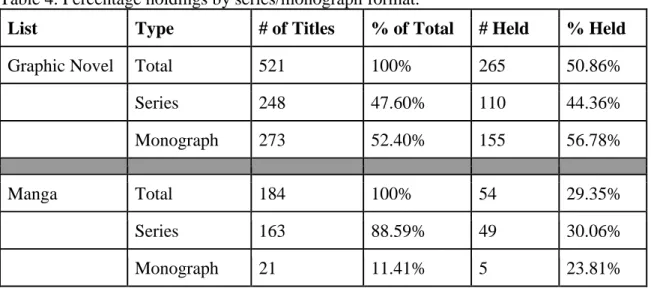
The third set of calculations subdivides the graphic novel and manga core lists
and holdings into series and monographs; these data are displayed in table 4. In the
graphic novel core list, 248 of the 521 titles (47.60%) are series, and the remaining 273
are monographs (52.40%). The library’s collection includes 110 (44.36%) of those core
series titles, and 155 (56.78%) of the core monograph titles. In the case of the graphic
novel collection, monograph holdings are stronger compared to the core list than series
holdings, and stronger compared to the overall total percentage; it is more probable to
find a core monograph title in the collection than a core series title.
The opposite is true for manga holdings with respect to series and monographs.
163 of the 184 titles on the core list are series (88.59% of the core titles), of which 49 are
held (30.06%). This is slightly higher than the overall percentage of manga holdings.
Only 21 of the core manga titles are monographs (11.41%), of which 5 are held
monograph titles on the manga core list, the series holdings are stronger than the
monograph holdings in this library’s collection.
Table 4. Percentage holdings by series/monograph format.
List Type # of Titles % of Total # Held % Held
Graphic Novel Total 521 100% 265 50.86%
Series 248 47.60% 110 44.36%
Monograph 273 52.40% 155 56.78%
Manga Total 184 100% 54 29.35%
Series 163 88.59% 49 30.06%
Monograph 21 11.41% 5 23.81%
The final set of calculations from the list-checking study focused specifically on
the series named on the graphic novel and manga lists. Until this stage in the statistical
analysis, if at least part of a series was held, it was counted as a title held. However, it is
also useful to know how many of those series are held in their entirety and how many are
incomplete, whether there are gaps due to lost volumes that need to be replaced, or
whether more recent volumes have been published that have not been acquired and the
holdings are not up to date. For graphic novel series and manga series, respectively, the
number of complete series was tallied and compared to the number of series held and the
number of series titles on the core list. These findings are summarized in table 5. Of the
248 series titles on the graphic novel list, 110 were partially or completely held, and 59 of
those were complete. This translates to 53.64% of the series titles held being complete
holdings, and only 23.79% of the series titles on the core list being complete. Of the 163
are complete. These 12 complete holdings represent 24.49% of the series held, and 7.36%
of the series from the core list. Although ongoing series can become significant
investments over time for selectors, there are significant gaps in series completion in both
the graphic novel and manga collections. Slightly over half of the graphic novel series
titles held are complete holdings, and nearly one-quarter of the manga series holdings;
filling in these gaps to provide readers with complete storylines would be a task worthy
of selector attention.
Table 5. Percentage of series for which holdings are complete.
List Type # of
Titles # Held % Held # Complete
% of List Complete
% of Held Complete Graphic
Novel
Series 248 110 50.86% 59 23.790% 53.64%
Manga Series 163 49 30.06% 12 7.362% 24.49%
Collection Analysis, Part 2: Direct Collection Analysis
Graphic Nonfiction, Biography, and Memoir
The Acquisition and Collection Department’s focus with respect to the graphic
nonfiction, biography, and memoir works in the collection (henceforth referred to as the
graphic nonfiction collection, for brevity) was the shelf location, specifically the extent to
which these works were shelved in the designated graphic novel section or interfiled with
print nonfiction and biography, the extent to which this practice was consistent, and what
would be required to move the interfiled titles to a unified graphic format section in
accordance with the recommendations of Fee (2013) and Hoover (2011). These results
are summarized in table 6 below.
List Total Volumes
Unique Titles Titles in GN Section
Titles Interfiled
Adult 116 98 3 (5 volumes) 95 (111 volumes)
Young Adult 32 29 7 (7 volumes) 22 (25 volumes)
The adult graphic nonfiction collection consists of 116 volumes, representing 98
unique titles. Although the practice has not been completely consistent, 95 of the titles
(96.94%) in the adult collection have been interfiled with the print nonfiction and
biography collections, for a total of 111 volumes. Only three graphic nonfiction titles
(3.06%) were shelved in the designated graphic novel section: The Best We Could Do by
Thi Bui, Can’t We Talk About Something More Pleasant by Roz Chast, and The
Life-Changing Manga of Tidying Up by Marie Kondo. It was noted that of these three, two are
memoirs and one is a graphic adaptation of a nonfiction title, although all are labeled as if
they were fiction works in the graphic novel collection. Given that these may not be the
only nonfiction volumes labeled incorrectly, it would be prudent to double-check each of
the other graphic nonfiction works before relabeling them. If the library were to choose to
shelve all of the graphic format nonfiction works with the rest of the graphic novel
collection going forward, and to bring the existing collection in line with that decision,
shelf space would need to be made available for these 111 volumes, the “GN” descriptor
would be added to the call numbers for these volumes, the call numbers would be
updated in the catalog records for those titles, and the volumes would be relabeled
accordingly.
The young adult graphic nonfiction and biography collection consists of 32
practice for the young adult titles; nearly one quarter (7 of 29 titles, 24.140%) of the
nonfiction and biography titles were shelved with the other graphic novels. The
remaining 22 titles (75.86%), which account for 25 volumes on the shelf, are interfiled
with the print nonfiction and biography collections. If the library were to decide to shelve
all young adult graphic format works together in the Teen Room, there would need to be
shelf space for these 25 additional volumes, and cataloging and labeling changes would
be made as described above for the adult collection.
Graphic Fiction Series
For the fiction series in the adult and young adult collections, data were collected
about series completion, cataloging practices, labeling conventions, and examples of
inconsistencies in the cataloging and labeling practices within a series. Table 7 contains
the findings with respect to series completion.
Table 7. Series completion percentages for fiction series, excluding properties.
List Series Held Series Complete Percent Complete
Adult 135 43 31.85%
Young Adult 224 70 31.25%
As indicated in the list-checking study, low rates of series completion are an issue
deserving of attention; in both the adult and young adult collections, slightly less than
one-third of the series held are complete. The adult collection includes 135 unique series,
of which there are complete holdings for 43 (31.85%). Of the 224 unique series held in
the young adult collection, 70 of them (31.25%) were complete. The data collection
spreadsheet notes exactly which volumes are missing from each of the remaining series,
which may be considered for replacement if those volumes are still in print and available
Table 8. Catalog records for series with multiple volumes held.
List # Series w/
Multiple Vol. Held
# with Multiple Bib Records (%)
# with Single Bib Record (%)
Adult 44 23 (52.27%) 21 (47.73%)
Young Adult 133 23 (17.29%) 112 (84.21%)
Table 8 above summarizes the findings related to the practice for catalog records
for series. Here, the focus is on series of which multiple volumes are held, and multiple
bound units are identified as part of the series. This excludes those series where the
volumes held are compiled in a single omnibus edition, resulting in only one unit being
cataloged for that series. In the adult collection, 44 series fit this description, and the
cataloging practice is split almost 50-50. Of those, 23 series (52.27%) are cataloged with
individual bib records for each volume held and would need to be consolidated under a
single bib record if the decision were made to catalog all graphic novel series in this way
in accordance with Fee’s (2013) recommendations, and 21 series (47.73%) are already
cataloged with item records for each volume under an overarching bib record with the
series title. In contrast, the practice for cataloging young adult series has overwhelmingly
been to consolidate the item records for each volume held under an overarching bib
record for the series. Of the 133 relevant series in the young adult collection, 112
(84.21%) have been cataloged in this way, and only 23 (17.29%) are cataloged with
separate bib records for each volume in the series and would need to be consolidated.
Table 9: Labeling practices for fiction series, excluding properties.
List Total Series # by Author (%) # by Series (%) # Split (%)
Adult 135 128 (94.82%) 7 (5.19%) 0 (0%)
Table 9 displays the results with respect to labeling conventions in the adult and
young adult fiction series (excluding properties), specifically whether series were labeled
by the author’s last name or by the series title. It was also noted if there was a labeling
inconsistency that resulted in the volumes of one series being separated to multiple shelf
locations. In both the adult and young adult collections, almost all of the fiction series
were labeled by the author’s last name. 128 of the 135 adult series (94.82%) and 217 of
the 224 young adult series (96.88%) were labeled in this way. Seven of the adult titles
(5.19%) were labeled by the series title; these series are AX: Alternative Manga, Best
American Comics, Fables, Flight, The Graphic Canon, Snow Piercer, and Will Eisner’s
The Spirit Archives. It was noted that three of these are anthology titles without a single
author, and that labeling Bill Willingham’s Fables series by the title separated that series
from Willingham’s other works, including the Fairest series and several standalone
works set in the Fables world, which are labeled with his name. In the adult collection,
no series were found that were unintentionally split by labeling inconsistencies.
Seven of the young adult series (2.68%) were labeled by the series title instead of
the author, including Dead Boy Detectives, Lumberjanes, Magic Knight Rayearth, My
Boyfriend is a Monster, The Sons of Liberty, Spectacle, and Tiger & Bunny. Noelle
Stevenson’s Lumberjanes series was noted to have been split by inconsistent labeling
practice. Volumes 1-5 of the series are labeled by author name (GN Stev), but volumes
6-9 and the recent bonus volume of short stories are labeled by the series title (GN
Lumberjanes). As a result, the series volumes are shelved in two different shelf locations,
making them harder for patrons to locate. If the decision is made by the library staff to
associated with the 14 series labeled by title would need to be relabeled and updated in
the OPAC.
Finally, each series record and call number was checked to determine if there
were any occasions where the words used to describe a unit of a series could be
misleading to patrons; as discussed previously, the distinction between a volume and a
book is important in cataloging and labeling graphic novels in order to accurately
describe the library’s holdings. Two examples of this kind of confusion are the library’s
holdings of Brian K. Vaughan’s Ex Machina and Robert Kirkman’s The Walking Dead.
Vaughan’s Ex Machina series consists of ten trade paperback volumes, but the series has
also been released in five “books”, each of which compile two volumes of the series as
well as additional bonus content. The catalog record in the library’s OPAC indicates that
the library holds volumes 1-5 of the series, and this record makes it appear that the library
only has the first half of the series on the shelf. The library’s holdings are actually
volumes 1-3 and books 4-5. Book 4 collects volumes 7-8, book 5 collects volumes 9-10,
and the library is missing volumes 4-6 of the series. This is a distinction peculiar to
graphic novels to which selectors and catalogers might be alerted.
Kirkman’s The Walking Dead presents a slightly different issue. The catalog
record indicates that the library’s holdings include volumes 1-14, plus the most recent
volume, volume 29. As a patron looking at this record, I might think that the library is
missing almost half of the series, and that I would need to go to another library to borrow
the rest of the volumes. In reality, the entire series is available on the shelf in the adult
collection, but books 1-14 are held, and then volume 29. Each book collects two volumes
and so forth. In addition to these two examples in the adult collection, the Bitch Planet,
Preacher, and Rocketeer series in the adult collection and the Junior Braves of the
Apocalypse and The Sixth Gun young adult series require similar attention to their labels
and catalog records. (This issue was not found in the adult or young adult
franchise/property series.) It may be possible, and less confusing to patrons, to change the
spine labels and catalog records on the books in question to say “v. 1-2, v. 3-4, etc.”, as
has been done with several manga series with collected editions of multiple volumes.
Properties
For the property series in the adult and young adult collections, similar data points
were collected about series completion, cataloging practices, labeling conventions, and
examples of inconsistencies in the cataloging and labeling practices within a series. An
additional question unique to the property series was also studied: to what extent do the
spine labels provide information to the reader to help them distinguish between story arcs
and identify the order of the volumes in a story arc?
Table 10. Series completion percentages for properties.
List Series Held Series Complete % Complete
Adult 89 51 57.30%
Young Adult 99 47 47.47%
Table 10 displays the findings with respect to series completion for adult and
young adult properties, indicating that series completion is an area of concern in all
aspects of the collection. Of the 89 series held in the adult collection, 51 (57.30%) were
complete, and 47 of the 99 young adult series (47.47%) were complete. As with the other
will be able to determine if the volumes in question are available to purchase and whether
it is worth the investment to buy the missing volumes from the series in question.
Table 11. Catalog records for property series with multiple volumes held.
List # Series w/
Multiple Vol. Held
# with Multiple Bib Records (%)
# with Single Bib Record (%)
Adult 15 5 (33.33%) 10 (66.67%)
Young Adult 34 6 (17.65%) 28 (82.35%)
Table 11 summarizes the findings related to the practice for catalog records for
property series. Again, the focus is on series of which multiple volumes are held, and
multiple bound units are identified as part of the series, thus excluding series holdings of
a single collected edition. This applies to 15 series in the adult collection, of which
two-thirds (10 series, 66.67%) are cataloged with item records for each volume under a bib
record for the series, and one-third (5 series) are cataloged with bib records for each
volume. As with the fiction series discussed previously, the practice for cataloging young
adult series is more consistent overall and has been to consolidate the item records for
each volume held under an overarching bib record for the series. Of the 34 relevant series
in the young adult collection, 28 (82.35%) have been cataloged in this way, and only 6
(17.65%) are cataloged with separate bib records for each volume in the series and would
need to be consolidated.
Table 12. Labeling practices for properties.
List Total Series # by Author (%) # by Series (%) # Split (%)
Adult 89 18 (20.23%) 71 (79.78%) 1 (1.12%)
Young Adult 99 18 (18.18%) 81 (81.82%) 2 (2.02%)
In contrast to the graphic fiction series, approximately four-fifths of both the adult
and young adult property series were labeled according to the series title or character