Johanna Shelby. Sensemaking and Group Relationships in Collaborative Exploratory Search. A Master’s Paper for the M.S. in I.S degree. May, 2011. 71 pages. Advisor: Robert Capra
This study investigates the information seeking and sensemaking processes undertaken by groups engaged in collaborative exploratory searches. A second research question was what, if any, role the familiarity of the group members with each other had on how sensemaking occurred. Semi-structured interviews were conducted with eight
participants, and each participant was asked to describe two collaborative search experiences, one with friends or family who they knew well, and one with an assigned group for school or work. Participants’ experiences matched up well with existing information seeking models and current sensemaking models, but highlighted the importance of extensive use of artifacts and in-person communication as behaviors that facilitate sensemaking in a collaborative searching environment.
Headings:
Collaborative Search
by Johanna Shelby
A Master’s paper submitted to the faculty of the School of Information and Library Science of the University of North Carolina at Chapel Hill
in partial fulfillment of the requirements for the degree of Master of Science in
Information Science.
Chapel Hill, North Carolina
April 2011
Approved by
Table of Contents
INTRODUCTION 2
LITERATURE REVIEW 6
METHODOLOGY 16
RESULTS 24
DISCUSSION 45
REFERENCES 59
APPENDIX A 63
APPENDIX B 65
Introduction
Collaborative information seeking describes the practice of conducting searches
for information in pairs or groups. These searching activities can be done in one sitting or
over a long period of time; in person or remotely; at the same time (synchronously) or at
different times (asynchronously); and using a variety of different search strategies and
methods of working together. A husband and wife looking for a house, a faculty member
and a research assistant working on a literature review, or a group of friends planning a
trip for spring break are all engaging in collaborative, exploratory searches. These
searches could involve a wide variety of levels of collaboration, ranging from passively
emailing items of interest over time, to sitting down on one computer and discussing the
results in person. In addition, the searches could span from personal to professional, and
between people who have a low level of familiarity to those who are extremely close.
Overall, collaborative search is a varied and amorphous process that covers a wide
spectrum of behaviors, actions, and group configurations.
An area of recent interest in collaborative information seeking research is support
for the sensemaking process. Sensemaking has been relatively well defined in
information-seeking models for individuals, as a process of contextualizing and
understanding search results, by identifying gaps in knowledge and information
deficiencies (Dervin, 1992; Dervin, 1998). Preliminary studies have shown that
sensemaking is an important component of collaborative search, especially considering
individuals (Paul and Morris, 2009; Paul and Reddy, 2010). Handoffs of information
from one group member to another, in particular, can be problematic, as group members
may not have a full picture of a situation before having to take on the task themselves. In
such situations, efforts may be duplicated, time may be lost, or problems may arise due to
deficiencies in available information.
The present study attempts to gain a deeper understanding of the sensemaking
process as it is undertaken by groups engaged in collaborative exploratory search. By
gaining this more thorough understanding of the sensemaking process, it is hoped that
systems designed to support collaborative searching efforts can be modeled on actual
search behaviors, and can enhance the collaboration process by explicitly addressing the
key sensemaking challenges and needs of groups working together on search tasks. An
additional variable to consider when analyzing how information seeking and
sensemaking occurs in collaborative searching is the relationship dynamics at play
between group members, such as their level of familiarity with each other and the search
setting (professional, academic, or personal). Having a clearer picture of how various
groups collaborate allows for the design of these tools to be informed by real
collaborative practices.
The aim of the study described in this paper is to analyze the information seeking,
collaboration and sensemaking strategies employed by different groups with varied levels
of familiarity and search contexts. Overall, the research questions driving this research
study are:
1) Do groups engaging in a collaborative exploratory search process conform to
behaviors in these collaborative processes that need to be accounted for when
modeling and designing for collaborative work? Specifically,
• How do people make sense of information they find;
• How do people prepare information to share and share information with
others; and
• How do people make sense of information found by their collaborators?
And:
2) Does the relationship between searchers affect these sharing and sense-making
processes?
To answer these questions, semi-structured interviews were conducted with
graduate students. Participants were asked to recall two recent collaborative searches
they had participated in, one that took place in an academic or work setting with assigned
group members, and one in a personal setting with friends or family. Questions focused
on the collaboration practices and strategies used by the group; information finding and
sharing processes; and how sensemaking occurred and was facilitated by different group
members. Through data analysis of interview transcripts, inductive coding was used to
find themes and common practices among the different searches discussed in detail.
Several interesting themes were found when analyzing these collaborative
searches. Participants reported extensive creation and use of shared artifacts to support
search, and highlighted importance of face-to-face meetings to facilitate sensemaking.
Also prevalent was a practice of dividing work among group members, no matter the
level of familiarity. Finally, group members engaged in sensemaking both individually,
found in divided tasks. Several tools to facilitate collaborative searching, result-sharing,
and organization have emerged in recent years, and it is hoped that the behaviors
observed in the present study can inform future design, as well as more broadly create a
Literature Review
The present study draws on several areas of literature in the information and
library science field as well as work done in the fields of social psychology and computer
supported cooperative work (CSCW). Significant research has been done on the
processes and models of information seeking that are commonly seen in exploratory
search behaviors, as well as into personal information management behaviors. In
addition, recent work on collaborative search has created a strong foundation of typical
behaviors, practices, and frequencies of these types of searches. The purpose of the
current study is to examine how existing models of information seeking, sensemaking,
and information management behaviors fit when applied to collaborative, rather than
individual, exploratory searches, while also exploring how collaborative search behavior
relates to expected outcomes from collaborative work and collaborative sensemaking
more generally.
Exploratory Searching
Exploratory searching refers to activities that involve the searcher learning and
investigating, rather than looking up information (Marchionini, 2006). Lookup or
fact-finding operations are supported by conventional information retrieval systems, and this
query-response model informs the design of most conventional search engines such as
well-defined and understood information need and can readily recognize relevant results
as matching that query: in contrast, the learn and investigate tasks identified by
Marchionini do not presuppose a well-defined information need. White and Roth argue
that exploratory search “must include complex cognitive activities associated with
knowledge acquisition and the development of new capacities, skills, values,
understanding, and preferences. Once a person has acquired information and internalized
it such that they understand its meaning, translation, interpolation, and interpretation,
they may then apply that knowledge in new domains and pursue higher-order learning
activities such as analysis, synthesis, and evaluation.” (White and Roth, 2009, pp. 9-10).
A rich set of information-seeking behaviors have been modeled to explain how
searchers move through their search process. Belkin (1980) uses the term ASK (or
anomalous state of knowledge) to refer to the idea that traditional information retrieval
systems presuppose a clear information need, whereas in many IR system users in
actuality have an incongruity between their actual information need and their expressed
information need. Bates (1989) takes this idea further, arguing that not only is the
searcher’s information need unclear at the initiation of a search, but that as the search
process evolves over time, this in turn defines and clarifies the information need. She
presents a berrypicking model, where each item found affects the searchers’ perspective
and their information need, leading them in a slightly different direction to find a new
item, in a meandering path over time. This contrasts with traditional information
retrieval models, in which a static query is used to return a set of results all at once.
Kuhlthau (1991) breaks down the information-seeking process into stages of initiation,
through this information seeking process, searchers exhibit a variety of behaviors and
emotions that are consistent with the idea that information seeking behaviors evolve over
the course of exploratory searching. Kuhlthau’s model helps explain how searchers
move through a search process from undefined need, to exploration and refinement,
learning, evolving search needs, and finally to a resolution (Kuhlthau, 1991). Kuhlthau
discovered by studying not only behaviors but the emotions experienced during the
search that uncertainty, doubt, and anxiety, as well as optimism and confidence, were
common feelings experienced during various stages of the search process.
Sensemaking
Another framework for understanding and analyzing how people go about complex,
exploratory searches is the concept of sensemaking. Broadly, sensemaking refers to the
process of understanding, or making sense of, information found during a search task.
This can involve reframing information, resolving conflicting pieces of information,
visualizing a complex information space, interpretation and analysis of search results, and
learning. Sensemaking has been explored in several fields including information and
library science, organizational science, business, and education. The most relevant
interpretations of the sensemaking process for the current study, which focuses on
exploratory searching in groups, are sensemaking in organizations and sensemaking as it
relates to information seeking in exploratory search. Brenda Dervin is a leading author
who has explored models of sensemaking in information and library science. Her
sensemaking model entails a process of identifying gaps in knowledge, addressing these
She explains this process as a way to come to understand the incompleteness of our
knowledge, by using “the metaphor of human beings traveling through time- space,
coming out of situations with history and partial instruction, arriving at new situations,
facing gaps, building bridges across those gaps, evaluating outcomes and moving on. The
central foundational concepts of the Sense-making methodology are, thus, time, space,
movement, gap; step-taking, situation, bridge, outcome”. (Dervin, 1998, p. 39). In the
context of a collaborative searching experience, this could be applied to moving through
a long search process, during which deficiencies in knowledge are discovered, solutions
that address these deficiencies are found, and final results are settled upon.
Sensemaking has also been studied in the context of organizations, which is relevant
to the present study since the focus is on group work, and participants were asked to
reflect on a search that occurred in a school or work setting. Weick et al. (2005) point out
that sensemaking in an organizational context is a social process that requires
communication, saying: “The image of sensemaking as activity that talks events and
organizations into existence suggests that patterns of organizing are located in the actions
and conversations that occur on behalf of the presumed organization and in the texts of
those activities that are pre- served in social structures” (Weick et al., 2005, p. 413). In
contrast to Dervin’s sensemaking model, sensemaking in an organizational context is
inherently social, and occurs through conversation and action, as well as internally.
In ILS literature, the sensemaking concept has been applied to the
information-seeking process and to exploratory searching in particular. White and Roth summarize
the critical steps of sensemaking as: “(1) knowledge gap recognition; (2) generation of an
relationships, and hypotheses; (3) search for information; (4) analysis and synthesis of
information to create insight and understanding; and (5) creation of a knowledge product
or direct action based on the insight or understanding.” (White and Roth 2009, p. 31).
Pirolli and Card (2005), using task analysis of intelligence analysts, modeled the
information seeking process into an information foraging loop and a sensemaking loop,
during which the searcher iteratively creates a mental model to frame their findings in a
way that was convincing and cohesive.
Collaborative Searching
All of these modeled behaviors, while sometimes incorporating the social aspects of
the search process, do not explicitly address information seeking that is undertaken by
groups, rather than individuals. There has been a significant amount of recent research
into collaborative information seeking and collaborative search behaviors, demonstrating
that collaborative search is an extremely common behavior and is used for a wide variety
of searches (Morris, 2008; Morris and Teevan, 2009). Morris (2008) reports in a survey
of collaborative searching practices, that approximately 53% of respondents said they had
worked together to find information with others online – however, she also noted that this
was likely an underestimation, because over 90% of respondents said that they had
engaged in one of the collaborative searching practices she outlined, such as emailing
search results or watching a search over someone’s shoulder and offering alternate query
terms. Evans and Chi (2008) similarly found that in their survey of people recruited
using the Amazon Mechanical Turk service, over two thirds of respondents reported
their most recent search experience, rather than seeking out experiences that had involved
collaboration.
The most common types of collaborative searches found by Morris (2008) were
travel planning, shopping, literature review, technical information, fact-finding, social
planning, medical information, and real estate. Evans and Chi (2008) report that more
complex informational searches, rather than transactional or navigational searches, in
particular lead to information foraging and sensemaking behaviors. They also described a
significant number of post-search activities such as organizing, schematizing, and
distributing information, following a similar process as described by Pirolli and Card
(2005). Almost half of the subjects in the Evans and Chi (2008) study created artifacts
from their searches, to aid in organization, saving, and synthesis of results. Distribution
was common both as a way of saving information to refer back to individually later, or to
share with others, and typical distribution methods were to share information over the
phone or in person. Anecdotally, they reported that tools to support post-search
information organization and distributions are an unmet need among many searchers.
Capra et al. (2010) also discuss what types of tools are used in collaborative searching
and during the process of organizing, sharing, and making sense of search information.
They report a reliance on pre-existing tools such as bookmarking, email, instant
messaging, and printing results, as well as a lack of specific tools to support the later
stages of a collaborative information seeking process such as sharing and analyzing
results. These artifact creation and memory aiding tactics are familiar personal
sensemaking during collaborative search, as they are used not only to manage one’s own
information but to facilitate sharing information with others.
Sensemaking in Collaborative Search
Two recent works have specifically studied the role of sensemaking in collaborative
information-seeking behaviors. Paul and Morris (2009) conducted a formative study of
how well the SearchTogether browser extension, which provides synchronous
collaborative searching capability, supports sensemaking in distributed groups working
together to plan a trip. They found that handoffs, particularly between group members
who were not able to search synchronously, were difficult, and that participants wanted
more visibility into what their collaborators were working on. While SearchTogether
allows users to see their collaborators’ queries, saved searches, and results, Paul and
Morris found that users wanted to see summarizations of their conclusions during
handoffs, as well as have an easier way to understand how their collaborators’ results
were reached over time and their relative significance. The search results were important
to share, but more importantly, and unsupported by SearchTogether, was the ability to
provide awareness of the search process itself.
They developed an experimental version of SearchTogether, CoSense, that facilitated
these sensemaking activities, and found that in a second round of testing, users felt that
they were better able to coordinate the handoff process. They specifically recommend
that the design of future collaborative searching tools provide support for not only
making sense of search results, but also the search process, stating: “for groups, this
the need to make sense of the collaboration process, such as group members’ roles and
task state. This sensemaking support becomes particularly important for asynchronous
collaborative search tasks, when handoff poses an extra sensemaking challenge” (Paul
and Morris, 2009, p.9). In particular, they recommend a focus on trajectories, timelines,
and other views that provide greater context to users.
Paul and Reddy (2010) discuss the process of sensemaking in the context of
collaborative information seeking in a hospital emergency department. In this highly
collaborative setting, handoffs were common and the ability of various hospital personnel
to effectively make sense of information contributed by different caretakers at different
times was crucial to providing quality patient care. During an ethnographic field study
consisting of extensive observation, they determined that collaborative sensemaking took
place in three main contexts: when there was ambiguous information; when information
was distributed unequally through a group due to their different roles; and when one team
member had a lack of expertise. In addition, they comment on the criticality of
situational and activity awareness among collaborators to effectively make sense of
situations: “in a collaborative environment, the multiple actions that comprise an activity
are performed by different actors over time and hence understanding the relationship
between these actions is important for collaborative sensemaking” (Paul and Reddy, p.
328). Further, awareness of another’s actions is not sufficient for sensemaking unless the
broader context of the shared activity is well understood. They conclude with two design
recommendations for systems that support collaborative information seeking and
sensemaking: first, they should allow for a visualization of the sensemaking trajectory
second, should allow for awareness not only of actions taken by individual group
members but of the progress of the activity as a whole.
Group Member Familiarity
A significant additional variable to consider when exploring collaborative searching
behaviors is the potential effect of relationships between different group members. The
present study focused on how familiar searchers were with one another and what, if any,
effect this had on the information-seeking and sensemaking process. While group
member relationships have been explored in relation to collaborative learning and
collaborative work, they have not been extensively explored in the context of
collaborative information seeking. Studies that have explored group performance in
relation to how well group members know each other in the Organization Science or
CSCW contexts have produced mixed results. Parise and Rollag (2010) found that in a
work environment, new teams with prior work or friendship relationships had better
initial group performance, arguing that people with pre-existing familiarity and
relationships “already have some degree of understanding about the skills, experience,
and work style of each other, and this familiarity helps reduce the amount of time
required to negotiate new roles, assign responsibilities, and build a productive
relationship” (Paris and Rollag, 2010, p. 892).
However, Adams et al. (2005) found that for groups collaborating face-to-face,
familiarity did not significantly affect decision accuracy, decision time, or satisfaction
with the collaboration process. This finding did not hold true for groups in groups
satisfaction and lessened decision time, but also decreased decision accuracy. In a
follow-up study, Janssen et al. (2009) found that while groups with higher familiarity had
higher positive perceptions of their collaboration and required less time monitoring task
performance, they did not actually perform better as a group. Across these studies, it is
unclear how significant the collaborators’ relationship is as a variable affecting search
outcomes, in large part due to the fact that there are often confounding factors such as
Methodology
Goals of the Study
The goals of this study were to gain a better understanding of:
1) How groups engage in collaborative exploratory searches, and do their
information seeking behaviors conform to individual information-seeking
models;
2) How individuals engaged in collaborative, exploratory searches make sense of
information they find or that is shared with them by their collaborators, and
what kinds of preparation and contextualization aid this sensemaking process;
and
3) How does the relationship of the searchers and the search context affect how
these sensemaking processes occur.
Description of Method
Semi-structured interviews were conducted with graduate students who had previous
experience with collaborative searching, both in a work or school context and in a
personal context. This interview technique allowed the researcher to gain a rich
understanding of a complex collaborative information space by providing the freedom to
pursue avenues that come up through conversation, while also maintaining consistency
Population and Sampling Technique
Graduate students were chosen as the target population for this study, because they
were expected to have a high level experience with collaboration and with research, and
more broadly a high level of information literacy and comfort with online searching. It
was expected that this population would have more experience with the types of personal
collaborative searches previously identified by Morris (2008) such as trip planning, major
purchases, and searches related to family medical conditions than would a population of
undergraduates, while also having a high degree of academic or work-related search
experience.
Participants were recruited using a flyer (attached in Appendix B) that was
distributed over a mass-mail listserv that reaches graduate students who have chosen to
receive informational emails. In addition, several university departmental lists were
targeted for subsequent distribution, due to an initially low response rate. While potential
participants were recruited through lists aimed specifically at graduate students, the
eligibility criteria for the study stated only that respondents: 1) were at least 18 years old;
2) spoke English fluently; 3) had conducted an on-going search for information on a topic
in cooperation with friends or family across multiple days or weeks; and 4) had
conducted an on-going search for information on a topic for work or school in
cooperation with co-workers or classmates across multiple days or weeks. The
recruitment flyer also noted that participants would be compensated $10 for their time.
Approximately 15 potential participants expressed interest in participation, and
eventually eight graduate students were interviewed. No effort was made to control for
The participants were students of four different schools at a single university. Their
distribution was somewhat uneven, with five of the eight belonging to various programs
in one university school, and the additional three each belonging to their own school. All
participants were current graduate students, including three Master’s degree students,
four PhD students, and one in a joint Master’s/PhD program. All were in the first or
second year of their programs. In addition, the gender distribution of participants was
mostly female, with seven of the eight participants being women.
Study Procedures
After respondents expressed interest in participating in the study, they were contacted
via follow-up email to confirm that they met the study’s eligibility criteria and to
schedule a convenient time for the interview. If the respondents had any questions about
the study or the interview process, these were addressed in a follow-up email as well. Six
respondents either did not respond to follow-up emails or declined to participate due to
the time commitment or feeling that they were not adequately qualified to participate.
One respondent scheduled the interview but did not make it on time and declined to
reschedule. For the eight successful interviews, study participation entailed one
audio-recorded session of approximately one hour that was conducted in a quiet, private
conference room, office, or classroom. Participants were encouraged, but not required, to
bring their laptop in case they wanted to refer to items or documents related to the
interview questions.
Once the participant arrived, they were informed of the nature of the study and given
to be recorded during the interview. All eight participants agreed to be
recorded. Once both the interviewer and participant signed the consent form, the
audio-recorder was started and the interview began. During the interview, participants were
asked to reflect on two recent collaborative, exploratory searches, one with people they
were close with (friends or family) and one with acquaintances on a work or school
project. A semi-structured interview protocol was used, allowing for the interviewer to
ask additional probing questions based on the participants’ responses. A more detailed
discussion of the interview guide follows below. The interviews ranged in length from
33 minutes to 73 minutes. Two of the participants chose to show items related to their
search processes on their laptops. After the interview, the participants were thanked and
offered an honorarium of $10 for their participation.
Interview Guide
The interview guide used during the study is included in Appendix A. The questions
were developed iteratively through a review of relevant literature, a review of the
interview questions used by Capra et al. (2010), and consideration of the research
questions driving the study. The interview guide was then further refined through
participation in a qualitative interviewing workshop offered by the Odum Institute and
three pilot interviews in which the pilot participants provided feedback on the interview
process.
The interviews began with questions regarding the interviewee’s current search
experience and background, comfort with technology and online searching, and
types of searches the study was focused on and asked to reflect on recent searches that
matched those descriptions. After brief discussion with the interviewer, two recent
experiences were identified that the participant would be comfortable discussing in more
depth, one in which the collaborative search was with an assigned group on an assigned
task (e.g. for work or school), and one that was self-motivated and with someone they
knew well (e.g. friend, family, significant other). If more than two search examples came
to light through conversation, those could be referred to throughout the interview as well.
After settling on the two search experiences to discuss, the experimenter then asked a
series of semi-structured questions about each experience in turn. Whichever of the two
experiences the interviewee was most comfortable discussing was discussed first. The
initial questions focused on establishing the background regarding one search experience,
such as the types of information that were searched for, how they were found, and with
whom the participant was working. After the background was established, further
questions asked about the details of how information was shared back and forth in this
particular scenario, particularly what types of sensemaking, contextualization, and
compilation activities took place both on the part of the interviewee and on the part of his
or her collaborators. Once this set of questions was completed for the first search task,
the interviewer went through the questions again for the second search task, asked the
participant to compare the two scenarios and their search process in each and reflect on
any differences or similarities between them, and finally asked the participant to reflect
Data Analysis
To preserve the flow and conversational nature of the interview, notes were taken
only sparingly during the interviews. Specifically, notes were only taken to record the
format and details of artifacts presented by the interviewee during the interview, or to
record information that spontaneously came up in conversation after the formal interview
had ended. Immediately after the interviews, the researcher took notes regarding anything
that occurred in the interview that would not be apparent from listening to the audio
recording, such as diagrams of documents that were referenced in the interview, general
mood, or information conveyed in casual conversation before or after the formal
interview. Each interview was then transcribed using paraphrased transcription, where
particularly relevant discussions were transcribed verbatim and more general background
information was noted using summarization. After the interviews were transcribed, the
data contained in the transcriptions was coded using an inductive, iterative coding
process. The initial coding included a detailed review of the interview transcripts and
open coding suggested by the data, with an eye towards the themes of sensemaking,
information seeking, and collaboration processes, as well as tool use. A portion of the
first interview was coded twice, by the researcher and her advisor, to gain familiarity with
the process and to compare codes. Coding was done using pen and paper as well as
managed in a spreadsheet, which allowed for easier grouping of data across interviews.
In addition to the open codes suggested by the data, other simple methods of grouping the
data were used, such as counts of participants who expressed similar sentiments.
For descriptive questions that were asked in each interview, such as how many
personal from academic/work examples. A similar process was used for other common
themes that were easily categorized and counted, such as methods of communication (e.g.
face to face, email) and software/tools used (Google Docs, RefWorks, Word documents).
In these categories all instances of each category was marked, such that any search
experience could contain many different types of software or communication strategies.
Again, all information was divided into personal and academic/work examples, allowing
for comparison between these two examples as well as the ability to view trends as a
whole.
For more complex concepts, themes were inductively chosen based on review of
codes applied to all search examples. Following this, an iterative review of these themes
was used to draw comparisons and extrapolate the overarching themes and modified to
include additional findings. Throughout the analysis, notes were taken on emerging
themes, and when a pattern emerged, the researcher went back first to the assigned
coding, and second to the transcripts themselves, to review and refine the ideas and pull
out relevant facts and quotes that may have been overlooked during the initial coding
process. This method allowed for themes and patterns to emerge from the data itself,
suggesting conclusions that could be drawn across multiple participants.
Limitations
While semi-structured interviewing allows for deep exploration of a topic while
providing basic guidance of an interview protocol, it also has methodological limitations.
First, it can be difficult to make generalizations from this type of qualitative research,
than a random sample that can be assumed to be representative of the larger population.
As such, qualitative interviewing may have high validity, but has less reliability than
other types of data collection. In addition, due to the small sample size, there is not
statistical significance, making any extrapolations to a larger population less reliable.
(Babbie, 2010).
Specific to the present study, graduate students were used as the sample population,
and their behaviors may not be applicable to a broader population, especially when
discussing experiences with online research and familiarity with technology and
collaborative tools. In addition, due to the recruitment tactics used, many of the
participants were clustered in similar academic programs, which may overemphasize
homogeneous behaviors and opinions. Since participants were recruited specifically for
having a recent collaborative searching experience, this group was not representative
even of graduate students as a whole, but rather was a self-selected sample of people who
had recent, relevant experiences in mind. Finally, the wording of the recruitment material
may have influenced the type of respondents and scenarios that were chosen for
discussion, since there was an emphasis placed on the searches being exploratory and
extensive (ongoing for days, weeks or months) which may have narrowed the types of
searching events to those reported in the study, such as travel, wedding planning, and
Results
Overview
Participants were asked to reflect on two recent collaborative searching experiences,
one where they were working with assigned partners for school or work, and one that was
a search with friends or family. For the purposes of this analysis, responses will be
discussed in terms of these two classes of collaborative search experiences. All eight
participants described a collaborative searching experience in which they worked with
assigned partners for a school or work task. In the discussion, this set of responses will
be referred to as the “work/school task” or the “assigned task”. In addition, participants
described a collaborative search with friends or family, which will be referred to as the
“friends/family task” or the “personal task”. A total of 16 searching events were
discussed throughout the interview process (8 participants x 2 events). At some points
the discussion here will focus on all 16 experiences, and in these cases the description
will refer to “all tasks” or “the entire set of tasks”. Finally, some participants referenced
previous or concurrent collaborative or individual searching experiences to contrast or
compare with the experience they were discussing, and these may be referenced and
identified as “additional tasks” in the text. However, these additional tasks were not
I. Previous Searching Background
Participants were asked to describe how often they engaged in collaborative searching
and how comfortable they felt performing online searches, as well as their comfort level
with technology in general. Overall, they collaborated with others frequently and were
comfortable or very comfortable with their online searching and technology skills. Five
of the eight participated in searches with other people very frequently: one participant
responded “constantly” while another discussed searching with others five to six times a
week. Another had frequent collaborative search experience, working with others
“weekly”, with a wide variety of different people. The final two participants said that
they had varied experience: one had rare academic collaboration, but significant levels of
personal collaboration, and another did a lot of group work for courses but less
collaboration while conducting research.
Three levels of comfort with online searching emerged. Half of the participants were
very confident in their search abilities and their comfort conducting online searches, for
instance describing themselves as “very, very comfortable”. Two described themselves
as comfortable with searching, without an emphasis on feeling particularly confident.
The final two participants described themselves as comfortable with their searching
ability, but also expressed self-doubt about their ability to use advanced search
techniques or utilize library resources. Half of the participants, throughout their
interviews, expressed a concern that there were search techniques or technologies that
II. Current Search Experiences
Of the eight personal friend/family searches, four were for wedding-related searches
(honeymoon planning, bachelorette party planning, and two general wedding planning
examples). Three additional searches concerned travel/vacation planning, and the final
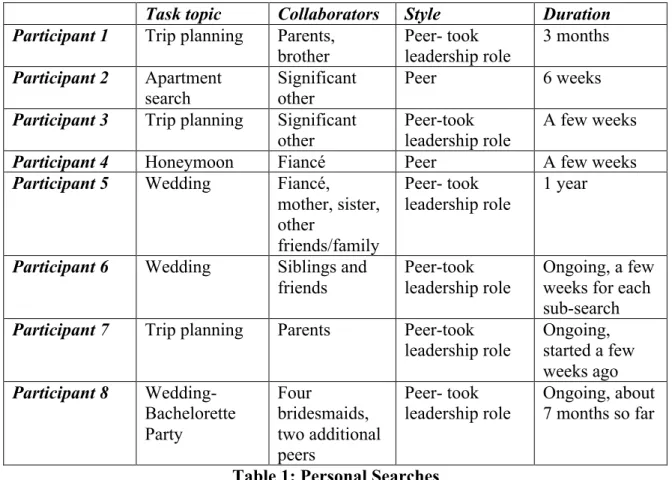
example was an apartment search. These are summarized in Table 1. This concentration
of activities on wedding and travel planning may be related to the chosen study
population of graduate students, and the strategy of recruiting participants who had a
recent collaborative searching experience in a personal context. It may be that the age or
life stage of graduate students coincides with the period of life that also includes wedding
planning, and that participants who were engaged in intensive wedding planning may
have been further motivated to volunteer for the study. Three of the searches were
between the participant and their significant other with a group size of two, and three
were with family and a group size of three or four. The remaining two search projects had
a core group of collaborators that ranged from three to five people who were a mixture of
family and friends, but also referenced additional outlying collaborators. In addition, two
of the three participants who discussed a travel search specifically referenced soliciting
recommendations from friends who would not be attending the trip as an information
source.
For the assigned task example, five participants discussed group projects for classes,
two chose literature reviews/research conducted for a faculty advisor, and one discussed a
grant proposal that was undertaken in cooperation with an advisor and peers. These are
summarized in Table 2. Group sizes ranged from two to five, with most groups
school and work projects. First, the relative power and involvement of different
collaborators played a role in how groups approached their work. Four of the
collaborations discussed in this context were among peers with similar levels of control
over the group process, investment in the topic and shared goals (completing an
assignment, creating a presentation). Two searches involved a hierarchical relationship
in which the interviewee collaborated with an advisor or doctoral student and were based
on that person’s search interests, where the collaborator had more power and control over
the search and its results, and two were mostly peer-led collaborations that also had
feedback and active support from a mentor or advisor. In addition, the level of hierarchy
in the group seemed to affect the methods and level of collaboration. When peer groups
were working together on a final product, they were more collaborative throughout the
search and compilation process, and collaborated at an earlier point in the project,
whereas during collaboration with an advisor or mentor, participants reported doing more
work on their own, and turning to their collaborators for guidance or to review final
products.
The interview guide prompted participants to choose searches that had lasted multiple
sessions and had taken days, weeks or months, and the range of search durations reported
by the participants reflected this. The period of time that the 16 searches spanned varied
from a week to a year, with four school-related searches spanning the course of a
Task topic Collaborators Style Duration
Participant 1 Trip planning Parents,
brother
Peer- took leadership role
3 months
Participant 2 Apartment
search
Significant other
Peer 6 weeks
Participant 3 Trip planning Significant
other
Peer-took leadership role
A few weeks
Participant 4 Honeymoon Fiancé Peer A few weeks
Participant 5 Wedding Fiancé,
mother, sister, other
friends/family
Peer- took
leadership role 1 year
Participant 6 Wedding Siblings and
friends
Peer-took leadership role
Ongoing, a few weeks for each sub-search
Participant 7 Trip planning Parents Peer-took
leadership role
Ongoing, started a few weeks ago
Participant 8 Wedding-
Bachelorette Party Four bridesmaids, two additional peers Peer- took leadership role Ongoing, about 7 months so far
Table 1: Personal Searches
Task topic Collaborators Style Duration
Participant 1 Group
project-program plan
3 peers Peer Semester
Participant 2 Group project-
program plan 4 peers Peer Semester
Participant 3 Group project-
teaching module 3 peers, advisor, subject matter expert
Peer + advisor Semester
Participant 4 Presentation 3 peers Peer A few weeks
Participant 5 Literature
review
1 peer, advisor Peer + advisor 3 weeks
Participant 6 Literature
review
Doctoral student
Hierarchical 4-6 weeks
Participant 7 Group project-
coding software
2 peers Peer
Ongoing-semester long
Participant 8 Grant proposal Advisor, 2
peers
Peer + advisor 6 months
III. Preferred Information Sources
When beginning their search for the work/school tasks, participants were most often
looking for academic articles or background facts and statistics. A common starting point
was turning to specific database searches, such as PubMed, ISI Web of Science, and
Academic Search Premiere, as well as searching through the library catalog and
electronic article search. Six of the eight also reported using Google Scholar, with two
commenting on its ease of use and that it turned up more results than conventional
database/library catalog searches, and one commenting that it brought up too many
results, which was overwhelming. Two participants reported doing searches on Google
Scholar to find results, and then copying citations into other databases to find the article
for free through the library. General Web search engines such as Google were referenced
in five of the work/school tasks, and it was specifically mentioned as being helpful for
finding non-academic information, for instance basic demographic or statistical
information that was used as background for a more detailed search.
Personal searches also relied heavily on Google and other search engines such as
Bing, as well as more specific sites for travel (Trip Advisor, Yelp, Kayak, Visitor’s
Bureau or government sites), wedding planning (Martha Stewart, Wedding Gawker, local
wedding planning sites and blogs), and apartment searching (Craig’s List). An additional
important source for information that was brought up by several participants was personal
recommendations. Several participants discussed soliciting opinions from other friends
or family to support their searches, emphasizing the importance of personal
recommendations and expert advice. In many cases this was a first step in the search
expert advice, it generally came after an extensive individual or group searching effort.
In addition to the use of personal or expert recommendations, other participants reported
browsing to find ideas, such as perusing website photographs and blogs. One interesting
instance of browsing for inspiration was watching reality television shows to get ideas for
wedding planning, which were available to watch online for free and could be easily
shared over email with collaborators.
Collaborative Information Seeking Practices
The first research question driving the current study is, how do groups engage in the
collaborative exploratory searches, and do their information seeking processes conform
to current information seeking models based on individuals? Several common patterns
emerged of how groups worked together to find information, and specifically what
strategies the groups used to manage their information seeking process across multiple
searchers.
I. Division of Labor
The first common group information seeking behavior observed was division of
labor. This refers to the process of determining who should do what for a search task, so
that each group member has different roles and subtasks, to reduce redundancy and
repetition of effort. All 16 of the search experiences discussed included some level of
division of labor, with a portion of the search being conducted individually. The types of
division of labor varied from informally taking on tasks and searching individually based
were coming to town, and the participant knew they would not do much searching on
their own) to explicitly dividing the task into sections and having one person entirely
responsible for that section. The process of initiating the search, and the level of early
cooperation, was very dependent on the search context: for instance, seven of the eight
academic or work searches began with a group meeting where either the group would
determine their information needs, or in the case of working with an advisor or doctoral
student, they would discuss background information about the topic and what types of
information to search for. In contrast, the personal searches had more nebulous
beginnings: two were explicitly initiated during a face-to-face interaction, but others
slowly ramped up over time.
In either case, groups would generally move from the initiation stage onward to
dividing up their search tasks, with several participants remarking that it was inefficient
to do searches together, or not feasible due to the large volume of information that needed
to be found. For instance, one participant remarked that “what we mostly do is the divide
and conquer, because I feel like trying to look up information together as a group isn’t
really that effective because you usually have one person at the computer clicking around
with the other three kind of just sitting there”. Another remarked that it would feel
inefficient to work together, when both group members were able to work on searching
independently when they had time.
However, participants did point out that dividing work up has negative consequences,
as well. One remarked that:
back and forth… it can be hard to keep track of sometimes…I have probably like 100 emails about it in my inbox.
This participant noted that work may be duplicated or lost when it is divided up among
group members, and especially when group members are relying on email and shared,
emailed documents, information management becomes an issue. Another participant
commented that the documents the group has produced while working face to face, rather
than dividing the searching and compilation process, have been higher quality, but that a
high level of collaboration is not feasible for most assignments, due to the size of the
project and searches.
II. Sharing Search Results
After group members searched for information individually, either due to an explicit
division of labor or an informal arrangement, there was a need to share their search
results with their collaborators. Table 3 summarizes common sharing methods. The
most common ways to share information in both academic/work and personal searches
were email and face-to-face communication. All 16 of the reported search tasks used
email to share information back and forth, both emailing links and summaries directly.
Fourteen of the 16 reported using face-to-face communication, including all eight of the
academic or work examples. Five out of eight of the personal searches involved people
who were more geographically distributed, and overall these types of searches relied
more on phone calls (six of eight). In the school/work searches, participants did not
report using the phone to share information; however, all of these groups had the
opportunity to meet in person regularly, perhaps reducing the need for synchronous,
(3 of 16), instant messaging (2), Facebook messaging (1), and printing out articles to
share (1). One interesting example was a “journal club” in which one participant and her
collaborators met regularly and took turns presenting articles related to their area of
research, promoting formal information exchange and collaborative analysis.
Shared resources, both online and hard copies that were emailed among group
members, were quite commonly used to compile, organize, and share information. Five
of eight work/school tasks mentioned using RefWorks to manage citations, either with
shared accounts that all group members could access, or individual accounts that were
used to keep track of items to refind later when compiling information. Google Docs
were used in both scenarios, with three searches using Google Docs and three using
Google Spreadsheets. In addition, three participants mentioned using or creating Google
Maps to keep track of location information in a way that was visually and spatially clear:
for example, one participant created a Google Map for a vacation that showed locations
of all hotels, restaurants, and attractions the group wanted to visit, to get a sense of their
walkability from each other and what order to visit them in. This was then shared with a
travel partner with notes explaining why each item had been added to the map, so that he
could understand how the items were chosen, key facts about each place, and how items
related to each other. Another common practice was emailing Word, Excel, or Power
Point documents back and forth between group members (10 of 16), with the majority of
Email Face-to face
Phone Shared doc.
Refworks Online doc.
Text Message
IM Facebook Paper
Personal 8 6 6 3 0 3 2 1 1 0
School/ work
8 8 0 7 5 3 1 1 0 1
Table 3: Sharing Methods
(Note: Table 3 shows how many of the total searches used these tools: as such, some tasks may have used several methods in combination, which may not be reflected here. For instance, a group using a Google doc and a Google spreadsheet would only be counted once in the Online Doc. category)
Both online documents and shared documents served a variety of purposes,
depending on the type of search. In multiple school/work examples, a Power Point file,
Google Doc, or Word document was used to create an outline of a presentation or report,
which would then facilitate dividing the final product into sections that each group
member could search for, compile, and synthesize independently, with a final review in
person to review and synthesize the work done by each individual. Five participants
discussed using Word documents in their school/work examples to store annotated
reference lists and notes about sources they had found, with two of these five then sharing
this document directly with collaborators to use to work together to build out a final
literature review. Google or Excel spreadsheets were used in three personal search
examples to facilitate making comparisons between items such as potential wedding
venues and apartments. One participant searching for an apartment discussed moving to
use the Google Spreadsheet as a way to facilitate comparisons, saying:
In these examples, participants using shared (rather than online) documents generally did
not report any specific tools or strategies to manage documents: rather, most said they
relied on folders, naming conventions, and a general knowledge of who had the
document at any given moment, to handle versioning and document organization.
III.Collaboration Strategies
A common pattern was detected during several searches, where collaborators would
begin a search if possible with an initial in-person meeting, which would provide a
framework and context for the search, and might include the creation of an outline and
explicitly divided tasks. Group members would then conduct most of their actual
searching individually, as well as synthesize, summarize and prepare that information to
share independently. Then, information sharing would occur either through online or
in-person communication, followed by an in-in-person meeting that would also be used to
synthesize other group members’ progress and come to an understanding of how each
piece fit together and identify any remaining gaps in knowledge. Finally, the groups
would reframe their search and iterate this process again, or finalize their results into
whatever format necessary. This process is demonstrated in Figure 1. In groups that had
a mixed hierarchical relationship, the process sometimes included additional step of
Figure 1: Sharing Methods
(Note: Steps shown in italics (search, summarize, and finalize) are undertaken individually, and those in bold happened collaboratively.)
While this was a common pattern that emerged in six of the eight work/school
collaborations, it was not true across all groups. In one work/school example, a higher
percentage of work was done independently, with most collaborators only involved in the
review portion of the search process. In addition, a second school/work example relied
on more tightly coupled collaboration with one peer collaborator, and less collaboration
with an advisor, who was only involved in the process for the meeting and reviewing
steps. In both of these cases, there was a hierarchical power dynamic involved, and the
participants took on a larger portion of the search process and a greater level of synthesis
and preparation of results before sharing. Similarly, in personal tasks, there were more
varied levels of collaboration and information sharing, perhaps due to a similar disparity
in levels of involvement in the search process by different collaborators. For instance,
while two of the participants’ experienced largely matched with this model, other
participants who discussed wedding planning with friends and family remarked on
initiating searches independently, and subsequently reaching out to other for additional
searching help and feedback. An additional factor in personal searches was geographic
distribution, leading to greater information sharing and sensemaking occurring through
Sensemaking Methods
A second research question guiding this study was, how do people engaged in
collaborative exploratory searches make sense of information they find, prepare that
information to share with others, and make sense of information shared back with them
by collaborators? Sensemaking, in this context, refers to understanding, processing, and
synthesizing the results of a search, and is a particular subject of interest because
sensemaking models generally apply to individuals rather than groups that are
undertaking a search together. Several common sensemaking behaviors emerged in the
course of the interviews, most significantly in-person synthesis and the process of
summarization and contextualization of shared information. In the interviews, these
behaviors appear to be directly related to the personality of the sharer and the
communication tool being used.
I. Face-to-Face Communication
A key sensemaking method, brought up in 14 of the 16 collaborative searches
discussed, was face-to-face communication. Several participants not only discussed
having face-to-face meetings, but stressed that it was crucial to their ability to process
information as a group and move forward. One participant remarked that in-person
communication allowed for immediate feedback and made their search easier:
Another commented that guidance and feedback on search results over email was more
difficult than meeting in person, and that in-person communication led to better
understanding, saying:
I wish I would have talked to him more face-to-face about it instead of just email back and forth and back and forth…I mean, the email thing is convenient, but, you know- sometimes if…you need help really understanding what it is he’s looking for or what you’re searching…to have him just sit down and tell you about it, or come help you search for it [is easier]”
This was found to be particularly the case in academic settings, where perhaps there is in
general a higher level of searching intensity or a greater amount of information to make
sense of. However, this happened in personal searches as well: three participants
remarked that convening in person allowed them to more easily make decisions, and fill
in gaps in their independent searching. One participant noted that after dividing up a
personal search task, the two collaborators sat down in person and “identified sort of a
series of gaps, things that neither of us had looked at yet, and then…we basically
assigned those tasks to one another” to continue working independently. The same
participant remarked that they would use a similar process on another task, coming
together to review search results and make a final decision on a hotel in person:
I’ll look at a couple dozen reviews of hotels and then I’ll come back and say, these are my top three, and we’ll sit down at the computer and look at them together. We’ll look at reviews together, we’ll look at the sites, the actual websites together, we’ll compare the prices, and then we’ll make a decision together.
Demonstrating the importance of in-person communication in both scenarios, one
effective way to kind of, synthesize everything that everyone’s found, has been in-person
conversation, that may result in a document, but it’s really personal interaction”.
II. Use of Tools and Artifacts
Participants described that both they and their collaborators made significant effort to
provide context for what they shared online rather than in-person, through methods such
as summarizing, note-taking, and copying relevant information directly into an email or
shared or online document, as well as sharing links through email. While participants all
reported using email, often to send links back and forth, they reported a variety of
summarization and contextualization behaviors, generally providing a brief description of
what to make of the information they were passing along, such as, “here’s a link to this,
here’s a link to this, here’s a link to this, here’s what I think…why I think it’d be cool,
check it out” or “so and so recommended this, he knows what he’s talking about, he’s
lived here for so long, I also recommend this or that.” In addition, while sharing
information related to academic research, note-taking, summarizing, and extracting
relevant quotes were mentioned by several participants. One participant noted:
What some people have done is just straight up copied and pasted the information they found into a Google doc, and then the rest of the people need to read that information. Then other times, and what’s more helpful, is if the person maybe copies and pastes, but then also summarizes the information. I like to summarize by making tables, or trying to organize it within an outline format.
Seven out of the eight participants made note of their personal organizational
style, and how it may have led to varied contextualization behaviors on the part of
themselves and their collaborators. For instance, three participants described themselves
effort they expended to organize and contextualize information as compared to their
collaborators who were less organized, and less likely to provide detailed notes. Another
noted that due to a “shockingly bad memory”, creating documents to take notes during
involved literature searches was essential, whether working alone or collaboratively.
Alternatively, two participants noted that in the friend/family task, knowing the level of
organization or lack thereof of their collaborators informed how they approached
organizing and sharing information. Four participants also explained that many of the
techniques they used for sharing information with others, such as creating documents that
summarized their findings and storing documents in RefWorks, were also techniques they
would use if working independently. This was useful to the participants not only because
it facilitated their own individual sensemaking process, but because it aided them in their
personal information management process, in a sense facilitating collaboration with
themselves at a future date.
When trying to make sense of information either for themselves or to share with their
collaborators, the features of the artifact or tool being used to share information often
informed how this was carried out. For example, when collaborating mainly through
email, participants used folders and labels to keep track of information, a common and
well-supported email feature that facilitates refinding and organization. In addition, four
participants described purposefully linking emails together so that all collaborators could
review the history of a conversation each time a new email was sent on the topic. This
was accomplished either by using Gmail, which automatically links conversations, or
explicitly ensuring that all previous emails are included each time through choosing the
addition, one participant mentioned using the same subject line and numbering each
email related to the search, so everyone would know that information was new but related
to the same topic.
When using Word or Google documents, document formatting was mentioned as a
way to facilitate understanding between group members, through techniques such as
using bolding, italics, headings and categories, the Track Changes feature, or using
different colored fonts to represent different group members’ contributions. One
participant noted that she does her best to “try to make it clear, use bold, or italics, or
different font sizes, to make really what she’s looking for clear in the text, and also to
separate out like, article by article, make a distinction there.” Another made an explicit
effort to facilitate understanding by using Word features, saying “I bolded some stuff,
and highlighted some stuff, and I would try and organize it as nicely as I could and
categorize and section things off, to make it easier for him to understand, and for me to
go back to”, also pointing out that this process supports individual organization and
refinding.
In RefWorks, two participants described adding notes and labels to a shared account
to distinguish who had added what, and why it was relevant. Both commented that
because their collaborator had provided notes and had labeled the document
appropriately, they were able to save time and effort by not having to start the search
from scratch. In addition, one commented that some group members were not as engaged
in the use of RefWorks, and were not as diligent in applying labels and notes, which
made the shared information source less useful. In one example, a participant was
computer code for a course project. The participant made extensive use of comments in
the code, explaining that it was not enough for collaborators to see the answers; they also
needed to have an explanation for how and why it worked, which adding comments
allowed them to. Finally, groups using Google Maps were able to spatially make sense
of data by creating a shared visualization of how various found items related to each
other, and use this information to help them make decisions as a group on what to do on
vacation.
Effects of Relationship Sensemaking Process
A final aim of the current study was to determine if the relationship between
searchers and the context of the search (school/work or personal) affected how the
sensemaking process occurred. Analysis of this was accomplished two ways: first, when
coding descriptive data, the results were separated into school/work or friends/family
tasks so that comparisons could be made between the two groups. Second, participants
were asked to compare the two experiences and how they shared and made sense of
information in each context. Two common themes emerged from analyzing this
information, related to both types of search tasks. The first was that trust is a critical
component of successful collaboration, in both environments. Four of the eight
participants mentioned needing to trust their collaborators to do their portion of the work,
and that trust needed to exist before they would feel comfortable dividing work up or
letting go of aspects of the project, which was often necessary due to the size of the
projects at hand. For instance, one participant discussed her ability to relinquish control