Kelly J. Agan. How Do Librarians Experience Copyright?: An Exploratory Study of Librarian Perception and Practice From A Survey of U. S. State Libraries. A Master’s paper for the M.S. in L.S degree. November, 2013. 74 pages. Advisor: Rebecca Vargha
Copyright law is the legal foundation for the existence and activities of libraries in the U.S. Yet the library field knows little about the day to day practices, experiences, and perceptions of librarians as they interact with the complexities of copyright law in the context of the collections and services of their institutions and the activities of the patrons they serve. Building on a literature review tracing the historical and legal context for contemporary library practice and the practice mandates of copyright law, this
exploratory research study surveyed the chief executives of the fifty state library agencies in the U.S. to collect qualitative data on professional practices related to copyright law and risk management, institutional experiences in navigating copyright, and librarian perceptions of their professional roles and responsibilities in the copyright law landscape.
Headings:
Copyright – United States
Duties of Librarians
Librarians – professional ethics – United States
Library administration
HOW DO LIBRARIANS EXPERIENCE COPYRIGHT?:
AN EXPLORATORY STUDY OF LIBRARIAN PERCEPTION AND PRACTICE FROM A SURVEY OF U.S. STATE LIBRARIES
by Kelly J. Agan
A Master’s paper submitted to the faculty of the School of Information and Library Science of the University of North Carolina at Chapel Hill
in partial fulfillment of the requirements for the degree of Master of Science in
Library Science.
Chapel Hill, North Carolina November 2013
Approved by
TABLE OF CONTENTS
INTRODUCTION... 2
PURPOSE AND IMPETUS FOR STUDY ... 4
BACKGROUND AND LITERATURE REVIEW ... 7
Historical perspectives: the librarian role and perceptions of roles and ethics ... 7
Professional practice and risk management in libraries ... 13
Professional training for librarians ... 20
Patron activities and perceptions of copyright ... 22
Perception of barriers to innovation by libraries ... 23
METHODOLOGY ... 24
Research questions ... 24
Study design ... 25
RESULTS ... 26
Survey completion statistics ... 26
Respondent institutional characteristics ... 27
Professional practices... 31
Institutional experiences ... 37
Librarian perceptions of copyright ... 39
DISCUSSION ... 42
CONCLUSION ... 50
BIBLIOGRAPHY ... 51
APPENDIX ... 60
INTRODUCTION
Libraries, as Carol Henderson (1998), past American Library Association (ALA) executive stated it, are “creatures of copyright.” Henderson used this evocative phrase to
demonstrate that American libraries owe their existence and ability to provide access to
copyrighted works to the specific provisions of Section 108 and 109 of the Copyright
Act. In their unique place in the copyright landscape, librarians are continually faced
with the need to mediate the legal risks of infringement involved in interpretation of the law’s requirements for access and use with their collective professional and philosophical
ethos to ensure that boundaries of access and use remain as wide as possible. Prior to the
1976 Copyright Act, librarians operated in a fairly well-defined and delimited
environment, with copyright coming across their radar increasingly as information
technology advanced along with tremendous growth in collections and demands for use
and preservation. The rapid development of digital media and publishing in the 1990s
together with the radical extension of copyright term and protection for digital copyright
owners have increased the challenges of interpreting statutory and case law. New efforts
in this environment to provide access and preservation services have challenged
librarians’ interpretations and public perception of what is and should be allowable. The
law makes few prescriptions to assist librarians in how they should go about the complex
tasks of mediating the divide between infringement risk and right to access and use. Despite legal space carved out for libraries as “creatures of copyright”, very little
relationship to copyright in their daily work. Librarians interact with copyright law daily,
whether indirectly by virtue of the substrate of the law or assumed professional ethics or
directly in the conscious development of systems for preservation and access, patron
activities and education, and professional librarian practice where the role of copyright is
acknowledged and accommodated. The role of librarians and their perceptions in this
landscape may shape the interaction between their professional practice and the
opportunities they can envision. A review of the published professional and research
literature suggests that there has been very little research in this foundational area of
librarian experience and library operation.
This paper reports the results of exploratory survey research from a sample of
state librarians on their professional perceptions and institutional experiences of
navigating the balance between risk and access in copyright law. State librarians and
their libraries were selected for a number of key reasons. First, they often serve a diverse
set of constituents, including their respective state legislatures, state government,
researchers and genealogists, school and community librarians, and citizens; and many
also have a leadership role for development of the public library systems in their states.
Operationally, they often contain diverse or mixed collections, including collections of
heritage materials, and they are increasingly developing digital preservation and
PURPOSE AND IMPETUS FOR STUDY
In the fall of 2012, this researcher conducted an investigation into the use of
copyright statements in public libraries. A review and analysis was conducted of a local
(North Carolina) public library copyright policy. While conducting the investigation, the
researcher also observed a potential vacuum in the practice literature about the
development of copyright policy and associated published statements. There was little
evidence in the published literature to suggest any prior field research into the
perceptions and practices of librarians or barriers encountered in the development of
copyright policy, particularly at the local library level. An informal review of public
library copyright policy statements available on the Internet suggested that, along with
the lack of practice and research literature, there is a wide range of approach to policy
statement development and content as well as little consistency in whether or not libraries
choose to have or publish policies or guidelines. The library selected for the study did
not have a published copyright policy statement. When the researcher contacted
administration to interview them on their approach, perceptions, and experiences with
copyright and policy, an initial interest in providing information ultimately turned to a “brick wall” when questions were provided to the library. This researcher hypothesized
that there might be underlying barriers and related issues to the development and
articulation of policy.
Review of library websites in the public library domain indicated, even among
published policy statements, and that for those that do, there is a wide variety of
approach, structure, and content. An additional review of state library websites suggests
the same, with many having no formal published copyright statement. At the
professional advocacy and educational level, neither the American Library Association
nor the American Public Library Association publish a formal statement, mandate, or
guidance for the development of copyright policy for their constituent communities. In
the domain of professional librarian education, a review of the websites of the top ten
professional university LIS programs in the United States suggests that most have no
formal requirement for legal training for their graduates.
At the same time, copyright policy statements are increasingly standard practice
for university libraries, with many having designated copyright librarians or university
copyright officers. Many have developed extensive policy statements that prescribe
appropriate use of materials and also educate users in use of copyrighted materials
provided by libraries.
The study presented in this paper arose from these observations and the potential
importance they suggested for formal inquiry into the experiences and perceptions of
librarians as they deal with copyright and into the ways their experiences might inform
their approaches to policy and program development. It sought to discover how
librarians perceive their role in the copyright environment, their relationship to patrons’
use of copyrighted materials, professional practices related to the law, and their
perceptions of infringement risk in relation to their institutional collections and services.
methods of access and presentation due to their perceptions and understanding of
BACKGROUND AND LITERATURE REVIEW
While the rationale for this study is situated at the intersection of four aspects of
professional librarian practice – professional training in copyright or intellectual property
law, legal requirements and professional risk management practices, established
professional ethics, and patron education – it is largely inferential since there is little
published evidence of an established foundation of research. The following literature
review will provide background supporting the rationale for study from these areas:
Historical perspectives: the librarian role and perceptions of roles and ethics
Professional practice and risk management in libraries
Professional training for librarians
Patron activities and perceptions of copyright
Perception of barriers to innovation by libraries
Historical perspectives: the librarian role and perceptions of roles and ethics
Looking at librarians’ relationship to copyright from an historical perspective
provides a framework for understanding the potentially complex role of librarians and
their practice concerns. Rapid development of reproduction and display technologies
have helped to shape the contemporary role, understanding of infringement, and concerns
of librarians. The Copyright Act of 1909, concurrent with advances in reproduction technology, while explicitly enumerating “copy” as an exclusive right of copyright
owners, made no provision for the needs or activities of libraries or the development of
reproduction technology, and understanding of infringement risk was based solely on
343). By the 1930s and 1940s, with the advent in the 1920s of microfilm and its rapid
adoption, libraries became inextricably linked with copying, despite the silence on
libraries in the1909 Act (Clapp, 1962; Tepper, 1992). As Verner Clapp, assistant chief librarian at the Library of Congress in the 1950s articulated, librarians were left “in a
quandary. . .trusting to luck. . .or [playing] safe by prohibiting all copying” (p. 55). In the absence of codification of “fair use,” the so-called “Gentlemen’s Agreement was
brokered in 1935 between the Joint Committee on Materials for Research of the
American Council of Learned Societies and the Social Science Research Council along
with the National Association of Book Publishers, notably without librarians. The
agreement carved narrow space for library copying of single copies of books or
periodicals for scholarship in order to replace loans or manual transcriptions (Smith,
1953, p. 46).
In 1941, the ALA reported to its members via the Bulletin of its “statement of policy” which it called the “Reproduction of Materials Code.” Based on the 1935
Agreement, the statement attempted to clarify the layers of issues and permissions
associated with copying, from distinguishing out of print and in-print sources (with equal
protection under copyright and the Agreement) to special guidelines on illustrations and
photos contained in copied materials. While it maintained the equality under the law
between out of print and in-print, it adopted the Gentlemen’s Agreement but advised its
members to pay more concern to its use of in-print materials (1941, p. 85), and it added
additional restrictions for limiting risk (Tepper, p. 346). Louis Smith (1953), then
attorney on the staff of the U.S. Copyright Office, pointed out the widely divergent
attesting to the burgeoning awareness of tension between ownership and access rights in
the growing copying issue, Clapp noted that scientists and scholars were mounting their
own investigation and favored an ASCAP-type approach to royalties in library copying. The “copyright-in-photocopying pot,” he concluded, “continues to boil” (p. 15).
Beginning a theme that endures today with each attempt at new legislation and
related guidelines, Tepper has pointed out that the 1935 Agreement created as many
problems as it solved, including: exposing a lack of liability protection for librarians
themselves; implication of “wrongdoing” by librarians in the word “liability”;
implication that the library “exemption” was not viewed as a public good or library right
but as a “gift”; as well as the sense among librarians that permitting copying merely as a
substitute for interlibrary loan was too restrictive (p. 347). She also points to the issue of
librarians as copyright “police”, evidenced in a 1954 statement by the Registrar of
Copyrights that libraries should “police” their copying (p. 347).
Eight years before these collective issues in copying and use were explicitly
codified in the Copyright Act of 1976, Clapp (1968) attempted to sum up the body of
assumptions that had built up around the library in copyright. In his publication
“Copyright: a librarian’s view,” he observed that in the absence of judicial or legislative
construction of what the creator’s exclusive rights actually meant, librarians were left
with a number of choices in dealing with the uncertainty of infringement risk: they could
obtain permission for each and every request; they could stop copying altogether; or they
could find some rationale for continuing to copy (p. 3). Presaging what has come to be a
common assumption that libraries, particularly public libraries, are unlikely to be sued, he
libraries. Clapp also articulated the defender of the “public interest” position which has
increasingly been carved out by libraries in their capacity as collectors, access providers,
and preservers of works for the greater public good. Clapp was among a growing voice
calling for new legislation to amend and clarify issues for libraries and copying brought
about by the 1909 Act and more generally in defense of library work.
Throughout the 1950s, 1960s, and early 1970s, librarians continued to grapple
with the law, the rapid growth of copying and display technologies, and burgeoning
collections. The dubious place of librarians was increasingly acknowledged as an “awkward position” (Zines, 1965), with evocative language to describe their concerns
and frustrations, such as librarians needing “cudgels to cut though copyright ice” (Mason,
1975) or librarians “living in the gap of ambiguity” (Flacks, 1977).
After a number of attempts by the library community and publishers to deal with
issues of copying, display technology, and growing reliance by libraries on the common
law doctrine of fair use (Tepper), the Copyright Act of 1976 provided codification of the
fair use doctrine and carved out the legal space of Section 108 which gives special
exemptions to libraries. The following year the Copyright Clearance Center was
incorporated, outside the law, to address the growing issue of permissions clearance.
By the late 1990s, concurrent with the advent of the digital age and following the
extension of copyright term in 1998 and the Digital Millennium Copyright Act (DMCA)
in 1996, a series of articles in a column titled “Conflicted Copyrights” in the journal
Online gave voice to a mounting sense of confusion and murkiness about digital rights
management in particular and copyright in general. In a 1998 article, independent
after the digital age and that librarians are “faced with uncertainty in complying and interpreting copyright laws” and that training sessions and conferences only increased the
confusion. They alluded to the increased tension, uncertainty, and risk of the digital era in phrases such as “a new era of conflicts” and “battles rage. . .about ownership. . .and
control. ” They articulated librarians’ conflicted place, between protection of copyright
for owners and protection of access for users, as “intermediaries. . .[who] feel responsible for implementing the law equitably.”
The issue of access has come to the forefront, fostered by both the library’s
longstanding commitment to provision of access for the public good and from new
assumptions in the wake of the DMCA that access is a right now also reserved for
creators (Gasaway, 2002). Dougherty (2010) uses the example of UCLA’s brush with
infringement from posting of videos on course websites to refer to copyright as a
“quagmire”, with every case its own issue in interpreting the relevance for libraries. The
sense that copyright is a mystery is evidenced in a simple web search via Google,
resulting in over 1,000 hits from across a spectrum of libraries, collection developers, and
other cultural institutions, most of which substantively deal with the theme of
“demystifying” copyright or other aspects of intellectual property law. Dames’s 2006
article “Demystifying Fair Use” attests to this from the perspective of one of libraries’
foremost intellectual property law gurus.
In 2000, Gasaway elucidated the library ethos as it conflicts with the rights of
content producers and creators despite the common values shared by both sides. She
underscored the tension of the inevitable conflict, particularly in the evolving world of
librarians “tend to view information as a necessary public good, such as food, shelter, and
warmth.” The role of freedom of access, free information, and free libraries is a hallmark
of democratic society promoted by librarians. Librarians, she states, have tended to see
fair use not as an affirmative defense to infringement but as a right. She traces the
historical underpinning of the public library ethos, with librarians now filling more than simply the role of collector and preserver. Librarians “fight the dominant culture” by
collecting materials outside its approval; they facilitate retention, organization, and access
to a varied universe of content and media formats; they hold to the tenet that access
should be free; yet she reminds readers that libraries pay for the materials they provide;
and libraries facilitate cooperative collecting and access. Cross (2012) concurs with
Gassaway, and articulates the dangers to the traditional and contemporary ethos of
librarians posed by the erosion of legal space for libraries brought about by the DMCA.
He argues that the assumed librarian role of advocate for the public good should rally librarians “aggressively to assert their rights in ways that respect the law but that also
recognize the privileged nature of library activities” (p. 208).
Finally, an interesting research study in 1999, in the wake of the DMCA, pointed
to the role of fear of liability on the part of librarians when confronted with articulating
their copyright decisions. In a column titled “Conflicted Copyrights” published in the
journal Online, Ardito and Eiblum (1999), published results of a study of approaches to
copyright in interlibrary loan services from a sample from the Internet-Plus Directory of
Express Services. The researchers found that, despite promising complete anonymity for
respondents, response rates were low, with a number of outright refusals. They
fear of liability. The survey included questions about institutional responsibility for
copyright policy, use of the Copyright Clearance Center for permissions and related
procedures for checking copyright status and ownership, handling of requests for masters
theses, fees charged, use of electronic questions for copies, and use of order forms with
the copyright notice. The researchers noted a significant “deafening silence” in
participation and reluctance on the part of librarians to speak candidly, despite their
efforts to ensure that the survey was non-confrontational and their interest in engaging
readers. Significantly, they titled the article “Document Delivery & Copyright: Librarians Take the Fifth.”
Professional practice and risk management in libraries
Librarians are understood, at least anecdotally, to be a “famously” “risk averse”
group (Joint, 2007, p. 543). And while risk management in libraries has historically been
focused (at least since notable twentieth century disasters from the flooding of the River
Arno in Florence in 1966 to Hurricane Agnes in 1972 to the brittle book crisis) on
physical protection and preservation of culturally and financially valuable library assets,
risk management is a central feature of assessing the legality of specific uses of material
under copyright and determining the risk of infringement that is surprisingly absent in the
published literature. At the same time, Tushnet (2006) observes that public libraries may have some protection from infringement suits because they lack “deep pockets” (p. 986),
and while a risk analysis gives some form to the critical content of a policy statement,
there is little guidance in the literature on specific structure or content for public library
The law, in essence, “conditions” the development of policy statements in its
provisions that make possible what librarians are able to do with copyrighted materials. The Association of Research Libraries (ARL) (2005, p. 23), in its manual “Campus
Copyright Rights and Responsibilities: A Basic Guide to Policy Considerations,” while
directed at the more complex uses (and increased risk) of universities and their libraries,
makes this connection explicit. Universities and their libraries run up against greater
requirements for policy and monitoring based on qualification for exceptions such as
distance education under the TEACH Act; however the basic concept is parallel for
public libraries. For the public library, the notice requirements provided in Section 108
provide a policy mandate. In a more indirect way, the first sale doctrine provision of
Section 109 provides an equally strong mandate for public libraries: without this
provision, they would have little ability to make circulating collections available to the
public. There is little evidence in the literature to suggest how librarians in the public
library realm experience this conditioning or the process of analyzing their risk in relation
to their materials and services.
In a 1992 working paper for presentation to the Association of Research Libraries
(ARL), Kenneth Crews outlined the relationship between libraries and copyright against
the backdrop of significant changes to U.S. Copyright law beginning in 1976 and in the
wake of recent legal cases involving interpretation of fair use (notably, Kinko’s, Texaco,
Salinger, and Wright). He described universities and research libraries, in particular, as in a “copyright squeeze” and on the “front line” of dealing with copyright questions
daily. At the same time, he asserted that misunderstanding and fear of exposure to
available within copyright. He went on to articulate libraries’ relationship on two sides
of the copyright coin: first, that libraries have a legal responsibility to “achieve
compliance” with the law and standards set by judicial precedent; and second, that they
have a responsibility to maximize “opportunities” within copyright law for meeting
informational needs. Libraries, he stated, “must assume a leadership role in shaping copyright issues as they emerge.” He argued strongly for a mandate for the use of policy
statements for libraries to articulate the specifics of both sides of this coin for their
communities.
The published literature contains a handful of studies that help shed some light on
librarian practice and concern from the university perspective. A 2003 study of 115
libraries in the American Research Library Association (ARLA) focused on library
practice in course reserves copying. Gould, Lipinski, and Buchanan (2005) surveyed
librarians on their practices as they navigated the law, use of fair use copying guidelines
and portion limitations, and institutional policy development. With 78 of 115 libraries
completing the mail survey, they found that only 13 institutions reported a university
committee on copyright with only 44.4% of these with a librarian on the committee,
which they observed was at odds with the reality that librarians are the “de facto front line interpreter and enforcer of the policy’s mandates” (p. 189). Results showed that 36%
of respondents adhered to a percentage limit in copying, with the majority following the
10% rule.
Despite adherence to guidelines, which have no precise legal mandate, librarian
respondents self-assessed themselves and their staff peers as generally having average to
to assess respondent practice by a series of copying scenarios, the study left unclear the
question of how precisely the non-percentage limitation libraries utilized tools or fair use
analyses to fill or deny copying requests. Results showed a lack of consistency on the
part of both sets of libraries in approach and process. The researchers ultimately
concluded that libraries in general need to revisit their policies and that using the
approach of arbitrary limits is restrictive (p. 196).
A 2005 study by researchers at Indiana University and the University of Illinois
provided a comparative analysis of approach to copyright across an international sample
of academic libraries using their published copyright statements. While international
comparisons are not the subject of this discussion, Shachaf and Rubenstein’s (2006)
results yielded useful information about practices among the 50 ARL libraries reviewed
and suggested the link between practice and professional ethics. Beginning with the
general caveat that assumptions about importance of copyright to librarians is evidenced
in their online presence, the researchers reported that copyright policy information from
the ARL libraries was accessed in 2 or fewer clicks by 70% of the libraries, with 15%
identifying a copyright librarian or committee at the institution and 15% stating a
commitment to monitor developments in copyright (p. 99). The researchers interpreted
this as a high value placed by librarians on copyright information. From the standpoint of libraries’ accepted responsibility to educate users, 60% provided educational and
explanatory information (p. 99). The researchers described the attitude of American libraries as “preventive” (compared to other countries they observed taking “defensive”
attitudes). They attempted to categorize reviewed libraries on a scale of social
discretionary. They categorized American libraries at the third level of demonstrating
accommodative ethical responsibility in intellectual property management (p. 100).
A 2008 study of online copyright statements in digital collections, from 786
collections representing 29 institutions in the Digital Library Federation, provided
interesting results confirming both efforts on the part of librarians to develop policy and
educational statements and at the same time a lack of established criteria and consistency
in their development and implementation. Schlosser (2009) points to policy statements
as an effort to reduce potential liability for end-user infringement (p. 373). She also
articulates the defender of the public good role of libraries in protecting the public
domain as an opportunity for creative approaches to knowledge creation (p. 374). At the
same time, she articulates a concern that libraries are constrained in digitization by
copyright and issues of fair use. Libraries’ role as stewards also mandates their role in
educating users (p. 374).
Particularly relevant for the state (and public) library with mixed collections, her
review suggested that only 28% of reviewed institutions with mixed collections had
published copyright statements. In addition, there was little evidence of consistency of
application across institutions or within single institutions, with no single institution
being completely consistent in use of statements across its own collections. Of the
institutions with statements on mixed collections, 39% of individual collections had no
statement, 56% had a statement, only 5% of collections linked a collection-level
statement to an institutional statement, only 12% made mention of public domain status,
and only 18% mentioned fair use of collections. Suggesting issues over definitions and
use but not specifically fair use (p. 381). Adding to the confusion and inconsistency over use of statements, Schlosser noted that statements could be grouped into four “memes” –
statements of specific ownership, vague ownership, what can and can not be done,
statements of protecting collections and users. She also concluded that the line between copyright and terms of use in statements is “fuzzy” (p. 382). She concludes that
inconsistencies and inaccuracies in statements may be a function of inadequate copyright
knowledge. She also suggested, along with Ardito and Eiblum, that librarians may be
reluctant to provide education for fear of additional legal risk.
A 2010 study of ARL libraries and their e-reserve practices and policy
development identified management of copyright compliance as a risk management
exercise as well as harmful “feedback effects” of risk-aversion on the part of librarians
(Hansen and Cross, 2010, p. 7). The authors noted a general lack of record keeping on
the part of libraries that leads to difficulties compiling statistics and assessing
compliance. They noted of the 32 libraries responding to the survey, 30 had developed
policies and 80% had updated them within five years (p. 18). Additionally, all but 2 of
these libraries used primarily internal counsel, best-practice guides, and peer-institution
policies to guide development. Only two libraries contacted colleagues at peer
institutions, suggesting a lack of dialogue between institutions in policy development.
The authors also noted that despite the arenas that inform library practice on copyright
(including free speech, intellectual property protection, and privacy), many librarians lack
sufficient graduate level training (p. 3).
Taking the view of libraries and librarians as copyright “enforcers”, Seadle (2005)
activity, not merely understanding copyright status of a work, because decisions and
actions may: expose institutions to potential legal action, present the possibility of
depriving copyright holders of income, or fall within fair use. He reminds readers that, being far from black and white, infringement is not “binary”. His discussion suggests a
more hidden or latent aspect of copyright compliance --- understanding enforcement
mechanisms, both on the part of the library, explicit remedies provided by law, and by the
private sector.
The use of tools for assessing and managing copyright risk has now seen more
than twenty years of persistent advocacy by legal experts in the library community.
Crews (2006, 2012), a noted copyright expert for libraries, has developed resources both
in print and online for librarians to use that focus on allowing librarians to understand the
specifics of the law as they apply in each unique informational situation. He has
provided fair use checklists that serve as a decision tree and a permanent record of the
rationale of a particular use. Other checklists and forms include documentation templates
for use with activities under the TEACH Act, forms to document copies made for
preservation or replacement or private study, and letters for permission requests.
Stanford University has published a range of tools online to help librarians and
educators. These include an extensive database of copyright renewals, a slider for
determining term and entry into the public domain in the U.S., a digital copyright slider, a
digital image risk computator, a spinner for Section 108 exemptions for libraries and
archives, and a fair use evaluator, among others. They have also gathered an extensive
services, and activities. Hirtle, Hudson, and Kenyon (2009), have added diagrams and
worksheets relevant to digitization work in libraries, archives, and museums.
Despite the growing number of credible sources available, the profession does not
have a clear picture on the extent to which librarians are aware of or use these tools in
their daily practice for decision making and risk management or the extent to which they
are able to determine credible sources to use.
From a professional practice perspective, establishing copyright policy is a
pro-active exercise for understanding, communicating, and mitigating infringement risks for
the library and its use community. The law does not provide an account of how libraries
should go about this effort; but library legal experts have distilled the requirements into
checklists and flow charts that provide decision-making tools that manifest the
conditioning of policies and practices. For example, Dames (2005a, p. 25) provides a
pyramid for concretely assessing risk in relation to provisions of Sections 107-110 that
specifically impact libraries. It is not known if or how librarians make use of these
important resources and what levels of detail are included in records they keep.
Professional training for librarians
Consistent with sentiments regarding librarian expertise or understanding of
copyright law expressed in some of the papers previously discussed, a study by Cross and
Edwards (2009) pointed to shortcomings in legal education during graduate training for
librarians. In a review and content analysis of the web presence of all fifty-seven
ALA-accredited programs, they observed that, strikingly, no institution had a requirement for a
course in legal issues for librarians. Their work also pointed out not only the range of
offerings tailored to law specifically for librarians. For example, twenty-four of the
schools had a course in legal research, twenty-two had a course in general issues, fifteen
had a course on technology and law, but only nine offered a course covering copyright
and/or intellectual property (p. 539). Forty-five of the programs had a faculty member
with a JD and 45% had a full-time professor with research interest in law. With lack of
access to faculty with legal training and lack of adequate coursework, the researchers concluded “pedagogical shortcomings” in LIS graduates (p. 540).
The librarian role of serving the needs of ensuring compliance with the law and
ensuring and advocating for open access for the public good may be seen as components
of the broader strata of information ethics. Notably, a case study of LIS education at the
University of Pittsburgh (Carbo, 2004, 2008) devoted to developing a foundation for
information ethics training for information professionals made no mention of the need for
training in copyright to help librarians navigate the complexities of the information
landscape.
This researcher’s search for studies on continuing education for legal issues
turned up very little that would inform the profession to what extent librarians seek
additional intellectual property or copyright law training after graduation, what types of
training they find the most useful, and how training might be tailored to their needs and
collections. The training may be offered in the context of annual association meetings
and provided through online venues (including ALA), but the field lacks knowledge of
the extent to which librarians take advantage of this or how training programs do or do
Patron activities and perceptions of copyright
Dames has articulated that some level of due diligence is required for libraries in their statutory role under the Copyright Act. Anecdotally, phrases such as “copyright
police” have been used by researchers and bloggers. The perceptions and attitudes of
users and their role in access and use of copyrighted materials is an important part of the picture of librarians’ experience. In the digital age of multi-media peer to peer sharing
and clamp down of enforcement of rights via the DMCA and anti-circumvention
technology, a number of writers have provided thought pieces on the role of public
perception and citizen ethos in participating in copyright compliance (Dames, 2008;
Schultz, 2006; Lunceford and Lunceford, 2008). These writers suggest that for the
public, rhetoric and social norms largely determine the extent to which the public at large
cares about copyright. If users are more likely to comply with laws that accord with
social norms (Schulz, p. 655), then short of sweeping change to law, what role do
libraries play, or do librarians see themselves playing, in shaping social norms? Quartey (2007), associate director of Brigham Young University’s Copyright Licensing Office,
noted in a review of strategies employed by her office at the University for increasing
copyright compliance (and thereby decreasing infringement risk) that over time the most broad questions such as “what is copyright” began to change to specific questions about
lawful uses (p. 99). The university used a multi-prong approach to change awareness and
attitude, through aggressive education, gaining administrative support, focused
marketing, and effective use of technology. She advocates for program developers to be “enthusiastic” about copyright. Wagner (2008), in a discussion of strategies and
success in making the library “the copyright touchstone” of the university in order to
engage and influence practices.
Perception of barriers to innovation by libraries
Numerous writers have discussed the chilling effects of copyright and increased efforts on the part of publishers to “shrink-wrap” content (McMannis, 1999) on the
development of preservation, access, and publication projects. Highly localized projects
and broader efforts to build universal libraries are perceived to be restricted by the law
and the corresponding fears of librarians and collection developers (Travis, 2005).
Copyright issues with orphan works have become an important concern in project
development (Brito and Dooling, 2005). This is an area where state libraries, in
particular, may be affected as they begin to participate in large-scale open access
initiatives to preserve and publish their heritage collections through portals such as
Internet Archive (IA). A number of state libraries, including those of Florida, Alaska,
California, and North Carolina, have already partnered with IA.
Knutson (2009) has surveyed the recent Internet Archive v. Shell case to discuss
the liabilities and defenses affecting innovators of digital projects. From another
perspective, Eschenfelder and Caswell (2010) have discussed efforts by cultural
institutions themselves to control access to collections and their possible motivations,
which involve a broad range of ethical and legal concerns such as uncertainties of misuse
METHODOLOGY Research questions
A review of historical and practice perspectives from the literature suggests the following
three areas of research questions:
1. Professional practices:
What are the professional practices of librarians in the copyright environment and how do they go about managing risk? Professional practices involved include: policy development, decision-making procedures, the use of applied resources such as checklists, workflows, and online tools; methods and resources for staying current on copyright case law and decisions; continuing education and utilization of educational resources; and access to sources of decision-making support (e.g., legal help).
2. Institutional experiences:
What are librarians’ experiences, positive and negative, with respect to copyright in their institutions, and what barriers might these suggest to the development of policy, advocacy, education, and development of new services and methods of access? Experiences would include: description of their collections, services, constituents; challenges to use of copyrighted material (either by copyright owners or patrons); experiences with patrons in librarians’ exercise of due diligence (i.e., denial of reproduction
requests); decisions to limit access and use or novel use of materials due to copyright concerns; experiences obtaining legal help; experiences
obtaining education and resources to support decision making.
3. Perceptions:
Study design
The research questions were used to develop a survey of qualitative measures
to collect data on the practice experiences and perceptions of the state librarians (or chief
officers) of state libraries in the U.S.
Criteria for study design and administration were:
1. Sample/Participants:
The sample selected was a purposive sample of fifty state libraries. The survey was addressed to the directors (or chief officers) of the libraries.
2. Survey development and administration:
The survey was developed and administered using Qualtrics software. Survey design ensured no forced responses, the ability to navigate forward and backward to change responses, and the ability of users to terminate the site at any point. The survey was available to
participants for a period of 4 weeks. Users were also able to return to incomplete surveys at any point during the open time period.
The method of administration involved the generation of an
anonymous URL in order to anonymize participants, their institutions, and their responses. The URL was given to the president of the
professional organization of state librarians, the Chief Officers of State Library Agencies (COSLA) for posting to its membership via an access controlled Ning site. Invitational script approved by the IRB was included with the posting.
Two reminders, approximately two weeks apart, were provided on Ning.
3. IRB approval:
RESULTS
The survey URL was activated for a period of three months beginning on
September 27, 2013, and data were downloaded for analysis after thirty-two days. Two
reminders were posted to COSLA members at approximately two-week intervals via the organization’s Ning. Despite the reminders, survey completion was poor, with 7
completed surveys, 14% of the original sample of 50, and four incomplete surveys.
Results presented below were compiled from the seven complete surveys since the
incomplete surveys were sufficiently incomplete to include in descriptive statistics, with
completion of fewer than 25% of survey data points. Surveys included in analysis had at
least 95% of the individual survey data points completed.
Analytic techniques used were primarily the development of descriptive statistics
by question and grouped to align with the three areas of research questions. Data are
insufficient for the development of any meaningful cross comparisons. The survey
instrument is attached in the APPENDIX.
Survey completion statistics
Survey completion statistics were obtained from the analytics provided by the
Qualtrics application. Qualtrics calculates the cumulative time the survey remains open
during a participant visit or accrued in multiple visits, with participants being able to
return to the survey as many times as wanted during the three month activation period.
completion was rounded to the nearest whole minute for the following summary
statistics. Survey completion time ranged from 10 minutes to 47 minutes, with an
average (mean) time of 24.5 minutes and a median time of 16 minutes. TABLE 1
presents the distribution of individual completion times.
Respondent institutional characteristics
Background data on institutional characteristics, collections, and services were
collected to contextualize survey data on institutional experiences and perceptions of
working with copyright law. Contextual and demographic data were collected on the
respondent’s institutional role, time in position, professional educational training,
professional continuing education training on copyright/intellectual property law, and
institutional approach to providing copyright education for staff and outside librarians. Data were also collected on respondent’s interest in taking continuing education on
copyright and preferred training formats. (Questions 1-14 and 16). Institutional context
was also developed from the collection of information about institutional collections and
services (Question 15). Results are summarized in TABLE 2.
From the seven responding institutions, all respondents reported they were their library’s director, and all respondents had obtained professional degrees relevant to
TABLE 1
SURVEY TIME TO COMPLETION N=7
Time (mins)
Respondent 1 13
Respondent 2 28
Respondent 3 44
Respondent 4 16
Respondent 5 10
Respondent 6 47
library operations and administration. Time worked in the institution overall was
collected along with time in current position; however, there were two discrepancies
(29%) observed between time in position and time in institution, potentially invalidating
one or both data points. Response to time in position was assumed to be the more likely
accurate response, and time in institution has not been utilized in reporting. Six of 7
respondents, 85%, reported being in their current position 6 or more years, and one
respondent reported time in position of 5 or fewer years.
Three of 7 respondents, 43%, reported having a course in intellectual property or
copyright law in their professional training, including one respondent with a Juris Doctor
(JD). A majority of the respondents, 71%, reported having continuing education training
in intellectual property or copyright law more than 5 years prior. Of the two reporting no continuing education in intellectual property or copyright, one indicated “not
interested/not needed” and the other indicated interest but “time constraints and not sure
where to find course.” Six of 7 respondents indicated they would take a class, with
in-person training reported by 4 as the most useful/convenient format.
Five of 7 institutions reported staff training in intellectual property/copyright law,
and 4 reported willingness of their institution to pay for the training. Webinar was the
most commonly reported format for staff training, 4 of 5 (80%). One respondent
TABLE 2
RESPONDENT INSTITUIONAL CHARACTERISTICS N=7
Respondent role N=7
Library director 7
Time in position N=7
0 to 5 years 6 to 9 years 10+ years 2 4 1 Professional training N=7 Masters (IS/LS)
Degree coursework in copyright/IP
Doctorate (IS/LS)
No degree coursework in copyright/IP
JD
Degree coursework in copyright/IP 5 (2) 1 (1) 1 (1)
Continuing education in copyright/IP
N=7
Yes (> 5 years ago) In-person workshop On-line self-paced
No
Not interested/not needed
Time constraints and not sure where to find course
Most useful/convenient format for training In person workshop
Online self-paced Webinar
Would not take a class
5 (5) (1) 2 (1) (1) (4) (1) (1) (1)
Staff training in copyright/IP N=6
Would your library pay for training for staff N=7
Yes
In person workshop Online self-paced Webinar
No
Opportunity has not arisen lately
Yes No
Do not know
Collection characteristics were assessed in a grid that included a range of
collection materials, formats, and services common to the spectrum of state libraries
(Question 15). Options presented in the survey included a number of collection types:
state government archives, newspaper collections, historical manuscript materials,
genealogy resources, digital collections of heritage materials, map collections,
photographic collections, motion pictures and audio visual works, digital resource
subscriptions, e-books, and development of online encyclopedias. Services included
interlibrary loan, digitization and publication, public programming, exhibits, digital
repository hosting, showing films, space provided for outside organization use (including
showing films), copying for patron use, and provision of self-service copying equipment.
Although it is difficult to generalize collections and services across state library
institutions, responses indicated some similarities across the responding institutions and
as well as a range of activities and services that intersect with copyright law. Six of 7
respondents reported serving as their state government archive, and while one of these
institutions does not have a library open to the public, 6 of 7 institutions have a library
open to the public. The institution without a publicly accessible library is its state
government archive, library development agency, and talking book service. Two
institutions with state government archives have a very broad mix of collections and
services, including heritage materials, digital resources, and digital preservation and
publication activities. Three respondents indicated less broad, but still mixed collections
and services. Excluding the library development agency, the institution with the least
loan (ILL), and a special professional collection. TABLE 3 provides a distribution of
reported collections and services.
Professional practices
Data on professional practices related to copyright were collected through a
number of questions covering the following areas of administrative and operational
practice: the existence and publication of copyright policy statements, provision of
copyright information to users, resources staff use to make decisions about copyright,
posting of the copyright notice on reproduction equipment and copies, and documentation
kept for copyright decisions and activities (Questions 20-42 and 53). Institutional
understanding of legal or infringement risk in relation to collections and services was TABLE 3
SERVICES AND COLLECTIONS N=7
Collections and services
# With Collection
State government archives 6
Inter-library loan 6
Licensed digital resources or subscriptions 6
Newspaper collections 5
Map collections 5
E-books 5
On-line encyclopedia 5
Copying for patrons 5
Public self-service copying equipment 5
Digital collections of heritage materials 4
On-line publication of heritage materials 4
Public programming by library staff 4
Public programming by outside organizations 4
Digital repository or hosting of other institution's collections 4
Genealogy resources 4
Provide program or meeting space for non-library groups 4 Digital consortia activities (e.g., digitization, lending, publication) 3
Exhibits 3
Digital preservation 3
Historical manuscript collections 2
Historical photographic collections 2
Historical or other sound recordings 2
Musical works 2
Motion pictures or other audio visual works 2
Films or movies shown by the library 2
captured in a matrix listing collection types and services paired with selection of risk
from a four-point rating scale from no perceived risk to high risk (Question 15). Results
of professional practice responses are summarized in TABLE 4, and the distribution of
risk assessments is summarized in TABLE 5.
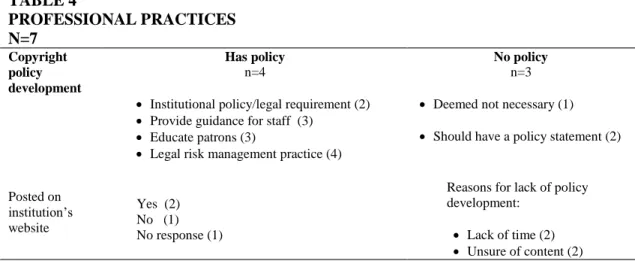
Presence of a copyright policy statement was indicated by 4 of 7 institutions
(57%). All 4 of these institutions cited legal risk management as a reason for policy
development; 2 cited institutional policy/legal requirement as another reason; 3 cited the
role of providing guidance for staff, and 3 indicated policy as patron education. Two
institutions without a policy indicated that they should have one, citing lack of time and
uncertainty of content as barriers to policy development. And the seventh institution, the
library development agency, indicated that a policy statement was not necessary in their
institution. Two of 4 indicated posting the policy on the institution’s website. A third
provided textual comments indicating it includes permissions statements on its digital
resources and provides copyright use information on reproduction equipment and in
handouts. These comments were provided to indicate that the institution views these
postings as elements of copyright policy statement.
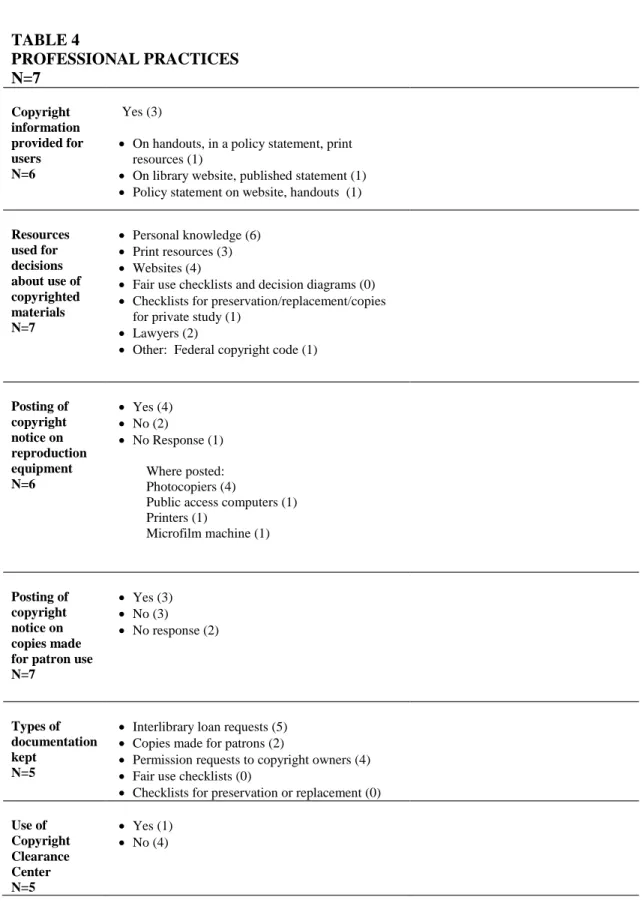
Respondents provided data on the types of resources used by staff for making
decisions related to copyright. Six of 7 (85%) respondents cited personal knowledge as a
resource, with 3 of this group citing print resources, 4 citing websites, 2 citing lawyers,
and one citing checklists for preservation/replacement. The seventh respondent, the
director with a JD degree, cited the Federal copyright code as his/her sole resource. No
included a text field to list favorite resources used. Only one institution provided
information in this field, indicating Laura Gasaway’s website.
Four of 7 surveys indicated posting the notice of copyright on unsupervised
reproduction equipment, with responses indicating posting at photocopiers (4), public
access computers (1), printers (1), and microfilm machines (1). One respondent indicated
comprehensive posting at three types of reproduction equipment, and another indicated
posting at two types. The other two respondents indicated posting at only photocopiers.
TABLE 5 provides a tabulation comparing institutional practices by institution.
Three of 7 respondents indicated use of the copyright notice on patron copies,
with two surveys having no response to the question. Five directors responded to the
question on types of documentation kept, with all 5 indicating they kept records of ILL
requests. Four indicated keeping records on permission requests. While 1 respondent
indicated use of checklists for preservation/replacement, no respondent indicated keeping
such records. One respondent indicated use of the Copyright Clearance Center.
TABLE 4 PROFESSIONAL PRACTICES N=7 Copyright policy development Posted on institution’s website Has policy n=4 No policy n=3
Institutional policy/legal requirement (2)
Provide guidance for staff (3)
Educate patrons (3)
Legal risk management practice (4)
Deemed not necessary (1)
Should have a policy statement (2)
Reasons for lack of policy development:
Lack of time (2)
Unsure of content (2) Yes (2)
TABLE 4 PROFESSIONAL PRACTICES N=7 Copyright information provided for users N=6 Yes (3)
On handouts, in a policy statement, print resources (1)
On library website, published statement (1)
Policy statement on website, handouts (1)
Resources used for decisions about use of copyrighted materials N=7
Personal knowledge (6)
Print resources (3)
Websites (4)
Fair use checklists and decision diagrams (0)
Checklists for preservation/replacement/copies for private study (1)
Lawyers (2)
Other: Federal copyright code (1)
Posting of copyright notice on reproduction equipment N=6
Yes (4)
No (2)
No Response (1)
Where posted: Photocopiers (4)
Public access computers (1) Printers (1)
Microfilm machine (1)
Posting of copyright notice on copies made for patron use N=7
Yes (3)
No (3)
No response (2)
Types of documentation kept
N=5
Interlibrary loan requests (5)
Copies made for patrons (2)
Permission requests to copyright owners (4)
Fair use checklists (0)
Checklists for preservation or replacement (0)
Use of Copyright Clearance Center N=5
Yes (1)
Although there are insufficient data to provide for statistically relevant
comparisons across institutions, TABLE 6 provides a comparison of professional and
institutional practices across the seven responding institutions to highlight the differences
in practice reported.
TABLE 6
PROFESSIONAL PRACTICES – INSTITUTIONAL COMPARISON
Respondent 1 2 3 4 5 6 7
Copyright policy statement
No statement
Statement No statement
Statement Statement Statement No Statement
Policy on library’s website?
NA Not on website
NA No On website On website NA
Copyright use information provided for users
No Handouts Published statement Print resources
No NR Website
Published statement
Handouts No
Staff Resources Utilized Personal knowledge No favorite resources Personal knowledge Print resources Websites Lawyers Favorite resource: Laura Gasaway online Personal knowledge Websites Personal knowledge Print resources Websites Lawyers Personal knowledge Websites Checklists for preservation/ Replacement Lawyers Federal copyright code Personal knowledge Print resources Copyright notice posted at reproduction equipment
No Photocopier No NR Photocopier Photocopier Public access computers Printers Photocopier Microfilm machine Copyright notice on patron copies
Yes Yes No NR No No
Record keeping Inter-library loan requests Permissions requests Inter-library loan requests Permissions requests
NR NR Inter-library
Data was collected on respondent assessment of infringement risk relative to
institution-specific collections and services (Question 15). Results are summarized in
TABLE 7. Responses showed a range of assessment of risk across institutions, with a
number of categories having a range of ratings for a given collection type or service.
Categories with the greatest range of assessment included: newspaper collections, digital
collections of heritage materials, online publication of heritage materials, interlibrary
loan, public programming by outside organizations, e-books, online encyclopedias,
genealogy resources, copying for patrons, and public self-service copying equipment.
TABLE 7
COLLECTION CHARACTERISTICS AND RISK ASSESSMENT
No Risk Minimal Risk Moderate Risk High Risk Library does not provide this Total Responses
Historical manuscript collections 0 0 1 1 5 7 Historical photographic collections 0 0 1 1 5 7 Historical or other sound recordings 0 0 2 0 5 7 Musical works 0 1 1 0 5 7 Motion pictures or other audio
visual works
0 1 1 0 4 6
Newspaper collections 0 4 0 1 2 7 Map collections 0 4 1 0 2 7 State government archives 4 2 0 0 1 7 Digital collections of heritage
materials
0 1 2 1 3 7
On-line publication of heritage materials
0 1 2 1 3 7
Digital consortia activities 0 0 2 1 4 7 Inter-library loan 0 3 2 1 1 7 Public programming by library staff 0 4 0 0 3 7 Public programming by outside
organizations
0 1 2 1 3 7
Exhibits 0 2 1 0 4 7
E-books 0 3 1 1 2 7
Licensed digital resources or subscriptions
0 3 2 1 1 7
Digital repository or hosting of 0 1 2 1 3 7 On-line encyclopedia 0 3 1 1 2 7 Digital preservation 0 0 2 1 4 7 Genealogy resources 0 1 1 2 3 7 Films or movies shown by the
library
2 0 0 0 5 7
Films or movies shown by outside organizations
0 2 0 0 5 7
Provide program or meeting space for non-library groups
0 4 0 0 3 7
Copying for patrons 1 2 1 1 2 7 Public self-service copying
equipment
Institutional experiences
Data on institutional experiences in managing and dealing with copyright were
collected through several data points on the survey. Questions included staff experience
receiving copyright questions from patrons and constituent public libraries, receipt of
challenges from owners of copyright, denial of reproduction requests to patrons due to
suspected abuse of copyright, use of legal counsel, and areas of uncertainty of the law.
Reported experiences are summarized in TABLE 8.
Three of 7 institutions reported receiving patron queries on copyright, and 6
reported queries from public libraries. Five institutions reported that there are areas of
copyright that seem important for the institution but where copyright is difficult to apply
or where there is uncertainty about decisions. Areas of concern reported were: state and
federal documents published by commercial publishers or state agencies, confusion over
public domain and copyright, concern over online encyclopedia with copyrighted entries,
digital rights, confusion of patrons and assumption that all government documents are in
the public domain, and concern over state government publications for states without
clear laws. Two institutions reported receiving challenges from copyright owners, with
both institutions reporting removal from publication or circulation of the material in
question. Two institutions reported denial of a copying request to a patron suspected of
copyright abuse. And 6 of 7 reported access to legal counsel, with 3 of this group
TABLE 8
INSTITUTIONAL EXPERIENCES
Areas of copyright importance to library but difficult to apply or unsure of decisions N=7
No Yes
Areas of concern:
State and federal documents with copyright when published by a commercial publisher or sold to state agencies
Confusion between public domain and copyright
Concern over online encyclopedia with copyrighted entries – i.e. publication by a state agency is public domain but use of individual entries is not
Digital rights
States without clear laws for state government publications
Confusion for patrons and assumption that all government publications are public domain
2 5
Patron queries to staff about copyright N=7 Yes No Don’t know 3 2 2 Receipt of queries on
copyright from public libraries in state N=6
Yes 6
Receipt of challenge from copyright owner to use of materials N=7
Yes
Online publication
Donated DVD put into circulation
No
Do not know
2
1 1
Denial of reproduction request to patron due to suspected abuse of copyright N=6 Yes No 2 4
Use of legal counsel N=7
Access to legal counsel
Librarian perceptions of copyright
Respondent perceptions of their institutional and professional relationship to
copyright were assessed in two panels of the survey (Questions 53 and 54). The first
panel provided a series of statements related to institution-specific activities and
practices, and the provided statements reflecting potentially common perceptions of the
professional and ethical role of librarians. TABLE 9 presents results from the survey
panels, organized with related questions grouped together (although this is not the
ordered the participants followed).
Comparison of responses indicates differences in perception of knowledge versus practice. For example, comparing the question “Staff are well trained to answer patron
questions” of copyright with “Staff understand fair use” shows a marked difference. Five
of 6 respondents to “Staff are well trained to answer patron questions” disagreed with the
statement, while 5 reported that “Staff understand fair use.” At the same time, the question “Staff are well trained to apply copyright” resulted in split results, with 3
agreeing and 3 disagreeing with the statement. This difference may reflect the difference
between an understanding of copyright in relation to institutional operations but difficulty
in working with patrons to explain how copyright applies to specific uses. (It may also
reflect the fact that the survey statement was interpreted as answering questions in
general versus questions specifically about copyright.) While 6 of 7 respondents (with
one non-responder) indicated that staff have resources available to consult, one of these
respondents disagreed that staff consult the available resources. In comparison, only 2 of
In general, responses tended to be split in the grid looking at perceptions of
institutional practices and training. The statement “Library managers follow court cases involving copyright” was split 3/3 (agree/disagree) with the corresponding statement “It
is sometimes difficult to understand how a court case applies to our library” was split 4/3 (agree/disagree). The related question “Library management understand how legal
opinions in intellectual property law affect our library” resulted in a 3/3 split
(agree/disagree) of respondents. Three of 4 institutions responding agreed with the statement “We sometimes have difficulty determining copyright ownership” while only 2
of 5 agreed “It is easy to figure out the copyright status of our materials.” The statement
“Our concerns or questions about copyright limit new uses of our library’s resources”
was split 2/3 (agree/disagree).
Respondent perceptions of professional roles and responsibilities indicated
agreement of all 7 respondents (100%) to the statements that professional training should
include intellectual property and copyright law education, that librarians should be
advocates for fair use, and that librarians should educate their users on lawful use of
copyrighted materials. However, responses were split on the question of the adequacy of
librarian knowledge of the law and whether copyright law conflicts with intellectual
freedom. Only 2 of 6 respondents (33%) agreed with the statement “Librarians generally have adequate knowledge of intellectual property and copyright law.” The statement
“Copyright law conflicts with intellectual freedom” was split 3 to 4, with 3 of 7