Http://www.ijetmr.com©International Journal of Engineering Technologies and Management Research [23]
THE EFFECT WEIGHT OF BACKPACK ON POSTURAL CONTROL
AMONG PREP SCHOOL STUDENTS IN TANTA CITY
Mohamed N. Al Khouli *1, Anees S. Ghait *2, Amr A. Abogazya *3
*1 Department of Growth& Development disorders and its Surgery in Pediatric, Delta University
for Science and Technology, Egypt.
*2 Department of Biomechanics, Kafrelsheikh University, Egypt.
*3 Department of Basic Science, Faculty of Physical Therapy, Kafrelsheikh University, Egypt
Abstract:
Background: The aim of this study was to evaluate the changes in postural control and stability among prep school students in Tanta city with and without backpacks.
Method: The study was conducted with a sample of 30 children, 16 boys and 14 girls with a mean age (years) 13 + 1.03, body mass (kg) 40.6 + 10.14, height (m) 1, 50 + 0.15, BMI (kg / m²) 20.25 + 3.70. Samples were selected randomly, divided into 2 equal groups. Group (A):15 Participants tested with back packs, group (B): 15 Participants tested without back packs. Balance assessment was done in biomechanics lab, faculty of physical therapy, Delta University for Science & Technology. The dynamic balance parameters (Anterior posterior (AP), Mediolateral (ML) and Overall (OA) stability indices) measured by Biodex Balance System at stability level-7, with standard load (3 kg), based on average back pack mass of the volunteers. Results: the results suggest there was statistical significant difference between both groups (A&B) (P< 0.05).
There is decrease in balance parameters including (OA, AP and MLindices) at seven level of stability during the dynamic balance test in group A which tested with back packs compared with group B which tested without backpacks.
Conclusions: When comparing between the mean values of participant's stability indices (OA, AP and ML) at stability level-7 within the same group (A or B), there was no statistical significant difference (P> 0.05).
Keywords: Postural Control; Stability; Backpack; Balance; Prep School Students.
Cite This Article: Mohamed N. AlKhouli, Anees S. Ghait, and Amr A.Abogazya. (2018). “THE EFFECT WEIGHT OF BACKPACK ON POSTURAL CONTROL AMONG PREP SCHOOL STUDENTS IN TANTA CITY.” International Journal of Engineering Technologies and Management Research, 5(9), 23-29. DOI: https://doi.org/10.29121/ijetmr.v5.i9.2018.284.
1. Introduction
Http://www.ijetmr.com©International Journal of Engineering Technologies and Management Research [24] Backpack is one of the most common and popular bags among different segments of society, especially students. Various studies have been reported that backpack has great popularity among various methods of carrying school books and stationaries (2).
Carrying heavy bags may cause musculoskeletal disorders and balance problems among students (3).
The backache pain usually caused by frequent carrying heavy bags and inappropriate walking movements would led children to be weaker in recent times and also there in action would resulted in the inability to carry back pack load. It must be taken him or her seriously if the child complains from various problems such as back ache, neck ache, shoulder pain, hand pain, waist bending, difficulty in picking up and removing the back pack, or shoulder pain (4).
If the bag is too heavy or carry incorrectly may cause backache and have effect on muscles and joints, thus child's body could be seriously fatigue. Such changes in body standing can lead to improper balance in the spine, and consequently harm spine disks. The most common detected abnormalities were included asymmetric shoulder due to carrying back packs in a one-way manner among girl students and curved lumbar due to carrying heavy two-way backpacks among boy students (5).
The habit of using back packs fit, combined with bad posture habits as the main cause of spinal diseases in children, even if these are considered multifactorial (6), being the excess weight of the back packs and time exposure to the load frames commonly associated with back pain (6).
Thus, the use of back packs can be change the normal postural control in children and can have varying effects on individuals eutrophic or are obese and with different levels of physical activity due to the change in center of mass caused by the implement load of the back pack on the back of the body, so that there is a displacement around the base of support of the feet (7) (8).
Due to the hazards of back pack on school children, the purpose of our study was to evaluate the changes in postural control and stability among prep school students in Tanta city with and without backpacks.
2. Material and Methods
The study was conducted with a sample of 30 children, 16 boys and 14 girls with a mean age (years) 13 + 1.03, body mass (kg) 40.6 + 10.14, height (m) 1, 50 + 0.15, BMI (kg / m²) 20.25 + 3.70. Samples were selected randomly, divided into 2 equal groups. Group (A):15 Participants tested with back packs, group (B): 15 Participants tested without back packs.
The load carried in his or her backpack during testing was calculated using the average of the values of the mass of the back pack of all children on the test day (3 kg) was established.,
Http://www.ijetmr.com©International Journal of Engineering Technologies and Management Research [25] lateral (ML) and Overall (OA) stability indices) measured by Biodex Balance System at stability level-7.
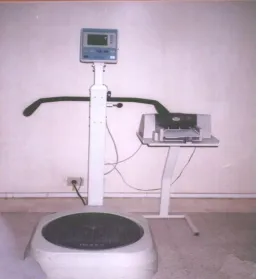
The dynamic balance parameters (Anterior posterior (AP), Medio lateral (ML) and Overall (OA) stability indices) measured by Biodex Balance System, It is a balance screening and training tool Biodex Medical System (IncShirley New York, U.S.A).
Biodex balance system consists of a movable balance platform, which provides up to 20 degree of surface tilt in 360-degree range. The stability levels available by the system range from a completely firm surface (Stability level-8) to a very unstable surface (Stability level-1).
The biodex balance assessment was performed in standing position. (Figure-1)
The subject was instructed to focus on the visual feedback screen directly in front of patient and attempt to maintain the cursor at the center of the screen while standing on the unstable platform (stability level -7).
Statistical Analysis: Means and standard deviations were calculated for each variable using descriptive statistics. Paired t-test was used to analyze and compare the gained results within each group and Independent t-test was carried out to assess differences in the balance parameters between both groups (A&B).
All statistical analyses were performed using SPSS (Statistical Package for social sciences, Version 18.0). The significance Level was set at P<0.05.
Http://www.ijetmr.com©International Journal of Engineering Technologies and Management Research [26]
3. Results
Table 1: Comparison between stability indices for group A :( prep school students tested with back packs) versus group B (prep school students tested without back packs) at stability level
seven.
Stability Index (SI)
X
±SD Sign.
Overall Stability Index group A 4.77± 1.94 P<0.05 group B 1.57 ±1.17
Anteroposterior Stability Index group A 3.38 ±1.36 P<0.05 group B 1.96±1.15
Mediolateral Stability Index group A 3.93 ± 1.23 P<0.05 group B 1.41 ±0.71
As shown in table (1), the mean values of overall, antero posterior and medio lateral stability index at stability level seven for group A :( prep school students tested with backpacks) versus group B (prep school students tested without back packs) were as follows:
Overall Stability Index
Statistical analysis of the mean values of overall stability index for the group A and group B showed high significant differences. The mean values of overall stability index for the group A and group B were 4.77± 1.94 and 1.57 ±1.17 respectively.
Antero posterior Stability Index
Statistical analysis of the mean values of antero posterior stability index for the group A and group B showed high significant differences.
The mean values of antero posterior stability index for the group A and group B were 3.38 ±1.36 and 1.96±1.15 respectively.
Medio lateral Stability Index
Statistical analysis of the mean values of medio lateral stability index for the group A and group B showed high significant differences.
The mean values of medio lateral stability index for the group A and group B were 3.93 ± 1.23 and 1.41 ±0.71 respectively.
The results suggest there was statistical significant difference between both groups (A&B) (P< 0.05). There is decrease in balance parameters including (OA, AP and ML indices) at seven level of stability during the dynamic balance test in group A which tested with back packs compared with group B which tested without back packs.
Http://www.ijetmr.com©International Journal of Engineering Technologies and Management Research [27]
4. Discussion and Conclusion
Within developed nations, backpack use amongst school children has become the most popular means of transporting belongings to and from school. However, there is a growing public concern that over loaded children’s and adolescent’s back packs may lead to the development of back pain and other musculoskeletal injuries (9).
In recent years, school health has been the object of attention in the scientific community, especially with regard to postural changes of the spine and back pain in children and teenagers (10).
Due to the great number of spinal disorders in adults, researchers investigate children and adolescents to find the possible causes for these disorders (11).
Back packs are commonly used by students of all ages with more than 90% of school children carrying back packs worldwide. Children are introduced to the concept of carrying a back pack as early as 2 years of age (12).
Decreased availability of school lockers as a result of vandalism and security concerns, increased homework, larger textbooks, and other objects being carried to school has prompted the increase use of back pack by school children which in turn, has led to both an increase in weight and duration of back pack carriage (13).
The aim of this study was to evaluate the effect of back pack weight on the dynamic balance among boys and girls of prep school students in Tanta city.
The results suggest there was statistical significant difference between both groups (A&B) (P< 0.05).
There is decrease in balance parameters including (OA, AP and ML indices) at seven level of stability during the dynamic balance test in group A which tested with back packs compared with group B which tested without back packs.
When comparing between the mean values of participant's stability indices (OA, AP and ML) at stability level-7 within the same group (A or B), there was no statistical Significant difference (P> 0.05).
Many researchers have suggested that children aged twelve to thirteen years old at the time of carrying back packs as much as seventeen percent of their body weight adopt leaning condition of forward. This implies that the weight of back pack is too heavy for this age group.
Http://www.ijetmr.com©International Journal of Engineering Technologies and Management Research [28] By moving the center of mass (COM) towards the back with carrying back pack, the anterior trunk muscles react and by increasing their activities try to neutralize this movement and are effective to balance body building.
It causes the back muscles less involved and dorsal anterior muscles work harder. Together, these changes in body building in order to stabilize the center of body are considered as body's compensatory responses.
Increasing the weight of back pack will lead to bending of the trunk, head and neck among adolescents.
These pressures on the muscles of neck and back make excessive fatigue and reducing balance and damage to the individual.
If the weight of back packs higher than a normal range, these changes may be because of weakness of musculoskeletal among adolescents and may be higher than the normal range among them.
It cause changes in structure of adolescents or make some disorders for balance controlling and problems in musculoskeletal.
The results of our study indicate accordance with other research results such as his study under title of the Effect of Back pack Weight on Static and Dynamic Balance among Male Students of 10 to 12 Years Old in Shahr-E Kurd. The results showed that, there was a significant difference among static and dynamic balance (P<0.05). The results indicate that there was reduction in static and dynamic balance as well as some of the dynamic balance dimensions in using back pack by weight of 10.5% and 13% among students of Shahre-Kurd (14).
The results of our study matched with another study under title of analysis of influence of back pack in balance in school children. The aim of this study was to evaluate the changes in balance in eutrophic children, overweight and obese through stabilometry, with and without backpacks (15).
The results suggest a significant increase in the COP displacements in the medial-lateral axis for eutrophic children when using back packs and a significant increase for overweight children compared to the maximum displacement in the anterior-posterior axis. Sothere was variation in static equilibrium between the two conditions, with and without backpack, more significant for the normal-weight group.
References
[1] Voll HJ, Klimt F 1977. Strain in children caused by carrying school bags. (From Die beanspruchung des kindes durch die schultasche). Offentliche Gesundheitswesen,39: 369-378. [2] Hong Y, Cheung, c.k. Electromyography response of back muscles during load carriage. Gait
posture. 2003; 17(1):28-33.
Http://www.ijetmr.com©International Journal of Engineering Technologies and Management Research [29] [4] Fong D.T.P, Hong Y, and Li J.X, (2004).The effect of load carriage and school bag design on lateral trunk posture during stairs descent in children, International Society of Biomechanics of Sports Congress XXII,Ottawa, Canada.
[5] Feingold AJ and Jacobs K, (2002). The effect of education on backpack wearing and posture in a middle school population, Work, 18: 287-294.
[6] COTTALORDA, J. et al. Backpack and spinal disease: myth or reality? Rev Chir Orthop Reparactice Appear. Mot. 004;90(3):207-14.
[7] MACKENZIE, W. et al. Backpacks in children, Clinical Orthopedics and Related Research 409 (2003), 78–84.
[8] RENEMAN, M.F. et al. Back pain and backpacks in children: Biomedical or bio psychosocial model? Disability and Rehabilitation, 2006, 1293–1297.
[9] LANES, T., et al. Long term follow up of patients with low back pain treated in a multidisciplinary y rehabilitation program. Spine 1995; 20: 801-806.
[10] Heather M. Brackley, Joan MS and Jessica CS (2009). Effect of backpack load placement on posture and spinal curvature in prepubescent children. Work. 32:351-360.
[11] Frances E.Kistner , Postural Compensations and Subjective Complaints Due to Backpack Loads and Wear Time in Schoolchildren Aged 8 to 11,Abstract of a dissertation at the University of Miami.August-2011, page no 25-107.
[12] Grimmer KA, Williams MT, Gill TK 1999. The association between adolescent head-neck postures, back Ache, weight and anthropometric features. Spine, 24: 2262-2267.
[13] Haselgrove C, Straker L, Smith A. (2008) Perceived school bag load, duration of carriage, and method of transport to school are associated with spinal pain in adolescents: an observational study. Australian Journal of Physiotherapy. 54:193-200.
[14] JACOBS K., Are backpacks making our children beasts of burden? Proceedings of the XVI Annual International Occupational Ergonomics and Safety Conference. Toronto: ISOES, 2002.
[15] Majid Bakhshi: The effect of Backpack Weight on Static and Dynamic Balance among Male Students of 10 to 12 Years Old in Shahr-E Kurd. International Journal of Sport Studies. Vol., 6 (3), 178-182, 2016.
[16] Ricardo Santana Braga, Raphael de Souza Alvarenga, Eric Leal, Flávia Porto, Pedro Paulo Soares, Jonas Lírio Gurgel: analysis of influence of back pack in balance in school children. Brazilian congress of biomechanics, 2013.
*Corresponding author.