Culturally Appropriate Adaptation of an Evidence-Based HIV Prevention Program for Latinas in North Carolina
by Tara Ilsley
A paper presented to the faculty of The University of North Carolina at Chapel Hill in partial fulfillment of the requirements for the
degree of Master of Public Health
in the Department of Maternal and Child Health. Chapel Hill, N.C.
11/15/2013
Approved by:
First Reader
Table of Contents
Introduction and Background: ... 3-8
Literature Review: ...8
Findings: ...9
Rationale for Adaptation: ...11
Tools for Adaptation: ...13 Theoretical Frameworks for Adaptation: ...18
Discussion: ...22
Case Studies: ...23
Case Study #1: VOCES Centers for Disease Control and Prevention (CDC) Diffusion of Effective Behavior Intervention ...23
Case Study #2: CDC, SEPA (Health, /Education, /Prevention, /Self-care): ...25
Case Study #3: Latino Commission on AIDS, Latinas por la Salud, ...27
Recommendations: ...28
Conclusion: ...29
Introduction:
The Latino population is the fastest growing ethnic group in the United States, increasing 30% from 2000 to 2010. (2) In 2010, Latinos and especially Latinas were one of the fastest-growing segments of the U.S. population to become infected with HIV. The Centers for Disease Control and Prevention (CDC) states that in 2009 the rate of HIV infection of Latinas was more than four times that of white women. (2) In many cities such as New York and San Francisco, Latina- specific HIV/AIDS prevention programs have been successfully implemented and effective in reducing risk of HIV/AIDS. The purpose of this paper is to discuss the results of a literature review of culturally appropriate HIV prevention programs for Latinas, and provide recommendations for implementation of such a program in North Carolina. The state of North Carolina need not wait while HIV/AIDS infection rates of Latinas rise, as HIV/AIDS prevention
programs exist to meet the needs of Latina women and can be adapted to meet the state’s needs.
Background:
The large influx of Latinos to the state of North Carolina has vastly shifted state demographics. From 2002 to 2010 the Latino population in North Carolina increased 77%. (3) Latinos make up a slightly higher proportion of AIDS cases (6.3%) than of HIV non-AIDS cases (5.3%); this may be an indication of cultural and language barriers to testing and access to care among Latinos in North Carolina. (3) Latinos are more likely to be tested late in HIV/AIDS and diagnosed with AIDS. The number of Latinos in the state is
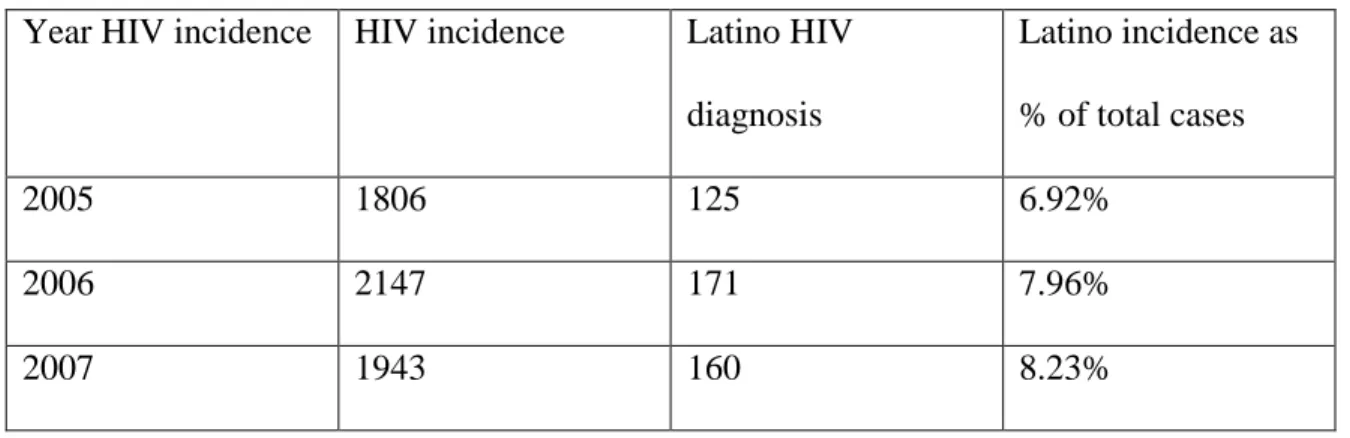
increasing, but HIV incidence is stable overall. Figure 1 details the levels of HIV incidence in North Carolina between 2005 and 2007. In 2006, 2007 and in 2008 8% of
North Carolina reported overall and Latino HIV diagnoses, 2005-2007
Year HIV incidence HIV incidence Latino HIV
diagnosis
Latino incidence as
% of total cases
2005 1806 125 6.92%
2006 2147 171 7.96%
2007 1943 160 8.23%
Figure 1: Sources: Surveillance Reports, North Carolina Division of Public Health, HIV/STD Prevention & Care Branch, 2005-2007 (3)
It is important to note that geographically, the largest populations of Latinos in
North Carolina reside in rural areas. Duplin County has the most prominent Latino
population at 20.6% of the county’s population. (10) In 2009 McCoy wrote a report
called, “HIV/AIDS Crisis in Eastern North Carolina” which detailed the high HIV/AIDS
rates in rural and eastern NC. (8) McCoy explained that NC has some of the highest HIV
infection rates in the nation. (8) Adapting an HIV/AIDS program for Latinas in rural
counties such as Duplin County would be extremely beneficial. The map below in Figure
2 shows the Hispanic/Latino population percentage among North Carolina’s cities and
towns in 2010. Figure 3 displays the rates of persons living with an HIV diagnosis, in
2009 by county in North Carolina per 100,000 persons. Note the areas of high Latino
population in Figure 2 and Figure 3 compared to rates of persons living with HIV
diagnosis in those areas in 2009. Chatham County has a high Latino population and high
Figure 2: U.S. Census Bureau. (2010). State and County Quick facts: North Carolina. (7)
Rates of persons living with an HIV diagnosis, by county, North Carolina, 2009
For many Latinos, late diagnosis may be related to an inability to access care and obtain
an HIV/AIDS test. Figure 3 does not include the many individuals who do not yet know
their HIV/AIDS status. Latina’s access to HIV education, testing, and prevention in
North Carolina is an important factor in adapting a specific HIV/AIDS prevention
program.
Culturally competent care may be insufficient in many areas of North Carolina. Barriers may exist such as lack of interpreters and materials in Spanish, lack of attention to literary levels and lack of sensitivity to cultural differences. In more densely populated areas of North Carolina such as Wake, Durham, and Mecklenburg Counties, bilingual staff is present in the public health departments, but bilingual services may not be present in all areas of the state. (6)
Access to HIV/AIDS testing and medical care in North Carolina for Latinos, and especially undocumented immigrants primarily falls on the Public Health Departments and Federally Qualified Health Centers (FQHC s). (6) FQHC’s are geographically dispersed across the state through 161 sites in 64 North Carolina counties. (6)
Latinas who have not accessed the healthcare system in North Carolina or have moved from another state or country.
North Carolina’s mandatory HIV/AIDS testing law for pregnant women states that when a woman enters prenatal care she will receive an HIV/AIDS test unless she refuses opt-out policy. (7) If a woman declines the test at prenatal visits, she will be tested at delivery with or without consent. (7) Once delivered, the baby will be tested before leaving the hospital, with or without the mother’s permission if mother declined earlier HIV/AIDS test. The goal of the 2007 mandatory HIV/AIDS Pregnancy Testing Law was to ensure that all women have the opportunity to be tested for HIV/AIDS early in their prenatal care those who are HIV-positive can begin ante-retroviral treatment early to reduce risk of mother-to-child transmission. (7)
In 2012, the North Carolina State Health Department expanded funding to increase the number of high risk individuals tested for HIV, particularly among minorities and young men who have sex with men, by expanding nonjudgmental and culturally sensitive nontraditional testing in high prevalence areas. (7) The State Health Department also implemented an HIV prevention project and offered testing at fixed sites including homeless shelters, jails, substance abuse treatment centers, migrant health centers, community-based organizations, mental health facilities, nightclubs, and college campuses. (7) The HIV prevention project was solely directed at young men who have sex with men. In 2012 the North Carolina State Health Department recognized the specific need to focus on the prevention of HIV/AIDS for the Latino population.
focused on a testing initiative for men who have sex with men. The Communicable Disease Branch of the State Health Department partnered with the Latino Commission on AIDS and the Centers for Disease Control and Prevention in 2012 to strengthen capacity of local Latino community-based organizations and to assist in implementing culturally proficient HIV prevention interventions. The Communicable Disease Branch works in collaboration with the state’s HIV/AIDS Statewide Community Planning Group, the Office of Minority Health and Health Disparities, Latino Health Advisory Group, the Latino Commission on AIDS “Deep South Project” Planning Committee, and the CDC Health Disparities Work Group. Each of these groups collaborates to address either directly or indirectly Latino HIV/AIDS/STD prevention, treatment, or healthcare related issues. (7) North Carolina is moving in the right direction by increasing the statewide HIV/AIDS testing program as well as prevention interventions. It is clear that North Carolina is making strides by focusing on HIV/AIDS prevention for Latinos, but solely with men and primarily with men who have sex with men. It is essential to adapt a
program specifically for women, as the prevention needs and impact of HIV are unique to women.
Literature Review:
much progress has been made in HIV/AIDS in the last twenty years. (14) The adaptation of HIV/AIDS programs prior to HAART (Anti-Retroviral Therapy) in 1997 were
excluded if they focused primarily on end-of-life AIDS adaptation programs. The second search reviewed recent articles on key initiatives and programs aimed at HIV/AIDS specifically for Latinas/Latinos/Hispanics. Twenty-four articles were selected out of 61 totals. Two databases were searched PUBMED and PsycINFO. Key search terms included best practices, HIV or AIDS Latino, Latinos, Latina, Latinas, Hispanic,
Hispanics, Mexican American, Mexican Americans and Cultur* 1and women. The use of Cultur* as a search term was important since titles and abstracts were examined with particular attention given to backgrounds and methods framing HIV/AIDS in terms of adaptation focus on cultural competence and particularly Latina women. Articles that were excluded did not primarily focus on Latinos and four articles that were excluded were published only in Spanish.
Findings:
The search strategies detailed above in the literature review yielded seven articles that focused on the theoretical frameworks for adaptation, four articles that focused on theoretical frameworks, and six articles focused on applied research of the acculturation of Latinos. The literature findings explained that neither the Centers for Disease Control and Prevention or National Institutes of Health has a recommended process or set of agreed-upon best practices for cultural adaptation of interventions to conditions different from those present in the original research. For example, effective HIV/AIDS prevention programs have been replicated for different sub-populations, geographical locations, and cultures; but there are no guidelines on how best to conduct a cultural adaptation of a
public health prevention program. Search results were insufficient in understanding the role of cultural adaptation of Latina focused interventions in the southern United States and specifically for North Carolina. Search results detailed five studies that were examples of HIV/AIDS prevention adaptation in large cities outside the South such as San Francisco and New York. Currently there are no guidelines on the process of adapting a public health program and specifically, there was a lack of guidance in the literature on how best to adapt an HIV/AIDS program for a specific sub-population.
Cultural adaptation was discussed extensively in the literature, and a study led by Mier in 2010 was found to have intervention success after culturally adapting the
intervention. Mier found that 13 of 18 studies produced significant effects for culturally adapted interventions on outcome measures. (15) Three intervention features appeared to be associated with intervention success: involvement of family or social support, literacy-level appropriateness, and incorporation of cultural values. (15) Cultural values are not easily understood, which is why it is so important to receive feedback from a community and specific population before adapting a program. (15)
The next three sections will further discuss and explore findings from different areas of the literature review. I will focus on three main areas that assist in better understanding how best to adapt an HIV/AIDS program for Latinas in North Carolina: rationale for HIV/AIDS adaptation in NC, tools for adaptation and theoretical frameworks than can assist in the adaptation process.
Rationale for HIV/AIDS Prevention Adaptation:
North Carolina. The Hispanic Women’s Health Project led two women’s and two-service provider’s focus groups in 2011 in Durham, Wake, and Orange Counties. (9) The study was conducted in two phases and included focus groups with immigrant Hispanic women and community-based healthcare providers who served them. (9) The focus of Phase 1 was with healthcare providers who work with Latino populations. The provider focus groups were compared to the self-reports of women from the community focus groups. This study was a pilot study, and Phase 1 was conducted with community health providers who work with Latinos in the Research-Triangle region. 73% of the providers said that the Latinas they serve to predominantly spoke Spanish. (9) Results from the women’s focus groups showed that 65% were in the United States without proper documentation. (9) Only 20% of the women participating in focus groups reported English proficiency.
treatment. Woman-focused intervention that focuses on HIV/AIDS as well as other women-focused empowering topics was found to be beneficial in the focus groups. (9)
Hernandez in 2011 from RTI studied the perspectives of Hispanic female immigrants to understand HIV risk factors, as well as the perspectives of community-based providers and sought to identify services they offer that support the adaptation of a best-evidence HIV behavioral intervention for Hispanic women. (9) Encouraging quality communication about sex, drugs, HIV, and other sexually transmitted diseases between families has the potential to promote safer sex practices and prevent the spread of HIV among Latinas. (9)
“It appears that recently immigrated women may benefit from a woman-focused intervention, such as the Women’s CoOp, that is adapted for Hispanic women which strives to educate and empower women. The Women’s CoOp synthesizes substance use, HIV prevention, and harm reduction skills for women in a
culturally appropriate intervention that can benefit Hispanic women as well as their male partners and can be placed in a health department or with medical providers within a rapid testing framework.” (9 p 9)
Tools for Adaptation:
Results from the literature review presented tools that are critical in adapting an HIV/AIDS prevention program for a sub-population such as Latinas. One example of a practical tool that has been used widely in adaptation of public health programs is the acculturation scale. (21) High levels of acculturation among Latinos are associated with increased rates of cancer, infant mortality, and other indicators of poor physical and mental health. (21) With some exceptions, rates of behavior such as risky health
behaviors such as smoking and alcohol use also increase with acculturation. (21) These findings suggest that, in the process of acculturation, Latinas may be exposed to different risk factors or may adopt unhealthy behaviors that result in shifts in morbidity and mortality for various diseases such as HIV/AIDS. (21)
While acculturation is a risk factor for myriad unhealthy behaviors, there is also some evidence that it is associated with several healthy behaviors. (21) For example, findings suggest that the degree of an individual’s assimilation may have very important implications on her/his understanding of program materials. (4) Assimilation is an essential component in HIV/AIDS prevention for Latinas and it has been widely used in public health prevention programs for subpopulations. (4) Multidimensional scales may be useful in identifying specific components of acculturation, such as norms concerning smoking or alcohol consumption, that present risk or protective factors for particular health problems, such as tobacco use, binge drinking, or condom usage. (21)
The literature reflected the importance of understanding language and nativity in understanding acculturation of an individual. The definition of cultural adaptation
the client’s cultural patterns, meanings, and values. (16) Language and nativity are imperfect proxy measures for acculturation; however, they are often the most practical measures that can be used in real-life public health settings. (17) Many terms are used to refer to the richly diverse Hispanic/Latino communities; consensus has emerged in Hispanic/Latino community on which term to use. (20) The government adopted the use of the term “Hispanic” in the 1970s, and the Census used that term in the 1980 and 1990 Censuses. Often, data that are reported by a government source use the term “Hispanic”
to refer to the population, and many data systems collect data using that as an ethnic category. The word “Hispanic” is derived from España, or Spain. (20) Other terms commonly used include Chicano, Latin American, and Latin. Others prefer to use something that refers to the person’s country of origin, such as Mexican American, Mexican national, or Puerto Rican. The data issues are important to note as well as the level of awareness of the concepts of Hispanic/Latino. How relevant and precise are the data for Latinos and Hispanics if different terminology is used? For the purpose of this paper the term Latino was used, but in North Carolina both terms are used and state forms use the term Hispanic. Whether an individual defines her/himself as Latino/a or Hispanic will differ with each individual; the level of assimilation is not defined by how long as a person has lived in the United States, but best understood through an
assimilation tool such as the Abbreviated Multidimensional Acculturation Scale created by Zea in 2003. (5)
culture not necessarily identifying with it, and vice versa. (16)
The Abbreviated Multidimensional Acculturation Scale (AMAS-ZABB) was developed based on the model of acculturation; the scale measures acculturation to both Anglo-American culture and the respondent’s culture of origin by including items on language preference and cultural competence. (5) The widely used Abbreviated
Multidimensional Acculturation Scale is a 42-item scale designed to assess three factors associated with acculturation in the United States. (5) A study by Zea in 2013 was developed to validate the AMAS– ZABB using two samples of Latinos/Latinas. The measure includes: cultural identity, language competence, and cultural competence. All of these domains are assessed for culture of origin and host culture. The AMAS– ZABB assumes that acculturation is a process by which individuals retain characteristics of the culture of origin while simultaneously acquiring characteristics of the new culture. (5) Zea notes that the acquisition of some characteristics may sometimes translate into losing others, but this is not always the case and may depend on the setting or cultural context in which the individual lives. (5)
speaking English or Spanish does not determine “assimilation”. An individual may prefer to speak in Spanish, but have fluency in English. Level of assimilation should not be defined by which language an individual prefers.
The Abbreviated Multidimensional Acculturation Scale (AMAS-ZABB)
1. I think of myself as being U.S. American
2. I feel good about being U.S. American. 3. Being U.S. American plays an important part in. 4. I feel that I am part of U.S. American culture. 5. I have a strong sense of being U.S. American. 6. I am proud of being U.S. American. 8. I feel good about being.
9. Being plays an important part in my life. 10. I feel that I am part of culture. 11. I have a strong sense of being 12. I am proud of being.
How well do you speak English?
13. At school or work? 14. With American friends? 15. On the phone? 16. With strangers? 17. In general?
How well do you how well do you understand English? 18. On television or in movies?
19. In newspapers and magazines? 20. Words in songs?
21. In general?
How well do speak your native language: 22. With family?
23. With friends from the same country as you? 24. On the phone?
25. With strangers? 26. In general?
27. On television or in movies? 28. In newspapers and magazines? 29. Words in songs?
Zea MC, Asner-Self K, Birman D, Buki LP. The Abbreviated Multidimensional Acculturation Scale: Empirical
validation with two Latino/Latina samples. Cultural Diversity and Ethnic Minority Psychology 2003 05; 9(2): 107-126.
Cultural norms, beliefs, and values as well as broader structural factors must be considered for an HIV/AIDS prevention program for Latinas. A Latina specific
HIV/AIDS prevention program would benefit from using the above Abbreviated Multidimensional Acculturation Scale. The scale can increase understanding of acculturation theories in the context of public health prevention and specifically
HIV/AIDS adaptation for a sub-population. There is no doubt that Latinas in the United 22. With family?
23. With friends from the same country as you?
24. On the phone? 25. With strangers? 26. In general?
27. On television or in movies? 28. In newspapers and magazines? 29. Words in songs?
30. In general?
How well do you know:
31. American national heroes? 32. Popular American television shows? 33. Popular American newspapers and magazines?
34. Popular American actors and actresses?
35. American history? 36. American political leaders? 37. National heroes from your native culture?
38. Popular television shows in your native language?
39. Popular newspapers and magazines in your native language?
40. Popular actors and actresses from your native culture? .
States face many hardships (e.g., poverty, inadequate access to health care,
discrimination). (25) It is important to differentiate the cultural resources and structural factors that better explain how acculturation affects the risk and infection of HIV/AIDS. (25) Theoretical frameworks are needed to adapt prevention programs to be more successful.
Theoretical Frameworks for Adaptation:
Neither the CDC nor The NIH has a recommended process or set of agreed-upon best practices for adapting interventions to conditions different from those present in the original research. (25) It is important that adaptation of public health programs is
effectively documented and managed to help advance the science of dissemination. Since
there are no agreed-upon best practices, theoretical frameworks can be very effective in
guiding adaptation of HIV/AIDS prevention programs.
Barrera (22) finds this very problematic; a number of approaches can be taken to create interventions having cultural elements to boost program appeal, appropriateness, and efficacy; but they are not specific to HIV/AIDS and Latinas. (22) Search results were lacking for cultural adaptation of Latina- focused HIV/AIDS interventions. The state of North Carolina can use the proven evidence that effective HIV/AIDS prevention
programs have been successfully adapted for sub-populations by utilizing an appropriate adaptation framework that specifically targets a specific sub-population.
Scholars examining culturally adapted treatments disagree as to the degree to which adaptations should be implemented from the outset (22) or if evidence-based practice should be modified only when existing treatments have been shown to be
in the client's preferred language. There is a disagreement regarding whether adaptation should be first implemented or proven ineffective before implementation. (26)
In 2013 Barrera explainedcultural adaptation as “the systematic modification of an evidence-based treatment or intervention protocol to consider language, culture, and context in such a way that is compatible with the client's cultural patterns, meanings, and values.” Barrea below explains the two widely used approaches to improving health of sub-populations in the public health field.
(a) A universal approach or “top down” views an original intervention's content as applicable to all subcultural groups and not in need of alterations.
(b) A culture-specific approach or “bottom-up” emphasizes culturally grounded content consisting of the unique values, beliefs, traditions, and practices of a particular
subcultural group. (23)
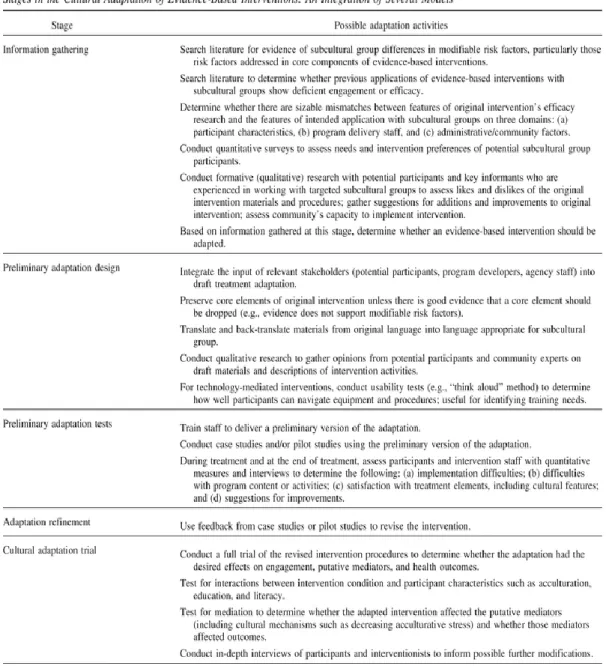
Table 1, created by Barrera in 2012, (22) shows the specific steps needed to adapt an evidence-based intervention. The stages in Table 1 explains the possible steps and recommendation that a HIV/AIDS prevention program may take in adapting a culturally appropriate program in North Carolina for Latinas that first includes information
Table 1: Describes the steps in adapting an evidence-based intervention. Figure 3: Barrera MJ, Castro FG, Strycker LA, Tolbert DJ.
Cultural adaptations of behavioral health interventions: A progress report. J Consult Clin Psychol 2013 04;81(2):196-205.
In 2012, Rhodes from Wake Forest University in Winston-Salem, North Carolina led a study that explored the “Sexual Health Priorities and Needs of Immigrant Latinas in the Southeastern United States.” (27) The purpose of the study was to develop an
immigrant Latinas. (27) The steps were determined through four focus groups in which 43 women participated. Approximately one-quarter of the women reported having
completed elementary or middle school; another one-quarter reported completing some or all of high school. (27) Nearly one-half of the participants noted living with a male
partner, one-third reported being single, and one-fifth reported either living alone but with a partner in their country of origin or having a living situation categorized as “other,” which included living with a female partner or relatives. (27) Length of time since arrival in the US averaged 7 years and ranged from 6 months to 17 years. The Mujeres intervention contained five modules to train Latinas to serve as lay health
advisors (LHAs) known as "Comadres."(27) The community-based participatory research (CBPR) partnership created a multistep intervention development process.
preexisting social networks of Latinas and the preexisting, culturally congruent roles of LHAs. (27) Rhode’s study provides a greater understanding of possible interventions that utilize community strengths of local Latina community through a multistep intervention development process. Rhodes’ study could play a pivotal role in a future HIV/AIDS intervention for Latinas in North Carolina
As described later in the case studies, HIV/AIDS prevention programs do exist for Latinas in larger urban settings, and the theoretical frameworks may be a helpful resource for North Carolina Health Department. Needleless to say, additional funding, perhaps from the CDC or NIH to allow would be required to allow the state to adapt a program for Latinas.
Discussion:
The need for an evidenced-based Latina focused HIV/AIDS prevention programs was well documented by the 2012 Hispanic Women’s Health Project by RTI; the study affirmed that Latinas in North Carolina are lacking the skills and resources to protect themselves against HIV/AIDS. Tools do exist to adapt a culturally competent HIV/AIDS intervention for a sub-population. Tools such as the Abbreviated Multidimensional Acculturation Scale created by Zea in 2003 may be influential in understanding the role of acculturation in shaping and adapting an HIV/AIDS prevention program. Theoretical frameworks for adaptation as discussed above can help guide adaptation of an HIV/AIDS prevention program for Latinas.
cultural context of Latina women in North Carolina and how that may differ from a larger urban area. Inadequate funding may also be a limitation if the prevention program is extremely complex and costly. The state health department could increase funding as well as sustainability by partnering with the CDC or NIH to adapt an HIV/AIDS prevention program for Latinas in North Carolina. The three case studies described below are excellent examples of effective HIV/AIDS programs specifically for Latinas in the United States that could be adapted for use in North Carolina.
Case Studies:
Case Study 1: VOICES/VOCES
VOCES is a Center for Disease Control and Prevention (CDC) Diffusion of Effective Behavioral Interventions (DEBI) program that is an excellent example of an effective adaptation of an intervention through proper training and feedback from local organizations. (29) VOCES translates to voices in English, and is a single-session, video-based HIV/STD prevention program designed to encourage condom use and improve condom negotiation skills. (29) The program is based on the theory of reasoned action, which explains how behaviors are guided by attitudes, beliefs, experiences, and expectations of other persons’ reactions. (29) The CDC intervention is grounded in extensive formative research exploring the culture- and gender-based factors that can facilitate behavior change. The intervention showed that
poster board presenting features of various condom brands in English and Spanish deliver information on HIV risk behaviors and condom use. Two culturally specific videos are used: one for African American participants and a bilingual video for Latinas. Skills in condom use and negotiation are modeled in the videos, then role-played and practiced by participants during the discussion that follows. The original program described above was adapted for use for Latinas in urban areas in the United States.
The adaptation of this specific intervention known as VOCES was the largest centralized effort to diffuse evidence-based prevention science to fight HIV/AIDS in the
United States. The adaptation process of VOCES wanted to ensure the most effective
science-based prevention interventions are widely implemented across the country in
community-based organizations. The issues of implementation are: (1) community
perceptions of a top-down mode of dissemination; (2) the extent to which local
innovations are being embraced, bolstered, or eliminated; and (3) contextual and
methodological considerations that shape community preparedness. Consideration of
these additional factors is necessary in order to effectively document, manage, and
advance the science of dissemination and technology transfer in centralized prevention
efforts within and outside of HIV/AIDS. (29) The CDC trained over 260 agencies on
VOICES/VOCES between August 2003 and April 2005. Interviews were conducted with agency staff three months after receiving VOICES/VOCES training. (29) The vast
“what happens when an effective intervention is packaged, translated, and diffused nationally for implementation by community–based organizations and health departments?”(29)
A study by Harshbarger noted that assistance in adaptation is needed for interventions to be successfully adapted and implemented with fidelity to the core elements, and to ensure program sustainability. (30) More effective interventions are needed of short duration and minimum complexity to easily match with existing resources and conditions of agency capacity among HIV prevention providers in the community are necessary.
The VOCES intervention is an excellent example of a large-scale adaptation incorporating feedback from organizations. It is important to note the VOCES program was on a national scale and was well funded by the CDC. An important factor in the VOCES intervention was its focus throughout the adaptation process on feedback from the organizations while still keeping the core of the program in place.
Case Study 2:
SEPA (Salud/Health, Educación/Education, Prevención/Prevention, Autocuidado/Self-care): A Small Group-level Intervention for Heterosexually Active Hispanic
Women/Latinas
relationships and safer sex. (31) SEPA consisted of six two-hour sessions that included presentations, group discussions, and practice exercises on male and female condom use, condom negotiation, and assertive communication. Session content covered HIV and STD transmission and prevention, male and female reproductive anatomy, human sexuality, interpersonal communications, and domestic and intimate partner violence. (31) SEPA is based on Social Cognitive Theory, which states that behavior is influenced by outcome expectancies, interaction with the environment, observation, and self-efficacy. (32) Individuals who believe they have the capability to perform an action are more likely to engage in the action. (32) SEPA employs demonstrations, role-play, and other skills-building exercises to enhance the self-efficacy of Hispanic women/Latinas in condom use, condom negotiation, and partner communication.
As Hernandez from RTI wrote, role-playing and skill-building exercises are extremely beneficial for HIV/AIDS prevention programs. (8) Culturally and linguistically appropriate information that is given to sexually active women reduces the risk of acquiring HIV from unprotected sex with a male partner. (31) The use of a female facilitator who speaks the native language of participants was an integral part of the intervention.
core elements of the intervention are changed interventions may lack effectiveness and understanding the effectiveness of adaptation will not be well understood. The REP is a beneficial tool that would be very useful for adapting HIV/AIDS prevention program for Latinas in North Carolina.
Case Study 3:
Latinas por la Salud, Latino Commission on AIDS
Latinas por la Salud is an HIV prevention intervention for Latinas in New York City targeting HIV-negative women between the ages of 18 and 50. (34) Through guided discussion groups the program aimed to: improve participants' knowledge about
HIV/AIDS and other sexual transmitted diseases by providing participants with tools to address HIV risk at the personal, family, and community levels. The interventions increased participants' self-esteem to engage in behaviors that will help them has a pleasurable and healthy sexual life. Participants are referred to other social or health services according to their needs. (34)
like culture, women’s sexuality, immigration, partner violence, and substance abuse. The intervention effectively adapted a culturally competent HIV/AIDS prevention program by addressing the unique risk to HIV/AIDS of Latina women living in New York City.
The case studies above provide excellent examples of demonstrated successes in HIV/AIDS prevention especially for Latinas. Each program took into account the unique cultural differences of Latina women and had bilingual, preferably female facilitators. VOCES intervention required community and organizational feedback throughout the adaptation process. All three studies focused on adaptation of HIV/AIDS programs for Latinas in large cities. The case studies demonstrate the feasibility of adaptation but also provide a toolkit for the different ways to adapt an HIV/AIDS Prevention program. The limitation of the case studies is that they are all in large areas and the HIV prevention needs of Latinas in New York City are different for women residing in rural North Carolina. For example, a woman in New York may not have a language barrier at the local clinic or may not need to travel 20 miles to reach a clinic. The risk factors of HIV/AIDS as discussed earlier are unique to the South and to North Carolina, also many Latinas may have recently immigrated to the state, which may not be as common for Latinas in an urban city who may have been born in the United States.
Recommendations:
for Latina women in the state. Tools such as the Abbreviated Multidimensional
Acculturation Scale (5) and Barrera's Cultural Adaptation theoretical framework (22) can provide the necessary tools to begin adapting a culturally competent HIV/AIDS
intervention for Latinas in North Carolina. The focus of this paper was to provide recommendations for the state of North Carolina to adapt a Latina specific HIV/AIDS prevention program. Literature review findings detailed that Latina focused HIV Prevention programs do exist in large settings in the United States. Adaptation of HIV/AIDS prevention programs was successful as noted by the VOCES intervention in many cities in the United States. A possible limitation in adapting a program here in North Carolina is the current instability of funding of public health programs and specifically HIV/AIDS Prevention Programs for Latinas. Politically North Carolina has shifted greatly since the 2012 election and it are unclear if HIV/AIDS prevention programs will continue to be funded or if any new programs will be implemented. Conclusion:
References
1. U.S. Census Bureau. (2010). State and County Quick Facts: North Carolina. [Internet]. [cited 2013 June 16]. Available
from:http://quickfacts.census.gov/qfd/states/37000.html. North Carolina. 2. Centers for Disease Control and Prevention. HIV/AIDS Risk Hispanic/Latinos.
Fact Sheet. [Internet]. Atlanta (GA): [cited 2013 June 17]. Available from: http://www.cdc.gov/hiv/risk/racialethnic/hispaniclatinos/index.html
3. North Carolina Epidemiologic Profile for HIV/STD Prevention & Care Planning. N.C. Department of Health & Human Services: Division of Public Health
Epidemiology [Internet]. [cited 2013 June 17]. Available from:
http://www.epi.state.nc.us/epi/hiv/epiprofile1209/Epi_Profile_2009.pdf 4. Office of Minority Health and Health Disparities and State Center for Health
Statistics. Racial and Ethnic Health Disparities in North Carolina: Report Card 2010. North Carolina Department of Health and Human Services, April 2010. [Internet]. [cited 2013 June 17]. Available from:
www.schs.state.nc.us/SCHS/pdf/ReportCard2010.pdf.
5. Zea Asner-Self, Birman, Buki. The Abbreviated Multidimensional Acculturation Scale: Empirical validation with two Latino/Latina samples. Cultural Diversity and Ethnic Minority Psychology 2003 05; 9(2): 107-126.
6. NC Department of Health Statistics. The Hispanic or Latino Population, 2011 North Carolina. North Carolina Epidemiologic Profile for HIV/STD Prevention & Care Planning. In: N.C. Department of Health & Human Services: Division of Public Health, Epidemiology [Internet]. [cited 2013 June 18]. Available from: http://www.epi.state.nc.us/epi/hiv/epiprofile1209/Epi_Profile_2009.pdf 7. NC Department of Health Statistics. The Hispanic or Latino Population, 2011
North Carolina. [Internet]. [cited 2013 June 18]. Available from: http://www.ncdhhs.gov/aging/cprofile/Hispanic_Latino2010.pdf
www.associatedcontent.com/article/812397/hivaids_crisis_in_eastern_north_carol ina. html?cat=5
9. Hernandez, Zule, Karg, Browne, Wechsberg. Factors That Influence HIV Risk among Hispanic Female Immigrants and Their Implications for HIV Prevention Interventions. Int J Family Med 2012;2012:876381
10.North Carolina Department of Health and Human Services. (2010). Racial and Ethnic Health Disparities in North Carolina, Report Card 2010. Raleigh, NC: Office of Minority Health and Health Disparities and State Center for Health Statistics. [Internet]. [cited 2013 June 18]. Available
from:http://www.schs.state.nc.us/SCHS/pdf/MinRptCard_WEB_062210.pdf 11. North Carolina Community Health Care Association. Migrant Health. 2010.
[Internet]. [cited 2013 June 8]. Available from:
http://ncchca.affiniscape.com/displaycommon.cfm?an=1&subarticlenbr=27 12.Calzada, Fernandez, Cortes. Incorporating the Cultural Value of Respeto into a
Framework of Latino parenting. Cultur Divers Ethnic Minor Psychol. 2010 Jan;16(1):77-86. doi: 10.1037/a0016071
13.Griner, Smith. Culturally Adapted Mental Health Interventions: A Meta-Analytic Review. Psychotherapy: Theory, Research, Practice, Training, and 43(4), 2006: 531-548Amerian Psychological Assoc. doi: 101037/0033-3204434531
14.Centers for Disease Control and Prevention Advancing HIV Prevention: New Strategies for a Changing Epidemic United States. (2003). MMWR Morbidity and Mortality Weekly Report, 52 (15), 329–332.
15.Mier, Ory. Anatomy of Culturally Sensitive Interventions Promoting Nutrition and Exercise in Hispanics: A Critical Examination of Existing Literature.. Health Promot Pract. 2010 July; 11(4): 541–554. Published online 2009 February 4. doi: 10.1177/1524839908328991
16.Mendez, Westerberg. Implementation of a culturally adapted treatment to reduce barriers for Latino parents. Cultur Divers Ethnic Minor Psychol 2012
Oct;18(4):363-372. doi: 10.1037/a0029436.
Rev Public Health 2005;26:367-397. doi: 0.1146/annurev.publhealth.26.021304.144615
18. Cashman. Anatomy of culturally sensitive interventions promoting nutrition and exercise in Hispanics: A critical examination of existing literature the Sexual Health Priorities and Needs of Immigrant Latinas in the Southeastern US: A Community-Based Participatory Research Approach. doi: 10.9741/.15.7.274.2412 19.Pemberton. How are implementation and adaptation of evidence-based
interventions applied in community practice settings? Lessons from the modelo de intervention psicomedica.[Internet]. [cited 2013 June 28]. Available from .
https://cdr.lib.unc.edu/indexablecontent?id=uuid:c04dbb59...ds...
20.Pew Research Hispanic Center. Data and Resources. [Internet]. [cited 2013 June 25]. Available from: http://www.pewhispanic.org/data-and-resources/
21. Abraído-Lanza, Aguirre, Toward. (2006). Theory-Driven Model of Acculturation in Public Health Research Am J Public Health; 96(8): 1342– 1346.doi: 10.2105/AJPH.2005.064980
22.Barrera, Castro Strycker, Toobert. Cultural adaptations of behavioral health interventions: A progress report. J Consult Clin Psychol 2013 04;81(2):196-205. [Internet]. [cited 2013 June 25].
Availablefrom:://www.apha.org/membergroups/sections/aphasections/intlhealth/c bphcw/ doi: 10.1037/a0027085.
23.Domenech-Rodríguez, Weiling. Developing Culturally Appropriate, Evidence-Based Treatments for Interventions with Ethnic Minority Populations. Voices of Color: First person accounts of ethnic minority therapists. (2004)Thousand Oaks: Sage Publications. [Internet]. [cited 2013 June 23]. Available from:
http://www.uk.sagepub.com/books/Book225976/toc#tabview=google
24.Bernal, Domenech Rodríguez. Cultural Adaptations: Tools for evidence-based practice with diverse populations. Washington, DC US: American Psychological Association; 2012.
Availablefrom:://www.apha.org/membergroups/sections/aphasections/intlhealth/c bphcw/
26.Rodriguez, Bauman, Schwartz. Cultural adaptation of an evidence based intervention: from theory to practice in a Latino/a community context. Am J Community Psychol 2011 Mar;47(1-2):170-186.
27.Rhodes, Cashman, McGuire. Using Community-Based Participatory Research (CBPR) to Develop a Community-Level HIV Prevention Intervention for Latinas: A Local Response to a Global Challenge Published online 2012 April 6.
doi: 10.1016/j.whi.2012.02.002
28.Smith, Rodríguez, Bernal. (2011), Culture. J. Clin. Psychol., 67: 166–175. doi: 10.1002/jclp.20757
29.Centers of Disease Control. Compendium of Evidence Based HIV Behavioral Interventions. Voces. Centers for Disease Control and Prevention. [Internet]. [cited 2013 June 7]. Available
from: http://www.cdc.gov/hiv/prevention/research/rep/packages/sepa.html 30. Harshbarger, Simmons, Coelho. An empirical assessment of implementation,
adaptation, and tailoring: the evaluation of CDC's National Diffusion of VOICES/VOCES. AIDS Educ Prev. 2006 Aug;18(4 Suppl A):184-97. 31.O'Donnell. San Doval,Duran, Labes. (1998). Reductions in STD infections
subsequent to an STD clinic visit: Using video-based patient education to supplement provider interactions. Sexually Transmitted Diseases, 25, 161-168. 32.Cianelli, Peragallo, Ferrer, Villegas. SEPA Evidence Base for HIV Prevention in
Latino Women as part of El Centro. School of Nursing and Health Studies [Internet]. [cited 2013 June 11]. Available from:
http://www.stti.iupui.edu/pp07/vancouver09/42465.Cianelli,%20Rosina-A%2003.pdf
34. Amaro, Cranston, Martin. Latino Commission on AIDS Latinas por Salud. [Internet]. [cited 2013 June 17]. Available from:
http://www.latinoaids.org/programs/latinas_por_la_salud/docs/LPLSMexicoAIDS .pdf
35.Kreuter, Skinner. (2000). Tailoring: What's In a Name? Health Education Research, 15, 1– 4. doi: 10.1093/her/15.1.1