This master’s paper explores the impetus for data stewardship policies and guidelines and describes an empirical study conducted to assess the feasibility of employing OAI-PMH as a tool to enable institutions to track data stewardship activities.
Quantitative analyses of Dublin Core metadata harvested from twelve data-specific repositories were used to make conclusions about the current state of OAI-PMH implementation, to consider ways in which the unique properties of scholarly domains and their data might be reflected in metadata values, and to suggest steps repositories can take to enable the development and implementation of a federated index of distributed data records as a tool to support the sustainability of the research enterprise.
Headings:
Data Libraries Dublin Core
Information retrieval Data policy
TRACKING INSTITUTIONAL DATA ASSETS USING OAI-PMH
by
Thu-Mai L. Christian
A Master’s paper submitted to the faculty of the School of Information and Library Science of the University of North Carolina at Chapel Hill
in partial fulfillment of the requirements for the degree of Master of Science in
Information Science.
Chapel Hill, North Carolina April 2012
Approved by
TABLE OF CONTENTS
LIST OF TABLES AND FIGURES 2
ABBREVIATIONS 3
Chapter
I. INTRODUCTION 4
II. REVIEW OF THE LITERATURE 9
The Data Deluge and the Research Enterprise 9
Roles and Responsibilities 12
OAI-PMH as a Tool for Institutional Data Asset Tracking 14
Dublin Core Metadata 15
III. METHOD 22
Identification of OAI-PMH Compliant Data Repositories 22 Installation and Configuration of the OAI-PMH Harvester 24
IV. RESULTS 27
Implementation of Dublin Core Metadata Elements 27
Dublin Core Metadata Content Analysis 29
V. DISCUSSION & CONCLUSION 35
APPENDICES 38
LIST OF TABLES AND FIGURES
Table
1. Dublin Core Metadata Elements 17
2. List of Harvested Repositories 23
3. Implementation of Minimum Dublin Core Elements by Repository 28 4. Categories of dc.type Element Usage by Repository 31
5. Examples of dc.identifier Element Values 32
6. Use of dc.creator, dc.contributor, and dc.publisher
Metadata Elements by Repository 33
7. Use of dc.date Metadata Element by Repository 34
Figure
1. Four Levels of Metadata Interoperability 16
ABBREVIATIONS
CISL RDA Computational and Information Systems Laboratory Research Data Archive
DC Dublin Core
DCMES Dublin Core Metadata Element Set DCMI Dublin Core Metadata Initiative DOI Digital Object Identifier
HDL Handle
IQSS DVN Institute for Quantitative Social Science Dataverse Network
NCAR CDP National Center for Atmospheric Research Community Data Portal NEH National Endowment for the Humanities
NIH National Institutes of Health NSF National Science Foundation
OAI-PMH Open Access Initiative Protocol for Metadata Harvesting OHS Open Harvester Systems
CHAPTER 1
INTRODUCTION
A great deal of attention has recently been given to research data stewardship as a result of mandates issued by major funding agencies that acknowledge both the
affordances of the technology that has enabled the substantial increase in research data production as well as the complexities that come along with digital scholarship. In May 2010, the National Science Foundation (NSF) issued a press release announcing its new data management plan requirement for all grant applications. As of January 18, 2011, all researchers who submit grant applications must include in their proposals a one- to two-page description of data types, data and metadata formats, access and sharing policies, provisions for reuse, and plans for archiving and preserving data. Taking its cue from NSF, the National Endowment for the Humanities (NEH) (2011) also issued its own data management plan policy for Digital Humanities Implementation Grants. These policies were preceded by the National Institutes of Health (NIH), which issued their Final NIH Statement on Sharing Research Data in February 2003. This statement emphasized NIH’s promotion of data sharing by requiring that grant proposals requesting funds totaling $500,000 or more to include a data sharing plan that details how data will be shared, or justifies why data will not be shared.
Environment for Research Preservation and Access) Project’s (2009) Juliet database contains a listing of 92 funding agencies around the world (not counting NSF and NEH) that have issued publication and/or data archiving policies. One can expect this number to increase in the coming years, which points toward the significance of data stewardship as an important component of the research enterprise that is changing in response to advances in technology.
Likewise, journal publishers have impressed upon authors the need for research results to be made accessible. Hanson, Sugden, and Alberts (2011) of the journal Science
published an editorial that justified extensions to their data policies as a means to ensure proper citation, description, standardization, preservation, and access of data underlying published research results. The American Naturalist (2010) published an editorial that introduced the journal’s new data archiving policy, which outlines expectations for data archiving for purposes of supporting conclusions in published articles and allowing for interpretation and reuse. This policy also applies to Evolution, Journal of Evolutionary Biology, Molecular Ecology, Hereditary, and other journals owned or sponsored by the Society of American Naturalists. For all of their journals, the Public Library of Science (PLoS) (2011) has specific policies on sharing materials, methods, and data, which are based on principles outlined in the National Academies Press (2003) report “Sharing Publication-Related Data and Materials.” The report highlights the authors’
journals. This letter declares APA’s requirement that authors share their data upon requests for validation of published results.
Aside from funding agency and publisher mandates, the push for research data preservation and access is in response to a growing emphasis on cross-disciplinary research and public interest in research data, including from non-scientists outside of the discipline in which the data were originally collected and used (Faniel & Zimmerman, 2010; National Research Council, 2010). Supporting the viability of research beyond the active primary research phase by providing access to data for secondary uses extends the utility of data to new communities, makes novel solutions to human problems possible, and enables “system-level” science (Faniel & Zimmerman, 2011).
Dozier and Gail (2009) use the topic of water as an example of the necessary integration of disciplines to conquer problems of water supply shortages. The types of data required to adequately address this issue include, but are not limited to, satellite data to identify water sources over an extended geographic area, sensor data to determine ground moisture levels, social science data to analyze human behaviors in relation to hydrologic phenomena—all of which require the cyberinfrastructure to integrate and provide real-time access to several forms of data (Dozier & Gail, 2009). In the medical field, the combination of electronic health records, biotechnology, and scientific research outputs (i.e., journal publications) enable researchers to ascertain the complexity of specific illnesses. These resources allow scientists to investigate patterns and
illness (Buchan, Winn, & Bishop, 2009). These examples show ways in which the value of data assets are further extended when made accessible beyond their initial purpose, thus providing funding agencies with greater returns on their investments (OECD, 2007; Rusbridge et al., 2005).
As a result of increasing pressures from funding agencies and publishers to manage their data in ways that enable sharing, discovery, and reuse, researchers are forced to consider the adequacy of their research data stewardship practices to achieve these mandated goals. Moreover, the institutions that host scholarly research are obliged to provide oversight of data stewardship practices to guarantee sustained funding and promotion of their research enterprise—a duty that is not easily fulfilled.
The scope of data being produced within any single institution is difficult to capture. In sites around the world, massive volumes of data in various forms are being generated in laboratories and by sensors. After they have served their primary research purpose, the data may be stored in any of a countless number of repositories in yet more locations spanning the globe. Each of these repositories operates according to the culture and norms of the scholarly community it represents. The burden, therefore, is placed on the institution to apprehend the data diversity, magnitude, locations, and research
domains to be able to track and support data stewardship activities that funding agencies and publishers require.
Sompel introduced the Open Archives Initiative and its development of a “low-entry and well-defined interoperability framework applicable across domains…[as an] appropriate catalyst for the federation of a broad cross-section of content providers” (p. 54). Though few articles about OAI-PMH have been published in the past few years, which might suggest that acceptance of the framework has waned, current trends in the research enterprise demand another look at OAI-PMH as a possible tool for tracking institutional data assets.
This master’s paper explores the impetus for data stewardship policies and guidelines and presents the analysis of an experiment to assess the feasibility of
CHAPTER 2
REVIEW OF THE LITERATURE
Data and the Research Enterprise
Today’s research enterprise is one that is characterized by the data deluge. Hey and Trefethen used this oft-cited term in 2003 to describe the magnitude of data being generated in the new age of e-Science1 for which current database capacity cannot
accommodate or soon will not be able to accommodate. Pointing to the petabytes of data produced in astronomy facilities each year and the anticipation of genome sequencing to increase four-fold per year, the authors do not lack compelling examples of data deluge. The National Research Council (2009) described the technological innovations that have enabled this enormous scale of data production as profound. Digital technology has allowed researchers to process and analyze these massive quantities of data while at the same time introducing new approaches to scientific inquiry enhanced by the integration of simulation, observation, and experimentation data. Furthermore, virtual platforms have made possible interdisciplinary collaborations that connect researchers from different parts of the world. New advances in technology for data access, sharing, and reuse have transformed the way scholars conduct research—and transformed the challenges associated with these advances.
1e-Science is a term that was coined in 1999 by Dr. John Taylor, Director General of Research Councils in
Despite all of the affordances of technology, Bell, Hey, and Szalay (2009) find the data deluge to be “burdensome,” particularly in regard to the proliferation of born-digital data in laboratories that engage in data-intensive research (p. 1297). The authors blame these burdens on the shortcomings of required tools, which have been slow to develop in comparison to the volume of data outputs. Lord, Macdonald, Lyon, and Giaretta (2004) state more plainly that the technology puts data at risk. Berman (2008) uses the term “fragile” to describe digital data, and as such requires infrastructure that is able to handle technical, policy, and economic issues among others (p.50). Brase (2004) notes that “project data is often poorly documented, therefore badly accessible and not maintainable over long time periods. Large amounts of data are unused as they are only known and accessible to a small group of scientists” (p. 488).
Funding agencies and publishers are attempting to overcome these challenges by issuing specific requirements for data access, preservation, and sharing. Funding
agencies want to ensure that funded research provides the greatest returns on their investments. The NSF’s (2011) Grant Proposal Guide requires that a data management plan document be included in the grant proposal. This document must contain
descriptions of the data type along with any other types of research output (e.g., software, samples); data and metadata format and content standards; access and sharing policies with information on measures to protect privacy, confidentiality, and intellectual property rights; policies for secondary analysis; and provisions for data archiving and preservation. NSF makes clear that the data management plan is a fundamental part of the grant
management plan as a way to promote collaboration. The press release included a quote from Jeanette Wing, assistant director for NSF’s Computer & Information Science & Engineering directorate, underscoring the value of data: “digital data are both the products of research and the foundation for new scientific insights and discoveries that drive innovation” (NSF, 2010). Appended to the announcement of the NEH new digital Humanities Implementation Grants program was a statement on the NSF-based data management plan requirement, which NEH adopted (Bobley, 2011). Other major funding agencies that have issued guidelines and/or policy on data management and sharing include the NIH (2003), Centers for Disease Control and Prevention (2005), the Department of Defense (1998), and the National Aeronautics and Space Administration (2011).
Meanwhile, publishers want to ensure that research results published in articles can be replicated as a means to maintain the integrity of their scholarly journals. An editorial written by the editors of Science echoed the sentiments about data-driven
science in the NSF press release (Hanson et al., 2011). The Science editors point out that new technologies not only have ushered in advances in research, but also have brought about challenges to making data accessible. The strengthening of their policies on data include, among other things, a requirement similar to funding agencies’ data management plan. Science now requires that authors submit a statement describing data access and archiving as part of the author’s acknowledgments. PLoS (2011) has not issued a
These are but few examples of policies that are now applicable to researchers seeking funding or publication. Among these policies are requirements that vary widely, even within a particular research domain. Weber, Piwowar, and Vision (2010) performed an analysis of data citation and sharing policies affecting the environmental science domain. Within this field of study alone, the authors found that various stakeholders commonly issue a diverse range of policies, many of which do not provide clear guidance on how to fulfill stated requirements. Beagrie, Beagrie, and Rowlands (2009) reported similar findings from a survey conducted of 179 researchers and face-to-face interviews of 37 researchers from four UK universities. Based on researchers’ responses to
questions covering data storage requirements, legal requirements, and data access, the authors concluded that funding agency requirements for data preservation and availability of services to enable archiving support for policy requirements are not consistent in each discipline.
Roles and Responsibilities
Where requirements differ, so do the research approaches, disciplinary culture, community best practices for data management, and relevant laws and policy dictating data stewardship responsibilities within the disciplines that produce data and publish articles based on those data. Thus, institutions have further reason to feel obligated to provide the services, infrastructure, and policies to ensure researchers are able to navigate the constellation of rules and policies that can affect their funding.
data archiving and sharing (Culliton, 1988; Fishbein, 1991). Institutions assert ownership rights because of the responsibility it bears for oversight of research ethics. This is a “work-for-hire” model that protects the reputation of the institution in instances of scientific misconduct (Fishbein, 1991, p. 131). Thus, several universities have been explicit about their ownership rights. Duke University (2007), Johns Hopkins University (2008), Stanford University (1997), University of Kentucky (2011), University of
Pittsburgh (2009) and many others have distributed institutional policy documents that put forth an assertion of institutional ownership in some version of a statement that reads, “the University owns all research data generated by research projects conducted at or under the auspices of the University” (Johns Hopkins University, 2008, p. 2). It is a tall order for the institution to protect its data assets and fulfill its owner obligations by supporting and overseeing data stewardship practices that are as heterogeneous as the data themselves.
Still, the institution must be able to track their researchers’ archiving and sharing activities among these and many other distributed data repositories. In 2009, the National Research Council held a workshop to ascertain the issues and challenges of integrating scientific research data. Workshop attendees acknowledged the need for a “homogenous logical view of data that is physically distributed over heterogeneous data sources”
(Zigeler & Dittrich, 2004 as cited in National Research Council, 2010, p. 2). The Council determined that this view could be seen using a data registry, which would allow users to “obtain a single view of collection all over the world” (National Research Council, 2010, p. 12). Such a view would allow institutions to track data stewardship activities for the purpose of accountability to data management plan mandates and to facilitate
interdisciplinary research that funding agencies promote.
OAI-PMH as a Tool for Institutional Data Asset Tracking
One potential tool for tracking institutions’ data assets is the Open Archives Initiative Protocol for Metadata Harvesting (OAI-PMH), which enables the harvest and aggregation of metadata from distributed repositories into a single searchable interface. Such a tool could act as a registry of existing datasets, which would allow institution administrators tasked with data management oversight to track archiving and sharing of the institution’s data assets and to ensure compliance with funding agency and publisher mandates.
such a development, they explained, is the rapid increase of data being produced in the sciences that requires mechanisms for sharing results along with the rising use of Internet technology for delivery of those results (Lagoze & Van de Sompel, 2001). These, along with increasingly prohibitive commercial publishing costs that have been cited as cause for a crisis in the traditional model of scholarly communication have instigated a movement towards open access initiatives (Lagoze & Van de Sompel, 2001; Yiotis, 2005).
OAI-PMH provides the technical framework to support a federated repository model for which scholars are able to engage with datasets across disciplines though an interoperable network of digital repositories (Lagoze & Van de Sompel, 2001). Such an apparatus also enables the development of a service that “might use information from various repositories and process that information to link citations, create cross-repository query interfaces, or maintain current awareness services” (Lagoze & Van de Sompel, 2001, p. 55). These services that OAI-PMH creators described over a decade ago is one that institutions are now seeking in light of the new and growing demands being placed on researchers to engage in data management practices—and on the institutions who are obligated to provide the resources and infrastructure required to sustain the value of their data assets. This is also the service that the current project hopes to demonstrate is feasible by exploiting the OAI-PMH framework as Lagoze and Van de Sompel described.
Dublin Core Metadata
requirements for metadata implementation that is based on the goal of interoperability, which is dependent on metadata standardization (Lagoze & Van de Sompel, 2001, p. 57). Hey & Trefethen (2003) stressed the importance of the quality of metadata associated with the data to allow for the mining of metadata though search engines (p. 9). Citing the astronomy domain as an example, the authors assert that “[t]he existence of such
standards for metadata will be vital for the interoperability and federation of [data] held in different formats in file systems, databases, or other archival systems” (Hey & Trefethen, 2003, p. 10).
The OAI-PMH requirement to use the Dublin Core Metadata Element Set (DCMES) fulfills the goal of interoperability. The Dublin Core Metadata Initiative (DCMI) emerged in the 1990s as a means to build core metadata vocabularies that support interoperability among content stewards. One of its principles of operation is “the discovery of resources across the boundaries of information silos on the Web and within intranets” (DCMI, n.d.) DCMI describes four “levels of interoperability” that defines the scope of metadata, or the “metadata landscape”: 1) shared term definitions, 2) formal semantic operability, 3) description set syntactic interoperability, and 4)
description set profile interoperability. DCMI provides the graphic below (fig. 1) to further illustrate these four levels (DCMI, n.d.).
4: Description Set Profile Interoperability
• Shared formal vocabularies and constraints in records
3: Description Set Syntactic Interoperability
• Shared formal vocabularies in exchangeable records
2: Formal Semantic Interoperability
• Shared vocabularies based on formal semantics
1: Shared Term Definitions
For the purpose of a federated index of datasets (as opposed to a federated catalog of the datasets themselves), only levels 1 and 2 are required, and are of interest in the current paper.
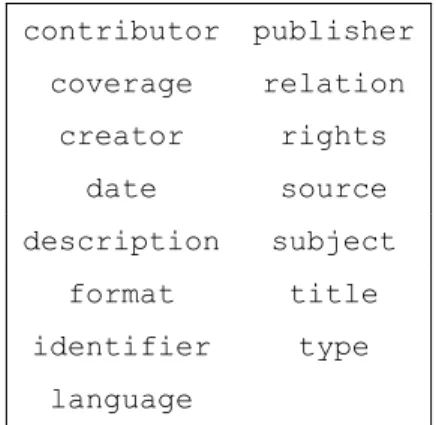
DCMES is comprised of 15 elements that provide generic descriptions applicable to a diversity of resource types and domains. The table below lists the elements (table 1).
contributor publisher coverage relation
creator rights
date source
description subject
format title
identifier type
language
Table 1. Dublin Core Metadata Elements
To achieve the 1st and 2nd levels of interoperability that enable the harvesting of
2005). Because the proposed registry focuses specifically on data sets, the dc.type element is necessary to distinguish among different types of repository content that may be present in any individual repository. Certainly, additional elements may further assist users in interpreting the nature of the data set. However, the degree to which a searchable registry is successful depends on the consistent and standard implementation of the five Dublin Core (DC) metadata elements identified above.
In 2001, the developers of OAI-PMH made the decision to make all DC elements optional rather than requiring a minimum set of elements (Lagoze & Van de Sompel, 2001). They argued that the purpose of unqualified DCMES as the common metadata set was for discovery, while detailed description of the resource would rely on local metadata specific to the community (Lagoze & Van de Sompel, 2001). This decision has drawn criticism from several fronts. Researchers have demonstrated that repositories’
implementation of DC metadata has been inadequate and undermines any of the technical affordances of OAI-PMH (Ward, 2004; Van de Sompel, Nelson, Lagoze, & Warner, 2004; Shreeves, Kaczmarek, & Cole, 2003; Jackson, Han, Groetsch, Musafoff, & Cole, 2008).
The Illinois OAI-PMH project, a Mellon Foundation funded project to test the efficacy of OAI-PMH for federated search across cultural heritage repositories, found that the flexibility of DCMES introduced wide variability in metadata implementation, which significantly affected the ability of the system to discover resources across
which prompted her call for further research into the underutilization of DC elements. Jackson et al.’s (2008) examination of metadata harvested via OAI-PMH by the Institute of Museum and Library Services (IMLS) Digital Collections and Content Project and the Committee on Institutional Cooperation Metadata Portal supports Ward’s findings that use of DC is limited at best; the only elements used consistently among harvested repository metadata were the dc.title and dc.identifier elements. Moreover, the authors found that the harvested DC metadata were not generated natively in DC but rather mapped from other schemas used in the repositories’ local context (Jackson et al., 2008, 2003). The result was incorrect mapping or mapping that ignored semantics values.
Yet, very little criticism specifically of the technical framework of OAI-PMH was found in the literature. Shortcomings primarily pointed to inadequacies of metadata implementation rather than to the protocol itself. Shreeves, Kaczmarek, and Cole (2003) conceded that OAI-PMH has the potential to support search and discovery; it is the implementation of the metadata that wants for further analysis. Where issues with OAI-PMH metadata harvesting have been identified, authors often suggest new approaches having to do with changes in how metadata are applied (Liu et al., 2002; Van de Sompel et al., 2004; Haslhofer & Schandl, 2008).
It should be noted that active federated repository indexes do exist that effectively employ OAI-PMH. The Research Library of the Los Alamos National Laboratory (LANL) uses OAI-PMH to store and access content (Jerez, Liu, Hochstenbach, & Van de Sompel, 2004). The Data Preservation Alliance for the Social Sciences (Data-PASS) group has successfully replicated archival content across a distributed network of
Digital Library’s use of OAI-PMH found the OAI approach to be appropriate for the development of a large-scale digital library (Arms, Dushay, Fulker, & Lagoze, 2003). Just seven years after its release, the number of metadata records harvested using the OCLC OAIster harvester tool was almost 20 million (Beisler & Willis, 2009).
Despite the lackluster use of a minimum set of DCMI elements, the examples of successful PMH implementation in the literature warrant a consideration of OAI-PMH as a tool for supporting a federated index of data sets. Therefore, the current paper examines OAI-PMH implementation by digital repositories dedicated to storing and providing access to datasets to determine whether or not the current state of OAI-PMH in terms of tool functionality and implementation of a minimum set of Dublin Core
metadata elements is able to effectively support a middleware service that aggregates discovery metadata from distributed data repositories. To do so, I conducted a research project to test the following hypotheses:
• OAI’s harvesting protocol is a viable option for the obtaining the metadata necessary to populate a federated index of data sets that are stored in spatially and disciplinary disparate data repositories.
• Any constraints to the development of a registry employing OAI-PMH would present themselves in an analysis of metadata values.
To test these hypotheses, I employed OAI-PMH to harvest and analyze metadata records from data repositories serving a diversity of scientific domains. Success in harvesting the metadata was meant to demonstrate the adequacy of the OAI-PMH tool to perform such a task, thus supporting the first hypothesis. To support the second
CHAPTER 3
METHOD
Identification of OAI-PMH Compliant Data Repositories
Identifying OAI-PMH compliant repositories that primarily contain data sets proved more difficultthan expected. No current list or registry of OAI-PMH compliant repositories exists on the World Wide Web. The Open Archives Initiative website does provide a list of registered data providers; however, dates of last validation of registration records are generally no more current than 2007 (OAI, 2011). Moreover, a repository’s inclusion in the list is voluntary, and many have not taken steps to register their
service includes a search function, which allowed me to obtain a list of repositories filtered by the “datasets” content type. A review of the resulting list showed that very few of the repositories contained primarily data, and fewer had implemented OAI-PMH. Thus, the repositories selected to participate in the investigation were few despite having used several sources to identify those meeting the research project criteria (i.e., data content, OAI-PMH compliance). Still, the repositories selected for the project contain data produced in a variety of research disciplines including the social sciences, biology, environmental sciences, archeology, and geography—each representative of their respective domains (see table 2).
Repository Domain Host
CISL Research Data Archive (RDA)
http://dss.ucar.edu/ Atmospheric and Geosciences
Computational and Information Systems Library (CISL) at the National Center for Atmospheric Research
DataCite Metadata Store (MDS)
http://oai.datacite.org/ Multidisciplinary DataCite members representing several data providers
Dryad
http://datadryad.org/ Biological Sciences
National Evolutional Synthesis Center;
University of North Carolina Metadata Research Center
eCrystals
http://ecrystals.chem.soton.ac.uk/ Biology and Chemistry University of Southampton Edinburgh DataShare
http://datashare.is.ed.ac.uk/ Multidisciplinary University of Edinburgh Institute for Quantitative Social Science
(IQSS) Dataverse Network (DVN)
http://dvn.iq.harvard.edu/ Social Science Harvard University National Center for Atmospheric Research
(NCAR) Community Data Portal http://cdp.ucar.edu/
Atmospheric and Geosciences
Computational and Information Systems Library (CISL) at the National Center for Atmospheric Research
Odum Institute Dataverse Network (DVN)
http://arc.irss.unc.edu/dvn/dv/odvn Social Science University of North Carolina Open Context
http://opencontext.org/ Archaeology Alexandria Archive Institute
PANGAEA
http://www.pangaea.de/ Environmental and Geosciences
Alfred Wegener Institute for Polar and Marine Research; Center for Marine Environmental Sciences
ShareGeo
http://www.sharegeo.ac.uk/ Geography EDINA, JISC National Data Centre
VizieR Catalogue
http://vizier.u-strasbg.fr/viz-bin/VizieR Physics and Astronomy
Centre de Données Astronomiques de Strasbourg
Installation and Configuration of the OAI-PMH Harvester
After download and attempted installation of several OAI-PMH harvesters, I selected the Public Knowledge Project’s Open Harvester Systems (OHS) for its user-friendly graphical user interface (GUI), which made the need for advanced command prompt programming unnecessary. The Public Knowledge Project website also provides comprehensive user documentation to support installation, configuration, and harvesting applications, which was useful during software set-up.
Installation of the current OHS version 2.3.1 requires several software applications to be present on the system:
• PHP
• MySQL
• Apache
• Operating system supporting PHP, MySQL, and Apache
For the current project, OHS was installed in a Mac environment. To fulfill prerequisites for OHS installation and operation, I downloaded MAMP on the project machine. As its name suggests, MAMP (an acronym for Macintosh, Apache, MySQL, and PHP) allows for a single, integrated download of the applications required to run OHS. MAMP sets up a local web server environment that supports the OHS GUI and the database that stores harvest data. A script included in the installation package files created the database, installed the database tables, and provided initial data. After exploring the newly-installed tool, I was able to begin harvesting repository metadata.
each harvested repository (fig. 2) and view the exposed metadata for individual records (fig. 3).
Figure 2. Open Harvester Systems GUI: Browsing repository records
To perform analyses of metadata content, the harvested metadata records were exported from the MySQL database containing the OHS records. This “data dump” was then imported into several database and spreadsheet applications to generate aggregations of metadata content to determine frequencies of metadata element usage. Aggregations provided a complete accounting of DC metadata elements used by each repository to determine whether or not inputs exist for the minimum metadata elements required for resource discovery and access. In addition, I conducted content analyses of the
dc.identifier and dc.type elements by running frequencies of element field values to determine the quality of metadata inputs. Quality metadata contains the necessary information required to support interoperability that is critical to the operation of the federated index. For the dc.identifier element, quality is based on the use of widely adopted, standard persistent identifiers that link the metadata record to the actual data set. For dc.type, the use of controlled vocabularies indicates quality. Where controlled
CHAPTER 4
RESULTS
Harvesting metadata from each repository using OHS was generally without incident. Harvests of larger collections took as long as one hour to complete with some failing initially. I found that successful harvest of the largest collections required a stable network using a wired connection. Any other harvest failures were resolved by editing incorrect base URLs or updating obsolete base URLs, which was expected based on Ward’s (2004) experiment finding that metadata harvests for approximately 25% of repositories were unsuccessful due to various errors in base URLs.
Implementation of Minimum Dublin Core Metadata Elements
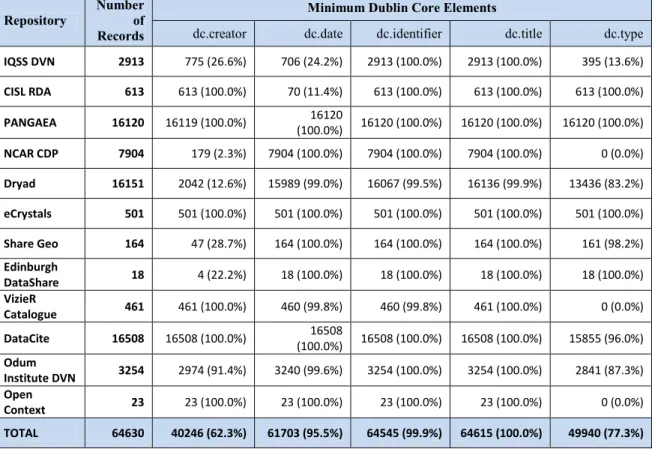
Repository Number of Records
Minimum Dublin Core Elements
dc.creator dc.date dc.identifier dc.title dc.type
IQSS DVN 2913 775 (26.6%) 706 (24.2%) 2913 (100.0%) 2913 (100.0%) 395 (13.6%)
CISL RDA 613 613 (100.0%) 70 (11.4%) 613 (100.0%) 613 (100.0%) 613 (100.0%)
PANGAEA 16120 16119 (100.0%) (100.0%) 16120 (100.0%) 16120 (100.0%) 16120 16120 (100.0%)
NCAR CDP 7904 179 (2.3%) 7904 (100.0%) 7904 (100.0%) 7904 (100.0%) 0 (0.0%)
Dryad 16151 2042 (12.6%) 15989 (99.0%) 16067 (99.5%) 16136 (99.9%) 13436 (83.2%)
eCrystals 501 501 (100.0%) 501 (100.0%) 501 (100.0%) 501 (100.0%) 501 (100.0%)
Share Geo 164 47 (28.7%) 164 (100.0%) 164 (100.0%) 164 (100.0%) 161 (98.2%)
Edinburgh
DataShare 18 4 (22.2%) 18 (100.0%) 18 (100.0%) 18 (100.0%) 18 (100.0%)
VizieR
Catalogue 461 461 (100.0%) 460 (99.8%) 460 (99.8%) 461 (100.0%) 0 (0.0%)
DataCite 16508 16508 (100.0%) (100.0%) 16508 (100.0%) 16508 (100.0%) 16508 15855 (96.0%) Odum
Institute DVN 3254 2974 (91.4%) 3240 (99.6%) 3254 (100.0%) 3254 (100.0%) 2841 (87.3%) Open
Context 23 23 (100.0%) 23 (100.0%) 23 (100.0%) 23 (100.0%) 0 (0.0%)
TOTAL 64630 40246 (62.3%) 61703 (95.5%) 64545 (99.9%) 64615 (100.0%) 49940 (77.3%)
Table 3. Repository Implementation of Minimum Dublin Core Elements
The data in the table suggests that the metadata elements required to make
connections to objects in their respective repositories are not used consistently among the vast majority of the repositories studied. For each repository, the table displays the number of metadata records that include each of the five DC elements along with the percentage of element use among all repository records. For example, of the 2913
records of all repositories studied is the dc.title element. More detailed results of the remaining four elements follow.
Dublin Core Metadata Content Analysis
dc.type
An aggregation of the values present in the dc.type element produced an exhaustive list of 148 unique terms used to describe the record type. Although the repositories were selected for the study based on the assumption that collections were comprised primarily of data sets, the analysis indicates that repositories also include in their collections a variety of other digital object types. Also, rather than describing the object type, some records provided the name of the file format used to render the data or aspects of the data collection method. Only 53% of the records use the DCMI (2010) Type vocabulary term “dataset” to describe the object, while others use more specific or specialized terms to describe the data type.
Because of the large number of unique terms used in the metadata records, each was placed into categories that define the manner in which the dc.type element was interpreted and used by the repository. Though most metadata inputs had straightforward correspondence to one of five different categories, some fell into two different categories. The categories are listed and defined below.
• Data Kind: Describes the data type such as survey data, aggregate data,
coded data, and observational data.
• Data Collection Mode: Refers to the data collection method. Examples include interview, field study, and survey.
• File Format: Indicates the file format or software application used to render the data. Examples include SAS, SPSS, HTML, and Excel.
• “Dataset”: This is the DCMI Type Vocabulary term prescribed by DCMI to refer to data. Values that use this term are counted in this category.
Some of the metadata indicated that the repository collection contains materials other than datasets. Also, some values could not be categorized into any of the five data type categories listed above. In those instances, the following categories were assigned:
• Non-Data: Terms referring to digital objects that are not traditionally considered data. These include thesis, conference paper, book, and journal article.
• Other: This category was assigned to terms that could not be interpreted or did not provide a meaningful description of the nature of the record. Some examples include Archive, Digital, and untilArticleAppears.
• Null: The type element field was left blank.
Repository Number of Unique Values Data Kind Data Collection Mode Time
Method Format File Non-Data Other Null “Dataset”
IQSS DVN 83 101 162 84 8 0 4 2616 4
CISL RDA 1 0 0 0 0 0 0 0 613
PANGAEA 1 0 0 0 0 0 0 0 16120
NCAR CDP N/A 0 0 0 0 0 0 7904 0
Dryad 9 63 0 0 0 544 753 2785 12006
eCrystals 1 0 0 0 0 0 501 0 0
Share Geo 6 157 0 0 0 0 4 3 0
Edinburgh
DataShare 1 0 0 0 0 0 0 0 18
VizieR
Catalogue N/A 0 0 0 0 0 0 461 0
DataCite 18 1 0 0 0 14879 378 684 566
Odum
Institute DVN 36 540 1 0 2647 0 0 458 12
Open Context N/A 0 0 0 0 0 0 23 0
TOTAL 148 1402 164 84 5302 15423 1640 15392 29351
Table 4. Categories of dc.type Element Usage by Repository
IQSS DVN had the greatest number of unique values in the dc.type element field (83), followed by Odum Institute DVN (36). CISL RDA, PANGAEA, and Edinburgh DataShare consistently applied the term “dataset” for each record in their collections. Though Dryad did use the term “dataset” to refer to the object type, the number of terms assigned to the Non-Data category suggests (whether incorrectly or not) that its collection contains materials other than datasets. The same assumption may be made about
DataCite, which applied the most Non-Data terms in the dc.type element field. NCAR CDP, VizieR Catalogue, and Open Context do not employ the dc.type element.
dc.identifier
An examination of the dc.identifier element shows that the majority of
the 12 repositories studied, 7 use either the DOI or HDL standard for persistent identification. Of the remaining 5 repositories, 3 make use of some type of identifier scheme, while the other 2 rely solely on URLs for identification. The table below (table 5) shows examples of dc.identifier values used by each repository.
Repository Examples of dc.identifier Element Value(s)
IQSS DVN iqss//hdl:1902.1/00001
CISL RDA ds010.0
PANGAEA http://doi.pangaea.de/10.1594/PANGAEA.50003
doi:10.1594/PANGAEA.50003
NCAR CDP cgd.cdas
https://cdp.ucar.edu/getCatalog.do?ID=cgd.cdas
Dryad doi:10.5061/dryad.100
http://hdl.handle.net/10255/dryad.100
eCrystals http://ecrystals.chem.soton.ac.uk/1000/
ShareGeo
http://hdl.handle.net/10672/10
http://www.sharegeo.ac.uk/bitstream/handle/10672/10/QBSatim agerySYRIA.zip?sequence=1
Edinburgh DataShare
http://hdl.handle.net/10283/10
Andrew, Theo; Greig, Morag; Ashworth, Susan. (2008). IRI-Scotland senior management survey [Dataset].
VizieR Catalogue ivo://CDS/VizieR/I/100A/w10
http://vizier.u-strasbg.fr/cgi-bin/Cat?I/100A/w10 DataCite
Metadata doi:10.5284/1000389
Odum Institute
DVN hdl:1902.29/030423
Open Context http://opencontext.org/projects/3/Animal Bone Table 5. Examples of dc.identifier Element Values
dc.creator
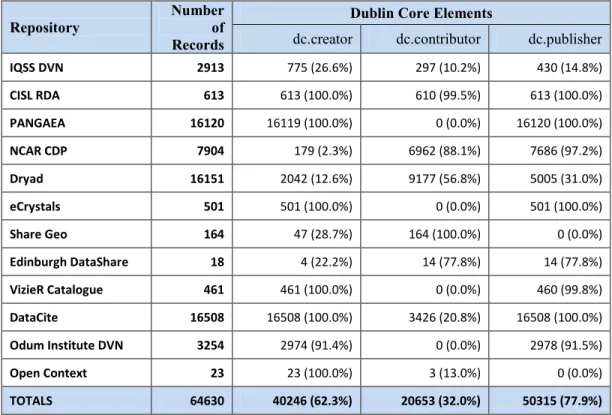
used the dc.creator element for all of their records, others used this element for as few as 2.3% (NCAR CDP). In this case, NCAR CDP used the dc.contributor element
significantly more often (88.1%) and the dc.publisher element for the vast majority of its records (97.2%). The same tendency is seen in the Edinburgh DataShare repository, in which 22.2% of its records include values in the dc.creator element field, while 77.8% of records use the dc.contributor and dc.publisher fields. With the exception of IQSS DVN, the “data producer” is represented in at least one of the three elements that provide authorship information.
Repository Number of Records
Dublin Core Elements
dc.creator dc.contributor dc.publisher
IQSS DVN 2913 775 (26.6%) 297 (10.2%) 430 (14.8%)
CISL RDA 613 613 (100.0%) 610 (99.5%) 613 (100.0%)
PANGAEA 16120 16119 (100.0%) 0 (0.0%) 16120 (100.0%)
NCAR CDP 7904 179 (2.3%) 6962 (88.1%) 7686 (97.2%)
Dryad 16151 2042 (12.6%) 9177 (56.8%) 5005 (31.0%)
eCrystals 501 501 (100.0%) 0 (0.0%) 501 (100.0%)
Share Geo 164 47 (28.7%) 164 (100.0%) 0 (0.0%)
Edinburgh DataShare 18 4 (22.2%) 14 (77.8%) 14 (77.8%)
VizieR Catalogue 461 461 (100.0%) 0 (0.0%) 460 (99.8%)
DataCite 16508 16508 (100.0%) 3426 (20.8%) 16508 (100.0%)
Odum Institute DVN 3254 2974 (91.4%) 0 (0.0%) 2978 (91.5%)
Open Context 23 23 (100.0%) 3 (13.0%) 0 (0.0%)
TOTALS 64630 40246 (62.3%) 20653 (32.0%) 50315 (77.9%)
dc.date
While the majority of repositories include values in the dc.date element field for virtually all of their metadata records, IQSS DVN, and CISL RDA use the dc.date element for 24.2% and 11.4% of their metadata records, respectively (see table 7).
Repository Number of Records Dublin Core Element
dc.date
IQSS DVN 2913 706 (24.2%)
CISL RDA 613 70 (11.4%)
PANGAEA 16120 16120 (100.0%)
NCAR CDP 7904 7904 (100.0%)
Dryad 16151 15989 (99.0%)
eCrystals 501 501 (100.0%)
Share Geo 164 164 (100.0%)
Edinburgh
DataShare 18 18 (100.0%)
VizieR Catalogue 461 460 (99.8%)
DataCite 16508 16508 (100.0%)
Odum Institute
DVN 3254 3240 (99.6%)
Open Context 23 23 (100.0%)
TOTAL 64630 61703 (95.5%)
CHAPTER 5
DISCUSSION & CONCLUSION
The results of the study support the hypotheses—with caveats. For the first hypothesis—OAI’s harvesting protocol is a viable option for the obtaining the metadata necessary to populate a federated index of data sets that are stored in spatially and
disciplinary disparate repositories—successful harvest of the data repositories with few obstacles demonstrated the ease at which OAI-PMH does fulfill the intended purpose of harvesting exposed metadata from distributed repositories. The key term, however, is “exposed.” The limited number of known data repositories that have exposed their metadata via OAI-PMH precludes any possibility of discovering all archived data sets from a single search portal. A comprehensive federated data repository index that represents the body of knowledge available requires that data repositories prescribe to open access initiatives such as OAI-PMH.
assumptions and to determine the constraints that prevent full-fledged adoption of OAI-PMH.
More profound insights were derived from the analysis to support the second hypothesis—considering the literature describing inconsistencies in the implementation of metadata among data providers, any constraints to a registry employing OAI-PMH
would present themselves in an analysis of metadata values—corroborated the previous literature on the inadequacies of DC metadata implementation to fully support the efficacy of OAI-PMH and its uses. Quoting Ward (2002), DC “is not used to the fullest extent possible.” Not only was that the case here, but also the interpretation of the metadata elements varied among repositories. The criticism of OAI-PMH in its use of unqualified DC metadata is warranted, but not because OAI-PMH fails to provide the framework for harvesting metadata records. Rather, it is warranted because of the lack of consistency of the interpretation and content of metadata elements. In the ten-year period since OAI-PMH was introduced, information professionals have made great strides to promote the importance of metadata. Yet, full implementation of DCMES has not yet been (if it will ever be) embraced by data repositories.
(Cole, 2008, p. 247). This was noted in the results of the harvesting project. The number of unique values in the dc.type element was largest among the two social science
repositories, both of which employ the Data Documentation Initiative (DDI) metadata specification. DDI proclaims itself as “an effort to create an international standard for describing data from the social, behavioral, and economic sciences” (DDI, 2011). When it comes to describing data, the DDI schema attempts to describe data throughout their lifecycle from conceptualization to archiving. It defines over 341 global elements, with another 231 “complexTypes” components used to further express the nature of the global elements (DDI, 2012). The analysis of the dc.type element reveals the number of ways the element has been interpreted by curators and the even larger number of terms used to characterize the object type, which is likely a reflection of the heterogeneity of data and their manifestations.
Appendix I:
Implementation of the 15 Dublin Core Metadata Elements by Repository
Repository Dublin Core Elements
dc.contributor dc.coverage dc.creator dc.date dc.description dc.format dc.identifier dc.language IQSS DVN 297 (10.2%) 524 (18.0%) 775 (26.6%) 706 (24.2%) 2913 (100.0%) 439 (15.1%) 2913 (100.0%) 16 (0.5%)
CISL RDA 610 (99.5%) 21 (3.4%) 613 (100.0%) 70 (11.4%) 613 (100.0%) 384 (62.6%) 613 (100.0%) 613 (100.0%)
PANGAEA 0 (0.0%) 16117 (100.0%) 16119 (100.0%) 16120 (100.0%) 254 (1.6%) 16120 (100.0%) 16120 (100.0%) 16120 (100.0%)
NCAR CDP 6962 (88.1%) 7069 (89.4%) 179 (2.3%) 7904 (100.0%) 7741 (97.9%) 3963 (50.1%) 7904 (100.0%) 0 (0.0%)
Dryad 9177 (56.8%) 12210 (75.6%) 2042 (12.6%) 15989 (99.0%) 12960 (80.2%) 10784 (66.8%) 16067 (99.5%) 48 (0.3%)
eCrystals 0 (0.0%) 0 (0.0%) 501 (100.0%) 501 (100.0%) 0 (0.0%) 0 (0.0%) 501 (100.0%) 0 (0.0%)
Share Geo 164 (100.0%) 164 (100.0%) 47 (28.7%) 164 (100.0%) 164 (100.0%) 131 (79.9%) 164 (100.0%) 164 (100.0%)
Edinburgh DataShare 14 (77.8%) 13 (72.2%) 4 (22.2%) 18 (100.0%) 18 (100.0%) 8 (44.4%) 18 (100.0%) 15 (83.3%)
VizieR Catalogue 0 (0.0%) 0 (0.0%) 461 (100.0%) 460 (99.8%) 0 (0.0%) 0 (0.0%) 460 (99.8%) 460 (99.8%)
DataCite 3426 (20.8%) 27 (0.2%) 16508 (100.0%) 16508 (100.0%) 13012 (78.8%) 15737 (95.3%) 16508 (100.0%) 15858 (96.1%)
Odum Institute DVN 0 (0.0%) 2112 (64.9%) 2974 (91.4%) 3240 (99.6%) 3254 (100.0%) 747 (23.0%) 3254 (100.0%) 15 (0.5%)
Open Context 3 (13.0%) 13 (56.5%) 23 (100.0%) 23 (100.0%) 0 (0.0%) 12 (52.2%) 23 (100.0%) 12 (52.2%)
Repository Dublin Core Elements
dc.publisher dc.relation dc.rights dc.source dc.subject dc.title dc.type IQSS DVN 430 (14.8%) 479 (16.4%) 338 (11.6%) 304 (10.4%) 511 (17.5%) 2913 (100.0%) 395 (13.6%)
CISL RDA 613 (100.0%) 251 (40.9%) 68 (11.1%) 51 (8.3%) 613 (100.0%) 613 (100.0%) 613 (100.0%)
PANGAEA 16120 (100.0%) 14557 (90.3%) 15342 (95.2%) 1332 (8.3%) 16120 (100.0%) 16120 (100.0%) 16120 (100.0%)
NCAR CDP 7686 (97.2%) 7783 (98.5%) 301 (3.8%) 238 (3.0%) 44 (0.6%) 7904 (100.0%) 0 (0.0%)
Dryad 5005 (31.0%) 2737 (16.9%) 12183 (75.4%) 1627 (10.1%) 13366 (82.8%) 16136 (99.9%) 13436 (83.2%)
eCrystals 501 (100.0%) 500 (99.8%) 0 (0.0%) 1 (0.2%) 501 (100.0%) 501 (100.0%) 501 (100.0%)
Share Geo 0 (0.0%) 10 (6.1%) 164 (100.0%) 77 (47.0%) 164 (100.0%) 164 (100.0%) 161 (98.2%)
Edinburgh DataShare 14 (77.8%) 12 (66.7%) 7 (38.9%) 10 (55.6%) 18 (100.0%) 18 (100.0%) 18 (100.0%)
VizieR Catalogue 460 (99.8%) 460 (99.8%) 460 (99.8%) 26 (5.6%) 0 (0.0%) 461 (100.0%) 0 (0.0%)
DataCite 16508 (100.0%) 2741 (16.6%) 13084 (79.3%) 813 (4.9%) 14865 (90.0%) 16508 (100.0%) 15855 (96.0%)
Odum Institute DVN 2978 (91.5%) 243 (7.5%) 3223 (99.0%) 3211 (98.7%) 3228 (99.2%) 3254 (100.0%) 2841 (87.3%)
Open Context 0 (0.0%) 0 (0.0%) 12 (52.2%) 2 (8.7%) 22 (95.7%) 23 (100.0%) 0 (0.0%)
Appendix II:
List of Unique dc.type Values
dc.type Value Number of Records
NULL 14934
Academic Test Score data 1
Administrative 1
administrative data 1
Administrative records data 23
Aerial or Satellite Imagery 26
aggregate data 33
aggregate data, and survey data; administrative records data 1
aggregate macropolitical and economic data 1
Archive 373
Article 552
Book 4
case study, survey 1
case study/oral history 11
case study/oral history, field study 1 case study/oral history, longitudinal 2
census data 3
census/enumeration 1
census/enumeration data 35
Collection of Datasets 4
commercial 1
Conference full text 607
Conference paper 962
Conference presentation 968
Conference proceedings 1
ConferencePaper 1412
Content Analysis Data 1
country-year observations 1
Cross-section, and Cross-Section Time-Series 1
cross-sectional 2
cross-sectional, field study 1
cross-sectional, longitudinal 3
cross-sectional, longitudinal, survey data 1
CSTS, country-year 1
data dictionaries + data definition statements + data files 1
Dataset 28986
Digital 5
Digital Terrain Model 8
Documentation + Data file (Stata, ASCII Codebook) 1
Documentation + data files 1
enter data type here 1
ESRI shapefile 1
Excel 2
Experimental data 1
field experiment 1
field experiment, longitudinal 1
field study 55
field study and institutional records 1 field study, case study/oral history 1
field study, follow-up 1
field study, hereditary, institutional 1
field study, longitudinal 8
field study, longitudinal, replication 1
field study, replication, follow-up 1 Firm, project, client, and contract information 1
follow-up 5
follow-up, field study 1
formulars and derivatives 1
Geographic 1
Geographic reference 6
Geographic reference file 7
Health history and access to health care facilities 1
Html files and I-View files 3
Image 62
institutional records 1
interview 2
interview qx, urinary samples 1
interviews 1
JournalArticle 19
KIND OF DATA HERE 1
lab data 1
laboratory experiment 2
laboratory experiment, longitudinal 2
longitudinal 18
longitudinal, case study/oral history 1
longitudinal, cross-sectional 1
longitudinal, cross-sectional, field study 1 longitudinal, field experiment 2
longitudinal, field study 18
longitudinal, field study, cross-sectional 1
longitudinal, field study, oral history 1
longitudinal, survey 6
Map 1
Metadata document 1
Micro level 1
Minnesota Multiphasic Personality Inventory (MMPI) 1
model results 1
Network Data on Political Science Journal Authors 1
none 143
NonPeerReviewed 501
Numeric 822
Numeric (Aggregate data) 1
Numeric (Aggregate) 4
Numeric (Excel File for Windows 95 Version 7.0 and Comma-delimited text
Numeric (geographic reference) 1
Numeric (Micro data) 2
numeric (micro) 2
Numeric (Microdata) 9
Numeric (microdata; unit of operation is individuals, families, and
households) 1
Numeric (Microdata; units of observation are housing units and persons
within housing units) 1
Numeric (SPSS and SAS portable files) 1
Numeric (Summary statistics) 171 Numeric (Summary statistics), 1 User's Manual 1 Numeric (Summary statistics, unit of observation in Files RC77-AT1 through
T4 is kind-of-business. In Files RC77-A-TA5 through T8 the unit of observation is individual geographic areas)
1
Numeric (Survey and existing academic records) 1
Numeric (Survey data) 151
Numeric (survey) 1391
Numeric (Survey) data 10
Numeric (Survey) data. SPSS portable file. 51
Numeric data 14
Numeric statistics 1
Observational macro-political/economic 1
oneyear 44
Other 4
Panel and Longitudinal Sampling 1
protocol 7
questionnaire 3
questionnaire, tests 1
Rectangular 1
Report 10886
Research Data 1
Scanned map 17
Simulated data for 5000 two-dimensional policy spaces 1
Social Science Data File 12
source code 1
STATA and SPSS 1
Stata Dataset 1
STATA, SPSS, EXCEL 1
Summary statistics 14
Summary statistics in PDF format, with hyperlinks to Lotus and Excel
worksheets. 6
Summary statistics in PDF, Microsoft Excel (.xls or .xlw), and Lotus (.wk1 or
.wk4) format 1
Supplementary Collection of Datasets 194
Supplementary Dataset 139
survey 31
survey and clinical data 1
survey data 71
Survey data (summary statistics) 3 survey data, and administrative records data 1
survey, longitudinal 2
survey, replication 1
Tabular data 1
Thesis 11
time series cross sectional macroeconomic/political data 1
Time-Series Cross-Section 1
untilArticleAppears 559
Village and GP Pradhan information 1
Appendix 3:
List of dc.type Values by Repository
IQSS DVN
dc.type Value Number of Records
[NULL] 2616
Academic Test Score data 1
Administrative 1
aggregate data 17
aggregate data, and survey data; administrative records data 1
aggregate macropolitical and economic data 1
case study, survey 1
case study/oral history 11
case study/oral history, field study 1
case study/oral history, longitudinal 2
census data 3
census/enumeration 1
census/enumeration data 35
commercial 1
Content Analysis Data 1
country-year observations 1
Cross-country data 1
Cross-section, and Cross-Section Time-Series 1
cross-sectional 2
cross-sectional, field study 1
cross-sectional, longitudinal 3
cross-sectional, longitudinal, survey data 1
CSTS, country-year 1
data dictionaries + data definition statements + data files 1 Documentation + Data file (Stata, ASCII Codebook) 1
Documentation + data files 1
enter data type here 1
Excel 2
Experimental data 1
field experiment 1
field experiment, longitudinal 1
field study 55
field study and institutional records 1
field study, case study/oral history 1
field study, follow-up 1
field study, hereditary, institutional 1
field study, longitudinal 8
field study, longitudinal, replication 1 field study, replication, follow-up 1
Firm, project, client, and contract information 1
follow-up 5
follow-up, field study 1
formulars and derivatives 1
Health history and access to health care facilities 1
institutional records 1
interview 2
interviews 1
KIND OF DATA HERE 1
lab data 1
laboratory experiment 2
laboratory experiment, longitudinal 2
longitudinal 18
longitudinal, case study/oral history 1
longitudinal, cross-sectional 1
longitudinal, cross-sectional, field study 1
longitudinal, field experiment 2
longitudinal, field study 18
longitudinal, field study, cross-sectional 1 longitudinal, field study, oral history 1
longitudinal, survey 6
Minnesota Multiphasic Personality Inventory (MMPI) 1
model results 1
Network Data on Political Science Journal Authors 1
Observational macro-political/economic 1
Panel and Longitudinal Sampling 1
questionnaire 3
questionnaire, tests 1
Research Data 1
Simulated data for 5000 two-dimensional policy spaces 1
Stata 1
STATA and SPSS 1
Stata Dataset 1
STATA, SPSS, EXCEL 1
survey 31
survey and clinical data 1
survey data 7
survey data, and administrative records data 1
survey, longitudinal 2
survey, replication 1
time series cross sectional macroeconomic/political data 1
Time-Series Cross-Section 1
Village and GP Pradhan information 1
CISL RDA
dc.type Value Number of Records
Dataset 613
PANGAEA
dc.type Value Number of Records
Dataset 16120
NCAR CDP
dc.type Value Number of Records
DRYAD
dc.type Value Number of Records
[NULL] 2785
Article 542
Book 2
dataset 12006
Image 62
Map 1
none 143
oneyear 44
protocol 7
untilArticleAppears 559
eCrystals
dc.type Value Number of Records
NonPeerReviewed 501
ShareGeo
dc.type Value Number of Records
[NULL] 3
Aerial or Satellite Imagery 26
Digital Terrain Model 8
GIS vector data 105
Other 4
Scanned map 17
Tabular data 1
Edinburgh DataShare
Dataset 18
VizieR Catalog
dc.type Value Number of Records
DataCite Metadata
dc.type Value Number of Records
[NULL] 684
Archive 373
Article 10
Book 2
Collection of Datasets 4
Conference full text 607
Conference paper 962
Conference presentation 968
Conference proceedings 1
ConferencePaper 1412
Dataset 229
Digital 5
JournalArticle 19
Metadata document 1
Report 10886
source code 1
Supplementary Collection of Datasets 194
Supplementary Dataset 139
Thesis 11
Odum Institute DVN
dc.type Value Number of Records
[NULL] 458
administrative data 1
Administrative records data 23
Aggregate data 16
Geographic 1
Geographic reference 6
Geographic reference file 7
Html files and I-View files 3
interview qx, urinary samples 1
Numeric (Aggregate data) 1
Numeric (Aggregate) 4
Numeric (Excel File for Windows 95 Version 7.0 and Comma-delimited text
file) 1
Numeric (geographic reference) 1
Numeric (Micro data) 2
numeric (micro) 2
Numeric (Microdata) 9
Numeric (microdata; unit of operation is individuals, families, and
households) 1
Numeric (Microdata; units of observation are housing units and persons
within housing units) 1
Numeric (SPSS and SAS portable files) 1 Numeric (Summary statistics) 171 Numeric (Summary statistics), 1 User's Manual 1 Numeric (Summary statistics, unit of observation in Files RC77-AT1 through
T4 is kind-of-business. In Files RC77-A-TA5 through T8 the unit of observation
is individual geographic areas) 1 Numeric (Survey and existing academic records) 1
Numeric (Survey data) 151
Numeric (Survey) 1391
Numeric (Survey) data 10
Numeric (Survey) data. SPSS portable file. 51
Numeric data 14
Numeric statistics 1
Rectangular 1
Social Science Data File 12
Summary statistics 14
Summary statistics in PDF format, with hyperlinks to Lotus and Excel
worksheets. 6
Summary statistics in PDF, Microsoft Excel (.xls or .xlw), and Lotus (.wk1 or
.wk4) format 1
Survey data 64
Survey data (summary statistics) 3
Open Context
dc.type Value Number of Records
REFERENCES
Altman, M., Adams, M., Crabree, J., Donakowski, D., Maynard, M. Pienta, A., & Young, C. (2009). Digital preservation through archival collaboration: The Data
Preservation Alliance for the Social Sciences. American Archivist, 72, 170-184. Altman, M. & King, G. (2007). A proposed standard for the scholarly citation of
quantitative data. D-Lib Magazine, 13(3/4). doi:10.1045/march2007-altman. Arms, W., Dushay, N., Fulker, D., Lagoze, C. (2003). A case study in metadata
harvesting: The NDSL. Library Hi Tech, 21(2), 228-237. Retrieved from
http://www.emeraldinsight.com/journals.htm?articleid=861371&show=abstract Beagrie, N., Beagrie, R., & Rowlands, I. (2009). Research data preservation and access:
The views of researchers. Ariadne, 60. Retreived from http://www.ariadne.ac.uk/issue60/beagrie -et-al/
Beisler, A. & Willis, G. (2009). Beyond theory: Preparing Dublin Core metadata for OAI-PMH harvesting. Journal of Library Metadata, 9, 65-97.
Bell, G., Hey, T. & Szalay, A. (2009). Beyond the data deluge. Science, 323(5919), 1297-1298.
Berman, F. (2008). Got data? A guide to data preservation in the information age.
Communications of the ACM, 51(12), 50-56.
http://www.neh.gov/ODH/ODHUpdate/tabid/108/EntryId/162/Announcing-a-New-Grant-Program-Digital-Humanities-Implementation-Grants.aspx.
Brase, J. (2004). Using digital library techniques—Registration of scientific primary data.
Lecture Notes in Computer Science, 3232(2004), 488-494. doi: 10.1007/978-3-540-30230-8_44.
Centers for Disease Control and Prevention. (2005). Releasing and sharing data. Retrieved from http://www.cdc.gov/od/foia/policies/sharing.htm
Cole, F. (2008). Taking “data” (as a topic): The working policies of indifference, purification and differentiation. 19th Australasian Conference on Information
Systems. Christchurch, New Zealand.
Culliton, B. (1998). Authorship, data ownership examined. Science, 242, 658. Data Documentation Initiative (DDI). (2011). What is DDI? Retrieved from
http://www.ddialliance.org/what/
Data Documentation Initiative (DDI). (2012). DDI specification. Retrieved from http://www.ddialliance.org/Specification/
Department of Defense. (1998). DoD Scientific and Technical Information (STI) Program (STIP) (DoD Directive No. 3200.12). Washington, DC: U.S. Government Printing Office. Retrieved from
http://www.dtic.mil/dtic/pdf/customer/STINFOdata/DoDD_320012.pdf Dozier, J. & Gail, W. (2009). The emerging science of environmental applications. In
Dublin Core Metadata Initiative (DCMI). (n.d.). Metadata basics. Retrieved from http://dublincore.org/metadata-basics/
Duke University. (2007). Policy on research records: Sharing, retention and ownership. Durham, NC: Duke University. Retrieved from
http://www.provost.duke.edu/pdfs/fhb/FHB_App_P.pdf
Fishbein, E. (1991). Ownership of research data. Academic Medicine, 66(3), 129-133. Hanson, B., Sugden, A., & Alterts, B. (2011). Making data maximally available. Science,
331(6018), 649.
Haslhofer, B. & Schandl, B. (2008). The OAI2LOD server: Exposing OAI-PMH metadata as linked data. International Workshop on Linked Data on the Web (LDOWS 2008). Beijing, China. Retrieved from
http://www.mendeley.com/research/oai2lod-server- exposing-oaipmh-metadata-linked-data/#page-1
Hey, T. & Trefethen, A. (2002). The UK e-Science core programme and the grid. Future Generation Computer Systems, 18(2002), 1017-1031. Retrieved from
http://eprints.soton.ac.uk/257644/1/UKeScienceCoreProg.pdf.
Hey, T. & Trefethen, A. (2003). The data deluge: An e-science perspective. In Berman, F., Fox, G., & Hey, A. (Eds.), Grid Computing – Making the global Infrastructure a Reality (809-824). UK: Wiley and Sons.
Jackson, A., Han, M., Groetsch, K, Mustafoff, M., & Cole, T. (2008). Dublin Core metadata harvested through OAI-PMH. Journal of Library Metadata, 8(1), 5-21. Jerez, H., Liu, X., Hochstenbach, P, Van de Sompel, H. (2004). The multi-faceted use of
the OAI-PMH in the LANL repository. Proceedings of the 4th ACM/IEEE-CS
Joint Conference on Digital Libraries. New York: ACM.
Johns Hopkins University. (2008). Policy on access and retention of research data and materials. Retrieved from
http://jhuresearch.jhu.edu/Data_Management_Policy.pdf
Lagoze, C. & Van de Sompel, H. (2001). The open archives initiative: Building a low-barrier interoperability framework. Proceedings of the 1st ACM/IEEE-CS Joint
Conference on Digital Libraries (JCDL ’01). New York: ACM.
Liu, X., Maly, K., Zubair, M., Hong, Q., Nelson, M., Knudson, F., & Holtkamp, I. (2002). Federated searching interface techniques for heterogeneous OAI repositories. Journal of Digital Information, 2(4). Retrieved from http://journals.tdl.org/jodi/article/viewArticle/55/58
Lord, P., Macdonald, A., Lyon, L., & Giaretta, D. (2004). From data deluge to data curation. Proceedings of the 3rd UK e-Science All Hands Meeting, August
31-September 3, 2004. Nottingham, UK.
National Aeronautics and Space Administration. (2011, June 23). Data & information policy. Retrieved from http://science.nasa.gov/earth-science/earth-science-data/data-information-policy/